
 |
| CAMP SHELBY, Miss. (June 15, 2007) - Culinary Specialist 2nd Class Rick Watson, of Naval Mobile Construction Battalion 23, helps Culinary Specialist Seaman Joshua Abshire and Culinary Specialist 3rd Class Frederick Kline as they prepare pork chops to feed about 1,000 Seabees. NMCB-23 is conducting Operation Desert Heat, a graded field exercise to sharpen the battalion's combat and contingency construction capabilities. U.S. Navy photo by Mass Communication Specialist 2nd Class Ja'lon A. Rhinehart (RELEASED). |
Showing posts with label BBQ. Show all posts
Showing posts with label BBQ. Show all posts
Monday, June 02, 2014
Seabee grill cooks
My Seabee battalion (NMCB-17) spent time at Camp Shelby in 1986 on a similar field exercise. I returned in 1992 for Seabee Crew Served Weapons School, where I was the platoon chief petty officer (equivalent to a Marine platoon sergeant) for platoon of M-60 machine gun students.


Saturday, June 15, 2013
Pulled pork party
 |
| We were running a bit late the other day with barbecued pulled pork. I had placed two pork butts, rubbed with the appropriate spices, in the bottom convection oven at 7 a.m. By 11 a.m., the pork should've emerged ready to shred. Sometime around 9 a.m., I discovered that the oven had cut off. The pork lost an hour or more of precious roasting time. Giving the two roasts and additional hour, my sous chef (in the Phillies ballcap) pulled the pork at noon. After cooling it for 15 minutes, he called a couple dishwashers over. They quickly shredded the meat and tossed in barbecue sauce for our 12:30 p.m. mealtime. |
Thursday, November 08, 2012
Chef Tyrone's pulled pork technique
Chef Tyrone of the Tyronbcookin: Seasoned and highly flavored blog has been running a series on menu items from his job. Last week he featured red beans and rice along with his thoughts on two fundraiser menus (pancake breakfast and Thanksgiving dinner. Interesting food related tidbits fill the spaces in between food articles.
Today Tyrone posted the first of a promised series of short how-to videos. "I am trying out a few introductory videos from the work kitchen and maybe even my home kitchen," said Tyrone on his blog. "(Each video) will be short and to the point. If you would like more details of the video in each post, please be sure to comment!"
YouTube video description: "Cooking Boston Butt in convection oven for pulled pork sandwiches."
Today Tyrone posted the first of a promised series of short how-to videos. "I am trying out a few introductory videos from the work kitchen and maybe even my home kitchen," said Tyrone on his blog. "(Each video) will be short and to the point. If you would like more details of the video in each post, please be sure to comment!"
YouTube video description: "Cooking Boston Butt in convection oven for pulled pork sandwiches."
Wednesday, August 31, 2011
El charro pinto beans
By Konrad "Teddy Bear" Haskins
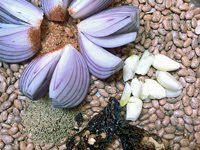 My basic pinto bean recipe is very simple. Beans, cumin, garlic, onion and chili with a little left over meat and finish seasoning.
Most recipe books go for a clean, simple and sterile recipe which leaves a whole story untold. For this recipe I like a whole small to medium yellow or red onion. Sweet onions (Walla Walla, Vidalia, Texas 1015 and Mayan sweet) are so mild. I up-size to a large if I'm using a sweet onion.
Mild chili powder works but I prefer using a whole Ancho (mild) pepper cut in two. You want to cooking the pepper halves with the beans and then when done, scrape the flesh of the pepper from the skin and discard the skin stirring the flesh back in.
Granulated garlic works in a pinch but I prefer a quarter to half a head of garlic. Whack the cloves with the side of a chef's knife. This crushes them, releasing flavor and makes peeling much easier. No flailing needed; just put the flat side of the knife over the clove and push down with the palm of your hand.
You'll save a ton of money if you buy whole cumin seeds and whole Ancho chili peppers in the Mexican or the bulk spice isle. Those little glass or plastic jars in the regular spice section can be ten times more expensive. New Mexico and California chilies can be substituted for Ancho.
I use two cups of pinto beans to eight cups of water. If you soak the beans and cumin seeds overnight they will cook faster. As BBQ is not that fast I usually just start with dry beans. With a large pit I put my Dutch oven of beans under some beef or pork to catch the drippings. Leftover beef or pork juice and meat works just fine. Throw some leftover BBQ in the freezer to make you next bean pot very happy.
I don't add salt until right at the end. I normal use about a tablespoon of BBQ rub right at the end as a finishing seasoning. If using straight kosher salt, I'd use a teaspoon or less. Use salt or rub, not both. If you don't have left over BBQ for the special flavor boost then use up to a cup of spaghetti sauce, added a half hour before the beans are done cooking.
How long? Well it's BBQ; so it's done when it's done. At 250 degrees F to 275 degrees for around four hours in a Dutch Oven with a good fitting lid. Allow around two hours if you pre-soaked the beans and cumin seeds overnight in the same eight cups of water you're going to cook them in. While it's okay to soak in an aluminum Dutch oven, I wouldn't soak in a cast iron Dutch oven. For cast iron do the overnight soak in a plastic or stainless steel container.
Enjoy.
This article was first published in the August 2011 edition of The BBQ Institute® Newsletter. Click on http://bbqinstitute.com/newsletter.htm to receive the free newsletter each month. Konrad is an award-winning barbecue pitmaster and instructor. He is based out of Texas.
 My basic pinto bean recipe is very simple. Beans, cumin, garlic, onion and chili with a little left over meat and finish seasoning.
Most recipe books go for a clean, simple and sterile recipe which leaves a whole story untold. For this recipe I like a whole small to medium yellow or red onion. Sweet onions (Walla Walla, Vidalia, Texas 1015 and Mayan sweet) are so mild. I up-size to a large if I'm using a sweet onion.
Mild chili powder works but I prefer using a whole Ancho (mild) pepper cut in two. You want to cooking the pepper halves with the beans and then when done, scrape the flesh of the pepper from the skin and discard the skin stirring the flesh back in.
Granulated garlic works in a pinch but I prefer a quarter to half a head of garlic. Whack the cloves with the side of a chef's knife. This crushes them, releasing flavor and makes peeling much easier. No flailing needed; just put the flat side of the knife over the clove and push down with the palm of your hand.
You'll save a ton of money if you buy whole cumin seeds and whole Ancho chili peppers in the Mexican or the bulk spice isle. Those little glass or plastic jars in the regular spice section can be ten times more expensive. New Mexico and California chilies can be substituted for Ancho.
I use two cups of pinto beans to eight cups of water. If you soak the beans and cumin seeds overnight they will cook faster. As BBQ is not that fast I usually just start with dry beans. With a large pit I put my Dutch oven of beans under some beef or pork to catch the drippings. Leftover beef or pork juice and meat works just fine. Throw some leftover BBQ in the freezer to make you next bean pot very happy.
I don't add salt until right at the end. I normal use about a tablespoon of BBQ rub right at the end as a finishing seasoning. If using straight kosher salt, I'd use a teaspoon or less. Use salt or rub, not both. If you don't have left over BBQ for the special flavor boost then use up to a cup of spaghetti sauce, added a half hour before the beans are done cooking.
How long? Well it's BBQ; so it's done when it's done. At 250 degrees F to 275 degrees for around four hours in a Dutch Oven with a good fitting lid. Allow around two hours if you pre-soaked the beans and cumin seeds overnight in the same eight cups of water you're going to cook them in. While it's okay to soak in an aluminum Dutch oven, I wouldn't soak in a cast iron Dutch oven. For cast iron do the overnight soak in a plastic or stainless steel container.
Enjoy.
This article was first published in the August 2011 edition of The BBQ Institute® Newsletter. Click on http://bbqinstitute.com/newsletter.htm to receive the free newsletter each month. Konrad is an award-winning barbecue pitmaster and instructor. He is based out of Texas.
Wednesday, May 11, 2011
Ugly drum smoker
On Easter Sunday, my sister took her family to a friend's house in Fresno for a barbecue. Her brother build this ugly drum smoker out of a drum that held honey.
I last commented on a UDS in October 2009. Dorie, my sister's friend, posted this description of her brother's UDS:


I last commented on a UDS in October 2009. Dorie, my sister's friend, posted this description of her brother's UDS:
Dorie said...Enjoy the pictures ...
BELIEVERS--My brother, who is in Ag Sales, gave us this ugly farmer's drum with holes at the side that a steel bar goes through. The next step is to hang chunks of meat on stainless steel hooks and smoke them to perfection for 2-3 hours. It uses very little charcoal and creates some great tasting meat. My husband has hauled this ugly thing to work BBQs and has made believers out of many tri-tip loving City of Fresno employees!


Thursday, April 14, 2011
Rotisserie roasted prime rib
Enjoy this video that features Billy and Sue Ruiz of Cowboy Flavor, a catering company in the Santa Maria area of California. In the video, Billy instructs you how to roast a standing rib roast on the Grizzly Spit battery operated portable rotisserie, made by Bar Brothers.
Saturday, January 29, 2011
Barbecued turkey
Here's a article that I posted to Suite101.com in the weeks leading up to Thanksgiving in 2000.
 Thanksgiving is one of those holidays where food is almost as important as the meaning behind the holiday. I’m thankful to have been raised in a family that agrees with me. It doesn't matter which direction we travel -- south to one of the in-law’s houses or to my sister’s in San Jose -- a roasted turkey awaits us.
A barbecued turkey at Thanksgiving -- or any other time of the year -- is simply divine. It’s browned to perfection in the barbecue. Instead of filling the house with the pleasant aroma of a roasting turkey, you’ll be inviting all of your neighbors as its scent wafts over the fence into their yard. Better set extra place settings just in case.
BARBECUED TURKEY
I find that a fifteen-pound turkey is about right for the barbecue. But the important question is this: Will the turkey fit under the dome lid? On their Website, Weber advises that turkeys over 24 pounds may not fit under the lid of their barbecue kettles.
 Completely thaw your turkey before grilling. It should be thawed in the refrigerator. A 15-pound turkey takes about three days to thaw. Thaw the turkey on the lowest shelf and place it over a pan to catch juices. Never thaw a turkey at room temperature.
I don’t recommend stuffing the bird. Instead, place the stuffing into a baking pan and place the pan on the grill during the last 45 to 60 minutes that the turkey is on the grill. Use a thermometer to test the stuffing for doneness. It should reach 165 degrees. If the stuffing isn't hot enough, leave it on the grill while the turkey cools. A colorful alternative is to stuff green, red and yellow bell peppers with your favorite stuffing. Grill alongside the turkey.
1 (15 pound) turkey, thawed if frozen
Olive or vegetable oil
Salt and pepper to taste
1 chopped medium onion
2 stalks diced celery
2 diced carrots
Consult the instructions for your charcoal barbecue kettle before proceeding. The amount of needed charcoal briquettes will vary slightly from model to model. This recipe is written for the Weber 22-1/2-inch Bar-B-Kettle™ Grill.
Ignite 50 charcoal briquettes and let them burn until they are barely covered with ash, about 20 to 30 minutes. While charcoal is burning, rinse thoroughly turkey under running cold water and pat dry. Rub skin with oil. Season with salt and pepper inside and out. Place turkey, breast side up, on a baking rack.
When charcoal is ready, place an even number of briquettes on the left and right sides of the lower grill. Place a drip pan between the charcoal. Position the cooking grill with the handles directly over the charcoal. This will make adding fresh briquettes easier. Adjust the top and bottom vents to maintain the barbecue at 325 degrees.
Place the turkey (in the baking rack) on the cooking grill. Make sure to center the turkey directly over the drip pan. Cover barbecue kettle. Add 7 charcoal briquettes to each side each hour. A 15-pound turkey is done in about 3 hours. During the last hour of grilling, add onion, carrot and celery to drip pan if desired to flavor drippings. You don’t have to turn or baste the turkey.
When the thermometer reaches 170 degrees in the breast or 180 degrees in the thigh, remove turkey from the grill. Let cool about 20 minutes before carving. The meat just under the skin will be pink. Figure about 1 pound of turkey (with bones) for each person.
Strain vegetables into a pint-sized measuring cup. Skim fat from drippings. Discard vegetables. Reserve 1/4 cup of the fat for the gravy, and discard the remainder. Serve sliced turkey with camp mashed potatoes and turkey gravy.
According the Weber Website, unstuffed turkeys will take:
10-11 pounds -- 1-3/4 to 2-1/2 hours
12-14 pounds -- 2-1/4 to 3hours
15-17 pounds -- 2-3/4 to 3-3/4hours
18-22 pounds -- 3-1/2 to 4hours
23-24 pounds -- 4 to 4-1/2hours
MASHED POTATOES
5 or 6 medium potatoes
Salted water to cover
3 tablespoons butter
3/4 cup milk
Salt and white pepper to taste
Bring 2 quarts salted to boil in a 4-quart stockpot. Peel potatoes with paring knife or vegetable peeler. Wash and pat dry. Cut potatoes into eighths. Carefully place in boiling water. Return to a boil, reduce heat and simmer until potatoes are tender, about 15 to 20 minutes.
Drain water. With a potato masher, mash potatoes until they’re broken up into small pieces. Add butter, milk, salt and white pepper. (You can use black pepper, but black specks will color the potatoes.) Continue to mash potatoes with the potato masher. Serves about 5 to 6.
TURKEY GRAVY
1/4 cup reserved turkey fat
1/4 cup all-purpose flour
3 tablespoons sherry (optional)
3 cups reserved turkey drippings and water
Salt and pepper to taste
In a skillet over medium heat, heat reserved fat. (Be careful: moisture in the fat will splatter.) Add flour and stir to combine. Cook for about 5 minutes. Pour in sherry and drippings and water. Whisk until roux is completely absorbed by the liquid. Cook for about 10 minutes until the gravy is thickened and the flour is cooked out. Season with salt and pepper. Serve over potatoes and turkey. Makes about 3 cups.
 Thanksgiving is one of those holidays where food is almost as important as the meaning behind the holiday. I’m thankful to have been raised in a family that agrees with me. It doesn't matter which direction we travel -- south to one of the in-law’s houses or to my sister’s in San Jose -- a roasted turkey awaits us.
A barbecued turkey at Thanksgiving -- or any other time of the year -- is simply divine. It’s browned to perfection in the barbecue. Instead of filling the house with the pleasant aroma of a roasting turkey, you’ll be inviting all of your neighbors as its scent wafts over the fence into their yard. Better set extra place settings just in case.
BARBECUED TURKEY
I find that a fifteen-pound turkey is about right for the barbecue. But the important question is this: Will the turkey fit under the dome lid? On their Website, Weber advises that turkeys over 24 pounds may not fit under the lid of their barbecue kettles.
 Completely thaw your turkey before grilling. It should be thawed in the refrigerator. A 15-pound turkey takes about three days to thaw. Thaw the turkey on the lowest shelf and place it over a pan to catch juices. Never thaw a turkey at room temperature.
I don’t recommend stuffing the bird. Instead, place the stuffing into a baking pan and place the pan on the grill during the last 45 to 60 minutes that the turkey is on the grill. Use a thermometer to test the stuffing for doneness. It should reach 165 degrees. If the stuffing isn't hot enough, leave it on the grill while the turkey cools. A colorful alternative is to stuff green, red and yellow bell peppers with your favorite stuffing. Grill alongside the turkey.
1 (15 pound) turkey, thawed if frozen
Olive or vegetable oil
Salt and pepper to taste
1 chopped medium onion
2 stalks diced celery
2 diced carrots
Consult the instructions for your charcoal barbecue kettle before proceeding. The amount of needed charcoal briquettes will vary slightly from model to model. This recipe is written for the Weber 22-1/2-inch Bar-B-Kettle™ Grill.
Ignite 50 charcoal briquettes and let them burn until they are barely covered with ash, about 20 to 30 minutes. While charcoal is burning, rinse thoroughly turkey under running cold water and pat dry. Rub skin with oil. Season with salt and pepper inside and out. Place turkey, breast side up, on a baking rack.
When charcoal is ready, place an even number of briquettes on the left and right sides of the lower grill. Place a drip pan between the charcoal. Position the cooking grill with the handles directly over the charcoal. This will make adding fresh briquettes easier. Adjust the top and bottom vents to maintain the barbecue at 325 degrees.
Place the turkey (in the baking rack) on the cooking grill. Make sure to center the turkey directly over the drip pan. Cover barbecue kettle. Add 7 charcoal briquettes to each side each hour. A 15-pound turkey is done in about 3 hours. During the last hour of grilling, add onion, carrot and celery to drip pan if desired to flavor drippings. You don’t have to turn or baste the turkey.
When the thermometer reaches 170 degrees in the breast or 180 degrees in the thigh, remove turkey from the grill. Let cool about 20 minutes before carving. The meat just under the skin will be pink. Figure about 1 pound of turkey (with bones) for each person.
Strain vegetables into a pint-sized measuring cup. Skim fat from drippings. Discard vegetables. Reserve 1/4 cup of the fat for the gravy, and discard the remainder. Serve sliced turkey with camp mashed potatoes and turkey gravy.
According the Weber Website, unstuffed turkeys will take:
10-11 pounds -- 1-3/4 to 2-1/2 hours
12-14 pounds -- 2-1/4 to 3hours
15-17 pounds -- 2-3/4 to 3-3/4hours
18-22 pounds -- 3-1/2 to 4hours
23-24 pounds -- 4 to 4-1/2hours
MASHED POTATOES
5 or 6 medium potatoes
Salted water to cover
3 tablespoons butter
3/4 cup milk
Salt and white pepper to taste
Bring 2 quarts salted to boil in a 4-quart stockpot. Peel potatoes with paring knife or vegetable peeler. Wash and pat dry. Cut potatoes into eighths. Carefully place in boiling water. Return to a boil, reduce heat and simmer until potatoes are tender, about 15 to 20 minutes.
Drain water. With a potato masher, mash potatoes until they’re broken up into small pieces. Add butter, milk, salt and white pepper. (You can use black pepper, but black specks will color the potatoes.) Continue to mash potatoes with the potato masher. Serves about 5 to 6.
TURKEY GRAVY
1/4 cup reserved turkey fat
1/4 cup all-purpose flour
3 tablespoons sherry (optional)
3 cups reserved turkey drippings and water
Salt and pepper to taste
In a skillet over medium heat, heat reserved fat. (Be careful: moisture in the fat will splatter.) Add flour and stir to combine. Cook for about 5 minutes. Pour in sherry and drippings and water. Whisk until roux is completely absorbed by the liquid. Cook for about 10 minutes until the gravy is thickened and the flour is cooked out. Season with salt and pepper. Serve over potatoes and turkey. Makes about 3 cups.
Monday, October 18, 2010
Smokin' in Cayucos
 You find smokers in the most unlikely places. When we checked in at the Cayucos Beach Inn two weeks ago, the clerk asked if we were with the "golf group." I said no and didn't think about the question until we returned from my nephew's wedding late that night.
At 11 p.m., I found several couples lounging around the picnic tables and large white tent in the parking lot. I must have missed the trailer-mounted smoker with its torpedo-shaped cooking chamber.
The motel parking lot was filled with the sweet aroma of oak when I walked to the breakfast room Saturday morning. I walked over to the smoker after breakfast and introduced myself.
Up at 3 a.m., the Texas-born pitmaster had loaded 12 full sized beef briskets into the smoker as soon as the fire was ready. Late morning found Roy, who now hails from California City, soaking in the brisk ocean air next to the smoker with the other cooks.
Roy and his companions were playing the waiting game, waiting for hungry golfers to return from the course and for the smoke to work its magic. Around 100 golfers were expecting Texas smoked brisket and simmered pinto beans at six.
 Roy's mission was two-fold that morning: Give the golfers good food and tell them about brisket. No one knows about brisket in California, said Roy. When approached, most presume he's smoking tri-tip, a reasonable presumption since we were a few miles up Highway 101 from Santa Maria tri-tip country.
"Everyone asks me if I do tri-tip," said Roy. "I'm from Texas. I do brisket."
He's done well with the golfers. We're like family," explained Roy. Rightfully so. Most of the golfers are co-workers and acquaintances of his employer, a rock quarry in Ridgecrest, California. The crew gathers annually in the seaside community for a company golf tournament.
Too bad I couldn't hang around to feast on some tender Texas smoked brisket. The deep red hue invited me when Roy opened the lid to show me the meat. But a six-hour road trip called me home.
Finding a smoker may not be a standard occurrence in this beach resort. But when you mix a group of dessert golfers with succulent Texas barbecue, you have the fixin's for a good game and a great meal.
Sunday, October 10, 2010
Ford Model A smoker
Last Sunday I asked my readers to identify this dome-like structure. Other that the detail offered in the photograph, I only gave two clues. "While it's connected to a food device today, it has its origin as a non-food object," I said in my blog article of October 3, 2010.
 Two intrepid readers posted their guesses as to the identity of the devise. Brenda first asked if it was a "pressure cooker" on Sunday evening. Her response sounds reasonable. As the past director of the Southern California Chapter of IDOS, Brenda wrangles cast iron Dutch ovens at the chapter's beach gatherings.
"I'm guessing a blowout for a steam loco," posted Ed on Monday from his Southern California home, where he chronicles his family's camping adventures at Our Camping Blog.
Neither Brenda or Ed supplied the right answer. You could say that Brenda came the closest to revealing the identity of the cooking devise. Here's another picture of the devise from last Sunday:
 I found this trailer-mounted smoker at the California BBQ Association-sponsored Smokin' For Gold event at the El Dorado County Fairgrounds. Andy Ferrendelli fabricated the smoker out of a early twentieth century fuel delivery tank.
"The closest I've been able to date (the tank) is 1918-1920," said Andy. He found the tank in Colusa, California, about 14 miles south of his home in Princeton. After burning it out, Andy discovered that the tank was built in Wasco, California, by Baker Brothers.
Today the dome serves no purpose other that as a historical attachment to the smoker. A cleaned and polished brass fuel breather valve tops the clean-out port.
Three such tanks were mounted on a Ford Model A truck, said Andy. The tank is made of a nickel alloy.
 Two intrepid readers posted their guesses as to the identity of the devise. Brenda first asked if it was a "pressure cooker" on Sunday evening. Her response sounds reasonable. As the past director of the Southern California Chapter of IDOS, Brenda wrangles cast iron Dutch ovens at the chapter's beach gatherings.
"I'm guessing a blowout for a steam loco," posted Ed on Monday from his Southern California home, where he chronicles his family's camping adventures at Our Camping Blog.
Neither Brenda or Ed supplied the right answer. You could say that Brenda came the closest to revealing the identity of the cooking devise. Here's another picture of the devise from last Sunday:
 I found this trailer-mounted smoker at the California BBQ Association-sponsored Smokin' For Gold event at the El Dorado County Fairgrounds. Andy Ferrendelli fabricated the smoker out of a early twentieth century fuel delivery tank.
"The closest I've been able to date (the tank) is 1918-1920," said Andy. He found the tank in Colusa, California, about 14 miles south of his home in Princeton. After burning it out, Andy discovered that the tank was built in Wasco, California, by Baker Brothers.
Today the dome serves no purpose other that as a historical attachment to the smoker. A cleaned and polished brass fuel breather valve tops the clean-out port.
Three such tanks were mounted on a Ford Model A truck, said Andy. The tank is made of a nickel alloy.
Monday, September 13, 2010
Barbecue of cat?
 My son caught our young male black and white cat napping in the ash pan of out Webber kettle grill the other day. One would hope he moves before things get toasty!
Wednesday, August 25, 2010
Grilled corned beef brisket
 Brisket is menued once each month at work. While I usually serve corned beef, I'll purchase a beef brisket when corned beef is too pricey for my budget. Since I grilled the brisket in July, I wanted to see how a grilled corned beef brisket would work. So, yesterday I grilled the 15-pound corned beef on the propane grill.
It took about two and one-half hours to reach an internal temperature of 185 to 190 degrees. The meat came out fork-tender and very succulent. Here's my procedure:
- Rinsed the brisket under cold running water to wash away as much brine as possible.
- Trimmed the fat off the top of the brisket to within a quarter inch of the meat.
- Turned all four burners on the grill to high to pre-heat the grill.
- Set the meat on the grill without a rub or any seasoning since corned beef already has a strong flavor.
- Browned the brisket on both sides with the meat centered on the grill.
- Turned the two outside burners to medium, cut the heat on the two center burners and closed the lid.
- Turned the brisket over once each hour.
- Periodically adjusted the two outside burners to keep the grill between 325 and 350 degrees with the lid closed.
- Cut the heat when the internal temperature of the brisket reached 185 degrees.
Friday, June 25, 2010
Smokin' for Gold in October
I just learned of this barbecue event in Placerville in the fall:
 The El Dorado County Fairgrounds are located in the Sierra foothills in beautiful Placerville, California. The BBQ action starts with top pit masters from all over the West Coast competing Saturday in a four-meat championship cook-off featuring chicken, pork butt or shoulder, pork spare ribs and brisket on Saturday, October 2, 2010.
Sundays sportsman's grill-off will feature pros and local teams. Teams will smoke California's favorite tri-tip, chicken wings and baby back ribs. The best part is the public gets to be the judge. Sample tickets are for sale with five tickets for $10.
Come out all weekend and enjoy the first annual Sportsman's Outdoor Expo at the El Dorado County Fairgrounds, Friday, October 1 to Sunday, October 3, 2010. It will feature top hunting and fishing guides. Equipment will be on display throughout the fairgrounds. General admission is $5 and parking is $5.
 The El Dorado County Fairgrounds are located in the Sierra foothills in beautiful Placerville, California. The BBQ action starts with top pit masters from all over the West Coast competing Saturday in a four-meat championship cook-off featuring chicken, pork butt or shoulder, pork spare ribs and brisket on Saturday, October 2, 2010.
Sundays sportsman's grill-off will feature pros and local teams. Teams will smoke California's favorite tri-tip, chicken wings and baby back ribs. The best part is the public gets to be the judge. Sample tickets are for sale with five tickets for $10.
Come out all weekend and enjoy the first annual Sportsman's Outdoor Expo at the El Dorado County Fairgrounds, Friday, October 1 to Sunday, October 3, 2010. It will feature top hunting and fishing guides. Equipment will be on display throughout the fairgrounds. General admission is $5 and parking is $5.
Thursday, March 18, 2010
You needs no teef to eat my beef ... part 2
Leonard "Wagon Cook" Sanders posted this photo of his 400-pound smoker on Camp-Cook.com Saturday. It reminded me of an article that I wrote for Suite101.com in 2001.
Sanders is the chef/owner of the Chuckwagon BBQ Company in Oroville, California.
Click to read part 1 of the story.
The camp kitchen
 Sanders is a master of his decade-old trade and camp kitchen, which includes a 300-pound Bushrods smoker (that's pounds of meat, not steel) that's full of pork butt with a spicy barbecue rub. A few feet away, stands a line of 12- and 14-inch Dutch ovens with cornbread and scalloped potatoes. And hanging from a 14-foot set of irons is no. 8 Lodge Dutch ovens with sweet rice pudding.
Sanders' signature dish for the evening -- pinto beans with ham hocks -- hang over red-hot coals in two no. 10 Lodge Dutch ovens (the kind with rounded lids and flat bottom). The beans were the hit of the evening, because in Sanders' words, "People just don't take time to cook them anymore."
They've the "best beans we ever made," says Sanders. At the last minute he dumped leftover breakfast sausage, ham and bacon into the beans.
But be warned Sanders' beans don't favor those with tender noses. He's aptly named them Gossiping Beans, so-called, "'Cuz the beans are pleasant to your face, but then they talk behind your back."
Sanders became a cowboy in the early 1990s to fulfill a life-long dream. By the time the new millennium dawned, he said, "I don't want to be a cowboy any more." He had worked "until I got it out of my system."
A cowboy does more than punch cows, Sanders learned along the trail. As his decade-long quest subsided, he says that he farmed hay, irrigated fields, mended fences and repaired ranch machinery. And he cooked over the open fire at roundup time.
So you might say that being a camp cook is the realization of Sanders' cowboy dream. After all, old cowboys don't die. They become camp cooks.
Sanders is the chef/owner of the Chuckwagon BBQ Company in Oroville, California.
Click to read part 1 of the story.
The camp kitchen
 Sanders is a master of his decade-old trade and camp kitchen, which includes a 300-pound Bushrods smoker (that's pounds of meat, not steel) that's full of pork butt with a spicy barbecue rub. A few feet away, stands a line of 12- and 14-inch Dutch ovens with cornbread and scalloped potatoes. And hanging from a 14-foot set of irons is no. 8 Lodge Dutch ovens with sweet rice pudding.
Sanders' signature dish for the evening -- pinto beans with ham hocks -- hang over red-hot coals in two no. 10 Lodge Dutch ovens (the kind with rounded lids and flat bottom). The beans were the hit of the evening, because in Sanders' words, "People just don't take time to cook them anymore."
They've the "best beans we ever made," says Sanders. At the last minute he dumped leftover breakfast sausage, ham and bacon into the beans.
But be warned Sanders' beans don't favor those with tender noses. He's aptly named them Gossiping Beans, so-called, "'Cuz the beans are pleasant to your face, but then they talk behind your back."
Sanders became a cowboy in the early 1990s to fulfill a life-long dream. By the time the new millennium dawned, he said, "I don't want to be a cowboy any more." He had worked "until I got it out of my system."
A cowboy does more than punch cows, Sanders learned along the trail. As his decade-long quest subsided, he says that he farmed hay, irrigated fields, mended fences and repaired ranch machinery. And he cooked over the open fire at roundup time.
So you might say that being a camp cook is the realization of Sanders' cowboy dream. After all, old cowboys don't die. They become camp cooks.
Saturday, March 13, 2010
You needs no teef to eat my beef ...
Leonard "Wagon Cook" Sanders posted this photo of his 400-pound smoker on Camp-Cook.com Saturday. It reminded me of an article that I wrote for Suite101.com in 2001.
Sanders is the chef/owner of the Chuckwagon BBQ Company in Oroville, California.
You might wonder how a man who tended boilers on a Navy destroyer during the Vietnam War, changed tires in his father's Oroville tire shop and wrangled cattle at a Sierra Nevada cattle ranch became a professional camp cook.
You'd expect him to be driving the lead wagon in a living history event instead. When you ponder Leonard Sanders' adult life, he's the quintessential camp cook.
Leonard has followed the in the foot steps of hundreds of trail drive and roundup cooks -- men (and a few women) who had taken up cooking after their cow punching days reached the end of the trail.
Like the Nineteenth Century chuckwagon cook, Sanders has no formal training in the culinary arts. That's unless you reckon the endless hours reading Ramon F. Adam's Come An' Get It: The Story of the Old Cowboy Cook as "formal training."
Dozens of Dutch oven and cowboy cookbooks -- like those by Stella Hughes (Chuck Wagon Cookin' and Bacon and Beans) and sisters Sue Cunningham and Jean Cates (Chuckwagon Recipes and Others) -- have shaped his style and chuckwagon fare.
Evolution of a wagon cook
I caught up with Sanders at the encampment of the 2001 Historic Sonora Pass Wagon Train at Kennedy Meadows.
Located on a 15-foot bluff overlooking the Middle Fork of the Stanislaus River, Sanders' large frame donned a black and white plaid flannel shirt tucked neatly inside a pair of bib coveralls.
With a black broad, flat-brimmed cowboy hat squarely fitted on his head, the camp cook's straightforward approach to camp cooking keeps some 60 living historians filled meal after meal.
Sanders started barbecuing in Santa Maria some 20 years ago. For this cowboy-turned-camp-cook, Santa Maria, located just inland from the Central California coast, was ideal. The Santa Maria Valley is home to some of California's oldest cattle ranches and tri-tip barbecue and deep-pit cookery.
Like Sanders' cooking, Santa Maria style barbecue is known for its simplicity. It's prime cuts of beef roasted over the coals of red oak wood and seasoned with salt, pepper and garlic.
Then about 1985, Sanders purchased his first Dutch oven. Today, this oven has grown into a collection of "about 50." When asked what prompted him to start cooking in the black cast iron pots, Sanders only says that it's "historic research" into cowboy life.
It was a book like Adam's Come An' Get It that probably inspired Sanders. Sometime after reading about the camp cook of Western lore, he was asked to cook for a cattle roundup and branding in the foothills above Oroville, Calif. Cowhands ate his food, and to his surprise, "Nobody died."
Next word of his camp cooking spread throughout Butte County. The food must've been good. First it was a wedding of a cowboy to a cowgirl.
Today, Sanders caters several large events throughout the year. They all have one thing in common: Each event celebrates the Western lifestyle.
To be continued ...
Sanders is the chef/owner of the Chuckwagon BBQ Company in Oroville, California.
You might wonder how a man who tended boilers on a Navy destroyer during the Vietnam War, changed tires in his father's Oroville tire shop and wrangled cattle at a Sierra Nevada cattle ranch became a professional camp cook.You'd expect him to be driving the lead wagon in a living history event instead. When you ponder Leonard Sanders' adult life, he's the quintessential camp cook.
Leonard has followed the in the foot steps of hundreds of trail drive and roundup cooks -- men (and a few women) who had taken up cooking after their cow punching days reached the end of the trail.
Like the Nineteenth Century chuckwagon cook, Sanders has no formal training in the culinary arts. That's unless you reckon the endless hours reading Ramon F. Adam's Come An' Get It: The Story of the Old Cowboy Cook as "formal training."
Dozens of Dutch oven and cowboy cookbooks -- like those by Stella Hughes (Chuck Wagon Cookin' and Bacon and Beans) and sisters Sue Cunningham and Jean Cates (Chuckwagon Recipes and Others) -- have shaped his style and chuckwagon fare.
Evolution of a wagon cook
I caught up with Sanders at the encampment of the 2001 Historic Sonora Pass Wagon Train at Kennedy Meadows.
Located on a 15-foot bluff overlooking the Middle Fork of the Stanislaus River, Sanders' large frame donned a black and white plaid flannel shirt tucked neatly inside a pair of bib coveralls.
With a black broad, flat-brimmed cowboy hat squarely fitted on his head, the camp cook's straightforward approach to camp cooking keeps some 60 living historians filled meal after meal.
Sanders started barbecuing in Santa Maria some 20 years ago. For this cowboy-turned-camp-cook, Santa Maria, located just inland from the Central California coast, was ideal. The Santa Maria Valley is home to some of California's oldest cattle ranches and tri-tip barbecue and deep-pit cookery.
Like Sanders' cooking, Santa Maria style barbecue is known for its simplicity. It's prime cuts of beef roasted over the coals of red oak wood and seasoned with salt, pepper and garlic.
Then about 1985, Sanders purchased his first Dutch oven. Today, this oven has grown into a collection of "about 50." When asked what prompted him to start cooking in the black cast iron pots, Sanders only says that it's "historic research" into cowboy life.
It was a book like Adam's Come An' Get It that probably inspired Sanders. Sometime after reading about the camp cook of Western lore, he was asked to cook for a cattle roundup and branding in the foothills above Oroville, Calif. Cowhands ate his food, and to his surprise, "Nobody died."
Next word of his camp cooking spread throughout Butte County. The food must've been good. First it was a wedding of a cowboy to a cowgirl.
Today, Sanders caters several large events throughout the year. They all have one thing in common: Each event celebrates the Western lifestyle.
To be continued ...
Sunday, February 21, 2010
This old pot
I love these old stockpots. Unlike a new out-of-the-box pot, this one at last week's 1st Annual Hangtown Winter Fest '10 matches the character of many of the competitors.
Rough and unkept on the outside, many are sweet people who have hearts full of kindness on the inside.
The pot's rough exterior -- tarnished from boiling over on top of an untamed propane flame -- shed light on its contents.
Full of simmering water when I shot the picture, I suspect the pot has been used to dissolve salt and sugar for a brine in the past. Or it may be from a lively pot of chili, one that boiled over when the cook's attention turned toward something else.
I didn't get a chance to talk to the owner of the stockpot. I suspect that the team was presenting its entry for beef brisket to the judges when I took the picture.
My only advise to the pot's owner: Please don't clean it exterior. It has too much character to srub it away!

Rough and unkept on the outside, many are sweet people who have hearts full of kindness on the inside.
The pot's rough exterior -- tarnished from boiling over on top of an untamed propane flame -- shed light on its contents.
Full of simmering water when I shot the picture, I suspect the pot has been used to dissolve salt and sugar for a brine in the past. Or it may be from a lively pot of chili, one that boiled over when the cook's attention turned toward something else.
I didn't get a chance to talk to the owner of the stockpot. I suspect that the team was presenting its entry for beef brisket to the judges when I took the picture.
My only advise to the pot's owner: Please don't clean it exterior. It has too much character to srub it away!
Saturday, February 20, 2010
Hangtown Winter Fest '10
 Louis and Stephanie Hudson of North Highlands, California pause for the camera moments before turning their beef brisket entry in to the judges.
Lou and Stephanie smoked a 13-pound brisket throughout the early morning hours of Sunday, February 14 for the 1st Annual Hangtown Winter Fest '10 in Placerville.
I first met the couple at Oinktoberfest in Oroville, California last October. Lou is currently a culinary arts student at Le Cordon Blue College of Culinary Arts in Sacramento.
"The only reason I'm going to school is to learn the restaurant and catering business," said Hudson.
A "stage lighting designer" by day, Hudson looks forward to the day that he can open a barbecue restaurant in his native Redding, California.
Tuesday, October 20, 2009
Ugly drum smoker
 It's always nice to put a name to a piece of equipment. Back when I worked at a large residential facility for the state, the kitchen staff enjoyed a picnic at Folsom Lake each June.
One of the sous chefs always brought his homemade vertical drum smoker to the park and smoked tri-tip. A package of six or seven Costco tri-tips fit inside the smoker. I'll post more of my experience with the smoker in a day or two.
I learned over the weekend that barbecue folks commonly call it an ugly drum smoker (or UDS). It may not be the best looking piece of barbecue equipment, but it produces some wonderful meat. (Here are instructions to build one from the California BBQ Association.)
In the photo, the meat was about 30 minutes from being pulled. The seven roasts took about three hours.
Saturday, October 17, 2009
Where there's fire, smoke follows
There's more than one way to light a fire inside a smoker. John Chips, of Butte Creek BBQ, uses a built-in propane torch to light the fire inside the smokebox of his Gater Pit mobile smoker.
I took my family to the 2009 NorCal Bash & Oinktoberfest in Oroville, California last Saturday. A whole smoked pig that was smoked on site was the centerpiece of the event.
Leonard "Wagon Cook" Sanders organized the gathering for the California BBQ Association. Leonard is the chef-owner of Chuck Wagon BBQ Company in Oroville.
Smoked whole hog
The most important man of the event was Harry Stewart, owner of Great American Barbecue Co. in Alameda, California. "Harry took time out of his busy schedule to come up and smoke the pig and demonstrate technique," said Sanders on the CBBQA discussion forum.
 After arriving around 10 p.m. Friday, Harry lightly seasoned the 65-pound pig with olive oil, dried thyme and black pepper. He didn't salt the pig because it draws out moisture and toughens the skin.
Sometime just before midnight, Harry stoked the fire and set the pig inside the smoker. Harry kept watch through the night, arising at two-hour intervals to check the temperature in the smoker.
"Manual pit with oven thermos to gauge temp, just like working on the railroad ...," explained Harry on the forum. His target was 225 to 250 degrees thoughout the night and morning.
Eighteen hours later, Harry rewarded event goers with the sweet, succulent flesh of a smoked hog. It's simplicity at its best, according to Harry.
"18 hours over Oak and charcoal, no injections just a simple rub and mop."

I took my family to the 2009 NorCal Bash & Oinktoberfest in Oroville, California last Saturday. A whole smoked pig that was smoked on site was the centerpiece of the event.
Leonard "Wagon Cook" Sanders organized the gathering for the California BBQ Association. Leonard is the chef-owner of Chuck Wagon BBQ Company in Oroville.
Smoked whole hog
The most important man of the event was Harry Stewart, owner of Great American Barbecue Co. in Alameda, California. "Harry took time out of his busy schedule to come up and smoke the pig and demonstrate technique," said Sanders on the CBBQA discussion forum.
 After arriving around 10 p.m. Friday, Harry lightly seasoned the 65-pound pig with olive oil, dried thyme and black pepper. He didn't salt the pig because it draws out moisture and toughens the skin.
Sometime just before midnight, Harry stoked the fire and set the pig inside the smoker. Harry kept watch through the night, arising at two-hour intervals to check the temperature in the smoker.
"Manual pit with oven thermos to gauge temp, just like working on the railroad ...," explained Harry on the forum. His target was 225 to 250 degrees thoughout the night and morning.
Eighteen hours later, Harry rewarded event goers with the sweet, succulent flesh of a smoked hog. It's simplicity at its best, according to Harry.
"18 hours over Oak and charcoal, no injections just a simple rub and mop."
Thursday, October 15, 2009
Smoked bacon log
 Leonard Sanders smoked a bacon log for breakfast on Saturday, October 10 at the 2009 NorCal Bach & Oinktoberfest in Oroville. He weaved a pound of bacon (16 slices) together and cooked it until it was starting to crisp, but pliable enough to roll.
 Next Sanders set a layer of deli ham over the bacon. He then topped it with a layer of shredded cheddar and jack cheeses. He smoked it inside his smoker after carefully rolling it.
Sanders said he didn't add a layer of ham the first he tried the log. Cheese oozed between the strips of bacon. In addition to adding a new flavor dimension, the ham prevented the melting cheese from escaping and making a big mess.
Once you've mastered the basic bacon log in a smoker or Dutch oven, try adding new ingredients. A third meat, like crumbled chorizo or sausage, will work, as will your favorite vegetables. Try adding sauteed onions, sweet or hot peppers and mushrooms on top of the ham.
Sanders also advised that you cook the bacon on top of a baking rack. This will let the grease drain from the bacon. (The picture doesn't show a rack because he forgot it Saturday.)
Friday, October 09, 2009
Oinktoberfest
 I'm heading north to Oroville, California this afternoon for the 2009 NorCal Bash and Oinktoberfest. As the guest of Leonard "Wagon Cook" Sanders, chef and proprietor of the Chuck Wagon BBQ Company, my contribution will be limited to Dutch oven bread.
The event appears to be limited to members and guests of the California Barbecue Association.
When I talked to Leonard two hours ago, he was on his way to pick up a whole pig in Yuba City. That should make for mighty fine tastin' barbecue tomorrow for dinner.
Potluck sign-ups feature assorted local BBQ Sauces, a North Carolina vinegar sauce, Dutch oven cowboy potatoes with "various pork," smoked cabbage and Grandma's All American potato salad. The one dessert listed is sweet potato pecan bread pudding with Southern Comfort sauce. I'm sure there'll be much more food.
I learned of the event last weekend when Leonard posted a Oinktoberfest photograph on his Facebook site. I jokingly commented, "Will work for free pig ..." Leonard shot back two hours later:
Steve Karoly: If you would like to come to Oroville this Saturday with one single Dutch oven and make one loaf of bread like you made 6-1/2 years ago for my 50th birthday, we will feed you and your family all the pork that you can eat.Not one to pass up free pork, my "one" 14-inch deep Dutch oven is packed in the truck with flour, yeast and fixin's for my basic Dutch oven bread. Since I can't pass up an opportunity to cook, I also loaded an extra 14-inch Dutch oven and 17-inch skillet.
Notebook and camera are packed as well. I'll report back with pictures and my thoughts on the pig fest during the week. This should be some seriously good eats.
Subscribe to:
Comments (Atom)


