
 |
| The mold on a number of pie entries to the baked goods and confections competition stuck me as odd. I understand when you consider entries were turned in and judged on Wednesday, opening day of the fair. What once appealed, was ready for the trash. Unfortunately, I didn't see how this pie placed in the competition. |
Showing posts with label cleaning and food safety. Show all posts
Showing posts with label cleaning and food safety. Show all posts
Sunday, August 24, 2014
Best in class?
Last week we visited the Plumas-Sierra County Fair in Quincy, California. Our last day at Oakland Feather River Camp was Saturday, August 16. Since one of our daughters was coming up to visit a friend, Debbie and I elected to delay our homecoming so we could visit. After worship on Sunday, we walked around, enjoyed the exhibits and let our granddaughter visit the midway.


Friday, December 30, 2011
Summa soup
This article was originally published to Suite101.com in November 2001. Carefully selected, leftovers become the perfect starting place for an impromptu soup in camp. It's a skill that I use at work some 35 years later.
Summa this. Summa that. That's what Navy cooks called the supper soup.
Each afternoon, the ship's cook added all of the noonday leftovers to the soup pot. Since the supper menu only identified the soup as "Soup Du Jour," the cooks hand a free hand at creating any soup for the evening meal. Summa soup, as the cooks called it, gave an outlet for breakfast and dinner leftovers, and it tested their culinary skills.
Leftover meals pose a problem for camp cooks as well. They eat up precious space in the ice chest, and they can quickly spoil if handled improperly. So, it's best to use them quickly. Summa soup is the answer this dilemma. Like Navy cooks, camp cooks can use leftover beans, spaghetti or stroganoff, for instance, as the foundation for flavor-packed soups.
A camp cooking adventure
Summa soup is the ultimate culinary adventure -- at least in the realm of leftovers. You never know how the soup's going to taste. Today, the soup's ingredients meld wonderfully. Tomorrow, they fall short. But despite expectations, summa soup's always good.
It's as easy as blending all the leftovers that you want into a large stockpot. All you need a leftover dish and a few other ingredients. Sometimes, leftovers are sufficient to build a summa soup. Other times, you'll need to add a few fresh ingredients to build your summa soup. Here are a few ideas:
Leftover beans are a good place to begin. Make vegetable bean soup by adding steamed vegetables (who doesn't have steamed broccoli or green beans lurking in the ice chest), chicken stock and bacon or sausage. Sprinkle salt and pepper, add fresh thyme and the soup is ready. It makes a quick lunch.
Leftover spaghetti easily becomes minestrone. Add chicken stock, julienned green peppers, shredded green cabbage and chickpeas. Season with salt and pepper and top each serving with freshly grated Parmesan cheese. The spaghetti sauce gives the soup its foundation while the pasta and vegetables add substance and a little starch for body. The stock brings it all together like an orchestra conductor.
Leftover stroganoff transforms into a beef mushroom soup. It's as simple as adding beef stock and cream. You can use milk if cream is too rich. Just remember to thicken the soup with flour or cornstarch. Stroganoff transforms into beef mushroom soup with a hint of tanginess.
With a little imagination, you'll have wonderful soup to accompany sandwiches on a drizzly day in camp. But remember summa soup is risky business. You may never create the same soup twice. Each meal is an adventure.
Sharpen your soup-making skills
Start with any foundation desired. Expect its flavor to dominate your soup like the beef and mushrooms of the stroganoff. What you start with doesn't matter. Chili becomes Mexican spiced soup with rice and beans. Leftover roast serves as the foundation for quick vegetable beef soup.
Just add to the flavors that your ice chest presents to you. Have chicken, beef or vegetable stock handy to add volume and the essence of meats or vegetables to your foundation. Fresh herbs like parsley, basil, thyme or cilantro enhance a lackluster dish. Soy sauce, Worcestershire sauce or hot pepper sauce send the soup on tangents -- Asian, American or Southwestern.
Even if your ice chest is lacking leftover steamed rice for a chicken vegetable, try leftover pasta or beans. Any complimentary ingredient is fair game. Start with traditional accompaniments and expand.
When you cook you summa soup, simmer. Don't boil. If you do, you run the risk of cooking everything into a pulp. Bring the pot to a boil and then reduce the heat on your camp stove as low as it'll go. By simmering, the meat, vegetables, pasta and starches will heat slowly so they retain they're shape and texture.
Food safety with leftovers
Remember to heat leftovers to 165 degrees. This is necessary to kill any wayward bacteria that may be lurking in your leftovers. If you don't have a thermometer to test the temperature, let the pot simmer (when bubbles are barely breaking the surface) for about 15 minutes. Since a simmer is about 190 degrees at sea level, this will ensure your safety.
Avoid using leftovers that have been hiding in your ice chest for more than three days. And throw out any that are questionable. If leftovers have a sour or putrid odor, toss them. Also avoid any that look funny, are discolored or have mold growing on the surface.
Is your appetite still there? Open the ice chest and see what lays hidden on the bottom. It just may be the beginning of your next culinary adventure.
Guidelines for handling leftovers in camp are found in my article "Handling Leftovers in Camp or Spaghetti that's Better Leftover." The leftover spaghetti's a good place to start.
Summa this. Summa that. That's what Navy cooks called the supper soup.
Each afternoon, the ship's cook added all of the noonday leftovers to the soup pot. Since the supper menu only identified the soup as "Soup Du Jour," the cooks hand a free hand at creating any soup for the evening meal. Summa soup, as the cooks called it, gave an outlet for breakfast and dinner leftovers, and it tested their culinary skills.
Leftover meals pose a problem for camp cooks as well. They eat up precious space in the ice chest, and they can quickly spoil if handled improperly. So, it's best to use them quickly. Summa soup is the answer this dilemma. Like Navy cooks, camp cooks can use leftover beans, spaghetti or stroganoff, for instance, as the foundation for flavor-packed soups.
A camp cooking adventure
Summa soup is the ultimate culinary adventure -- at least in the realm of leftovers. You never know how the soup's going to taste. Today, the soup's ingredients meld wonderfully. Tomorrow, they fall short. But despite expectations, summa soup's always good.
It's as easy as blending all the leftovers that you want into a large stockpot. All you need a leftover dish and a few other ingredients. Sometimes, leftovers are sufficient to build a summa soup. Other times, you'll need to add a few fresh ingredients to build your summa soup. Here are a few ideas:
Sharpen your soup-making skills
Start with any foundation desired. Expect its flavor to dominate your soup like the beef and mushrooms of the stroganoff. What you start with doesn't matter. Chili becomes Mexican spiced soup with rice and beans. Leftover roast serves as the foundation for quick vegetable beef soup.
Just add to the flavors that your ice chest presents to you. Have chicken, beef or vegetable stock handy to add volume and the essence of meats or vegetables to your foundation. Fresh herbs like parsley, basil, thyme or cilantro enhance a lackluster dish. Soy sauce, Worcestershire sauce or hot pepper sauce send the soup on tangents -- Asian, American or Southwestern.
Even if your ice chest is lacking leftover steamed rice for a chicken vegetable, try leftover pasta or beans. Any complimentary ingredient is fair game. Start with traditional accompaniments and expand.
When you cook you summa soup, simmer. Don't boil. If you do, you run the risk of cooking everything into a pulp. Bring the pot to a boil and then reduce the heat on your camp stove as low as it'll go. By simmering, the meat, vegetables, pasta and starches will heat slowly so they retain they're shape and texture.
Food safety with leftovers
Remember to heat leftovers to 165 degrees. This is necessary to kill any wayward bacteria that may be lurking in your leftovers. If you don't have a thermometer to test the temperature, let the pot simmer (when bubbles are barely breaking the surface) for about 15 minutes. Since a simmer is about 190 degrees at sea level, this will ensure your safety.
Avoid using leftovers that have been hiding in your ice chest for more than three days. And throw out any that are questionable. If leftovers have a sour or putrid odor, toss them. Also avoid any that look funny, are discolored or have mold growing on the surface.
Is your appetite still there? Open the ice chest and see what lays hidden on the bottom. It just may be the beginning of your next culinary adventure.
Guidelines for handling leftovers in camp are found in my article "Handling Leftovers in Camp or Spaghetti that's Better Leftover." The leftover spaghetti's a good place to start.
Saturday, November 05, 2011
Army dish washing
In the coming weeks I will be posting additional photographs of Robert Mast's World War II era field kitchen. Robert is a reenactor from Tionesta, Penn. His group of reenactors represents Easy Company, 393rd Infantry. As one of three infantry regiments in the 99th Infantry Division, the unit crossed the Rhine River into the heart of Germany on March 11, 1945 at the Remagen Bridge.
 The reenactors use the gasoline fueled immersion heater to clean and sanitize field mess equipment in the field. After each soldier finishes his meal, he dips his personal mess kit and canteen cup into the series of wash cans (32-gallon GI garbage can). After scraping leftover food into the garbage can (at the far end of the line), he washes his gear in the first two cans (pre-wash and wash cans). The third can is used to rinse the gear. A bleach solution in the last sanitizes the gear.
 The reenactors use the gasoline fueled immersion heater to clean and sanitize field mess equipment in the field. After each soldier finishes his meal, he dips his personal mess kit and canteen cup into the series of wash cans (32-gallon GI garbage can). After scraping leftover food into the garbage can (at the far end of the line), he washes his gear in the first two cans (pre-wash and wash cans). The third can is used to rinse the gear. A bleach solution in the last sanitizes the gear.
Sunday, March 06, 2011
Do you know where your fingers are?
This doesn't apply to me ... I'm right handed!
 "Do you know where your fingers are?"
That's my question when I observe a resident handle a chef's knife. It's my way of emphasising the proper way to handle a knife in the kitchen.
 "Do you know where your fingers are?"
That's my question when I observe a resident handle a chef's knife. It's my way of emphasising the proper way to handle a knife in the kitchen.
Friday, March 04, 2011
Teaching food safety
 I'm not the only person on staff with expertize in the cooking arts. Over the past 15 months, I've tasted a number of wonderful dishes that staff have brought in to share. Plus, several staff can prepare a meal in my absence.
Cooking is just one aspect of my job. While it's my most public function, my expertize extends beyond the kitchen. As the chef, I purchase all food for the house, develop menus, plan meal production and supervise residents in the kitchen.
Last week I explained one of my most important tasks to staff at our weekly training session. I discussed the importance of food safety on the kitchen. This topic is critical because line staff supervise the resident cooks on weekends when I'm enjoying two days off.
I used a PowerPoint slide-show to present the topic. Back when I taught food safety to prison cooks, I used a four-fold approach to emphasize the importance of developing habits that prevent foodborne illnesses in large institutional kitchens.
I led the training with a review of important terms, like "potentially hazardous food" and "time-temperature abuse." I explained that potentially hazardous foods are typically moist, high in protein and are slightly acidic. These are the foods that are associated with outbreaks of foodborne illness.
I next introduced the four elements of a well-designed food safety program. Such a system establishes controls to prevent:
- Time and temperature abuse
- Cross-contamination
- Poor personal hygiene
- Improper cleaning and sanitation
Saturday, February 05, 2011
Food labels
One of my constant challenges is making sure that all food in the refrigerators and freezers are labeled correctly. It's disconcerting to arrive at work on Monday morning and find a half-dozen unlabeled containers of food in the kitchen reach-in.
I'm usually able to identify the such food items. Occasionally a container will confuse me. If color or texture can't help, I'll toss the offending item into the garbage, unless the resident cooks can shed light on its makeup.
This leads me to a recent thread on the ChefTalk.com Professional Chefs Forum. A question posed by Chicago Chef, a new member on the forum, brought a tear to my eye.
"Just wondering what funny things you have seen on labels in the walk-in, or anywhere else in your kitchen," wrote the cook. "The other day I was going through the walk-in trying to find some bleu cheese, and was having a hard time, until I noticed the container labeled 'Bloochies' and found what I was looking for."
I'm usually able to identify the such food items. Occasionally a container will confuse me. If color or texture can't help, I'll toss the offending item into the garbage, unless the resident cooks can shed light on its makeup.
This leads me to a recent thread on the ChefTalk.com Professional Chefs Forum. A question posed by Chicago Chef, a new member on the forum, brought a tear to my eye.
"Just wondering what funny things you have seen on labels in the walk-in, or anywhere else in your kitchen," wrote the cook. "The other day I was going through the walk-in trying to find some bleu cheese, and was having a hard time, until I noticed the container labeled 'Bloochies' and found what I was looking for."
Sunday, January 16, 2011
Handling leftovers in camp or there’s nothing better that leftover spaghetti
There's nothing better that leftover spaghetti, especially when camping. I don’t know exactly what happens, but the pasta and tomato sauce seems to age with time. It's one of those meals that tastes better the second time around.
Spaghetti also makes a great meal for the first night in camp. It heats up quickly with little fuss. Just fire up the stove, preheat a cast iron skillet and reheat the spaghetti. Toast some garlic bread and toss a salad and dinner is ready. (The recipe for spaghetti that's better leftover follows at the end of the article.)
But before you toss the pasta and sauce in the skillet, you need to understand a few rules about handling leftovers in camp. A few minutes after each meal is all you need to take care of leftover food.
Handling leftovers in camp
Leftover food must be cooled quickly. Professional chefs understand that food must be cooled through the "danger zone" in four hours or less. The danger zone is the temperature range from 41 to 135 degrees. This is the zone in which bacteria and other harmful microorganisms grow rapidly. To prevent rapid bacterial growth, chefs divide leftovers into small portions and place the containers of food over ice. This quickly dissipates the heat in the dish.
It's always best to avoid leftovers in camp. The camp cook often finds it difficult to make sure that leftovers are adequately cooled, especially in hot weather. That's the down side of saving leftovers. But, despite the best efforts of the camp cook, wayward appetites can easily foil the best-laid plans.
Saving leftovers
Few camp cooks like to throw food away. That's guidance I even find hard to follow in camp. So when you're faced with leftovers, use these techniques to save them:
Leftovers make great lunches. Their also ideal quick meals in camp. So use these techniques to make sure leftover are safely reheated:
Spaghetti is the perfect meal for the first night in camp. Prepare the sauce and pasta at home two days before the trip and cool in the refrigerator. As hungry campers set up the tent, reheat the spaghetti in a skillet. Sprinkle some grated Parmesan cheese and squeeze a lemon wedge or two over the pasta. You'll enjoy mouth-watering tomato sauce and pasta without all the fuss.
1 pound lean ground beef or Italian sausage
1/2 medium chopped onion
2 cloves minced garlic
1 15-ounce can diced tomatoes
1 15-ounce can tomato sauce
1 6-ounce can tomato paste
1 cup water
1 tablespoon dried basil
2 tablespoons chopped fresh parsley
1 teaspoon ground black pepper
1 teaspoon salt
12 ounces of your favorite pasta
Brown beef or sausage in a skillet over medium heat. Break up meat as it cooks. Add onions and garlic and cook until onions are translucent. Drain fat. Add seasoning, tomatoes and water. Bring to a boil. Reduce heat and simmer for about 30 to 45 minutes to blend flavors. Makes about 7 cups of sauce.
In a large stockpot, boil 4 quarts salted water. Add pasta to water and reduce to a simmer. When done (5 to 6 minutes for vermicelli and 9 to 12 minutes for spaghetti), drain in a colander and rinse. If desired, mix sauce and pasta. Otherwise, serve sauce over pasta. Serves 4 to 7.
To chill — Chill leftover spaghetti and sauce within 2 hours. Mix pasta and sauce together. Place in a plastic self-closing bag or plastic container, uncovered. Cover once spaghetti has cooled. Place spaghetti into the refrigerator or ice chest and store at 41 degrees or lower. Use within 3 days.
To reheat — Place skillet over medium heat and preheat. Add leftover spaghetti. Stir often with a spoon, being careful not to scorch. Heat spaghetti until it's steaming and hot throughout (heat to 165-degrees). Serve immediately.
Spaghetti also makes a great meal for the first night in camp. It heats up quickly with little fuss. Just fire up the stove, preheat a cast iron skillet and reheat the spaghetti. Toast some garlic bread and toss a salad and dinner is ready. (The recipe for spaghetti that's better leftover follows at the end of the article.)
But before you toss the pasta and sauce in the skillet, you need to understand a few rules about handling leftovers in camp. A few minutes after each meal is all you need to take care of leftover food.
Handling leftovers in camp
Leftover food must be cooled quickly. Professional chefs understand that food must be cooled through the "danger zone" in four hours or less. The danger zone is the temperature range from 41 to 135 degrees. This is the zone in which bacteria and other harmful microorganisms grow rapidly. To prevent rapid bacterial growth, chefs divide leftovers into small portions and place the containers of food over ice. This quickly dissipates the heat in the dish.
It's always best to avoid leftovers in camp. The camp cook often finds it difficult to make sure that leftovers are adequately cooled, especially in hot weather. That's the down side of saving leftovers. But, despite the best efforts of the camp cook, wayward appetites can easily foil the best-laid plans.
Saving leftovers
Few camp cooks like to throw food away. That's guidance I even find hard to follow in camp. So when you're faced with leftovers, use these techniques to save them:
- Put leftover food away within two hours of being served. The longer food remains within the danger zone, the greater chance you have of contaminating it with harmful bacteria.
- Place leftovers in plastic containers. Plastic transfers heat more rapidly than glass or metal. I like the Ziploc Brand 20- and 32-ounce containers. They're easy to handle and are the right size holding leftovers in camp.
- Set the container of food directly on the block of ice to cool. This is especially important in hot weather since your ice chest may be higher than the 41-degree maximum temperature. Once the dish is cooled, you can move it to a more convenient area of the ice chest.
- Use leftovers within three days. Bacteria growth doesn't stop in the ice chest. It just slows considerably. It's much safer to eat the leftovers within three days. If you can’t, dispose of them.
Leftovers make great lunches. Their also ideal quick meals in camp. So use these techniques to make sure leftover are safely reheated:
- Wash your hands. A salmonella infection -- or worst yet E. coli -- is the last ailment you want when camping. Hand washing is one of
your top defenses against food borne illness. - Heat leftovers until they're 165 degrees throughout. Add a little water to the pan if the dish is dry. This will moisten the dish and help it heat quickly. Purchase an instant-read or digital thermometer for your camping set-up. It's the only accurate way to test for temperature. Cooper Instruments and Taylor USA both make thermometers for home and camp use.
- Reheat only what your hungry campers can eat. If you have enough of a particular leftover dish for two meals, divide it in half and only reheat what your campers want. Return the remaining half to the cooler for a later meal.
- Never save leftovers a second time. Once you’ve reheated a leftover dish, it’s best to dispose any that remains.
- Keep hot food hot and cold food cold. All chefs recite the mantra of food service in their sleep nightly. Camp cooks and campers get sick when contaminated food is allowed to stay in the danger zone long enough for bacteria to grow.
Spaghetti is the perfect meal for the first night in camp. Prepare the sauce and pasta at home two days before the trip and cool in the refrigerator. As hungry campers set up the tent, reheat the spaghetti in a skillet. Sprinkle some grated Parmesan cheese and squeeze a lemon wedge or two over the pasta. You'll enjoy mouth-watering tomato sauce and pasta without all the fuss.
1 pound lean ground beef or Italian sausage
1/2 medium chopped onion
2 cloves minced garlic
1 15-ounce can diced tomatoes
1 15-ounce can tomato sauce
1 6-ounce can tomato paste
1 cup water
1 tablespoon dried basil
2 tablespoons chopped fresh parsley
1 teaspoon ground black pepper
1 teaspoon salt
12 ounces of your favorite pasta
Brown beef or sausage in a skillet over medium heat. Break up meat as it cooks. Add onions and garlic and cook until onions are translucent. Drain fat. Add seasoning, tomatoes and water. Bring to a boil. Reduce heat and simmer for about 30 to 45 minutes to blend flavors. Makes about 7 cups of sauce.
In a large stockpot, boil 4 quarts salted water. Add pasta to water and reduce to a simmer. When done (5 to 6 minutes for vermicelli and 9 to 12 minutes for spaghetti), drain in a colander and rinse. If desired, mix sauce and pasta. Otherwise, serve sauce over pasta. Serves 4 to 7.
To chill — Chill leftover spaghetti and sauce within 2 hours. Mix pasta and sauce together. Place in a plastic self-closing bag or plastic container, uncovered. Cover once spaghetti has cooled. Place spaghetti into the refrigerator or ice chest and store at 41 degrees or lower. Use within 3 days.
To reheat — Place skillet over medium heat and preheat. Add leftover spaghetti. Stir often with a spoon, being careful not to scorch. Heat spaghetti until it's steaming and hot throughout (heat to 165-degrees). Serve immediately.
Saturday, October 02, 2010
Field day
In Navy parlance, a field day is a day, or specific period of time, devoted to heavy cleaning. When I was in the Navy, we typically devoted one evening each week to the field day. All ship's cooks, including the off duty watch, scrubbed every nook and cranny in the galley, bakery and food storage spaces.
 SAN DIEGO (Sept. 30, 2010) -- Culinary Specialist Seaman Anne M. Alfiler, from Seattle, Wash., wipes down the inside of a ventilation system in the galley of Wardroom III during a ship-wide field day aboard the aircraft carrier USS Nimitz (CVN 68). Nimitz is scheduled for a board of inspection and survey in October.
U.S. Navy photo by Mass Communication Specialist 2nd Class Orrin Batiste.
 SAN DIEGO (Sept. 30, 2010) -- Culinary Specialist Seaman Anne M. Alfiler, from Seattle, Wash., wipes down the inside of a ventilation system in the galley of Wardroom III during a ship-wide field day aboard the aircraft carrier USS Nimitz (CVN 68). Nimitz is scheduled for a board of inspection and survey in October.
U.S. Navy photo by Mass Communication Specialist 2nd Class Orrin Batiste.
Sunday, January 24, 2010
Five-second rule
 When the cooks on the USS Robison (DDG-12) dropped a pork chop onto the deck in the galley, the offending cook called out, "I just changed the wax paper."
I suppose the lighthearted remark eased the guilt of scooping the round, preformed chop off the deck and tossing it back onto the griddle.
In defense of the Robison's galley team, there was little chance for bacteria to catch a ride to the griddle and contaminate the rest of the meal. Quick action on the cook's part limited the time the chop rested on the deck.
Plus, the deck was scrubbed after each meal, a process that washed bacteria down the drain. The cooks ran a tight ship in the sanitation sense of the word.
While our process called for decisive action, it won't work in today's kitchen. No one uses wax paper any longer.
I found the answer on Facebook this afternoon. Friend and fellow chef Ira Krizo posted a link to the five-second rule decision tree.
I traced the photograph back to the San Francisco Food Blog (SFoodie).
We've all been there: You dropped your cupcake on the ground. Did it land icing up, down? Can you just scrape off the icing? How many hours have you lost trying to decide? Here's a time-saving flow chart to help out. (Andrew Wright, "You Dropped Food on the Floor. Do You Eat It?" January 19, 2010.)There you have it. Commit it to memory. Next time you drop a pork chop (or cupcake) onto the floor, you can quickly determine if it's edible or not.
Since cats weren't allowed on the the Robison, it looks like the cooks rightly threw it back onto the griddle. Following the "Is it a raw steak?" chain, the cooked pork chop was safe to eat!
Sunday, June 28, 2009
Mandoline vs. mandolin
I just learned this afternoon that I've been misspelling mandoline at 'Round the Chuckbox. While you slice potatoes (and other produce) on a mandoline, Doc Mercer won't play one with his Cumberland Highlanders band.
Drop the "e" and you have Doc's favorite muscical instument, the mandolin.
Whishbone, a camp cook from the neighborhood of Wichita, Kansas, posted this request at Camp-Cook.com last Thursday:
 I wouldn't spend more than $40 or 50. I spent about $200 and now wish that I had purchased an economy model. They do the same thing for much less. I found an Oxo V-blade model on Amazon for $40 (pictured at left).
Either way, Wishbone, a mandoline is a worthy investment if you plan to do any camp cooking for large groups. A sharp one will quickly cut a load of potatoes for scallops or au gratin.
I used mine at camp yesterday to cut cucumbers for the cuke and onion salad for today. I had the job done in 10 minutes with nice, thin slices of cucumber.
I don't care how good you are with a knife, a mandoline just makes good sense for the camp kitchen.
 I wrote a safety brief on the use of a mandoline in the kitchen last year. Mandoline safety is serious business in the kitchen. Properly used, they are a great time saver and help you produce professional looking products. In the wrong hands, you'll be spending a lot of time in the emergency ward.
Remember: Doc Mercer plays great Bluegrass tunes on his mandolin as I slice potatoes for scallops on my mandoline.
Drop the "e" and you have Doc's favorite muscical instument, the mandolin.
Whishbone, a camp cook from the neighborhood of Wichita, Kansas, posted this request at Camp-Cook.com last Thursday:
Anyone ever use one & what type do You Like. I looking at Pampered Chef ones on eBay. Son & I need to cook up a bunch of potatoes (augratin style) for 28 Girl Scouts, Leaders & Parents the last Meal at Local summer Camp. Wishbone-KsStick with a simple mandoline, one that cuts without all the "bells and whistles." I purchased a top-line model at a local restaurant supply several years ago (pictured below). It works well enough, but it's heavy, a bit clunky and the safety guard is doesn't flow smothly.
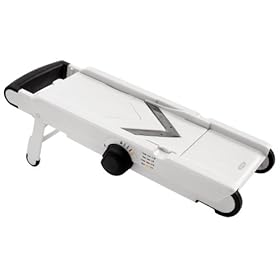 I wouldn't spend more than $40 or 50. I spent about $200 and now wish that I had purchased an economy model. They do the same thing for much less. I found an Oxo V-blade model on Amazon for $40 (pictured at left).
Either way, Wishbone, a mandoline is a worthy investment if you plan to do any camp cooking for large groups. A sharp one will quickly cut a load of potatoes for scallops or au gratin.
I used mine at camp yesterday to cut cucumbers for the cuke and onion salad for today. I had the job done in 10 minutes with nice, thin slices of cucumber.
I don't care how good you are with a knife, a mandoline just makes good sense for the camp kitchen.
 I wrote a safety brief on the use of a mandoline in the kitchen last year. Mandoline safety is serious business in the kitchen. Properly used, they are a great time saver and help you produce professional looking products. In the wrong hands, you'll be spending a lot of time in the emergency ward.
Remember: Doc Mercer plays great Bluegrass tunes on his mandolin as I slice potatoes for scallops on my mandoline.
Thursday, June 25, 2009
Water in a wilderness camp
All cooks and food service workers understand the importance of personal hygiene. A daily shower and clean uniform form the first line of defense in the daily battle against food borne illness. It’s an aspect of food safety that most cooks take for granted.
The situation changes when you’re working in a wilderness kitchen. Since the local utility companies don’t supply water or electricity to Deer Crossing Camp, which is located on the wilderness side of Loon Lake in Eldorado National Forest, all water for cooking, cleaning and hygiene must be pumped from the lake and treated.
Fuel becomes a precious commodity when at a camp that generates its own electricity and pumps, filters and chlorinates lake water in a wilderness location. When the supply of propane and gasoline dips below the comfort level, propane tanks and Jerry cans must be hauled down to the boat landing, loaded on the boat and transported across the lake.
One person must then drive to Pollock Pines or Georgetown to re-stock, a four-hour trip (or more) round trip. This process is repeated every two weeks during the summer season. Not only does the supply trip pull a staff member from his duties, each full fuel container must then be carried back up the hill to their respective storage points.
We view each drop of water as a precious resource, one that must be conserved whenever possible. We run the water generator only for short periods to build water pressure, except when washing dishes.
A 10-minute run on the generator will fill the supply tanks. As long as the campers don’t flush too many toilets during food preparation, the cooks will have sufficient water to cook the meal and clean the kitchen. When the water runs out, the I head down to the generator shack and start the water generator.
In addition to his normal duties as the chef-in-charge of the kitchen, I start the water generator each morning. Water pressure is zero most mornings. I often run down to the generator shack before walking into the kitchen at 6 a.m. and run the generator for 10 minutes.
This process is necessary just to wash our hands; fill the wash, rinse and sanitize sinks; and set aside water for cooking (plus coffee!). I also test the water for chlorine level each day.
Vigilance in all aspects of food safety doesn’t change in the wilderness camp. If anything, the primitive setting calls for increased attention to detail. All the cooks must pay close attention to sanitation, especially where water is needed to clean and sanitize.
The chef must find a balance between the need for a clean kitchen and water and fuel conversation. We run the water generator five or six times each day. This supplies sufficient quantities of water into the kitchen for our needs.
Since hot showers use an incredible amount of propane to heat the water heater, most staff and campers take a shower every three to four days. Since the cooks can’t ignore hygiene, I take a sponge bath each morning. This way I help the camp conserve critical fuel supplies while maintaining a high level of hygiene.
If the cook can’t perform basic hygiene tasks, like washing his hands upon entry into the kitchen, then he must find a reliable source of water before food preparation can begin.
Otherwise, canned food is on the menu.

The situation changes when you’re working in a wilderness kitchen. Since the local utility companies don’t supply water or electricity to Deer Crossing Camp, which is located on the wilderness side of Loon Lake in Eldorado National Forest, all water for cooking, cleaning and hygiene must be pumped from the lake and treated.
Fuel becomes a precious commodity when at a camp that generates its own electricity and pumps, filters and chlorinates lake water in a wilderness location. When the supply of propane and gasoline dips below the comfort level, propane tanks and Jerry cans must be hauled down to the boat landing, loaded on the boat and transported across the lake.
One person must then drive to Pollock Pines or Georgetown to re-stock, a four-hour trip (or more) round trip. This process is repeated every two weeks during the summer season. Not only does the supply trip pull a staff member from his duties, each full fuel container must then be carried back up the hill to their respective storage points.
We view each drop of water as a precious resource, one that must be conserved whenever possible. We run the water generator only for short periods to build water pressure, except when washing dishes.
A 10-minute run on the generator will fill the supply tanks. As long as the campers don’t flush too many toilets during food preparation, the cooks will have sufficient water to cook the meal and clean the kitchen. When the water runs out, the I head down to the generator shack and start the water generator.
In addition to his normal duties as the chef-in-charge of the kitchen, I start the water generator each morning. Water pressure is zero most mornings. I often run down to the generator shack before walking into the kitchen at 6 a.m. and run the generator for 10 minutes.
This process is necessary just to wash our hands; fill the wash, rinse and sanitize sinks; and set aside water for cooking (plus coffee!). I also test the water for chlorine level each day.
Vigilance in all aspects of food safety doesn’t change in the wilderness camp. If anything, the primitive setting calls for increased attention to detail. All the cooks must pay close attention to sanitation, especially where water is needed to clean and sanitize.
The chef must find a balance between the need for a clean kitchen and water and fuel conversation. We run the water generator five or six times each day. This supplies sufficient quantities of water into the kitchen for our needs.
Since hot showers use an incredible amount of propane to heat the water heater, most staff and campers take a shower every three to four days. Since the cooks can’t ignore hygiene, I take a sponge bath each morning. This way I help the camp conserve critical fuel supplies while maintaining a high level of hygiene.
If the cook can’t perform basic hygiene tasks, like washing his hands upon entry into the kitchen, then he must find a reliable source of water before food preparation can begin.
Otherwise, canned food is on the menu.
Wednesday, August 13, 2008
Disease prevention at Virginia Boy Scout camp
I found another camp kitchen story Monday evening. The Waynesboro News Virginian published this one on its website on August 4, 2008.
The story recounts food safety measures being taken by head cook Annette Bess of Camp Shenandoah, a Boy Scout camp in Swoope, Virginia.
After a serious E. coli outbreak at a camp in nearby Goshen, "safety vigilance is a constant," says the lead paragraph. The outbreak closed the larger camp and sent 17 campers and one adult to the hospital.
The article first gives you the impression the Bess implemented a series of measures in reaction to the Goshen outbreak. When you read it, it’s clear that she uses standard measures to reduce or eliminate the possibility of a food-borne illness striking Camp Shenandoah.
Bess brings food safety credentials to her leadership role at the camp from her regular job:
The camp incorporates other measures into its prevention plan. It excludes sick staff members from preparing food and stores chemicals and food items in separate locations. Staff monitors refrigeration temperatures throughout the day.
And Bess discards all leftovers "just to be on the safe side." Although this sounds wasteful, it's a smart move.
Many camps use the family style of service. The cooks dish the meal onto platters and bowls. A waiters from each table then brings the dishes to the dining table, where the diners serve themselves as they do at home.
From the moment the food leaves the kitchen, it's under assault. Contaminants attack the food from many quarters -- dirty hands, sick campers and an open-air dining area.
The "safe side" -- and many state health codes -- dictate that such food not be re-used.
The article is a reminder to all cooks -- not just camp cooks -- of the four-fold approach to food safety. While the article doesn’t cite FightBac.org, Bess clearly follows its four-fold approach to fighting the bacterial growth in food. These measures come from the FightBac website:
That gives the Scouts a head start for next year's camp.
The story recounts food safety measures being taken by head cook Annette Bess of Camp Shenandoah, a Boy Scout camp in Swoope, Virginia.
After a serious E. coli outbreak at a camp in nearby Goshen, "safety vigilance is a constant," says the lead paragraph. The outbreak closed the larger camp and sent 17 campers and one adult to the hospital.
The article first gives you the impression the Bess implemented a series of measures in reaction to the Goshen outbreak. When you read it, it’s clear that she uses standard measures to reduce or eliminate the possibility of a food-borne illness striking Camp Shenandoah.
Bess brings food safety credentials to her leadership role at the camp from her regular job:
Bess, a food services supervisor in the Waynesboro Public School division, is one of eight people on the camp’s food service staff and has gone through numerous training seminars on food handling and safety practices. She outlined steps the camp takes to ensure proper food sanitation, saying that it is as much about common sense as anything else.That common sense approach includes "preventative measures, she said, include cooking and holding foods to their proper temperatures, checking food with calibrated thermometers, taking food temperatures three times a day and following proper sanitation procedures," says writer Jimmy Laroue.
The camp incorporates other measures into its prevention plan. It excludes sick staff members from preparing food and stores chemicals and food items in separate locations. Staff monitors refrigeration temperatures throughout the day.
And Bess discards all leftovers "just to be on the safe side." Although this sounds wasteful, it's a smart move.
Many camps use the family style of service. The cooks dish the meal onto platters and bowls. A waiters from each table then brings the dishes to the dining table, where the diners serve themselves as they do at home.
From the moment the food leaves the kitchen, it's under assault. Contaminants attack the food from many quarters -- dirty hands, sick campers and an open-air dining area.
The "safe side" -- and many state health codes -- dictate that such food not be re-used.
The article is a reminder to all cooks -- not just camp cooks -- of the four-fold approach to food safety. While the article doesn’t cite FightBac.org, Bess clearly follows its four-fold approach to fighting the bacterial growth in food. These measures come from the FightBac website:
The goal of Camp Shenandoah and Bess is to keep the Boy Scouts returning year after year. Like a restaurant, the camp uses good food and a good reputation to ensure that all campers return home healthy.
- Clean -- Wash hands with warm water and soap for at least 20 seconds before and after handling food. Wash utensils and surfaces with hot soapy water after preparing each food item and before you go on to the next food. Using a disinfectant cleaner or a diluted mixture of bleach and water on surfaces can provide some added protection.
- Separate -- Keep raw meat, poultry, eggs and seafood and their juices away from ready-to-eat foods; never place cooked food on an unwashed plate that previously held raw meat, poultry, eggs or seafood.
- Cook -- Cook food to a safe internal temperature (this varies for different cuts and types of meat and poultry) and check for doneness with a food thermometer. Cook eggs until both the yolk and white are firm.
- Chill -- Refrigerate or freeze perishables, prepared food and leftovers within two hours and make sure the refrigerator is set at no higher than 40°F and that the freezer unit is set at 0°F. Use an appliance thermometer to monitor the temperature of your refrigerator.
That gives the Scouts a head start for next year's camp.
Wednesday, July 02, 2008
Camp 2008 -- Finger saving tips
The mandoline -- the sleek hand-operated vegetable-slicer, not the instrument (a mandolin) -- is an essential culinary tool in my book. In the hands of the right person, it saves time and gives many dishes a nice, professional look. The mandoline's sharp blades will slice vegetables to a uniform thickness.
But I don't allow sliced fingers in my kitchen. The bite of the mandoline quickly disfigures in the hands of an untrained operator. One slip quickly means the loss of a finder tip. Any time gained is quickly lost as the chef puts in a 9-1-1 call to the camp nurse.
Each cook who uses the mandoline must study my five rules of mandoline operation. They're designed to save finger tips and to speed up production. They are:
But I don't allow sliced fingers in my kitchen. The bite of the mandoline quickly disfigures in the hands of an untrained operator. One slip quickly means the loss of a finder tip. Any time gained is quickly lost as the chef puts in a 9-1-1 call to the camp nurse.Each cook who uses the mandoline must study my five rules of mandoline operation. They're designed to save finger tips and to speed up production. They are:
- No multitasking when using the mandoline; your single job at this point is to cut the food and to watch the blade, because it bites.
- Use the blade guard at all times; it will protect you fingers.
- No distractions allowed; this means no talking and no visiting when cutting on the mandoline.
- Know where you fingers are at all times; otherwise, you'll find them when the blade bites.
- Your finder is more valuable than the last bit of food; in other words, you don't have to be a hero and balance the food budget with the mandoline.
Sunday, June 29, 2008
Camp 2008 -- Pre-chill tuna salad
 Place canned tuna fish in the walk-in to jump start chilling. Even though my salad cook won't make tuna salad for sandwiches until Monday morning, I placed the three cans in the walk-in this afternoon. Pre-chilling canned salad ingredients helps you stay ahead of the food safety game. Pre-chilling the mayonnaise, tuna and pickle relish helps us ensure the tuna salad will quickly chill to 41 degrees or lower.
Thursday, December 27, 2007
Don't Smell Me, I'm Here to Work
Blog no. 25 brings you a little gem from 90 years ago ...
In October 1917, the American Railway Bridge and Building Association met in Chicago for its 27th annual convention. Among the convention topics was a discussion on the feeding and housing of railway maintenance crews.
Association president S.C. Tanner of the Baltimore and Ohio Railroad told this story to highlight the need for bathing facilities to convention goers:
As a tugboat and destroyer sailor in the 1970s, the captain always exempted the cooks and hospital corpsmen from water restrictions in the showers. The captain -- with persuasion from the ship's medical officer -- recognized the importance of hygiene for these key crewmen.
After all, smelling the food is much more pleasurable than smelling the cook!
In October 1917, the American Railway Bridge and Building Association met in Chicago for its 27th annual convention. Among the convention topics was a discussion on the feeding and housing of railway maintenance crews.
Association president S.C. Tanner of the Baltimore and Ohio Railroad told this story to highlight the need for bathing facilities to convention goers:
It reminds me of a story of a little boy whose mother sewed him up in his underclothes and sent him to school. He had been going in a steam-heated schoolroom for about a month. Finally the teacher didn't like his smell, so she sent him home with a note which said, "Give Jackie a bath and send him back." Jackie came back all right, and written across the bottom of the note the teacher had sent was scrawled, "Jackie isn't a rose—learn him—don't smell him."Fortunately, my experience falls to the positive side of the bathing equation.
As a tugboat and destroyer sailor in the 1970s, the captain always exempted the cooks and hospital corpsmen from water restrictions in the showers. The captain -- with persuasion from the ship's medical officer -- recognized the importance of hygiene for these key crewmen.
After all, smelling the food is much more pleasurable than smelling the cook!
Saturday, December 22, 2007
Hand Washing Station
Your local health department brings you the 19th post of the month.
 Proper hand washing is an essential skill for any camp cook, a practice that's vital to food safety. Unclean hands contaminate food. The cooks must be able to wash his hands often. And he can't do that without the right facilities.
Many outdoor kitchens lack the necessary sink and hot running water so the cook can wash his hands often. This set up gives you the tools to wash your hands with warm running water.
It's really simple. All you need is an insulated beverage jug, detergent dispenser, roll of paper towels and catch basin. Any beverage container that'll hold the heat for more than a few hours will suffice.
Heat a gallon or two of water to at least 120 degrees F. and pour it into the beverage container. The water should be on the hot side, but not too hot to burn. Add cold water to cool the water if necessary.
 The diagram illustrates the requirements for temporary hand washing facilities by the El Dorado County, California, Environmental Management Department.
 Proper hand washing is an essential skill for any camp cook, a practice that's vital to food safety. Unclean hands contaminate food. The cooks must be able to wash his hands often. And he can't do that without the right facilities.
Many outdoor kitchens lack the necessary sink and hot running water so the cook can wash his hands often. This set up gives you the tools to wash your hands with warm running water.
It's really simple. All you need is an insulated beverage jug, detergent dispenser, roll of paper towels and catch basin. Any beverage container that'll hold the heat for more than a few hours will suffice.
Heat a gallon or two of water to at least 120 degrees F. and pour it into the beverage container. The water should be on the hot side, but not too hot to burn. Add cold water to cool the water if necessary.
 The diagram illustrates the requirements for temporary hand washing facilities by the El Dorado County, California, Environmental Management Department.
Thursday, September 07, 2006
Diamond Springs Taco Man
Ingenuity is the motivator that drives some street vendors. The lack of a mobile catering trailer doesn't stop them. They use materials that are readily available to construct a "street legal" vending outfit.
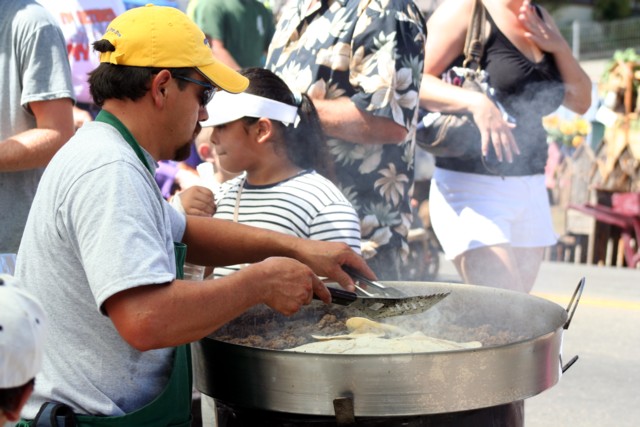
This vendor's taco cooker fascinated me Monday. The cook placed a convex cooking pan over a propane burner. The burner sets inside the drum. He cooked ground beef in the hollow of the cooking pan and used the hump to warm tortillas. I didn't see how he drained the grease from the ground beef.
My only concern with the set up is ease at which cross-contamination could occur. The first time I walked by the booth, the cook was warming torillas in close proximity to raw ground beef. I think a better approach would be to use a flat griddle to warm the tortillas. With care it was a good set up.
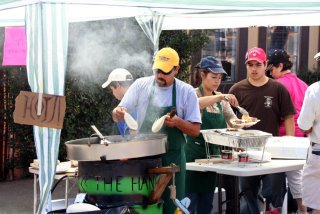


This vendor's taco cooker fascinated me Monday. The cook placed a convex cooking pan over a propane burner. The burner sets inside the drum. He cooked ground beef in the hollow of the cooking pan and used the hump to warm tortillas. I didn't see how he drained the grease from the ground beef.
My only concern with the set up is ease at which cross-contamination could occur. The first time I walked by the booth, the cook was warming torillas in close proximity to raw ground beef. I think a better approach would be to use a flat griddle to warm the tortillas. With care it was a good set up.
Monday, July 10, 2006
Thursday, September 01, 2005
Hurricane Katrina Aftermath: Keeping Food Safe During Flooding and Power Outages
Food safety is critical important during natural disasters. This press release will help you take food safety precautions in the hours after flooding. I recognize this press release is too late for those in the path of Katrina. But it will help those who live in flood-prone areas.
=====<<>>=====
WASHINGTON, Aug. 29, 2005—The U.S. Department of Agriculture is providing recommendations in the aftermath of Hurricane Katrina, which has caused widespread flooding and power outages in Gulf Coast states. Distribution of this important public health information will help minimize the potential for foodborne illnesses due to power outages or flooding.
In response to this public health emergency, USDA is extending the hours of the USDA Meat and Poultry Hotline this week in order to accommodate consumers' questions and concerns 24 hours a day. Callers to the hotline will be able to speak to a live-operator who will be able to provide them with answers to their food safety questions. The Hotline number is 1-888-MPHotline.
Food Safety and Power Outages
Consumers can also ask safe food handling questions by logging on to FSIS' online automated response system called "Ask Karen," on the Food Safety and Inspection Service's Web site, http://www.fsis.usda.gov/. E-mail inquiries can be directed to http://www.fsis.usda.gov/contact_us/Email_Form/index.asp?rcpt=mphotline.fsis@fsis.usda.gov. Additional information about USDA's food safety efforts can be accessed on the FSIS Web site.
Food Safety and Flooding
Discard:
Canned foods, including those bought in stores as well as home-canned foods.
All foods in cardboard boxes, paper, foil, cellophane or cloth should be thrown out.
Meat, poultry, eggs or fish.
Spices, seasonings, extracts, flour, sugar, grain, coffee and other staples in canisters.
Unopened jars with waxed cardboard seals such as mayonnaise and salad dressing. Also throw away preserves sealed with paraffin.
Wooden cutting boards, plastic utensils, baby bottle nipples and pacifiers.
Save:
Canned foods that did not come into contact with flood waters.
Any metal pans, ceramic dishes and utensils that came in contact with flood water that has been washed with hot soapy water and sanitized by boiling in clean water or by immersing for 15 minutes in a solution of one teaspoon of chlorine bleach per quart of water.
When in doubt, throw it out.
Susan Conley (301) 504-9605Matt Baun (301) 504-0235
=====<<>>=====
WASHINGTON, Aug. 29, 2005—The U.S. Department of Agriculture is providing recommendations in the aftermath of Hurricane Katrina, which has caused widespread flooding and power outages in Gulf Coast states. Distribution of this important public health information will help minimize the potential for foodborne illnesses due to power outages or flooding.
In response to this public health emergency, USDA is extending the hours of the USDA Meat and Poultry Hotline this week in order to accommodate consumers' questions and concerns 24 hours a day. Callers to the hotline will be able to speak to a live-operator who will be able to provide them with answers to their food safety questions. The Hotline number is 1-888-MPHotline.
Food Safety and Power Outages
- Keep the refrigerator and freezer doors closed as much as possible to maintain the cold temperature. Each time the door is opened, a significant amount of refrigeration is lost.
- The refrigerator will keep food safely cold for about four hours if it is unopened. A full freezer will hold the temperature for approximately 48 hours (24 hours if it is half full and the door remains closed.)
- Food may be safely refrozen if it still contains ice crystals or is at 40° F or below.
- Never taste a food to determine its safety!
- Obtain dry or block ice to keep your refrigerator and freezer as cold as possible if the power is going to be out for a prolonged period of time. Fifty pounds of dry ice should hold an 18-cubic-foot full freezer for two days.
- If the power has been out for several days then check the temperature of the freezer with an appliance thermometer or food thermometer. If the food still contains ice crystals or is at 40° F or below, then the food is safe.
- If a thermometer has not been kept in the freezer then check each package of food to determine its safety. If the food still contains ice crystals, then the food is safe.
- Discard refrigerated perishable food such as meat, poultry, fish, soft cheeses, milk, eggs, leftovers and deli items after four hours without power.
- Drink only bottled water if flooding has occurred.
- Discard all food that came in contact with flood waters, including canned goods. Discard wooden cutting boards, plastic utensils, baby bottle nipples and pacifiers.
- Thoroughly wash all metal pans, ceramic dishes and utensils that came in contact with flood water with hot soapy water and sanitize by boiling them in clean water or by immersing them for 15 minutes in a solution of one teaspoon of chlorine bleach per quart of water.
- When in Doubt, Throw it Out!
Consumers can also ask safe food handling questions by logging on to FSIS' online automated response system called "Ask Karen," on the Food Safety and Inspection Service's Web site, http://www.fsis.usda.gov/. E-mail inquiries can be directed to http://www.fsis.usda.gov/contact_us/Email_Form/index.asp?rcpt=mphotline.fsis@fsis.usda.gov. Additional information about USDA's food safety efforts can be accessed on the FSIS Web site.
Food Safety and Flooding
Discard:
Canned foods, including those bought in stores as well as home-canned foods.
All foods in cardboard boxes, paper, foil, cellophane or cloth should be thrown out.
Meat, poultry, eggs or fish.
Spices, seasonings, extracts, flour, sugar, grain, coffee and other staples in canisters.
Unopened jars with waxed cardboard seals such as mayonnaise and salad dressing. Also throw away preserves sealed with paraffin.
Wooden cutting boards, plastic utensils, baby bottle nipples and pacifiers.
Save:
Canned foods that did not come into contact with flood waters.
Any metal pans, ceramic dishes and utensils that came in contact with flood water that has been washed with hot soapy water and sanitized by boiling in clean water or by immersing for 15 minutes in a solution of one teaspoon of chlorine bleach per quart of water.
When in doubt, throw it out.
Susan Conley (301) 504-9605Matt Baun (301) 504-0235
Monday, August 08, 2005
Camp -- Qualities of a Good Kitchen Crew
Here are a few areas where the 2005 Northern California FC Camp kitchen crew excelled.
I was encouraged late in the week when the two new couples told me that they're definitely returning for 2006 camp. And I have a maybe from another person. That'll give the kitchen crew four on year number five, two on year three and four or five on year two. I may have all eleven crew members back for 2006.
Sanitizing all work surfaces: The crew learned early in the week to spread a thin coat of quat sanitizer solution over all food contact surfaces. I believe that this is an extension of our concern for bacteria and viruses in the home.
Keeping the salad bar stocked: Every time I asked, "Has the salad bar been restocked," the answer was, "Yes." Wendy, Helen and Alisa kept the salad bar fully stocked for lunch and dinner.
Washing pots and pans: Some has to clean pots and pans. It's a laborious job that must be done three times each day. It's especially important when you realize that we didn't have sufficient pots or pans to function beyond two meals. Both men and women jumped in throughout the day and got the job done. At one point or another all 11 staff washed pots and pans. Phil, Debbie and David were the main pot washers.
Filing the ice water jug: My wife took this task on as hers throughout the week. She's now talking about using two Igloo water jugs next year because the campers suck down water at an insatiable rate during sports breaks.
Keeping busy: I'm blessed with a crew that's willing to work. They usually need someone to get them started. Throughout the week, I often hear, "What can I do next?"
Completing each task: I rarely had to search for volunteers to get the job done. Yes, they took breaks but sometimes it was an issue of kicking them out of the kitchen for a break. I never had to ask, "Where have you been? We have work to do." David and Carol take the prize for spending the most hours in the kitchen. We usually had to push Carol out of the kitchen around 4 p.m.
Concern for food safety: I had a crew who's hearts were in the right place. I believe that this stems from my training on Saturday evening and from the concern that they brought from home.
I was encouraged late in the week when the two new couples told me that they're definitely returning for 2006 camp. And I have a maybe from another person. That'll give the kitchen crew four on year number five, two on year three and four or five on year two. I may have all eleven crew members back for 2006.
Sanitizing all work surfaces: The crew learned early in the week to spread a thin coat of quat sanitizer solution over all food contact surfaces. I believe that this is an extension of our concern for bacteria and viruses in the home.
Keeping the salad bar stocked: Every time I asked, "Has the salad bar been restocked," the answer was, "Yes." Wendy, Helen and Alisa kept the salad bar fully stocked for lunch and dinner.
Washing pots and pans: Some has to clean pots and pans. It's a laborious job that must be done three times each day. It's especially important when you realize that we didn't have sufficient pots or pans to function beyond two meals. Both men and women jumped in throughout the day and got the job done. At one point or another all 11 staff washed pots and pans. Phil, Debbie and David were the main pot washers.
Filing the ice water jug: My wife took this task on as hers throughout the week. She's now talking about using two Igloo water jugs next year because the campers suck down water at an insatiable rate during sports breaks.
Keeping busy: I'm blessed with a crew that's willing to work. They usually need someone to get them started. Throughout the week, I often hear, "What can I do next?"
Completing each task: I rarely had to search for volunteers to get the job done. Yes, they took breaks but sometimes it was an issue of kicking them out of the kitchen for a break. I never had to ask, "Where have you been? We have work to do." David and Carol take the prize for spending the most hours in the kitchen. We usually had to push Carol out of the kitchen around 4 p.m.
Concern for food safety: I had a crew who's hearts were in the right place. I believe that this stems from my training on Saturday evening and from the concern that they brought from home.
Subscribe to:
Comments (Atom)


