
 |
| CAMP SHELBY, Miss. (June 15, 2007) - Culinary Specialist 2nd Class Rick Watson, of Naval Mobile Construction Battalion 23, helps Culinary Specialist Seaman Joshua Abshire and Culinary Specialist 3rd Class Frederick Kline as they prepare pork chops to feed about 1,000 Seabees. NMCB-23 is conducting Operation Desert Heat, a graded field exercise to sharpen the battalion's combat and contingency construction capabilities. U.S. Navy photo by Mass Communication Specialist 2nd Class Ja'lon A. Rhinehart (RELEASED). |
Showing posts with label Seabees. Show all posts
Showing posts with label Seabees. Show all posts
Monday, June 02, 2014
Seabee grill cooks
My Seabee battalion (NMCB-17) spent time at Camp Shelby in 1986 on a similar field exercise. I returned in 1992 for Seabee Crew Served Weapons School, where I was the platoon chief petty officer (equivalent to a Marine platoon sergeant) for platoon of M-60 machine gun students.


Wednesday, September 07, 2011
Code of the campfire #5

In the Seabees, the cooks dedicated one 15-gallon stockpot to hot water in the field. The water was used for sanitation, cooking and coffee. (Seabees can get a hot cup of coffee from the field galley any time of the day.)
The second part of the code says share a cup of tea, coffee or chocolate with camp neighbors before retiring for the night.
Wednesday, June 09, 2010
Standing watch
Although the caption doesn't give CS2 Kowall's unit, I suspect that he may be a Seabee. Seabee cooks are equally at home with a M-60 machine gun as with a spatula.
 |
PAKTIKA PROVINCE, Afghanistan (June 4, 2010) -- Culinary Specialist 2nd Class Pete Kowall, from Enterprise, Miss., provides security during a mission in Sharana district. Kowall works for the Paktika Provincial Reconstruction Team as a supply technician and also works as a gunner while on missions outside the base.
U.S. Air Force photo by Master Sgt. Demetrius Lester.
|
Saturday, May 22, 2010
NMCB 133 sets others up for success in Kandahar, Afghanistan
 My readers may not realize that Navy cooks are in charge of all enlisted barracks and officer quarters on shore bases. The change in responsibility occurred on January 1, 1975 with the merger of the commissaryman and steward ratings.
The new rating was called mess management specialist. The rating was re-titled to culinary specialist (abbreviated CS) on January 15, 2004.
As an old-school CS (commissaryman, not culinary specialist), I never cared for the Navy's concept of hotel-restaurant management. I managed to stay in the galley until my retirement as a senior chief mess management specialist in 1999.
Had my battalion been mobilized, the barracks staff would've reported to me as the leading galley chief for NMCB-17. But it was largely a paper role as we focused on culinary training during our annual training cruises.
By Chief Culinary Specialist Eric Holiman, Naval Mobile Construction Battalion 133 Public Affairs
KANDAHAR, Afghanistan (NNS) -- Naval Mobile Construction Battalion 133 culinary Specialists assisted Kandahar Airfield Afghanistan personnel in preparing for the surge of troops in April.
NMCB 133 culinary specialists attached to the 22nd Naval Construction Regiment, assembled furniture and accessories including beds, lockers and chests for 606 rooms. The housing facilities, contained in Re-locatable Buildings and stacked two high in rows, similar to an apartment complex.
The effort was spearheaded by Culinary Specialist 2nd Class Jarad Baker, who was assisted by Culinary Specialist 3rd Class Dwight Carter and Culinary Specialist Seaman Ray Stargent in outfitting the rooms.
The culinary specialists were also responsible for the proper disposal of excess materials created from the pallets and protective coverings used in transporting the furniture and accessories, spending numerous hours organizing and breaking down materials at KAF's waste management site.
The rooms were completed in time for the arrival of NMCB 21, the battalion which relieved NMCB 22 at KAF. The team of culinary specialists worked tirelessly until the rooms were ready for each arriving unit.
Sunday, September 06, 2009
Field range gasoline burner
 As one who used the military field range burner for 20 years in the U.S. Navy Seabees, I initially expressed concern when Tom asked the readers of the Royal Tine camp cooks forum for advise on his M59 field range outfit. I know from first hand experience that the gasoline-powered burner can be deadly when misused.
I advised Tom to not use the burner. In its place I suggested that he to rig a propane burner in the frame of the military M2 burner.
Tom assured me that he's proficient in the operation of the burner. "I have used the burners keeping a close eye on the pressure gauge," said Tom. He explained that he will shut the burner down when the fuel tank pressure climbs above the green zone, a practice that we follwed in the Seabees.
"I worked in the place that made (the field range) before the Army changed" to the new multi-fueled burner, said Tom. He acquired the "double pots, whisk, ladle, serving spoon, strainer, and the pot rack from where I worked" by asking the owner, who gave the equipment to him.
Tom was able to purchase two new-in-box burners from a military surplus dealer. He later purchased the roasting pan and 10- and 15-gallon stockpots to complete the field range.
Wednesday, August 05, 2009
Knot tying chef
One of the side benefits to working a wilderness camp is you have the opportunity to learn skills other than in the culinary arts. Over the past nine weeks, I've become proficient in operating two different Honda generators, testing the water for chlorine content, bear-proofing waist disposal and cleaning the grease trap.
These are skills that I initially learned in the U.S. Navy Seabees in the early 1980s, but had set aside. But they are skills that the wilderness chef must master if he's to work independently of other camp staff.
Often the chef and his crew are the only ones in camp between meals. A self-sufficient culinary crew can relieve others of these tasks during the day when many are busy with other duties.
 I recently re-learned to tie several important camp knots. Last week I asked David at Deer Crossing Camp to show me the bowline, a knot that's eluded me for years. I could never remember when the rabbit was supposed to come in or out of the hole or when he was supposed to go around the tree and dive back into the hole.
David patiently said, "The rabbit comes out of the hole, goes around the tree and back into the hole."
Simple enough. Then he said something that made sense to me.
"The tree in the lower piece in the loop," explained David.
It clicked -- suddenly I understood the process. In one simple sentence, David, an 18-year-old sailing instructor from Lenzie, Scotland, erased several decades of frustration with the bowline.
Since our Saturday know tying class -- one that took me back to knot tying in Navy boot camp -- I've working on a dozen other knots. Musty from handling pigtails, my hands have been busy practicing several useful knots.
 Some, like the monkey fist, won't help me secure a kitchen tent to the forest floor. But it may if I need to weight down the end of a line or anchor a line to a rock crevace.
The figure eight, clove hitch and half hitch -- all knots that I've re-acquainted myself with over the past week -- will come in handy next time I need to secure a tarpiline over the wilderness kitchen.
Note: The links take you to an animated knot tying website called Animated Knots by Grog.
These are skills that I initially learned in the U.S. Navy Seabees in the early 1980s, but had set aside. But they are skills that the wilderness chef must master if he's to work independently of other camp staff.
Often the chef and his crew are the only ones in camp between meals. A self-sufficient culinary crew can relieve others of these tasks during the day when many are busy with other duties.
 I recently re-learned to tie several important camp knots. Last week I asked David at Deer Crossing Camp to show me the bowline, a knot that's eluded me for years. I could never remember when the rabbit was supposed to come in or out of the hole or when he was supposed to go around the tree and dive back into the hole.
David patiently said, "The rabbit comes out of the hole, goes around the tree and back into the hole."
Simple enough. Then he said something that made sense to me.
"The tree in the lower piece in the loop," explained David.
It clicked -- suddenly I understood the process. In one simple sentence, David, an 18-year-old sailing instructor from Lenzie, Scotland, erased several decades of frustration with the bowline.
Since our Saturday know tying class -- one that took me back to knot tying in Navy boot camp -- I've working on a dozen other knots. Musty from handling pigtails, my hands have been busy practicing several useful knots.
 Some, like the monkey fist, won't help me secure a kitchen tent to the forest floor. But it may if I need to weight down the end of a line or anchor a line to a rock crevace.
The figure eight, clove hitch and half hitch -- all knots that I've re-acquainted myself with over the past week -- will come in handy next time I need to secure a tarpiline over the wilderness kitchen.
Note: The links take you to an animated knot tying website called Animated Knots by Grog.
Wednesday, May 27, 2009
Comdr. Duane G. Wolfe, CEC, USNR
I learned yesterday that shipmate and brother-in-Christ Duane Wolfe was killed Monday in the line of duty in Iraq. Duane and I served together in Naval Mobile Construction Battalion 17 in the 1980s and early 1990s as chief petty officers. He later promoted in to the officer ranks in the Navy Civil Engineer Corps.
The Department of Defense announced today the death of a sailor who was supporting Operation Iraqi Freedom.
Cmdr. Duane G. Wolfe, 54, of Port Hueneme, Calif., died May 25, 2009, from injuries suffered as a result of an improvised explosive device attack on his convoy southeast of Fallujah. Wolfe was assigned to the U.S. Army Corps of Engineers’ Gulf Region Division in Iraq.
The Department of Defense announced today the death of a sailor who was supporting Operation Iraqi Freedom.
Cmdr. Duane G. Wolfe, 54, of Port Hueneme, Calif., died May 25, 2009, from injuries suffered as a result of an improvised explosive device attack on his convoy southeast of Fallujah. Wolfe was assigned to the U.S. Army Corps of Engineers’ Gulf Region Division in Iraq.
Wednesday, May 20, 2009
Navy cooks test field skills at Seabee Rodeo
By Naval Air Station Jacksonville Public Affairs
JACKSONVILLE, Fla. (NNS) (5/20/09) -- The Third Naval Construction Regiment Seabee Rodeo was held aboard NAS Jacksonville April 28-May 3, and the competing teams were Naval Mobile Construction Battalion (NMCB) 14 of NAS Jax, NMCB 23 of Fort Belvoir, Va., and NMCB 24 of Redstone Arsenal, Ala.
"Each team competes in general military skills, uniform appearance, physical training and readiness, construction skills, marksmanship and other skills," explained NMCB 14 Commanding Officer Capt. Joseph Hinson.
To simulate being deployed, competitors bivouacked in tents and dined on MREs (Meals Ready to Eat). Events took place throughout the day and night with teams competing in events representing every aspect of Seabee life — such as personnel inspections, close order drill, land navigation, erecting tents within a secure perimeter and command operations center exercises that simulate attacks on their base.
They also participated in practical rate exercises that test the skills of the individual Seabee. Construction mechanics had to build a working cabinet with sink. Engineering aides surveyed construction sites. Equipment operators were tasked with loading and unloading a tractor onto an 18-wheeler flat bed. Steelworkers welded and cut sheet metal, and utilitiesmen erected lights and ran power cables. Other rates attached to Seabee battalions, such as storekeepers and culinary specialists, had events of their own.
The "Iron CS Challenge" mimicked the Iron Chef television show — but with some aspects geared more toward cooking on deployment rather than in a regular galley kitchen.
"This is the second running of the Iron CS Challenge. We try to set the same tone and environment, as they would encounter in the field. They get limited resources and a surprise item, which today happens to be a tomato," said Culinary Specialist Chief Michael Farrell of NMCB 23.
"Competitors have to create a meal around that tomato and only have 2.5 hours to prepare, cook and serve the meal. The skipper and the commodore will evaluate each chef's creation on taste, presentation and creativity. The winner is presented with the Iron Culinary Specialist Trophy that they will keep until next year's rodeo."
Hinson continued, "After six days of friendly but serious competition, we tally up the scores to determine our rodeo champion. They take home the trophy until the next year's rodeo."
Staff from the 3rd Naval Construction Regiment, headquartered in Atlanta, judged the events. At the end of the competition, NMCB 23 came out on top — winning both the Iron CS Challenge and the overall Seabee Rodeo.
JACKSONVILLE, Fla. (NNS) (5/20/09) -- The Third Naval Construction Regiment Seabee Rodeo was held aboard NAS Jacksonville April 28-May 3, and the competing teams were Naval Mobile Construction Battalion (NMCB) 14 of NAS Jax, NMCB 23 of Fort Belvoir, Va., and NMCB 24 of Redstone Arsenal, Ala.
"Each team competes in general military skills, uniform appearance, physical training and readiness, construction skills, marksmanship and other skills," explained NMCB 14 Commanding Officer Capt. Joseph Hinson.
To simulate being deployed, competitors bivouacked in tents and dined on MREs (Meals Ready to Eat). Events took place throughout the day and night with teams competing in events representing every aspect of Seabee life — such as personnel inspections, close order drill, land navigation, erecting tents within a secure perimeter and command operations center exercises that simulate attacks on their base.
They also participated in practical rate exercises that test the skills of the individual Seabee. Construction mechanics had to build a working cabinet with sink. Engineering aides surveyed construction sites. Equipment operators were tasked with loading and unloading a tractor onto an 18-wheeler flat bed. Steelworkers welded and cut sheet metal, and utilitiesmen erected lights and ran power cables. Other rates attached to Seabee battalions, such as storekeepers and culinary specialists, had events of their own.
The "Iron CS Challenge" mimicked the Iron Chef television show — but with some aspects geared more toward cooking on deployment rather than in a regular galley kitchen.
"This is the second running of the Iron CS Challenge. We try to set the same tone and environment, as they would encounter in the field. They get limited resources and a surprise item, which today happens to be a tomato," said Culinary Specialist Chief Michael Farrell of NMCB 23.
"Competitors have to create a meal around that tomato and only have 2.5 hours to prepare, cook and serve the meal. The skipper and the commodore will evaluate each chef's creation on taste, presentation and creativity. The winner is presented with the Iron Culinary Specialist Trophy that they will keep until next year's rodeo."
Hinson continued, "After six days of friendly but serious competition, we tally up the scores to determine our rodeo champion. They take home the trophy until the next year's rodeo."
Staff from the 3rd Naval Construction Regiment, headquartered in Atlanta, judged the events. At the end of the competition, NMCB 23 came out on top — winning both the Iron CS Challenge and the overall Seabee Rodeo.
Friday, May 01, 2009
Camp coffee
 I'm reminded of a 2003 piece that was written about what chuckwagon cook Kent Rollins had to say about camp coffee. The October 29 issue of the Chef2Chef Recipe Club said this about the Oklahoma wagon cook and his coffee:
Cookie’s first thing on the fire, and the last thing off; was for sure - The coffee; and some say - the most important part of a camp meal! Cowboy’s savored the aroma of smoky coals and aromatic scent of brewin’ Coffee in the air and the best of the cooks not judged by their cookin’, but by the tried and true brewin’ techniques learn’d along the way.Like the coffee being poured by Dave Herzog last week at the IDOS Region II Dutch Oven Gathering, the wagon cook only knew one one method to make camp coffee. He boiled it. No "percolating, bubbling, gurgling and spewing drip coffee makers" allowed.
I perfected my coffee boiling technique under the watchful eye of Gunnery Sergeant Tingle at the U.S. Marine Corps 29 Palms base in July 1985. Seabee and Marine Corps cooks brought a 15-gallon pot of cold water to a boil. After cutting the heat, the cook poured a three-pound can of coffee grounds over the water and let it brew undisturbed.
Ten minutes later -- more or less -- the cook sprinkled a quart of cold water over the hot coffee to settle the grounds. Then using caution so not to disturb the settled grounds, the cook dipped the coffee into a waiting vacuum jug.
I can't say that cowboy cook developed the technique. It probably dates back to the early days of coffee. The cowboy process is the same. You need a "old large coffee pot, water and three handfuls of Cowboy Coffee." Here's the process:
Put enough water in the ole coffee pot to come up to the spout. Boil the coffee until your desired strength which can be determined by the color. The longer it boils - the Stronger it is. Pull off the fire and pour 1/2 cup of cold water to settle the grounds. Let set about 2 minutes and its ready.The Recipe Club email recommended that you use "fresh roasted beans ground just before using," coarse-ground for boiling.
I bet Dave got a jolt from the coffee that was prepared by wagon cook Randy Brown. I sure did.
But, that's what it's supposed to do. It's coffee, "Guaranteed to get you goin’ in the morning."
Tuesday, March 31, 2009
Chemical warfare
This was one of my least favorite activities during my 20 years service in the U.S. Navy Seabees ...
 |
CAMP PENDLETON, Calif. (March 25, 2009) -- Lt. Cmdr. Ferdinand Herrera fastens a chemical, biological and radiological suit for Culinary Specialist 1st Class Victor Rojas during a recent Amphibious Construction Battalion 1 field exercise. The exercise focuses on controlled tactical training scenarios demonstrating the battalion's primary mission to support real-time ship-to-shore operations in a hostile environment.
U.S. Navy photo by Mass Communication Specialist 2nd Class Brian Morales.
|
Friday, December 26, 2008
ACB-1 Seabees share holidays with San Diego Center for Children
By Mass Communication Specialist 3rd Class Brian Morales, Amphibious Construction Battalion 1
CORONADO, Calif. (NNS) (12/25/2008) -- Amphibious Construction Battalion 1 Seabees invited the San Diego Center for Children into ACB-1's chiefs mess to share a home cooked meal for the holidays on Dec. 23 at Naval Amphibious Base Coronado.
SDCC is San Diego's oldest non-profit organization, celebrating more than 121 years of service. Children and adolescents face many challenges: mental, emotional, or behavioral. SDCC helps them regain a healthy and normal life with family, friends, and school.
The ACB-1 first class mess gathered donations of $450 from the command to supply food and gifts for the holiday gathering.
"I just wanted to show these kids we care," said Boatswain's Mate 1st Class Kisha L. Jacobi, vice president of the ACB-1 first class mess.
Many ACB-1 Seabees took time out of their normal duties to participate in making this holiday gathering a success.
"This time of year, it is better to give than receive," said Engineering Aide 2nd Class Salvador Hernandez, ACB-1 assistant Seabee Combat Warfare coordinator. Salvador provided an enchilada dish and assisted in arranging other dishes to form a buffet style serving line.
Prior to eating, ACB-1 Seabees, friends, family and SDCC bowed their heads in prayer as Chaplain Joseph Roach led everyone in prayer.
The holiday gathering also provided a home cooked meal to ACB-1 single Seabees far away from home.
They feasted on turkey, mashed potatoes, candy yams, sweet potatoes, corn, chips, dip and much more.
"It's priceless to see a smile on everyone's faces, especially during this time of the year," said Culinary Specialist Seaman Jugdeep Kingra, from San Fernando Valley, Calif. Like Salvador and many other ACB-1 Seabees, Jugdeep helped setting up food, chairs, and plates.
SDCC children and adolescents enjoyed the holiday meal and gifts provided by ACB-1.
"It's a great opportunity for them [SDCC children and adolescents] to get to meet new people and positive role models," said Allison Christian, a native San Diegan child care provider working with SDCC.
After the meal, Seabees continued to play with many of the younger children in various games.
CORONADO, Calif. (NNS) (12/25/2008) -- Amphibious Construction Battalion 1 Seabees invited the San Diego Center for Children into ACB-1's chiefs mess to share a home cooked meal for the holidays on Dec. 23 at Naval Amphibious Base Coronado.
SDCC is San Diego's oldest non-profit organization, celebrating more than 121 years of service. Children and adolescents face many challenges: mental, emotional, or behavioral. SDCC helps them regain a healthy and normal life with family, friends, and school.
The ACB-1 first class mess gathered donations of $450 from the command to supply food and gifts for the holiday gathering.
"I just wanted to show these kids we care," said Boatswain's Mate 1st Class Kisha L. Jacobi, vice president of the ACB-1 first class mess.
Many ACB-1 Seabees took time out of their normal duties to participate in making this holiday gathering a success.
"This time of year, it is better to give than receive," said Engineering Aide 2nd Class Salvador Hernandez, ACB-1 assistant Seabee Combat Warfare coordinator. Salvador provided an enchilada dish and assisted in arranging other dishes to form a buffet style serving line.
Prior to eating, ACB-1 Seabees, friends, family and SDCC bowed their heads in prayer as Chaplain Joseph Roach led everyone in prayer.
The holiday gathering also provided a home cooked meal to ACB-1 single Seabees far away from home.
They feasted on turkey, mashed potatoes, candy yams, sweet potatoes, corn, chips, dip and much more.
"It's priceless to see a smile on everyone's faces, especially during this time of the year," said Culinary Specialist Seaman Jugdeep Kingra, from San Fernando Valley, Calif. Like Salvador and many other ACB-1 Seabees, Jugdeep helped setting up food, chairs, and plates.
SDCC children and adolescents enjoyed the holiday meal and gifts provided by ACB-1.
"It's a great opportunity for them [SDCC children and adolescents] to get to meet new people and positive role models," said Allison Christian, a native San Diegan child care provider working with SDCC.
After the meal, Seabees continued to play with many of the younger children in various games.
Saturday, June 24, 2006
NMCB 74 Galley Striving for Excellence
By Ens. Tim Walker, SC, USN
Food Service Officer
Naval Mobile Construction Battalion 74
NMCB 74 deployed to Camp Shields, Okinawa, Japan, on what was supposed to be a run of the mill Seabee deployment for the galley crew. Six months on the ground operating an undersized galley, and extensive barracks to support a battalion with 400 personnel on the main deployment site.
Upon arrival to Camp Shields, it was discovered that the galley had received Three Star Accreditation the previous year. The procedures, and significance of CNI accreditation were explained and the junior Sailors became intrigued. They wanted to go for the Five Star Accreditation. Suddenly there was a common goal to work towards.
Immediately the crew of the Camp Shields Galley started reviewing the inspection checklist from the previous year's inspection. "We went through the inspection checklist and identified all the areas where we would need improvement. That provided us a strong foundation to build from and got us headed in the right direction," said CSCS Calvin Dukes, Food Service Leading Chief Petty Officer. Thorough in-rate training, which stressed involvement by all culinary specialists, was coupled with an emphasis on brilliance in the basics.
Every member of the galley crew got involved in correcting any known deficiencies. Extensive field days were conducted in off hours to improve the overall sanitation and aesthetics of the galley. Extra training was conducted in all areas of Food Service. Junior cooks would commonly ask the records keeper about the inner workings of FSM and the junior officer of the day was frequently quizzed on break out and inventory procedures. There was even instruction given on preparing garnishing.
The Navy Food Management Team, Yokosuka, come to Camp Shields for a mid-deployment assist visit in September. The team provided invaluable training and materials to the culinary specialists, who were already performing at a level far above their experience. The team also gave an unbiased view of delinquencies that remained in the galley. The visit was a success on all counts, and ended with a recommendation that NMCB 74 place a request for a CNI Five Star Accreditation visit.
Over the deployment the Food Service department supported over 400 personnel in the main galley, Wardroom, and CPO mess. They have also taken great strides to support personnel in all battalion evolutions, project sites, and training exercises around the island, with superior hot meals. The galley also adjusted to 24-hour operations to support all hands while they were preparing to forward deploy personnel to earthquake relief efforts in Pakistan. Not to mention that one-fourth of the CS's returned to homeport, Gulfport, Miss., to deal with the devastation that Hurricane Katrina had left in her wake. Despite all the distractions the dedicated crew kept their focus on the task at hand.
NMCB 74's Food Service Department received validation for all their efforts on Nov. 7 when the NFMT awarded the unit a total score of 813 out of 818 possible points and the Five Star Accreditation.
"Earning a Five Star Accreditation at the Camp Shields galley is a rare feat," according to NFMT Lead Inspector CSC Lester Griffith. "This is the first battalion I've ever inspected that earned the accreditation. In fact, this is by far the best galley I've inspected in the 18 months that I've been doing this job."
Reprinted from the U.S. Navy Supply Corps Newsletter, March/April 2006 issue.
Food Service Officer
Naval Mobile Construction Battalion 74
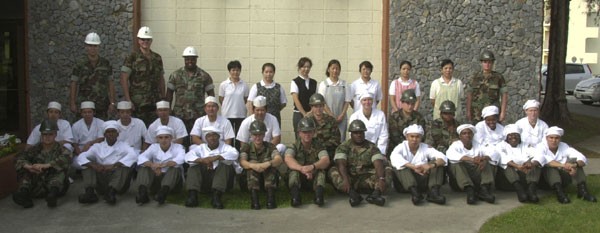 |
| The Camp Shields Galley staff gathered for a photo to commemorate the Five Star Accreditation they received. Included in the photo, seated, from left, are EOCN Christopher Newman, CSSA Montrio Funzie, CS3 Osvaldo Quintanilla, CSSN Eddy Williams, EOCN Susan Knox, CS1 Tony Tierno, CS2 (SW/AW) Michael Young, CSSN Anthony Katimbang, CSSA Carl Douglas, CS3 Ashley Hoskins, and CS3 Miguel Nunez. Kneeling, from left, are I. Asato, S. Nagamine, T. Oiski, M. Tamae, M. Medoruma, M. Akamine, BU3 Asta Hargas, CS3 Kelley Vaughan, UTCN Michael Schmidt, CS2 (SCW) Patricia Alexander, CS3 (SCW) Lacey Seay, and CS3 (SCW) Brenda Rush. Standing, from left, are ENS Tim Walker, LCDR Craig Retzlaff, CSCS (SCW/SW/AW) Calvin Dukes, K. Chinen, M. Kinjyo, T. Kimura, N. Goya, Mrs. K. Kamizato, K. Arakaki, H. Komori, and CS1 (AW) Leslie Schwartz. Not available for the photo were CS1 Danny Hansch, CS3 Herbet Myers, CS3 (SW) Mario Smith, CS3 (SCW) Kisha Hopkins, and CMCN Daniel Bennetch. |
Upon arrival to Camp Shields, it was discovered that the galley had received Three Star Accreditation the previous year. The procedures, and significance of CNI accreditation were explained and the junior Sailors became intrigued. They wanted to go for the Five Star Accreditation. Suddenly there was a common goal to work towards.
Immediately the crew of the Camp Shields Galley started reviewing the inspection checklist from the previous year's inspection. "We went through the inspection checklist and identified all the areas where we would need improvement. That provided us a strong foundation to build from and got us headed in the right direction," said CSCS Calvin Dukes, Food Service Leading Chief Petty Officer. Thorough in-rate training, which stressed involvement by all culinary specialists, was coupled with an emphasis on brilliance in the basics.
Every member of the galley crew got involved in correcting any known deficiencies. Extensive field days were conducted in off hours to improve the overall sanitation and aesthetics of the galley. Extra training was conducted in all areas of Food Service. Junior cooks would commonly ask the records keeper about the inner workings of FSM and the junior officer of the day was frequently quizzed on break out and inventory procedures. There was even instruction given on preparing garnishing.
The Navy Food Management Team, Yokosuka, come to Camp Shields for a mid-deployment assist visit in September. The team provided invaluable training and materials to the culinary specialists, who were already performing at a level far above their experience. The team also gave an unbiased view of delinquencies that remained in the galley. The visit was a success on all counts, and ended with a recommendation that NMCB 74 place a request for a CNI Five Star Accreditation visit.
Over the deployment the Food Service department supported over 400 personnel in the main galley, Wardroom, and CPO mess. They have also taken great strides to support personnel in all battalion evolutions, project sites, and training exercises around the island, with superior hot meals. The galley also adjusted to 24-hour operations to support all hands while they were preparing to forward deploy personnel to earthquake relief efforts in Pakistan. Not to mention that one-fourth of the CS's returned to homeport, Gulfport, Miss., to deal with the devastation that Hurricane Katrina had left in her wake. Despite all the distractions the dedicated crew kept their focus on the task at hand.
NMCB 74's Food Service Department received validation for all their efforts on Nov. 7 when the NFMT awarded the unit a total score of 813 out of 818 possible points and the Five Star Accreditation.
"Earning a Five Star Accreditation at the Camp Shields galley is a rare feat," according to NFMT Lead Inspector CSC Lester Griffith. "This is the first battalion I've ever inspected that earned the accreditation. In fact, this is by far the best galley I've inspected in the 18 months that I've been doing this job."
Reprinted from the U.S. Navy Supply Corps Newsletter, March/April 2006 issue.
Monday, February 07, 2005
May Your Campfires Sizzle
I re-wrote the Blogger profile this afternoon as promised -- it's much better.
Just in case you can't get enough of me, here's a few thoughts that explain what 'Round the Chuckbox is all about.
I've always envisioned myself as a nineteenth century camp cook. I would've loved cooking for an El Dorado County ranch as they made their annual cattle drive to summer pasture in the Lake Tahoe basin. Everything about the job appeals to me: family atmosphere, the outdoors and good old country cooking.
I've got one problem: I was born 50 years too late. And I grew up in Fresno and Bakersfield.
Those who know me will tell you that I'm just a city boy who's loved the Sierra Nevada high country ever since my father carried me to Peter Grub Hut in 1954.
The closest I came to camp cooking was feeding Seabee construction warriors during a 20-year stint in the Naval Reserve.
I haven't ridden a horse in over 30 years, and I've never driven a chuckwagon or fed a beef-centered diet to cowboys on the Western prairie. Nor have I piled flapjacks onto chipped enamel plates meant for hungry Sierra Nevada lumbermen.
That's what happens when I take my family camping in the Eldorado National Forest where I live out a week-long fantasy each summer. You'd think that I was prepared to feed a crowd of hungry hunters and fishermen.
I carry enough cookware to feed a baker's dozen or two. Just give me a white A-framed cook-tent, an assistant or two and outdoorsmen who appreciate good old camp cooking and I'm in my environment.
Just in case you can't get enough of me, here's a few thoughts that explain what 'Round the Chuckbox is all about.
I've always envisioned myself as a nineteenth century camp cook. I would've loved cooking for an El Dorado County ranch as they made their annual cattle drive to summer pasture in the Lake Tahoe basin. Everything about the job appeals to me: family atmosphere, the outdoors and good old country cooking.
I've got one problem: I was born 50 years too late. And I grew up in Fresno and Bakersfield.
Those who know me will tell you that I'm just a city boy who's loved the Sierra Nevada high country ever since my father carried me to Peter Grub Hut in 1954.
The closest I came to camp cooking was feeding Seabee construction warriors during a 20-year stint in the Naval Reserve.
 |
| That's me, CSCS Steven C. Karoly, USN, now retired. My assistant, CSC Bob Voigt, stands behind me. The food service officer of Naval Mobile Construction Battalion 17 is to my right. The photo was snapped during Operation Bearing Duel at Fort Hunter Liggett, June 1994. |
I haven't ridden a horse in over 30 years, and I've never driven a chuckwagon or fed a beef-centered diet to cowboys on the Western prairie. Nor have I piled flapjacks onto chipped enamel plates meant for hungry Sierra Nevada lumbermen.
That's what happens when I take my family camping in the Eldorado National Forest where I live out a week-long fantasy each summer. You'd think that I was prepared to feed a crowd of hungry hunters and fishermen.
I carry enough cookware to feed a baker's dozen or two. Just give me a white A-framed cook-tent, an assistant or two and outdoorsmen who appreciate good old camp cooking and I'm in my environment.
 |
| Steve's Café, located just south of the Visalia, California airport, on Hwy 99. |
Subscribe to:
Comments (Atom)


