Showing posts with label food service records. Show all posts

Saturday, October 09, 2010

The 1090

I know you can't wait to learn the answer to the question, "What 'food supply form' is Petty Officer White filling out?" It's the 1090, of course.

The 1090 is also known as the Food Preparation Worksheet (NAVSUP FORM 1090). The
Mess Management Specialist 1&C Rate Training Manual offers this explanation of the worksheet:
The first requisite to good cooking is an accurate knowledge of the items to be prepared. MS personnel have specific instructions on which foods to prepare, the recipe card number, the number of portions to prepare, time to start preparations, special instructions from the leading MS, and serving instructions. These instructions are furnished on the Food-Preparation Worksheet, NAVSUP Form 1090.
Now you know ...


ATLANTIC OCEAN (Oct. 6, 2010) -- Culinary Specialist 2nd Class Melody White, assigned to the supply department's S-2 division, fills out a food supply form in the S-2 office aboard the aircraft carrier USS George H.W. Bush (CVN 77). George H.W. Bush is conducting training operations in the Atlantic Ocean.

U.S. Navy photo by Mass Communication Specialist 3rd Class Tony Curtis.

Thursday, April 08, 2010

Trimming the budget

At my place of employment, the kitchen is allotted a set budget each month. With just over $5 per resident per day, the money must cover food purchases, along with paperware and smallware purchases.

When I overspend in one area, I must adjust the budget in other areas in order to stay within must allotted funds for the month. It doesn't matter if the excessive spending is due to my mismanagement or for a special function. I still have to keep my spending under control.

As of last Friday, I was about $250 in deficit after purchasing food for a special Easter event. That means that I would spend about $250 oven my anticipated expenditures for April if I didn't compensate elsewhere.

Although I may be able to justify the extra expense, I instead elected to adjust the budget for each of the four remaining weeks in April, as follows:
  • Cut $60 from a planned purchase at a local big box store
  • Reduce the weekly Smart and Final shopping trip by $25, for a total of $100
  • Reduce the second semi-monthly Sysco drop by $100
I may have to forgo my planned shopping trip to the local restaurant supply store this month. Either way, I'll wait until the end of the month. I'll have a better view of the fiscal picture by then.

Tuesday, November 03, 2009

Seagoing paperwork

Someone has to do the paperwork at sea! Typically, the watch captain, or galley shift leader, records important historical data on the worksheet after each meal. The leading chief culinary specialist uses this information to plan future meals.

PACIFIC OCEAN (Oct. 28, 2009) -- Culinary Specialist 1st Class Neil Monato verifies figures on a food preparation worksheet while underway aboard the amphibious command ship USS Blue Ridge (LCC 19).

U.S. Navy photo by Mass Communication Specialist 3rd Class Daniel Viramontes.

Sunday, July 06, 2008

Camp 2008 -- Goal #3: Watch food production worksheet instructions

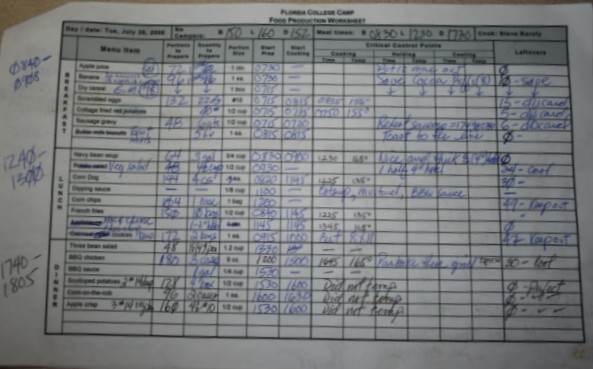
My third goal of the week was to carefully watch the instructions that I give to the cooks via the food production worksheet. We were only moderately successful at accomplishing this goal.

This ties nicely with the other two goals -- to reduce volume of leftovers and reduce end-of-camp donations. This point is important because I use the worksheet to communicate meal instructions to the crew.

My intent here was to improve the staff's use of the worksheet. Until two or three years ago, I was the only one recording information onto the worksheet. Then in 2005 or 2006 I started training the cooks to record to use the worksheet.

It's difficult to get the cooks to take time to document their actions. Most cooks like to focus on cooking, not record keeping. I spent most of the week reminding my second and third cooks to record the number of portions that they prepared, final cooking temperatures for potentially hazardous food items and leftover portions.

I say I was moderately successful because the cooks were using the worksheet about 60 to 75 percent of the time. I filled in the gaps for about one out of three meals.

We'll keep working on the importance of keeping good records next year. The food production worksheet, along with the inventory and food safety log, give me the history (click here and here) that I need to plan for next year's camp.

Monday, July 09, 2007

Camp -- Danger in the Kitchen

Twice last week my desk was unmercifully attacked by flying glasses of iced tea. It seems we had a clutz in our midst this year. Of course, repeated warnings by the self-professed clutz went unheeded by this chef -- after all, one wants a cold drink nearby when the mercury tips 90 in the kitchen.

Friday, February 02, 2007

Cookin' The Books

During my time at sea (in the 1970s), the watch captain prepared a NAVSUP Form 1282 each watch. As the senior cook on watch, the watch captain formulated a requisition for the following day's food needs in the galley.

Once approved by the chief, the jack of the dust -- the Navy term for the subsistence storeroom supervisor -- fulfilled the order. The JOOD didn't run a delivery service. I usually sent the mess cooks to the storeroom and reefers to hustle the food up to the galley.


Pacific Ocean (Feb. 1, 2007) – Culinary Specialist 2nd Class Jimnett Santos checks food order forms for accuracy in the galley aboard the Nimitz-class aircraft carrier USS Ronald Reagan (CVN 76). Ronald Reagan recently received the Captain Edward F. Ney Award for excellence in food service for aircraft carriers. The Ronald Reagan Carrier Strike Group is currently underway on a deployment in support of U.S. military operations in the western Pacific.

U.S. Navy photo by Mass Communication Specialist Seaman Kathleen Gorby.

Saturday, June 03, 2006

Preparations for Camp

I've been spending a good part of my non-working hours getting ready for my fifth year to chef the kitchen for the Northern California Florida College Camp in Felton. I have my staff in place with 11 or 12 from 2005 returning to the kitchen this year. The menu is ready and my Sysco Food Services of San Francisco rep faxed the order guide to me yesterday.

My Binders
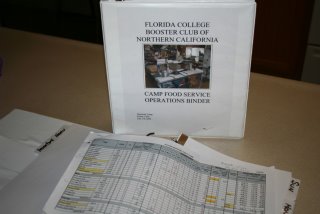
I organize my menu, notes, inventory and recipes for camp into two binders. The first -- "Camp Food Service Operations Binder" -- is used to assemble all the emails and notes for the administrative end of running a camp kitchen. All this information gets filed under appropriate tabs (menu, program, production, purchasing, food safety, staff, training, facility and snack shack).

The second binder -- "Camp Menu and Recipe Binder" --holds the "meat" of the information to operate the kitchen. The menu, inventory, purchase guides and recipes are again filed under the appropriate tabs. I include a tab for each day of the week where I file the recipes for breakfast, lunch and dinner. Recipes for salads and cookies are located under their own tabs.

The binders help me organize all of the records for the camp kitchen. I do this for two reasons: I case I get sick and can't work the camp, all the details to operate the kitchen are recorded in the two binders. They also serve as the records for camp. Each year, I look up information from prior as I plan for camp food service. Just in case, the county health department can review the binders in the event of a food borne illness complain (it's not happen yet).
Detailed records are a must. As the saying goes, the pen is mightier than the sword. Daily food production worksheets and food safety logs, accurately completed, can defend your organization against allegations of foodborne illness.

The binders will come in handy when I decide it's time to move on and pass the baton to a younger chef. I'm always ready to teach someone my job because I don't plan on being the camp chef forever. At this point, I'm looking at another four or five years (or until my son graduates high school). I need to start thinking about a predecessor. (A note on the next chef -- I have identified a 30-something mother that's willing to learn the job. She starts her training next year.)

As chef, I've learned that I can't be present in the kitchen all the time. Daily meetings with the director, inventories and Costco runs occupy my time. The cooks reference the menu, corresponding recipes and purchase lists when necessary.

Each year, I print the recipes from into the recipe binder. Each day's recipes are readily available behind daily divider tabs in the binder. I also created a food production planning worksheet that lists all of the tasks that must be accomplished each day (thawing, prep for the next day recipes to cook, for instance).

Friday, July 15, 2005

Second Set of Lessons from a Week-Long Bible Camp, Part 7

You know a lot about the food business, especially if you've been going it to 35 years as I have. So what happens if you break your leg the week prior to camp? Or you decide it's time to move on and pass the baton to a younger chef?

My answer is to keep detailed records. I'm always ready to teach someone my job because I don't plan on being the camp chef forever. At this point, I'm looking at another four or five years (until my son graduates high school). I need to start thinking about a predecessor.

Document Your Extensive Knowledge Base as a Chef

As chef, you can't be present in the kitchen all the time. Daily meetings with the director, inventories and Costco runs occupy your time. And there are times that you have to walk out of the kitchen to preserve your sanity (like your 10th or 11th continuous hour in the kitchen -- my point about working staff to the bone applies to the chef as well).

Keep your knowledge base in a three-ring binder. The cooks can reference the menu, corresponding recipes and purchase lists when necessary. Each year, I have printed military recipes from into a recipe binder.

Each day's recipes are readily available behind daily divider tabs in the binder. I also created a food production planning worksheet that lists all of the tasks that must be accomplished each day (thawing, prep for the next day recipes to cook, for instance).

And don't forget to keep detailed records. As the saying goes, the pen is mightier than the sword. Daily food production worksheets and food safety logs, accurately completed, can defend your organization against allegations of foodborne illness. It also gives you history for next year's camp.

I'll post some photographs of my binders tomorrow ...