
 |
| An Army cook with the 180th Transportation Company prepares a meal at Crane Army Ammunition Activity, Ind., June 14 as part of Operation Golden Cargo. Operation Golden Cargo gives food service specialists the opportunity to get field training that prepares them for future deployments. U.S. Army photo by Sgt. David Turner. |
Showing posts with label US Army. Show all posts
Showing posts with label US Army. Show all posts
Wednesday, November 11, 2015
Veteran's Day tribute: Army


Saturday, January 31, 2015
World War II Army field kitchen
Yes, I'm still alive! My last post to 'Round the Chuckbox was over a month ago. I do intend on resuming posts soon. In the meantime, enjoy these videos of World War II era U.S. Army field stoves.
Video description: "Byron "Cooky" Vinyard explains the M1937 field range stove."
Video description: "It has been said that an army marches on their stomachs. For American units in World War II, the field kitchen was the only thing between the hated C-rations and hunger for GIs near the front lines. This functioning field kitchen was set up in the Allied encampment at the Collings Foundation's 2013 Battle for the Airfield re-enactment."
Video description: "Byron "Cooky" Vinyard explains the M1937 field range stove."
Video description: "It has been said that an army marches on their stomachs. For American units in World War II, the field kitchen was the only thing between the hated C-rations and hunger for GIs near the front lines. This functioning field kitchen was set up in the Allied encampment at the Collings Foundation's 2013 Battle for the Airfield re-enactment."
Tuesday, November 11, 2014
Veteran's Day tribute: Army
 |
Sgt. Thao Vangsouan, Division Headquarters and Headquarters Battalion, 1st Infantry Division, shows Pfc. Jacques Herrington, Headquarters and Headquarters Company, 705th Military Police Battalion, Fort Leavenworth, Kan., how to properly filet a Dover sole during a cook off as part of the Big Red One's Food Service NCO and Soldier of the Quarter Competition. Five Soldiers participated in a cook off, demonstrating their cooking and presentation skills, and were required to make a meal using Dover sole, bacon, leeks and rice. Competitors took a written test after the cook off and attended a board Thursday, Dec. 8, 2011. Photo by Amanda Kim Stairrett, 1st Inf. Div. Public Affairs.
|
Saturday, December 10, 2011
Robert Mast's World War II U.S. Army field kitchen
Here are two photographs and an article by Robert Mast, a World War II reenactors from Tionesta, Penn. Robert uses the M59 field range outfit in his field kitchen. The M59 was developed after World War II and served military cooks well until it was replaced in the late 1990s. In November I posted a photograph of Roberts immersion heater battery.
 The unit that I cook for is Easy Company, 393rd Regiment, 99th Infantry Division. They were instrumental in securing the last bridge over the Rhine for the Allied crossing into German in World War II.
We have had 150 allied and 150 German reenactors for the past three years. You can go to The Bridge at Remagen for information on the event. Everyone has a pretty good time.
I was in during 'Nam 1966-1968. But I was an MP instead of a cook. The MPs and cooks also got along fine. It was like, You scratch my back and I'll scratch yours. Anyway, I decided to buy some cook gear and try being the company cook. It's a lot of fun and a lot of work.
This past year we had two meals for the guys. We served about 175-200 for supper and about 125 for breakfast. We cooked 200 pounds of chicken leg quarters for supper along with mashed spuds, corn, gravy and brownies. For breakfast we had sausage gravy on toast with eggs.
 If you look at the picture, you will see a makeshift oven I made out of an old cooling cabinet, which I modified to a shorter height to match the M-59s. It is located to the left of the "open" sign.
I had a third M2 unit that I used to heat the oven. I baked the chicken in it. It has five shelves, each holding two 13- x 18-inch trays. Of course the potatoes, gravy and corn went into the 10- and 15-gallon pots.
The square roasters held the chicken after it was cooked. Of course the SOS went into the 10-gallon pot and the toast was baked in the homemade oven. Coffee was made in another 10 gallon pot and dipped. Wish I had an insulated urn of 4- to 5-gallon size. Eggs were scrambled in the roaster lid.
 The unit that I cook for is Easy Company, 393rd Regiment, 99th Infantry Division. They were instrumental in securing the last bridge over the Rhine for the Allied crossing into German in World War II.
We have had 150 allied and 150 German reenactors for the past three years. You can go to The Bridge at Remagen for information on the event. Everyone has a pretty good time.
I was in during 'Nam 1966-1968. But I was an MP instead of a cook. The MPs and cooks also got along fine. It was like, You scratch my back and I'll scratch yours. Anyway, I decided to buy some cook gear and try being the company cook. It's a lot of fun and a lot of work.
This past year we had two meals for the guys. We served about 175-200 for supper and about 125 for breakfast. We cooked 200 pounds of chicken leg quarters for supper along with mashed spuds, corn, gravy and brownies. For breakfast we had sausage gravy on toast with eggs.
 If you look at the picture, you will see a makeshift oven I made out of an old cooling cabinet, which I modified to a shorter height to match the M-59s. It is located to the left of the "open" sign.
I had a third M2 unit that I used to heat the oven. I baked the chicken in it. It has five shelves, each holding two 13- x 18-inch trays. Of course the potatoes, gravy and corn went into the 10- and 15-gallon pots.
The square roasters held the chicken after it was cooked. Of course the SOS went into the 10-gallon pot and the toast was baked in the homemade oven. Coffee was made in another 10 gallon pot and dipped. Wish I had an insulated urn of 4- to 5-gallon size. Eggs were scrambled in the roaster lid.
Friday, November 11, 2011
Veterans Day tribute -- U.S. Army
As part of my annual Veterans Day tribute, I'm featuring a photograph of a cook from each of the services. We owe a lot to these men and women, many who have sacrificed a big part of their lives to serve this great county. A hearty thank you from 'Round the Chuckbox.
 223rd Medical Detachment holds field sanitation course
Christina R. Marks, a food services specialist at Camelot, dining facility three, with the 13th Sustainment Command (Expeditionary) out of Fort Hood, Texas, and a New Iberia, La., native, inspects a water buffalo for rust during a field sanitation class Oct. 19 through Oct. 22 at the 223rd Medical Detachment at Joint Base Balad, Iraq.
Photo Credit: Sgt. Ryan TwistSgt.
 223rd Medical Detachment holds field sanitation course
Christina R. Marks, a food services specialist at Camelot, dining facility three, with the 13th Sustainment Command (Expeditionary) out of Fort Hood, Texas, and a New Iberia, La., native, inspects a water buffalo for rust during a field sanitation class Oct. 19 through Oct. 22 at the 223rd Medical Detachment at Joint Base Balad, Iraq.
Photo Credit: Sgt. Ryan TwistSgt.
Saturday, November 05, 2011
Army dish washing
In the coming weeks I will be posting additional photographs of Robert Mast's World War II era field kitchen. Robert is a reenactor from Tionesta, Penn. His group of reenactors represents Easy Company, 393rd Infantry. As one of three infantry regiments in the 99th Infantry Division, the unit crossed the Rhine River into the heart of Germany on March 11, 1945 at the Remagen Bridge.
 The reenactors use the gasoline fueled immersion heater to clean and sanitize field mess equipment in the field. After each soldier finishes his meal, he dips his personal mess kit and canteen cup into the series of wash cans (32-gallon GI garbage can). After scraping leftover food into the garbage can (at the far end of the line), he washes his gear in the first two cans (pre-wash and wash cans). The third can is used to rinse the gear. A bleach solution in the last sanitizes the gear.
 The reenactors use the gasoline fueled immersion heater to clean and sanitize field mess equipment in the field. After each soldier finishes his meal, he dips his personal mess kit and canteen cup into the series of wash cans (32-gallon GI garbage can). After scraping leftover food into the garbage can (at the far end of the line), he washes his gear in the first two cans (pre-wash and wash cans). The third can is used to rinse the gear. A bleach solution in the last sanitizes the gear.
Thursday, November 11, 2010
We owe a lot to combat veterans
Here's re-print of an article I wrote in March 2008 on these pages ...
Although two of my ships sailed in and out of Vietnamese waters in 1972 and 1973, I was never directly exposed to combat. So, please understand that I pass this quote on from Lt. Calhoun not as a member of the fraternity of combat veterans, but as a serviceman who has a limited understanding of the sense of loss felt by combat veterans.
It really doesn't matter that Calhoun wrote these words in 1990. I'm sure the events of two and one-half weeks combat on the island fortress Corregidor were permanently etched in his mind. Combat has a way of changing the lives of its participants forever.
Here's Calhoun's description of his deep sense of loss as the 2nd Battalion prepared to leave Corregidor on March 8, 1945:
It's their sacrifice (and that of all veterans before and after World War II) that allow this nation to live and enjoy the freedoms that we hold dear. Thousands of lives have changed just in my 55 years on earth. While our freedoms come from the Constitution and Bill of Rights, it's the serviceman who allows us to keep those freedoms.
Whether fighting the spread of Communism in Vietnam and during the Cold War or fighting terrorists on the fields of Iraq and Afghanistan today, many veterans willing enlisted in a cause they see as greater than themselves. These men and women have set their individual lives aside for a time to willing and voluntarily serve their country.
And many gave their lives so others could live. When you see a veteran today, give him a hug and offer your heart-felt thanks. He or she has been through a lot.
Let me close with this though from Lt. Calhoun from an article titled, "Does it Matter?":
Although two of my ships sailed in and out of Vietnamese waters in 1972 and 1973, I was never directly exposed to combat. So, please understand that I pass this quote on from Lt. Calhoun not as a member of the fraternity of combat veterans, but as a serviceman who has a limited understanding of the sense of loss felt by combat veterans.
It really doesn't matter that Calhoun wrote these words in 1990. I'm sure the events of two and one-half weeks combat on the island fortress Corregidor were permanently etched in his mind. Combat has a way of changing the lives of its participants forever.
Here's Calhoun's description of his deep sense of loss as the 2nd Battalion prepared to leave Corregidor on March 8, 1945:
For the most part we were happy, and relived, to be leaving this dusty mass of wreckage where death lurked at every turn. Possibly just as great an emotion was intense pride; we had retaken our great fortress marking this event forever as the high water mark of our lives, or at the least ranking with the high water marks. Memories were indelibly burned in our minds for so long as we shall live. Yet not all was joy. We were leaving behind some forty-nine battalion brothers who would never grow old. Even after forty-five years the grief is still there. Another thought which survives the years is the haunting question, why them and not me?As a nation, we owe these veterans the greatest sense of gratitude we can muster. They gave their lives -- even those who survived the 49 who remain on the island to this day.
It's their sacrifice (and that of all veterans before and after World War II) that allow this nation to live and enjoy the freedoms that we hold dear. Thousands of lives have changed just in my 55 years on earth. While our freedoms come from the Constitution and Bill of Rights, it's the serviceman who allows us to keep those freedoms.
Whether fighting the spread of Communism in Vietnam and during the Cold War or fighting terrorists on the fields of Iraq and Afghanistan today, many veterans willing enlisted in a cause they see as greater than themselves. These men and women have set their individual lives aside for a time to willing and voluntarily serve their country.
And many gave their lives so others could live. When you see a veteran today, give him a hug and offer your heart-felt thanks. He or she has been through a lot.
Let me close with this though from Lt. Calhoun from an article titled, "Does it Matter?":
... physical discomforts are superficial which can be laughed at ... later.Enough said ...
It is the mental trials that are seared in the soul. The memory of those young men with whom you served will never end. We were a close team, brothers following orders in every move. Our association was seven days a week. More that that, we company grade officers were required to censor mail--a hated task. I learned their loved ones, their dreams, their fears, their plans for the future, and often their inner thoughts. To some I became father-confessor. As some made the supreme sacrifice, the living became more precious. "Oh, God, don't let them die!" Though that pain began so long ago, it is still here today. The tears still flow and will as long as I draw breath.
Friday, January 01, 2010
U.S. Armed Forces chef's battle in Salt Lake City
I haved spent the morning catching up on YouTube videos. Viewing YouTube with a dial-up Internet connection isn't practical. A decent highspeed Internet connection is hard to come by in the Serria Nevada foothills.
This video was posted to YouTube in April 2008. Chefs from each of the five military services battled in an Iron Chef style competition.
This video was posted to YouTube in April 2008. Chefs from each of the five military services battled in an Iron Chef style competition.
Wednesday, November 11, 2009
Guard cooks compete for annual food service title
 A member of Nebraska's 267th Support Maintenance Company decorates a chocolate cake with an ear of corn during the 42nd annual Phillip A. Connelly Award for Excellence in Army Food Service held at the Greenlief Training Site in Nebraska Oct. 17. Food service units from six states recently showcased their culinary abilities before a national judging panel, while competing for the title. (Photo courtesy of Nebraska National Guard)
By Mark Roland
Nebraska National Guard
GREENLIEF TRAINING SITE, Neb., (10/22/09) -- Call it the military’s version of the "Iron Chef."
Competing on a grassy plain in central Nebraska while the sounds of Soldiers conducting marksmanship training echoed in the distance, food service units from six states recently showcased their culinary abilities before a national judging panel, while competing for the 42nd annual Phillip A. Connelly Award for Excellence in Army Food Service here Oct. 17.
Working together under the ever-watchful eyes of the national inspectors, cooks from Nebraska, Nevada, Ohio, Oregon, Puerto Rico, Rhode Island and West Virginia prepared a meal for 50 Soldiers in a field environment using their unit's Mobile Kitchen Trailer, essentially a kitchen on wheels.
Along with being evaluated on their cooking abilities, the Soldiers also were graded on 10 separate areas ranging from cooking and sanitation procedures to their adherence to Army administrative, safety and supply regulations.
Simply getting to this point meant that the section, which represented a particular region in the Army National Guard’s National Field Kitchen Category, had to conduct hours of training and practice on the unit's mobile kitchen trailer to develop the level of expertise needed to be competitive.
"At first it was to get some experience for my cooks on a (mobile kitchen trailer), some field training," said Sgt. Katherine Smith, first cook for Nebraska’s 267th Support Maintenance Company. "When they go to (advanced individual training) the MKT is already popped open. They just show them what it looks like. When they actually get to cook on it, it was good experience for them."
"It just grew from there," Smith said. "When I learned that it was the first time Nebraska competed in five years, it became really important to do our best."
The work must have paid off, because the cooks had already won the state and regional competition. Still, this was the national competition, which meant that the Soldiers had to take their efforts to an entirely different level.
Chief Warrant Officer Tollie Yoder, food service officer for Nebraska's maintenance company, said the work actually started at the beginning of the year when the unit decided to compete in the competition.
"When we first talked about competing (the cooks) said 'It would be easy, I cook.' I had to explain to them that it’s more than just cooking… it’s site setup, power plan, field sanitation issues, rodent disposal, sanitary issues, taking care of ration accounting, ration accessibility, ration control, portion control, trash management, water distribution point, and water purification tasks."
Smith agreed, saying the training and preparations made a major impact on the unit’s success.
"When we learned that you have to do more to do it, it was like ‘Alright we can do this.’ Then it became really hard because we realized that we couldn’t do it with just five cooks."
Instead, Smith said, it took the work of the entire unit to help the cooks prepare for the various stages of the competition. That level of support especially came in handy when, the night before the regional competition, a thunderstorm blew in, sending the Soldiers to tornado shelters while it dumped four-and-a-half inches of rain on the training site, flooding the area the mess section had spent days preparing for the competition.
The unit halted training and moved the site to a down range location and completely set up the new site in one day.
"That was very challenging, but they overcame it," Smith said.
This weekend's competition also marked the last time these Soldiers will be together as a team. Two cooks have been transferred to another maintenance company and are preparing for deployment next year, one cook will become a wheeled mechanic to take a position in a detachment closer to home and stay in the unit, and Smith will soon change jobs because of her full-time military position.
Still, that didn’t make the Soldiers work any less hard. In fact, it actually caused them focus that much more on making sure the inspection went well.
"We all knew this was like our like our last hurrah," Smith said, "and the section wanted to do really well. Out of all the cooks I’ve ever worked with, this is probably one of the best because we got along so well. We all hope we will be able to work together in the future."
After completing the inspection, the cooks now are participating in a different type of competition… the waiting game. They should find out how if their work paid off in December when the results are releases. Smith was optimistic.
"I think we set the bar really high. I think the biggest thing is that we couldn’t have gotten this far without the unit’s support and everyone in the cook’s section really, really, really appreciates the help the unit gave us."
Wednesday, September 23, 2009
Army's 'Grill Sergeant' matches skills against culinary hero
 The Grill Sergeant, Sgt. 1st Class Brad Turner, takes a look at what Chef Bobby Flay cooks up for an episode of "Throwdown with Bobby Flay," filmed at Fort Lee, Va. last summer. The episode airs on the Food Network tonight at 9 p.m. Eastern Daylight Time.
Story and photograph by Kimberly Fritz, Fort Lee (Virginia) Public Affairs
FORT LEE, Va. (July 2, 2009) -- For Sgt. 1st Class Brad Turner, his work is his passion. The culinary artist, currently working in the Executive Dining Facility inside the Pentagon, is also well-known by the moniker of "The Grill Sergeant."
Recently Turner returned to Fort Lee, where he was once an instructor at the Army Center of Excellence, Subsistence, to film a special for the Food Network ... or so he thought.
With food service training students watching and learning, Turner began entertaining and engaging the Soldiers gathered for a special day of culinary training.
Turner, who is known for singing while he cooks, shared his cooking philosophy and culinary tips, as well as his unique lexicon. Words like "marinipulating, splaining" and ingredients dubbed "ooh, wee and wow" roll off his tongue as he cooks. Salt, otherwise known as "ooh," "wee," known as pepper, and "wow," representing garlic are staples in most Turner original recipes. Turner asked the audience to help him by shouting "ooh, wee, wow" when he used these ingredients.
The students happily engaged as he prepared the mustard-based marinade for his special "Sunshine Barbecue Chicken." The origin of his marinade came early in his career when a fellow Soldier asked Turner to concoct a milder sauce that wouldn't aggravate his fierce heartburn.
As the culinary students watched his every move, Turner didn't miss an opportunity to educate and inspire. He told the students how they are learning the same methods during their training as any other culinary student in the world.
With his chicken on the grill, Turner began preparations for his baby red potato salad when famed Chef Bobby Flay jumped from the back of a tactical vehicle at the field services training area and challenged Turner to a competitive cook-off for an episode of "Throwdown with Bobby Flay."
Turner, astonished at the appearance of one of the world's premiere grill chefs, immediately rose to the challenge set before him. Claiming to always be the professional, Turner cited some of the NCO Creed.
"No one is more professional than I," he said.
The set originally configured for one chef was quickly transformed into dueling work stations where Flay's team worked to catch up with Turner's progress.
As the two chefs worked over the hot coals of the charcoal grills, culinary students soaked up the delicious aromas and the cooking tips emanating from the two successful chefs.
When the cooking was completed, the dishes were served up and each Soldier sampled the dueling chefs' creations.
Brig. Gen. Jesse R. Cross, Quartermaster Center and School commanding general, and Frances Daniel, owner of Mrs. Marshall's Carytown Cafe, served as judges in a blind taste test to determine the winner of the cook-off.
The results are a well-guarded secret which viewers will learn when the show airs later this year.
No matter which recipe and chef won the lighthearted and entertaining battle of the barbecue, the young culinary Soldiers walked away winners.
Cross said the students would remember this day for years to come.
"These guys will be cooking their corn bread and their barbecue recipes and they'll remember they saw Bobby Flay at work," he said.
For Turner, the events of the day didn't quite hit him until he walked away from the set. He was overcome with emotion and overwhelmed at the events.
"When one of your heroes steps around the corner and you're doing what you love to do and they do what you love to do, and then to inspire 100 new Soldiers that are going to be in all parts of the world, it's just overwhelming," Turner said. "They saw something today that let them know that anything is possible. Nineteen years ago I was sitting right where they were sitting and someone inspired me."
For a moment he was at a loss for words thinking about the gravity of the event.
"I love what I do," Turner said. "The greatest part of today came when we were cooking and Chef Flay came to the back where I had set my chicken and potato salad down and he ate three more pieces of chicken and dug into the potato salad. "There is no greater compliment than for someone to genuinely like your food. And he ate it genuinely," he continued. "For me that was the greatest compliment."
When asked what he thought of Turner's unique recipe, Flay said he loved it.
"I was eating throughout the competition. I kept thinking there was curry or something in it," Flay said. "It had natural heat from the mustard and the brown sugar for the sweet, it was a great balance."
Flay wasn't able to pinpoint the spice he tasted in the marinade, until Turner told him.
"Brad told me it was ginger," Flay said. "He shared his secret underlying ingredient."
The consensus of all who gathered to watch the memorable event was that both chefs' dishes and the event were a treat.
Tuesday, December 30, 2008
Surplus field feeding equipment on eBay
I occasionally receive email or comments that ask where the sender can locate U.S. Army surplus field feeding equipment. Since I joined eBay 10 years ago, I've always found that the on-line auction site to a good source of these items.
I found three interesting military food service equipment items while searching for an unrelated auction. I've purchased items from the seller, Coleman Military Surplus, LLC, 360 Klinger Road, Millersburg, Pennsylvania, 17061 (1-888-4-SURPLUS).
These items are pricey. The steamtable and griddle assemblies start at $399 each (with a $425 Buy it Now feature). The tent will set you back $795 (with $850 Buy it Now). And you have to drive to Millersburg, Pennsylvania, to pick up your winning bid. The seller has indicated that he won't ship.
The first two items carry the same description. I can't tell from the item description which burner unit is included with the bid, whether it's the M2A or the MBU. You'll have to contact the seller to answer that question.
The third item is an M-1948 kitchen tent, which is a bear to set up. These tents were designed in the wake of World War II to shelter a company-sized field mess. The cooks could fit three M-1937 field ranges under the "stack" in the back of the tent.
M-1948 Kitchen Tent

Here's the description:
I found three interesting military food service equipment items while searching for an unrelated auction. I've purchased items from the seller, Coleman Military Surplus, LLC, 360 Klinger Road, Millersburg, Pennsylvania, 17061 (1-888-4-SURPLUS).
These items are pricey. The steamtable and griddle assemblies start at $399 each (with a $425 Buy it Now feature). The tent will set you back $795 (with $850 Buy it Now). And you have to drive to Millersburg, Pennsylvania, to pick up your winning bid. The seller has indicated that he won't ship.
The first two items carry the same description. I can't tell from the item description which burner unit is included with the bid, whether it's the M2A or the MBU. You'll have to contact the seller to answer that question.
Part of the MFK (Modular Field Kitchen) issued to all hospital units except the MASH. Designed to feed up to 250 people. Unit measures 54" x 24. Holds four 19" x 11" x 4" steaming trays(included) with lids. With the supplied base the top sits 36" off the floor. Two burner assemblies included that are currently set up to run off of gasoline, but can be converted to use propane.


The third item is an M-1948 kitchen tent, which is a bear to set up. These tents were designed in the wake of World War II to shelter a company-sized field mess. The cooks could fit three M-1937 field ranges under the "stack" in the back of the tent.
M-1948 Kitchen Tent

Here's the description:
You are bidding on the complete kit for a M-1948 Military Issue Kitchen Tent. Brand new, originally designed for use as field kitchens. Everything is included in the crate including tent, poles and stakes. Tent is constructed with a raised roof section to dissipate heat from cooking. Makes an excellent camping tent because sidewalls of canvas may be rolled up, or raised outward to create a canopy while the screening protects occupants from insects! Outfitters, emergency units, festival promoters, whoever needs a great tent at a great price, this is a great deal! Overall dimensions 18 ft. long x 12 ft wide. Height at rear 12 ft., sides at rear 9 ft. Height at front 9 ft., sides at front 6 ft. Made of Olive Drab Cotton Duck fabric. This item cannot be shipped UPS. Please call or email for shipping quote. Crate size 28 1/2"H x 47 1/2"W x 97" L. Weight 670 lbs. US Government surplus.
Tuesday, November 11, 2008
Top sergeant to top sergeant
These photographs serve as a Veteran's Day tribute to the hard-working cooks and bakers of the U.S. Army ...
 FORT HOOD, TEXAS (October 19, 2007) -- Sergeant Major of the Army Kenneth Preston, a native of Mount Savage, Md., and the Army's senior noncommissioned officer, welcomes home Charleston, S.C., native Sgt. 1st Class Carl Steed, the senior food service noncommissioned officer for the 15th Sustainment Brigade's Brigade Troops Battalion, at Fort Hood's Robert Gray Army Airfield Oct. 18, 2008.
Photo by Sgt. Robert Strain, 1st Cavalry Division Public Affairs.
 FORT HOOD, TEXAS (October 19, 2007) -- Sergeant Major of the Army Kenneth Preston, a native of Mount Savage, Md., and the Army's senior noncommissioned officer, welcomes home Charleston, S.C., native Sgt. 1st Class Carl Steed, the senior food service noncommissioned officer for the 15th Sustainment Brigade's Brigade Troops Battalion, at Fort Hood's Robert Gray Army Airfield Oct. 18, 2008.
 Photo by Sgt. Robert Strain, 1st Cavalry Division Public Affairs.
Monday, September 22, 2008
Army mobile kitchen trailer for catering?
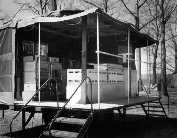
I'm not aware of anyone who's purchased an U.S. Army surplus mobile kitchen trailer (MKT in army parlance) to use in a commercial venture. The design of the culinary war-fighting platform makes conversion to civilian use a difficult issue.
Like military collectors who've restored vintage Army mess trucks, I'm sure there are collectors who've bought the MKT as a collectible. It makes sense when you consider the thousands of trailers that were in service from the 1970s on.
Last week, Ron, a retired U.S. serviceman, posted a comment to an article I wrote on the MKT in June 2006. Although Ron doesn't say so, I suspect that he's a retired Army cook. Here's his question:
You might want to reconsider your plans to use a MKT for street-side vending. I don't believe the trailer will meet code in most U.S. locations without extensive conversion. An used commercial catering trailer or van would serve you better.
Although I'm guessing that you might have more experience on the MKT than I do, the platform wasn't designed with civilian food service in mind. The Army took the existing 2-1/2-ton trailer and added field cooking equipment (mainly the M59 field range outfit with the M2 burner), built in few storage cabinets and and put a collapsing roof over the top.
The lack of on-board lighting, plumbing, ventilation and water storage systems will certainly hinder your plans. The South Carolina health code is going to require on-board lighting, sufficient water storage capacity, sewage holding tanks, hand-washing and food-preparation sinks and adequate refrigeration.
I certainly don't want to discourage you. Your business plans are intriguing. I'd be there to help if I lived in South Carolina.
Talk to your local county environmental health inspectors. They'll be able to guide you in the right direction. It's always helpful to have the local authorities involved in the process from the beginning since they're going to issue the permit.
South Carolina Regulation 61-25, Retail Food Establishments, should help. While I don't know the how South Carolina regulations function in the working world, this paragraph will give you a starting place. Click here to reach the South Carolina food protection program website.
Like military collectors who've restored vintage Army mess trucks, I'm sure there are collectors who've bought the MKT as a collectible. It makes sense when you consider the thousands of trailers that were in service from the 1970s on.
Last week, Ron, a retired U.S. serviceman, posted a comment to an article I wrote on the MKT in June 2006. Although Ron doesn't say so, I suspect that he's a retired Army cook. Here's his question:
Thank you for writing Ron. Your plans are certainly ambitious. But with skill and drive, you should be able to bring you idea to fruition.May name is Ron I am retired military and currently reside in SC. My dream is to Someday open my own restaurant. I am planning on starting small, with a on the go (type) menu that hopefully will lead to catering, and ultimately a restaurant in 5-10 years.
I was hoping to buy at DRMO a used MKT. Has any one done this before? Would like to know what the drawbacks and positives my be.
You might want to reconsider your plans to use a MKT for street-side vending. I don't believe the trailer will meet code in most U.S. locations without extensive conversion. An used commercial catering trailer or van would serve you better.
Although I'm guessing that you might have more experience on the MKT than I do, the platform wasn't designed with civilian food service in mind. The Army took the existing 2-1/2-ton trailer and added field cooking equipment (mainly the M59 field range outfit with the M2 burner), built in few storage cabinets and and put a collapsing roof over the top.
The lack of on-board lighting, plumbing, ventilation and water storage systems will certainly hinder your plans. The South Carolina health code is going to require on-board lighting, sufficient water storage capacity, sewage holding tanks, hand-washing and food-preparation sinks and adequate refrigeration.
I certainly don't want to discourage you. Your business plans are intriguing. I'd be there to help if I lived in South Carolina.
Talk to your local county environmental health inspectors. They'll be able to guide you in the right direction. It's always helpful to have the local authorities involved in the process from the beginning since they're going to issue the permit.
South Carolina Regulation 61-25, Retail Food Establishments, should help. While I don't know the how South Carolina regulations function in the working world, this paragraph will give you a starting place. Click here to reach the South Carolina food protection program website.
Mobile food units preparing food shall have preparation and display areas completely enclosed with a solid material, and doors shall be kept closed when not in use. These units shall be provided with a handwashing lavatory equipped with hot and cold water under pressure, soap and disposable towels, an approved waste water tank, and may prepare such foods as hot dogs, corn dogs, pizza, soft ice cream, and other similar foods approved by the health authority. (Chapter X, Mobile Food Units, page 43.)While you should be able to move forward from mobile vending to catering to a restaurant, I don't think a MKT is the way to go.
Tuesday, June 03, 2008
More on the M-59 army field range
Stan, a US Army cook from the 1980s, left a comment Sunday on my blog post about the M-59 field range for sale on eBay. His experiences seem to morrow mine. As many of you know, I served as a mess management specialist with the US Navy Seabee Reserves from 1979 until my retirement in 1999.
Here are my thoughts, Stan:
Despite the long, exhausting hours in the field, the leaders always had to enforce safety awareness.
 Yes, I remember scraping greasy bread from the bottom of vat cans (Seabee and Marine term for mermites). Toward the end of a two-week exercise at 29 Palms in 1986, I saw a Marine field mess being set up on the perimeter of Camp Wilson. As a boot chief petty officer, I thought I'd walk over and meet the gunnery sergeant in charge of the galley.
As I walked up to the gunny, I saw a maintenance tent with four rows of vat cans -- there must've been over 100 of the rectangular OD green cans in the tent. After quizzing the gunny, I learned the field galley was only feeding 200 Marines and Sailors in camp, all members of regimental headquarters.
The gunny was feeding remainder of Camp Pendleton-based infantry regiment out of the vat cans. Chow was being trucked in the back to 2-1/2-ton trucks to battalion and company positions throughout 29 Palms. The thing you have to understand about Marine cooks is they toss the inserts aside when pouring the meal into the cans.
But I will say this, at the four-hour mark, Navy corpsmen insist that the cook close the lid and return to the galley. They're not going to risk a case of the runs over old food.
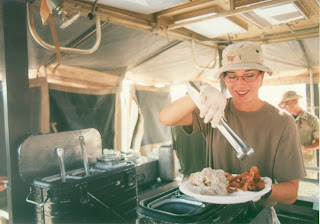
US Marine Corps photo by Cpl. Eric McLeroy. It was taken at Camp Doha, Kuwait, circa 1998.
Here are my thoughts, Stan:
As an Army cook in the 80's I used these units a lot. I forgot all about them till I saw the picture. One thing for sure ... you had to be careful or you could set the whole unit on fire and once in awhile the whole mess tent would catch fire.Safety was our biggest issue in Seabee field galleys. Many military cooks were burned over the 50 or 60 years these burners were used. I remember reading of a cook (in Bosnia, I believe) that stacked two lit M-2 burners on top of each other. The bottom unit heated the top unit to the point of explosion. Fire and the threat of burns was of little consequence when compared to the .223 M-16 ammunition that cooked off that morning in the mess tent.
Despite the long, exhausting hours in the field, the leaders always had to enforce safety awareness.
I couldn't begin to tell you how many gallons of GI coffee I made in those pots, or the gallons of green eggs I would deliver to the guys out at the remote sites on the frozen mornings. They didn't care what color the eggs were as long as the coffee was hot and you had enough food. We would stick slices of bread in the bottom of the mermite cans that carried the bacon to absorb all the grease.My basic formula for field coffee is this: Bring 12 gallons water to a boil in the 15-gallon stockpot. Remove water from heat and sprinkle the contents of a 2-1/2-pound can of coffee grounds over hot water. Let steep until strong enough for crusty, old Seabees. Sprinkle cold water from a #56 dipper over grounds and carefully ladle into a vacuum beverage jug. Make sure you save enough so the equipment operators can have there afternoon coffee in 120-degree heat at 29 Palms.
 Yes, I remember scraping greasy bread from the bottom of vat cans (Seabee and Marine term for mermites). Toward the end of a two-week exercise at 29 Palms in 1986, I saw a Marine field mess being set up on the perimeter of Camp Wilson. As a boot chief petty officer, I thought I'd walk over and meet the gunnery sergeant in charge of the galley.
 As I walked up to the gunny, I saw a maintenance tent with four rows of vat cans -- there must've been over 100 of the rectangular OD green cans in the tent. After quizzing the gunny, I learned the field galley was only feeding 200 Marines and Sailors in camp, all members of regimental headquarters.
The gunny was feeding remainder of Camp Pendleton-based infantry regiment out of the vat cans. Chow was being trucked in the back to 2-1/2-ton trucks to battalion and company positions throughout 29 Palms. The thing you have to understand about Marine cooks is they toss the inserts aside when pouring the meal into the cans.
But I will say this, at the four-hour mark, Navy corpsmen insist that the cook close the lid and return to the galley. They're not going to risk a case of the runs over old food.
US Marine Corps photo by Cpl. Eric McLeroy. It was taken at Camp Doha, Kuwait, circa 1998.
Tuesday, March 11, 2008
We owe a lot to combat veterans
Although two of my ships sailed in and out of Vietnamese waters in 1972 and 1973, I was never directly exposed to combat. So, please understand that I pass this quote on from Lt. Calhoun not as a member of the fraternity of combat veterans, but as a serviceman who has a limited understanding of the sense of loss felt by combat veterans.
It really doesn't matter that Calhoun wrote these words in 1990. I'm sure the events of two and one-half weeks combat on the island fortress Corregidor were permanently etched in his mind. Combat has a way of changing the lives of its participants forever.
Here's Calhoun's description of his deep sense of loss as the 2nd Battalion prepared to leave Corregidor on March 8, 1945:
It's their sacrifice (and that of all veterans before and after World War II) that allow this nation to live and enjoy the freedoms that we hold dear. Thousands of lives have changed just in my 55 years on earth. While our freedoms come from the Constitution and Bill of Rights, it's the serviceman who allows us to keep those freedoms.
Whether fighting the spread of Communism in Vietnam and during the Cold War or fighting terrorists on the fields of Iraq and Afghanistan today, many veterans willing enlisted in a cause they see as greater than themselves. These men and women have set their individual lives aside for a time to willing and voluntarily serve their country.
And many gave their lives so others could live. When you see a veteran today, give him a hug and offer your heart-felt thanks. He or she has been through a lot.
Let me close with this though from Lt. Calhoun from an article titled, "Does it Matter?":
It really doesn't matter that Calhoun wrote these words in 1990. I'm sure the events of two and one-half weeks combat on the island fortress Corregidor were permanently etched in his mind. Combat has a way of changing the lives of its participants forever.
Here's Calhoun's description of his deep sense of loss as the 2nd Battalion prepared to leave Corregidor on March 8, 1945:
For the most part we were happy, and relived, to be leaving this dusty mass of wreckage where death lurked at every turn. Possibly just as great an emotion was intense pride; we had retaken our great fortress marking this event forever as the high water mark of our lives, or at the least ranking with the high water marks. Memories were indelibly burned in our minds for so long as we shall live. Yet not all was joy. We were leaving behind some forty-nine battalion brothers who would never grow old. Even after forty-five years the grief is still there. Another thought which survives the years is the haunting question, why them and not me?As a nation, we owe these veterans the greatest sense of gratitude we can muster. They gave their lives -- even those who survived the 49 who remain on the island to this day.
It's their sacrifice (and that of all veterans before and after World War II) that allow this nation to live and enjoy the freedoms that we hold dear. Thousands of lives have changed just in my 55 years on earth. While our freedoms come from the Constitution and Bill of Rights, it's the serviceman who allows us to keep those freedoms.
Whether fighting the spread of Communism in Vietnam and during the Cold War or fighting terrorists on the fields of Iraq and Afghanistan today, many veterans willing enlisted in a cause they see as greater than themselves. These men and women have set their individual lives aside for a time to willing and voluntarily serve their country.
And many gave their lives so others could live. When you see a veteran today, give him a hug and offer your heart-felt thanks. He or she has been through a lot.
Let me close with this though from Lt. Calhoun from an article titled, "Does it Matter?":
... physical discomforts are superficial which can be laughed at ... later.Enough said ...
It is the mental trials that are seared in the soul. The memory of those young men with whom you served will never end. We were a close team, brothers following orders in every move. Our association was seven days a week. More that that, we company grade officers were required to censor mail--a hated task. I learned their loved ones, their dreams, their fears, their plans for the future, and often their inner thoughts. To some I became father-confessor. As some made the supreme sacrifice, the living became more precious. "Oh, God, don't let them die!" Though that pain began so long ago, it is still here today. The tears still flow and will as long as I draw breath.
Monday, March 10, 2008
Ships that stand on end
After wrestling Corregidor from the entrenched Japanese army, the Second Battalion, 503rd Parachute Infantry Regiment, boarded a division of nimble Navy LCIs on March 8, 1945. The battalion, along with the rest of the regiment, made a combat jump onto the island fortress on February 16, 1945 to liberate the island in Manila Bay.
After nightfall, "the seas became wild. The LCIs seemed to stand on one end and then the other," recounted William T. Calhoun, platoon leader of 1st Platoon, F Company.
The seas were so bad on their overnight voyage north to Mindoro that sleep was not an option. Like sailors have done for centuries, the soldiers found they had to strap themselves into their bunks as a matter of survival. They "tried various means of tying ourselves onto the bunks with out web equipment."
When dawn broke, the soldiers of F Company surveyed their surroundings. Many latched onto any object that would keep them from being thrown overboard. Others bowed their "heads over the side desperately trying to throw up when there was nothing left to throw up."
But this isn't the most interesting passage in Lt. Calhoun's account of the voyage. The Navy cook seemed to be the sickest member of the crew. Here's what the battle-hardened paratrooper had to say:
The lunch menu included hamburgers, French fries and beans -- food that doesn't stay down very long once the ship slams into the first wave.
Through the fog and rain, Grande Island appeared off the port beam as she left Subic Bay. The Cocopa slammed into the the first of a series of breakers. Upon entering the open sea, this tired, old tug sounded as if she would break up any time.
Like the LCI cook, my hands were busy. In a split second, I had a decision to make: grab the copper full of boiling water or the hot oven door. Instead, I ducked for safety.
The Cocopa slammed into the next wave. Hamburgers became lethal projectiles. Pots and pans danced about the deck as spice cans dropped like grenades. My French knife, laying on the cutting board, hurdled towards me as if it were under its own power.
For the next three days, the cooks of the Cocopa produced three meals each day. Surprisingly, many crewmen lined up as soon as the meal was called. I couldn't call in sick even though I was about as sick as the unnamed LCI cook.
But I -- and those 200 sailors and paratroopers on the LCI -- somehow survived. My hat goes off to them.
After nightfall, "the seas became wild. The LCIs seemed to stand on one end and then the other," recounted William T. Calhoun, platoon leader of 1st Platoon, F Company.
The seas were so bad on their overnight voyage north to Mindoro that sleep was not an option. Like sailors have done for centuries, the soldiers found they had to strap themselves into their bunks as a matter of survival. They "tried various means of tying ourselves onto the bunks with out web equipment."
When dawn broke, the soldiers of F Company surveyed their surroundings. Many latched onto any object that would keep them from being thrown overboard. Others bowed their "heads over the side desperately trying to throw up when there was nothing left to throw up."
But this isn't the most interesting passage in Lt. Calhoun's account of the voyage. The Navy cook seemed to be the sickest member of the crew. Here's what the battle-hardened paratrooper had to say:
The galley was particularly noisy. The galley was manned by one cook who prepared meals for the crew. The passengers had to bring their own field rations aboard. In this instance the ship's cook seemed to be the sickest of all, hanging on the chains at the fantail.Calhoun's story is reminiscent of my own experience in the South China Sea 27 years later as a cook on the USS Cocopa. Calhoun continues:
I don't think he really cared if he hung on or not- a fall into the deep might bring on the peace of Davy Jones's Locker and end all this misery. A look into the galley disclosed the source of the noise. A large frying pan with associated utensils was bouncing from wall to wall. Raw eggs had hit the walls and run down to the floor. Evidently the cook held on long enough to get several eggs into the pan ready to cook when he was overcome, dropped everything and headed for the fantail. The old salts were not happy with this land-lubber who had yet to gain his sea legs. They were hungry.I feel for that cook. My typhoon came in July 1972 as the Cocopa shipped out of Subic Bay for Da Nang, Vietnam.
The lunch menu included hamburgers, French fries and beans -- food that doesn't stay down very long once the ship slams into the first wave.
Through the fog and rain, Grande Island appeared off the port beam as she left Subic Bay. The Cocopa slammed into the the first of a series of breakers. Upon entering the open sea, this tired, old tug sounded as if she would break up any time.
Like the LCI cook, my hands were busy. In a split second, I had a decision to make: grab the copper full of boiling water or the hot oven door. Instead, I ducked for safety.
The Cocopa slammed into the next wave. Hamburgers became lethal projectiles. Pots and pans danced about the deck as spice cans dropped like grenades. My French knife, laying on the cutting board, hurdled towards me as if it were under its own power.
For the next three days, the cooks of the Cocopa produced three meals each day. Surprisingly, many crewmen lined up as soon as the meal was called. I couldn't call in sick even though I was about as sick as the unnamed LCI cook.
But I -- and those 200 sailors and paratroopers on the LCI -- somehow survived. My hat goes off to them.
Sunday, November 11, 2007
Chow Time in Iraq
A tribute to U.S. Army cooks serving our nation on this Veteran's Day ...
 Pfc. Emril Getscher, a cook for the 15th Infantry Regiment's 1st Battalion, serves mashed potatoes to Spc. Brendan Murphy, a medic at Combat Outpost Cleary, Iraq.
U.S. Army photograph by Sgt. Natalie Rostek.
 Pfc. Emril Getscher, a cook for the 15th Infantry Regiment's 1st Battalion, serves mashed potatoes to Spc. Brendan Murphy, a medic at Combat Outpost Cleary, Iraq.
U.S. Army photograph by Sgt. Natalie Rostek.
Friday, March 16, 2007
Army Chefs from Fort Bliss Claim Title
FORT LEE, Va. - Soldier-chefs from Fort Bliss, Texas claimed the Installation of the Year title at the 32nd Annual U.S. Army Culinary Arts Competition.
Fort Bliss team members and winners in other categories were recognized at an awards ceremony held today concluding the two-week long competition.
Team U.S. Army, Europe placed second followed by Fort Stewart, Ga. rounding out third in the Installation of the Year competition. This year's competition was extremely close with less than 2/10ths of one point deciding this year's winners.
Winners in the other major competition categories were:
Fort Bliss team members and winners in other categories were recognized at an awards ceremony held today concluding the two-week long competition.
Team U.S. Army, Europe placed second followed by Fort Stewart, Ga. rounding out third in the Installation of the Year competition. This year's competition was extremely close with less than 2/10ths of one point deciding this year's winners.
Winners in the other major competition categories were:
- Senior Army Chef of the Year: Staff Sgt. Nolan Kniss, Team Pentagon
- Junior Army Chef of the Year: Pvt. 1st Class Robert Capazzi, Fort Bliss, Texas Field
- Cooking Competition: 1st - Fort Bliss, Texas; 2nd - Fort Bragg, NC; 3rd - Team Hawaii
- Student Team Skills Competition: Team Korea
- Best Exhibit Cold Food Buffet: Staff Sgt. Monica Roberts, Team Korea
- Best Exhibit Hot Food Shown Cold: Sgt. 1st Class Bryan Nixon, Fort Bragg, N.C.
- Best Exhibit in Pastry and Confection: Pvt. 1st Class Robert Capazzi, Fort Bliss, Texas
- Best Exhibit in Culinary Showpiece: Spec. Laron Smith, Fort Bliss, Texas
- Special Judges Award Most Artistic Centerpiece: Spec. Laron Smith, Fort Bliss, Texas
- Best Team Buffet Table Exhibit: Team Korea
- Best in Class - Contemporary Cooking: Master Sgt. Mark Morgan, Fort Benning, Ga./75th Ranger Regiment
- Best in Class - Contemporary Pastry: Spec. Leia Heeter, Team Europe
- Best Two Member Team, Nutritional Hot Food Challenge: Team Europe Baron H. Garland
- Culinary Knowledge Bowl: 1st - Team Alaska, 2nd - Team Hawaii, 3rd - Fort Carson, Co.
- Best Centerpiece in Ice: Sgt. 1st Class David Russ, Sgt. 1st Class Andre Rush and Cpl. Robert Lough, Fort Bragg, N.C.
Friday, November 10, 2006
Pull Tab and Eat
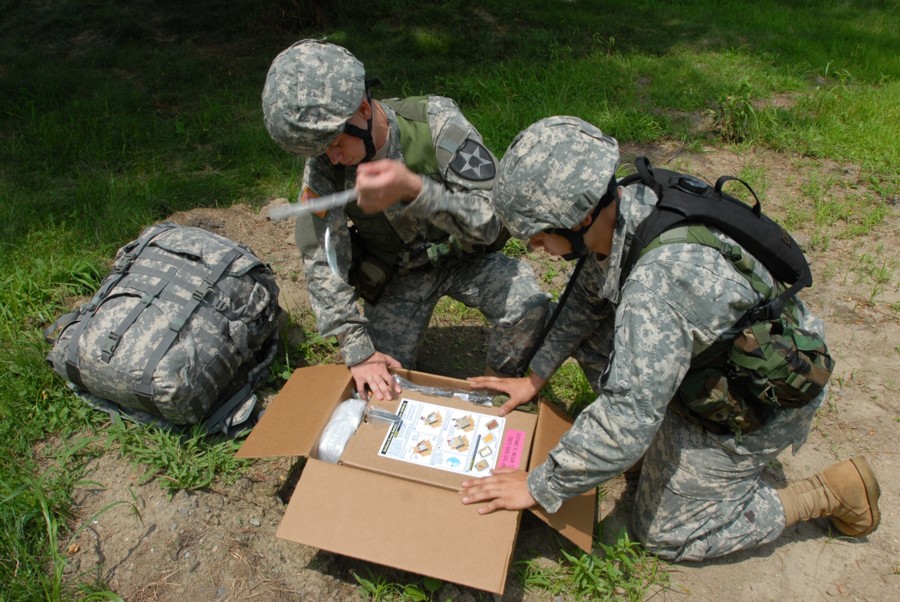 Soldiers pull a tab to activate the Unitized Group Ration-Express. UGR-E modules serve hot meals for up to 18 warfighters without requiring kitchen equipment, cooks, fuel or a power source.
Photo credit: Sarah Underhill, October 23, 2006.
Friday, October 20, 2006
Navy Culinary Specialist 'Stirs' Interest in Cooking for Yokosuka Students
By Tim Shannon, Commander, Fleet Activities Yokosuka Public Affairs
YOKOSUKA, Japan (NNS) (10/11/2006 ) -- Senior Chief Culinary Specialist Lester Griffith, of U.S. Fleet and Industrial Supply Center Yokosuka, has volunteered his time since Sept. 25 to teach local students the finer points of preparing select dishes.
Griffith teaches shipboard Sailors how to cook, but he is volunteering some of his time to teach middle school students at Department of Defense Dependant School Yokosuka Middle School the way to cook almond chicken and stir-fry vegetables, among other dishes.
"This is a great opportunity to help in the community," said Griffith.
His visits to the middle school are intended as a break from the students' normal classroom instruction and as a way to show them the career options for a chef. He also answers their questions about educational opportunities and life in the Navy.
Sherri Thomas, 8th grade family-consumer science teacher, said this is a great benefit to the students.
“Many of my students are truly interested in becoming chefs in the future. Many of our DoDDS high schools offer culinary programs. This is a great way to prepare them for that program if they are still interested when they reach high school,” said Thomas.
Griffith, along with Army food inspector, Sgt. 1st Class Tampa Transou, also of U.S. Fleet and Industrial Supply Center Yokosuka, conduct most of the preparations before class starts so they can focus their classroom time on teaching the students cooking and plate presentation.
Zachary Cooper, a student in the class, said he was impressed with Griffith.
“He’s cool. He looks like one of those people on ‘Master Chef’ or something,” Cooper said.
In addition to learning actual cooking techniques, the students learned about food preparation, food safety, knife handling and sanitation.
"Having Sgt. 1st Class Transou here was a great opportunity," stated Thomas. "The students were given a lab safety and sanitation test a few weeks ago. She made sure that they were on their P’s and Q’s in the sanitation department."
Many of the students shared their creations with their teachers and principals and received rave reviews. Griffith said that he enjoyed the experience.
"The kids did great. The job was done to perfection," he said.
YOKOSUKA, Japan (NNS) (10/11/2006 ) -- Senior Chief Culinary Specialist Lester Griffith, of U.S. Fleet and Industrial Supply Center Yokosuka, has volunteered his time since Sept. 25 to teach local students the finer points of preparing select dishes.
Griffith teaches shipboard Sailors how to cook, but he is volunteering some of his time to teach middle school students at Department of Defense Dependant School Yokosuka Middle School the way to cook almond chicken and stir-fry vegetables, among other dishes.
"This is a great opportunity to help in the community," said Griffith.
His visits to the middle school are intended as a break from the students' normal classroom instruction and as a way to show them the career options for a chef. He also answers their questions about educational opportunities and life in the Navy.
Sherri Thomas, 8th grade family-consumer science teacher, said this is a great benefit to the students.
“Many of my students are truly interested in becoming chefs in the future. Many of our DoDDS high schools offer culinary programs. This is a great way to prepare them for that program if they are still interested when they reach high school,” said Thomas.
Griffith, along with Army food inspector, Sgt. 1st Class Tampa Transou, also of U.S. Fleet and Industrial Supply Center Yokosuka, conduct most of the preparations before class starts so they can focus their classroom time on teaching the students cooking and plate presentation.
Zachary Cooper, a student in the class, said he was impressed with Griffith.
“He’s cool. He looks like one of those people on ‘Master Chef’ or something,” Cooper said.
In addition to learning actual cooking techniques, the students learned about food preparation, food safety, knife handling and sanitation.
"Having Sgt. 1st Class Transou here was a great opportunity," stated Thomas. "The students were given a lab safety and sanitation test a few weeks ago. She made sure that they were on their P’s and Q’s in the sanitation department."
Many of the students shared their creations with their teachers and principals and received rave reviews. Griffith said that he enjoyed the experience.
"The kids did great. The job was done to perfection," he said.
Subscribe to:
Comments (Atom)


