Showing posts with label railroads. Show all posts

Saturday, August 23, 2014

A culinary car for the El Dorado Western Railroad?

The El Dorado Western Railway Foundation purchased this tool car from the Richmond Pacific Railroad in December 2011. It has intrigued me since then. I've often talked about converting it into a culinary car for the El Dorado Western Railroad, which operates on eight miles of the old Southern Pacific Placerville Branch rail line between Shingle Springs and Diamond Springs.

It's a natural desire in my informal role as the the railroad chef. Several times each year, I host a track-side meal for railroad volunteers. My last such meal occurred in November last year, when I prepared pork chili with guajillo chili adobo, cheesy butter milk biscuits and berry cobbler for the bridge crew. My hope is that my winter schedule will allow me to cook for the crew more frequently during my home season.

A dedicated culinary car would improve conditions for cooking on the railroad. I'm not saying that the complete car has to be remodeled into a galley on wheels. There's plenty of room for rail tools and equipment on the starboard side. It would give me a mobile platform to transport the two-burner stove, ice chest, Dutch ovens and utensils.

I could easily work with the port side of the tool car. That's the side with the shallow tool box. The side with the deeper tool cabinet can be used by the maintenance crew. The pictures describe how I intend put this plan into action.

This is the port side of the Richmond Pacific Railroad tool car. Of two tool cabinets, this one reaches about two-thirds of the way across the deck. The open space leaves sufficient room to mount a two-burner Camp Chef propane stove. The ice chest can be set in the center space for transport. The center section would then be used as a Dutch oven table. This would keep burning coals off the ground when at the work site. 
This is the starboard side of the tool car. There is enough space to mount a small generator, air compressor or water tank. The tool cabinet can be used to secure tools and equipment.
The A end of the tool car. This is the forward end. It will normally be the end that is coupled to the gang car, locomotive or trackmobile. 
The B end of the tool car. There is plenty of storage space on top of the tool cabinet, plus room to hang hoses, chains and other large tools.

Sunday, March 06, 2011

What's a railroader to do?

We found the Rogue Express Coffee two and one-half years ago on a trip to Washington for a family reunion. After camping at the Valley of the Rogue Campground in July 2008, I found the Rouge Express Coffee "caboose" in Rogue River, Oregon.

We made a return visit this morning on a trip to Canby, Oregon. Leaving home at oh-dark-thirty, we I guided the pick-up truck onto the "coffee caboose spur" some six hours later at 8:30. The coffee was a refreshing pick-me-up midway through our 10-hour trip.

The coffee caboose is located on the Central Oregon and Pacific Railroad. The railroad purchased the Siskiyou line between Eugene, Oregon and Weed, California from the Southern Pacific in the mid-1990s. Rogue River is located on the Roseburg Subdivision of the railroad.

Friday, December 24, 2010

Hogger on the Placerville rail line

Hogger is the traditional term for a locomotive engineer. According to one story, engineers were the best paid on the train crew. It's said they ate better (and more!) than the conductors and trainmen. It sorta goes hand-in-hand with being a chef, doesn't it?

Today I have my first chance to operate the El Dorado Western Railway No. 1 locomotive on the historic Placerville Branch rail line in the town of El Dorado, California. While the 15-minute run doesn't make me a card-carrying hogger, it was the first step toward certification as a locomotive engineer.
The 18-ton switcher and I share a birth year! Constructed by Plymouth Locomotive Works of Plymouth, Ohio, in 1952, the El Dorado Western Railway received it from the CertainTeed Corporation in Chowchilla, California last Friday.

Wednesday, December 08, 2010

Not all railroad work is work

On Saturday, the El Dorado Western Railway participated in the Town of El Dorado's Gold Rush Christmas. It was a relaxing day after working on the track for the past seven Saturdays. Instead of cutting brush or wielding a shovel all day, Jacob and I enjoyed a pancake breakfast with railroad buddies at the El Dorado Community Hall.

Put my granddaughter in a moving vehicle and she's sound asleep! She's drifting into dreamland as she watches her reflection the speeder's taillight. It's as if she has a built-in dimmer switch. Turn the engine on and her eyes glaze over in an instant.

My wife Debbie and our granddaughter pose for a portrait as the speeder returns to El Dorado. Since her first ride in October, Nevaeh has asked when she could ride the train gain.

Twice I was able to take the Camino, Placerville and Lake Tahoe Railroad No. 4 speeder out for a spin between the old SP depot site and Blanchard Road to the east. Click to read an article on the operation of the speeder.

Saturday, November 20, 2010

A railroading letdown

While stopped at the Q Street railroad grade crossing in mid-town Sacramento yesterday afternoon, I waited for the train to appear.

No roar from of a pair of EMD diesel-electric locomotives or train horn warmed me of an approaching train. I wondered if the crossing gate had malfunctioned.

After several minutes a lone Union Pacific hi-rail truck rambled up the Sacramento Subdivision, the old Western Pacific line that slices mid-town Sacramento in two between 19th and 20th streets.

The crossing arms on P Street dropped then shot back up as if the signal grew impatient. As he approached the crossing, the driver braked to give the gates time to activate again.

It was a railroading letdown. Like the scene in one of the Lethal Weapon films, I expected a northbound freight to come barreling up the tracks, right on the bumper of the hi-railer!

In the photograph, a Union Pacific Chevy hi-rail maintenance-of-way pickup truck escorting a Dakota Helicopters spray rig through the Sacramento Amtrak depot in May 2006. Dakota Helicopters & Air Service is a company that specializes in railway vegetation management.

Sunday, October 31, 2010

Labor savin' backhoe

You appreciate the value of heavy machinery after devoting the past two Saturdays to working on the railroad. In the photograph, Bob McCormack of Placerville excavates a drainage ditch alongside the historic Southern Pacific Placerville Branch rail line near the Town of El Dorado. Bob operates M&M Performance, an auto repair and engine rebuild shop in Diamond Springs, with his son, Jeremy.

Tuesday, October 19, 2010

Please respect trains

I rode the Gold Line from mid-town Sacramento to the Hazel Station this evening. While the train was stopped at the University/65th Street Station, a westbound train slowly approached the station.

Several people must've ran between the two trains because the operator of my train gave this warning in a stern voice over the intercom:

"There is a train coming (on the track) beside me," warned the operator. "Please do not run in front of it."

I share her concern. Approaching trains kill and maim thousands each year. Many of these accidents occur at grade crossings.

Although I don't know the extent of Sacramento Regional Transit Anthority light rail safety record around its stations, I frequently see pedestrians darting around operating trains.

I'm reminded of a similar incident in 2007. As I waited for my evening bus home, I watched a young teenage pedestrian jump a coupler on the Blue Line at 8th and K Streets.

While these incidents didn't result in an accident, they're a stark reminder of what can happen when someone tries to outrun an approaching train.

Next time you see a train coming, please wait. You'll be rewarded with life.

I borrowed the image from an Amtrak conductor who's known as El Cobrador on Flickr.com. Steve and I routinely share photos and information on local railroad operations.

Thursday, October 07, 2010

Three hands

Saturday morning, El Dorado Western Railway President Keith Berry instructed volunteer Cal Jessiman to give me a refresher course on the operation of the CP< No. 4 speeder. I last ran the track inection car two years ago at an open house on the site of the then proposed railway park in the Town of El Dorado.

Keith wanted my son Jacob and me to make several training runs between the El Dorado and Blanchard crossings while he picked up additional equipment at the county museum.

I followed as Cal detailed the protocol to start the speeder. "This is going to take three hands," explained Cal. I soon leaned what he meant.

To operate the Kalamzoo speeder, grip the clutch lever with your right hand and grab the brake lever with your left hand, said Cal. Then somehow, use your "free hand" to control the throttle.

As Cal explained the process, I rehearsed the emergency braking procedure in my hand and with my hands. Better to simulate disengaging the clutch and engaging the brake now than to fumble through it when a worker walks onto the tracks in front of the moving speeder.

To start the engine, set the brake and place the transmission in neutral, instructed Cal. Turn the key, while gently nudging the throttle forward until the engine catches. Next came the tricky part -- throwing the transmission into gear and proceeding without stalling the engine.

Cal continued. Disengage the clutch with your right hand, shift the transmission into low range and slowly let the clutch out. This is wear the three handed operation comes into play.

I slowly guided the clutch until the transmission was firmly engaged. At the same time I had to be ready to give the engine gasoline to keep it from cutting out. With my left hand on the brake, I slipped the clutch, slowly reduced pressure on the brake and gave the engine one-third throttle -- it worked!

The speeder only jerked once or twice. Two longs on the horn and we were off for the El Dorado Road crossing. (Two long toots on the horn tells railroad workers that you've released the brakes and are proceeding forward.)

Once we were rolling westward on the Placerville Branch, I asked Cal about the origin of his three hands tag. "You know, that sounds a lot like something Keith would say."

"That's exactly what Keith was telling me (yesterday)," said Cal. "You need three hands to do this." Cal operated the speeder for the first time Thursday.

Twenty-three minutes later the run ended. We arrived at Hagen's Crossing, a dirt driveway that crosses the tracks about one-quarter mile east of the railroad depot site. It was time to pass the throttle to the next operator.

Jacob jumped into the operator's seat. A bit apprehensive about the process, he motioned with his hands as I walked him through it.

"Wear gloves," I said as I guided him through the process. "The engine throws off a lot of heat. Keep your left hand on the brake and your right on the clutch and your eye on the road."

It was up to Jacob to figure out how to manage the throttle!

Saturday, October 02, 2010

Learning to drive

My son Jacob learned how to operate a speeder car on the Placerville Branch rail line today. Jacob and I joined a work crew from the El Dorado Western Railway at the site of the El Dorado County Historical Railroad Museum in the Town of El Dorado, California.

The Camino, Placerville and Lake Tahoe Railroad No. 4 speeder rolls into the old Southern Pacific Railroad depot site at El Dorado during a November 2008 open house. Also called a track inspection car, railroads used speeders to inspect the track and quickly shuttle work crews on the rails. Pick up trucks with flanged rail wheels replaced speeders in the 1990s.

Thursday, September 30, 2010

Drivin' spikes


Drivin' spikes
Originally uploaded by SeabeeCook
When the El Dorado Western Railway drives spikes, it does so the old fashion way. Maul in hand, railway volunteer Ben Cunha takes his turn at driving a railroad spike on the Southern Pacific Placerville Branch last Saturday.

Railway crews are currently replacing missing spikes by manually driving them into the tie with a sledge hammer. Once the crew becomes proficient in the use of a sledgehammer, it will graduate to the traditional spike maul, a large double-sided sledge hammer with long, thin heads.

Thursday, September 23, 2010

PG&E No. 35 trolley car near White Rock Road

The Pacific Gas & Electric Trolley No. 35 picked up railroad workers near the White Rock Road grade crossing as it prepared to return to Hampton Station on Sunday, September 19, 2010. The El Dorado Western Railway came close to putting its Whiting Trackmobile to work on the Placerville Branch line. Around 2:30 p.m., an official from the Folsom Rail and Transportation Festival stopped by our booth to ask if the Trackmobile was available to recover the trolley as it had stalled on the tracks just north of White Rock Road.

We were told that the trolley's power supply had failed and the vehicle that was going to tow it back, a Regional Transit Unimog hi-rail truck, had jumped the rails. Event organizers thought that the Trackmobile was the ideal recovery vehicle. To effect the recovery, plan was for Keith Berry to drive it south on Old Placerville Road to the site, mount the rails between the Unimog and the trolley and tow it to a point where crews could repair the generator.

In the end, our services weren't needed. But it would've been a photographer's dream to see the El Dorado Western No. 601 Trackmobile towing the PG&E No. 35 back to the northern terminus.

Like EDWR's Trackmobile, the trolley was one of unique artifacts at the Folsom Railfest. It required an alternate source of electricity for the event since the Placerville Branch doesn't have overhead power lines. Normally, the trolley is more at home on the Regional Transit rail lines, where it draws electricity from overhead power line through the trolley pole.

Photographer Philip S. Rose provided some insight into the operation of the trolley in the Village Life newspaper: "To power the vintage rail conveyance, Railfest organizers rented the huge generator being towed behind. (Folsom, El Dorado & Sacramento Historical Railroad Association) member Bob Morrison built a rectifier to convert the AC to DC power for the old streetcar."

The trolley was used throughout the weekend event to give paid rides to the public. The PG&E No. 35 was built in 1913 by the American Car Co. PG&E ran it on its Sacramento City Lines until 1934, when it was retired.

"In 1999, Sacramento Regional Transit purchased a beautifully restored trolley (PG&E 35) from the California Trolley & Railroad Corporation in San Jose," according to the Railway Preservation Resources (RPR Consulting) website page for Sacramento. "The car had been completely rebuilt in the late1980s as part of group of seven immaculately restored trolleys for operation in San Jose. Car 35 is operated on special occasions over a portion of the Light Rail system in the downtown area."

An interesting fact about the trolley is that it carries two road numbers. When restored, the car operated as the San Jose Railroad No. 129. The No. 35 wasn't available and it was renumbered 129, the next available number for the railroad. When Regional Transit purchased the car, a representative told us that the purchase agreement required them maintain the car's No. 129 identity.

Conductor Eric Olds of Folsom, punches a passenger's ticket on an afternoon trolley run on Saturday. Eric is a member of the Folsom, El Dorado & Sacramento Historical Railroad Association. He frequently operates their Skagit No. 30 speeder as the motorman.

Saturday, June 26, 2010

Speeder run on the Placerville Branch


Fairmont A-6 gang car
Originally uploaded by SeabeeCook
Last Saturday, the Folsom, El Dorado and Sacramento Historic Railroad Association (affectingly know as the FEDS) sponsored a speeder run on the old Southern Pacific Placerville Branch for its members. My son and I joined the ride as representatives of the El Dorado Western Railway, which is developing the El Dorado County Historical Railroad museum in the town of El Dorado, California.

We put on the tracks at the Southern Pacific freight depot at Shingle Springs and rode to the end-of-track at Missouri Flat Road, near the site of the Diamond Springs depot and interchange with the former Diamond and Caldor Railway.

Here, the FEDS Fairmont A-6 gang car stands ready for passengers for the afternoon run.

Sunday, April 19, 2009

UP No. 844 rolling in to Roseville yard

Keith Berry and I drove over to Roseville to view the Union Pacific No. 844 roll into town for the weekend.

The large Northern-type was the last steam locomotive built and delivered to the UP. With a 4-8-4 wheel arrangement and massive 80-inch drivers, the locomotive was used in fast passenger train service from 1944 to 1957. It then spent its last days in active service pulling freight trains.

The Union Pacific saved the engine from the scrapper's torch in 1960. It now tours the country as a living legacy to the days of steam.

The 844 is one of 45 Northerns built by the American Locomotive Company for the UP. Of the four reamining Northers, the 844 is the only one that steams under its own power.

Thursday, December 27, 2007

Old Rail Never Dies

Blog no. 27 brings a lesson in recycling ...

I suppose you could say, "Old rail never dies. It gets reused."

Several feet of old railroad rail, presumably salvaged from the Camino, Placerville and Lake Tahoe Railroad, were fashioned into an iron retaining wall. The wall supports the built-up roadbed around a culvert. This retaining wall won't rust away soon.

Maintenance of way crews fabricated the wall from discarded rail. Railroad mechanics were masters at reusing old materials laying around the shop. It fit their operating model to scrimp, save and repair everything without spending a dime.

I'd say this wall, when amortized over the years, this wall will cost less than a penny per year!

Tuesday, December 25, 2007

A Step Back in Time

We're hiking on the old railroad in blog no. 23. There are no more ties to count on the old Camino, Placerville & Lake Tahoe right-of-way. Soon I'll stop counting the blogs of December.

Trails like the El Dorado Trail fascinate me. Hiking gives me a chance to collect my thoughts and peer into the thick understory. And it's a wonderful walk to enjoy with my wife.

My love of history sometimes shades my view of the trail. It's the evidence of human interaction with the environment that draws me. Each rusted hulk of an iron culvert or rotting railroad tie supplies endless hours of exploration along the trail.

As we hiked the grade, it was easy to picture one of the railroad's two 70-ton Shay geared locomotives pulling a consist of empty cars to the mill in Camino.

The Shay wouldn't have broken any speed records up the grade, which reached five percent in places. Like the turtle in the children's story, the locomotive pulled the grade with a slow, steady pace. Set in perpetual granny gear, the engine always made it to the top.

Ditches, old roads and any foundation or rotting trestle timbers help me visualize the lay of the land. I can trace a railroad right-of-way through the forest, making judgements as to its likely route.

This is really walking relaxation -- much like my love of driving forest roads -- that helps me unwind from the events of the day.

We'll come back to the El Dorado Trail often. This is the first time we've hiked the trail in our 14-year residence in El Dorado County. Often, the best outings are located in your backyard.

Even though the path fascinates me, with its connection to the short line that wound its way up the hill on a 1,900-foot climb from Mosquito Road in Placerville to the old Michigan-California lumber mill in Camino, it also gives me time to walk with Debbie and enjoy the outdoors.

Tuesday, October 30, 2007

Room with a View

The cupola to the Camino, Placerville and Lake Tahoe Railroad's only caboose stands empty on a pleasant fall day. I'm sure the brakeman and conductor admired the fall colors along the eight-mile line between Placerville and Camino. The subdued yellow oaks with the occasional bright red tree helped the crew pass the time as the train rambled up the grade to the mill.

The gutted standard-gauge caboose sits in front of the El Dorado County Historical Museum in Placerville.

Shot settings: f/16, 1/60 second shutter speed, 30 mm focal length, ISO 200 in aperture priority.

Saturday, May 06, 2006

Catch a Freight

Yesterday, I walked over to the Union Pacific tracks and Amtrak station for my afternoon break. I though that I might catch a freight train during my 15-minute respite from dollar signs and numbers.

Instead, I caught this Chevy highrail maintenance-of-way pickup truck escorting a Dakota Helicopters spray rig. Dakota Helicopters & Air Service is a company that specializes in railway vegetation management.

Friday, April 21, 2006

Railroad Photographs

I've taken up a new hobby -- railroad photograph. Take at my favorite rail blog -- Dogcaught.com --if you enjoy railfan pictures.

With a new Canon Digital Rebel EOS 350D in hand, I'll be featuring some of my photographs in the coming months. Until I can get out into the countryside, I'll display pictures in and around the Sacramento Amtrak depot and the California State Railroad Museum.

Although my office location is handy for such photography -- I work a block from the depot -- ultimately I'll have to locate some more picturesque locations. I may even drive into work once or twice a month and stop along the tracks on the commute home.

Amtrak engine 2007 pulls westbound Train 537 for San Jose. This engine is one of 14 EMD F59PHI locomotives purchased by the California Department of Transportation for use on the Capitol Corridor and other routes.
 
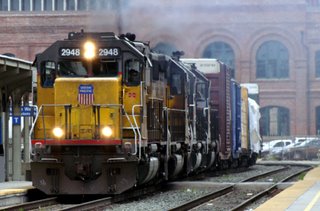
Union Pacific 2948, an EMD SD40-2TR, leads three other locomotives as the westbound freight rambles through the depot on track 3.
 
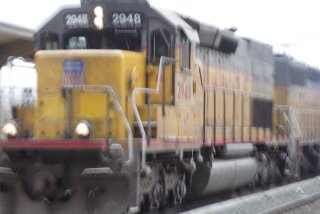
Here's what happens when you use the wrong setting on the camera. The automatic setting set the shutter speed much too low for my telephoto lens. I had a shot of the San Joaquin 701 arriving on track 2 as the UP roared by on track 3. Next time.