Showing posts with label Chef Steven. Show all posts

Friday, October 03, 2014

Meet the camp cook

You may have noticed the new menu bar just under the masthead. It currently lets you quickly access the homepage and contact information for 'Round the Chuckbox. I just posted a page titled, "Meet the camp cook." In the future, I plan to add one or two more links to the menu bar, including a description of my services as a camp cook. Enjoy ...

Therefore, whether you eat or drink, or
whatever you do, do all to the glory of God”
1 Corinthians 10:31

Sauteing fajitas at Upper Blue Lake, Eldorado National Forest, Calif.
I've long envisioned myself a nineteenth century camp cook. I can see myself cooking for an El Dorado County ranch as it drove cattle drive to summer pasture in the Lake Tahoe basin each spring. Everything about the job appeals to me: family atmosphere, outdoors and good old country cooking.

Chuckwagon cookin' in the rain
Yet, I've one problem: I was born 50 years too late. And I grew up in Fresno and Bakersfield. Those who know me will tell you that I'm a city boy who’s loved the Sierra Nevada high country ever since his father carried him to Peter Grub Hut in 1954.

I’ve only ridden a horse three times in the last forty years and have never driven a chuckwagon or fed a beef-centered diet to cowboys on the Western prairie. Nor have I piled flapjacks onto chipped enamel plates meant for hungry Sierra Nevada lumbermen or slopped biscuits and gravy on trays for a railroad gang.

At this point in my forty-year cooking career I could never call myself a “wagon cook.” While I've cooked in the shadow of one or two chuckwagons, it takes a special breed of cook to wrangle pots like Ramon F. Adam's “Sultan of the Skillets.”

The first time I cooked near a chuckwagon was at Leonard “Wagon Cook” Sander's 50th birthday bash in December 2002. Since that experience – cooking Dutch oven scalloped potatoes and baking bread in driving rain on a porch – I’ve only had the honor to view a couple other chuckwagons.

Seabee cooks of NMCB-17
I prefer Seabee Cook, a moniker earned after years of service in the U.S. Navy Construction Battalions. Like the wagon cook, who was at home on the range, feeding Seabees was special skill developed over a two-decade-long career in the Naval Reserves. I was known as the “field mess guru” during my tour with the 3rd Naval Construction Brigade and Pacific Fleet Seabees.

My large chuckbox, stained in a reddish hue and built to impeccable detail, draws folks to my camp. Since 2001, it has been the signature item in my camp cooking reparatory. Like the back end of the chuckwagon, the chuckbox has become the center point of my camp kitchen.

While the label of wagon cook may be something to aspire, I can only accept the moniker “chuckbox cook” (somehow “box cook” doesn't run off the tongue like Seabee Cook). I'll certainly answer to camp cook any day of the week. The title has an unpretentious ring to it. It's as if you’ve described me as a cook who harkens back to a simpler time, one born in the wrong century.

The chuckbox
For years I compensated on our annual camping trek to the Sierra Nevada Mountains. I lived out a week-long fantasy each summer. You'd think I was fixin’ to feed a crowd of hungry hunters and fishermen. My outfit carried enough cookware to feed a baker's dozen or more. Give me a canvas A-framed cook-tent, a swamper and hungry outdoorsmen that appreciate good old camp grub, and I'm in the right setting.

In the end, my life will have spanned the back end of one century and front end of another, far removed from the glory days of the chuckwagon. As a retiree, I’m free from the day-to-day drudgery of a career. I now can pursue my life-long ambition to be a camp cook.

Each spring, my lovely bride and I journey to Oakland Feather River Camp in Quincy, Calif., where I’m the camp cook and chef for three and one-half months. Around the time I tire of 12-hour days and six-day work weeks, we return home to eight months of relaxation. I’m then free to cook for the El Dorado Western Railroad or camp at my leisure.

Artisan bread in camp
I bake bread in cast iron camp ovens just to give it away. While my camp may not always lodge under canvas, family and friends benefit from camp cuisine. Those that eat vittles ‘round the chuckbox share in my forty-year quest to replicate the life of a camp cook.

Welcome to my camp. From one camp cook to another, enjoy ‘Round the Chuckbox, where we cook delicious camp meals in frying pan, Dutch oven and grill. Cook with passion and “Come an’ Get It” will draw hungry diners to your chuckbox. Give thanks to God, settle into flavorsome grub and take pleasure in good companions.

MSCS Steven C. Karoly, USN, Retired
Camp cook and editor of ‘Round the Chuckbox

Monday, September 08, 2014

Shallow vs. deep camp oven

Chef Steven with three shallow
and two deep camp ovens at
Leonard "Wagon Cook" Sanders'
50th birthday celebration in Oroville,
California, December 2002.
Selecting the right pan or pot is as much a science as cooking the meal itself. Capacity and shape are important features to consider when selecting a cast iron Dutch oven. Each  plays an important role in how the dish cooks in the pot. Cast iron ensures even cooking, slow transfer of heat to the product and heat retention in the pot. And its well-developed patina helps the cooking surface resist sticking.

The question being asked here is whether you will use a regular or shallow Dutch oven or a deep model? The popular manufacturers cast Dutch ovens in both sizes. Lodge Manufacturing, for instance, produces a line regular and deep camp ovens in 10-, 12- and 14-inch diameter pots.

The Lodge deep 10-inch camp oven holds one additional quart of volume and is five-eighths-inch deeper than the shallower model. The Lodge deep 12- and 14-inch camp ovens each hold an extra two quarts and are one and one-quarter inch deeper. The deeper ovens feature a narrower base.

Camp Chef also manufactures a line of deep camp ovens in 10- and 12-inch diameters. Their camp ovens are made to similar specifications used by Lodge. Lodge uses the term “camp oven” to differentiate ovens made for outdoor cooking from home-style Dutch ovens.

The added height and capacity of the deeper camp ovens provides extra headroom. This lets the outdoor cook prepare fit larger roasts and poultry into the Dutch oven without being cut into smaller pieces. Deep ovens are also useful for bread baking, stewing and frying.

When considering the type of Dutch oven to use, look at the pan or pot you’d use for a recipe inside the home kitchen. You want to select the Dutch oven that best fits that profile. For instance, a layered dish, like lasagna, works best inside the wide, flat confines of a regular oven while a rib roast can only fit in a deeper oven.

The regular or shallow camp oven is best used for any recipe that benefits from the shallow pan with a wide base. Use for rolls, biscuits, cookies and cakes; casseroles, lasagna and other layered dishes; small cuts of meat, fish and poultry; etc. The wide base also makes a better skillet than the narrow base of the deep camp oven.

Cakes are best baked in a regular Dutch oven. The shallow oven and wide base more closely mimics the shape and size of a standard round aluminum cake pan. This allows for even baking while maintaining moderate depth in the cake.

As explained above, the deep camp oven is best when you need extra depth for large cuts of meat and poultry, loaves of bread, or any dish where you want the extra headroom. The also make good bean pots. The narrow base lets you concentrate heat and moisture around pieces of meat and vegetables, thus minimizing the likelihood of the dish drying out. Use the deep oven for stews and soups as well.

For meat and poultry, the size of the piece determines the oven to use. A whole chicken, for instance, requires a deep oven because of its size and structure while several smaller Cornish hens should neatly fit inside a regular oven. Cut-up chicken (individual pieces or quarters) works best in a regular oven where the wide base and shallow headroom allow for even heat distribution and cooking.

Next time you want to cook in a Dutch oven, consider whether a shallow or deep oven is best for the dish. While it's possible to interchange these ovens (as I have done many times), consider the advantages of each oven. The deep camp oven is best reserved for dishes that neatly fit inside its deep profile. The same hold true for the shallow oven.

Sunday, July 20, 2014

Roast eye of round at camp

I menu roast beef at Oakland Feather River Camp every week or two. I have been using the eye of round (IMPS/NAMP 171C) for five years now. It can usually be purchased at a reasonable price, slightly above $3 per pound when purchased in a 54-pound case. Each case holds six to eight individual roasts.

You can also purchase the eye of round at the local cash and carry restaurant supply house. I purchased it at Cash and Carry on Richards Boulevard, Sacramento, California, when I worked in midtown Sacramento. The store currently sells the roast for $3.22 per pound for a five-pound average roast.

I like the roast because it cooks quickly and gives a reasonably tender serving to the camper. The cylindrical shape of the roast yields a consistently round serving when sliced on the meat slicer. I don't use a recipe for the roast, but will describe my process:
  1. Trim fat and silver skin on the roast. I generally leave a quarter-inch of fat on each roast.
  2. Rub each roast with a light coat of canola oil. Then rub kosher salt, coarse ground and granulated garlic.Place in roasting pan.
  3. Brown roasts in pre-heated 450-degree convection oven until browned, 20 to 25 minutes.
  4. Pull pan from oven and reduce oven setting to 200 degrees. Turn roasts over. Add a bit of water or stock to pan if the drippings have dried.
  5. Cover pan and return to the oven. Roast until roasts reach desired temperature. At camp I pull them when the internal temperature reaches 145 to 150 degrees. This gives you a nice, evenly colored roast.
  6. Rest meat 10 to 15 minutes. Slice on meat slicer to desired thickness. I prefer it on the thinner side. This lets campers take as many slices as they desire without impacting portion control. Each six to seven-pound roast yields 20 to 25 (4-ounce) servings at Oakland Camp.
  7. Prepare gravy or au jus as desired from the drippings.


I find that it's best to slice the roast using a meat slicer. The slicer gives you consistently sized pieces. It also helps maximize the slices from each roast. 

Sunday, July 13, 2014

Horse ridin' chef

Please do not think that I'm a seasoned horseman as I guide Samsonite into the corral. I just appear to know what I'm doing. I spent a good part of the hour-long ride trying to convince him that I'm the chef and he's the horse. Yet, Samsonite is a good steed. I look forward to riding him again before Debbie and I leave for home next month.

Saturday, July 05, 2014

Raising the ensign, year two

For the second year, I was selected to lead Independence Day ceremonies around the camp flagstaff. The honor has fallen to the chef for the last several years. The ceremony has special meaning to me as a retired U.S. Navy senior chief petty officer. The raising of the ensign at 8 o'clock in the morning was always a memorable time of day.

During the ceremony, I discussed protocol surrounding raising the ensign (the U.S. Navy term for the Stars and Stripes), read the Resolution of the Continental Congress of June 14, 1777 and led campers in the Pledge of Allegiance.

Wednesday, June 04, 2014

Chef under pressure

Credence Clearwater Revival song melting in the CD player? Oven alarm sounding? It's not a problem for this chef. Note his steady hand as he calmly sprinkles sugar and cinnamon over the baked apple pancake.

Monday, April 14, 2014

Comments on 'Round the Chuckbox

I turned Google+ comments off today on 'Round the Chuckbox. As a result, the original comment form is once again visible at the end of each article. You may post a comment by typing it into the comment box and clicking the publish button. Your comment will be visible as soon as I approve it.

You may have noticed that you were forced to establish a Google+ profile in order to post a comment. This happened when I switched to Google+ comments last September. It sounded nice at the time. However, I quickly learned that the blogger commend mechanism was shut down in the process. Plus I lost the ability to moderate comments.

The most noticeable result of using Google+ comments was the sudden drop in comments. While 'Round the Chuckbox has never inspired a flood of comments, readers have had their moments. Every month or so an article would inspire interactive conversation.
You'll notice that Google+ comments from the last seven months have disappeared. Please return and comment if you'd like to re-join the conversation. Comments on 'Round the Chuckbox are subject to moderation, as they were prior to September. I'll approve comments for publication as quickly as I see them. (Please note that I delete spam and inappropriate remarks.)

Thank you for being a loyal 'Round the Chuckbox reader. I appreciate your readership and would love to see a vibrant exchange of ideas on the blog.

CSCS Steven C. Karoly, USN, Retired
Chef-blogger on 'Round the Chuckbox

Tuesday, March 18, 2014

Raising the ensign

During the 2013 camp session, I was selected to lead the Independence Day ceremonies around the camp flagstaff. I am told that the honor has fallen to the chef for the last several years. As a retired U.S. Navy senior chief petty officer, the ceremony had special meaning to me. The raising of the ensign at 8 o'clock in the morning was always a memorable time of day.

At Oakland Feather River Camp, the emcee gives a brief talk on the historical significance of the 4th of July, raises the flag and leads campers in the Pledge of Allegiance. Afterwards we sing America The Beautiful, then adjourn for a fun afternoon of games and field activities. (Of course, culinary staff return to the kitchen to finish the barbecue!)


Tuesday, December 03, 2013

No mixer, no problem

Last Saturday I catered a banquet for the San Jose Youth Shakespeare in the Bay Area. With an ambitious menu at hand, I began meal production with rosemary-garlic dinner rolls at 12:30 in the afternoon. After unloading the equipment, food and supplies into the kitchen, I setup the scale, opened the bag of bread flour and began measuring.

With over 20 pounds of flour, along with yeast, salt, sugar, egg, oil, herbs and water to mix, I'd normally knead the dough in a 20-quart stand mixer. However, the kitchen at the rental hall was not equipped with one. With a large bus tub, I mixed the dough by hand. The pictures tell the rest of the story.

All in ingredients were weighed into a 20 by 15 by 7-inch bus tub. The formula called for 100% bread flour, 6% sugar, 4% chopped fresh parsley, 4% minced garlic, 2% instant yeast, 2 % kosher salt and 1% dried rosemary for the dry ingredients. I used 20 pounds 5 ounces flours as the basis for the dough. Click here for a discussion on baker's percent.

After pouring in about 55% water, 16% egg and 8% olive oil, I mixed the dough by hand. It took several minutes for the dough to come together.

After the dry ingredients were thoroughly mixed into the wet, I cleaned my hands and let the dough rest for 10 minutes. This lets the flour begin to absorb moisture and hydrate.

I started others on separate projects before working on the dough. My niece learned how to dice 10 pounds of yellow onions as another (to my right) set up the buffet area. As the dough came together, I folded the corners into the center of the bus tub. And two gallons of apple cider reduced on the range behind me.

Once the dough was workable, I turned it out onto the bench and continued kneading.

I could only fold the dough 10 to 15 turns before it was too stiff to handle. I gave the dough a 10 to 15-minute rest between kneading sessions. I then divided the dough in half and set each piece in a bus tub to ferment.

Once the dough fermented 90 minutes in an out-of-the-way corner of the kitchen, it was all hands on deck to cut and mold individual rolls. This process took around 30 minutes. We produced 455 rolls Saturday. The diners ate 2 rolls each on average.

Friday, February 05, 2010

1,000 articles and counting ...

While one-thousand blog articles in five years may not form the basis for an earth shattering record, it's a significant milestone for me personally. 'Round the Chuckbox represents my longest running writing project.

Prior to the establishment of 'Round the Chuckbox on February 4, 2005, my average writing project would fall apart in its second year. I was beginning to worry if I had it in me to stick with one project for the long term.

I pulled the plug on each of a dozen projects for various reasons. Lack of capital forced me to cease publication of my most ambitious project in early 1999.

I published the Seabee Log, a journal that "celebrated Seabee wit and ingenuity through history," between 1997 and 1999.

Some, like the Seventeen Stewburner, a quarterly newsletter for the cooks of Naval Mobile Construction Battalion 17 in 1992 and 1993, came to a close when I moved on to my next assignment.

But most projects fell for less valid reasons. I usually lost interest and quit writing or contributing to the project around the 18-month mark. That's what happened when Suite101.com stopped paying its contributing editors in 2001.

When I conceived the idea for 'Round the Chuckbox in late 2004, my concern was that I'd loose interest sometime in 2006. Another writing project would fail.

But something happened. Writing for 'Round the Chuckbox. I posted a steady stream of blog articles for the next eight months. Even after my productivity fell off in the winter, I surprised myself.

I kept writing and posting recipes. I currently have no plans to let 'Round the Chuckbox die a premature death. I'll keep writing as long as I'm able.

'Round the Chuckbox has become a natural extension of my work as a chef and cook in the world of non-commercial food service. I enjoy cooking for residential populations (like my current position in a drug-alcohol treatment program).

As long as I'm able to cook and write, I trust that you'll continue to find the blog interesting. Please drop a note. I'd always enjoy hearing from my viewers.

Thursday, February 04, 2010

5th anniversary

Today marks the fifth anniversary of 'Round the Chuckbox. And I'll post my 1,000th blog article tomorrow, which is the fifth anniversary of my first blog article. See you then.

In the meanwhile, enjoy a photograph of me that was taken last summer at Deer Crossing Camp.

Friday, September 11, 2009

Fifteen minutes of fame

Andy Warhol said in 1968, "In the future, everyone will be world-famous for 15 minutes." I'm not certain that I obtained world notoriety. But I may have gain a bit of regional fame in the Sacramento Bee this morning.

Bee writer Cathy Locke interviewed Keith Berry, myself and the crew at the engine house of the El Dorado Western Railway on Wednesday. We enjoyed the opportunity to tell the California capital region about the recently approved El Dorado County Historical Railroad Park in the town of El Dorado.


Enthusiasts hope El Dorado rail park is just around the bend

By Cathy Locke, Sacramento Bee writer
Published: Friday, Sep. 11, 2009, Page 3B

El Dorado Western Railway Foundation volunteer Steve Karoly talks about the Shay No. 4 behind him. It is the last of the locomotives from the California Door Company's logging railroad. Bought in 1907, the engine was retired in 1952 after years of hauling logs for the Diamond and Caldor Railway. (Sacramento Bee photograph by Anne Chadwick Williams.)

An old locomotive, screened by a chain-link fence and a row of trees, is easy to miss at the El Dorado County Historical Museum in Placerville.

But volunteers have labored for years in the storage yard to restore vestiges of an industry and an era nearly as important to the county as the Gold Rush. By next spring, their handiwork may be on view in the El Dorado County Historical Railroad Park.

The park, to be developed within a former Southern Pacific Railroad right of way in the town of El Dorado, will spotlight the county's logging railroads. [Continue reading]

Click here to view the photo gallery.

Wednesday, July 04, 2007

Camp -- Spoon Licking Chef

A note to all aspiring camp cooks: Only the camp chef is authorized to lick the country gravy spoon!

Saturday, September 03, 2005

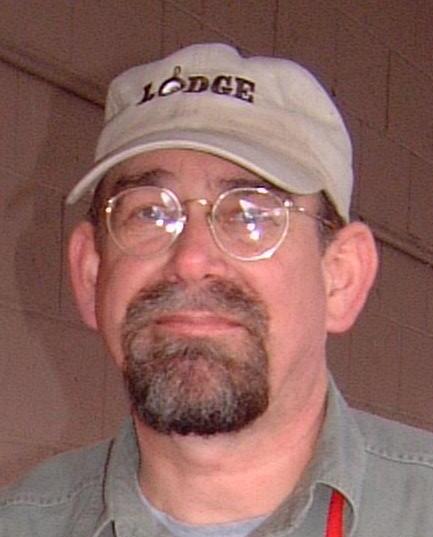
New Photo for Profile

I've uploaded a new photo of myself. The one was taken at camp last July.

Monday, February 07, 2005

May Your Campfires Sizzle

I re-wrote the Blogger profile this afternoon as promised -- it's much better.

Just in case you can't get enough of me, here's a few thoughts that explain what 'Round the Chuckbox is all about.

I've always envisioned myself as a nineteenth century camp cook. I would've loved cooking for an El Dorado County ranch as they made their annual cattle drive to summer pasture in the Lake Tahoe basin. Everything about the job appeals to me: family atmosphere, the outdoors and good old country cooking.

I've got one problem: I was born 50 years too late. And I grew up in Fresno and Bakersfield.

Those who know me will tell you that I'm just a city boy who's loved the Sierra Nevada high country ever since my father carried me to Peter Grub Hut in 1954.

The closest I came to camp cooking was feeding Seabee construction warriors during a 20-year stint in the Naval Reserve.

That's me, CSCS Steven C. Karoly, USN, now retired. My assistant, CSC Bob Voigt, stands behind me. The food service officer of Naval Mobile Construction Battalion 17 is to my right. The photo was snapped during Operation Bearing Duel at Fort Hunter Liggett, June 1994.

I haven't ridden a horse in over 30 years, and I've never driven a chuckwagon or fed a beef-centered diet to cowboys on the Western prairie. Nor have I piled flapjacks onto chipped enamel plates meant for hungry Sierra Nevada lumbermen.

That's what happens when I take my family camping in the Eldorado National Forest where I live out a week-long fantasy each summer. You'd think that I was prepared to feed a crowd of hungry hunters and fishermen.

I carry enough cookware to feed a baker's dozen or two. Just give me a white A-framed cook-tent, an assistant or two and outdoorsmen who appreciate good old camp cooking and I'm in my environment.

Steve's Café, located just south of the Visalia, California airport, on Hwy 99.

Friday, February 04, 2005