Showing posts with label camp 2005. Show all posts

Sunday, May 28, 2006

Lessons From a Week-Long Children's Bible Camp

Last year I posted my thoughts on operating a kitchen at a children's Bible camp. Each summer, I chef for the Northern California Florida College Camp, which meets at Daybreak Camp in Felton, California for one week. I'll blog on preparations for the 2006 session as we get closer to our July 2 start date.

I started telling you about my preparations for food service at camp in April 2005 . My blogs shared my thoughts on running a kitchen for a weeklong children's camp. They're based operating a stand-alone kitchen where you plan the menu, purchase food and cook meals for the week only. Several points won't apply to a camp kitchen that operates all summer because you can hold excessive stock from one week to the next.

Second Set of Lessons from Week-Long Bible Camp, Part 9--Get ready to go home.

Second Set of Lessons from Week-Long Bible Camp, Part 8--Walk the ground.

Second Set of Lessons from Week-Long Bible Camp, Part 7 -- Document your extensive knowledge base as chef.

Second Set of Lessons from Week-Long Bible Camp, Part 6 -- Service is not a four-letter word.

Second Set of Lessons from Week-Long Bible Camp, Part 5 -- Thank your staff.

Second Set of Lessons from Week-Long Bible Camp, Part 4 -- Hire sufficient cooks and dishwashers.

Second Set of Lessons from Week-Long Bible Camp, Part 3 -- Think about where you're going to shop.

Second Set of Lessons from Week-Long Bible Camp, Part 2 -- Purchase ready-to-cook food and keep the menu simple.

Second Set of Lessons from Week-Long Bible Camp, Part 1 -- Don't neglect the spiritual aspect of camp.

Lessons From a Week-Long Children's Bible Camp, Part 7 -- More purchasing tips.

Lessons From a Week-Long Children's Bible Camp, Part 6 -- Check your list twice.

Lessons From a Week-Long Children's Bible Camp, Part 5 -- Service and signature menu ideas.

Lessons From a Week-Long Children's Bible Camp, Part 4 -- Five a day is a noble goal.

Lessons From a Week-Long Children's Bible Camp, Part 3 -- Children and adult leaders enjoy salads.

Lessons From a Week-Long Children's Bible Camp, Part 2 -- Keep the campers hydrated.

Lessons From a Week-Long Children's Bible Camp, Part 1 -- Your mission is to feed children, nothing more.

Friday, August 12, 2005

Apple Crisp for a Crowd

Sharilyn posted this message over at Growlies Recipe Exchange and Party Planning Board this morning:

Have you ever used can apples for [apple crisp]? I need to make it for about 300 people and I would like to use canned apples. Pease let me know if canned apples would work ... I would appreciate your reply thanks.

Sharilyn

=====<<>>=====

Here's the recipe that I use at camp each summer for the Tuesday night cookout. This recipe is adopted from the U.S. Armed Forces Recipe Service.

APPLE CRISP

20-3/4 pounds canned apple slices
1/2 cup lemon juice
1 tablespoon lemon zest
2-3/4 pounds sugar
4 ounces cornstarch
3 tablespoons ground cinnamon
1 tablespoons salt
3 pounds brown sugar
1-1/4 pounds rolled oats
1-1/4 pounds all-purpose flour
1-2/3 tablespoons baking powder
1-3/4 tablespoons baking soda
1 tablespoons salt
2 pounds butter, softened

Arrange 4-1/2 quarts apples in each full-sized sheet pan greased pan. Sprinkle juice and zest over apples. Combine granulated sugar, starch, cinnamon and salt. Sprinkle half sugar mixture over apples in each pan.

Combine brown sugar, rolled oats, flour, baking powder, baking soda, salt and butter. Blend flour mixture to form a crumbly mixture. Sprinkle an equal quantity of the mixture evenly over apples in each pan.

Using a convection oven, bake at 350 degrees F for 30 minutes or until top is bubbling and lightly browned on low fan, open vent. Cut each pan 6 by 9. Serve with serving spoon or spatula. Serves 108.

Notes: Use 3 #10 cans sliced apples per 100 portions. Use two 18x26-inch sheet pans per 100 portions. Three lemons will yield 1/2-cup juice. Two pounds flour (total) may be used in place of rolled oats.

Monday, August 08, 2005

Camp -- Qualities of a Good Kitchen Crew

Here are a few areas where the 2005 Northern California FC Camp kitchen crew excelled.

I was encouraged late in the week when the two new couples told me that they're definitely returning for 2006 camp. And I have a maybe from another person. That'll give the kitchen crew four on year number five, two on year three and four or five on year two. I may have all eleven crew members back for 2006.

Sanitizing all work surfaces: The crew learned early in the week to spread a thin coat of quat sanitizer solution over all food contact surfaces. I believe that this is an extension of our concern for bacteria and viruses in the home.

Keeping the salad bar stocked: Every time I asked, "Has the salad bar been restocked," the answer was, "Yes." Wendy, Helen and Alisa kept the salad bar fully stocked for lunch and dinner.

Washing pots and pans: Some has to clean pots and pans. It's a laborious job that must be done three times each day. It's especially important when you realize that we didn't have sufficient pots or pans to function beyond two meals. Both men and women jumped in throughout the day and got the job done. At one point or another all 11 staff washed pots and pans. Phil, Debbie and David were the main pot washers.

Filing the ice water jug: My wife took this task on as hers throughout the week. She's now talking about using two Igloo water jugs next year because the campers suck down water at an insatiable rate during sports breaks.

Keeping busy: I'm blessed with a crew that's willing to work. They usually need someone to get them started. Throughout the week, I often hear, "What can I do next?"

Completing each task: I rarely had to search for volunteers to get the job done. Yes, they took breaks but sometimes it was an issue of kicking them out of the kitchen for a break. I never had to ask, "Where have you been? We have work to do." David and Carol take the prize for spending the most hours in the kitchen. We usually had to push Carol out of the kitchen around 4 p.m.

Concern for food safety: I had a crew who's hearts were in the right place. I believe that this stems from my training on Saturday evening and from the concern that they brought from home.

Saturday, August 06, 2005

Camp 2005 -- The Chef's Role

Camp is now over. We're all home waiting for the 2006 session, which will be July 2 to 7, 2006. I learned last week that for 2006 the camp is being moved back to its original week over Independence Day.

This week has given me time to contemplate my role as chef at a children's camp. The job of camp chef stimulates me like no other. I look forward throughout the year for one week each summer.

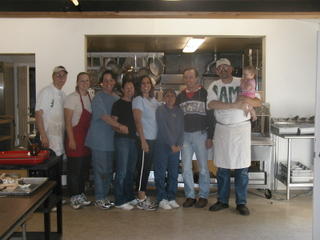
The kitchen crew for 2005 Northern California FC Camp.
I'm looking to turn this experience into a fulltime career once I retire from my current position. A career change will give me the opportunity to work in a small- to medium-sized camp kitchen with a tightly knit staff of cooks and food service workers. I'll be able to get back to my first love (career wise) -- cooking.

I enjoy most aspects of the camp setting. The remote wilderness locations of most camps attract me for sure. But the best part of the job is the opportunity to prepare and serve good food to campers and staff.

So much for my future career plans. Let's turn back for a moment and remember the focus 'Round the Chuckbox has taken over the past two months: Operating a camp kitchen at a weeklong children's Bible camp with a volunteer workforce.

The job of camp chef requires commitment. You're on your feet 12 to 16 hours each day directing volunteers in the kitchen. Most volunteer cooks are unfamiliar with quantity cooking. They don't know all of the finer aspects of producing quality meals for a crown.

As chef, it's your job to lead so you serve the best meals possible. I find that I spend most of my time in the kitchen directing the crew, answering questions about the recipes and making sure that the job gets done for the next meal.

You're the "attention to detail" that many of the volunteers find lacking -- at least in the culinary sense of the word. At any given moment in the kitchen I find myself:
  • Reminding the cook to take the final cooking temperature for the dinner entrée.
  • Stirring a saucepan of béchamel to keep it from scorching.
  • Turning the burner down under the pot of macaroni so it won't boil over.
  • Instructing the salad cook to clean up a spill on the prep table.
  • Rescuing empty #10 cans out of the garbage and reminding staff that we must recycle.
  • Answering the question, "What do you want me to do?" (These words are music to a chef's ears!)
  • Finding someone to take the garbage to the dumpster so we don't have to handle a 150-pound garbage bag.
  • Updating the inventory and writing a few ideas in my notebook for next year.
  • Asking for a "time check" one hour before mealtime (the idea here is to find out the status of all dishes for the next meal).
You're the culinary traffic cop -- not a tyrant, rather a sensible, loving chef that's full of mercy for volunteers. A few burned cookies won't ruffle your feathers, especially when the baker forgot to adjust for the convection oven (something we all missed that morning). As camp chef, you must be kind, patient and tolerant.

Eager volunteers are a blessing. They'll lighten your burden. Volunteers with a good work ethic leave you to planning and directing meal. You'll find that you won't have to cook every dish. Just be there as mentor, culinary counselor and leader. A good crew will carry the day.

Tuesday, August 02, 2005

A Letter from the Bay Area

Here's the second email that I received yesterday. This one's from JT of San Francisco and was sent via the IDOS website.

How did you EVER find the time to create such a GRAND report?
I would have lasted through the (maybe) first day.
I got tired just reading the blog.
VERY VERY well done.
--JT

=====<<>>=====

JT, thanks for your confidence in my ability to produce a blog. I trust your fatigue is simply from the sheer volume of material on 'Round the Chuckbox and not from any over-produced drudgery on my part.

I guess the best way to answer your question is this: I enjoy writing about my vocation of three and a half decades. Its fun and I do get a certain about of self satisfaction from writing.

When 'Round the Chuckbox grows tedious, as it does every month or two, I set it aside for a few days to collect my thoughts. This gives me a chance to cook (something I don't do at work) and to gather fresh material for upcoming blogs.

During my frequent breaks, I inevitably have to answer the question, "Why am I doing this?" I guess that's a question every blogger has to answer at some point. You learn to write, post a few recipes to the blog and enjoy the labor. You're happy if a few dollars flow Amazon.com to your coffers.

Camp cooking journal

The other thing I do is to keep a culinary journal. I've written about it on 'Round the Chuckbox and in the Dutch Oven News several times because it's an excellent way to record my cooking experiences. I'm now into my 17th journal in nearly 20 years. (I started it at camp on Sunday, July 24 and have already filled 60 pages of a 200-page composition notebook.)

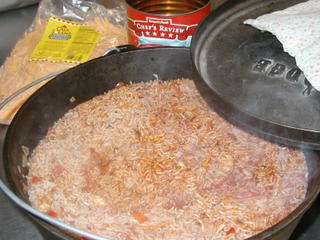
A 14-inch deep Dutch open of Mexican rice for last week's camp. To make the rice in the 10-quart camp oven: sweat 2 chopped onions in bacon fat, add 2 quarts of longgrain rice and brown, add 1-1/2 quarts crushed tomatoes diluted with 1-1/2 quarts chicken broth and season with chili powder, garlic powder, bay leaves and dried oregano. Replace the lid and simmer with hot coals for a 350 degree oven (22 coals top and 12 bottom) until tender. Yield of 8 to 9 quarts of rice is 60 to 70 (1/2-cup) servings.

My original idea for the journal was to records a chronological history of our family camping trips. Consequently, my first journals took multiple years to fill. By 1994-1995 I had filled four notebooks. Since 1996, I've been cranking out one to two books per year.

I use the journal to record what works and what doesn't; what I liked and didn't like about a dish; ideas to improve a dish's flavor; and to create menus. And, if I decide to write a cookbook, I'll already have a score of notebooks bristling with recipes and stories of my culinary adventures.

'Round the Chuckbox is just a natural extension of my culinary notebooks. Thanks for writing ...

Sunday, July 31, 2005

Camp 2005 -- Pot Luck Saturday

Camp finished yesterday with a breakfast "pot luck." This isn't your traditional pot luck where the guests share their favorite dish. At our camp kitchen, the pot luck is designed to empty the refrigerator so that we can go home.

You might say that each staff member is the kitchen was given a chance to show off his or her favorite dish from the week. According to my inventory as we emptied the contents of the walk-in onto the center table, we had no less than 17 items to dispose of. I recorded this inventory in my notebook as we emptied the reefer.

The center table about half-way through our unloading operation.

Here's the tally:

  1. A 2-inch full-sized hotel pan of lasagna from Wednesday dinner.
  2. A half-sized hotel pan of Thursday's brown gravy.
  3. Two soup bowls of ground cooked beef.
  4. 39 grilled hamburgers from the All-American BBQ Friday.
  5. 23 grilled hot dogs from the BBQ.
  6. 8 pounds of raw bacon.
  7. 10 pounds of raw sausage links.
  8. 14 baked potatoes.
  9. 15 pounds seasoned cooked diced chicken from quesadillas Friday (I purchased too much pulled chicken meat).
  10. 10 dozen flour tortillas.
  11. 8 dozen eggs.
  12. A full 4-inch full-sized hotel pan of baked beans from the BBQ.
  13. 13 pounds of shredded cheddar cheese.
  14. 1 quart of barbecued pulled chicken from Thursday's lunch.
  15. A small pan of sauteed onions and bell peppers.
  16. A 2-inch full-sized hotel pan of sliced tomatoes from the BBQ.
  17. A 4-inch full-sized hotel pan of braised red cabbage from Thursday's roast pork loin dinner.

I'm sure that your mind said, "Breakfast burritos!" as you browsed the list. We prepared 100 breakfast burritos from scrambled eggs, seasoned diced chicken, torillas and cheese. They've become a Saturday morning tradition at our camp. I would've made salsa from the tomatoes, but I didn't have enough hot peppers.

From left to right: sausage bacon, hot dogs and bacon; lasagna; barbecued chicken; and SOS.

After making the burritos, we heated everything except the red cabbage and placed it on the tables in the dining room. My staff wouldn't let me serve braised red cabbage for breakfast. (Instead, several of us took it home -- I have two tubs in my home freezer!)

Some of the items were well accepted, burritos included. After a 30-minute meal from 9 a.m. to 9:30 a.m., we found that the bacon, sausage and hot dogs were fast sellers. The kids attacked about half of the lasagna, a few hamburgers, some of the SOS (brown gravy and crumbled beef), all of the fried potatoes (remember the baked potatoes?) and about half of the barbecued pulled chicken.

We saved the Cocoa Puffs and Cocoa Krispies for Saturday because they're so popular. One of the drawbacks of buying the Kelloggs and G.M. variety packs is that the campers tend to favor the sweeter breakfast cereals. They shun healthy cereals like Total, which we also saved for Saturday.
The rest of the meal consisted of dry cereal and milk (we had to buy seven gallons Friday night), fresh fruit, orange juice cartons and a coffee cake made from biscuit mix and canned apples.

Friday, July 29, 2005

Camp 2005 -- Improvising Clam chowder

Using up food stocks is one of the drawbacks of running a kitchen for the week only. Sometimes good planning fails. Other times, kitchen staff uses items for something other than its intended use.

Whatever the reason, it's difficult to make quality clam chowder when someone used the half-and-half for French toast (in this case that someone was me) and the fresh potatoes were used up yesterday.

Improvisation makes sense when it means another trip to the local market. Instead of cutting into camp profits (which go to FC students from Northern California in the form of scholarships), it gives you a chance to reduce some of the excess food.

IMPROVISED CLAM CHOWDER

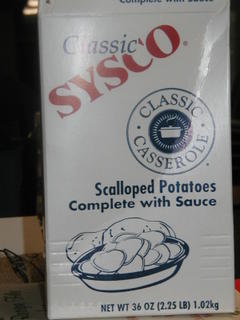
This clam chowder was made using 1 (32-ounce) box of Classic Sysco scalloped potatoes complete with sauce. This product is packaged in a milk carton with dehydrated potato slices andt two packages of sauce mix.


Sweat 4 chopped onions in bacon fat in a 15 to 20 quart stockpot. Meanwhile, crush the contents of a 32-ounce package of scalloped potatoes and add to the stockpot. Pour contents of 2 (46-ounce) cans of clam juice and 3 (51-ounce) cans of minced clams into stock pot. Stir until combined.

Make a slurry from the two packages of scalloped potato sauce mix and add to soup while constantly stirring. Thicken soup with a flour and water paste (about 3 quarts flour to 2 quarts water), storing constantly to avoid lumps. Gently simmer for 45 minutes until thick and creamy.
Just before serving, add 2 quarts milk and bring to serving temperature. Check seasoning. You may not need to add any salt.

Thursday, July 28, 2005

Camp -2005 - Catch Up Day and Bread Pudding

Thursday is "catch up day" in the Northern California FC Camp kitchen. It allows the cooks to catch our breath and deplete some of the leftovers from the previous four days.

Leftovers are one of the 10 plagues of a poorly managed camp kitchen. Children's appetites vary from day to day and year to year. What's popular this year will flop next year. All camp kitchens -- including well-managed kitchens -- must plan to deal with leftovers.

To use most leftovers, we often reheat them to 165 degrees and place them directly on the serving line. Monday we served the leftover chicken tenders as an extra. And today, the French fries from Tuesday went on the serving line at lunch.

But some products, like 32 slices of French toast made from thick Texas toast, can't be re-heated. No one wants to eat leftover French toast. Nor will my culinary conscience won't allow it. So, I baked a hotel pan of bread pudding this morning for the lunchtime dessert.

Overheard in the dining room: Two young boys, both about 10 years old, were going down the self service line, when they came to the bread pudding. "What's that?" asked the first boy. "I don't know," said the second boy, "but if Steve made it, it's gotta be good!"
The boys were right. We only had three servings leftover!

Other leftovers used today: 30 barbecued chicken quarters, meat pulled, left from Tuesday's dinner, mixed with 2 gallons barbecue sauce and 4 sliced onions to create BBQ chicken sandwiches; grilled cheese and luncheon meat sandwiches (leftover bologna, salami and ham from Monday's lunch); and 12 pints of strawberries were used for a special dessert for the Cabin 1 girls (presented to them by the senior boys in Cabin 9).

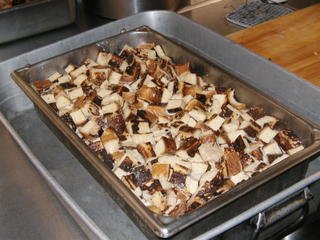
Bread pudding, made from leftover French toast, is ready for the oven. Bake the pudding in a water bath as you'd any custard. Place both pans in the oven, them pour hot water into the larger pan to about one-inch up the side of the bread pudding pan.

BREAD PUDDING

This recipe yields one 12- by 20- by 4-inch hotel pan. Serve the bread pudding with a #10 scoop. Serves 75.

3 pounds white bread
12 ounces butter, melted
3 dozen eggs
3 cups granulated sugar
1-1/2 teaspoon salt
1-1/2 ounces vanilla extract
3-3/4 quarts milk
Cinnamon, to taste
Nutmeg, to taste

Cube bread and place in full-sized hotel pan. Drizzle butter over bread cubes. Mix together eggs, sugar, salt and vanilla extract until thoroughly combined. Add milk and mix to combine.

Pour egg mixture over bread cubes. Let stand, refrigerated, 1 hour or longer, so the bread absorbs the eggs mixture. If necessary, push bread down into pan once or twice after mixture has had time to stand.

Sprinkle top with cinnamon and nutmeg. Set pan in larger pan containing about 1-inch of hot water. Bake in preheated 350-degree oven for 1 hour or until set.

Serve warm or cold. Garnish with whipped cream, fruit puree or confectioners sugar.

Wednesday, July 27, 2005

Camp 2005 -- Salsa

Here's a simple salsa that campers love at FC Camp. I prepare one batch on Wednesday and use the salsa for three meals through the second half of the week.

CAMP SALSA

Use a #10 can of diced tomatoes to build this salsa. I found the Montecito brand salsa style dice tomatoes is a good product to use for this salsa. It's available at Smart & Final. You can use fresh tomatoes if desired. This salsa is mild. You can adjust the heat to suit the camper's tastes.

6-3/8 pounds canned diced tomatoes (1 #10 can)
2 cups onion, chopped
5 jalapeno peppers, peeled, seeded and chopped
1 cup chopped cilantro
5 limes, juiced
2 tablespoons sugar
1 teaspoon ground red pepper
2 tablespoons cumin
3 tablespoons chili powder
1 tablespoon paprika
2 tablespoons dried oregano

Combine canned diced tomatoes or finely chopped fresh tomatoes with onions, peppers, cilantro, lime juice, salt to taste, sugar and seasonnings. Blend well. Cover and refrigerate at 41 degrees F or lower at least 1 hour before serving.

Yield: 3-1/2 quarts.

Camp 2005 -- Sanitizing Solution

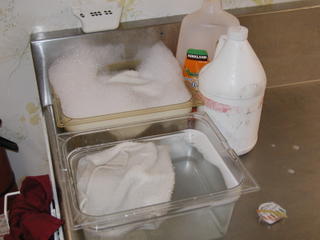
I maintain a sanitation station on the drain board to the pot and pan sinks in the kitchen. Two containers -- one with hot soapy water for cleaning and a container of sanitizer solution -- set on the counter throughout the day.


Both solutions are changed three to four times each day as it's solied. A new solution is made until the end of the day. Fresh towels are placed in each solution. The sanitizer solution is made from quaternary ammonia. "Quat" can be purchased at restaurant supply houses in a one-gallon bottle.

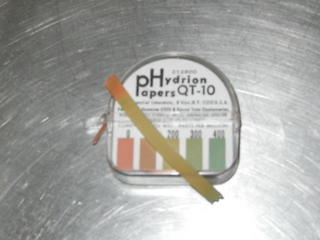
To test solution strength (at 200 parts per million), dip the quat test strip into the solution for 10 seconds. Remove the test strip and compare it to that color chart on dispenser. If you measured correctly, the color will match the color for 200 ppm (olive green on my test strips). Add additional quat to the solution if it reads less than 200 ppm.


Most manufactures instruct you to use 1-ounce for 4 gallons water. However, always follow the instructions on the product label. Test solution after mixing and record the strength (in ppm) on the food safety log. Never increase sanitizer concentration levels above manufacturer’s recommendations due to potential safety hazards to employees.

To use the sanitizing solution, ring the towel dry and wipe the solution on all clean food contact surfaces in the kitchen. A food contact surface is any surface the contacts food in the kitchen. It includes work tables, cutting boards, can openers, serving lines, mixer, meat slicer, etc. When possible, run pots, pans, utensils, etc., through the dishmachine to sanitize.

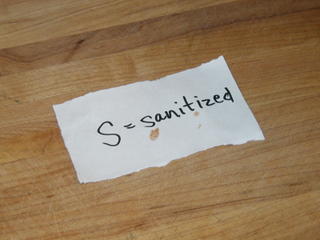
The ladies started marking sanitized surfaces with "S equals sanitized" tags this year.
Tuesday, July 26, 2005

Camp 2005 -- Corn Dogs and Salad Bar Cart

Here are a few additional comments on Tuesday's meals:

Corn dogs and French fries panned and waiting for the meal. I've got to re-think the corn dog meal. It's been on the menu two years now. It's never been well received. This year we panned 288 corn dogs (4 (18-pound) cases from Sysco). The idea was to give each camper two corn dogs. In the end I served about 180. But now I'm faced with about 100 leftover corn dogs. Next year I'll either trim my order considerable or serve something else. Only 30 of the 150 campers took two.

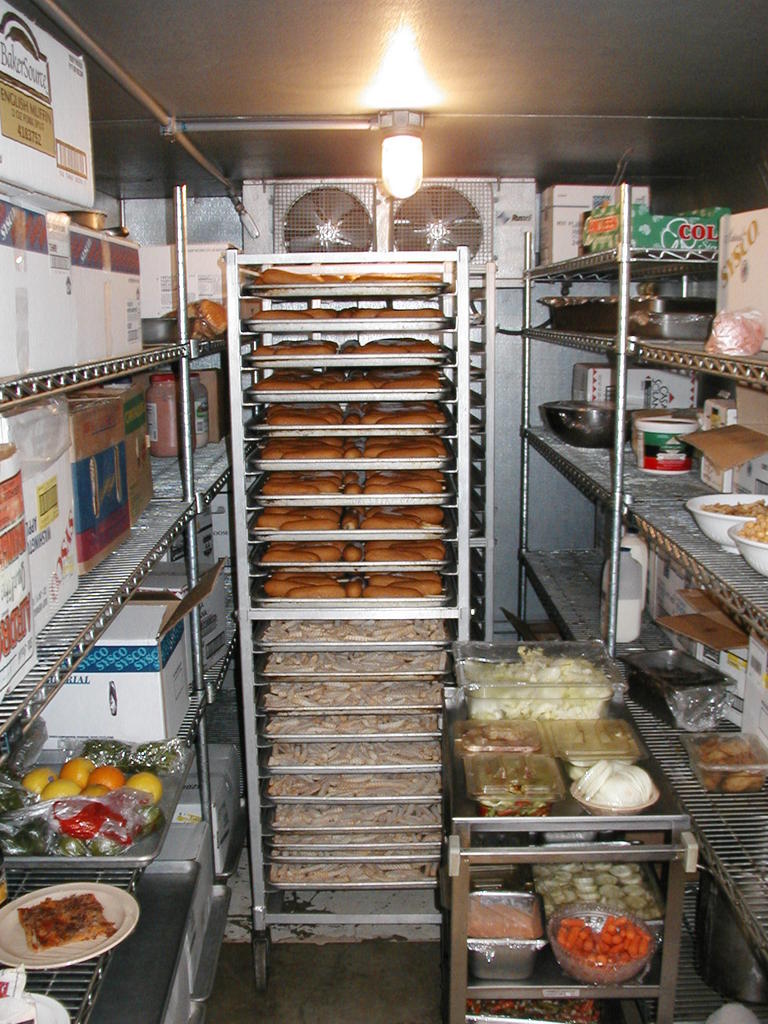
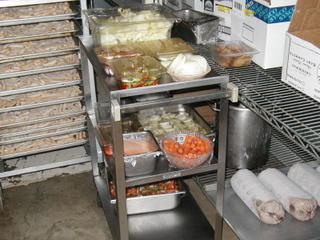
We keep all salad bar items on a cart in the walk-in refrigerator. The cart makes set-up and take-down much easier on our backs and feet. Ground beef for tomorrow's lasagna is thawing on the bottom shelf.

Camp 2005 -- Tuesday's Meals

Here are a few pictures from Tuesday's meals at Northern California FC Camp:

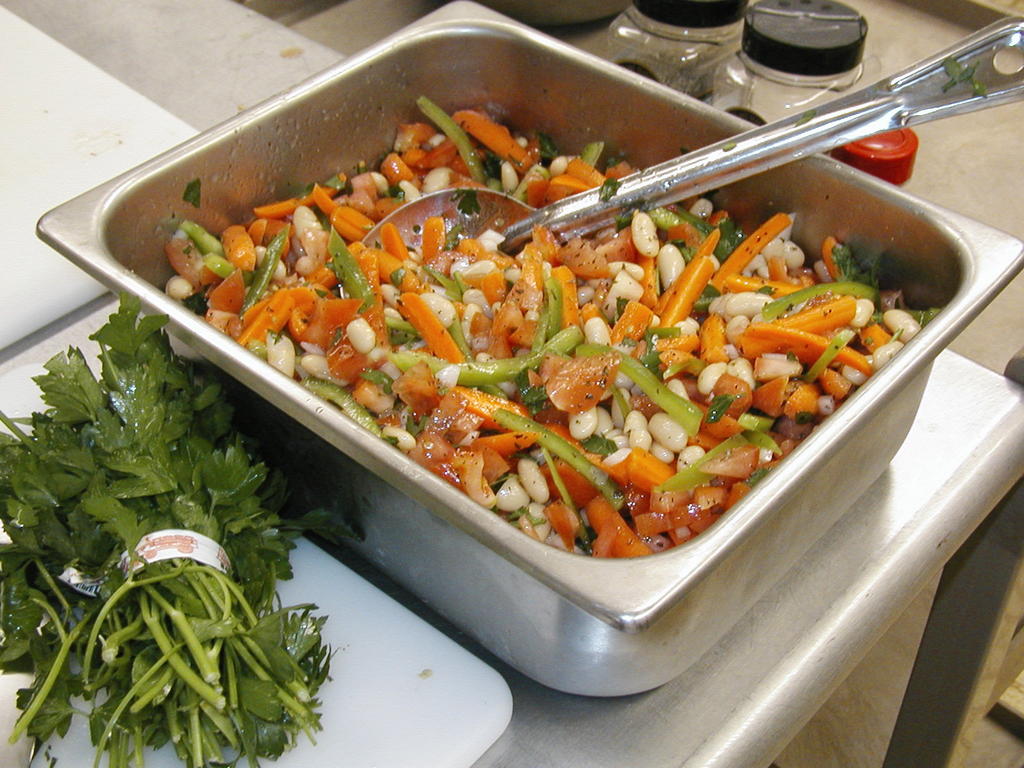
A marinated vegetable salad that we served for lunch today. Today at lunch was the first day that the salad bar filled with salads and condiments. We served the marinated vegetables, sliced cucumber and onions, tuna salad and a tossed green salad.

The vegetable salad included: 1 quart dice tomatoes, 1-pound carrot slivers, 2 green bell peppers, sliced thin, 1-cup chopped parsley, 3 small cans Italian beans, drained and washed. The marinade consisted of 2-1/2 cups of leftover marinade from the tomatoes Sunday evening.

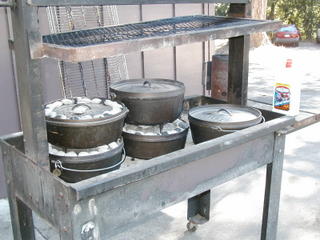
My improvised Dutch oven table. I didn't pack any of my Dutch oven tables this year. To protect the ground and sidewalk, I used the camp's old barbecue pit and a platform for five Dutch ovens. The three regular #14 ovens contain an apple cobbler. I baked scalloped potatoes in the two deep #14 ovens. The deep ovens are the ones with no charcoal on the lid.

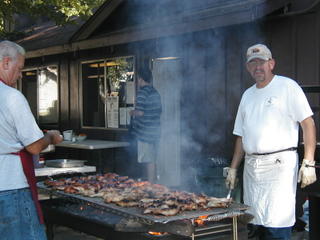
We are grilling chicken on the grill. I use a Sysco 9-ounce chicken hindquarter that comes packed 60 to a case. I par-bake the chicken for 45 to 60 minutes in a 325-degree convection oven to save time and heartache over undercooked chicken. I then the grill the hot chicken for about 10 minutes to give it color and apply sauce.

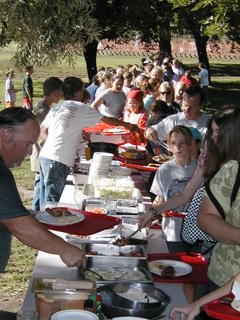
We served tonight's dinner under the trees.

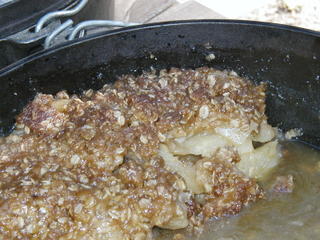
The apple crisp. It takes 1-1/2 (6-1/2-pound) cans of water-packed apples for each #14 Dutch oven. Combine the apples with sugar, cornstarch, cinnamon, lemon juice and lemon zest. Top with your favorite crisp topping and bake for 45 to 60 minutes in a 350-degree Dutch oven.

Monday, July 25, 2005

Camp 2005 -- Monday's Meals

Here are a few pictures from Monday's meals at Northern California FC Camp:

The recipe for macaroni and cheese. I often use the U.S. Armed Forces Recipe Service cards as the basis for my camp recipes.

At lunch, we served tuna salad sandwiches and luncheon meat sandwiches with vegetable soup and macaroni and cheese. I used the basic military recipe today with a good quality pre-shredded cheddar cheese.

Each 4-inch hotel pan holds: 5 pounds macaroni and a scant gallon rich cheese sauce.

We get approximately 7- to 75 servings from a pan with a #10 scoop.


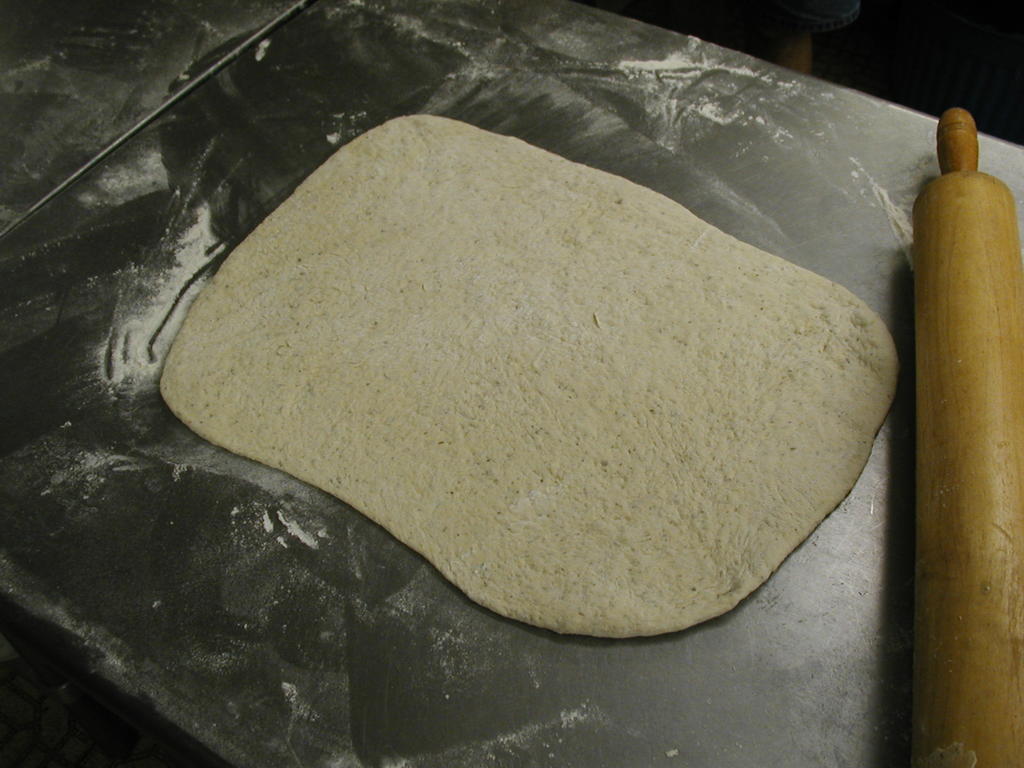
Pizza dough for dinner. For 150 campers, I made 9 sheet pans pizzas. You yield 20 servings per pan when you use the full-sized sheet pan (18 by 26 iches).

In past years, we've baked six or seven pepperoni pizzas. This year we baked a wide variety of pizzas because the local market ran out of pepperoni yesterday.


Here's what we baked tonight:

2 pepperoni pizzas
1 sausage
1 sausage and bacon
1 bacon and black olive
1 chicken pesto (the best in my opinion)
1 cheese
1 vegetarian with onions, bell peppers, tomatoes and olives
A 3/4-sheet with cheese and bacon.

We had 20 pieces leftover before calling seconds. This is the most popular meal during the week. And it's one of the few meals where everyone takes the entree.


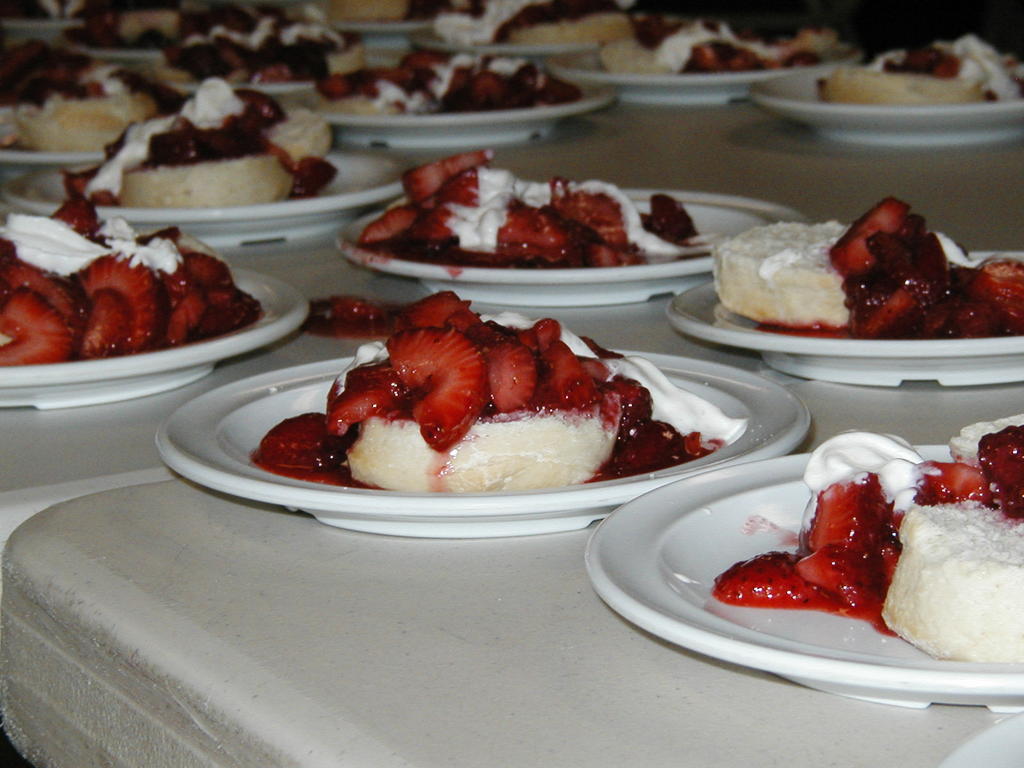
Tonight's dessert -- strawberry shortcake.

Camp 2005 -- Daily Meeting with the Director

Communication is vital to any venture, including a camp. A schedule change that appears simple to the director can impact the kitchen, especially if it means moving the meal up 10 or 15 minutes. I resolve this problem by talking to the camp co-directors throughout the day. This is fairly easy in my camp since I see both directors at each meal.

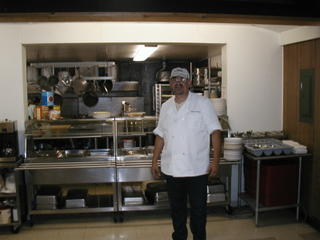
Chef Steve on Sunday evening, running on about five hours sleep and 20 cups of coffee!

I am also on the director's calendar for 10 a.m. each morning. We usually meet for two minutes or so we can discuss the day's progress and the impact of the camp schedule on kitchen. The director is always interested in the performance of the K.P. cabins. Other questions that arise include new campers with unique health issues, purchasing trips to Costco or the local market and special events like picture day for campers and staff.

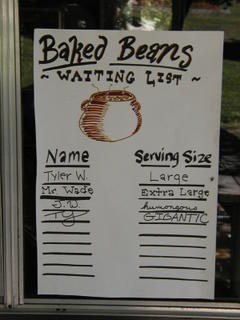
We have fun too! Last year, Tyler, a councelor from the Sacramento area, boldly announced during Fear Factor that he dislikes baked beans. I took care of his mis-guided adversion to Boston's culinary gift to the world by serving him a special bowl of baked beans for breakfast late in the week.

Since one co-director handles logistics at our camp, she's always interested in kitchen budgetary matters and the quantity of food on hand. I’m fortunate in that she doesn't micro-manage. Laura learned four years ago that I'm capable of handling food services for our camp.

I give her periodic updates on the amount of money spent. This is especially important because I need to arrange for reimbursement at the end of camp. The directors do want any end-of-camp budget-busting news.

Tyler's beans wait on top of the serving line each meal.

Sunday, July 24, 2005

Camp 2005 -- Opening Night Dinner

We served our first meal tonight at about 6:30 p.m., after the evening worship. I just confirmed with the registrar about 30 minutes ago that we have 98 campers and 42 staff at camp this years, for a total of 150.

Earlier in the week, when I was given a projected camp census of 135, I decided to purchase food for 150 campers and staff. I knew from past experience that we'd have 10 to 15 walk-ins during our afternoon registration.

This year my projection worked to my advantage. I purchased enough food to feed 150 for the next week. This is one of those areas where you'll be the camp's savoir if the numbers fall to your advantage.

However, it can backfire on you. Just remember that there are many factors that drive camp attendance, like the weather, competing activities, family vacations, etc. Over the years, I've developed a sense of projecting food purchases for these type of events. Although I'm never that far off, I still over- and under-project for some items.

Menu

The menu for Sunday evening, opening night of camp:

Chicken tenders (2 each, about 3-1/2 ounces)
Barbecue sauce
Oven roasted potato wedges (3 wedges)
Buttered broccoli (1/2 cup)
Tossed green salad with vegetable toppings
Marinated tomatoes with basil
Brownie with vanilla ice cream
Milk, punch and iced tea

Chicken tenders -- We panned four (10-pound) boxes onto nine 18- x 26-inch sheet pans. That's about 45 servings per box.

Barbecue sauce -- we used 1/2-gallon of bottle BBQ sauce tonight.

Oven roasted potato wedges -- We washed and cut 50 pounds of U.S. No. 1 bakers this afternoon. I counted about 54 wedges per sheet pan. The cooks melted butter and pour it over the potatoes. They seasoned them with salt, pepper, garlic and paprika and baked them in a 350-degree convention oven for about 30 minutes.

Broccoli -- We steamed 15 pounds of broccoli. Surprisingly, about 50 percent of the kids took my favorite vegetable.

Marinated tomatoes and basil -- We used 15 sliced tomatoes this evening. At the end of the meal I had the salad cooks save the leftover marinade for tomorrow's tomatoes. The marinade keeps growing in flavor as the week progresses.

Tossed green salad -- It took about 6 pounds of salad mix to feed 150 campers and staff. We also used 1-1/2 pounds baby carrots, 1-1/2 peeled and sliced cucumbers, 1 each sliced red and green bell peppers and radishes. It takes about 6 cups of ranch dressing for each meal. Although we place creamy Italian and 1,000 island dressings on the salad bar, very few folks use them.

Brownies with ice cream -- It took 110 brownies and 3 gallons of vanilla ice cream for dessert tonight.

Camp 2005 -- Saturday Prep Day

I arrived at Daybreak Camp yesterday around 1230 p.m. with my family. Since we were the first staff to arrive, it gave us time to eat a picnic lunch and enjoy the near 90 degree temperature (we're just far enough inland from the coast to feel the heat!).

The truck from Sysco Foodservices of San Francisco arrived about an hour later. Driver Mike was cordial and very helpful, especially since the checkbook was still in the South Bay. After completing the unload, he waited.

This year I had three adults and five children help me unload the Sysco truck and put groceries away. I was able to direct traffic instead of humping boxes into the refrigerators. It reminded me of my days as the storeroom supervisor on the USS Stein in the mid-1970s. During underway replenishments, I stood in the passageway between the storeroom and refrigerators and played traffic cop.

As chef it's my job to make sure each box lands in the right location. This saves much grief later. It saves us from frantic searches for missing items. After four years, I've developed a storage system that works very well for this camp.

Camp Kitchen Crew

This year, I'm blessed with 11 staff in the kitchen, including myself. We have four couples plus three individuals. Because some of my volunteer workers come with physical limitations, the 10 will be doing the work of six or seven full-time workers. That's okay. We're here to enjoy camp, not work ourselves to the bone.

I've assigned positions as follows:

Steve -- Chef (4th year)
CD -- 2nd cook (4th year)
WE -- 3rd cook
AK -- Salads and baker
HB -- Salads and baker
DK -- Kitchen helper (4th year)
EM -- Dining room host (4th year)
CS -- Dishwasher and utility (2nd year)
AK -- Dishwasher and utility
PD -- Dishwasher and utility
DB -- Dishwasher and utility

With 10, well be able to take more breaks and relax a little more in between meals. This also give us more opportunity to attend Bible class and to watch some of the camp activities, like Fear Factor tomorrow night.

I conducted food safety training from 4 p.m. to 6 p.m. Since I'm a certified ServSafe instructor, I use a PowerPoint slide presentation to present the class. I lead with an overview of the menu, work assignments, camp schedule, my work philosophy and documentation for the kitchen.

After an hour-long presentation on food safety (about 50 slides), we take a walk through the kitchen to familiarize everyone with safety features (Ansul system, fire extinguishers and exits), discuss the different work stations, tour the dining room and show them where all the food is stowed. After a quick all-staff meeting at about 6:30 p.m., everyone enjoyed pizza and sodas.

Tuesday, July 19, 2005

Second Set of Lessons from a Week-Long Bible Camp, Part 9

This is my last round of lessons from operating a camp kitchen at a week-long children's Bible camp. I'll post relevant information as I come across it.

I'm sure that I can come up with a second camper's dozen with little effort. I could write 13 more lessons on the topic of food safety alone--not necessarily lessons from this year's camp but from three decades in the culinary arts. These lessons are dedicated to those who're going to head up a kitchen at a children's camp.

Don't Forget De-Mobilization

Unless you operate a year-round kitchen, you need to start thinking about home. Emergency responders (police, fire, medical) call this process de-mobilization. Often, thousands of firefighters and support personnel are called to the large wildland fires. As the fire progresses and the firefighters get it contained, the staff works on a plan to make an orderly transition from from full mobilization to de-mobilization.

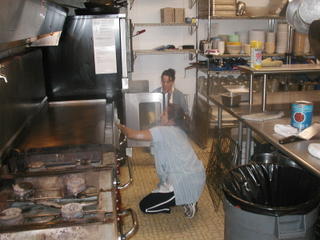
Cooks at FC Camp clean the Wolf range (foreground) and the convention oven Friday morning last year.

Early in the week, make plans to distribute leftover food and supplies, pack cookware and utensils (remember the two-dozen Dutch ovens that you carried to camp?) and clean and return the kitchen back to the facility manager.

Other questions come to mind:

  • Do you have a plan in place to clean all of the equipment in the kitchen?
  • Are all kitchen employees staying to the end? Or are some staff leaving early?
  • Does staff need reimbursement for food purchases?
  • Do you need to account for lost/broken equipment, utensils or dinnerware?
  • What time does the kitchen need to ready to turn back to facility managers?
  • Do you have equipment to pack and transport home (like, 300 pounds of cast iron)?

I've listed just a few questions here. Sometimes it takes as much effort to go home as initial preparations for camp. Make a list of the tasks that must be accomplished and start making assignments two days before the end of camp.

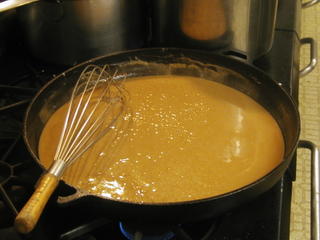
A perfectly browned roux. I love this cast iron skillet. It's a 20-inch skillet that belongs to Daybreak Camp. I use it all week to brown ground beef, make gravy and saute vegetables.

But don't be alarmed. If you're like me, you'll piece together an extensive list. After all, kitchen work can be complex at time.

Here's a few tasks that must be tackled:

  • Final inventory--the chef must evaluate where to fine tune next year's order
  • Records--don't forget to pack the food production worksheet, food safety longs, etc.
  • Dispose of excess food--donate to a food bank, give it to staff, save for next year if possible
  • Clean all major equipment--refrigerators, range, convection ovens, serving line, dishmachine, etc.
  • Plan a leftover blow-out for the last meal--if it can be served safety, it's on the serving line Saturday morning !
  • Garbage and recyling--at Daybreak Camp, we always spend an hour on Saturday compacting the dumpsters because they're too full
  • Take care of personal belongings--don't forget to allot time so your staff can pack their bags
  • Meet with the facility manager--plan a walk-through with the facility manager when you're ready to turn the keys back

The 2004 kitchen crew at the Northern California FC Camp. The girl that I'm holding just happens to be an exact copy of my oldest daughter--in personality and looks!

Monday, July 18, 2005

Second Set of Lessons from a Week-Long Bible Camp, Part 8

This is my second-to-last blog taken from three years of "lessons learned." I'll post one note tomorrow that's appropriately titled, "Don't Forget About De-Mobilization."

Military Wisdom Says "Walk the Ground"

When a military unit occupies a new position, the first thing a troop leader does is to "walk the ground." The commander learns the lay of the land, notes likely enemy avenues of approach and looks for ideal places to spot weapons. He does this to avoid any unpleasant surprises on the battlefield.

Likewise, the camp chef must tour the kitchen and dining facilities, especially when using the kitchen for the first time. A trip to the camp--I toured Daybreak Camp in February 2002--removes unnecessary surprises.

I learned, for instance, that while the kitchen had two mixers (a 10-quart commercial model and a 5-quart Kitchen Aid), the larger of the two didn't have sufficient capacity to prepare enough dough for 150 campers in one batch. Though this wan't earth shattering news, it told me that I would have to allot enough time to prepare two batches of the pizza dough and the cinnamon roll dough on their respective days.

Friday, July 15, 2005

Second Set of Lessons from a Week-Long Bible Camp, Part 7

You know a lot about the food business, especially if you've been going it to 35 years as I have. So what happens if you break your leg the week prior to camp? Or you decide it's time to move on and pass the baton to a younger chef?

My answer is to keep detailed records. I'm always ready to teach someone my job because I don't plan on being the camp chef forever. At this point, I'm looking at another four or five years (until my son graduates high school). I need to start thinking about a predecessor.

Document Your Extensive Knowledge Base as a Chef

As chef, you can't be present in the kitchen all the time. Daily meetings with the director, inventories and Costco runs occupy your time. And there are times that you have to walk out of the kitchen to preserve your sanity (like your 10th or 11th continuous hour in the kitchen -- my point about working staff to the bone applies to the chef as well).

Keep your knowledge base in a three-ring binder. The cooks can reference the menu, corresponding recipes and purchase lists when necessary. Each year, I have printed military recipes from into a recipe binder.

Each day's recipes are readily available behind daily divider tabs in the binder. I also created a food production planning worksheet that lists all of the tasks that must be accomplished each day (thawing, prep for the next day recipes to cook, for instance).

And don't forget to keep detailed records. As the saying goes, the pen is mightier than the sword. Daily food production worksheets and food safety logs, accurately completed, can defend your organization against allegations of foodborne illness. It also gives you history for next year's camp.

I'll post some photographs of my binders tomorrow ...

Thursday, July 14, 2005

Second Set of Lessons from a Week-Long Bible Camp, Part 6

Camp food service is labor intensive. It takes a lot of volunteers to run the camp kitchen. Unless you're running an austier menu and feeding on paper plates, you're going to need support from the campers. Traditionally, this comes in the form of K.P. duty.

Here are my thoughts:

Service is not a Four-Letter Word

Scriptures are full of references to service to God and man. At FC Camp, we still require the campers to perform K.P. even though the trend at some camps has been to discontinue service jobs. Service instills character and keeps them humble (remember James 4: 6 says that there are two kinds of people in the world--the humble and the proud).

We use a two-tiered system for K.P. Each meal, two 11th and 12th grade campers were assigned to the kitchen to perform the heavier work (sweeping, mopping and garbage removal, for instance). The younger campers (4th through 10th grades) rotated by meal to the kitchen. They set tables (hoppers), served the meal (servers) and scraped dirty dished (cleaners). Each child, on average, only served two meals in the kitchen or dining room. The adults typically do K.P. for the first and last meals.

Here are the job descriptions for the various K.P. positions:

Dining Room Host

Reports to: Chef
Work hours: Reports at 0800 - 1200 - 1700 (may get one meal off)

Duties:
  1. Supervises dining room and outdoor eating areas.
  2. Coordinates use of KPs with cabin counselors and camp director.
  3. Supervises KPs in their cleaning duties.
  4. Prepares cold and hot beverages.
  5. Assigns cleaning tasks to K.P.s.
  6. Assists the cooks set up the salad and dessert bars.
  7. Assists the dishwasher as needed.
  8. Applies HACCP food safety principles during meal service and clean up.
  9. Cleans insulated beverage containers.
  10. Assists in other camp program areas between meals.
Cabin Counselor
  1. Assemble the campers from the selected cabin in the dining room 30 minutes before the meal.
  2. Report to the dining room host that your cabin is ready to work.
  3. The dining room host will explain your duties and give a handwashing demonstration.
  4. Find out from the dining room host how many campers will be needed for each team.
  5. Divide the campers into three teams: (1) hoppers--dining room crew; (2) servers--steam line crew; (3) cleaners--dirty dish crew.
  6. Monitor the campers to see that they remain on the job.
  7. Encourage the campers and assist the dining room host as needed.
  8. The counselor, hoppers and cleaners may eat as soon as the prayer is said. The servers have to wait until the end of the meal.
Hoppers––dining room crew
  1. Wash your hands in hot water with soap for 20 seconds. Dry your hands with a paper towel.
  2. Put a hat and apron on. You will be told if you need to wear disposable gloves.
  3. Set each table with: 8 place settings (napkin, fork, spoon, knife and cup), 1 salt and pepper set, 1 pitcher of ice water and 1 pitcher of punch.
  4. Place condiments and other dishes as directed on each table.
  5. As soon as prayer is said, the hoppers may get in line and eat first.
  6. During the meal, be ready to re-fill ice water and punch pitchers. Also replenish any other food dishes as needed.
  7. After the meal, clear each table. Place serving dishes, pictures, silverware and cups in the dirty dish tubs. Return leftover punch and food to the kitchen.
  8. Pick up litter in the patio and surrounding area.
  9. Sweep the patio area and empty the garbage.
  10. Check with your counselor before leaving.
Servers––steam line crew
  1. Wash your hands in hot water with soap for 20 seconds. Dry your hands with a paper towel.
  2. Put a hat and apron on. You will be told if you need to wear disposable gloves.
  3. The cook will show you how to serve each item on the steam line.
  4. Serve the meal. Neatly place each item on the plate.
  5. Clean any spills on the steam line and on the floor as the happen.
  6. Do not eat or drink while serving the meal.
  7. You may eat as soon as all campers have eaten (before the second’s bell is rung).
  8. Check with your counselor before leaving.
Cleaners––dirty dish crew
  1. Wash your hands in hot water with soap for 20 seconds. Dry your hands with a paper towel.
  2. Put a hat and apron on. You will be told if you need to wear disposable gloves.
  3. Set the dirty dish area up on the covered patio. The dining room host will tell you how to do this.
  4. As soon as prayer is said, the cleaners may get in line and eat first.
  5. During the meal, help the campers scrape and sort the dishes into dish racks.
  6. Run dish racks to the dishwasher when they fill up.
  7. After the meal, clean the dish sorting area.
  8. Clean the sorting table.
  9. Put away clean dishes as instructed by the dishwasher.
  10. Empty the garbage cans as they fill up.
  11. Check with your counselor before leaving.