Tuesday, November 03, 2015
Baked French toast for Valley Fire victims
The chefs served over 2,500 meals during the 10-day deployment from Mercy One, a 32-foot kitchen trailer. The kitchen is based near Dallas, Texas. Chefs and support staff converged on Middletown from homes in California, Colorado, North Carolina, Virginia and Texas toward the end of September.
Once the managing chef posted the menu each day, we set about preparing the different dishes for the next day. Several days into the mission, I saw an excessive amount of biscuits, cinnamon rolls and apple crumb cake in the refrigerator trailer. Quick calculations showed that the leftovers would give us five two-inch hotel pans, enough to feed a filling breakfast to 150 persons.
This recipe for baked French toast is offered as I prepared it for our fourth breakfast. (I posted a recipe for Dutch oven baked orange French toast last year.) I quickly put the formula together after briefly confirming custard ratios on the internet. Note that I didn't add any sugar or syrup to the recipe. I felt the orange juice and berries added sufficient sweetness to the dish.
BAKED FRENCH TOAST WITH MIXED BERRIES
The important thing here is to fill each pan with diced or crumbled biscuits and pastry. I understand that you won't duplicate my mix of leftovers breads. You'll need about three and one-half to four pounds bread for each hotel pan. (Remember the apples in the crumb cake added additional weight to the formula.)
6-1/2 pounds buttermilk biscuits, cut into medium dice
4-1/2 pounds iced cinnamon rolls, cut into medium dice
8-1/4 pounds apple crumb cake, crumbled
10 pounds frozen mixed berries, thawed
2 flats whole eggs (30 eggs per flat)
1 gallon whole milk
6 cups orange juice
1/4 cup ground cinnamon
1 tablespoon ground nutmeg
1/4 cup vanilla extract
1 tablespoon kosher salt
Lightly grease or spray each 12 by 20 by2-inch hotel pan. Equally divide crumbled/diced biscuits and pastry among five hotel pan. Spread 2 pounds berries over each pan.
In a large bowl, whisk the eggs, milk, juice, cinnamon, nutmeg, vanilla and salt together. Evenly pour 6 to 7 cups of the custard over the bread in each pan. Cover and place in the refrigerator overnight.
In the morning, bake in a 350-degree F oven for 45 to 60 minutes, until set and puffed up. Serves 25 to 30. Serve with fresh berries if available and maple syrup.
Sunday, November 16, 2014
Iron skillet apple pie in a 12-inch pan
I thought that the crust was the best part of the pie! The crisp crust, both top and bottom, complimented the soft and sweet apples. A clean skillet was all that we brought home. Word of mouth quickly brought diners to the dessert table to try a slice of pie.
Enjoy ...
![]() |
| Iron skillet apple pie in a 12-inch pan will feed a crowd. |
This is an enlarged version of an on-line recipe MyRecipes.com, from the September 2011 issue of Southern Living. Amounts have been adjusted to fit inside a larger cast iron skillet. I used an 11-1/2-inch Wagner skillet for the test run.
Purchase 5 large Braeburn and 5 large Granny Smith apples. Yield will be approximately 4 pounds, give or take, of apple slices after peeling, coring and slicing. You may need to prepare your own pie dough since the skillet is several inches larger than a 9-inch pie pan. Or you can use my recipe.
2-1/2 pounds Braeburn apples
2-1/2 pounds Granny Smith apples
2 teaspoons ground cinnamon
2 cups sugar
Pinch salt
6 ounces unsalted butter
1-1/2 cups packed light brown sugar
2 pounds 4 ounces pie dough, rolled into 2 pieces
1 egg
2 tablespoons sugar
Pre-heat oven to 350 degrees. Peel and core apples. Cut into 1/2-inch wedges. Toss with cinnamon and 2 cups sugar. In a 12-inch cast iron skillet, melt butter over medium heat. Add brown sugar. Cook, stirring constantly, 1 to 2 minutes, until sugar is dissolved. Do not caramelize. Remove from heat.
Place 1 pie crust over brown sugar mixture. Spoon apples over bottom pie crust. Top with second pie crust (with several slits cut in to vent steam). Pinch crusts to seal. Whisk egg. Brush top crust with egg wash. Sprinkle 2 tablespoons sugar over crust.
Bake for 1 hour 15 minutes to 1 hour 30 minutes or until golden brown and bubbly. Place pan under skillet to catch syrup spills. Shield crust with foil sheet in last 15 to 30 minutes to prevent excessive browning. Cool before serving. Serves 12.
Thursday, October 16, 2014
Pork tenderloin and apples with cider glaze
Last year I started reducing fresh unfiltered apple cider until it had a syrupy consistency. I've added it to homemade hotcake syrup, roasted Brussels sprouts, apple mahogany sauce and apple glaze. I typically purchase the cider in half-gallon bottles and reduce it over high heat to one-quarter its beginning volume (see recipe below). Apple cider is at its peak in the fall.
PORK TENDERLOIN AND APPLES WITH CIDER GLAZE
The recipe for apple mahogany sauce lists several ideas for a sauce such as this one. You can substitute pork chops or chicken breasts for the tenderloin. Saute the meat in a cast iron skillet or grill over hot coals as desired. Brush sauce on the meat during the couple minutes of cooking.
2-1/2 pounds pork tenderloin
Kosher salt and ground black pepper, to taste
2 tablespoons chopped fresh rosemary
2 tablespoons chopped fresh thyme
1 tablespoon unsalted butter
1-1/2 cups apple cider reduction (click for recipe)
2 medium Granny Smith apples, peeled, cored and sliced, 3/4-inch thick
1 tablespoon cider vinegar
2 teaspoons Dijon mustard
Rinse pork and pat dry. Season with salt and pepper. Coat all sides with thyme and rosemary. Melt butter in a 12-inch Dutch oven over medium-high heat. Add pork and cook until browned on all sides.
Place lid on oven and arrange 10 charcoal briquettes under and 19 on lid (heat for 400 degrees F.). Cook 20 to 25 minutes until pork reaches 145 degrees on an instant-read thermometer. Note size and shape will influence cooking time. Place pork on a platter and rest 10 minutes. Pour off any moisture (and reserve for future application, if desired).
Combine cider reduction, vinegar and mustard. Add apples and cider mixture to Dutch oven. Cook over medium heat until apples are al dente and sauce has thickened to glaze consistency. If needed, thin glaze with a small amount (1 tablespoon or less) to apple cider or reserved moisture. Meanwhile, slice pork 1/2-inch thick. Spoon sauce over pork and place apples on either side. If desired, sliced pork can be served from Dutch oven (as pictured).
Makes 6 to 8 servings. Serve with roasted Brussels sprouts and rice pilaf.
Apple cider reduction
I use Barsotti organic apple cider, a local El Dorado County, California, company that presses fresh apples at their Apple Hill plant. Barsotti juices can be purchased at many Northern California markets, co-ops and big-box stores, plus a number a local wineries and Apple Hill ranches.
APPLE CIDER REDUCTION
8 cups unfiltered apple cider
Boil apple cider over high heat until reduced to one-fourth its beginning volume, stirring occasionally. Skim surface build up as it collects. Allow as little as 45 minutes and as long as two hours to complete the reduction. The quantity being reduced, size and shape of the saucepan and heat setting determine how long it takes. Freeze leftover cider reduction or use within seven days.
Sunday, June 22, 2014
Baked Dutch apple pancake recipe
After testing Paul's baked Dutch apple pancake on staff at Oakland Feather River Camp last month, I introduced it to the adult campers of the art camp this week. They loved it. After receiving several compliments from the older campers, many in their sixties and seventies, I will place it on the menu every other week.
BAKED DUTCH APPLE PANCAKE
I prepared six 2-1/2-inch hotel pans of the baked apple pancake for around 140 adult campers Friday. The picture shows me portioning eight cups batter into each pan. Liquid eggs stand in for fresh eggs at Oakland Camp. Use 14 large or 16 medium eggs if you don't buy liquid eggs. To date, I've simultaneously baked six pans in the oven.
One pan will serve 25 campers. At Oakland Camp, we place a pan of plain scrambled eggs on the vegetarian line for campers that prefer them.
8 ounces butter
1/2 can sliced apples, drained, juices reserved
2 ounces sugar
1.5 pounds eggs
3 cups all-purpose flour
1 cup reserved apple juice
2 cups milk
Toppings: nutmeg, powdered sugar, lemon wedges and honey
Place butter in a 12 by 20 by 2-1/2-inch hotel pan and set on lowest rack of oven. Preheat oven to 425 degrees in a conventional oven or 375 degrees in a convection oven. Combine apples and sugar. Remove pan from oven and place apples in pan. Return to oven and cook until lightly caramelized, 10 to 15 minutes.
While the apple caramelizes, quickly mix batter. Put eggs in a blender or food processor and whirl on high speed for 1 minute. With motor running, gradually pour in milk and juice, then slowly add flour; continue whirling 30 seconds. (Or, in a bowl, beat eggs until blended; gradually beat in milk, then flour.)
Remove pan from oven and pour batter over apples. Return pan to oven and bake until pancake is puffy and well browned, 20 to 25 minutes, rotating pan halfway through baking. When working with multiple pans in the oven, rotate from top to bottom shelves if necessary for even cooking.
Dust pancake with nutmeg if desired, then powdered sugar. Cut as desired and serve with more powdered sugar and lemon wedges, plus a drizzle of honey if you like.
Sunday, June 01, 2014
Friday, May 30, 2014
Working on baked apple pancake recipe for camp
![]() |
| The first test recipe for the bug Dutch baby. We served it with honey and lemon juice. |
For our next test, I plan to adjust the quantity of flour and add lemon juice or apple cider reduction to the batter. Apple cider will certainly complement the caramelized apples. I'll report back after my next test.
![]() |
| I'm caramelizing fresh apples for the second test recipe. While I though the recipe was good, it needs perfection before I post it on these pages. |
Sunday, October 20, 2013
Apple cider mahogany sauce
This article is really about two sauces. First, you must reduce unfiltered apple cider to about 25 percent of its original volume. Once reduced, you can prepared the apple cider mahogany sauce.
While you can prepare sufficient quantity of the apple cider reduction for your current recipe project, I like to reduce a half-gallon or more at a time. This gives me a supply of syrup to use as I see fit.
Use the cider reduction as a stand-in for maple syrup or honey in almost any recipe. Let your imagination be your guide. The recipe for apple cider mahogany sauce is included below. Three weeks ago I braised pork butt in cider reduction and chicken stock and served it with roasted carrots.
My next project is to prepare Brussels sprouts by first roasting with caraway and mustard seeds, then braising in chicken stock and cider reduction. The cabbages will be good alongside bratwurst, fried potatoes and homemade sauerkraut.
To prepare the reduction, boil unfiltered apple cider (I use Barsotti cider) over high heat until reduced to one-fourth its beginning volume, stirring occasionally. Skim surface build up as it collects. Allow as little as 45 minutes and as long as two hours to complete the reduction. The quantity being reduced, size and shape of the saucepan and heat setting determine how long it takes.
Brush cider mahogany sauce on grilled pork chops (pictured above) or sautéed chicken breasts. Dip sliced tri-tip (roasted to medium doneness) or smoked brisket in the sauce, quickly sear on griddle and place on toasted French roll. You can use the sauce to glaze your favorite cuts of lamb, pork, poultry or fish.
APPLE CIDER MAHOGANY SAUCE
3 slices bacon, diced small
1/2 cup medium sweet onion, diced small
1 cup apple cider reduction
1 cup catsup
2 tablespoons cider vinegar
1 tablespoon Worcestershire sauce
1/2 teaspoon chopped fresh thyme
In a medium saucepan or skillet, sauté bacon and onion until onion is tender. Drain bacon drippings from skillet. Add cider reduction, catsup, vinegar and Worcestershire sauce, Simmer 10 to 15 minutes, stirring occasionally. Stir in thyme. Adjust seasoning. Makes 2-12 to 3 cups.
Wednesday, September 29, 2010
A summer of salads
The combination of common fruits and vegetables (cantaloupe, pear tomatoes and cucumbers, for instance) with fresh herbs (mint in this case) transformed individual flavors into new culinary adventures.
Success is often measured in small steps at work. There's always going to be one or two vocal residents who'll never touch anything green. "I don't eat no stinkin' vegetables, Chef Steve," was the refrain from one such resident all summer long.
"Steve, you're an odd duck," proclaimed another resident as she watched me place a large bowl the cantaloupe and tomato salad in the refrigerator several weeks ago.
The combination of cantaloupe chunks, pear tomato halves and diced cucumber may seem odd to some. But when coated with a minty, slightly sweet vinaigrette, about half the residents enjoyed the salad.
Sometimes the oddest combinations produce the best results. Cantaloupe and tomato salad helped me present the melon in a new form, one that the residents appreciated.
If that makes me an "odd duck," so be it!
=====<<>>=====
Here is a list of salads that I've posted to 'Round the Chuckbox over the past several years. In addition to the salads that I worked on this summer, I've included several from my tenure at FC Camp.
Sunday, September 13, 2009
Lunch at the engine house
I haven't cooked lunch for the crew at the engine house of the El Dorado Western Railway in six months. Several priority projects kept me from cooking in the months leading to my early June departure for the summer camp job. My labor was more important at that point.Railway President Keith Berry and I first discussed a lunch meal several weeks ago. We both wanted to reward the crew for a summer of notable accomplishments. Twice this summer, Keith called on the volunteers to complete high-profile projects in a short period of time.
Last June the crew rallied to remove the rail, tie plates and rail joiners from the old Southern Pacific yard at Diamond Springs. Once the county gave its approval to remove the track and associated hardware, we had no more than two weeks to complete the track disassembly.
The crew completed the project in eight days. Several volunteers worked every day. The rails and hardware will be used to add a third rail and build the yard at the recently approved El Dorado County Historical Railroad Park in the town of El Dorado.
The county board of supervisors approved the park on August 25. The park will be located on the right-of-way of the Southern Pacific depot in El Dorado.
Volunteers again answered the call this weekend when it became evident that we had to move about 300 ties to a secure location. The ties were open to theft in their current location along the old right-of-way, which is being converted into a riding and walking trail.
Lunch menu
I often use meals at the engine house to try new recipes and to use ingredients that I already have at home. Since I had a 4-pound pork shoulder in the freezer, I knew the menu would be built around a pork dish.
Although chili verde is a favorite -- a dish I enjoy cooking for potlucks -- I wanted to try a flavor combination that was new for me. The idea for a pork stew came to me as I watched Alton Brown's Good Eats television show last week.
In the re-broadcast of his 2005 "Dis-Kabob-Ulated" episode, Brown marinated beef sirloin in a spicy marinade with red wine vinegar and olive oil. Turmeric, smoked paprika and cumin formed the flavor base for the marinade.
Since it isn't practical to make pork kabobs with the tougher pork shoulder, a braised or stewed dish seemed to be the best way to tenderize the meat. I used the marinade to impart flavor, then prepared a tradition stew from that point.
I worked the recipe in my mind Friday evening as I moved railroad ties. I had originally planned to work out the menu and shop that evening. But a 3 p.m. telephone call from Keith brought me to the Diamond Springs yard instead.
When I arrived at the storage site for the ties, the crew asked me what was on the lunch menu for Saturday. I received a chuckle or two when I told them that Keith had pulled me away from my menu planning duties.
They weren't amused when I said that I should be home planning the menu. At that moment, the crew was more interested in my back than culinary skills. Since we didn't quit until 7:30 p.m., I delayed shopping until Saturday morning.
My original thought was to prepare the stew with orange marmalade, but hit on the idea to build the stock with apple juice after moving almost 250 ties. Yams and apples seemed like a natural addition from that point.
Here's the menu for the El Dorado Western Railway lunch:
- Pork stew with yams and apples
- Buttermilk biscuits
- Dutch oven bread pudding
All three dished were prepared in 14-inch Dutch ovens. While I could've made the stew in a 12-inch deep Dutch oven, I customarily use 14-inchers when cooking for crowds.
In the end, 11 crew and guests enjoyed the meal. While I cooked, the crew loaded the 1937 Waukesha engine from the Diamond and Caldor railbus onto Doug's trailer. Doug is going to rebuild the six-cylender engine and return it to the museum next spring.
After lunch, Keith asked if I was going to help move the last 40 or 50 ties at Diamond Springs yard. Lunch over, it was time to get back to work.
PORK STEW WITH YAMS AND APPLESUse the marinade to flavor diced beef for spicy beef kabobs. Prepare the marinade and combine with 3 to 4 pounds of boneless beef sirloin as directed. Alton Brown's recipe has cooking instructions.
4 pounds pork shoulder
8 cloves garlic, minced
4 teaspoons paprika
1 teaspoon turmeric
2 teaspoons ground cumin
2 teaspoons kosher salt
1 teaspoon ground black pepper
2/3 cup red wine vinegar
1 cup olive oil
1 quart apple juice
2 pounds yams or sweet potatoes, diced
3 Granny Smith apples, diced
Cut the pork into 1- to 1-1/2-inch cubes and place into a large bowl or container. Set aside.
In a bowl combine garlic, paprika, turmeric, cumin, salt, pepper and red wine vinegar. Drizzle in olive oil while vigorously whisking.
Pour the marinade over meat and toss to coat. Place in the refrigerator in an airtight container or a zipper-lock bag and marinate for 2 to 4 hours.
In a colander, drain marinade from stew. Discard remaining marinade. Heat a 6- or 8-quart Dutch oven to medium-hot. Brown pork in 2 or 3 batches to avoid overcrowding. Remove each batch to a waiting plate or bowl as it's done.
Return browned pork to Dutch oven. Add apple juice and stir. Season with salt to taste. Simmer until pork is tender, about 60 to 75 minutes. Add yams and apples and continue cooking until yams are tender, about 15 to 20 minutes.
Makes about 12 (1-cup) servings. Serve over buttermilk biscuits.
Tuesday, March 25, 2008
How many servings will a 12-inch Dutch oven deliver?
The last discussion that I joined in on began with a question from a Dutch oven group in Porterville, California. Dutchin' Dave, a member of the Sequoia Dutch Ovens, asked this question at Camp-cook.com:
Got a problem. We've been asked to do cobbler for 300 folks at a fancy fundraising dinner for our Cancer Camp for children. We're thrilled to do it, but the problem stems from the fact that the majority of our Sequoia Dutch Ovens chapter is already committed to another function and there will only be 4-5 of us left. Under the circumstances, it's going to be critical that our operation run as efficiently and streamlined as possible. We need to figure out how many ovens these 4-5 cooks are going to have to manage and so we need to calculate pretty closely how many servings we can get out of an oven.Dave went on to explain his thought process on the issue. Even though he knows how many servings can be served from a 12-inch regular Dutch oven ("6-18 servings of a 'main dish' or 'to 30' servings of a 'side dish'"), he recognized that the number of servings per pot depends upon the portion size.
He planned to prepare one recipe in a 12-inch Dutch oven and scoop the cobbler out in 2- to 3-ounce portions. Dave estimated that the his recipe would yield about 15 servings. The results will, of course, depend on the volume of fruit and topping in his recipe.To feed 225 guests, Dave figures it will take 15 (12-inch) ovens. He believes "approximately 3/4 of them will want dessert." The remaining 25 percent will avoid dessert due to health concerns or personal taste, said Dave.
Number of cobbler servings per No. 12 Dutch oven
Let me answer Dave's question in two parts. I'll address his immediate cobbler question first since that's the main point of his discussion. Then in a couple days, I'll address the broader question of catering large groups out of Dutch ovens.
I always work from volume, not some generalized table of servings per Dutch oven. Most Dutch oven food is semi-liquid or semi-solid. It spoons or ladles out very well. The key is to calculate the volume each Dutch oven holds for a particular dish and divide by the serving size. That's the basic formula for determining portions per Dutch oven.
There are other factors, like toppings and the number of pieces (of meat, chicken, potatoes, etc.) in the pot. It's hard to serve 20 (1-cup) servings out a pot of pork chops and gravy when there's only 15 chops in there to begin with. Toppings will also limit the number of servings. A pot pie or cobbler that's topped with 15 biscuits will only give you 15 servings.
I like to work out of 14-inch oven when cooking for a crowd. They're lighter than 16-inch ovens and holds more than a 12-inch oven. The 14-inch is a happy medium between lugging heavy 16-inchers and having to wrestle lots and lots of 12-inch ovens. I recommend that you locate as many 14-inch ovens as possible.
I don't recommend using deep-style ovens for recipes that use a topping as a key component of the dish. Deeper ovens are best reserved for bread loaves, large cuts of meat and soups, chili and stew.
The problem with baking a cobbler or crisp in a deep-style oven is it can hold a larger ratio of filling to topping. You'll run out of topping long before the filling is gone. The people at the head of the dessert line will get all the topping.
For the cobbler, I use 2 or 3 (14-inch) Dutch ovens to serve apple crisp to 150 campers. A 14-inch regular oven holds 8 quarts full to the brim. A good working volume is about 2/3 of the oven capacity, or about 5-1/3 quarts of product. Divide that by 1/2-cup into 5-1/3 quarts and you get about 42 servings per 14-inch regular oven. I round to 40. My recipe (below) uses three 14-inch ovens to feed 100 campers.You can get 50 servings if you push the volume to 6 quarts. Just make sure you leave enough head room for the crisp topping to brown. But remember, to get 50 (1/2-cup) servings per 14-inch oven, you need about 6-1/2 quarts crisp/cobbler in each oven. And don't forget my caution about the filling to topping ratio above.
APPLE CRISP FOR A CROWD
Dutch oven instructions are located in the notes.
FILLING
3 (#10) cans sliced apple
1/2 cup lemon juice
1 tablespoon lemon zest
2-3/4 pounds sugar
8 ounces cornstarch
3 tablespoons ground cinnamon
1 tablespoon salt
TOPPING
3 pounds brown sugar
1-1/4 pound rolled oats
1-1/4 pounds all-purpose flour
1-2/3 teaspoons baking powder
1-3/4 teaspoons baking soda
1 tablespoon salt
2 pounds butter, softened
Arrange 4-1/2 quarts apples in each greased 18x26-inch sheet pan. Sprinkle juice and zest over apples. Combine granulated sugar, starch, cinnamon and salt; sprinkle half over apples in each pan.
Combine brown sugar, flour, baking powder, baking soda, salt and butter or margarine; blend to form a crumbly mixture. Sprinkle an equal quantity of the mixture evenly over apples in each pan.
Using a convection oven, bake at 350 deg F for 30 minutes or until top is bubbling and lightly browned on low fan, open vent. Cut each pan 6 by 9. Serve with serving spoon or spatula.
Yield: 2 sheet pans
Serving ideas: Serve 1 piece or approx 1/2-cup per portion. Acceptability is approx. 100 percent.
NOTES: Use 3 #10 cans sliced apples per 100 portions. Use two 18x26-inch sheet pans per 100 portions. Three lemons will yield 1/2-cup juice. Two pounds flour (total) may be used in place of rolled oats.
For 14-inch Dutch oven, use 1 #10 can of canned apples and a 1/3 the remaining ingredients per oven. This will yield approx 33 (1/2-cup) servings per oven.
Sunday, November 18, 2007
Apple and Red Onion Relish
Isn't it interesting how a photograph attracts you to something? Take this picture of Woods Lake. The idyllic winter setting prompts you to return in July after the snows have melted and the wildflowers are in full bloom.My reaction to the deep red color of the red onion and apple relish is similar. To me the dish resembled German red cabbage, a holiday side dish that I've loved since childhood. As soon as I saw the picture, I could smell the marriage of the sharp vinegar and sweet apple.
Like many recipes in Christine France's cookbook, The Complete Guide to Making Sauces by (Hermes House: London, 2005), this one comes together quickly. You can prepare the relish in a little more an hour.
You may need to cover your eyes while the onions braise in their own juices. But as they soften into a thick relish, the sharp bite of the onion will mellow into a delicately sweet condiment.
You may find that the relish is a refreshing change from candied cranberry sauce. Use the relish in place of cranberry sauce at the Thanksgiving table this week. And it's great as a condiment on ham or turkey sandwiches made with holiday leftovers.
APPLE AND RED ONION MARMALADE
A pinch of salt will help extract the juices from the onion during the first step. Be careful not to brown the relish. You want it to slowly braise in its own juices and the vinegar.
4 tablespoons extra virgin olive oil
2 large red onions, thinly sliced (about 2 pounds)
6 tablespoons granulated sugar.
2 Granny Smith apples, peeled, cored and grated
6 tablespoons cider vinegar
Heat the olive oil in a large heavy skillet over medium heat. Add the onions and stir in the sugar. Let cook, uncovered, for 40 minutes, stirring occasionally until the onions have softened.
Add apples to the skillet with the vinegar. Continue to cook for an additional 20 minutes until the relish is thick and sticky. Cool and place in an airtight container. It'll keep for a month in the refrigerator. Makes about 3 cups.
Saturday, September 08, 2007
From Apple Hill to the El Dorado Western
Friend Keith Berry spreads cold-application roof adhesive to the roof of the Westside and Cherry Valley Railway combine car. The crew from the El Dorado Western Railway is re-roofing the combination caboose and baggage car in preparation for the winter rains.Crewman Bill Rogers, a local retiree who drives a tractor at one of the Apple Hill ranches, supplied the five-gallon bucket for the roofing job.
I wandered out loud: "Why is Apple Hill buying prepared apple filling? I thought its reputation was built on fresh ingredients like recently picked apples."
Bill assured me that his employer makes apple pies with fresh apples from the ranch. You know, the kind with a six-inch high crown of sliced apples that have been sweetened with sugar and cinnamon. The ranch uses sliced apple pie filling from a five-gallon bucket for turnovers.
A nice slice of apple pie with a scoop of vanilla bean ice cream would've hit the spot in the 90-degree heat on the roof.
Wednesday, July 04, 2007
Camp -- Anatomy of an Independence Day BBQ
1600 -- lit a 20-pound bag of charcoal for the Dutch ovens.1620 -- placed 14-inch skillet over coals. I used a stack of three 14-inch Dutch ovens as the cooking platform the the skillet.
1625 -- added 1 pound chopped bacon to the skillet to brown for the beans. At the same time, I dumped 1-1/2 #10 cans of baked beans into two 14-inch deep Dutch ovens. Added a 17-ounce bottle of catsup, two large spoons of mustard and 6 ounces brown sugar to each bean pot as well and stirred.
1630 -- lit a 20-pound bag of charcoal for the barbecue grill.
1633 -- stacked the bean pots on top of a 12-inch Dutch oven. I used 9 coals under the bottom pot and a ring (about 25) coals on each lid. The 12-incher served as the base since I didn't want to place coals directly on the sidewalk.
1640 -- added 1 #10 can of drained apples to each of three 14-inch regular Dutch ovens. I then mixed a sugar-cinnamon mixture into each pot of apples. The filling mix was made of 2-3/4 pounds granulated sugar, 8 ounces cornstarch, 3 tablespoons cinnamon and 1 tablespoon salt. The filling was divided between all 3 pots.
1643 -- topped each apple pot with half of the crisp topping. The topping was made from 3 pounds brown sugar, 1-1/4 pounds rolled oats, 1-1/4 pounds all-purpose flour, 1-2/3 baking powder, 1-3/4 tablespoons baking soda and 2 pounds softened margarine. I stored the topping in the refrigerator between uses to keep the margarine from melting.1646 -- stacked the apple crisp Dutch ovens. I placed a ring of charcoal on each lid. I didn't use bottom heat.
1658 -- stirred bacon and onions into the beans and rotated the bean pots.
1700 -- started grilling the hamburgers, hot dogs and chicken.1715 -- rotated the apple crisp pots.
1731 -- rotated the bean pots.
1735 -- added the second layer of crisp topping to the apple pots. I add the crisp topping in two batches to make sure that it's crisp throughout.
1753 -- rotated the apple pots.
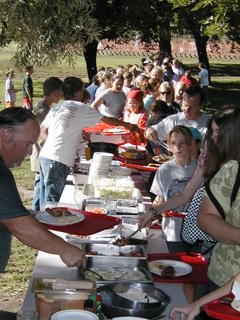
1805 -- started serving dinner to 155 campers and 5 guests. The first bean pot and first apple pot went to the serving line.
1815 -- the last of the hamburgers and hot dogs were removed from the grill. I also removed all heat from the apple pots.
1820 -- second apple pot went to the serving line. I started washing the Dutch ovens and lids inside the kitchen.
1822 -- second bean pot went to the serving line.
1832 -- third apple pot went to the serving line.
1844 -- the last camper went through the serving line. The cooks and servers (from Cabin 5) finally had a chance to eat.
1846 -- called seconds.
1848 -- I sat down with my wife to eat my own dinner.
1850 -- the meal is done. We served 97 hamburgers (3 fell into the fire!), 59 hot dogs 41 left over) and 34 pieces of chicken (6 leftover) for 155 campers. The meal also included two 14-inch deep pots of baked beans (about 10 quarts) and three 14-inch pots of apple crisp. Three-bean salad, potato salad, cole slaw and all the fixin's for hamburgers and hot dogs were included on the salad bar. The campers ate all of the apple crisp and most of the beans.1903 -- I cleaned the last two Dutch ovens.
1905 -- all leftovers have been placed in the walk-in refrigerator.
1912 -- I ate my second piece of chicken.
1920 -- walked into the air conditioned office to relax and get off my feet. Now that the blog is written, it's time for a shower!
Sunday, November 05, 2006
Apple Hill Crowds
I overheard this conversation at the at the engine house yesterday:
"Have your crowds dropped up there now that it's cooled down?" asked Dale, the master welder for the El Dorado Western Railway.
"Yea, they've dropped off like a hammer," Bill responded. Bill works part-time at one of the apple ranches.
The crows at Apple Hill typically fall off after Halloween, said Bill. He said now is the time to visit.
"The apples are still there," added Bill.
Monday, October 23, 2006
A Visit to Apple Hill
My son and I took a late-afternoon stroll through High Hill Ranch yesterday. It's fun to walk around the Apple Barn (pictured below) and watch the sorting and packing process. Granny's, goldens and many varieties that I've never heard of can be bought by the pound or by the case.
The Apple Hill season celebrates the apple harvest up on Carson Ridge. Apple pie, apple fritter, apple butter and apple cider are available in abundance from early September until Thanksgiving time.The Apple Hill Association features some 50 locally-owned apple ranches, Christmas tree farms, resorts and wineries. Most can be accessed along Carson Road between Placeville and Camino, right off of US 50.
Friday, August 12, 2005
Apple Crisp for a Crowd
Have you ever used can apples for [apple crisp]? I need to make it for about 300 people and I would like to use canned apples. Pease let me know if canned apples would work ... I would appreciate your reply thanks.
Sharilyn
=====<<>>=====
Here's the recipe that I use at camp each summer for the Tuesday night cookout. This recipe is adopted from the U.S. Armed Forces Recipe Service.
APPLE CRISP
20-3/4 pounds canned apple slices
1/2 cup lemon juice
1 tablespoon lemon zest
2-3/4 pounds sugar
4 ounces cornstarch
3 tablespoons ground cinnamon
1 tablespoons salt
3 pounds brown sugar
1-1/4 pounds rolled oats
1-1/4 pounds all-purpose flour
1-2/3 tablespoons baking powder
1-3/4 tablespoons baking soda
1 tablespoons salt
2 pounds butter, softened
Arrange 4-1/2 quarts apples in each full-sized sheet pan greased pan. Sprinkle juice and zest over apples. Combine granulated sugar, starch, cinnamon and salt. Sprinkle half sugar mixture over apples in each pan.
Combine brown sugar, rolled oats, flour, baking powder, baking soda, salt and butter. Blend flour mixture to form a crumbly mixture. Sprinkle an equal quantity of the mixture evenly over apples in each pan.
Using a convection oven, bake at 350 degrees F for 30 minutes or until top is bubbling and lightly browned on low fan, open vent. Cut each pan 6 by 9. Serve with serving spoon or spatula. Serves 108.
Notes: Use 3 #10 cans sliced apples per 100 portions. Use two 18x26-inch sheet pans per 100 portions. Three lemons will yield 1/2-cup juice. Two pounds flour (total) may be used in place of rolled oats.
Tuesday, July 26, 2005
Camp 2005 -- Tuesday's Meals
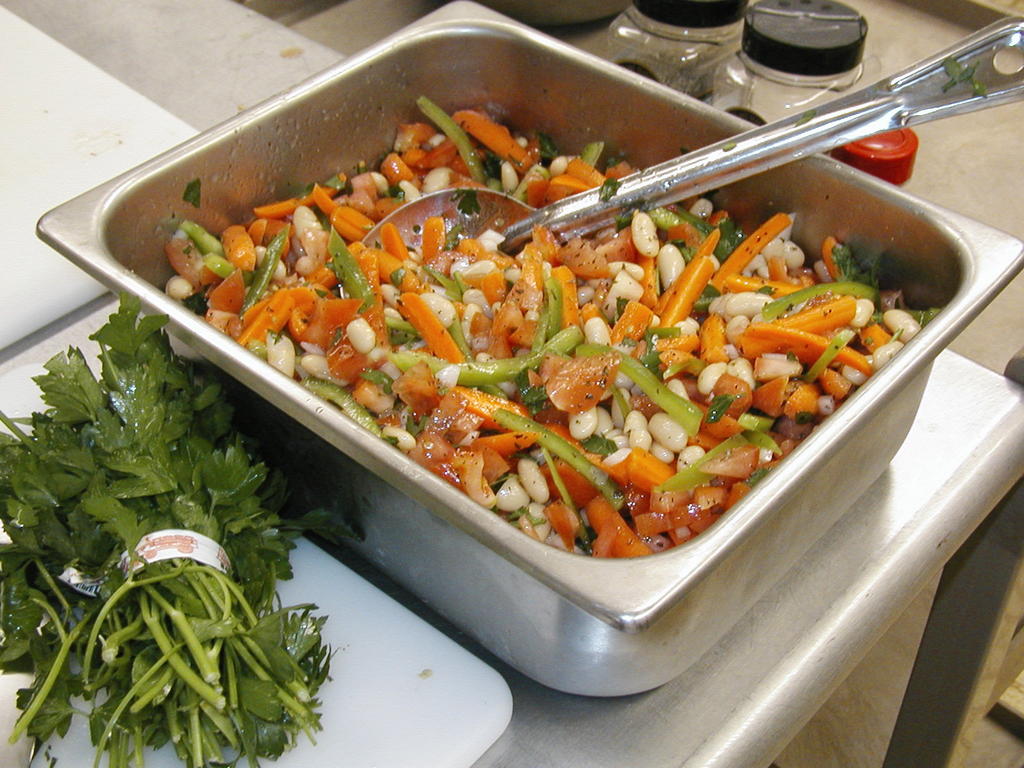
A marinated vegetable salad that we served for lunch today. Today at lunch was the first day that the salad bar filled with salads and condiments. We served the marinated vegetables, sliced cucumber and onions, tuna salad and a tossed green salad. 
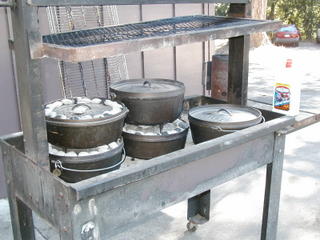
My improvised Dutch oven table. I didn't pack any of my Dutch oven tables this year. To protect the ground and sidewalk, I used the camp's old barbecue pit and a platform for five Dutch ovens. The three regular #14 ovens contain an apple cobbler. I baked scalloped potatoes in the two deep #14 ovens. The deep ovens are the ones with no charcoal on the lid.

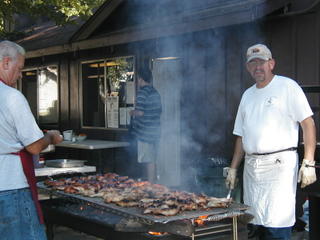
We are grilling chicken on the grill. I use a Sysco 9-ounce chicken hindquarter that comes packed 60 to a case. I par-bake the chicken for 45 to 60 minutes in a 325-degree convection oven to save time and heartache over undercooked chicken. I then the grill the hot chicken for about 10 minutes to give it color and apply sauce.

We served tonight's dinner under the trees.

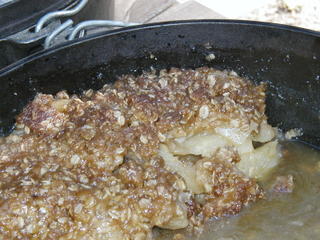
The apple crisp. It takes 1-1/2 (6-1/2-pound) cans of water-packed apples for each #14 Dutch oven. Combine the apples with sugar, cornstarch, cinnamon, lemon juice and lemon zest. Top with your favorite crisp topping and bake for 45 to 60 minutes in a 350-degree Dutch oven.
Monday, July 25, 2005
Camp 2005 -- Monday's Meals
The recipe for macaroni and cheese. I often use the U.S. Armed Forces Recipe Service cards as the basis for my camp recipes.At lunch, we served tuna salad sandwiches and luncheon meat sandwiches with vegetable soup and macaroni and cheese. I used the basic military recipe today with a good quality pre-shredded cheddar cheese.
Each 4-inch hotel pan holds: 5 pounds macaroni and a scant gallon rich cheese sauce.
We get approximately 7- to 75 servings from a pan with a #10 scoop.
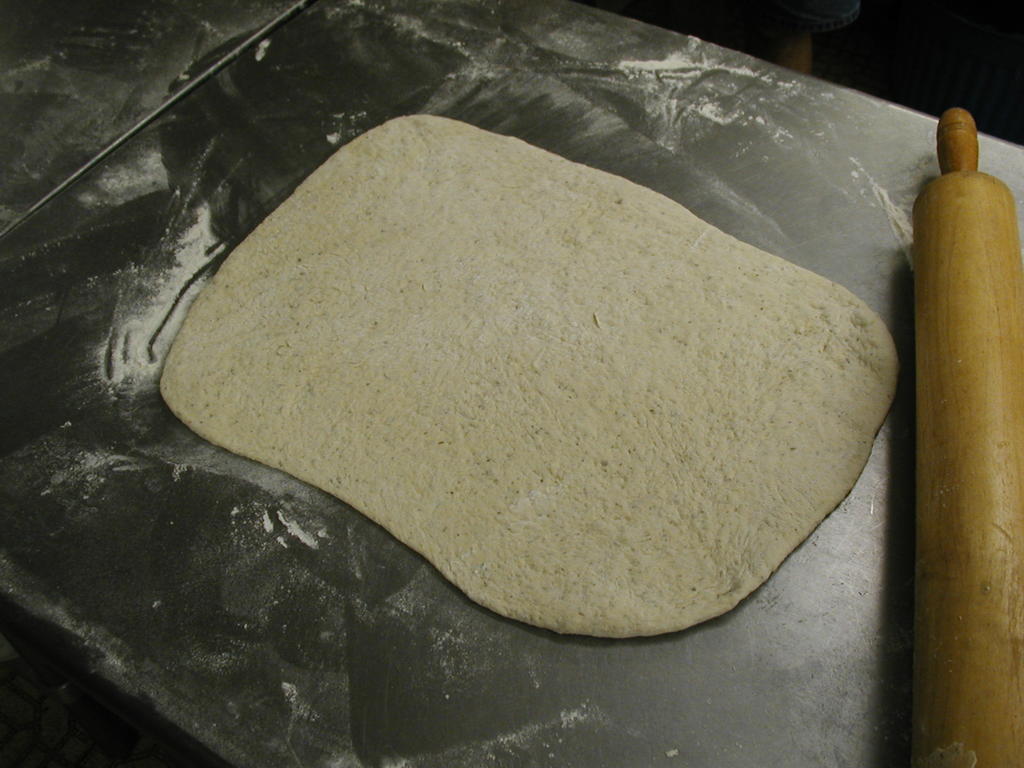
Pizza dough for dinner. For 150 campers, I made 9 sheet pans pizzas. You yield 20 servings per pan when you use the full-sized sheet pan (18 by 26 iches).In past years, we've baked six or seven pepperoni pizzas. This year we baked a wide variety of pizzas because the local market ran out of pepperoni yesterday.

Here's what we baked tonight:
2 pepperoni pizzas
1 sausage
1 sausage and bacon
1 bacon and black olive
1 chicken pesto (the best in my opinion)
1 cheese
1 vegetarian with onions, bell peppers, tomatoes and olives
A 3/4-sheet with cheese and bacon.
We had 20 pieces leftover before calling seconds. This is the most popular meal during the week. And it's one of the few meals where everyone takes the entree.
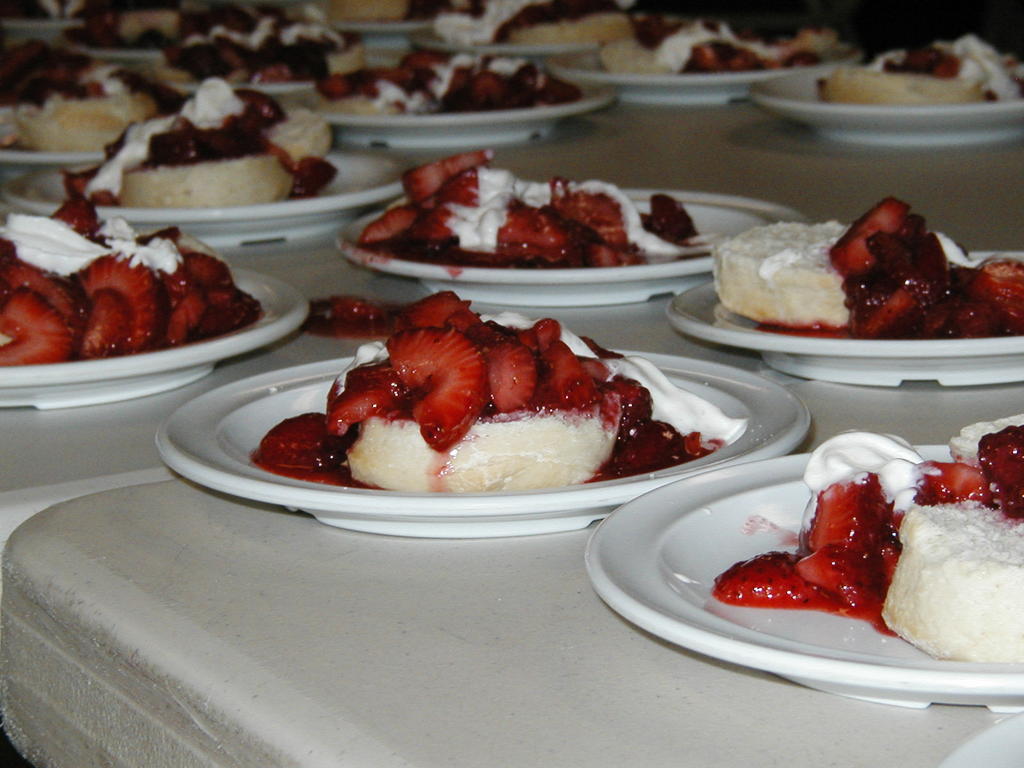
Tonight's dessert -- strawberry shortcake.