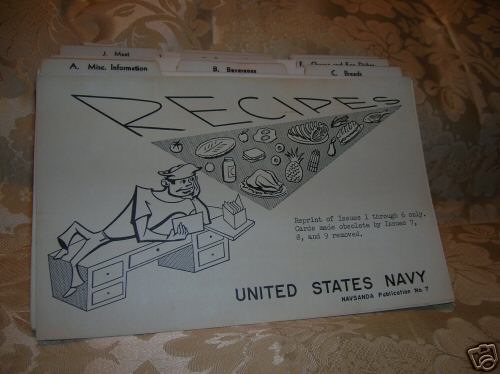
Showing posts with label armed forces recipes. Show all posts

Monday, January 07, 2013

Steamship round

The General Mess served steamship round of beef at NAS Kingsville, Texas, weekly during my tour from 1976 to 1978. In 1976, the roast was served on Thanksgiving Day and Christmas Day alongside roast tom turkey and baked Virginia ham. The roast was one of the signature dishes of the galley at the air station.

The cooks on the night watch placed the rounds in the large rotating oven early in the morning. According to U.S. Armed Forces Recipe Card No. L-4-1, a 60 to 75-pound steamship round took eight or more hours to roast at 300 degrees. When I worked the night watch, we set the oven temperature between 225 to 250 degrees. While the cooler oven temperature added two or three hours to roasting time, the crew was rewarded with a succulent slice of roast beef at meal time.

U.S. 5TH FLEET AREA OF RESPONSIBILITY (Jan. 1, 2013) -- Culinary Specialist Seaman Teresa Arnold, from Hamilton, Texas, serves steamship round in the aft galley aboard the aircraft carrier USS John C. Stennis (CVN 74). John C. Stennis is deployed to the U.S. 5th Fleet area of responsibility conducting maritime security operations, theater security cooperation efforts and support missions for Operation Enduring Freedom.

U.S. Navy photo by Seaman Daniel P. Schumache.


Monday, December 10, 2012

Creamed ground beef

Each year I receive two or three requests for the old military recipe for creamed beef. Known as SOS or "stuff" on a shingle, most ask for the recipe from the time period of their service to this great nation. In view of a recent request for a recipe that's suitable for a "small family," I have posted such a recipe. It's based on one pound of ground beef, which should be sufficient for the average family.

Click for the recipe for 100 portions if you need to serve a crowd. It's based on the 1969 U.S. Armed Forces Recipe Service card No. L-30.

I "enjoyed when it was served in the (CPO) mess," wrote a retired Navy chief petty officer.

CREAMED GROUND BEEF

1 pound ground beef
5-1/2 tablespoons all-purpose flour
1/4 teaspoon black pepper
1-1/2 teaspoons beef base
3-1/4 cups milk
1/2 teaspoon Worcestershire sauce

Brown beef in its own fat in an saucepan or skillet. Drain excess fat. Add flour, pepper and beef base to beef. Mix thoroughly and cook until flour is absorbed.

Add milk and Worcestershire sauce to beef mixture. Heat to a simmer, stirring frequently. Cook until thickened. Adjust seasoning with salt, pepper and Worcestershire sauce to taste. Serves 4 to 6.

Saturday, May 12, 2012

Military recipe committee meets to explore healthy options

By Kathy Adams
Naval Supply Systems Command Corporate Communications

MECHANICSBURG, Pa. (NNS) -- Members of the Joint Services Recipe Committee met April 25 at Naval Supply Systems Command headquarters to collaborate on new recipes and suggest new food products that provide healthy options for the 21st Century Sailor and Marine.

PERTH, Australia (April 26, 2012) -- Culinary Specialist 3rd Class Darrius Thomas, left, assigned to the guided-missile destroyer USS Bunker Hill (DDG 52), and Culinary Specialist 2nd Class Roosevelt Roberts, right, assigned to the Nimitz-class aircraft carrier USS Carl Vinson (CVN 70), prepare vegetables at the Incontro Restaurant in Perth during a chef exchange visit. The visit is part of the Cooks and Chefs Exchange Program, which allows U.S. Navy culinary specialists and restaurant chefs to meet and exchange information. Carl Vinson was anchored in Perth for a port visit. (U.S. Navy photo by Mass Communication Specialist Seaman Dean M. Cates.)
The Joint Services Recipe Committee is comprised of Army, Air Force, Marine Corps, and Navy dietitians, and Army Public Health Command personnel. The committee meets quarterly to review recipes and determine new products to be tested at the Armed Forces Recipe Service testing site in Natick, Mass.

"It all starts with a great recipe," said Cmdr. Danny King, director of food service for the Navy. "Our recipes bring quality ingredients together creating the base for our menus. By choosing healthy ingredients, we make healthy recipes that create healthy menus."

The recipe committee's efforts contribute toward the goal of producing healthy, nutritious meals that taste great, sustain the warfighter and support a one-catalog concept that can be supportable worldwide by Defense Logistics Agency-Troop Support for all services (Army, Navy, Marines, Air Force, and Coast Guard).

"Taking a fresh look at recipes is an important part of incorporating healthy alternatives in food prepared for all services," King said.

"The Joint Services Recipe Committee is the backbone of nutrition for Sailors and Marines," said Jennifer Person-Whippo, Navy nutrition program manager and registered dietician. "The committee ensures that quality ingredients are available for use by food service personnel around the world.

"Ethnic flavors and food trends are considered during recipe development and revision," said Person-Whippo. "Feedback from service members who prepare the food is key to determining what works and what food items are well-liked in the field. When new recipes are proposed, dietitians prepare the recipes and scale them to quantities of 100 portions for all services to use.

"From a Navy perspective, food is the biggest factor affecting morale on the ship," said King. "Nothing impacts Sailors more on a daily basis than meals. Trained culinary specialists prepare top quality, fresh, and nutritious foods, contributing to the quality of life for Sailors and Marines who are deployed as well as those stationed ashore."

The Navy's more than 7,300 culinary specialists, deployed around the globe feed on average more than 92.5 million wholesome and nutritious meals per year, ensuring the Navy's fighting forces operate at peak performance and are ready to respond to threats worldwide.

Navy commanding officers agree that nothing impacts Sailors on a day-to-day basis more than the food culinary specialists prepare for them; they believe these top quality meals contribute directly to Sailor quality of life and morale.

Today's culinary specialists have greater culinary instruction than ever before. With even more advanced training on the way, Sailors, both afloat and ashore, can look forward to even healthier and better-tasting meals in the near future.

Friday, October 30, 2009

Armed Forces Recipe Service link

I have repaired the link to the Armed Forces Recipe Service. It seems the U.S. Army plays with the URL every year or so.

The Army IT folks moved the file to a new folder that reflects the new Army food service organization. The organization is now called the Joint Culinary Center of Excellence.

The main AFRS link takes you to a searchable PDF file that's located on the U.S. Army Quartermaster School website.

If you prefer, you can download a ZIP file of the military recipe database. The link takes you to the food service publications page. Click on "Download Recipe Service" and follow the instructions to extract the file.

The Army food service publications webpage also includes a nutritional analysis of recipes in the AFRS.

The AFRS is also available on the U.S. Navy and Marine Corps websites at:
  • Marine Corps -- a PDF with a table of contents
  • Navy -- note that there's a problem with the Navy's security certificate

Monday, February 23, 2009

Recipe set sold

A quick note: The 1963 Navy-Marine Corps Recipe Service set that was for sale on eBay was purchased this afternoon.

This is the first time that someone purchased an eBay item as a result of this blog.

Sunday, February 22, 2009

1963 US Navy and Marine Corps recipe set for sale on eBay

I occasionally receive an email like this one:
Hello, my name is Robert. I served in the Navy from 1985-1989. During that time I was a cook. I served at GTMO and the USS SAIPAN. Recently I purchased a disc with military recipes. While this has been helpful, it doesn't seem to be the same as the cards from the old days. My memory from that time tells me that some recipes are not on the disc. My question is this, is it possible to obtain a set of recipe cards from that time frame? And if possible how would I go about purchasing them?
You're right, Robert. The Armed Forces Recipe Service on CD-ROM is an electronic copy of the current version of the famed military recipe cards. All the manufacturer does is download the Adobe PDF files from a U.S. Government website and package it into a format the most computers can read.

I often use my copy of the CD recipes to plan for event. I print each recipe so I can write purchasing, production and serving notes right on the recipe.

Since I rarely cook for exactly 100 persons (and the fact that US military serving sizes can be hefty), I also make adjustments to ingredients and note that right on my printed sheet. After the event, I save all the printed recipes in a file as a record of the event.

In addition to giving you standard ingredient amounts and instructions, the big advantage with AFRS is purchasing. Anytime you need to know how many pounds of an item serves 100 persons, just look it up on AFRS. (Remember that servings per hundred is always tied to serving size.)

Once you have a basic understanding of ingredients, amounts and method, you can easily add that special ingredient or two that sends the recipe "over the top."

In case you're interested in a piece of Navy and Marine Corps history, I found a set of 1963 Navy-Marine Corps Recipe Service recipe cards for sale on eBay. The seller is asking just under $60 for the set, which appears to be complete (although individual recipes could be missing).

Saturday, January 10, 2009

US Navy Recipe Service for sale on eBay update

Interestingly, no one bid on the 1950s U.S. Navy recipe set on eBay. The auction, which just concluded, ran for about a week.

Watch the eBay listings if you're interested in this recipe set. Although it's tempting, I already have several recipe sets from the era and won't be bidding.

Click here to locate seller's listing. I'm sure that he will re-list the item soon.

You can also locate this set and similar military cookbooks, like the 1944 Cook Book of the U.S. Navy, by searching on the terms "navy recipe."

Sunday, January 04, 2009

US Navy Recipe Service for sale on eBay

Here's another item from my eBay watch: It's post-World War II Navy recipe set. The starting bid is $5. The auction ends just after noon on January 10, 2009. There are no bids currently.

Good luck and enjoy ...

Thursday, November 06, 2008

Navy minced beef

I received this email from a disabled Navy veteran the other day:
I would like the recipe for mince beef on toast for a family of 4. I loved that when I was in the Navy. I am now a disabled vet.

Thank you,
Billy G. Reeder
Before I print my scaled-down recipe, here's a bit of history on Navy minced beef. I last wrote on the topic two and one-half years ago here.

According to retired chief commissarymam Tom Selland, his ship only served chipped beef one time each year.

"The crew went up in arms," said Selland. Minced beef on toast was the SOS of choice for sailors.

"Minced beef was highly acceptable," said Selland. "They liked it a lot better than spinach quiche."

As you may guess, Selland said this with a smile on his face. To paraphrase a popular cliche from the 1970s: Real sailors didn't eat quiche in those days.

Minced beef is uniquely Navy. It was found in every Navy cookbook until the inception of the Armed Forces Recipe Service in 1969. In fact, the recipe for creamed beef doesn't appear in any Navy cookbook between 1940 and 1962.

Minced beef is prepared by adding ground beef to a tomato sauce, according to Selland. It’s cooked much like Army cooks prepared creamed beef. But it’s the of mace or nutmeg that made minced beef unique.

According the Navy’s 1962 recipe, the commissaryman braised ground beef and chopped onions in a copper -- that’s what commissarymen have called steam-jacketed kettles since the day’s of sail.

He then added flour to the meat and cooked the mixture until it browned. (Commissarymen stirred the meat mixture with large flat paddles called copper paddles.) He finished the dish by adding water, nutmeg or mace, salt and ground black pepper.

Like chipped beef or creamed beef, minced beef was served over toast points.

Selland learned to cook minced beef on his first ship, the USS Polaris (AF 11), as a seaman and commissaryman third class. He said that the chief commissaryman on the Polaris -- he couldn't remember his name -- taught the cooks to thicken the tomato sauce for the minced beef with cornstarch.

Instead of adding flour to the beef as it braised in the copper, the commissarymen on the Polaris added tomatoes, water, nutmeg or mace, salt and pepper to the copper. They thickened it with a cornstarch slurry. Selland continued to use this recipe throughout his career.

NAVY MINCED BEEF

I scaled Armed Forces Recipe Service recipe No. 36 from 100 portions down to 5. It's the recipe I used on the USS Cocopa and USS Stein in the late 1970s.

On board ship, we would cooked the beef in a steam-jacketed kettle with the drain open. The fat drained off as we stirred the meat and onions. Cook beef with onions in its own fat until beef loses its pink color, stirring to break apart. Drain or skim off excess fat.

1-1/2 pounds ground beef
1/2 cup chopped onions
6 tablespoons all-purpose flour
1 (15-ounce) can tomatoes, crushed
1/2 teaspoon ground mace (or ground nutmeg)
1/3 to 1/2 teaspoon salt
1/4 teaspoon ground black pepper
6 tablespoons water

Braise beef in its own fat with onions. Sprinkle flour over beef and continue cooking until flour is absorbed. Add tomatoes, spices and water. Stir to mix well. Simmer 10 to 15 minutes. Makes 5 (1-cup) or 10 (1/2-cup) portions.

Saturday, September 27, 2008

Value of a recipe ...

Early last week Cathy posted a comment to my recipe for Beef Tacos for 100. The recipe helped her determine purchase amounts for the tacos. Here's he brief message:
Thanks for the help! I'm cooking for church this week and I didn't have any idea how many pounds of stuff to purchase. Cathy
Thank you for your input, Cathy. Your comment succinctly indicates that a recipe is more than a list of ingredients and a set of instructions.

A well-written recipe tells you how much food to purchase. When it's written for 100 portions (as many institutional recipes are) you can derive important data on the quantity per hundred to purchase and prepare.

As you found out, 22 pounds ground beef will yield 100 (1/4-cup) servings of seasonned, cooked taco meat. That's enough meat for 200 tacos.

Saturday, August 23, 2008

Armed Forces Recipe Service

I fixed the link to the U.S. Armed Forces Recipe Service. Adobe Acrobat copies (in PDF format) are available for download for free from the U.S. Army Quartermaster website.

Monday, May 28, 2007

Armed Forces Recipe Service Set on eBay

Here's a fitting post for Memorial Day:

The U.S. Armed Forces Recipe Service is a wonderful recipe resource. A 1969 set has appeared for sale on eBay. The Buy it Now is $50. This a great find for anyone who cooks for large groups often.

The seller's mother "aquired this years ago when she first started catering. The man she got it from told her he was a cook in the Army and this was the recipe box that they used for cooking. Every card has the ingredents for making 100 portions. The metal box is 8-1/2 wide, 13 long and 6 inches high."

I used them throughout my 29-year active and reserve career with the U.S. Navy. Most recipes are basic and do not have a lot of exotic ingredients or preparation techniques.

Each recipe is written for 100 portions and gives you:
  • Number of pans per 100 portions
  • Pan size in common U.S. pan sizes
  • Serving size, usually in ounces, cups or pieces
  • Oven temperature for baked items
  • Ingredient list on the left-hand column
  • Weight and volume of each ingredient for 100 portions--on these cards, each preparation step is tied to one or more ingredients in the two center columns
  • Preparation method delineated in clear steps in the right-hand column
  • Notes at the end of the recipe that list alternative ingredients (especially dehydrated) and preparation notes—most notable are: "as purchased" (A.P.) and "edible portion" (E.P.) amounts are given here
  • Variations to the recipe--often, these variations are for dehydrated and other special foods that the US military buys

Although I have a number of AFRS sets from the 1950s to the 1990s, I most often use the Internet version of AFRS when planning an event. I print each recipe so I can write purchasing, production and serving notes right on the recipe.
Since I rarely cook for exactly 100 persons (and the fact that US military serving sizes can be hefty), I also make adjustments to ingredients and note that right on my printed sheet. After the event, I save all the printed recipes in a file as a record of the event.

In addition to giving you standard ingredient amounts and instructions, the big advantage with AFRS is purchasing. Anytime you need to know how many pounds of an item serves 100 persons, just look it up on AFRS. (Remember that servings per hundred is always tied to serving size.)

Once you have a basic understanding of ingredients, amounts and method, you can easily add that special ingredient or two that sends the recipe "over the top."

I don't have any connection with the seller.

Monday, October 09, 2006

French Fried Cauliflower

This recipe may be nothing more than a curiosity to most folks. It's adapted from the circa 1970s U.S. Armed Forces Recipe Card Q-20.

For those who want to try this recipe, use it a starting point. I found one recipe that calls for a yeast-risen batter that's flavored with dry mustard and a touch of sugar, not no Parmesan. Another used cumin and tumeric to give it a Southern flare.

FRENCH FRIED CAULIFLOWER

Prepares 100 (1/2-cup) portions.

5 cups milk
12 eggs, beaten
12 pounds frozen cauliflower, partially thawed
2 pounds 6 ounces all-purpose flour
2-1/2 ounces salt
2 teaspoons black pepper
9 ounces grated Parmesan cheese

Mix milk and eggs well. Cut large cauliflower pieces in half . Combine flour, salt, pepper and cheese.

Dip in milk and egg mixture. Drain well. Dredge cauliflower in flour mixture. Shake off excess. Fry 3 minutes in 375-degree deep fat fryer or until golden brown. Drain on absorbent paper.

NOTE: Fry in small batches. Cauliflower loses crispness if allowed to stand on steam table.

Thursday, June 22, 2006

Navy Recipe Cards on eBay

Occasionally I receive an email asking me to locate a Navy recipe card set. I found this set on eBay this morning. It's misidentified as a World War II recipe set. During World War II the Navy published its recipes in book form. The Navy Recipe Service was first published in card form sometime in 1950s.

Here's the description:
I came across these awesome old recipe cards at an estate sale. The seller was selling her parents personal belongings, these belonged to her father, who was the Chief Petty Officer on board the U.S.S. MONTPELIER. The recipe cards are in wonderful condition. There are 16 different catorgories from MISC. INFORMATION to VEGETABLES, all the recipes are for 100 PORTIONS. Very interesting to read.

Saturday, June 03, 2006

Armed Forces Recipe PDFs

I found a source of the U.S. Armed Forces Recipe Service in Adobe Acrobat files. They're the same recipes that you find on the Navy Supply website. Click here to access the recipes.

Monday, May 29, 2006

Tartare Sauce

I had a request from a World War II veteran trying to locate the Navy recipe for tarter sauce.
Norman Scott wrote: "A friend, now 84 years old, was in the navy long ago aboard a carrier and when fish was served he thought the tarter sauce was exceptional. He now fishes for fun in Ontario, Canada, and would dearly like to have the recipe for tarter sauce. Other than buying old USN cookbooks, is there a way I can find an old tarter sauce formulation?"
Here's the recipe for tartare sauce (yes, that's the correct spelling for the recipe):

TARTARE SAUCE

1/2 cup capers
1/2 cup chopped olives
1/2 cup chopped pickles
1/4 cup chopped onions
1/4 cup chopped parsley
1/2 gallon mayonnaise

Combine capers, olives, pickles, onion and parsley. Stir into mayonnaise. Mix well. This recipe makes approx 1/2-gallon. Serving size is 1-1/2 tablespoons.

Source: Cook Book of the United States Navy, 1944, page 218.

Sauerbratten and Armed Forces Recipe Service

I received this email from Davis Boshart:

I am a former CS-2 and served on the Bon Homme Richard (CVA-31) from '69-'72. I helped de-commission her. Recently I tried to remember how to do sauerbraten beef which was a recipe in the standardized recipe file. I came close but the flavor wasn't what I remembered. How do I get a copy of that recipe? For that matter is there a chance of getting a complete set of those cards? I look forward to hearing from you on this; any help you could give would be greatly appreciated.
Thanks for writing, David. I too remember cooking sauerbraten, although it wasn't one of my favorites. I like the sharpness that the vinegar adds, but the dish looses it for me once you add the gingersnaps.

I'll post the recipe tonight.

Armed Forces Recipe Service

The US Armed Forces Recipe Service is a wonderful recipe resource. I used them throughout my 29-year active and reserve career with the US Navy. I use them each summer at camp. You can find the AFRS on the Internet at http://nll.navsup.navy.mil/recipe/.

Each recipe is written for 100 portions and gives you:
  • Number of pans per 100 portions
  • Pan size in common US pan sizes
  • Serving size, usually in ounces, cups or pieces
  • Oven temperature for baked items
  • Ingredient list on the left-hand column
  • Weight and volume of each ingredient for 100 portions--on these cards, each preparation step is tied to one or more ingredients in the two center columns
  • Preparation method delineated in clear steps in the right-hand column
  • Notes at the end of the recipe that list alternative ingredients (especially dehydrated) and preparation notes. Most notable are: "as purchased" (A.P.) and "edible portion" (E.P.) amounts are given here
  • Variations to the recipe--often, these variations are for dehydrated and other special foods that the US military buys
Although I have a number of AFRS sets from the 1950s to the 1990s, I most often use the Internet version of AFRS when planning an event. I print each recipe so I can write purchasing, production and serving notes right on the recipe. Since I rarely cook for exactly 100 persons (and the fact that serving sizes can be hefty), I also make adjustments to ingredients and note that right on my printed sheet. After the event, I save all the printed recipes in a file as a record of the event.

In addition to giving you standard ingredient amounts and instructions, the big advantage with AFRS is purchasing. Anytime you need to know how many pounds of an item serves 100 persons, just look it up on AFRS. (Remember that servings per hundred are always tied to serving size.) Once you have a basic understanding of ingredients, amounts and method, you can easily add that special ingredient or two that sends the recipe "over the top."

As for collecting complete recipe sets: AFRS is very difficult to locate, especially on eBay. I'm not curtain that I've every purchased a 5- x 8-inch AFRS set on eBay. Most AFRS sets in my collection were acquired during my 29-year career in the Navy. A retired chief commissarryman gave me one or two sets before he passed on.

AFRS is now available on CD for less than $10. I purchased a set in Adobe Acrobat last year from eBay. A CD is available right now for $9.99 with the "Buy it Now" feature of eBay. Search on the keywords "Navy recipe" and you'll find it. A few dollars saves you the time of individually downloading each recipe from the naval supply website. It's a valuable addition to any culinary library, especially if you cook for large groups.

MSCS Steven C. Karoly, USN, Ret

Monday, May 08, 2006

American Chop Suey Recipe

This recipe is adapted from U.S. Armed Forces Recipe Service card L-64. It yields 100 (1-cup) portions or 2 (18 by 24-inch) roasting pans. Bake at 350 degrees.

1-1/2 gallons water
1 (#10) can tomato paste
1 (#10) can diced tomatoes, drained
1-1/2 pounds diced green bell peppers
1-1/4 pounds chopped onions
3/4 cup granulated sugar
1/4 cup salt1 tablespoon ground black pepper
1 tablespoon garlic powder
2-2/3 tablespoons dried crushed basil
1 tablespoon crushed red pepper
1 tablespoon dried thyme
6 pounds elbow macaroni
11 pounds lean ground beef
1 pound shredded cheddar cheese

Combine water, tomato paste, tomatoes, peppers, onions, sugar, salt, black pepper, garlic powder, basil, red pepper and thyme in steam-jacketed kettle or stock pot. Combine and bring to a boil. Reduce heat, cover and simmer 10 to 15 minutes or until thickened.

Add macaroni to boiling, salted water. Return to a boil, stirring constantly. Cook 10 minutes, stirring occasionally. Drain well. Do not overcook.

Brown beef until it loses its pink color. Drain or skim off excess fat. Combine beef, tomato sauce mixture, and macaroni. Mix well. Pour about 8-1/4 quarts macaroni mixture in each pan. Sprinkle 1-1/3 cups cheese over macaroni mixture in each pan.

Using a convection oven, bake 20 minutes at 325 degrees on high fan, closed vent or until mixture is bubbling and cheese is melted. Internal temperature must reach 155 degrees or higher for 15 seconds. Hold for service at 140 degrees or higher.

Sunday, April 30, 2006

SOS

I received this email from J P Maher the other day. He writes about SOS, or creamed beef. SOS is the dish that most servicemen either loved or hated. Few straddled the fence on this one.
My brothers, brothers-in-law and I logged a total of nearly forty years in the military. My hitch of 3 years, 9 months and 6 days was in the Cold War, the others in WWII and Korean War era. I'm a translator, culture historian and etymologist. We know whereof we speak.

SOS ("stuff" on a shingle) was NOT Creamed CHIPPED Beef, but Creamed GROUND Beef. Quite gloppy. Some troops loved it. I tried it once and swore off. This is not to say that some troopers learned it another way, but here's the authentic scoop.

Creamed CHIPPED Beef was one of my favorite dishes, whether in the mess Hall or my mother's kitchen.

It was the greyish ground beef recipe that we called "'stuff' on a shingle/SOS."

J.P. Maher, Ph D, E-5RA
(Regular Army)
Professor Emeritus
Thanks for the information, J.P. From my recollection as a 29-year veteran of Navy and Seabee galleys -- both active service and reserve duty -- SOS had a generic definition. Any of the dishes, creamed ground beef, creamed chipped beef and minced beef for instance, were collectively called SOS by sailors.

My favorite? Creamed ground beef. I still eat it's country kin: sausage gravy with biscuits when I get a chance. Creamed chipped beef was too salty, even after rinsing the salt away. Minced beef is just plain horrible any way you fix it!

We served creamed ground beef each morning during my last large field exercise with NMCB-17 in 1994 at Fort Hunter Liggett, California.

Official 1969 Armed Forces recipe for Creamed Ground Beef

1969 Armed Forces Recipe Service Card no. L-30
Yield: 100 portions
Portion: 1 cup

24 pounds ground beef
2 pounds all-purpose flour
1 tablespoon black pepper
6 tablespoons salt
4 ounces beef soup and gravy base
3-1/2 gallons warm milk
2 tablespoons Worcestershire sauce

Brown beef in its own fat in steam-jacketed kettle or roasting pan. Drain excess fat. Add flour, pepper, salt, and soup and gravy base to beef. Mix thoroughly and cook about 5 minutes until flour is absorbed. Add warm milk to beef mixture. Add Worcestershire sauce; heat to a simmer, stirring frequently. Cook until thickened.

Thursday, September 22, 2005

Dijon Crusted Pork Chops

.
The other night I baked pork chops with a Dijon crust. After dipping the thin chops is a Dijon mustard and mayonnaise sauce, I dredged them in Panko bread crumbs. The chops were good. But the soggy crush slipped right off the chops when I removed them from the baking dish.

The top crust browned fairly well around the edges of each pork chop. The center was soggy disappointed me. My guess is the sauce pooled in the center of each chop. A messy experience indeed!

The subtle flavor of the Dijon-infused crust impressed me. The sauce, tempered with the richness of the mayonnaise and sweetness from the apple juice, contrasted the herb-flavored Panko bread crumbs very well.

This recipe was definitely a keeper. I got the idea from a U.S. Armed Forces Recipe Service recipe card. (I’ve said in the past that these recipes are ideal for any volume operation that’s looking for basic quantity recipes. You do need to test each recipe before adapting it to your menu.)

I found the recipe for Dijon baked pork chops Tuesday afternoon in my computer recipe file. I needed to do something with three pork chops that were sitting in the refrigerator. The Dijon crusted pork chop appealed to me with the marriage of distinct flavors and textures.

After dipping the pork chops in the Dijon sauce, the recipe instructed the cook to dredge it in bread crumbs and set them on lightly oiled sheet pans. Military cooks use convection ovens today. The blast of dry, hot air quickly browns the crust. The bottom crust even browns as heat is conducted up through the thin skin of the aluminum sheet pans.

Although the recipe for Dijon baked pork chops might work in an institutional setting, my challenge was to re-work the recipe for a cast iron skillet or Dutch oven.

Instead of baking the pork chop in the sometimes unpredictable heat of a Dutch oven, I elected to cook the in a skillet. I first dredged the pork chops in flour seasoned with salt and pepper. Next came a quick dip in a thinner Dijon mustard sauce. I found that you need to let the excess sauce drain from the chop.

To finish, I dredged the pork chops in bread crumb and herb mixture and placed them in hot fat. Do not crown more that four chops in a 10-inch skillet. I also reduced the heat to medium after pre-heating the skillet over medium-high heat. This gave the crust time to brown and thoroughly cook without burning. And it cooked the pork chop to a nice medium to medium-well doneness.

DIJON CRUSTED PORK CHOPS

Panko bread crumbs are used in Japanese cooking for coating fried foods. They’re ideal for breading because they create a deliciously crunchy crust. Locate Panko bread crumbs in the Asian isle of the supermarket. About 1/4 cup bread crumbs are needed for each pork chop.

1/4 cup Dijon mustard
2 tablespoons mayonnaise
1/4 cup apple juice (or chicken broth)
1/3 cup all-purpose flour
Salt and pepper, to taste
1 cup Panko bread crumbs
2 tablespoons finely chopped fresh parsley
1-1/2 tablespoons chopped fresh thyme
4 center-cup pork chops, about 5 ounces each

Combine flour, salt and pepper on a plate. Combine mustard, mayonnaise and apple juice or broth in a bowl. Combine bread crumbs, parsley and thyme on a plate. Pre-heat a 10-inch cast iron skillet over medium-high heat. Heat about 2 tablespoons oil in skillet.

Dredge pork chops in flour to coat. Then dip pork chops in mustard sauce and drain off excess. Dredge in bread crumb mixture. Place chops in skillet and cook until nicely browned, about 5 to 8 minutes per side. Add additional oil as needed to brown chops. Adjust heat under skillet to prevent burning.