Showing posts with label Diamond and Caldor Ry. Show all posts

Wednesday, October 07, 2009

New reader ... sort of

One of the joys of writing a blog is that you occasionally meet one of your readers. Most find 'Round the Chuckbox through web searches or word-of-mouth as I don't expend a lot of effort marketing the blog.

Occasional Dutch oven cook Matt Allen (pictured, left) first found the blog some two years ago during a Google search for camping recipes. Matt enjoys baking sheepherder's bread and apple crisp in his Dutch ovens while camping.

However, Matt and I didn't meet in a culinary context as you might expect. He quickly jumped to the the El Dorado Western Railway blog. As a railroad enthusiast, he's followed the crew's effort to restore the Diamond and Caldor No. 4 Shay locomotive for the past two years.

We finally met Saturday at the engine house, where Matt quickly found a place as the railway pipefitter. He's agreed to evaluate and design the piping for the airbrake system for the Diamond and Caldor Railnus No. 10 at the El Dorado County Historical Museum.

Maybe Matt will agree to assist me next time I cook for the crew.

Sunday, September 13, 2009

Lunch at the engine house

I haven't cooked lunch for the crew at the engine house of the El Dorado Western Railway in six months. Several priority projects kept me from cooking in the months leading to my early June departure for the summer camp job. My labor was more important at that point.

Railway President Keith Berry and I first discussed a lunch meal several weeks ago. We both wanted to reward the crew for a summer of notable accomplishments. Twice this summer, Keith called on the volunteers to complete high-profile projects in a short period of time.

Last June the crew rallied to remove the rail, tie plates and rail joiners from the old Southern Pacific yard at Diamond Springs. Once the county gave its approval to remove the track and associated hardware, we had no more than two weeks to complete the track disassembly.

The crew completed the project in eight days. Several volunteers worked every day. The rails and hardware will be used to add a third rail and build the yard at the recently approved El Dorado County Historical Railroad Park in the town of El Dorado.

The county board of supervisors approved the park on August 25. The park will be located on the right-of-way of the Southern Pacific depot in El Dorado.

Volunteers again answered the call this weekend when it became evident that we had to move about 300 ties to a secure location. The ties were open to theft in their current location along the old right-of-way, which is being converted into a riding and walking trail.

Lunch menu

I often use meals at the engine house to try new recipes and to use ingredients that I already have at home. Since I had a 4-pound pork shoulder in the freezer, I knew the menu would be built around a pork dish.

Although chili verde is a favorite -- a dish I enjoy cooking for potlucks -- I wanted to try a flavor combination that was new for me. The idea for a pork stew came to me as I watched Alton Brown's Good Eats television show last week.

In the re-broadcast of his 2005 "Dis-Kabob-Ulated" episode, Brown marinated beef sirloin in a spicy marinade with red wine vinegar and olive oil. Turmeric, smoked paprika and cumin formed the flavor base for the marinade.

Since it isn't practical to make pork kabobs with the tougher pork shoulder, a braised or stewed dish seemed to be the best way to tenderize the meat. I used the marinade to impart flavor, then prepared a tradition stew from that point.

I worked the recipe in my mind Friday evening as I moved railroad ties. I had originally planned to work out the menu and shop that evening. But a 3 p.m. telephone call from Keith brought me to the Diamond Springs yard instead.

When I arrived at the storage site for the ties, the crew asked me what was on the lunch menu for Saturday. I received a chuckle or two when I told them that Keith had pulled me away from my menu planning duties.

They weren't amused when I said that I should be home planning the menu. At that moment, the crew was more interested in my back than culinary skills. Since we didn't quit until 7:30 p.m., I delayed shopping until Saturday morning.

My original thought was to prepare the stew with orange marmalade, but hit on the idea to build the stock with apple juice after moving almost 250 ties. Yams and apples seemed like a natural addition from that point.

Here's the menu for the El Dorado Western Railway lunch:
I arrived at the museum yesterday around 9 a.m. After setting the chuckbox and firepan up next to a historic Studebaker wagon, charcoal briquettes were lit by 9:30 a.m. and the meat was at a simmer shortly after 10 a.m.

All three dished were prepared in 14-inch Dutch ovens. While I could've made the stew in a 12-inch deep Dutch oven, I customarily use 14-inchers when cooking for crowds.

In the end, 11 crew and guests enjoyed the meal. While I cooked, the crew loaded the 1937 Waukesha engine from the Diamond and Caldor railbus onto Doug's trailer. Doug is going to rebuild the six-cylender engine and return it to the museum next spring.

After lunch, Keith asked if I was going to help move the last 40 or 50 ties at Diamond Springs yard. Lunch over, it was time to get back to work.

PORK STEW WITH YAMS AND APPLES

Use the marinade to flavor diced beef for spicy beef kabobs. Prepare the marinade and combine with 3 to 4 pounds of boneless beef sirloin as directed. Alton Brown's recipe has cooking instructions.

4 pounds pork shoulder
8 cloves garlic, minced
4 teaspoons paprika
1 teaspoon turmeric
2 teaspoons ground cumin
2 teaspoons kosher salt
1 teaspoon ground black pepper
2/3 cup red wine vinegar
1 cup olive oil
1 quart apple juice
2 pounds yams or sweet potatoes, diced
3 Granny Smith apples, diced

Cut the pork into 1- to 1-1/2-inch cubes and place into a large bowl or container. Set aside.

In a bowl combine garlic, paprika, turmeric, cumin, salt, pepper and red wine vinegar. Drizzle in olive oil while vigorously whisking.

Pour the marinade over meat and toss to coat. Place in the refrigerator in an airtight container or a zipper-lock bag and marinate for 2 to 4 hours.

In a colander, drain marinade from stew. Discard remaining marinade. Heat a 6- or 8-quart Dutch oven to medium-hot. Brown pork in 2 or 3 batches to avoid overcrowding. Remove each batch to a waiting plate or bowl as it's done.

Return browned pork to Dutch oven. Add apple juice and stir. Season with salt to taste. Simmer until pork is tender, about 60 to 75 minutes. Add yams and apples and continue cooking until yams are tender, about 15 to 20 minutes.

Makes about 12 (1-cup) servings. Serve over buttermilk biscuits.

Wednesday, March 12, 2008

Through the eyes of a steam dome

The engine house and museum yard reflect back into the polished steam dome cover from the Diamond and Caldor No. 4 as I take the picture. The Shay geared locomotive is being restored to full operation by the El Dorado Western Railway. It's located at the El Dorado County Historical Museum in Placerville, California.

Monday, February 04, 2008

Cookin' hot dogs in the rain

We try to cook several times each year at the engine house of the El Dorado Western Railway. Since our focus is restoration of the Diamond and Caldor Railway No. 4 locomotive, the fare is simple and direct.

This is railroad food, alter all. I don't have a lot of time to cook gourmet meals, especially when I have a newsletter to produce and need to help with projects. Our meals tend to be quick affairs that let us get back to work quickly.

Thus past Saturday, Keith Berry lit a charcoal fire in an old blacksmith's forge. His object was to bake old grease off of the brake linkage rods for the locomotive.

True to our nature, fire in the engine house can only mean one thing -- it's time to cook!

Four large Polish sausages (about 6 ounces each) came courtesy of Bill Rodgers, our treasurer and jack-of-all-trades. In the picture, Bill tends sausages on the grill during a light rain. An inverted wheelbarrow shields the sausages and fire from the rain.

Saturday, December 08, 2007

Headin' to Logger's Final Rest

I took the photo for blog no. 9 this afternoon at the El Dorado Western Railway engine house.

This is one of those special effects that's not supposed to be. Standing on the deck of the Diamond and Caldor No. 4 Shay locomotive, I shot a series of photos of Keith and Sam as they removed the number three piston from the engine.

As I shot one last picture of Sam haul the piston to the machine shop, the camera buzzed back and forth while it tried to find a focal point. Sam was nearly outside the engine house when the camera flashed. The photo reminds me of Sam heading to the logger's final reward with a 75-pound piston slung over his shoulder.

Shot settings: f/5.6, 1/45 second shutter speed, ISO 400, 49 mm focal length in manual exposure mode with flash.

Sunday, October 07, 2007

Grilled Hot Mexican Beef Sandwich Santa Fe

At first glance, this sandwich filling looks like mystery meat. You know, one of those chopped meat fillings that you'd expect to find between two slices of white bread in a 1950s cafeteria.

With the possible exception of tuna salad, I've never had much use for these sandwiches. I'd rather build my own sandwich with meat, red onion, dill pickle and lettuce. There's comfort in taking the mystery out of distasteful ingredients.

While searching for a grilled sandwich last week in Dining By Rail, I ran across this chopped meat sandwich. It was served in the dining cars of the Atchison, Topeka and Santa Fe Railway.

What I found was a delightful roast beef sandwich. The robust flavor of the roast beef comes through even when mixed with chopped hard cooked egg, minced chili pepper, chopped pimento and shredded Swiss cheese. And the Russian dressing gives the sandwich a nice creamy texture.

No anonymous ingredients here. The sandwich was a hit Saturday at the engine house of the El Dorado Western Railway. I served it with old fashion navy bean soup and cole slaw.

GRILLED HOT MEXICAN SANDWICH SANTA FE

This sandwich is a great way to use leftover roast beef. Santa Fe cooks toasted open faced sandwiches under a red-hot broiler. I adapted the sandwich to engine house cooking by toasting it in a cast iron skillet. I added sliced tomatoes and changed the hot chilies to fresh (from fresh, parboiled).

Filling:
1 pound cooked roast beef, diced fine
4 hard cooked eggs, chopped
4 hot chilies, chopped fine
1 (4-ounce) jar pimentos
1 celery stalk, chopped fine
4 ounces Swiss cheese, shredded

Russian dressing:
1/2 cup mayonnaise
1 teaspoon lemon juice
1/2 cup chili sauce
2 teaspoons hot pepper sauce

Soft butter
12 medium tomato slices
12 slices French or Italian bread

In a medium bowl, mix thoroughly the roast beef, eggs, chilies, pimentos, celery and Swiss cheese. For the dressing combine mayonnaise, lemon juice, chili sauce and hot pepper sauce. Fold dressing into the sandwich filling.

Spread butter on one side of each bread slice. Lay out 6 slices, buttered side down. Divide filling generously on bread slices. Top each sandwich with 2 tomato slices on and top with remaining bread, buttered side up.

Grill sandwiches in a heavy skillet over medium-high heat until both sides are golden brown, about 2 to 3 minutes per side. Serves 6.

Saturday, October 06, 2007

Old Fashioned Navy Bean Soup

The crew of the El Dorado Western Railroad pulled its star attraction out of the engine house this morning for the second annual Fall Home and Harvest Show.

I used the occasion to prepare lunch for 12 volunteers of the railway and museum. In honor of our locomotive's 100th year, I selected dining car recipes from two railroad cookbooks -- Chesapeake and Ohio Dining Car Recipes, compiled by E. Stirling "Tod" Hanger, Jr. (C&O Historical Society: Clifton Forge, VA, 1995), and Dining By Rail: The History and Recipes of America's Golden Age of Railroad Cuisine, by James D. Porterfield (St. Martin's Griffin: New York, 1993).

The old fashion navy bean soup is composite recipe from the Denver and Rio Grand Western Railroad and the Chesapeake and Ohio Railway. I also prepared cole slaw from the Missouri Pacific Lines and toasted hot Mexican sandwich from the Santa Fe.

The 100-year old locomotive (Diamond and Caldor No. 4) is located at the El Dorado Historical Museum. Volunteers are on hand each Saturday from 8 a.m. to about 1 p.m. to show visitors the inner workings of a geared Shay locomotive.

OLD FASHION NAVY BEAN SOUP

I use low-sodium beef broth in the recipe so I can control the amount of salt that gets added to the recipe. I'd rather add salt later than use a heavily salted beef stock or base.

You need an 8-quart stockpot or No. 10 Dutch oven for this recipe. Use a 12-inch deep camp oven if you're cooking over hot coals outdoors.

2 pounds navy beans
4 quarts low sodium beef broth
12 ounces bacon, chopped
2 medium onions, chopped
2 medium carrots, diced small
6 medium tomatoes, peeled and diced
1/4 cup all-purpose flour
1/2 cup cold water
1 cup heavy cream
1/4 cup flat leaf parsley, chopped
Salt, to taste
Black pepper, to taste

Pick over beans, removing discolored beans and foreign matter. Wash thoroughly in cold water. Cover beans with beef broth and bring to a boil. Boil 2 minutes. Turn off heat. Cover and let stand 1 hour.

Saute bacon in a heavy large skillet until crisp. Drain off most of the bacon fat. Add onions and carrots and sweat under medium-low heat until soft. Add tomatoes and cook for 2 minutes before adding bacon-vegetable mixture to the bean pot.

Bring beans to a boil, cover and simmer 2 hours or until beans are tender. If needed, thicken soup with a flour and paste. Stir in the heavy cream and parsley just before serving.

Serves 20 (1-cup) portions. When used as the main course, the recipe will only serve 12 to 16 persons. This recipe yields about 5 to 5-1/2 quarts.

Saturday, April 14, 2007

Photography and the Diamond & Caldor No. 4 Shay

The sole surviving locomotive from the Diamond and Caldor Railway's 49-year existence is under restoration. The No. 4 Shay geared locomotive is located at the El Dorado County Historical Museum in Placerville, California. Bill Rodgers (in cab), Sam Thompson (on ladder) and Keith Berry discuss repairs to the number two cylinder.

I entered a new dimension of photography when I purchased a Canon Digital Rebel XT single lens reflex camera in 2006. I've used the past year to study its features and to elevate the camera beyond the realm of an $800 point-and-shoot camera.

Two lessons helped me compose today's photograph at the El Dorado Western Railway engine house. First, I used a tripod to steady the camera so I could shoot in the low-light inside the building. I knew the in-camera flash could never reach beyond the smokestack.

Sam made the point that you pay greater attention to composition when you use a tripod. He's right. Because the tripod often requires the use of a remote, I find you take greater care while setting up the shot. I find that want a perfectly composed picture as I remove my eye from the view finder.

The second lesson has greater value to me as the photographer for the railroad. You have to get dirty (while protecting the camera!). I climbed on top of the security cage and snapped the picture at eye level. Good photographs require the photographer to travel off the beaten track. You have to go to the picture. The best ones require effort.

This lesson became clear when the Mountain Democrat printed a feature story on the locomotive's 100th birthday. Photographer and writer Dan Burkhart stopped by the engine house three weeks ago to research the story.

Even though I missed his visit, Keith described Burkhart's climb to the top of the cage. After studying his feature picture in the paper, I knew I had to duplicate it.

Sunday, February 25, 2007

Where Do You Heat a Burrito in a Locomotive?

I sat down to lunch with Garrtett Augustus at Denny's after working at the engine house yesterday. I wanted to know where on the backhead is the best place to heat lunch.

Garrett ordered the mega meat lover's breakfast, a meal that comes loaded with hash browned potatoes, scrambled eggs and three breakfast meats.

It's easy to imagine sausage, bacon and sausages sizzling on a clean shovel. But I forgot one key element to cooking on West Coast Shays.

"Oil-fire locomotives have no coal scoop," said Garrett. He's right.

An experienced locomotive cook and one who has fired historic Shay locomotives, like the Yosemite Mountain Sugar Pine Nos. 10 and 15, Garrtett should know.

Garrett heats burritos, sandwiches and "anything that's packaged" in the engine cab with heat from the backhead. But he doesn't really cook.

There's "no surface with a controllable heat source that you can really cook on," said Gattett.

But the immense heat radiating off the boiler backhead will heat any prepared meal through. It's a matter of locating a good spot to capture the wasted heat.

The theory is simple enough. "Look for a good place to basically jam your food so it doesn't fall out."

Garrett likes several spots, but has no favorite. "It just depends what you're making," said Garrett.

Do you need slow heat? Try the oil can pan that sits above the firebox door. But be sure to wrap the burrito well as things get messy.

Intense heat can be found on the hydrostatic lubricator on the engineer's side of the cab. The four lubricating lines on the Shay are full of steam. Set close together, the lines act "almost like a grill."

It sounds like a good spot to grill a Rubin or grilled cheese sandwich. Just keep it simple and focus on firing the engine.

Any spot will do. All you need is is an exposed steam line, added Garret.

Garrett will sometimes jam a burrito behind the lifting injectors on the fireman's side. He also tucks it up behind the steam turret on top of the backhead. The turret's a great spot because it's the steam source for all accessories in the engine cab.

It's too bad an oil-burning locomotive like the Diamond & Caldor No. 4 Shay doesn't need a coal shovel. Just think of the culinary creations a fireman could cook on its flat griddle-like surface.

The photograph shows the backhead of Roaring Camp & Big Trees Narrow-Guage Railroad No. 1 Shay.

Thursday, February 15, 2007

Cookin' on the Railroad

Good food and railroads had symbiotic relationship until Amtrak took over passenger service in the early 1970s. Mainline roads were know for operating high-class diners as their trains crossed the country. Even the logging companies and their railroads used food draw employees. Many loggers were known for their cookhouses.

It was nice to see another railroad that cooks in the engine house like we do at the El Dorado Western.

My counterpart on the Pacific Coast Railroad Co. blog, Ed "Oil Can" Kelly, recently posted his January 2006 update. The crew gathered mid-month to thaw the engine house and trainmen at the height of California's deep freeze last month.

A busted water main left as flood in the engine house. The coffee pot, beef brisket and a frozen fireman's manifold competed for space on the shop's wood stove.

"Sometimes I am also the cook for this outfit and the chief bottle washer as well," said chief mechanical officer Phil Reader in response to my message on the Narrow Gauge Railroad Discussion Forum.

"Dutch ovens are a lot of fun. I get a kick out of using them."

I agree. Dutch ovens are a great way to combine my love for outdoor cooking and trains. A hearty meal in the engine house can bring the crew together. It's akin to mealtime tradition in the caboose.

So it seems natural that a train guy like Phil would cook in the steam locomotive. You have the essential ingredients for great railroad chow. Heat from the backhead and a hungry crew make for the perfect combination.

Cooking on the backhead is a tradition at the PCRR. Simplicity seems to be the rule. No gourmet foods on these rails. Spam and eggs, burritos and canned chili beans make perfect railroad fare.

"Someday I may have to write the steam railroader's backhead cookbook," said Phil.

Saturday, January 20, 2007

Sunset over Plummer Ridge

I hiked Trestle Trail in Eldorado National Forest last Sunday afternoon. It was nearly 5:30 p.m. after I made a brisk mile-long hike up the old Steely Fork railroad grade to the truck. The bright orange hues of the sun as it set over Plummer Ridge caught my eye. The photo is a little grainy. Next time I'll carry the tripod and shoot the picture at a much lower ISO.

Friday, January 19, 2007

Trestles on the Steely Fork Branch Line

Once the rails of the Diamond & Caldor Railway reached Caldor, some 34 rail miles east of Diamond Springs, three main feeder lines fanned to the north, east and south of the mill. The California Door Company used these lines to haul the freshly cut logs to its mill each day during the six to seven month logging season.

One of these feeder lines is still viable in the Eldorado National Forest several miles east of Grizzly Flat. The Steely Fork line ran northwest from the mill. At its northern most limit, it reached Bear Meadow.

The narrow-gauge expansion began in 1907. The line encompassed some 50 miles of logging spurs. The line allowed the company to log along North and South Steely creeks to Capps Crossing on the North Fork of the Consumnes River. The line reached Long Canyon and Bear Meadow to the west.

The Steely Fork line heads to the west as it climbs out of the Steely Fork canyon. This cut is found a hundred feet west of the ruins of the river trestle. The Steely Fork trestle crossed the river just west of the confluence of the North and South Steely creeks.

One of the few trestle bents that's remains upright. All four trestles collapsed years ago. Today the heavy timbers are slowly rotting.

The first trestle can be reached after a 10 minute hike from the Trestle Trail trail head. It's still possible to see some organization to the heavy bridge timbers on the ground. I was able to count a dozen or more bents at this trestle site. Most of the timbers (10x10 or larger) are in very good condition considering it's been 54 years since abandonment.

Bridge timbers are lined up on the ground between the eastern and western landings. This picture looks to the east.
Cross-posted at El Dorado Western Railway blog.

Sunday, January 07, 2007

Trestle Trail

This afternoon I took advantage of a light snow pack in the old logging area of the California Door Company. I've been looking for a weekend where I could survey the Trestle Trail in Eldorado National Forest east of the community of Grizzly Flat.

Very little evidence of the Diamond & Caldor Railway and its parent company, California Door Company, remain in the forest. Trestle Trail is a hiking trail that travels along one of the logging company's main feeder lines north of Caldor.

Here are three photos of our hike:

To access Trestle Trail, take Capps Crossing Road from Grizzly Flat to Forest Road 9N86. Continue east along the road for a half mile. Turn right onto Road 9N86A. An abandoned vehicle about three-tenths of a mile down the road partially blocks the road.
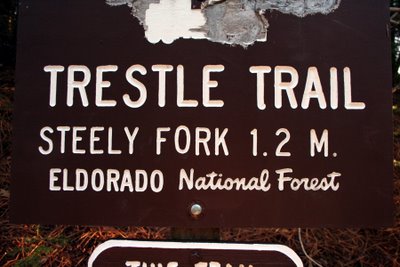
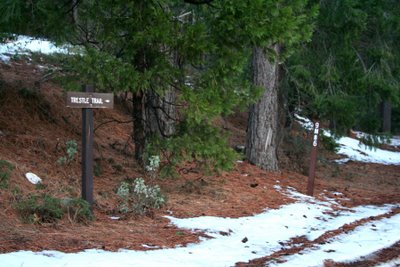
After you drive another half mile (or so -- I didn't clock it), you'll see this sign to the left up on the old railroad grade. Park your car in the wide spot and hike the trail.
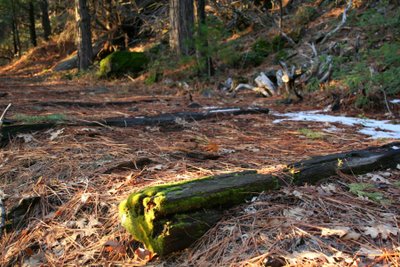
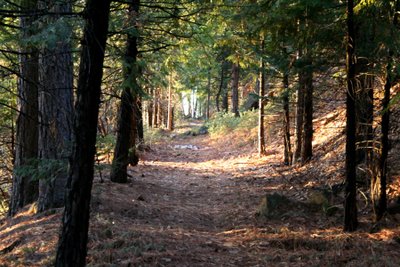
Partially buried railroad ties are visible a few hundred feet from the trail head. Please don't disturb the ties.

You can visualize a Shay locomotive pulling a consist of empty skels up the grade toward Camp Webster.

Here's what the Eldorado National Forest website has to say about the trail:

Trestle Trail: Follow the Capps Crossing Road from Grizzly Flat or the North South Road (Forest Route 6) to the dirt road 9N36. Turn south on this road and stay to the right for approximately one-half mile to the trailhead. This pleasant foot trail follows a railroad grade for 1.2 miles to the site of the main bridge (removed) over Steely Fork Creek. The trail is in excellent condition, and passes three collapsed trestles (wooden railroad bridges) on the steep hillside. Return to the trailhead along the same route.
Technorati Tags: , , , , , ,

Saturday, October 21, 2006

Shay Station Coffee Co. in Michigan

I just saw a post from last September over at Robert Harrington's Controlled Chaos blog. There's a coffee shop in Cadillac, Michigan named after the venerable Shay locomotive.

The Shay Station Coffee Co. menu includes "special beverages from cream fruit drinks to double chocolate mochas." A fajita chicken wrap and spicy bacon turkey salads are waiting to be discovered by 1920s-style soda fountain and eatery. The ciabatta bread paninis sounds good!

Cadillac is a former logging town up on the Michigan peninsula. Logging in the region began with the opening of the Pioneer Mill in 1871, with the Grand Rapids and Indiana Railroad reaching Cadillac in 1872.

The Michigan Iron Works Company of Cadillac manufactured the Shay locomotive for a short time before designer Ephraim Shay licensed the Lima Locomotive Works in Lima, Ohio to manufacture the geared locomotive from 1880. Production continued until 1945.

A Placerville Shay Station?

We could franchise the Shay Station Coffee Shop out Placerville way. After all, we have plenty of coffee lovers in El Dorado County. And we have the most important accoutrement -- a 99-1/2-year old Shay locomotive.

It would be much more romantic than walking into a Starbucks each day!

What more can you ask for? A Shay geared loco and good coffee. And it might be a good way to raise cash for the old No. 4!

Cross-posted at El Dorado Western Railway.

Saturday, August 13, 2005

Diamond & Caldor Shay Locomotive No. 4

For the last two Saturdays I've helped friend Keith Berry renovate a passenger rail car at the El Dorado California Museum. The parlor car was once owned by Taco Bell founder Glen Bell's defunk Westside & Cherry Valley Railway.

Keith and members of the El Dorado Western Railway Foundation someday plan to operate the refurbished parlor car, with a caboose and a flatbed car, as an excursion train on the abandoned Southern Pacific Placerville branch line.

The train will be pulled by the only surviving Shay locomotive from the Diamond & Caldor Railway, which carried lumber from the Caldor sawmill 35 miles west to the a planing and box mill in Diamond Springs.

As the weather cools, I plan to bring my Dutch ovens to the engine house at the El Dorado County Museum and cook some railroad vitles for the volunteers. More in a couple months. It's still too hot to cook.

Diamond & Caldor Ry. Shay locomotive no. 4 is about two years away from full steam operation. Keith and a team of volunteers, many skilled machinists, have labored for 10 years to renovate the only surviving Shay engine from the D&C.

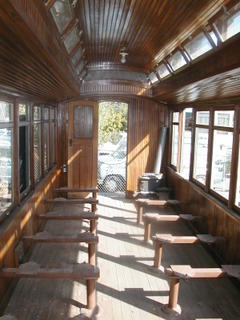
The interior of the Westside & Cherry Valley Ry. Passenger car. According to Keith, Bell built the parlor car on an original logging flatbed car. The flat car is about 100 years old today. Bell operated the tourist rail line in the late 1970s in Tuolumne, California.

Volunteers Rob McMillian (left) and Keith Berry contemplate their next move as they renovate the exterior siding of the passenger car. Rob is a finish carpenter who recently started volunteering his time for the project. Keith has been involved for 10 years.
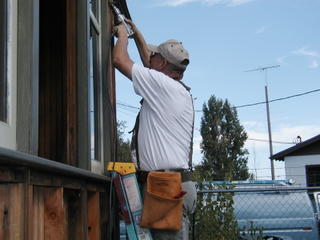
Volunteers work on their projects each Saturday from 8 a.m. to noon to avoid the summer heat. For the past two Saturdays, Rob, Keith and I have stripped the weathered siding from the car's exterior. Rob replaced rotten stubs and cross-pieces while Keith and I cleaned and prepared the car for new siding.