Showing posts with label Chef 2014. Show all posts

Sunday, December 28, 2014

2015 Christmas dinner menu

Nearly 25 residents, staff and guests enjoyed a festive dinner at work on Christmas Day. Holidays are important to the residents. With half the residents restricted to the house for various reasons, the meal gave them a chance to celebrate.

Staff do their best to make the recovery house a home during the 90-day program. Christmas tree, presents and frequent visits from family help the residents through the holiday season. One could argue that the holiday meal is the most important aspect of the festivities.

Christmas dinner gave me the opportunity to present a meal that's a cut above the normal fare. With a modest daily food allowance, the high cost of beef roast keeps it off of the menu. And it let the residents enjoy a special meal.

Two chuck shoulder clod roasts, averaging six and one-half pounds each, gave a generous portion. Into a hot oven just before noon, the intense heat developed a richly-colored crust. From that point, a 100-degree reduction in oven temperature (from 425 to 250 degrees F.) let the roasts coast to a perfect medium.

Accompanying the roast were scalloped red potatoes with a rosemary cream cheese sauce, roasted broccoli florets and Dutch apple pie. One of the residents, a former professional cook, assisted me on Thursday. He enjoyed the day as much as I did.

The festive Christmas dinner gave the men the opportunity to enjoy a family tradition, one which gave them a brief respite from their struggles with addiction.

2015 CHRISTMAS DINNER

SALADS
Garden Salad with Ranch & Italian Dressings
Seasoned Croutons
Fresh Vegetables Marinated in Balsamic Vinaigrette

MAIN COURSE
Beef Gravy from Natural Juices
Scalloped Red Potatoes in a Rosemary Cream Cheese Sauce
Broccoli Florets Roasted in Garlic Olive Oil
Freshly Baked Dinner Roll

DESSERT
Dutch Apple Pie

BEVERAGES
French Roast Coffee
Sweet Iced Tea

Monday, December 01, 2014

Meatloaf flop

I won't be posting the recipe to cheeseburger meatloaf anytime soon. After testing the recipe last night, I wasn't pleased with the results. Though the recipe appeared to be straight forward, it needs re-working before I can give it the 'Round the Chuckbox stamp of approval.

I must confess that the failure of the recipe isn't entirely the fault of the source. It was located on the ChefRef cell phone application by Sysco. A major contributing factor was my selection of the wrong measuring cup, something that I rarely do.

The recipe called for a mixture of bread crumbs, chopped pickles, ketchup, Worcestershire sauce, egg and mustard. Once mixed, it was worked into ground beef and shredded cheddar cheese. Since the initial ingredients were portioned in quarter and half-cup increments, I had intended to select the quarter-cup measure.

There's one problem. Our quarter-cup measure has been missing for some time. (It's likely buried in the rice or flour container.) Instead, I absentmindedly selected the third-cup measure. While I enjoyed the basic flavor, I couldn't move beyond the pasty texture. And I couldn't slice it for the plate without it falling apart.

I do intend on presenting a Dutch oven meatloaf recipe on these pages in the coming week or two. I will place the recipe for cheeseburger meatloaf on the back burner for now and work on a basic comfort recipe.

Friday, November 28, 2014

Thanksgiving spread at work

For the last month and one-half I've been working at a men's residential recovery program in Sacramento, California. My former boss called me in early October looking for a cook. I agreed to work lunch and dinner until I leave town for my summer job.

Readers who've been around for several years will remember that I previously worked in a woman's recovery home. I am once again working in the same location in mid-town Sacramento. The woman's facility was closed some 20 months ago. Most staff were laid off and the house was converted into a sober living home.

Little has changed in the house other than the fact that male parolees have replaced the women. While the men eat more than the women, they have the same heartfelt appreciation for the meals that I cook during the week. Six weeks ago I move into the job as if I had never left.

This isn't the first time I've talked about Thanksgiving at work. I last featured my menu and prep list in 2011 on 'Round the Chuckbox. Here's the menu for 2014 Thanksgiving dinner:
Roast turkey breast
Sour cream mashed red potatoes
Candied sweet potatoes
Cornbread dressing
Traditional turkey gravy
Orange cranberry sauce
Seasoned green beans
Tossed green salad with homemade ranch dressing
Hot dinner roll
Pumpkin pie 

I miss working in a commercial kitchen with a steam line. Cold food isn't an issue since 25 residents can be served in 15 minutes. I lay the pans out on the counter and on the range and serve each resident as he passes through the kitchen. 

Serving the residents gives me the opportunity to set a nice looking plate. It also ensures even portion control. I want the last resident to receive the same portion as the first. Note that I forgot to place the cranberry sauce on my sample plate.

Thursday, November 20, 2014

Throwback Thursday: Finding inspiration for the camp menu

I originally posted this story in 2006 during the ramp-up to a camp that I worked at for one week each summer. 

I glean menu and recipe ideas from many sources. Professional trade magazines -- Foodservice Director and Food Management among them -- give me ideas that are specially suited for the institutional kitchen. Popular magazines like Sunset also provide inspiration. I can often use an idea and work it until it fits a group setting.

A photograph of an artfully arranged collection of skillets arranged on an outdoor buffet table sparked my cowboy breakfast idea. Twin stacks of blue enamel plates and a lone Dutch oven complete the display -- no fancy garnish for the dudes of the Mountain Sky Guest Ranch, near Emigrant, Montana.

This thousand-word inspiration gave me the impetuous to celebrate our nation's 230th birthday. The crisp, smoky air of the campfire will greet campers next Tuesday. Bright yellow scrambled eggs, airy biscuits smothered in sausage gravy and gallons of cowboy coffee (hot chocolate for campers) will kick off our celebration next week. The meal will be cooked in cast iron that's stood the test of time from the colonial hearth to the Western range to the backyards of today.

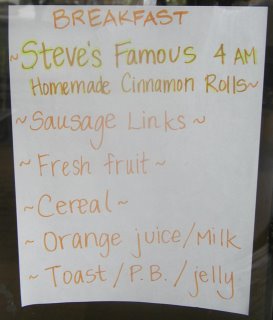
In 2004, campers kept saying, "That's what 4 a.m. rolls look like!," as they walked through the cafeteria line. Their response puzzled me all morning until I walked out into the dining area and saw this hand-printed menu.
Inspiration for camp menu ideas come from many sources. Television programs, cookbooks and magazines have helped my over 35-year culinary career. The one thing that's worked best for me since the late 1980s has been a series of culinary notebooks.

I keep the notebook handy. Now that I'm commuting to Sacramento each day, the 200-page composition book rests in my daypack. I record ideas -- often gathered from professional magazines on my desk -- and clippings on my hour-long commute home. My 18-notebook collection is full of ideas.

It doesn't matter if the idea comes from TV or print. Shows like Al Rocker's Rocker on the Road can give wonderful ideas. Take Douglas Coffin's New Haven, Conn.-based Big Green Pizza Truck (the show that aired last January). I may not be able to restore a 1946 International Harvester flat-bed truck. But the pizza menu idea will come in handy one day.

They key is to clip ideas and place them in your culinary scrapbook. Soon your collection of ideas, complete with thousand-word photographs will have you cooking for a herd of hungry campers.

Sunday, November 16, 2014

Pie dough for a 12-inch skillet

Use this recipe for pie dough with the iron skillet apple pie in a 12-inch pan.

PIE DOUGH FOR A 12-INCH SKILLET

Keep butter and shortening in the refrigerator to ensure a flaky crust.

18 ounces all-purpose flour
1-1/2 teaspoons table salt
9 ounces unsalted butter, cold and cut into 1/2-inch cubes
3 ounces shortening, cold
3/4 cup ice water

Place flour and salt in a mixer bowl. Using flat beater, mix flour and salt on low speed 15 seconds. Place cubed butter and shortening in bowl. Mix on low speed 1 minute, or until mixture resembles cornmeal. Some butter lumps will remain.

With mixer on low speed, gradually add ice water. Mix just until water is absorbed. Do not over work the dough. Scoop dough onto counter. Gently press into a large ball and cut in to two pieces. Flatten each piece into a rounded disk. Place the disks in a zip-top bag. Refrigerate 30 minutes.

Remove dough from refrigerator. Lightly dust each piece with flour. Flatten gently. Using a floured rolling pin, roll lightly with quick strokes from center out to edge in all directions. Form a circle 13 to 14 inches in diameter and about 1/8 inch thick. Bottom crust will be slightly thicker. Shift or turn dough occasionally to prevent sticking. If edges split, pinch cracks together.

BOTTOM CRUST: Fold each piece of rolled dough in half. For iron skillet apple pie, proceed with instructions in the recipe. For other applications, such as chicken pot pie, carefully place in ungreased 12-inch skillet with fold at center. Unfold and fit carefully into skillet, being careful not to leave any air spaces between skillet and dough. Place contents over bottom crust, being careful not to overfill.

TOP CRUST: With top crust folded in half, make several small slits with a knife near center fold to allow steam to vent during baking. Brush outer rim of bottom crust with water. Lay top crust over filling with fold at center. Unfold and press edges of two crusts together lightly. Trim overhanging edges of dough by with a knife or spatula. Seal pie by pressing edges of crust firmly together or crimping with thumb and forefinger to make a fluted edge.

Brush top crust with 1 whisked egg. On fruit pies, sprinkle 2 tablespoons sugar evenly over crust. Do not use sugar on savory pies. Bake pie as directed in recipe. Place pan under skillet to catch syrup spills. Watch skillet pie in oven as it requires longer baking than a traditional 9-inch pie. If needed, shield crust with foil sheet in last 15 to 30 minutes to prevent excessive browning.

Iron skillet apple pie in a 12-inch pan

I presented my version of the iron skillet apple pie last night to a potluck Thanksgiving dinner. The pie was baked in a large cast iron skillet. We arrived just as the last diners we filling their plates. I placed the pie among the other desserts and cut it into 12 servings.

I thought that the crust was the best part of the pie! The crisp crust, both top and bottom, complimented the soft and sweet apples. A clean skillet was all that we brought home. Word of mouth quickly brought diners to the dessert table to try a slice of pie.

Enjoy ...

Iron skillet apple pie in a 12-inch pan will feed a crowd. 
IRON SKILLET APPLE PIE IN A 12-INCH PAN

This is an enlarged version of an on-line recipe MyRecipes.com, from the September 2011 issue of Southern Living. Amounts have been adjusted to fit inside a larger cast iron skillet. I used an 11-1/2-inch Wagner skillet for the test run.

Purchase 5 large Braeburn and 5 large Granny Smith apples. Yield will be approximately 4 pounds, give or take, of apple slices after peeling, coring and slicing. You may need to prepare your own pie dough since the skillet is several inches larger than a 9-inch pie pan. Or you can use my recipe.

2-1/2 pounds Braeburn apples
2-1/2 pounds Granny Smith apples
2 teaspoons ground cinnamon
2 cups sugar
Pinch salt
6 ounces unsalted butter
1-1/2 cups packed light brown sugar
2 pounds 4 ounces pie dough, rolled into 2 pieces
1 egg
2 tablespoons sugar

Pre-heat oven to 350 degrees. Peel and core apples. Cut into 1/2-inch wedges. Toss with cinnamon and 2 cups sugar. In a 12-inch cast iron skillet, melt butter over medium heat. Add brown sugar. Cook, stirring constantly, 1 to 2 minutes, until sugar is dissolved. Do not caramelize. Remove from heat.

Place 1 pie crust over brown sugar mixture. Spoon apples over bottom pie crust. Top with second pie crust (with several slits cut in to vent steam). Pinch crusts to seal. Whisk egg. Brush top crust with egg wash. Sprinkle 2 tablespoons sugar over crust.

Bake for 1 hour 15 minutes to 1 hour 30 minutes or until golden brown and bubbly. Place pan under skillet to catch syrup spills. Shield crust with foil sheet in last 15 to 30 minutes to prevent excessive browning. Cool before serving. Serves 12.

Thursday, November 06, 2014

Throwback Thursday: Lightening cake with pears and almonds

I posted this recipe from a cookbook of my grandmother's in September 2005.

I suspect that this recipe was called lightning cake because it’s made “lightning fast.” The original cake is a brownie-like dessert with a sugar-cinnamon topping. I adapted it by folding diced Bartlett pears and sliced almonds into the batter. And a used a crumb topping made from oatmeal, flour and sugar.

All meals at grandma Bertha Karoly’s Mill Valley home were good. We often enjoyed a Sunday afternoon roast leg of lamb with roasted potatoes and German red cabbage. Although, I don’t remember many desserts, I’m certain I ate any number of sweets at her table.

This recipe is adapted from Any One Can Bake, published by Royal Baking Powder Company in 1927. My grandmother purchased this book on April 18, 1927 when my father was 17 months old.

LIGHTNING CAKE WITH PEARS AND ALMONDS

Use your favorite crumb topping for the cake. My favorite recipe follows.

1/2 cup milk
3 eggs
1/2 cup melted butter
1-1/2 teaspoon vanilla
1-1/2 cups sugar
1.2 teaspoon salt
3 cups all-purpose flour
1 tablespoon baking powder
2 Bartlett pears, peeled, stemmed and diced
1/2 cup sliced almonds
2 cups crumb topping (recipe follows)

Pre-heat a 12-inch Dutch oven with 9 coals underneath and 18 coals on the lid. Combine milk, eggs, sugar and vanilla in a large bowl. Sift flour, salt and baking powder in a bowl. Add dry ingredients to liquid ingredients and mix thoroughly. Dough will be stiff. Fold in pears and almonds.

Lightly oil Dutch oven. Spread dough in Dutch oven. Sprinkle crumb topping evenly over cake dough. Bake at 375 degrees for 50 minutes or until a toothpick inserted in the center comes out clean. Cool; cut into 12 to 18 servings.

CRUMB TOPPING

1-1/2 cups all-purpose flour
3/4 cup packed brown sugar
1/2 cup sugar
1/4 teaspoon salt
1 teaspoon cinnamon
1-1/2 cups old fashion rolled oats
1/2 cup softened butter, cut into pieces

Combine flour, sugars, salt, cinnamon and oats in a medium bowl. Rub in the butter with your finger tips until it’s well blended and the mixture crumbles coarsely. Refrigerate until needed. Makes about 1 quart.

Tuesday, November 04, 2014

Hot sauce update

Last Saturday I prepared a new batch of hot sauce. This time I multiplied my original recipe by two and one-half times. Fresno chilies stood in for Serrano chilies, mainly because I couldn't locate red Serrano chilies locally. And I even managed to rub capsicum juices in my left eye!

I tasted the hot sauce on Sunday. Coming away with a good, strong medium heat profile, I thought the hot sauce has a lot of potential. My hope is that the sauce will mellow out as it ferments in the refrigerator.

HOT SAUCE, VERSION 2

Weigh about 1 pound chilies at the market if you don't have a scale at home. That will yield around 10 ounces chili flesh. Add just enough water to barely cover the chilies and onions in the skillet. You can locate ground arbol and pequin chiles at MexGrocer.com.

2-1/2 tablespoons vegetable oil
10 ounces red Fresno, jalapeno or Serrano chili peppers, stemmed and sliced
7-1/2 ounces sliced onion
1 ounce minced garlic
1-1/2 teaspoons kosher salt
2 to 3 cups water
1 tablespoon ground arbol chili pepper
1 tablespoon ground pequin chili pepper
1 cup distilled white vinegar

Heat oil in a large heavy skillet over medium-high heat. Add chilies, garlic, onion and salt. Saute 3 minutes. Add water and continue to cook, stirring occasionally, for 20 to 30 minutes, or until peppers are very soft and most of the liquid has evaporated. Ventilate room with exhaust fan if necessary. Stir in ground arbol and pequin chilies.

Puree mixture in a food processor or blender until smooth. With motor running, add vinegar in a steady stream. Adjust seasoning with additional salt if needed. Strain sauce through a fine-mesh strainer, then transfer to sterilized half-pint canning jars. Cover with air-tight lids. Age 14 days in refrigerator before using.

Store in the refrigerator for up to 6 months. This recipe prepares 4 cups hot sauce.

Tuesday, October 28, 2014

Beginning my hot sauce journey

For the last five years I have been working on a variety of fresh and cooked salsas. I posted a series of articles titled, "My salsa journey," in February 2011. (Read the articles here, here and here.) Salsa ranchera is the most popular salsa recipe on 'Round the Chuckbox. Since that time I have featured the salsas at several jobs, including two summers at Oakland Feather River Camp in Quincy, California.

I'm now ready to explorer scratch-made hot sauce. My original thought was to duplicate Cholula brand hot sauce, which is my favorite commercial hot pepper sauce. After a brief Internet recipe search, I changed my focus. I figured that it would be wiser to develop a sauce than to attempt to replicate a commercial sauce. Commercial producers use a variety of production techniques that aren't available to the small producer.

I produced my first batch over two weeks ago. I tasted that hot pepper sauce after a 14-day ferment in the refrigerator. While I'm not entirely satisfied with the flavor, I can accept the hot sauce for now. The texture and spiciness are right on. However, I don't enjoy the sharp tingle from the vinegar. While acid is an essential ingredient of hot sauce, one cup of vinegar is overkill.

My next batch will continue to feature serrano chili peppers. They add a base of flavor to the hot sauce. I'll also hold onto the ground arbol chili pepper. I want to try adding ground pequin chili pepper and reducing the vinegar to less than one-half cup. The pequin chili pepper should compliment the arbol. I look forward to trying my next batch.

SERRANO HOT SAUCE

This recipe is adapted from chef Emeril Lagasse. I used his Food Network recipe as a starting point. I added ground arbol chili pepper for depth of flavor and to boost the rich color. As explained above, my next batch will reduce the amount of vinegar and introduce ground pequin chilies.

1 tablespoon canola oil
4 ounces serrano chili peppers, stemmed and sliced (about 20 chilies)
1-1/2 ounces minced garlic
3 ounces sliced onion (1/2 medium onion)
3/4 teaspoon kosher salt
2 cups water
1 teaspoon ground arbol chili pepper
1 cup distilled white vinegar

Heat oil in a large heavy skillet over medium-high heat. Add serrano chilies, garlic, onion and salt. Saute 3 minutes. Add he water and continue to cook, stirring occasionally, for 20 to 30 minutes, or until peppers are very soft and most of the liquid has evaporated. Ventilate the room with exhaust fan if necessary. Stir in ground arbol chili.

Puree mixture in a food processor or blender until smooth. With the motor running, add vinegar in a steady stream. Adjust seasoning with additional salt if needed. Strain sauce through a fine-mesh strainer, then transfer to sterilized half-pint canning jars. Cover with air-tight lids. Age 14 days in refrigerator before using.

Store in the refrigerator for up to 6 months. This recipe prepares 1-3/4 to 2 cups hot sauce.

Thursday, October 16, 2014

Pork tenderloin and apples with cider glaze

Apple cider glaze is amazingly good with pork roast, pork chops and chicken breast. Most recipes direct you to begin with fresh apple cider, then reduce it in a heavy skillet under high heat. A sweetener, such as maple syrup or honey, blends well with the succulent flesh of the meat. Vinegar or wine, mustard and herbs balance the flavor.

Last year I started reducing fresh unfiltered apple cider until it had a syrupy consistency. I've added it to homemade hotcake syrup, roasted Brussels sproutsapple mahogany sauce and apple glaze. I typically purchase the cider in half-gallon bottles and reduce it over high heat to one-quarter its beginning volume (see recipe below). Apple cider is at its peak in the fall.

PORK TENDERLOIN AND APPLES WITH CIDER GLAZE

The recipe for apple mahogany sauce lists several ideas for a sauce such as this one. You can substitute pork chops or chicken breasts for the tenderloin. Saute the meat in a cast iron skillet or grill over hot coals as desired. Brush sauce on the meat during the couple minutes of cooking.

2-1/2 pounds pork tenderloin
Kosher salt and ground black pepper, to taste
2 tablespoons chopped fresh rosemary
2 tablespoons chopped fresh thyme
1 tablespoon unsalted butter
1-1/2 cups apple cider reduction (click for recipe)
2 medium Granny Smith apples, peeled, cored and sliced, 3/4-inch thick
1 tablespoon cider vinegar
2 teaspoons Dijon mustard

Rinse pork and pat dry. Season with salt and pepper. Coat all sides with thyme and rosemary. Melt butter in a 12-inch Dutch oven over medium-high heat. Add pork and cook until browned on all sides.

Place lid on oven and arrange 10 charcoal briquettes under and 19 on lid (heat for 400 degrees F.). Cook 20 to 25 minutes until pork reaches 145 degrees on an instant-read thermometer. Note size and shape will influence cooking time. Place pork on a platter and rest 10 minutes. Pour off any moisture (and reserve for future application, if desired).

Combine cider reduction, vinegar and mustard. Add apples and cider mixture to Dutch oven. Cook over medium heat until apples are al dente and sauce has thickened to glaze consistency. If needed, thin glaze with a small amount (1 tablespoon or less) to apple cider or reserved moisture. Meanwhile, slice pork 1/2-inch thick. Spoon sauce over pork and place apples on either side. If desired, sliced pork can be served from Dutch oven (as pictured).

Makes 6 to 8 servings. Serve with roasted Brussels sprouts and rice pilaf.

Apple cider reduction

Apple cider reduction is used in several recipes at 'Round the chuckbox, as follows:
I use Barsotti organic apple cider, a local El Dorado County, California, company that presses fresh apples at their Apple Hill plant. Barsotti juices can be purchased at many Northern California markets, co-ops and big-box stores, plus a number a local wineries and Apple Hill ranches.

APPLE CIDER REDUCTION

8 cups unfiltered apple cider

Boil apple cider over high heat until reduced to one-fourth its beginning volume, stirring occasionally. Skim surface build up as it collects. Allow as little as 45 minutes and as long as two hours to complete the reduction. The quantity being reduced, size and shape of the saucepan and heat setting determine how long it takes. Freeze leftover cider reduction or use within seven days.

Wednesday, October 08, 2014

Baking artisan bread in camp

In the nearly two years since I first talked about artisan no-knead bread, I have baked this bread numerous times, based on my standard recipe. I currently have a batch of dough in the refrigerator at home. While camping at Upper Blue Lake last month, I was able to record notes on my baking process in camp.

These instructions are for use in temperate weather. You need to gauge weather conditions and determine how ambient temperature, humidity and wind conditions will influence internal baking temperature and cooking time. Flexibility is the key. As a rule, coals burn hotter in lower humidity and windier conditions. Cooler, wet weather reduces the heating potential of the coals.

For any Dutch oven recipe on 'Round the Chuckbox, the number of coals are calculated for average summer conditions in the Western United States. You need to experiment and learn how to adapt my instructions to seasonal weather conditions where you live and camp. Use my instructions as a starting point. Experiment at home before taking the the bread into camp to bake.

Light campfire. While hardwood is the ideal choice of wood, I usually cook with pine, cedar and fir in the Sierra Nevada. As a rule, I build a fire that's two to three times the size in volume than the Dutch oven. The fire must produce sufficient coals to heat the Dutch oven for one hour. I continue to add wood to the fire once I remove the first coals to have a ready source of fresh coals.
When you desire to bake a loaf of bread, dust surface of chilled dough with flour. Pull a 16- to 24-ounce piece dough out and cut with a knife or kitchen sears. Gently stretch dough by pulling it down to the bottom, turning the dough one-quarter turn each fold. If desired, slash load before setting it in the Dutch oven, as I did here. This dough was made with 20 percent whole wheat flour.
Gentle place the loaf inside a 12-inch deep-style camp oven. Slash the loaf if not done earlier. Place the lid on the oven. Set in shade on a warm day. On a cool day, set in a sunny location. Proof in oven for 40 minutes.
Coals are almost ready. You won't see much noticeable rise during proofing. After the 40-minute fermentation period, the load will be ready for baking. Remove the lid, splash about 1 tablespoon cold water over the loaf and replace the lid.
Hang the Dutch oven about 18 inches above the bed of coals. Shovel a solid bed of coals on the lid. Bake 15 minutes, then lift the lid and quickly check bread. If it's browning properly, remove the coals from the center of the lid. I've found that this is necessary to ensure the loaf bakes without burning. You need coals for 450 degrees (10 under oven and 23 on lid) when using charcoal briquettes. 
Continue baking for an additional 30 to 40 minutes. You're looking for a nicely browned crust and firm to the touch Remove coals and cool. 

Friday, October 03, 2014

Meet the camp cook

You may have noticed the new menu bar just under the masthead. It currently lets you quickly access the homepage and contact information for 'Round the Chuckbox. I just posted a page titled, "Meet the camp cook." In the future, I plan to add one or two more links to the menu bar, including a description of my services as a camp cook. Enjoy ...

Therefore, whether you eat or drink, or
whatever you do, do all to the glory of God”
1 Corinthians 10:31

Sauteing fajitas at Upper Blue Lake, Eldorado National Forest, Calif.
I've long envisioned myself a nineteenth century camp cook. I can see myself cooking for an El Dorado County ranch as it drove cattle drive to summer pasture in the Lake Tahoe basin each spring. Everything about the job appeals to me: family atmosphere, outdoors and good old country cooking.

Chuckwagon cookin' in the rain
Yet, I've one problem: I was born 50 years too late. And I grew up in Fresno and Bakersfield. Those who know me will tell you that I'm a city boy who’s loved the Sierra Nevada high country ever since his father carried him to Peter Grub Hut in 1954.

I’ve only ridden a horse three times in the last forty years and have never driven a chuckwagon or fed a beef-centered diet to cowboys on the Western prairie. Nor have I piled flapjacks onto chipped enamel plates meant for hungry Sierra Nevada lumbermen or slopped biscuits and gravy on trays for a railroad gang.

At this point in my forty-year cooking career I could never call myself a “wagon cook.” While I've cooked in the shadow of one or two chuckwagons, it takes a special breed of cook to wrangle pots like Ramon F. Adam's “Sultan of the Skillets.”

The first time I cooked near a chuckwagon was at Leonard “Wagon Cook” Sander's 50th birthday bash in December 2002. Since that experience – cooking Dutch oven scalloped potatoes and baking bread in driving rain on a porch – I’ve only had the honor to view a couple other chuckwagons.

Seabee cooks of NMCB-17
I prefer Seabee Cook, a moniker earned after years of service in the U.S. Navy Construction Battalions. Like the wagon cook, who was at home on the range, feeding Seabees was special skill developed over a two-decade-long career in the Naval Reserves. I was known as the “field mess guru” during my tour with the 3rd Naval Construction Brigade and Pacific Fleet Seabees.

My large chuckbox, stained in a reddish hue and built to impeccable detail, draws folks to my camp. Since 2001, it has been the signature item in my camp cooking reparatory. Like the back end of the chuckwagon, the chuckbox has become the center point of my camp kitchen.

While the label of wagon cook may be something to aspire, I can only accept the moniker “chuckbox cook” (somehow “box cook” doesn't run off the tongue like Seabee Cook). I'll certainly answer to camp cook any day of the week. The title has an unpretentious ring to it. It's as if you’ve described me as a cook who harkens back to a simpler time, one born in the wrong century.

The chuckbox
For years I compensated on our annual camping trek to the Sierra Nevada Mountains. I lived out a week-long fantasy each summer. You'd think I was fixin’ to feed a crowd of hungry hunters and fishermen. My outfit carried enough cookware to feed a baker's dozen or more. Give me a canvas A-framed cook-tent, a swamper and hungry outdoorsmen that appreciate good old camp grub, and I'm in the right setting.

In the end, my life will have spanned the back end of one century and front end of another, far removed from the glory days of the chuckwagon. As a retiree, I’m free from the day-to-day drudgery of a career. I now can pursue my life-long ambition to be a camp cook.

Each spring, my lovely bride and I journey to Oakland Feather River Camp in Quincy, Calif., where I’m the camp cook and chef for three and one-half months. Around the time I tire of 12-hour days and six-day work weeks, we return home to eight months of relaxation. I’m then free to cook for the El Dorado Western Railroad or camp at my leisure.

Artisan bread in camp
I bake bread in cast iron camp ovens just to give it away. While my camp may not always lodge under canvas, family and friends benefit from camp cuisine. Those that eat vittles ‘round the chuckbox share in my forty-year quest to replicate the life of a camp cook.

Welcome to my camp. From one camp cook to another, enjoy ‘Round the Chuckbox, where we cook delicious camp meals in frying pan, Dutch oven and grill. Cook with passion and “Come an’ Get It” will draw hungry diners to your chuckbox. Give thanks to God, settle into flavorsome grub and take pleasure in good companions.

MSCS Steven C. Karoly, USN, Retired
Camp cook and editor of ‘Round the Chuckbox

Thursday, September 04, 2014

Throwback Thursday: My first recipe on the blog

Beginning today, I intend to re-post articles from the early days of 'Round the Chuckbox each Thursday. My goal is to give new life into some of my early articles. I will fix broken links and take care of spelling and bad grammar. Otherwise, I'll leave the article as originally written. 

The recipe for chuckwagon chili was first posted on February 5, 2005. It was my first recipe and second article to the blog. 

My daughter, son-in-law and granddaughter are over for the weekend. Since it’s their first trip up from the Bay Area since the wedding, we’re having a few friends over this afternoon. I though a simple chili, cooked in one of my 14-inch Dutch ovens over the camp stove would hit the spot.

Traditional red chili is defined by the International Chili Society as any kind of meat or combination of meats, cooked with red chili peppers, various spices and other ingredients, with the exception of beans and pasta, which are strictly forbidden. Traditions aside, beans have a nice way of rounding a hot bowl of red. Besides, the cowboys ate beans by the bowl. Add 4 (14-ounce) cans of pinto or red beans at the second spice dump.

If you're so inclined, use a mixture of beef base diluted with beer instead of water. Make sure that you use Grandma's or Gephardt's chili powder, not a generic brand.

CHUCKWAGON CHILI

6 pounds round steak, coarsely ground
1/2 cup olive oil
3 ounces chili powder
6 tablespoons ground cumin
6 clove garlic, minced
2 medium red onion -- chopped
6 dried ancho peppers, remove stems and seeds and boil 30 min in water
1 tablespoon dried oregano
2 tablespoons paprika
2 tablespoons red wine vinegar
3 cups beef broth
1 (4-ounce) diced green chiles
12 ounces crushed tomatoes
Hot pepper sauce, to taste

Brown meat in olive oil in a 6-quart Dutch oven over medium heat. Drain excess fat; add chili powder, cumin, garlic and chopped onions. Simmer over low heat 30-45 minutes using as little liquid as possible. Add beef stock only as necessary. Stir often.

Remove skins from boiled pods, mash pulp and add to meat mixture. Add oregano, paprika, vinegar, 2 cups beef broth, chiles, stewed tomatoes and hot pepper sauce. Simmer 30-45 minutes. Stir often. Adjust seasoning. Serve with fresh bread. Makes about 1 gallon or 12 (1-1/3 cup) servings.

Traditional chili garnishes -- diced onions, grated sharp cheddar cheese and chopped cilantro -- compliment this dish well.

This recipe is adapted from the October 2004 issue of Food Management. Chef Joe Eidem of the Washoe (Reno, Nevada) Health System serves his chuckwagon chili in the hospital’s cafeteria.

Wednesday, September 03, 2014

1,500 posts on 'Round the Chuckbox

The 1,500th post on 'Round the Chuckbox nearly slipped away without notice! My picture of the US Foods truck arriving at Oakland Feather River Camp that was posted Monday takes the honor. Though a random picture, it represents my post-retirement career as a summer camp chef.

While I enjoy the long hours and seemingly chaotic atmosphere of the commercial kitchen, laboring in the outdoor camp kitchen has been my true love for decades. I share a common interest in outdoor cooking with the readers of 'Round the Chuckbox. Together we enjoy cooking in cast iron Dutch ovens, grilling over a campfire and smoking in the barbecue.

When I look back at the articles I posted while away from home this summer, those that relate to outdoor cooking were the best performers. Of the 36 pieces between late-April and mid-August, two standout. This means they performed significantly better than the thirty or so articles on cooking in the camp kitchen.

It seems readership declines whenever I shift focus from outdoor cooking to my work as a camp chef. The statistics show more readers would rather read my thoughts on locating the massive Lodge 20-inch skillet last April than to view a picture of my baked apple pancake. These two were the best and worst performing posts of the spring and summer.

The second highest performing blog of the season was a series of images of a Dutch oven cookout last May. And the two Dutch oven recipes that I've posted since returning home (baked orange French toast and layered cabbage and potatoes with bacon) are above the others.

Not everyone goes away when I place emphasis on cooking for large numbers of campers. 'Round the Chuckbox draws readers from those interested in cooking for groups as well as outdoor cooks. But the pool of those interested in outdoor cooking seems to be somewhat larger than the group of quantity cooking enthusiasts.

I plan to continue posting articles on cooking for groups and outdoor cooking. As I see it, both types of cooking fit within my calling as a camp cook. Since many folks enjoy reading Dutch oven articles, the focus for the fall and winter will be towards outdoor cooking. While I may post one or two more articles from Oakland Camp this summer, I'm ready to put the modest cast iron collection to work.

=====<<>>=====

Click here to see what I had to say when I posted my 1,000th blog article. "As long as I'm able to cook and write," I said on February 5, 2010, "I trust that you'll continue to find the blog interesting. Please drop a note. I always enjoy hearing from my viewers."

Monday, September 01, 2014

The truck, the truck

The US Foods truck negotiates a sharp turn as it moves from the main entrance to the upper road at Oakland Feather River Camp last July. The big three purveyors (US Foods, ProPacific Fresh and Sysco) generally sent medium-sized tractor-trailer combinations to the camp, which is located inside the Spanish Creek canyon, five miles north of Quincy, California. Due to the size of the trucks and awkwardness of the dock, drivers parked on the delivery road and moved product into the kitchen with pallet jack and hand truck.

Wednesday, August 27, 2014

Baked orange French toast

The Stanley Ranch Cook Book is one my favorite sources for inspiration and recipes. It’s hosted by the Stanley Ranch in Fossil, Oregon. Many recipes seem to the contribution of the unnamed ranch cook. (Edit: The cookbook is no longer available on-line).

The recipe for baked orange French toast caught my eye while pursuing side dishes last week. This recipe is the contribution of by Marlene Stanley, who owns the ranch with husband her Rick. Once I prepared my rendition for camp in a Dutch oven, I discovered the subtle orange flavor throughout. It doesn't overwhelm. Instead, the orange juice and zest give the breakfast dish wonderful balance between traditional French toast and the orange flavor.

BAKED ORANGE FRENCH TOAST

Eliminate the pecans to make the recipe nut free. Marlene Stanley’s version called for 2/3-cup orange juice and 1/3-cup orange liqueur. Since I generally don’t purchase liqueurs, I used a full cup of juice. I’m certain the liqueur will give the French toast an even richer flavor.

12 ounces day old French bread, cut into 1-inch cubes
1 cup toasted pecan pieces (see recipe below)
6 large eggs
1 cup half and half
1 cup orange juice
1 tablespoon orange zest
3 tablespoons granulated sugar
1/4 cup melted butter

Place bread cubes in a lightly greased 9- or 10-inch round cake pan. Spread pecans evenly over bread. Whisk eggs, half and half, orange juice, orange zest and sugar together in a medium bowl. Pour batter evenly over the bread. Push bread down into the batter.

Cover and place in refrigerator or ice cooler. Refrigerate at least four hours or overnight if being served for breakfast. In the morning, take the pan out of the refrigerator or ice cooler. Light 28 charcoal briquettes. Meanwhile, pour melted butter evenly over bread.

When coals are barely covered with ash, pre-heat a 12-inch Dutch oven with 8 coals underneath and 20 on the lid. (Alternatively, pre-heat the oven to 350 degrees F.; bake in oven as directed.) Remove lid and place the pan inside the Dutch oven. Replace the lid and bake 40 minutes, until French toast is set and puffed up.

Remove pan from Dutch oven. Cool 10 minutes. Cut into 8 wedges. Offer 1 or 2 wedges to each person. Serve with syrup. Marlene Stanley recommends serving a sauce of melted butter and marmalade on the side.

TOASTED PECANS

Toasting brings out the wonderfully nutty flavor of the pecan. Remove from the heat as soon as you smell wonderfully nutty aroma of the nuts. Stop the cooking by placing the nuts in a small bowl.

1 cup chopped pecans (approximately 2-1/4 ounces)
1 tablespoon unsalted butter

Melt butter in a small heavy skillet over medium heat. Add pecans and toss to coat with butter. Toast, stirring frequently, until lightly toasted, about 5 to 8 minutes. Do not brown. Remove from heat and use as directed.

Thursday, August 21, 2014

Cabbage and potatoes with bacon

Debbie and I returned home after four months away. This included a quick trip to Oregon, where I located a rare Lodge 20-inch skillet. After visiting Debbie's sister and husband on the Oregon coast, we made our way to Quincy, California, where I was the chef for Oakland Feather River Camp for the next three and one-half months.

I hauled two 12-inch Dutch ovens to the camp, along with three large skillets. Twice during the pre-camp session I showed the cooks how to cook in cast iron Dutch ovens. Once camp ramped up in early June, long days and large numbers of hungry campers eliminated the opportunity for any Dutch oven cooking.

Serving  from 100 to over 300 campers three times each day is rewarding in itself. But I missed the chance to cook in cast iron. While we occasionally used the skillets in the kitchen, the Dutch ovens lacked the capacity to feed the crowds. I knew I'd have to wait until we came home to get back to cast iron cooking.

Layered cabbage and potatoes with bacon made a great welcome home dish. As a one-pot meal, it was relatively easy to prepare. And it has a great flavor. The marriage of two of my favorite vegetables makes for a succulent meal.

Enjoy ...

LAYERED CABBAGE AND POTATOES WITH BACON

Sufficient liquid should be released from the cabbage to keep the dish moist. If the cabbage and potatoes are dry during baking, add 2 to 4 tablespoons water or chicken stock to the dish. When served, you should see a light coating of delicious liquor on the bottom surface of the Dutch oven.

Feel free to substitute your favorite sausage (sliced) for the bacon. Or to add a second layer of bacon, boost it to 12 or 16 ounces and spread half over each layer of cabbage.

8 ounces bacon, diced
2 medium onions, thinly sliced
1-1/2 pounds green cabbage, shredded
3 pounds red or gold potatoes, sliced 1/4-inch thick
Salt and pepper, to taste

In a 12-inch Dutch oven over medium high heat, cook bacon until crisp. Remove to plate. Pour off most of the rendered fat, leaving about 3 tablespoons.

Add onion and cabbage. Season to taste with salt and pepper. Sauté, stirring frequently, until it’s just beginning to brown and the volume of cabbage is reduced by one-third. If necessary, add an additional tablespoon or two bacon fat to keep cabbage moist. Remove to separate plate or bowl.

Layer potatoes, cabbage mixture and bacon, lightly seasoning each layer with salt and pepper. Place 1/3 potatoes on bottom of Dutch oven. Spread 1/2 cabbage mixture over potatoes, then spread all of the bacon over the cabbage. Place another third of the potatoes over the cabbage and bacon layer. Layer of remaining cabbage over potatoes. Place remaining potatoes over the cabbage.

Place lid on Dutch oven. Add coals for 375 to 400 degrees, approximately 8 under the oven and 20 on the lid. Bake for 50 to 60 minutes, until the potatoes are tender and they are beginning to brown.

As an entrée, cabbage and potatoes serves 6 hearty eaters. It serves up to 12 as a side dish.

Sunday, August 03, 2014

Arroz con pollo

It may not be the prettiest dish that we serve at Oakland Feather River Camp. But arroz con pollo is packed with flavor (the link takes you to my Dutch oven version). Two weeks ago, five 12 by 20 by 2-1/2-inch pans fed 135 campers and staff at the family camp. Simmered black beans, succotash with kale and chocolate bread pudding rounded the menu.

Sunday, July 27, 2014

Lots of hummus

Until yesterday, I had only prepared two quarts of hummus at one time. Now my personal record is somewhere around five gallons! The Cuisinart food processor labored for over one hour to turn six #10 cans of chickpeas into the wonderful spread. When I completed the task, one quart olive oil, one quart lemon juice, three pounds tahini, one cup minced garlic and salt and pepper joined the chickpeas.

Oakland Feather Rover Camp featured a Middle Eastern menu for a private camp on Saturday. The two-hour lunch included pita bread, hummus bi tahini, tabbouleh and tuna salad, plus a large salad bar. We will serve the remaining hummus throughout the week on the salad bar.