Showing posts with label pizza. Show all posts

Saturday, November 12, 2016

Sicilian-style cast iron skillet pizza

I haven't prepared skillet pizza in over four years for 'Round the Chuckbox. In February 2012, I baked a pizza in a 17-inch cast iron skillet when my baking stone "bit the dust." Three month later, when the home oven quit working, I baked a take 'n bake pizza in an inverted 14-inch Dutch oven. I felt it was time to feature another cast iron pizza.

After testing a recipe from the Serious Eats website two weeks ago, cast iron skillet pizza sounded good. I wanted a recipe that I can use at my summer job and when camping. This recipe will serve both purposes. It can either be baked in a half-sized (13x18-inch) sheet pan or in two large cast iron skillets (10- to 12-inch diameter).

The camp edition of the pizza can be baked with charcoal briquettes or inside the home oven. While this recipe uses a stand mixer (I use a Kitchen Aid 5-quart mixer), the Serious Eats website has instructions for hand-mixing the dough. You can use an inverted Dutch oven as well. I will post hand-mixing instructions when I get a chance.

The full-sized (18x26-inch) sheet pan will be used for the camp. It takes six to eight sheet pan pizzas for each 100 campers. Pizza is often pared with honey barbecued chicken wings, pasta salad and a loaded salad bar. We typically feature cheese pizza, pepperoni pizza, vegan pizza and a meat-lover's pizza.

I proofed the dough on the picnic table on the patio. The skillet in the foreground in a Lodge No. 12. The other one is a Wagner 1891. My wife and I purchased the Wagner in the early 1980s when we were first married.
The pizza is ready for toppings. Each skillet pizza needs 1/4- to 1/2-cup sauce, 3 to 4 ounces shredded cheese and 2 to 4 ounces meat (if used). I added a bunch of sauteed spinach to both pizzas. Four ounces sliced chicken sausage with feta and spinach was used on the larger pizza.
You have to pile the charcoal briquettes to achieve a close approximation of 550 degrees F. Lighting 10 extra briquettes will give you extra heat should you need it.
Finished pizzas. The crust could've been a bit more crisp. The smaller pizza is vegetarian.
Sheet pan pizza prepared from the same recipe. I will use this recipe to bake pizza in full-sized (18x26-inch) sheet pans for Oakland Feather River Camp, where I am the executive chef. Four sheet pans yield 96 slices.
SICILIAN-STYLE CAST IRON SKILLET PIZZA

This recipe requires two large cast iron skillets, 10- to 13-inches in diameter. Match each skillet to the rimmed Dutch oven lid (or camp-style Dutch oven) that fits best. The 12-inch lid will fit the smaller skillet while the larger skillets will require the 14-inch lid.

To bake in a rimmed 13x18-inch half-sized sheet pan, pour remaining oil (in second paragraph of instructions) into a half sheet pan. Place dough on sheet pan and let rise as directed. About 30 minutes before baking, preheat home oven to 550 degrees with rack in the middle position. Proceed to stretch dough to the sides and corners of the pan, as directed. Double toppings and bake 15 to 20.

This recipe was adapted from the SeriousEats.com website.

17-1/2 ounces bread or all-purpose flour
2 teaspoons kosher salt
1 teaspoon instant yeast
1/2 cup olive oil, divided
12-1/4 ounces room temperature water

Combine flour, salt, yeast and 2 tablespoons oil in the bowl of a stand mixer. Whisk to combine. Add water and mix on medium speed until it comes together and no dry flour remains. Increase speed to medium-high and mix until the dough is stretchy and smooth, about 6 minutes. The dough should stick to the bottom of the bowl but pull away from the sides.

Divide oil between 2 cast iron skillets and spread over surface with hands. Divide dough in half and place one piece in each. (Add slightly more dough to the larger skillet when using mismatched pans.) Rub top surface with oil until thoroughly coated. Cover with plastic wrap. Allow to rise at room temperature until dough has spread out to nearly touch each rim of each skillet, about 2 hours.

Carefully remove plastic wrap. Using oiled hands and being as gentle as possible to maintain air bubbles, push and stretch dough into corners of each skillet by pressing out from the center and lifting and stretching it beyond the rim of each skillet. The dough should pull back until the skillet is just filled with dough.

Light 45 to 60 charcoal briquettes in a charcoal chimney about 30 minutes before the dough is ready. One lid is needed since you will bake the pizzas one at a time. For 550 degrees, use around 45 briquettes (30 on lid and 15 under skillet) on the 12-in camp-style Dutch oven lid. The 14-inch lid requires around 60 briquettes (40 on lid and 20 under skillet).

Top each pizza with about 1/3- to 1/2-cup sauce, 3 to 4 ounces shredded mozzarella cheese, plus additional toppings as desired. Place the first skillet on trivet. Place the lid from a Dutch oven on top of the skillet. Bake with charcoal briquettes for 550 degrees until bottom is crisp and top surface is bubbling, 15 to 30 minutes. Repeat for second skillet. Allow to cool at room temperature for 5 minutes. Slice as desired.

Saturday, June 14, 2014

Old 'school' pizza

In the days before frozen pizza shells came in the market, sheet pan pizza was common in school dining rooms and military chow halls. I suspect that many camps still produce 'school' pizza. More efficient when feeding large numbers of campers, I prefer sheet pan pizza over frozen pizza shells. Using a basic dough recipe, four to eight sheets will feed 100 campers one or two slices per person.

The last meal of staff training week at Oakland Feather River Camp featured old 'school' pizza. Unlike last year, where we used 12-inch frozen pizza shells, this pizza was prepared from scratch, using a basic formula with 58 percent water and active dry year. While I generally favor instant yeast, we are using active dry yeast that I inherited from my predecessor.

We didn't mix the yeast, sugar and warm water until 10 a.m. Not one to be deterred by a late start, the dough was fermenting in the mixer bowl at 10:25. One hour later the baker divided the dough into five balls. Four of the dough balls weighted 2 pounds, 7-ounces. The smaller one came in at around 12 ounces.

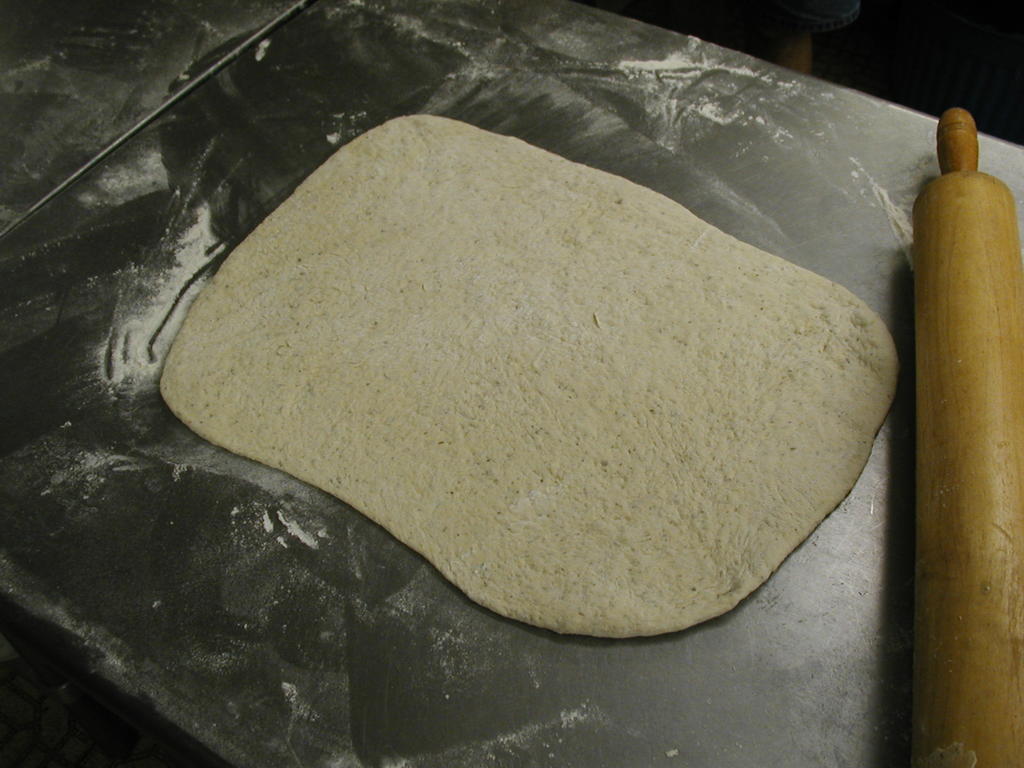
After resting 10 minutes, each dough ball was rolled into a rectangle, sized to fit in 18 by 26-inch sheet pans. The smaller dough ball was rolled out for a half-sized sheet pan. Following instructions in Armed Forces Recipe Service card number L-165, each pizza was par-baked in a 450-degree convection oven for about 7 minutes.

After cooling briefly, we spread one quart pizza sauce over each pizza. Do not forget to dock the dough before baking (as we did!). Each pizza was then topped with about 4 cups shredded mozzarella cheese and other toppings. Each pizza was returned to the oven for eight to 10 minutes.

Once removed from the oven, the pizzas cooled for 5 minutes before slicing. The larger pizzas were cut into 24 servings (4 by 6); the smaller one was cut into 12 servings (3 by 4). We prepared the following pizzas:
  • Ranch dressing with roasted garlic, shredded chicken and vegetables
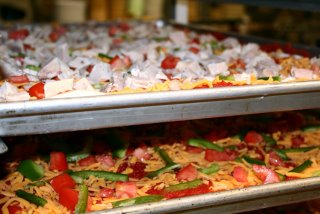
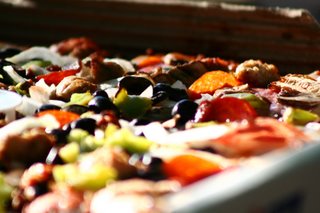
  • Meat lovers with diced ham, bacon and Italian sausage (middle picture)
  • Italian sausage combination (top picture)
  • Cheese with mozzarella and Parmesan
  • Vegetarian (half sheet pan)

Monday, February 25, 2013

Deep dish pizza rice casserole for 24

I have posted this recipe several times in the history of 'Round the Chuckbox. The first time I prepared deep dish pizza rice entree was at a 2006 family camping near Fortuna, California. My son mumbled "This is good" over and over as he shoveled multiple helpings into his face. I then set the recipe aside for several years.

In 2010 on a camping trip to South Lake Tahoe, Jacob asked for "that pizza stuff." I obliged by sneaking baby spinach into the dish. I posted a pictorial recipe of my reworked deep dish pizza rice.

Since I left work an hour before the residents served dinner on Friday, I asked a staff member to snap this picture of deep dish pizza rice casserole on her cell phone. Thinking back, I should've asked then to save me a serving for my lunch today! This dish was baked with cheddar-jack cheese mixture.

Last fall, the residents at work were asking that I prepare some new dishes in the evening. This gave me the opportunity to re-work the recipe from a 10-inch Dutch oven to a 12 by 20 by 2-inch hotel pan. I first prepared the deep dish pizza rice casserole for 24 in mid-December.

The first meal gave me the opportunity to fine tune the recipe for larger portions. I prepared the casserole for the second time last Friday.

DEEP DISH PIZZA RICE CASSEROLE FOR 24

Use the drained tomato juice as part of the chicken stock. You need 2 quarts total chicken stock and tomato juice for the recipe.

1/4 cup olive oil
2 cups diced yellow onion
1-1/2 tablespoons minced garlic
10 ounces Italian sausage, cooked and crumbled
2 (28 ounce) cans diced tomatoes in juice, drained
1 quart long grain rice
1 tablespoon dried oregano
1 teaspoon dried thyme
1 teaspoon dried basil
2 quarts chicken stock, boiling
2 cups pizza sauce
8 ounces shredded mozzarella cheese
5 ounces grated Parmesan cheese
10 ounces sliced pepperoni

Heat oil in saucepan or brazier over medium heat. Add onion and garlic and sweat until soft. Do not brown or burn. Stir sausage, tomatoes, rice, garlic and herbs into onion and garlic mixture.

Spread mixture evenly into bottom of greased 12 by 20 by 2-inch hotel pan. Evenly pour stock over mixture; cover tightly with foil or lid. Bake 45 to 50 minutes or until liquid is absorbed and rice is tender.

Remove pan from heat and fluff rice mixture with fork. Gently smooth out top of rice. Top with layer of pizza sauce, then layers of both cheeses. Top with pepperoni. Continue bake an additional 5 to 7 minutes or until cheese melts.

Remove from heat. Let stand at least 10 minutes before dishing up. Cut or score pan 4 by 6 for 24 servings. Serve equal portion of rice and topping.

Friday, February 08, 2013

Cast iron skillet pizza

What do you do when your pizza stone bites the dust? Use a pre-heated cast iron skillet as a pizza pan. With similar heat holding capacity, the skillet yields a better pizza than a sheet pan. The skillet absorbs heat as the oven heats up, then transfers it to the pizza during baking. The heavy floor of the skillet mimics the deck of a pizza oven in the same manner as ceramic pizza stone.

I prepared a pizza dough last night. I had intended to purchase a new ceramic stone on my way home from work this afternoon. When other chores got in the way, I arrived home without a stone. My first thought was to bake the pizza in an inverted 14-inch Dutch oven.

During a telephone conversation with my sister, we hit on the idea to use a skillet. I said that I had the perfect skillet to bake the pizza in the home oven. I recovered my 17-inch cast iron Lodge skillet from the garage and put the 14-inch Dutch oven away.

I formed the pizza from a 14 ounce piece of dough, After setting it on a pizza peel dusted with cornmeal, I spread 3/4-cup pizza sauce on the dough. Eight ounces mozzarella cheese and 6 ounces crumbled Italian sausage topped the pizza.

To bake, I slipped the pizza into the pre-heated skillet and placed it in a 450-degree oven. The pizza was ready in 15 minutes. The under crust of the pizza was evenly browned. And the pizza was cooked to perfection.

At this point, I'm not sure that I'm going to purchase a new pizza stone. Why spend the money when the 17-inch skillet serves the same purpose? Plus, it's being used. Since I rarely use the skillet, except when cooking for a crowd, it stays seasoned and clean.

Since not everyone owns Lodge's largest skillet, roll out a piece of dough to fit the diameter of your largest skillet. Pre-heat the skillet in the oven for 20 to 30 minutes before baking the pizza. A pizza peel simplifies the task of transferring the pizza into the skillet. With practice, you'll drop the pizza into the center of the skillet.

I baked a 13-inch pizza inside my Lodge 17-inch cast iron skillet this evening. The pizza fit comfortably on the surface of the skillet, which is 14 inches in diameter.

Thursday, November 08, 2012

Sea going pizza maker

This photograph exhibits the reality of life for a U.S. Navy culinary specialist on an aircraft carrier. Much of your time on watch is spent repeating the same task over and over. I counted six sheet pans of pizza in each upper convection oven.

With two pizzas per sheet pan, Seaman Beverley has 24 pizzas in the oven. Another 24 pizza pre-baked shells in the stack stand ready for the oven. More product awaits on the right side of the picture. I suspect Seaman Beverley worked up to half of her 12-hour shift on pizzas on last Saturday.

PHILIPPINE SEA (Nov. 3, 2012) -- Culinary Specialist Seaman LaDecha Beverly, from Pittsburgh, prepares pizzas in the galley aboard the aircraft carrier USS George Washington (CVN 73). George Washington and embarked Carrier Air Wing 5 provide a combat-ready force that protects and defends the collective maritime interest of the U.S. and its allies and partners in the Asia-Pacific region.

U.S. Navy photo by Mass Communication Specialist 3rd Class William Pittman.

Thursday, May 17, 2012

Dutch oven pizza (take 'n bake)

I purchased two take and bake pizzas from Gularte's Pizza & Deli in Diamond Springs, Calif., last night. My usual practice is to call home and ask my son to preheat the home oven to 450 degrees. He set the oven as directed. When I arrived home 15 minutes later, I learned the oven wasn't working.

To bake the pizzas -- 16-inch large and 12-inch medium -- I inverted a 14-inch regular camp Dutch oven and set it on a lid rack. After lighting a chimney of lump charcoal, I piled burning coals on the top (normally the bottom) of the oven. A number of coals were stuffed under the oven as well. To lift the oven off of the lid, I wore heavy welder's gloves.
The 16-inch pizza had to be trimmed to fit inside the Dutch oven. I folded the dough over into a braid, trimmed the cardboard tray and set the pizza in the inverted lid. I set the on the lid and loaded it with coals. Since mesquite lump charcoal (I use Lazzari brand) burns very hot, I was confident I had sufficient heat to bake both pizzas. Each pizza took around 25 minutes to bake.

Thursday, July 22, 2010

Deep dish pizza rice revisited

I first made my Dutch oven deep dish pizza rice on a camping trip to the North California coast in July 2006. My then 14-year-old son Jacob devoured two hefty helpings as he mumbled "This is good!" over and over.

Now that he's 18 and growing. He asked for "that pizza stuff" several times this week on our camping trip to South Lake Tahoe. I prepared the dish in a 10-inch Dutch oven for the second time last night.

Here's my revised recipe. I didn't change too much from the original recipe that was posted on July 26, 2010. I added half of a 3-ounce bag of baby spinach and used prepared pizza sauce in place of pesto.

Heat 1 or 2 tablespoons olive oil in a 10-inch Dutch oven over medium-high heat. Add onions and garlic and sweat until translucent.

Add rice and stir to coat with oil. Fry rice while stirring frequently until it takes on a light-brown color. Add 4 ounces each pre-cooked Italian sausage and peperoni. Cut the peperoni into quarters or chop as desired. Reserve 13 peperoni slices for the final step.

Add about 3 ounces of washed and dried baby spinach to the rice. Continue cooking for several minutes to wilt the rice. Many other green vegetables will work in place of spinach. I'd like to try broccoli rabe, cut into 2-inch pieces next time.

My three-year-old granddaughter didn't flinch at the sight of cooked spinach last night! She matched her uncle bite-for-bite (adjusted for age, of course!).

Combine 2-1/2 cups chicken stock, 1/2-cup prepared pizza sauce and 1 teaspoon dried oregano. Pour into rice mixture and stir. Cover with lid. Bake 20 minutes or until rice is done. Use coals for approximately 350 degrees (5 charcoal briquettes under the oven and 16 on lid in temperate weather).

When done, spread 1-1/2 cups shredded cheese over the rice. Arrange the reserved 13 peperoni slices over the rice. Return lid to oven and continue baking until cheese is melted.

Enjoy! Serves a family of four to six. Multiply the recipe one and one-half times for a 12-inch Dutch oven.

To Lib: Use a three or four-quart home Dutch oven for the casserole. Sweat onions on the burner, saute rice, wilt spinach, then add pizza sauce and stock and bring to a boil. Cover and place in a 350-degree oven and bake for about 20 minutes. Top with cheese and peperoni and finish in oven.

Friday, June 26, 2009

Pizza night

Pizza night was last night. Since the menu was pizza, double chocolate chip cookies and punch, I planned of three to four slices for each camper. Three campers helped assemble the pizzas.

I used one of Sysco's pre-baked pizza shells and had the campers apply either pesto or pizza sauce to each pizza. We then topped them with mozzarella, sprinkling of cheddar cheese and Parmesan.

The pizza were baked in a 450- to 500-degree oven and cut into eighths. Here's the breakdown for 45 campers and staff:
20 pizzas total
10 cheese with tomato sauce (50%)
6 cheese with sausage (30%)
4 cheese with pesto and various toppings (20%)

Friday, May 15, 2009

Bakery scales and pizza

I have long advocated the use of scales in the bakery. Measurement by weight is more accurate the by volume. This is especially true for the dry ingredients like flour.

The actual weight of a cup of flour, for instance, varies considerably. A cup of sifted bread flour weighs about 4 ounces while a cup of unsifted weighs about 4-3/4 ounces. The difference is considerable when working with multiple cups of flour.

For consistent results, bakers weigh most of the ingredients. This includes the water and most other the wet ingredients. Although a "pint is a pound the world 'round," liquid measures vary in capacity, unlike scales.

The dough comes together nicely when weighing the ingredients. You'll achieve the right balance between flour and water (usually in the neighborhood of a 3:2 ratio by weight). If the dough is a little loose, you can work some additional flour into it.

After using a mechanical portion scale for 10 years, I purchased a digital scale last month. The digital scale is convenient. To measure, set a measuring container on the scale, press the tare button and it's ready to go.

To add a second ingredient without removing the first, press the tare bottom again and add the next ingredient. This method is helpful when you're going to sift the dry ingredients together.

I purchased the My Weight 7000DX digital scale (pictured) from Old Will Knot Scales on the Internet. The scale has a capacity of 7,000 grams or 15.45 pounds. With the right-sized measuring container, you can weigh enough flour for 15-pound batch of bread, pizza dough or pastry.

I plan to take the scale with me to camp this summer (without the bowl). Its slender profile easily fits inside a duffel bag with a few other must-have baking tools, like a dough cutter, plastic bowl scraper and lame.

CHEESE PIZZA

This recipe makes enough for 4 (10- to 12-inch) pizzas. It'll yield 24 to 32 slices, depending on how you slice the pizzas. You can double the recipe when using the 5-quart Kitchen Aid mixer.

I provided baker's percent so you can adjust the recipe to fit the needs at your camp.

1 pound 12 ounces bread flour (100 baker's percent)
1/4 ounce instant yeast (.9%)
1/2 ounce table salt (1.8%)
1/4 ounce sugar (.9%)
3/4 ounce olive oil (2.7%)
1 pound warm water (57%)
3 ounces pizza sauce
4 ounces shredded cheese

Place flour, yeast, salt and sugar into 5-quart mixer bowl. Mix dry ingredients using paddle attachment. Replace paddle with dough hook. Knead dough for 15 minutes on medium speed.

Use widow pane test to determine if dough is kneaded long enough. Pinch off a small piece of dough and slowly stretch it like pizza dough. As you gently pull and rotate the dough, stretch it until a thin, translucent membrane forms. If it tears easily, continue kneading for a few more minutes and test again.

Roll pizza dough into a smooth ball on counter top. Place into a stainless steel or glass bowl. Add a little olive oil to the bowl and toss to coat. Cover with plastic wrap and ferment 45 minutes, until double in size.

Place the pizza stone onto bottom of a cold oven and turn the oven to its 500 degrees F. If the oven has coils on the oven floor, place the tile onto the lowest rack of the oven.

Split the pizza dough into 4 equal parts, about 11 ounces each. Flatten into a disk on counter top and then fold the dough into a ball. Let dough relax 5 to 10 minutes.

Work with 1 dough at a time. Flatten dough with hands on a slightly floured work surface. Starting at the center and working outwards, use your fingertips to press the dough to 1/2-inch thick.

Turn and stretch dough until it won't stretch further. Let relax 5 minutes and then continue to stretch it until it reaches the desired diameter, 10 to 12 inches. Flatten edge of the dough where it is thicker.

Dust pizza peel with light coat of cornmeal. Place pizza on peel. Brush with light coat of olive oil. Spoon on tomato sauce and sprinkle with cheese.

Slide pizza off the peel onto pizza stone. Bake 7 to 10 minutes until cheese is golden and crust has browned. Remove pizza from oven with peel. Rest pizza about 3 minutes before slicing.

Cut each 12-inch pizza into 6 or 8 slices as desired.

Wednesday, July 26, 2006

Deep Dish Pizza Rice Entree

Three times during dinner my son pronounced, "This is good!" He backed his words with action and ate two hefty portions.

Deep dish rice pizza grew out of a desire to bake a pizza in the Dutch oven last night. But a dead laptop battery prevented me from searching for a recipe.

The recipe that I could find was one for 100 servings on the Palm Pilot. That wouldn't work. The recipe was written for weights, not measures. And I didn't want to break the dough recipe down to one pie.

Also on the Palm Pilot was a "pizza" recipe that I clipped from Food Management magazine several years ago. Thomas Long created this dish for the Milton Hershey Schools in Hershey, Penn.

Give it a try. This deep dish "pizza" is good. You find yourself reaching for seconds.

DEEP DISH PIZZA RICE ENTREE

Don't add any additional oil to the recipe. Pesto has sufficient oil to sweat the onions and garlic.

1 cup chopped onion
2 cloves garlic, minced
1-1/2 cups long-grain rice
4 ounces sliced pepperoni, cut into quarters
4 ounces Italian sausage, cooked and crumbled
1/2 cup sun-dried tomato pesto
1 teaspoon dried oregano
2-1/2 cups chicken broth
1-1/2 cups shredded mozzarella cheese

Use a 10-inch Dutch oven for this recipe. Ignite 21 charcoal briquettes and let them burn until they are barely covered with ash, about 20 minutes. For a 350-degree oven, you'll need 5 briquettes underneath and 16 on top of the oven.

Arrange 16 briquettes underneath oven in a checkerboard pattern. Pour about 1 tablespoon of pesto oil into oven and heat. Add onions and garlic and sweat until translucent. Add rice and stir to coat with oil.

Add pepperoni, sausage, pesto, oregano and broth. Stir. Place lid on oven. Remove 11 briquettes from underneath the oven and set aside. Arrange remaining 5 briquettes underneath oven in a circle. Arrange 16 briquettes on lid. Replace lid and cook for about 20 minutes, until done.

Top with cheeses and bake an additional 5-7 minutes, until cheese melts. Top cheese with additional pepperoni slices before baking if desired. Serves 6.

Monday, July 17, 2006

Big Blue and White Pizza Bus

I'd rather ride on the back of Douglas Coffin's Big Green Pizza Truck than to face El Dorado Transit bus 9506 again. (See this blog for a January story.)

With the A/C on working poorly, Sacramento Commuter No. 3 bus became the Big Blue and White Pizza Bus (my apologies to Doug for the analogy!).

The mercury tipped the scales at 109 degrees this afternoon in the river city. I believe it's the hottest day of the year so far.

I suspect that the A/C in the bus couldn't handle the heat. The air blowing on my head actually got cooler as we approached Placerville at 5:30 p.m., with the thermometer hovering somewhere around the its high of 105.

It was more like a Big Blue and White Bread Oven Bus at that point.

Placerville temperatures are expected to plunge to the low 100s for the remainder of the week.

Monday, July 03, 2006

Camp -- Pizza Night

As I write kids are screaming up in the amphitheater (do you see a common thread developing here!). It's Fear Factor...

Tonight was pizza night. This in one of the items that I love to prepare from scratch. Since I couldn't find the dough hook or the rolling pin, I mixed and kneaded a double recipe by hand. I know that these items were around last year, because I used them for the pizza dough and the cinnamon rolls.

I found the dough hook deep behind the mixer stand, almost under the ice machine (the two are located side-by-side). The rolling pin was buried under the large center work table that's in front of the range. My first though was that the camp had disposed of these items. I had visions of rolling pizza dough with a can or bottle!

At the suggestion of my second cook, we prepared these pizzas this year:

4 cheese pizzas
3 chicken pizzas
3 combination pizzas

Unlike past years, we didn't prepare pepperoni pizza tonight. It was time for a change. Three to five pounds of pre-cooked chicken is sufficient for the three pizzas. We buy a Sysco product that comes packed two 5-pound bags per box. The pizzas are cut 4x5. Off 200 servings, 23 were left oven. This meal is the most popular of the week.

PEPPERONI PIZZA

2-3/8 ounces active dry yeast
1-1/8 cups warm water
1-1/2 quarts cold water
6-5/8 pounds bread flour
1 ounce salt
2-1/3 ounces sugar
1-1/2 cups olive oil, divided
1 gallons pizza sauce
4 pounds mozzarella cheese, shredded
1 pound sliced pepperoni
7 ounces Parmesan cheese

Sprinkle yeast over water. Do not use temperatures above 110 deg F. Mix well. Let stand 5 minutes, stir. Place water, flour, salt, sugar and olive oil in mixer bowl in order listed. Add yeast solution. Using a dough hook, mix at low speed about 8 minutes until dough is smooth and elastic. Dough temperature should be 86 deg F to 88 deg F.

Divide dough; shape into 4 (2-pound 2-ounce) balls. Cover; let rise in warm place 1 to 1-1/2 hours or until double in bulk. Coat bottom and sides of each pan with 1 tablespoon olive oil.

Place dough balls on lightly floured working surface. Roll out each ball to 1/8-inch thickness. Transfer dough to 18x26-in sheet pans pushing dough slightly up edges of pan. Using 1 tablespoon oil per pan, lightly brush dough. Gently prick dough to prevent bubbling.

Spread 1 quart sauce evenly over dough in each pan. Sprinkle 1 quart shredded cheese over each pan. Thinly slice pepperoni; evenly distribute 4 ounces over cheese in each pan. Sprinkle 1/2 cup grated cheese over mixture in each pan.

Using a convection oven, bake 8 minutes at 450 deg F on high fan, closed vent or until crust is browned and cheese starts to turn golden. Cut each sheet pan 4 by 5. CCP: Hold for service at 135 deg F or higher.

Serving Ideas: This recipe prepares 5 (18x26-in) sheet pans. For 150 campers, prepare 9-10 sheet pans. Serve 1 slice for firsts before calling seconds. Acceptability is approx 115-120%.

This recipe takes about 3-4 hours to set the dough, let it ferment, punch it and roll out the pizzas. You should have sufficient time to work the dough if you activate the yeast at 2:30 p.m. for a 5:30 p.m. dinner. Do not activate the yeast any later than 2:30 p.m. It will take 2 batches as the mixer cannot accommodate any more than 1 recipe. Prepare 1 full recipe for each batch. Each recipe will yield 4-1/2 to 5 sheets of pizza, depending on how efficiently you work.

For cheese pizza, omit the pepperoni.

Saturday, July 01, 2006

Camp -- Pizza, More Campers and Training

Good things are in store for the week!

Saturday is training day for kitchen staff at Northern California FC Camp. With the food stowed and the kitchen ready for Sunday dinner, I held a training session for the cooks from 5 to 6 p.m. this evening. The key here is to cover food safety basics, make job assignments and orient all staff to the kitchen, including safety (fire evacuation, etc.). Today's training only took an hour as most of my staff returned from 2005.


Roundtable Pizza hosted dinner tonight. Staff provide their own breakfast and lunch tomorrow. We start cooking dinner at 2 p.m. Sunday and serve the meal after evening worship.
I received news yesterday morning that out camper count unexpectedly climbed to 160 during this past week. We have 20 extra mouths to feed all week. Although this could mean we have to run to Costco Santa Cruz and purchase additional food, I believe we'll be good. I purchased the same quantity of food as last year. Based on the leftovers we had each meal last year, we have sufficient cushion to absorb the extra campers (a split between kids and counselors).

The few items that I cut from last year -- like the chicken tenders and corn dogs -- will good. These were items that I over-purchased and needed to trip. At this point I feel confident that we'll have enough food for the week. Costco is 10 mile south of Felton in the rare event that we need extra food.

Tuesday, June 27, 2006

Finding Inspiration for the Camp Menu

I glean menu and recipe ideas from many sources. Professional trade magazines -- Foodservice Director and Food Management among them -- give me ideas that are specially suited for the institutional kitchen. Popular magazines like Sunset also provide inspiration. I can often use an idea and work it until it fits a group setting.

A photograph of an artfully arranged collection of skillets arranged on an outdoor buffet table sparked my cowboy breakfast idea. Twin stacks of blue enamel plates and a lone Dutch oven complete the display -- no fancy garnish for the dudes of the Mountain Sky Guest Ranch, near Emigrant, Montana.

This thousand-word inspiration gave me the impetuous to celebrate our nation's 230th birthday. The crisp, smoky air of the campfire will greet campers next Tuesday. Bright yellow scrambled eggs, airy biscuits smothered in sausage gravy and gallons of cowboy coffee (hot chocolate for campers) will kick off our celebration next week. The meal will be cooked in cast iron that's stood the test of time from the colonial hearth to the Western range to the backyards of today.

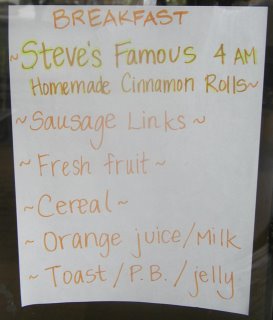
Two years ago, campers kept saying "That's what 4 a.m. rolls look like!" as they walked through the cafeteria line. Their response puzzled me all morning until I walked out into the dining area and saw this hand-printed menu.

Inspiration for camp menu ideas can come from many sources. Television programs, cookbooks and magazines have helped my over 35-year culinary career. The one thing that's worked best for me since the late 1980s has been a series of culinary notebooks.

I keep the notebook handy. Now that I'm commuting to Sacramento each day, the 200-page composition book stays in my daypack. I record ideas -- often gathered from professional magazines on my desk -- and clippings on my hour-long commute home. My 18-notebook collection is full of ideas.

It doesn't matter if the idea comes from TV or print. Shows like Al Rocker's Rocker on the Road can give wonderful ideas. Take Douglas Coffin's New Haven, Conn.-based Big Green Pizza Truck (the show that aired last January). I may not be able to restore a 1946 International Harvester flat-bed truck. But the pizza menu idea will come in handy one day.

They key is to clip ideas and place them in your culinary scrapbook. Soon your collection of ideas, complete with thousand-work photographs will have you cooking for a herd of hungry camper.

Tuesday, January 03, 2006

Big Green Truck Pizza

My favorite shows on the Food Network are those that give me food business ideas. You'll find me viewing Best Of, Food Finds and Rocker on the Road when my schedule permits. I love it when one of these shows features a big green 1946 chuckwagon on rubber tires.

I like these shows -- I believe Al Roker's show is the only one currently in production -- because they move around the country showcasing small food businesses.

As a frustrated government worker, these shows have given me hundreds of hours of fantasy-filled viewing. I always seem to be a retirement check away from filling a food niche here in El Dorado County.

My latest business idea came to me Friday evening in the form of a 1946 International Harvester flatbed truck. Roker featured the New Haven, Connecticut based truck in the Tapas and Brownies episode.

The Big Green Truck is a self-contained wood-fired pizza oven on wheels. For $950, Douglas Coffin, a self-trained chef who’s operated a successful catering business for 15 years, will bring the truck to your home or business and prepare hand-made pizza for 50 of your closest friends or business associates.

I'm always looking business ideas. My ideal post-retirement culinary business must meet several self-imposed limitations. The full service restaurant is definitely out. I’m done with late hours and early mornings and every hour in between.

My concept has to fill a local need -- one that's unique to the local area. The idea must sell and not cost a fortune. And it must be operated with two or three employees.

I have no illusions about starting the next culinary empire in Northern California. Ideally, my concept will be centered around on or two products -- like Coffin's handmade pizza, galeto and cappuccino.

That's where the Big Green Truck comes in. It gave me an idea for a local catering business. More correctly, his idea confirmed an idea that I've had for some time now. All I have to do now is to blend the two (soon, Lord willing).

But just in case Coffin finds these words: Don’t worry about competition from the left coast.

Coffin's concept will give me ideas. I can certainly garner thoughts on menu, design and concept. Unless he shares his well-guarded trade secrets for a West Coast division, I’ll develop my own concept from scratch.

You'll have to click over to Douglas Coffin’s website to see more photographs. It sounds fun if you live near New Haven.

Monday, July 25, 2005

Camp 2005 -- Monday's Meals

Here are a few pictures from Monday's meals at Northern California FC Camp:

The recipe for macaroni and cheese. I often use the U.S. Armed Forces Recipe Service cards as the basis for my camp recipes.

At lunch, we served tuna salad sandwiches and luncheon meat sandwiches with vegetable soup and macaroni and cheese. I used the basic military recipe today with a good quality pre-shredded cheddar cheese.

Each 4-inch hotel pan holds: 5 pounds macaroni and a scant gallon rich cheese sauce.

We get approximately 7- to 75 servings from a pan with a #10 scoop.


Pizza dough for dinner. For 150 campers, I made 9 sheet pans pizzas. You yield 20 servings per pan when you use the full-sized sheet pan (18 by 26 iches).

In past years, we've baked six or seven pepperoni pizzas. This year we baked a wide variety of pizzas because the local market ran out of pepperoni yesterday.


Here's what we baked tonight:

2 pepperoni pizzas
1 sausage
1 sausage and bacon
1 bacon and black olive
1 chicken pesto (the best in my opinion)
1 cheese
1 vegetarian with onions, bell peppers, tomatoes and olives
A 3/4-sheet with cheese and bacon.

We had 20 pieces leftover before calling seconds. This is the most popular meal during the week. And it's one of the few meals where everyone takes the entree.


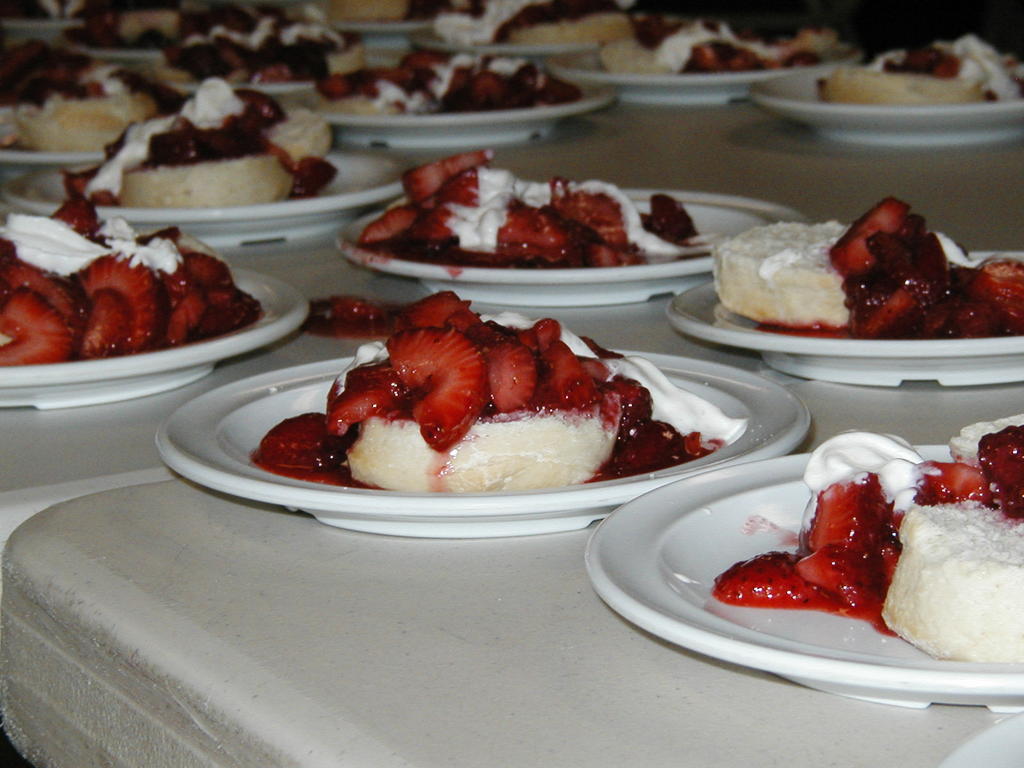
Tonight's dessert -- strawberry shortcake.

Saturday, February 12, 2005

Saturday Campfire and Picnic

Last night's rain cleared this morning into a beautiful day. My original plan was to smoke two racks of ribs on the Webber barbecue this afternoon. But tee-shirt weather and a clear sky called us to the forest for a picnic and campfire.


Pizza and a salad make a satisfying camp meal. Posted by Hello

A Saturday afternoon campfire in the forest has been a Karoly tradition for more than 20 years. Now that my oldest daughter in married and the youngest is staying with her grandmother, my son and I use the time to talk, read the Bible and write.

The campfire is the centerpiece of the outing year-round. By mid-July, when fire restrictions hinder campfires, we'll move our campfire ritual to one of the organized campgrounds in Eldorado National Forest.

Why a Campfire, You Ask?

A campfire is an inseparable part of the camping. I'm sure you can argue that modern campers don't need campfires. After all, we have camp stoves to cook dinners, waterproof tents to capture body heat and the stars to gaze at for entertainment. Campfires are as much a part of the camping experience today as they were when my grandparents were featured on the masthead the San Francisco Chronicle (Monday, July 10, 1922).

A campfire gives warmth. And that's more than heat. For me there's nothing more comforting than to sit around a crackling fire reading my favorite book and gazing at the stars. Camping without a campfire is like a day without food. It refreshes the soul after a strenuous day camping.

I can think of dozens of reasons for burning a campfire. To name a few: campfires give warmth (the heat kind), provide light for that book, burn garbage and food scraps, give a beacon when you walk into the forest to take a leak and hasten the decomposition process so necessary for a lively forest.

A campfire also tests your wilderness skills. Try starting a fire after three days of rain. If you can accomplish it without the aid of lighter fluid (sorry, gasoline's out), you're a pro.

Building the Campfire

I build my campfires in the Sierra Nevada high country with downed pine, fir and cedar. To me, it's a waste of precious dollars to haul oak firewood or charcoal briquettes to the campground. I instead rely of the natural resources of the forest. (In wet conditions I carry dried and cured firewood start the fire.)

You must pay constant attention to your Dutch oven when using softwood. Pine, fir and cedar burn quickly. Watch your oven and replenish the coals often.
Don't focus on oven temperature. Just pile hot coals from the campfire onto the oven with a gloved hand and a pair of 14-inch tongs. Experience and the five senses guide you to approximate the correct number of coals.

Build a campfire that's four to five times the volume of the Dutch oven and burn it down to a glowing bed of coals. This'll take approximately 30 to 45 minutes with pine, fir and cedar.

I've learned from many poorly-cooked dishes that you can never have too many campfire coals. Continue feeding the campfire so you will finish the dish with sufficient heat. Feed the fire as long as you have a plentiful supply of firewood.

QUICK DUTCH OVEN PIZZA

I've given instructions for charcoal briquettes in case you prefer them to campfire coals.


The pizza is ready to slice. I prefer to slice the pizza in the oven. Just take care not to gouge the cast iron with your knife. When forming the pizza, the trick is to fit a square peg into a round hole. Form the 9- x 12-inch piece of pizza dough as neatly as possible in the round Dutch oven. Posted by Hello

1 (13.8-ounce) package Pillsbury classic pizza crust
1/2-3/4 cup prepared pizza sauce
3/4 cup grated mozzarella cheese
15-20 salami or pepperoni slices
Toppings as desired

Use a 12-inch Dutch oven for this recipe. Lightly grease the oven and pre-heat with 10 briquettes underneath and 19 on top of the oven. Remove lid and set aside. Unroll pizza dough and mold it evenly into the oven. Return lid and bake pizza crust for 8 minutes, until crust sets and is about halfway done.

Remove lid and set aside. Spread pizza sauce over the dough, leaving a 1-inch margin. Sprinkle cheese over sauce. Arrange pepperoni slices on sauce. Add favorite toppings as desired. Return lid and bake for an additional 6 to 11 minutes. Baking time will vary greatly depending on heat and weather conditions.

Remove the oven from the heat when the crust has browned and the cheese and meat is bubbling. Cool pizza about 5 minutes. Cut into 6 slices, being careful not to cut into the cast iron. Remove slices with spatula or pie server.


I didn't take any oil to grease the Dutch oven. My solution was to render fat from three slices of Italian salami. Posted by Hello