Showing posts with label mobile kitchen. Show all posts

Tuesday, August 09, 2011

CalFire's mobile kitchen units

I found this video at the Fire Department News Network. Although I never worked on one of the mobile kitchens depicted in video during my career with the state, I visited MKU-27 at Growlersbrg Conservation Camp while writing the chapter on emergency feeding for the state food service handbook.

Carlin Manufacturing of Fresno, California, built 11 MKUs between 1990 and 1991 for Cal Fire. Based on Carlin Model 36F5 High Mobility Kitchen, the MKU was designed to feed 1,200 persons three meals per day. When augmented by a support trailer, water tender, generator and mobile dishwashing unit, Cal Fire found that the MKU can feed over 2,000 people a day at an incident base camp.

As you see in the video, the conservation camps have purchased additional equipment to boost the operating capacity of the MKU. They often set-up an outdoor kitchen. Inmate cooks use gas grills and griddles to compliment the equipment inside the MKU.

Each 36-foot trailer contains the following cooking equipment:
  • 2 dual-stack convection ovens
  • 2 (30-gal.) tilt skillets
  • 1 (40-gal.) steam-jacketed kettle
  • 6-burner gas range with conventional oven
  • 1 meat slicer
  • 2-tank coffee brewing system
  • 2 twin-well steam lines

VIDEO DESCRIPTION: Firefighters working a wildfire need to eat 3,000 calories a day. These meals usually consist of sack lunches or MREs. That is why CAL FIRE Mobile Kitchen Units (MKU) have been bringing food to firefighters battling wildfires for the past 15 years. There are eleven MKUs placed throughout California that can each feed up to 2,000 people. They can be set up and ready to serve within four hours.

"It's an unusual resource. The Forest Service, by law, they have to hire mobile kitchens. And so, they will do that because that's how they're directed. But for CAL FIRE, if we're running an incident, we just request these and out they go. But, no, it's a very limited resource. It does take a lot of funding and staffing to make it work," says Bill Peters, CAL FIRE's Public Information Officer.

Inside, the trailer houses ovens, a stove, and large vats for cooking beans and soup. These are used to store canned goods when not in use. Last minute touch-up cooking is done inside the trailer, while heavy duty cooking is done outside. The food is high quality because the units are staffed by conservation camp inmates, who are paid $1 an hour for fires.

A chef hired by CAL FIRE creates the menu and directs the inmates. Bill Peters says, "There's actually a little bit of competition between the different Mobile Kitchen Units as to who puts out the best menu. Are we getting salmon tonight? Steak tomorrow? And I've been out where the cooks are good enough cooks, they can do Chicken Cordon Bleu." The variety is appreciated by firefighters who spend days fighting wildfires.

There are numerous support vehicles that carry tables, chairs, and salad bar equipment. The other vehicles are generators to keep everything up and running, and refrigerator trailers.

Wednesday, November 11, 2009

Guard cooks compete for annual food service title

A member of Nebraska's 267th Support Maintenance Company decorates a chocolate cake with an ear of corn during the 42nd annual Phillip A. Connelly Award for Excellence in Army Food Service held at the Greenlief Training Site in Nebraska Oct. 17. Food service units from six states recently showcased their culinary abilities before a national judging panel, while competing for the title. (Photo courtesy of Nebraska National Guard)

By Mark Roland
Nebraska National Guard

GREENLIEF TRAINING SITE, Neb., (10/22/09) -- Call it the military’s version of the "Iron Chef."

Competing on a grassy plain in central Nebraska while the sounds of Soldiers conducting marksmanship training echoed in the distance, food service units from six states recently showcased their culinary abilities before a national judging panel, while competing for the 42nd annual Phillip A. Connelly Award for Excellence in Army Food Service here Oct. 17.

Working together under the ever-watchful eyes of the national inspectors, cooks from Nebraska, Nevada, Ohio, Oregon, Puerto Rico, Rhode Island and West Virginia prepared a meal for 50 Soldiers in a field environment using their unit's Mobile Kitchen Trailer, essentially a kitchen on wheels.

Along with being evaluated on their cooking abilities, the Soldiers also were graded on 10 separate areas ranging from cooking and sanitation procedures to their adherence to Army administrative, safety and supply regulations.

Simply getting to this point meant that the section, which represented a particular region in the Army National Guard’s National Field Kitchen Category, had to conduct hours of training and practice on the unit's mobile kitchen trailer to develop the level of expertise needed to be competitive.

"At first it was to get some experience for my cooks on a (mobile kitchen trailer), some field training," said Sgt. Katherine Smith, first cook for Nebraska’s 267th Support Maintenance Company. "When they go to (advanced individual training) the MKT is already popped open. They just show them what it looks like. When they actually get to cook on it, it was good experience for them."

"It just grew from there," Smith said. "When I learned that it was the first time Nebraska competed in five years, it became really important to do our best."

The work must have paid off, because the cooks had already won the state and regional competition. Still, this was the national competition, which meant that the Soldiers had to take their efforts to an entirely different level.

Chief Warrant Officer Tollie Yoder, food service officer for Nebraska's maintenance company, said the work actually started at the beginning of the year when the unit decided to compete in the competition.

"When we first talked about competing (the cooks) said 'It would be easy, I cook.' I had to explain to them that it’s more than just cooking… it’s site setup, power plan, field sanitation issues, rodent disposal, sanitary issues, taking care of ration accounting, ration accessibility, ration control, portion control, trash management, water distribution point, and water purification tasks."

Smith agreed, saying the training and preparations made a major impact on the unit’s success.

"When we learned that you have to do more to do it, it was like ‘Alright we can do this.’ Then it became really hard because we realized that we couldn’t do it with just five cooks."

Instead, Smith said, it took the work of the entire unit to help the cooks prepare for the various stages of the competition. That level of support especially came in handy when, the night before the regional competition, a thunderstorm blew in, sending the Soldiers to tornado shelters while it dumped four-and-a-half inches of rain on the training site, flooding the area the mess section had spent days preparing for the competition.

The unit halted training and moved the site to a down range location and completely set up the new site in one day.

"That was very challenging, but they overcame it," Smith said.

This weekend's competition also marked the last time these Soldiers will be together as a team. Two cooks have been transferred to another maintenance company and are preparing for deployment next year, one cook will become a wheeled mechanic to take a position in a detachment closer to home and stay in the unit, and Smith will soon change jobs because of her full-time military position.

Still, that didn’t make the Soldiers work any less hard. In fact, it actually caused them focus that much more on making sure the inspection went well.

"We all knew this was like our like our last hurrah," Smith said, "and the section wanted to do really well. Out of all the cooks I’ve ever worked with, this is probably one of the best because we got along so well. We all hope we will be able to work together in the future."

After completing the inspection, the cooks now are participating in a different type of competition… the waiting game. They should find out how if their work paid off in December when the results are releases. Smith was optimistic.

"I think we set the bar really high. I think the biggest thing is that we couldn’t have gotten this far without the unit’s support and everyone in the cook’s section really, really, really appreciates the help the unit gave us."

Sunday, January 11, 2009

Municipal self-help in Eastern Texas

Steve Litten from Buna, Texas sent me this message last weekend. In his responsibility as the fire chief for the Buna Volunteer Fire Department, Steve explained how his department saw a problem in the wake of Hurricane Rita in September 2005 and solved it with community resourcefulness.

Here's what Steve's has to say:


After Hurricane Rita hit us, we worked on the emergencies and clearing roads first. We then quickly saw that we - and the public had nothing to eat. We immediately began to assemble BBQ pits and propane burners to cook with.

The area had no power, so with us gathering cooking supplies being seen, we soon had donations of the supermarkets and the restaurants and the school's supply of meat to preserve and prepare. We lined up freezers and cooks to start. In this heat, we soon had our firefighters overcome with heat exhaustion trying to take care of all our community's needs.

Since then - we have been hit twice more with hurricanes - although not as bad. We are now preparing for the next disaster. We have obtained two Military Kitchen Trailers. We are converting them to propane and are now learning how to cook on them. We have converted military "Shelters" to refrigeration units.

This is a new experience for us, learning how to cook for so many. I have found your site very helpful and would like to thank you for it. If anyone has a manual for using these kitchens, it would be helpful.

Thanks for writing, Steve. You letter is a testament to the help that a community can find within themselves in times of trouble. I have located my file on the U.S. Army's mobile kitchen trailer. I'll email so that we can make arrangements to pass the information on to you.

Friday, October 03, 2008

Hunting camp trailer for sale on eBay

I found this interesting camping trailer this morning on eBay.com. While not a true mobile kitchen or travel trailer, it apparently comes with tents, kitchen equipment and support gears to set up a long-term hunting camp.

From the description, it'll support about a dozen campers or hunters.

The opening bid sets at a respectable $2,900. Or you can use the "Buy it Now" feature and pick up the outfit for $3,300. Biding closes Sunday evening at 9:25 p.m.

Here's the sellers description:


Hunting Camp Trailer - Fully Equipped

This listing is for a fully equipped hunting camp with a heavy duty trailer. The trailer is set up on a one ton axle with brakes and spare tire. The tires have very low mileage.

The trailer has two fifteen gallon propane tanks mounted on the front. The propane is plumbed to the rear of the trailer which is where the kitchen tent area is set up. You can attach the cook stove/oven to the propane at the end of the trailer.

This trailer is set up for off road use and extreme conditions. All of the included tents are set up for gas or electric lighting.

The trailer includes the following items:

  • One 16 x 32 wall tent with frame
  • One 16 x 24 cook tent with frame
  • One 12 x 14 wall tent with poles and ropes
  • One arctic tent with poles and ropes
  • Three wood stoves with pipes
  • One wood stove with 5 gallon water heater attached
  • Two steel bed frames
  • Power cords and light strings for inside the tents
  • Twelve metal folding chairs
  • One 55 gallon cook stove/oven
  • One 8 foot cook table
  • Ten traps in different sizes
  • Trash containers - soft and hard sided
  • Two trailer mounted five gallon gas cans
  • Cook box with dividers and haul handles
This trailer is a complete hunting camp.

The pictures don't do justice. The trailer is stored inside a shop. The seller is selling this outfit for a friend who doesn't use it any more.

He is located in South Central Idaho and is willing to deliver the hunting camp up to 300 miles.

See the item description on eBay.com for more information.

Wednesday, October 01, 2008

Kitson fire mobile kitchen

Even though fall is upon us, wildland fire continues to threaten many areas in the Western U.S. The worst is yet to come in some areas, like Southern California. Last year's firestorm didn't explode until October 20-21, 2007.

Late summer and early fall often bring out the most damaging forest fires. A long hot summer of without rain has left the forest and grasslands ripe for fire.

The Kitson fire has burned in the central Cascade Range since the early morning hours of September 24, 2008. Containment of the 800-acre fire, which continues to burn in "old growth timber ... regeneration units, brush and grass," is expected by this Friday, according to InciWeb.org.

Cooler weather and decreasing winds have helped firefighters who are fighting the burn in Willamette National Forest. The fire is located about six miles southeast of Oakridge, Oregon, on the south side of State Route 58.

The pictured mobile kitchen unit, owned and operated by Stewart's Firefighter Food Catering out of Redmond, Oregon, was feeding about 775 firefighters and support staff as of this morning's update. The culinary crew is operating from the incident base camp, somewhere near the fire.

The Montana Standard published this on the catering company's work at Big Timber, Montana last August:
Food is prepared by a 20-person crew employed with Stewart’s Firefighter Food Catering out of Oregon. It costs about $45 a day to feed one firefighter.

The kitchen crew must be able to serve 350 meals per hour for breakfast and supper, and each meal carries certain dietary requirements, such as serving 10 ounces of meat on each supper plate.

Lunches go out to the fire line in paper sacks. On a recent day, sacks were filled with a sandwich on wheat bread, two boiled eggs, a peach, a candy bar, a roll, a bag of cookies and two juice packs.

Kitchen manager Anita Hyde wakes at 3 a.m. to begin preparing breakfast, and the last of the kitchen crew turns in after 11 p.m. (Diane Cochran, "Wildfire camp a huge undertaking," August 27, 2008)
Hyde divides her staff into three crews. The "salad bar and service group keep food bowls full and tables clear and clean," said Carrol Harrison (Eureka Reporter, "Hard work, low pay, miserable conditions and more," July 26, 2008).

The kitchen crew preps and serves two hot meals each day. Hyde served breakfast from 5 to 10 a.m. to 1,600 firefighters at Junction City, California last July. Dinner was served from 5 to 10 p.m.

The lunch and freight crew fixes sack lunches for the noon meal and unloads food, beverages and paper goods from the Sysco truck.

Hyde has served some 800,000 meals to firefighters over 18 years as the unit manager of Stewart's mobile kitchen SK-101, according the the company website.

Stewarts is contracted to operate three large mobile kitchens. The federal mobile food service contract sates that each unit can feed up to 1,800 persons per meal. Units are staged in Lakeview and Medford, Oregon, and Wenatchee, Washington during the fire season.

Each mobile kitchen unit is composed of a kitchen trailer, two or three refrigeration units, hand washing unit and beverage trailer. A supply truck, pick-up truck, supply van, office van and bunkhouse round out the kitchen.

Monday, September 22, 2008

Day in the life of a Hurricane Ike relief kitchen worker

Here's a snapshot of what it's like to prepare food during disaster relief operations. This information comes from Jason Fletcher's blog, Hey Fletch. Jason lives in Live Oak, Florida.

Jason posted this quote from Fritz Wilson, Director Disaster Relief and Recovery Dept., Florida Baptist Convention, this morning. Fritz was reporting from in Texas City, Texas. He and his team have responded to Hurricane Ike relief.
Yesterday was a good day. We moved out of survive mode and into performing mode. Our kitchen prepared over 23,000 meals yesterday, most of that went out on Salvation Army canteens but about 2,400 meals were served by our people in the drive through line. Our volunteers got up @ 3:30 AM to do the following:
  • Start cooking @ 4 AM so they can have lunch (12,000 meals) ready and shipped by 9 AM.
  • Unloaded, sorted, and organized over 9 semi-trailers of food, drinks and paper products
  • Washed over 700 cambros – That is the containers that we put the food in
  • Cleaned up the site.
  • Went to bed @ 9:30 so they can do it again the next day
About 170 volunteers from Alabama and Florida are working 16 hours per day at the mega kitchen, said writer Mickey Noah ("Sacrifice, sweat and sharing Jesus in Ike-ravaged Texas"). The "mega feeding center" is located in the parking lot of Texas High School in Texas City. (The NAMB.net photo was taken by Jim Whitmer.)

The center is one of four in East Texas currently. The others are located in Baytown, Houston and League City. Each center was asked to "gear up" to 80,000 meals per day. Here's a few more thoughts from the article:
Of course, local victims didn't care who provided their food and bottled water or where they came from. Most of the victims who came through the Alabama/Florida drive-through line had not had power or tap-water in their homes for nearly a week

When asked what she thought about the Southern Baptists’ operation as she drove through to pick up her beef stew-over-rice meals, Cheryl Kasper of Lamarque, Texas said, "I think it’s the most wonderful thing anyone in the world could do for us."

Friday, September 30, 2005

Camp Kitchens for Hurricane Katrina Relief Workers, #5

.
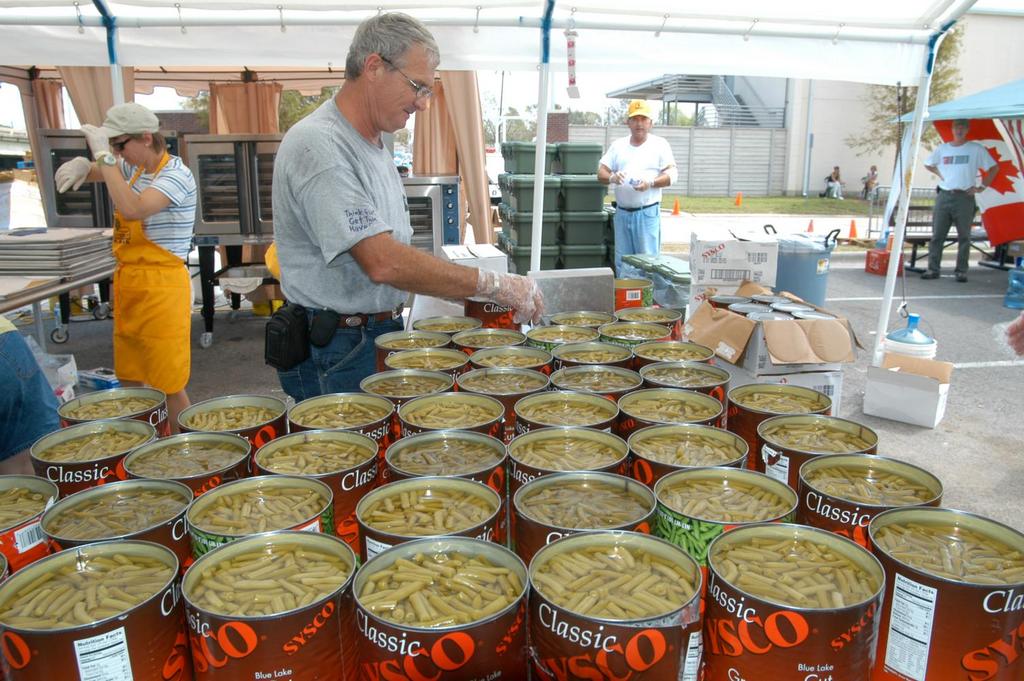
New Orleans, Louisiana, September 17, 2005 -- Gallon-sized cans of green beans are open and ready to be cooked at a field kitchen set up by the Arkansas branch of the Southern Baptist relief association. The American Red Cross provides these hot meals using their feeding trucks to people throughout the city . Win Henderson/FEMA photo. (A #10 can is actually 3 quarts in volume.)

Thursday, September 29, 2005

Camp Kitchens for Hurricane Katrina Relief Workers, #4

.
Base Camp, New Orleans, Louisiana, September 15, 2005 -- A cook prepares the grill to cook a meal at Base Camp Zephyer Field. This mobile kitchen is operated by Port-A-Pit Catering Services of Tuscon, Arizona. Marvin Nauman/FEMA photo.

Camp Kitchens for Hurricane Katrina Relief Workers, #3

.
Base Camp, Louisiana, September 15, 2005 -- A relief worker hands out a meal to a disaster worker at Base Camp Zephyer Field. Marvin Nauman/FEMA photo.

Wednesday, September 28, 2005

Camp Kitchens for Hurricane Katrina Relief Workers, #2

.
Base Camp, New Orleans, Louisiana, September 15, 2005 -- The food line for emergency workers and relief workers at Base Camp, Zephyer Field. Hotel rooms are difficult to find and many workers sleep in tents, sleeping bags, cars or where ever they can. Many areas of the city are still without power and utilities. Marvin Nauman/FEMA photo.

Camp Kitchens for Hurricane Katrina Relief Workers, #1

.
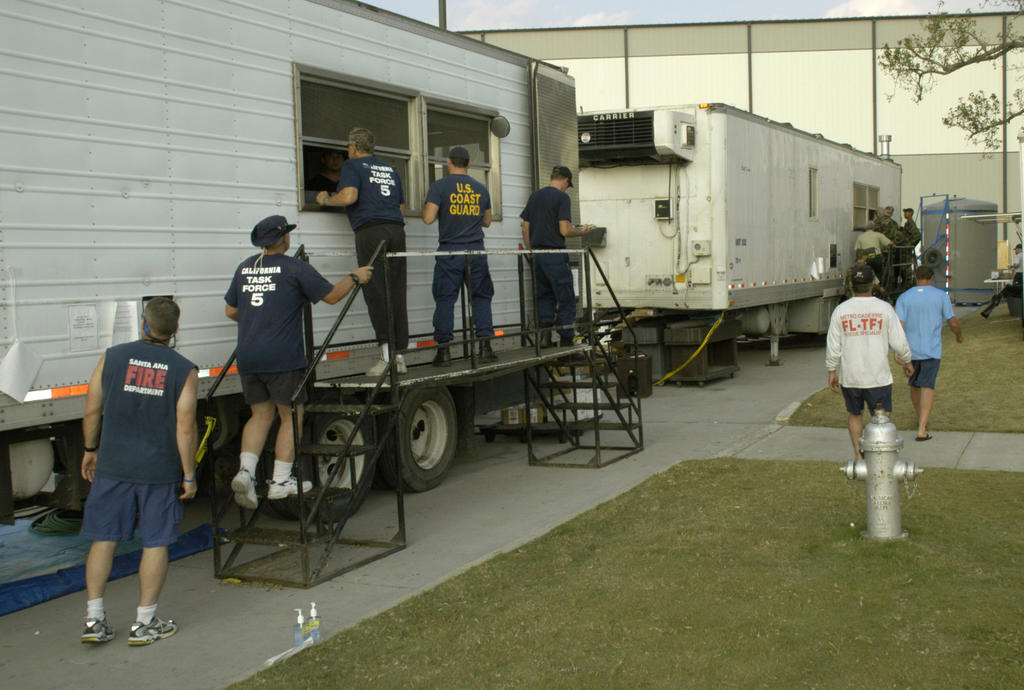
New Orleans, Louisiana, September 15, 2005 -- Disaster Workers at Base Camp are lined up at one of the kitchens to get a meal. During a disaster all of the needs of disaster workers must be met along with those of the victims. Marvin Nauman/FEMA photo.