Showing posts with label campfire. Show all posts

Friday, March 20, 2020

Coney Island chili sauce

This Coney Island chili sauce adds an element of spice and richness to any hot dog. With a helping of finely chopped onions and a stream of yellow mustard, you have a dish that is worthy of any camp meal or potluck. And it can also be turned into a stand-alone chili with the addition of beans.

Now I admit that I have never had a hot dog covered in authentic Coney Island chili sauce. The sauce is said to have been originated by Greek and Macedonian immigrants to Indiana and Michigan in the early Nineteenth Century. One day I'll have to search out a Coney Island restaurant in Michigan.

In my quest for a good hot dog chili for my summer camp, I first thought of trying Coney Island chili sauce when I ran across several YouTube videos. Although I enjoyed these recipes, many were lacking in texture and smoothness. After much research, I found that many "authentic" recipes added ground hot dogs to the chili. That was the key ingredient. Along with the addition of masa as a binding agent, I found what I was looking for.

So, while I don't make any claim to the authenticity of this recipe, you have my guarantee of its goodness. Give it a try. You will enjoy it.

Large quantity recipe for Coney Island chili sauce.

CONEY ISLAND CHILI SAUCE

Do not brown the ground beef as you would in a pot of chili con carne. Once you puree the hot dog, onion and garlic, place all chili sauce ingredients in a medium pot with the water. As the chili comes up to temperature, break up the ground beef with a potato masher until the chili is smooth. Simmer, thicken and enjoy!

Purchase lean ground beef for this recipe. While I used 90/10 ground beef for this recipe, a leaner grind will work as well. Lean ground beef reduces the amount of grease that rises to the top. I used an all-beef hot dog for the puree.


Hot dog paste:
6 oz hot dog
½ cup onions
3 garlic cloves

Chili sauce:
1 pound 3 ounces lean ground beef
2 cups cold water
⅓ cup ketchup
¼ cup butter or margarine
2 tablespoons chili powder
1 teaspoons ground cumin
1½ teaspoons salt
½ teaspoons celery salt
½ teaspoons ground black pepper
Pinch cayenne pepper

Thickener:
⅓ cup cold water
2 tablespoons masa

In a food processor, process hot dogs, onion and garlic into a smooth paste. Combine hot dog paste, ground beef, water, ketchup, butter or margarine, chili powder, cumin, kosher salt, black pepper, celery salt and cayenne pepper to medium pot. Mix with a potato masher or spatula over med-high heat until mixture has a finely ground consistency and begins to bubble. Reduce heat to medium-low, and cook, stirring occasionally, until sauce thickens and reduces, about 1 hour.

Mix cold water and masa into a smooth paste. Slowly pour into sauce, stirring constantly. Cook until sauce has thickened. Adjust seasoning with salt and pepper to taste. Serve over steamed hot dogs with finely chopped onions and yellow mustard. Makes a bit over 5 cups.

This recipe is based a recipe by Chef John of Food Wishes, also available on YouTube and Allrecipes.

Thursday, October 09, 2014

Throwback Thursday: Frank's killer breakfast

Today's throwback blends two posts from August 2005. Frank and his lovely wife, Ann, have since moved to Boise, Idaho, and have become grandparents. Debbie and I need to travel north and hold a reunion camping trip.

All camp cooks savor a day off from the kitchen. Yesterday was my day off. My duty was to make coffee, lounge beside the campfire and dish out advice. A buddy handled all culinary tasks.
Jacob and I went camping with Frank and Hunter Friday evening.

We spent the night at Wench Creek Campground on the east shore of Union Valley Reservoir in Eldorado National Forest. Camping is pleasant now that the heat wave has subsided in the Sacramento Valley. Friday’s high was about 75 degrees. The overnight low was 50.

Frank prepared a killer breakfast for us. He got up about 45 minutes ahead of me Saturday morning. Frank had a good bed of coals for cooking by the time I got up at 6:30 a.m.
Frank’s breakfast is hearty -- an epicurean contradiction -- good tasting and not-so-good for you, all in one setting. A carpenter and general contractor by trade, he cooked  breakfast in two large cast iron skillets, each course in succession. He normally cooks breakfast in one skillet. When Frank told he about breakfast plans last week, I threw in an extra skillet.

Bacon and sausage patties and links inaugurated the morning meat-egg-potatoes fest. Then in quick succession, Frank fried potatoes to a crisp in the bacon fat and scrambled eggs, again in bacon fat. Lastly he cooked gravy from more bacon grease, flour and milk.

Build a roaring cookfire. I follow two rules: First, build a fire that’s twice to three times the size that you think you need. In pine and cedar country it’s easy to underestimate the amount of wood.

The second rule is equally important. Keep the fire going and avoid the tendency to let it burn out once you start cooking. Otherwise Murphy’s Law steps in and kills any further plans for breakfast.

"I love the smell of bacon in the morning."
Use this time to dice the potatoes, crack and whisk the eggs and form sausage patties. The fire will take 30 to 45 minutes to burn down to a nice bed of coals. Don’t forget to add fresh wood as the fire burns.

With the fire ready, it’s time to cook breakfast. I said that Frank cooks each course in succession. The bacon goes into the first pre-heated skillet.

Push the bacon aside if you’re using a large skillet (14 inches or larger) and add sausage patties to the skillet. You may want to cook the bacon and sausage in batches if you’re using a smaller skillet. Once browned to the desire color, the move the meat waiting plate covered with a double layer of paper towel. (I’m not sure why the paper towels are necessary—you’re going consume enough grease to worry your cardiologist!)

Don’t discard any of the rendered bacon fat. Frank divides it between three dishes (health warnings aside). The potatoes, eggs and gravy all receive generous portions of the swine nectar.

You're allowed to break one egg yoke over a campfire.
A pot-full of diced potatoes are next poured into the meat skillet. Watch for splattering grease! Crumble a few bacon strips and sausage patties into the potatoes if desired.

Fifteen to 20 minutes over a hot fire will crisp the potatoes to a nice golden color. Move the skillet to a cooler spot over the fire. Stir the potatoes occasionally to keep them from burning.

At this point, turn your attention to the scrambled eggs. It’s important to pre-heat the egg skillet over a medium fire. Otherwise, you’ll burn the eggs and ruin breakfast.

Slow cooking is best for the eggs. Stick around once you pour the whipped eggs into the skillet. They require constant stirring until cooked. Frank never left the fire until the eggs were cooked.

The secret to moist scrambled eggs is to cook them over low heat. Remove the eggs when they’re still moisture seeping out. Remember, overcooked eggs in the skillet become overcooked eggs on the plate.

Place the eggs into a waiting bowl, cover with a sheet of foil and wipe the skillet clean. The pour the remaining bacon fat into the skillet and return it to medium heat. Next place enough flour into the skillet to absorb the fat. (You’ll have to judge quantities for yourself.)

Stir the roux for a few minutes over a low flame, being careful not to brown it. The last step before breakfast is to pour three or four cups of milk into the gravy skillet. Stir constantly for about 10 minutes to work the lumps out. Once the gravy thickens, you’re ready to eat.

Give the potatoes a quick stir just before serving. Warm potatoes, eggs and gravy are a must. And pour gravy over the potatoes and eggs. After all, gravy is the culinary elixir that brings the whole meal together.

Wednesday, September 24, 2014

New masthead image

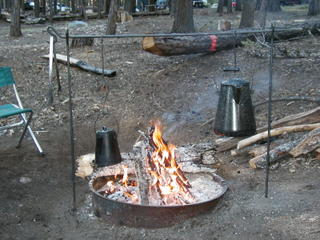
For the first time in nearly 10 years, 'Round the Chuckbox has a masthead image. The photograph was taken in Eldorado National Forest during one of my many campfires up Iron Mountain Road in January 2009.

I originally developed this image last year to use as a business card. As shot, the Dutch oven was on the left side. I cannot remember the reason that I flipped the image, although I'm certain it was for some obscure artistic reason. 
Here's a peak Inside the Dutch oven. My cooking journal didn't reveal any details about this pizza. It looks like a take-and-bake pizza from a local shop.

Wednesday, September 17, 2014

20-inch Lodge skillet at Upper Blue Lake

Debbie and I returned from our annual camping trip to Upper Blue Lake with my sister and husband. This year one of our daughters and granddaughters joined us, along with one of the wranglers from Oakland Camp. We enjoyed six days of sun, wind and cool mountain air.

This is the first article from the trip. As I coordinated the menu with my sister, my thought was to prepare several meals in my "new" 20-inch Lodge skillet (model 20SK). I found the skillet at an Eagle Point, Oregon, antique shop last April. Newly re-seasoned, I used the large skillet to cook four meals for the family. I wanted to cook as many meals as possible to hasten the build-up of patina.

Enjoy these photos.

The Lodge model 20SK skillet awaits dinner Thursday evening. I use the large World War II Navy surplus coffee boiler to heat water for washing dishes. The boiler was manufactured by Vollrath.
Spicy Japanese buckwheat noodles (called soba noodles) was on the menu Thursday evening. The sauce was made from sesame oil, rice vinegar, soy sauce and chili garlic sauce. Two (9.5-ounce) packages soba noodles and two pounds shrimp were used.
I fried 1-1/2 pounds thick sliced bacon for breakfast Friday morning. The small pot holds syrup for hotcakes.
Oat blueberry hotcakes were cooked in the skillet. The batter ran until it set in the less than level skillet 
To make the hotcake batter, I doubled my families traditional hotcake recipe, then replaced 1 cup of the flour with a cup of old fashion oats. I dropped a 6-ounce package fresh blueberries to the batter at the last minute.
Friday evening I prepared succotash with kale to accompany grilled chicken. After sauteing onion, roasted red pepper and garlic, I added a bunch of kale.
After adding two (1-pound) packages frozen whole kernel corn to the vegetables, I scooped the dish into the waiting pot. Garlic bread is warming in the foil packages to the left. My brother-in-law grilled chicken for the entree.
We used Saturday's leftover tri-tip to make fajitas for lunch Sunday. I'm seasoning the meat and vegetables with scratch-made taco seasoning.

Tuesday, April 01, 2014

Campfire cooking with charcoal briquettes

Over 10 years ago, a reader to my former writing project on Suite101.com posed a series of Dutch oven questions. The reader -- named Sheila -- found that the Dutch oven was the ideal piece of camp cookware because it solved a few "camp cooking problems."

Even after summer campfire restrictions were in place, the Dutch oven let her avoid "hot dogs, red meat and a lot of processed foods." She was able to create a myriad of one-pot meals in the three-legged cast iron pot.

Sheila's questions

Camping took her mind off of her ailments, said Sheila. Since she often didn't have the energy to build a campfire, she used charcoal briquettes to cook her meals. "A lot of times I go camping because I’m not feeling well and making a fire, especially learning by trial and error," said Sheila, "is exhausting and time consuming."

Here's her dilemma: "I found that the charcoal briquettes sank into the soft ashes in the fire pit that the state park provides. I’m thinking that next time I’ll put the briquettes into an aluminum cake pan and cook from there."

Sheila believed that charcoal briquettes were a good "way to cook up dinner." She asked:
  1. Can you perk coffee on charcoal briquettes?
  2. Will an old lightweight aluminum coffee pot work?
  3. Can you cook pancakes or eggs on a cast iron griddle over charcoal briquettes?
  4. What types of pots are good on charcoal briquettes in addition to cast iron?
"I’d like to try some cast iron Dutch oven and other types of charcoal briquette cooking using what I have and see if I like it first before getting any special equipment," concluded Sheila. "I was just checking to see if I got some of the beginner’s rules correct."
Cooking with charcoal briquettes
The answer to Sheila's questions was a resounding yes. While I prefer campfire cooking, charcoal briquettes are a good substitute for those times when campfires are banned.

Here are my general rules:

Cooking with charcoal. Charcoal makes a good ready-made source of heat for camping. The briquettes are easy to count and light. And they burn at a predictable rate. Here are four considerations :
  1. Chimney charcoal starter. Don't use lighter fluid to ignite charcoal briquettes. Instead, crumple one or two sheets of newsprint in the bottom compartment of a chimney charcoal starter and light. You'll have gray ash-covered coals in about 20 minutes.
  2. Heat control. Control the heat by adding and removing burning briquettes. This takes practice. Start by placing a thick field of briquettes under the skillet or pot. Then watch the food. If it's cooking too fast, remove briquettes with a pair of tongs. Add burning briquettes if the food is cooking too slow. And, yes, Sheila can brew coffee in the aluminum coffee pot and fry breakfast on the cast iron griddle.
  3. Fire safety. You need nearby water source to douse any fires. Purchase a galvanized steel bucket and ash shovel to collect spent briquettes. Drown spent coals inside the bucket. When all fires have been extinguished, discard the ash and briquettes. 
  4. Wind shield. Charcoal briquettes burn hotter and faster under windy conditions. In a brisk wind, coals that normally burn for 60 minutes may evaporate within 30 to 45 minutes instead.
Use a firepan. It's important to protect the environment and to guard against wildland fires. Any fireproof implement can be turned into a firepan. Set a baking sheet (or any iron or steel sheet) between two or more bricks to hold the coals. You can also cook in a kettle-style barbecue. You'll need to elevate the pots and pans two to three inches above the coals.

Cookware. Any cookware can be used when cooking over a charcoal fire. However, don't place burning charcoal briquettes directly on top of any cookware that isn't cast iron. Conversely, don't set anything directly on the briquettes. Thin-skinned cookware (like aluminum) will warp. And enamel pots can burn and chip. Either suspend pots over the coals with a chain or use a grill to hold them two to three inches above the fire.

After our conversation on Suite101.com, Sheila purchased several fireproof bricks at a local brickyard and a pizza sheet and grill at a secondhand store. She planned to suspend the grill between two bricks, about two and one-half inches above the charcoal. After setting the pizza sheet on top of one or two bricks, she said that she'd burn the charcoal directly on the pizza sheet.

Sunday, September 29, 2013

Ready, bake, flop

Or should I say, ready, bake fizzle? That's precisely what happened two weeks ago on our annual camping trip to Upper Blue Lake with my sister and family. I mixed a double batch of my no-knead bread at home early in the week before heading to the lake, located in the southeastern reaches of Eldorado National Forest. We readied for the trip as the dough slowly fermented in the home refrigerator.

I set the dough aside Thursday and Friday while we enjoyed relief from the heat of the Sacramento Valley and Sierra Nevada foothills. After exploring nearby lakes and four-wheel drive trails with my sister, I settled in to prepare dinner. I quickly got ready to bake two breads from the dough. Eighteen biscuits went into a 12-inch camp oven. My thought was to bake the biscuits, then set them aside for breakfast. The remaining dough was formed into five balls and placed inside a 12-inch deep camp oven.

Since the biscuits were rising at this point, I already had half of what I needed to fix for the replacement meal. Encouraged on by more than one B&G enthusiast in camp (notably, my brother-in-law's nephew), I lit a roaring campfire. Hot coals were soon being shoveled onto the waiting Dutch oven. The photos tells the story.

I usually burn pine and cedar wood when I camp in the National Forest. It's a matter of supply. Since I don't see the need to buy firewood when it's available for free, I burn the wood that I find on the forest floor. It's different when we camp with my sister and brother-in-law. Jim brings a mixture of hard and soft woods with then to the campground.
Sunday afternoon before the camping trip, I mixed a 4-pound dough (flour weight) and fermented in in the refrigerator. The dough went into the cooler Wednesday afternoon in preparation for departure. I filled a 12-inch Dutch oven with biscuit-sized pieces of dough late Friday afternoon.

The Cambro container is a bit messy because the batch of dough was too large for its 8-quart capacity. I had to punch the dough down as it fermented Sunday. The dough settled down once I placed it in the fridge for a cold slow ferment.
The 12-inch camp oven held 18 golf ball-sized biscuits. To form each biscuit, I pinched off a piece of dough and molded it into a smooth ball.
While the biscuits appear done in the photograph, they're doughy on the bottom. Within 15 to 20 minutes, the coals gave out. When I dug the half done biscuits out of the Dutch oven, I learned they were nearly raw underneath. To rescue them, I placed the dough on the grill. While I generally have success when cooking with campfire coals, sometimes the coals burn out.

Thursday, September 19, 2013

Penne rigate with poblano cream sauce in camp

All of our meals last week were prepared over the campfire. With a mix of hard and soft wood supplied by my brother-in-law, the campfire burned most of the day, from six in the morning to late in the evening. Rain clouds, distant thunderstorms and cool breeze off Upper Blue Lake made the fire a welcoming feature of our camp. Its comforting flames provided warmth throughout the day.

I prepared our first campfire meal Thursday evening. Penne pasta with poblano cream sauce and chicken sausages filled the crew after an ambitious afternoon of setting up camp. I'll post the recipe for the poblano cream sauce soon. Please enjoy the photographs in the meantime.

I began the meal by placing a large pot of salted water over the fire. Once the water boiled, two 13.25-ounce packages of whole wheat penne rigate were cooked al dente. In the meantime, I combined around 3 cups poblano chili base with 1 pint of heavy cream in a saucepot. The sauce simmered over medium heat to blend flavors and reduce.

The chili base was prepared at home and transported to camp in the cooler. It consisted of roasted poblano chilies, chicken stock, garlic, cilantro and lime juice, pureed in the blender.

With pasta cooking in the stockpot and sauce simmering next to it, I sautéed onions and sweet peppers in my Lodge No. 12 skillet (hidden from view). Here, I'm adding a dozen roasted red pepper and asiago chicken sausages to the skillet.

A close up of the sausages as they brown in the Lodge No. 12 skillet.

Saturday, January 12, 2013

Yeast raised hotcakes for camp

This recipe looks forward to spring and summer when campers head outdoors. It began as another blog post, one prepared in my home kitchen. As I mixed the batter last night, my thoughts carried me to our camp kitchen at Upper Blue Lake last September. Why not offer the recipe for the camp kitchen?

"Yeasted pancakes ... have a bubbly texture and a clean, slightly earthy (from the cinnamon) flavor that I can't resist," promises Daniel Leader. "It is easy to make this batter just before bedtime, so that it is ready for the griddle when you are the next morning." He wrote Simply Great Breads: Sweet and Savory Yeasted Treats from America's Premier Artisan Baker (The Tauton Press: Newtown, Conn., 2011) with Lauren Chattman.

Other than to slightly adjust the quantity of the flour and modify the instructions, the recipe remains true to Leader's original. Even though I tested the recipe for yeast raised hotcakes at home, it can be quickly assembled in camp.
 
Mix the dry ingredients in a zipper top bag, expel excess air and you're ready to travel. The only other task is to make sure you pack buttermilk, honey, butter, eggs and vanilla. While you can measure precise quantities for the wet ingredients, I pack them in their original containers so they can used for other dishes.

As Leader explains, mix the dry and wet ingredients (except eggs and vanilla) on the evening before your hotcake feast. After "kneading" with a wire whisk, cover the bowl with plastic wrap and set inside the cooler. The yeast will work through the night, giving the batter a sour edge. 

Light the campfire first thing in the morning. As the campfire burns, mix the eggs and vanilla into the batter and set aside. Cook the hotcakes on the griddle when the fire is ready. Have the butter and hot syrup ready so your hungry campers can begin eating as each hotcake comes off the griddle.

Oat hotcakes on the griddle last September at Upper Blue Lake Campground in Eldorado National Forest.
YEAST RAISED HOTCAKES

While I haven't tested the recipe for larger groups, I see no reason why doubling it won't give you the same wonderful results.
Dry ingredients (mix at home):
12 ounces all-purpose flour (2-1/2 cups)
2-1/2 teaspoons instant yeast
1 teaspoon kosher salt
3/4 teaspoon ground cinnamon

Wet ingredients (prepare in camp):
1-3/4 cups buttermilk
1/4 cup honey
5 tablespoons melted unsalted butter
2 large eggs
1-1/2 teaspoon vanilla extract

At home. Measure or weigh flour, yeast, salt and cinnamon in to a zipper top bag or other container. Pack the buttermilk, honey, butter, eggs and vanilla.

In camp, during the evening before breakfast. Pour dry ingredients into a bowl. Stir in buttermilk, honey and butter. Slowly whisk to moisten

ingredients. Continue whisking for about two minutes until batter is smooth, about 250 strokes. Cover bowl with plastic wrap and place in the cooler overnight, taking care so it doesn't spill.

In camp, on the day of breakfast. Light a campfire and burn until you have a bed of hot coals. When coals are ready, spread under a lightly greased cast iron skillet or griddle and heat just until it smokes. (Hotcakes can be cooked over a campstove if desired.)

Stir eggs and vanilla into batter. For each hotcake, pour about 1/4 cup of batter onto the hot greased griddle or skillet. Turn when the surface of each hotcake is bubbly and edges are slightly dry. Cook until golden brown.

Serve immediately. Dish hotcakes directly onto the plates of hungry campers. Serve with butter and brown sugar syrup (recipe follows). Makes 15 to 16 hotcakes.

BROWN SUGAR SYRUP

Some things are just too easy to make at home, including hotcakes and brown sugar syrup. I figure, why buy the bottled stuff when you can easily produce quality syrup at home.

1 cup brown sugar
1 cup granulated sugar
1/4 cup corn syrup
2 cups water
3 tablespoons unsalted butter

In a medium saucepan, bring the sugars, corn syrup and water to a boil. Reduce heat to a vigorous simmer until thickened to a syrupy consistency, about 30 minutes. Stir in butter. Let cool slightly. Store in the refrigerator for up to one month.

Saturday, October 27, 2012

The Softwood Solution

I depend on downed softwood in the Sierra Nevada high country to build my campfires. To me, it’s a waste of precious dollars to haul oak firewood or charcoal briquettes to the campground. Instead, I rely on the natural resources of the forest.

I’ve learned that to be successful with softwood you must pay constant attention to your Dutch oven. Pine, fir and cedar burn quickly. As a result, you need to watch your oven and replenish the coals often.

I don’t focus oven temperature when camping. I just pile hot coals from the campfire onto the oven with a gloved hand and a pair of 14-inch tongs. I use experience and the five senses to approximate the correct number of coals.

I usually build a campfire that’s four to five times the volume of the camp oven and burn it down to a glowing bed of coals. You can accomplish this in approximately 30 minutes with pine, fir and cedar.

I've learned from many poorly cooked dishes that you can never have too many campfire coals. To make sure I finish the dish with sufficient heat, I continue to feed the campfire even after I’ve heated the oven. I keep feeding the fire as long as I have a plentiful supply of firewood.

This article was originally presented in the Fall 2004 issue of the Dutch Oven News, the official newsletter of the International Dutch Oven Society, as a sidebar to "Three-Sided Chicken: Use Your Next Campfire to Roast a Chicken in a Dutch Oven."

Saturday, October 13, 2012

Oat hotcakes in camp

I am posting this recipe by request. After a camping trip with my sister's family to Upper Blue Lake in Eldorado National Forest last month, I received this email from Elizabeth: "Hope you are going to post the recipe for your impromptu hotcakes. Both Ashley and Naomi want it!"

Elizabeth and I worked out the menu in the month leading to the trip. With family favorites, like campfire grilled chicken and roast trip-tip planned for the dinner meals, I was to bring my Dutch ovens into camp, prepare my much requested bread pudding for a dessert and the family hotcake recipe for Saturday morning breakfast.

Everyone enjoyed dinner and dessert Friday evening. My brother-in-law grilled chicken breasts and thighs to perfection over the cooking fire while I introduced Ashley, a young culinary student and my niece's high school friend, to cast iron Dutch ovens. As Ashley sliced 14 apples (a mixture of Granny Smith, honeycrisp and Fuji) for apple crisp, I prepared the 14-inch Dutch oven for the dessert.

I enjoyed a lazy Saturday morning next to the campfire with a cup of coffee while the fishing brigade worked the lake. As Elizabeth and I talked about our late-morning breakfast, I learned that I had misread her email. I was supposed to prepare the hotcake mix at home (click for my original article on "Hotcakes at 9,000 feet").

After a quick inventory, I realized that flour was in short supply in camp. Elizabeth had purposely left her flour at home. And my supply amounted to a meager cup of all-purpose flour. So, I prepared the hotcake batter with ingredients on hand. Quick cooking rolled oats filled in for most of the flour.

Oat hotcakes are a new camp favorite.

OAT HOTCAKES IN CAMP

These are approximate measurements as I eyeballed each ingredient. For a richer flavor, substitute molasses or dark brown sugar for the white sugar. Try adding toasted pecans or walnuts for a nutty flavor. Raisins or currants will also work in this recipe. Click for my oatmeal walnut hotcake recipe from 2011.

1 cup all-purpose flour
2 cups quick cooking rolled oats
2 tablespoons granulated sugar
1 tablespoon baking powder
1 teaspoon kosher salt
3 large eggs
1 teaspoon vanilla
1-1/2 cups milk
1/4 cup liquid bacon grease or vegetable oil

Light a campfire and burn until you have a bed of hot coals. (Hotcakes can be cooked over a campstove if desired.)

In a bowl, stir flour, oats, sugar, baking powder and salt together. Crack eggs into the dry mixture. Add milk and vanilla. Whisk just until the batter is blended. Add the oil or bacon grease and mix again just until the batter is blended. The batter will be slightly lumpy.

When the coals are ready, spread them under a lightly greased cast iron skillet or griddle and heat just until it smokes. For each hotcake, pour about 1/4 cup of batter onto the hot griddle or skillet. Turn when each hotcake’s surface is bubbly and the edges are slightly dry. Cook until golden brown.

Serve with butter and brown sugar syrup (recipe follows). While I didn't count how many hotcakes that I cooked, each person in camp (11 total) received one cake. It should give you around 12 hotcakes.

BROWN SUGAR SYRUP

Some things are just too easy to make at home, including hotcakes and brown sugar syrup. I figure, why buy the bottled stuff when you can easily produce quality syrup at home.

1 cup brown sugar
1 cup granulated sugar
1/4 cup corn syrup
2 cups water
3 tablespoons unsalted butter

In a medium saucepan, bring the sugars, corn syrup and water to a boil. Reduce heat to a vigorous simmer until thickened to a syrupy consistency, about 30 minutes. Stir in butter. Let cool slightly. Store in the refrigerator for up to one month.

Thursday, September 29, 2011

Code of the campfire #10

The code of the campfire says put the fire dead out when you break camp. The U.S. Forest Service campfire permit requires that you use the "drown, stir and feel" technique to extinguish the campfire. Any method that leaves burning embers -- even those buried under a layer of dirt -- can spark a wildland fire.

To drown the campfire, pour several pails of water over the campfire. I find that it takes five or more gallons of water to drown the fire. With a shovel, thoroughly mix the ash and water until it resembles a soupy mess. Feel the ashes to make sure the fire is dead out. Walk the ground within a fifty-foot radius to make sure no embers have escaped.

The second part of the code says consider your neighbor. Watch the prevailing wind as you pour water onto the hot fire. This way you'll avoid showering your neighbor (or wife for that matter!) with an ash cloud.

Saturday, September 24, 2011

Code of the campfire #9

The code of the campfire says be responsible. Don't wander from camp while the campfire is hot. A momentary wind gust could carry embers far from the campfire. Be ready to extinguish any that escape.

The responsible camper always considers the ramifications of a misstep or two. As I said earlier this week, you could be held legally and financially responsible should embers from your campfire spark a wildland fire.

The second part of the code points back to a prior code -- tool up. Should campfire embers escape, stomp it out with your shovel (or boot if that's quicker!). Once the flame is dead, extinguish the ember with water.

Sunday, September 18, 2011

Code of the campfire #8

The code of the campfire says obey all laws. This is especially critical when forestry officials restrict or prohibit campfires when conditions warrant. These conditions often occur in late summer and early fall.

The last thing I desire is to be responsible for a wildland fire. The Angora Fire, which destroyed 254 homes and burned 3,100 acres in South Lake Tahoe in June 2007, started when an illegal campfire escaped on a windy day. You can be held criminally and financially libel for such a fire.

Be a good citizen. That's the second part of the code. Secure an annual campfire permit where required by law. Please pay attention to instructions from the issuing official. And make sure you know current fire restrictions before lighting a campfire.

Friday, September 16, 2011

Code of the campfire #7

The code of the campfire says clear all debris on the forest floor away from the campfire. The U.S. Forest Service says the camper should rake a "minimum of five feet in all directions" from the fire. Like a fire break, the clearing creates a buffer zone between the fire and surrounding forest. The break will give the cook the chance to extinguish hot embers should any escape.

I rake all leaves, needles and kindling away from the campfire ring with a small bamboo rake. It's small size conveniently fits inside the storage compartment of the tent trailer. The rake is a key component in my collection of campfire tools.

Yes, there's a follow up to this rule as well. Be curious. Leave the circle around the campfire cleaner than you found it. This rule has been a key component of my personal lifelong code. Always leave a clean campsite.