Showing posts with label fire departments. Show all posts

Tuesday, August 09, 2011

CalFire's mobile kitchen units

I found this video at the Fire Department News Network. Although I never worked on one of the mobile kitchens depicted in video during my career with the state, I visited MKU-27 at Growlersbrg Conservation Camp while writing the chapter on emergency feeding for the state food service handbook.

Carlin Manufacturing of Fresno, California, built 11 MKUs between 1990 and 1991 for Cal Fire. Based on Carlin Model 36F5 High Mobility Kitchen, the MKU was designed to feed 1,200 persons three meals per day. When augmented by a support trailer, water tender, generator and mobile dishwashing unit, Cal Fire found that the MKU can feed over 2,000 people a day at an incident base camp.

As you see in the video, the conservation camps have purchased additional equipment to boost the operating capacity of the MKU. They often set-up an outdoor kitchen. Inmate cooks use gas grills and griddles to compliment the equipment inside the MKU.

Each 36-foot trailer contains the following cooking equipment:
  • 2 dual-stack convection ovens
  • 2 (30-gal.) tilt skillets
  • 1 (40-gal.) steam-jacketed kettle
  • 6-burner gas range with conventional oven
  • 1 meat slicer
  • 2-tank coffee brewing system
  • 2 twin-well steam lines

VIDEO DESCRIPTION: Firefighters working a wildfire need to eat 3,000 calories a day. These meals usually consist of sack lunches or MREs. That is why CAL FIRE Mobile Kitchen Units (MKU) have been bringing food to firefighters battling wildfires for the past 15 years. There are eleven MKUs placed throughout California that can each feed up to 2,000 people. They can be set up and ready to serve within four hours.

"It's an unusual resource. The Forest Service, by law, they have to hire mobile kitchens. And so, they will do that because that's how they're directed. But for CAL FIRE, if we're running an incident, we just request these and out they go. But, no, it's a very limited resource. It does take a lot of funding and staffing to make it work," says Bill Peters, CAL FIRE's Public Information Officer.

Inside, the trailer houses ovens, a stove, and large vats for cooking beans and soup. These are used to store canned goods when not in use. Last minute touch-up cooking is done inside the trailer, while heavy duty cooking is done outside. The food is high quality because the units are staffed by conservation camp inmates, who are paid $1 an hour for fires.

A chef hired by CAL FIRE creates the menu and directs the inmates. Bill Peters says, "There's actually a little bit of competition between the different Mobile Kitchen Units as to who puts out the best menu. Are we getting salmon tonight? Steak tomorrow? And I've been out where the cooks are good enough cooks, they can do Chicken Cordon Bleu." The variety is appreciated by firefighters who spend days fighting wildfires.

There are numerous support vehicles that carry tables, chairs, and salad bar equipment. The other vehicles are generators to keep everything up and running, and refrigerator trailers.

Saturday, September 04, 2010

Close call

A Placerville family is safe this afternoon after a wildland fire damaged their home on Missouri Flat Road. The fire was sparked by a malfunctioning catalytic converter, according to FOX40 News at 5:30 P.M. Firefighters contained the fire before it grew out of hand.

The fire had the potential to destroy a number of homes in the vicinity. At one point, the CHP Traffic Incident Information Page reported that it was evacuating Halyard Lane to the northeast of the fire. The fire had the potential to wipe out about a dozen historic California Door Company mill homes on Wedge Hill.

Units from the Diamond Springs-El Dorado Fire Protection District (DSP), El Dorado County Fire Protection District (ECF), Rescue Fire Protection District (RES) and California Department of Forestry and Fire Protection (CalFire) responded to the incident. DSP Fire Chief Todd Cunningham was on the scene. While I'm not certain, he may've been the incident commander.

A cell phone call by my daughter alerted me to the fire shortly after 1 p.m. She encountered the CHP blockade at Forni Road while traveling south on Missouri Flat. Christen deduced from drifting smoke and a circling helicopter that a fire in the area caused the road closure.

Little did Christen know that she awakened the fire photographer in me. While I don't desire any loss of life or property, there's a certain sense of excitement when a fire occurs in the area. (I'm certain that excitement would turn to panic if my home was threatened by an advancing wildland fire.)

Bright yellow Nomex fire suits, polished red fire engines and drifting smoke all come together to make for great photography. Add a long camera lens and plenty of action and you have the potential for award-winning photographs. Although I've not received any awards for any of my photography, it's personally exciting to produce colorful photographs that are full of action.

In the past three years I've chanced upon four incidents that have given me the opportunity to "play" fire photographer. They include the 49er and Palmer fires in 2007. The 49er burned within two miles on my home. I also caught aircraft action at Dawson helispot and on the Clay Fire in 2008. Today was my first opportunity in two years to photograph a fire.

Here's a sampling of the pictures that I captured this afternoon:

The fire damaged the south side of the house, which was originally built for mill workers employed by the California Door Company. Shortly after I took this picture, I saw firefighters dragging smoldering objects from the interior of the house.

Firefighters assigned to Engine 2761 mop up hot spots on Wedge Hill. The CalFire engine is based at Station 20 in Camino. The headquarters of the Amador-El Dorado Unit (AEU) of CalFire is located at Station 20.

A firefighter assigned to AEU Engine 2771 just shut off the reel hose from the engine. You can see water dripping from the nozzle when you enlarge the picture. E2771 is quartered at Station 43 at the El Dorado Wye.

Water Tender 46 dwarfs E2771 during the mop up stage of the fire. Three water tenders supplied much needed water to the units on the scene.

A FOX40 cameraman interviews DSP Assistant Fire Chief Erik Peterson. The television station only ran a 10- or 15-second video of the fire as the second story at 5:30 p.m. The chief's interview was omitted from the coverage.

Thursday, April 30, 2009

Gearing up for fire season

To look outside, one wouldn't think that fire season is just around the corner. The past two mornings the thermometer hovered above freezing. And a layer of clouds cooled the Sierra Nevada foothills today.

But Cal Fire's fleet of North American-Rockwell OV-10A air attack aircraft and Grummun S-2T air tankers were busy preparing for fire season. As I listed to one of the air operations frequencies, I heard the pilots talking back and forth as they coordinated practice runs at two target areas.

The pilots of Air Tankers 80, 86, 89, 94 and 95 took turns dropping their loads at practice areas located near Georgetown and Bear Valley. Meanwhile, Air Attacks 120, 340 and 460 were in the air as well.

We'll soon be listening to these same pilots as they drop their cooling loads on real fires over the sky's of El Dorado County.

In the picture, Cal Fire Tanker 88 runs up the center of the 2008 Clay Fire in Placerville, California, and drops its load of fire retardant on Division Mike, a group of fire engines led by Diamond Springs Fire Chief Todd Cunningham (Chief 8100). Division Mike was assigned to suppress the head of the fire as it ran up a ravine toward a cluster of houses.

Friday, February 20, 2009

Engine 74 at the museum


ECF E74 at the museum
Originally uploaded by SeabeeCook
This isn't exactly earth-shattering news, but El Dorado County firefighters stopped by the El Dorado County Historical Museum this afternoon to help with a fire alarm issue.

We're still not sure what happened, but think one of the heat sensors in the engine house or machine shop malfunctioned. We weren't doing anything in either building that would've set the alarm off.

I'm not sure why E74 responded as the engine is houses at Station 74. The station is located in the community of Lotus, about 10 miles northwest of Placerville. Maybe the closest engine, Engine 25, was out at the time.

Saturday, December 06, 2008

Engine 49 departs ...


DSP E49 departs ...
Originally uploaded by SeabeeCook

I was a "kid in a candy store" last night! I got to eat, enjoy friends and watch fire trucks all in the same evening.

You'll have to watch quickly as the fire engine is leaving the station in Blog No. 6 ...

Engine 49 answers a medical aid call toward the end of last night's annual Christmas social of the El Dorado Western Railway Foundation. For several years, the Diamond Springs-El Dorado Fire Protection District graciously allowed us to use one of their spacious rooms at Station 49 for the party.

This year's venue overlooked the equipment bay. The photo came out a filtered on the left side since I was shooting through a window.

It's interesting that the fire fighters monitor the El Dorado command radio net in the bathroom that's adjacient to the conference room. That helped me time the shot.

The only problem was that I didn't have my remote in my hand. It was in my camera bag on the other side of the room.

To avoid loosing the shot, I used the 10-second camera delay, which made timing the picture a bit tricky. It took two shots to get this one.

Monday, September 01, 2008

Tanker 88 drops on Division Mike

Cal Fire Tanker 88 runs up the center of the Clay Fire and drops its load of fire retardant on Division Mike, a group of 4 or 5 fire engines led by Diamond Springs Fire Chief Todd Cunningham (Chief 8100). Division Mike was assigned to suppress the head of the fire as it ran up a ravine toward a cluster of houses.

You'll have to excuse the grainy shots. My Canon EF 17-300 mm lens had a hard time producing crisp photos from my vantage point on Sacramento Hill, about a mile to the southwest of Clay Street in Placerville.

Sunday, August 10, 2008

Pennsylvania camp kitchen burns

I'm sure it was an upsetting day for one Pennsylvania camp cook. The kitchen at Trails End Camp in Beach Lake burned in a Thursday morning fire, according to a WNEP TV on-line news story.

The fire started in the laundry, which was located next to the kitchen. A concrete fire wall saved the adjoining dining hall, said the Wayne Independent on-line story from nearby Homestead, Penn.

The "concrete fire wall put in place after a worse inferno 11 years ago, said Beach Lake Fire Chief Tony Franklin," continued the article. The 1997 blaze completely destroyed the kitchen and dining room, the chief reported to the newspaper.

Neither new story reported a cause to the fire, which completely destroyed the laundry and kitchen. The state fire marshell will investigate.

I suspect that the camp is thankful none of the 550 campers were near the kitchen during the fire, which started sometime after 5 a.m. The children would've been asleep in their cabins at the early hour.

The Wayne Independent continued:

No one was in the building at the time of the fire, the Chief related. The camp had a function there last night and everyone was out by 3:30 a.m. With 550 hungry campers, camp management was quick to order food from Sysco Corp., and campers were having breakfast on picnic tables. Camp Director Marc Honigfeld said on scene that everything was under control.

Saturday, June 21, 2008

Dawson helispot


Dawson Helispot
Originally uploaded by SeabeeCook
This one of those rare instances where I had a chance to record some helicopter action around my home. As I drove south on Missouri Flat Road Thursday evening, I saw Diamond Springs Engine 46 (from the Town of El Dorado) blocking the driveway to Dawson Oil's fuel facility at Missouri Flat and Pleasant Valley roads.

I dashed home, grabbed my camera and returned five minutes later.

In the photo, firefighter-medics from Diamond Springs Engine 49 and El Dorado County Medic 26 prepare to transfer the patient from the gurney to the helicopter stretcher as the REACH air ambulance stands ready to lift off.

During the transfer, the pilot sat in the right seat with the rotor blades spinning. Two REACH air medics assisted with the transfer.

Medic 26 transported the patient from the accident site at Mother Lode and Pleasant Valley roads the helispot. Diamond Springs Engines 46 and 49 supplied personnel to control the helispot and assist with patient transfer.

Since Diamond Springs Assistant Chief 8101 was on site, I assume he directed the transfer.

Tuesday, May 27, 2008

Smokin'

This post is offered in good humor ... I don't know any of the cooks at the hospital.

I often listen to an on-line police and fire scanner at work. It helps pass the time and provides background noise at my desk.

Aside from the anxiety of listening to an ambulance dash to my mother's senior park, most police and fire dispatches are routine. Endless medical calls and traffic stops fill the speaker.

Today, one such call offered a little amusement. The call went something like this:

"Response area 25, commercial fire alarm Marshall Hospital," reported the dispatcher at the Camino inter-agency fire command center.

"Engine and Medic 25 ... respond to a commercial fire alarm in the cafeteria at Marshall Hospital. Units check back ..."

The dispatcher paused for a moment. "All units cancel response. Medic 17 says it's burnt food."

I suspect it was good fortune that Medic 17 was already on scene. One cook was spared the embarrassment of watching 20 firefighters barrel down the hallway to the cafeteria.

If I were that cook, I'd have a big batch smoked ribs waiting for my new friends ...

Tuesday, July 31, 2007

Helicopter on the Palmer Fire

We had an exciting afternoon yesterday. I worked on the laptop while my wife was in the dentist's chair. Shortly after 4 p.m., a patient walked in the office and said that she saw a large fire along the highway.

I ran to the truck, grabbed my camera and walked out to the street to view the fire. After her appointment, we spent the next hour trying to get around the fire as we made our way home.

Most of the local roads were busy, but not impassible. After taking photos of air activity, we decided to visit our daughter in Cameron Park. I took these pictures at 7:15 p.m. after Cal Fire crews had built a line around the fire and air craft had been released.

For the second time in two weeks, I was able to watch Cal Fire helicopters shuttle water to the brush fire. Here Cal Fire H-104 lands along U.S. 50 to take down its water bucket and (presumably) head to base. The pilot set the copter down in a small clearing in the chaparral.

Helitack crew members run up to the water bucket to disconnect it and place it in the cab of the helicopter. The helicopter landed about 20 feet to the north of the highway. The LZ was located about one-quarter mile east of the fire.

Monday, July 30, 2007

Close call on the Palmer Fire

A helicopter from the California Department of Forestry and Fire Protection prepares to drop water on the Palmer Fire. The fire, which burned around 20 acres in the dry chaparral between Cameron Park and Shingle Springs this afternoon, forced the evacuation of 150 homes. In the end, no homes burned.

Engine 285 from the El Dorado Hills Fire Department passes backed up eastbound traffic on U.S. 50. At this point the fire had been burning for about 60 minutes. I took this photograph from the Cambridge Drive overpass on Highway 50 while my wife was at the dentist.

Tuesday, July 17, 2007

Too Close for Comfort

A large plume of smoke drifted above El Dorado County this afternoon. We first saw the smoke as we drove through the town of Plymouth in Amador County on Highway 49.

Just after the top-of-the-hour news at 3 p.m., I struggled to locate a news story on the radio. All I heard on KFBK NewsTalk Radio were the words "evacuation" and "El Dorado County Fair Grounds."

In my haste to find news, I had neglected to leave the radio dial on one station. The tail end of the story did little to comfort me.

Once we drove into our driveway, I realized the fire was burning in the area between Big Cut and Coon Hollow roads, along the east side of Highway 49.

Although my neighborhood was safe, some 50 to 60 homes were threatened by the 49er Fire according to CBS-13.

Sheriffs deputies evacuated 15 homes in the area. An additional 45 homes fell under a voluntary evacuation. The fire was contained sometime after 5:30 p.m. It burned around 30 acres.

Cal Fire Helitack 404 pulls skyward after dipping its water bucket into a local pond. I took my first photo at 3:24 p.m. and continued aiming my telephoto lens at the two helitacks working the fire for 45 minutes.

Helimax Aviation Helitack H-516 drops needed moisture on the 49er Fire just before 4 p.m. Both helicopters shuttled water between the pond and the fire for over an hour. During the six-minute round trip, the helicopters flew in a counter-clockwise pattern.

The Bell 214B1 is stationed at the Big Hill Helitack Base in Eldorado National Forest. Although two Cal Fire air tankers circled above the helicopters, I didn't see them drop any retardant on the fire.

The contractor-operated Bell Helicopter lifts up through the trees after filling its water bucket. Each pilot approached the pond from a different angle. The Helimax pilot flew straight into the pond from the north, filled the bucket and continued along his southern track as he lifted his load out of the pond.

In contrast, the Cal Fire pilot pivoted himself northward before he glided down to the pond. He approached the pond from the south. Helitack 404 was then oriented toward the fire as he gained altitude and headed for the fire.

Wednesday, October 25, 2006

Note on the Skunk Fire

"Firefighters breathed a sigh of relief Wednesday morning after a wildfire that burned 92 acres in El Dorado County was fully contained," reported the Sacramento Bee at 8:50 a.m.

Quick response by the California Department of Forestry and Fire Projection may have saved any number of homes in the largely rural area.

The Bee story describes the response in terms of the resources committed to the Skunk Incident:

Battling the blaze at its height were about 200 firefighters, 18 engines, eight inmate crews, four air tankers, three helicopters and one air attack aircraft, according to the CDF.
Although such a response can be costly for these incidents, this is one area where I don't mind committing hard-earned tax dollars.

I'd rather knock down these fires that occur in the foothills in the vicinity to homes and businesses first before committing millions to fires in the national forests and parks that are away from life and property.

Skunk Fire Contained

As of the 7 a.m. report on the CDF website, the Skunk fire is being reported as fully contained. Interestinly, the New10 story that was last updated at 9:58 a.m. makes no mention of the 100 percent containment.

Tuesday, October 24, 2006

Skunk Fire

Even at this late date, fires like the Skunk show that the Northern California fire season is not over. I snapped this photo from my back yard at about 6:10 this evening. The CDF Bell Huey was flying to the northwest toward a new fire burning in the brush east of Folsom Lake, about 15 miles from my home.

A vehicle fire spread this afternoon into the nearby brush along Salmon Falls Road in El Dorado County. Currently at 80 acres, this fire has the potential to blow up.

"A red flag warning is in effect Tuesday night through Wednesday afternoon," according to a KXTV Internet news story updated at 6:14 p.m.

"News10 meteorologist Monica Woods said breezy north winds will make for dry conditions," said writer C. Johnson. "Tuesday night northwest winds are expected to be between 15 and 25 miles per hour with gusts up to 35 mph."

Friday, September 22, 2006

State Fire Director Urges Caution Due to Risky Fire Weather

Sacramento – Californians should be extremely cautious due to the current dry and windy weather patterns, the California Department of Forestry and Fire Protection announced yesterday.

The National Weather Service has issued a Red Flag Warning for Northern California and parts of Southern California for extreme wind gusts of up to 65 mph and low humidity levels throughout this weekend.

In response to the increased fire risk associated with this weather forecast, CDF is warning Californians that conditions are still ripe for a wildland fire. “There is a lot of dead vegetation that is extremely dry,” said CDF Director Ruben Grijalva. “Dry north winds increase the chance of a spark igniting a major fire.”

CDF units throughout the state are placing additional firefighters on duty, staffing more fire engines and keeping bulldozers on 24 hours a day. CDF is also asking for the public’s help during this high danger time. Make sure cigarette butts are properly extinguished, and that any mowing and electric/motorized weeding is done before 10 a.m. and after 6 p.m. Most importantly, all homes and businesses in wildfire-susceptible areas must have 100 feet of defensible space around structures.

For additional tips on how to be fire safe contact your nearest CDF facility or visit the CDF website at www.fire.ca.gov.

Thursday, September 21, 2006

Mule Fire Contained

The California Department of Forestry and Fire Protection reported that the Mule Fire was 100 percent contained at 8 a.m. The fire burned in the area of Texas Canyon and Mule Skinner roads, north of the South Fork of the American River.

Wednesday, September 20, 2006

Fire Season is Not Over

The Ralston Fire may be contained. But the danger hasn't passed the Sierra Nevada foothills. Three new fires were reported within 50-60 miles of my El Dorado County home this week.

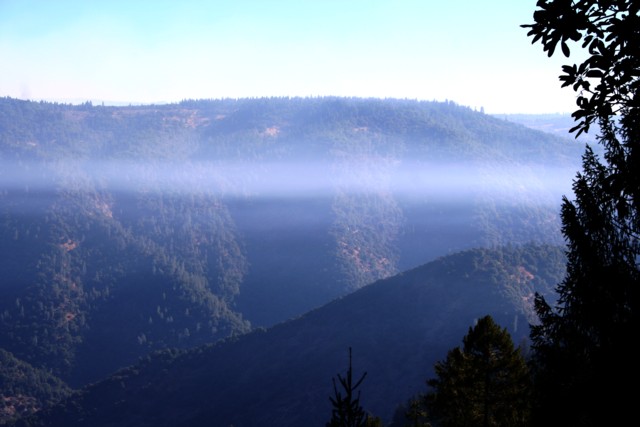
Smoke from the Ralston Fire hangs in layers in the Rubicon River Canyon (see photo). Fire officials declared the 8,423-acre fire 100 percent contained Sunday evening. Mop up and rehabilitation efforts will continue for several days.

At the time I took the picture Saturday, the fire continued to burn along an uncontrolled line beyond Ralston Ridge. Cooler temperatures and favorable wind conditions helped fire fighters gain the upper hand over the weekend.

Warm, dry north winds returned to the north state Monday. Conditions were once again ripe for new fires. Three new fires are now burning in El Dorado, Placer and Sierra counties.

It's a stark remainder that the fire season is not over for the year. The danger remains high in the Sierra Nevada foothill region.

Closer to home, the Mule Fire threatens the foothill community of Kelsey, about 6-7 miles north of Placerville on Hwy. 193. It's burning in the brush and timber slopes of the South Fork of the American River above Chili Bar.

At last report (10 a.m. on the CDF website), the California state fire department has slowed the advance of the Mule Fire. They've poured significant fire fighting resources into the fire, including a command airplane, four helicopters and a strike team of five engines from the Nevada-Yuba-Placer Unit of CDF.

Voluntary evacuations along Texas Canyon Road were lifted this morning, according to the KXTV 6 p.m. news. The report cautioned that a fire watch is currently in place for most of Northern California.

El Dorado County residents are fortunate this time. Quick action has knocked the fire down. KXTV's website story said:
The fire was reported just before 2 p.m. Tuesday at 5100 Mule Skinner Road near Rock Creek. It has burned between 60 and 75 acres and is 40 percent contained as of Wednesday morning. Fire crews say they've stopped the fire's forward progress.

Thursday, September 14, 2006

All Quiet Along Division Z

I returned to the Volcanoville area last night a second time to watch the Ralston Fire.

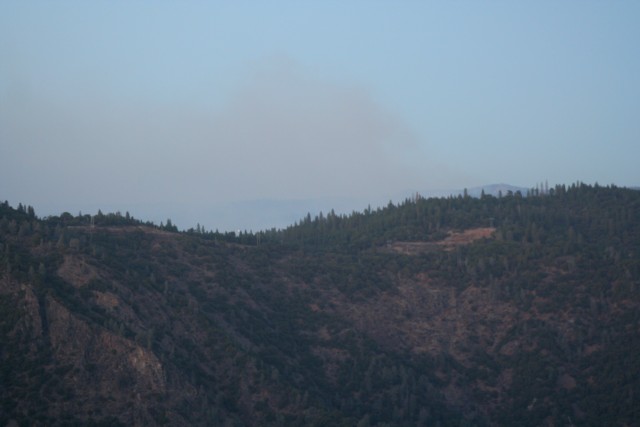
There was little activity along Division Z, compared to Sunday. The division is the southernmost of the wildfire. It's the portion of the fire that dips into Eldorado National Forest.

The threat to Volcanoville has greatly diminished. The daily update on InciWeb.com indicates that the incident commander has pulled pulled structure suppression resources from the area.

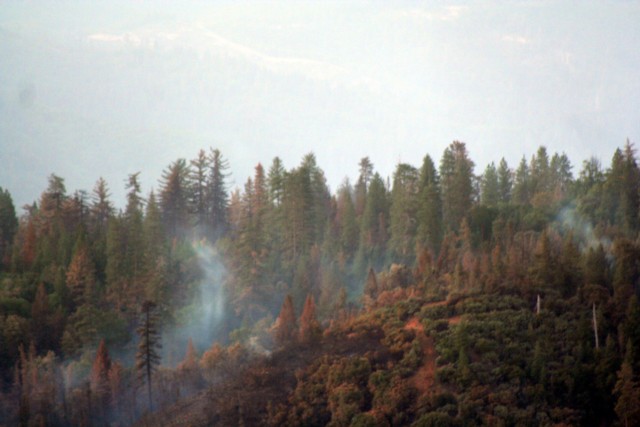
I didn't arrive in the area along road 13N66 until after 7 p.m. I was still able to take these photographs with a tripod, zoom lens and moderate ISO (ISO 400) setting.

I plan to head up to the area again Saturday. Although I'll check Division Z for activity, I'd like to drive north on Wentworth Springs Road and get as close to the Ralston Ridge area in northern Eldorado National Forest.

But it may be tough to find a vantage point to snap photos. The Forest Service has closed significant portions of Ralston Ridge and Blacksmith Flat roads.

One of my rules is that I don't interfere with incident personnel (more on my rules of "engagement" later). My primary objective is to gather pictures of the helicopters in action.

Tuesday, September 12, 2006

Ralston Fire

I was out on Volcanoville Road, north of Georgetown, Calif., Sunday afternoon for two hours trying to get photos of the helicopters hauling water to the Ralston Fire.

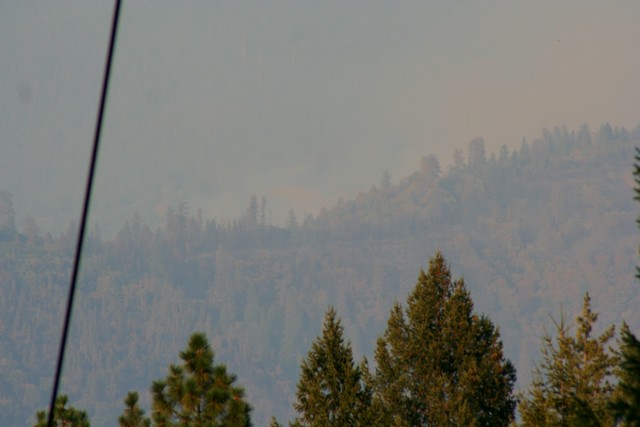
The photo looks across the Rubicon River canyon to the northeast into the fire. The Middle Fork of the American River is beyond the ridge. I shot this picture under a high-power electric line.

Just after 6 p.m. I drove up on a strike team as they were departing the Donaldson Staging Area. The team was composed of five CDF engines (nos. 1454, 1455, 1459, 1470 and 1493 if you're interested) from the Sonoma-Lake-Napa Unit.

I came up on the engines too fast to get any pictures (I too busy writing down the engine numbers). A captain from the Camino Fire Center was also at the equestrian staging area and picnic ground. He said the strike team was keeping a presence in the area for the night. El Dorado Supper Services, Inc., tanker 45E was also staged there.

Since the past 20 years of my work life has been in food service in large government institutions, I asked the captain who's feeding the firefighters. He said Growlersberg Conservation Camp was feeding those in the Volcanoville area and Mobile Kitchen Unit 45 out of the camp was feeding on the Foresthill side.

By the way, I never got any good helicopter photos. The trees were too thick to safely locate an observation point.