Showing posts with label cast iron stuff. Show all posts

Wednesday, November 29, 2017

Scrambling eggs in a cast iron skillet

Cast iron cookware has been an American icon of cookery for centuries. When given reasonable care, it will outlast the cook. And it's often passed on to the next generation.

Readily available at a modest cost, millions of cooks rely on its properties to cook good food, which include the ability to generate a good crust or sear, maintain even heat over a low to medium flame and clean up with little fuss. And it's easily placed in the oven to finish a dish as most cast iron cookware is ovenproof.

I frequently use a Lodge cast iron skillet to cook scrambled eggs at home and in camp. At home, my skillet of choice is a 10-inch cast iron chef skillet (model LC3S) with sloped sides. This is the ideal for two to six eggs.

When feeding larger groups, I scale up to the 13.25-inch skillet (model L12SK3), the larger 17-inch skillet with loop handles (model L17SK3) or the massive 20-inch skillet (model 20SK). (The 20-inch skillet is no longer produced by Lodge. It does show on eBay.com from time to time; however, be aware it comes with a hefty price tag!)

I find the Lodge 13.25-inch skillet ideal for cooking one to three
dozen scrambled eggs in a single batch.

IRON SKILLET SCRAMBLED EGGS

Cooking scrambled eggs in a cast iron skillet is straight-forward, so let practice guide you. Practice will teach the right heat setting when preheating, how much butter to use and the right setting for cooking the eggs. These basic steps will ensure perfectly scrambled eggs:
  • Select the right size skillet for the job. A six- to ten-inch diameter skillet is best for a family, while the larger skillets (see my notes above) work best for large groups. I find it's best to stick with a familiar skillet, one you frequently use. The advantage is that you know what heat setting to use as it preheats, when to turn the heat down and its capacity.
  • Preheat the dry cast iron skillet (without oil or butter). Medium-low to medium heat is best for scrambled eggs. Any higher than medium and you run the risk of scorching the eggs and creating a burned-on mess that's difficult to clean.
  • Crack two to three eggs per person into a bowl. Season with salt and pepper, then vigorously whisk to combine.
  • Add butter to the skillet and let it melt. The fat adds flavor to the eggs and helps ensure a non-stick surface (when pared with a properly seasoned skillet). Olive oil can be used in place of butter. Use one tablespoon butter or oil per serving.
  • Pour the eggs into the skillet. You should hear a slight sizzle. Any louder means that the skillet is too hot. Immediately turn the heat down a notch or two.
  • Using a spatula, slowly move the curd from the edge of the skillet toward the center. Continue until the egg is set, but still a bit runny. Take care not to overcook. I always remove scrambled eggs from the skillet when they reach the soft-set stage. The eggs will continue to cook for several minutes as they cool. If desired , top eggs with cheese. Serve immediately.

A typical breakfast at Star Valley Outfitters in Bridger-Teton National Forest in Western Wyoming. This meal included scrambled eggs with cheese, pork breakfast sausage and cottage fried potatoes.


Monday, April 28, 2014

Classic Lodge skillet located at Eagle Point antique shop

Chef Steven and his assistant scramble
eggs in the Daybreak Camp
Lodge 20-inch skillet.
I introduced my perspective on collecting cast iron cookware on these pages some five years ago. A self-imposed spending limit of $100 restrained me from investing hundreds of dollars in cookware that I’d never use. Any new purchase -- mainly cookware capable of feeding a crowd -- had to fill a specific need in my outdoor kitchen. Functionality was my watchword. Any piece must be ready to work, I reasoned. There are no museum pieces in my outfit.

With more than two dozen cast iron Dutch ovens and skillets in my modest collection, I saw little need to expand my holdings as I rarely use the entire collection in one setting today. Yet, for some time I’ve felt that one skillet was missing from my collection.

My introduction to Lodge’s heavy 20-inch skillet came in the Daybreak Camp kitchen in 2002. Unknown to me, Lodge had discontinued production of the skillet sometime before I first saw it. For the next seven years I put the camp’s skillet to work frying potatoes and scrambling eggs for one week each July. A pall of sadness fell over me each time I left the skillet on the range for the next group.

I’ve been searching for the skillet since then. A number of leads in the intervening years came up empty, including a call to a Bishop, California, hardware store that forgot to pull its webpage ad after they sold the last unit. Discouraged, search efforts waned over the past five or six years. I felt that I’d missed my chance to ever own one.

Scrambled eggs ready for campers on
Independence Day 2006.
Then, by chance, I found a 20-inch Lodge skillet (model 20SK) Saturday at an Eagle Point, Oregon, antique shop on Saturday. Debbie and I stopped at the Butte Creek Mill to briefly meet fellow Dutch oven cook Ron Clanton of the Rogue River Dutch Cookers. As we waited for Ron, my wife drifted to the antique store, located next to the water-powered grist mill.

Curious as to where Debbie had disappeared, I walked to the antique shop and found her. And I found my skillet! Inside, I saw several cast iron bean pots and skillets. Then the massive skillet jumped out at me as I rounded the corner toward the back of the shop. Its rusty hulk was propped against a vintage piece of furniture. As I inspected the skillet, I immediately realized that I was holding the object of my decade-long search.

The skillet is in decent condition. Though rusted inside and out, there is little pitting on the cooking surface. It looks like most of the rust is on the surface. I should be able to remove it with steel wool and wire brush. It’s my project for the first week of camp, when Debbie and I work alone in the kitchen. Once cleaned, it’ll receive a coat of shortening and an hour-long bake in one of the convection ovens. I’ll give the skillet a test run when the cooks arrive next week.

A rare find, my "new" Lodge 20-inch
skillet needs a bit of elbow grease
and seasoning in a hot oven before
I put it to work.
As it turned out, Ron missed our appointment because he was sick. Yet, the missed opportunity to meet and share our love for outdoor cooking opened into the chance to see the great millworks in Eagle Point and trace of Southern Oregon pioneer history. And I acquired a great piece of cast iron cookware, one that I would’ve missed had Ron been well.

With a $55 price tag, I acquired a great piece of cast iron cookware for well under my price cap. The skillet will serve me well at Oakland Feather River Camp and on the range. The Lodge skillet will certainly feed a crowd. And it’ll soon take center stage on my sauté line, next to 14- and 17-inch Lodge skillets.

Thank you, Ron. I plan to bring the skillet to Eagle Point next November for the annual Gobble ‘Till You Wobble (link takes you to the 2013 event) at the mill. We’ll see you to cook, talk about shared craft and enjoy some wonderful Thanksgiving vittles!

Monday, March 24, 2014

Recovering a rusty Dutch oven

"You can't beat cast iron," says Scott Leysath, the Sporting Chef on the Sportsman Channel. "No matter how it's been abused, you can always bring it back to life."

Watch Cee Dub demonstrate how to rescue a rusty cast iron Dutch oven in this Camp Chef video. You can heat the oven inside your home oven. However, open the windows for ventilation and be ready to fan the smoke alarm.

At the end of the video, Scott gives the link to Cee Dub's website, where you can purchase Lodge and Camp Chef outdoor cookware.


Tuesday, January 21, 2014

Cast iron soup station

Last week my mother and I joined my sister for lunch at the Virginia Theological Seminary, where she's an employee. Dining facilities at the school are called The Refectory and are operated by Meriwether-Godsey, an employee-owned company that specializes in premier dining services. Meals for students, staff and visitors are prepared under the leadership of dining services manager Benjamin Judd.

The layout of service stations impressed me the most about the operation. Set up in the main dining hall, four primary stations allowed diners to freely move about as they selected their meal. Each station included a large buffet stand with a wood framed sneeze shield. Ornate chaffing dishes held the hot food on the meat and vegetarian stations. The salad bar and build-your-own sandwich station each contained an ice well with plenty of space for square and round ingredient containers.

The soup station caught my eye as I walked past it. Looking back I should've taken more than one cell phone picture. Unfortunately, I couldn't locate any photos of The Refectory in the Internet.

The picture shows the layout of the soup pots, cups and bowls. The station was located on the inside end cap to the sandwich station. As I think about the layout, locating soup and sandwiches adjacent to each other makes sense. Two Lodge two cast iron Dutch ovens -- each placed over a heat source -- held the soup, vegetable (vegetarian, I believe) on the left with cream of cauliflower to the right.


Two cast iron Lodge Dutch ovens make up the soup station at Virginia Theological Seminary. They appear to be Lodge Model L8DOL3 Dutch ovens with loop handles.

Saturday, March 16, 2013

One antique pot, five hearty meals

For more than two years, this Dutch oven languished in the garage. It was a gift from a long-time docent at the El Dorado County Historical Museum. A widow of many years, the Dutch oven was a wedding gift, along with a set of cast iron skillets.

Too small to feed large groups, the Dutch oven joined my modest collection of small cast iron pieces in the corner of the garage, near the roll-up door. Dust collected on its domed lid. And a light patina of rust covered the bottom of the five-quart kitchen Dutch oven.

While I moved two of the small skillets into the house, most of my Dutch oven cooking in the house had been with a covered fry skillet that I acquired from my mother. Among the skillets was a nine-inch grill pan that I’ve used a number of times to give nice grills marks to chicken breasts and pork chops.

Our recent vacation in Ocean Shores, Washington, was the perfect opportunity to recover the Dutch oven from the garage and put it to use in our resort kitchen. As I planned for the trip, I was looking for a small Dutch oven to use in the kitchen of the time-share condominium. Though each unit featured a fully furnished kitchen, I knew that I would need a heavy pot for soups and stews.

I considered taking a 10- or 12-inch camp Dutch oven. But the weather forecast called for a week of rain. We would take all our meals indoors. With the family confined to the condominium, I settled on packing my 12-inch Griswold skillet. It would handle most of the frying, sautéing and grilling. Its domed lid extended its usefulness.

As I searched my garage-bound collection of cast iron pieces, the Dutch oven looked like the perfect vessel for a wide range of dishes. My large kitchen Lodge Dutch ovens carried too much capacity for the family at nine- and 12-quarts each. The Dutch oven, a Revere Ware brand oven, seemed like the perfect match for our meals.

The Griswold skillet and Revere Ware Dutch oven proved useful over the week. The three main cooks of the trips each used both implements a number of times. I led the week on Monday by roasting red bell peppers in the oven for the soup. Sautéed asparagus on the skillet accompany a pot of spaghetti on Tuesday. Candie used it to steam her dish of Mexican rice for taco on Wednesday. (We missed taco Tuesday!)

The Revere Ware pot proved to be the star of the week. With a five-quart capacity, it was large enough to feed seven and eight adults (eight Debbie’s brother arrived on Wednesday). Mike and I prepared a wonderful pot of albondigas soup for Monday dinner. Tuesday dinner was a big pot of Spaghetti with Italian sausage. Ground beef tacos kept the family going on Wednesday.

The up received double duty on Thursday. Candie simmered a wonderful pot of cheesy potato soup for lunch on Thursday. Then after I cleaned the pot, I seared two chuck roasts for Yankee pot roast. A late dinner of pot roast, roasted vegetables (broccoli, cauliflower and carrots) and gravy filled us.

One pot gave us five great meals this week. The cuisine prepared out of the Griswold and Revere Ware pieces of cast iron provided a week of comfort food for the family. Now safely tucked away in the truck for the trip home, the Dutch oven is ready for our next adventure.

Saturday, November 12, 2011

CIA chef weighs in on cast iron myths

Have ever wondered why most chefs don't use cast iron pans in their restaurants? Or heard that soap will ruin your precious cast iron skillet?

As with most topics, there are more opinions than writers. Articles rarely explain why or how something is good (or bad) for you when it's cooked in a cast iron skillet and Dutch oven.

The answer to these questions (and more) comes from an unlikely source. Fox News "set the record straight" in "5 Myths of the Cast Iron Pan Explained," with chef David Kellaway.

The article explorers five myths about cast iron cookware. Will soap ruin a cast iron pan? Kellaway says go ahead if "you had a particularly messy sticky cooking session." But there's a caveat! The pan must be "re-seasoned immediately."

Why don't more restaurants use cast iron pans? They're too heavy for routine use, Kellaway explained to Fox News writer Sasha Bogursky. Too much "care (is) required to keep them clean without rusting."

Read on. You'll want to read the article before cooking in a cast iron skillet or Dutch oven.

Chef Kellaway is a certified master chef and the managing director of the San Antonio campus of the Culinary Institute of America. Soon you'll un

Sunday, October 03, 2010

My cast iron rule

This blog article began as a comment to the Ramblings on Cast Iron blog. After typing three paragraphs on my thoughts about purchasing cast iron skillets and Dutch ovens on eBay, I converted my comments into a blog post here.

I occasionally browse the cast iron listings on eBay, mostly for fun. I've never purchased any cast iron from the on-line auction site. Shipping is just too expensive, especially since many of the vendors seem to be located east of the Mississippi and I'm in California.

Any cast iron piece in my collection must be functional and ready to use. That's my rule. There are no idle pieces in my collection. Each piece must serve a function and be able to work over a hot bed of coals. You won't find any museum pieces in my modest collection (12 skillets, 13 Dutch ovens and two or three trivets).

When I purchase a cast iron skillet or Dutch oven (a rare event these days), I don't want to screw around with heavy cleaning or reconditioning. I leave that for others. Plus, I just don't have the time for the lengthy process.

This rule saved me from purchasing a $510 Griswold 20-inch cast iron skillet last year, a piece that I'd love to own. Two factors attract me to the skillet. It's size makes it the perfect cooking vessel for a crowd. The 20-inch skillet will make quick work of a big batch of cottage fried potatoes for a hungry crowd of campers.

The mammoth skillet was manufactured in a time when durability and quality meant something. While I find the contemporary Lodge 17-inch skillet is an acceptable replacement, the larger vintage Griswold or Lodge 20-inch skillet would be the perfect addition to my battery of cast iron cookware.

(For readers that feel compelled to advise me buy the Bayou Classic 20-inch skillet, please save your words. I won't buy it.)

If you feel the need to purchase cast iron through eBay, click over to the Ramblings on Cast Iron blog. "And I've found that many (eBay) sellers don't know much about what they're selling," warns greenturtle, the Ramblings' blogger. "Often, the description of the size and volume is listed incorrectly."

As a buyer, you need to do your homework. "And always search online for the current market price," adds greenturle. "Some sellers vastly overcharge." Armed with common model and size information, you'll also know that the "8" on the handle is the model number, not the diameter, for instance. The Lodge No. 8 skillet (SKU L8SK3) is 10-1/4 inches in diameter, not 8 inches.

Unless you're a serious collector of cast iron, my rule will serve you well. Avoid eBay and make sure each purchase is ready to work. If you locate a 20-inch Griswold skillet for a reasonable price, buy it. Make sure it's ready to fry up a huge batch of sausage gravy at your next family reunion breakfast.

Saturday, August 14, 2010

Cast iron 20-inch skillet

Here's greenturtle's blog post from this afternoon from Ramblings on Cast Iron. She graciously allowed my to reprint it on 'Round the Chuckbox.

This is a cast iron 20-inch skillet. It's huge.

It's sometimes called a "lumberjack skillet."

These skillets were frequently used by railroad workers, to cook full meals for the crew. It's useful for large group fishing, hunting, or camping trips.

Cook an entire breakfast of eggs, bacon and hash browns, or an entire supper of fish and all the trimmings. Or steaks, fajitas, fried chicken, etc.

Since it takes a lot of heat to use this skillet, regular oven mitts won't do; You need heavy duty oven mitts with silicone.

The only brand still selling them is Bayou Classic, but I have not been impressed with their quality.

If you're lucky enough to find a better quality brand, expect to pay between $500-600. Way more than I'd want to pay!

A more affordable alternative, without sacrificing quality, is the Lodge 17 inch skillet for $69.

It's smaller, but will serve the same purpose, and you can at least use that in your oven as well as outdoors. The 20-inch will not fit in most ovens.

Large cast iron skillets revisited

Some 18 months ago, I commented on a vintage Griswold 20-inch cast iron skillet that was being actioned on eBay. I noted that any cast iron purchase was destined to be put to work feeding large groups.

My self-imposed limit was $100. Any higher and it would have to be chained to a tree.

I want camp equipment, including cast iron, that's ready for any culinary application. Museum piece or not, I don't want added worries about theft to hinder my ability to use the skillet in camp.

The article, originally posted on February 2, 2009, remains active to this day. As of this afternoon, seven readers have left comments. And I have responded four times.

It's the most active blog article in 'Round the Chuckbox history!

In April 2009, an anonymous reader left a link for the Bayou classic 20-inch cast iron skillet in response to my question. My research showed that it was the only 20-inch skillet on the market at the time.

I asked several questions of the anonymous reader:
Do you have a review of the Bayou Classic 20-inch skillet? How does it compare to the Lodge 17-inch in construction and durability? Amazon reviews highlight some problems, although most said they liked the product.
Questions unanswered, I opted to purchase a Lodge 17-inch cast iron skillet. I cooked fried chicken thighs smothered in gravy at the 3rd Annual IDOS Region II Dutch Oven Gathering shortly after the purchase.

I finally received an answer to questions early this afternoon.

"I don't recommend bayou classic quality," said greenturtle, the prolific editor of the blog Ramblings on Cast Iron. (In three months, the writer has posted 182 articles. Most are reviews of cast iron cookware.)

"It's cheaper but I wasn't impressed," continued greenturtle. "It was pitted in some places and made the food taste funny."

With my suspicion confirmed, I'm happy that I purchased the Lodge 17-inch cast iron skillet from Placerville Hardware last year. It received full use last summer, as attested my the photographs attached to this article.

Saturday, August 07, 2010

Too much iron

I have this problem. I can never pack the right amount of cast iron cookware for a job or camping trip. I always take more gear than I use in the end.

This ailment struck as late as yesterday. In the morning, I loaded three 14-inch camp ovens, one #10 Dutch oven and one 14-inch skillet into the truck for an outdoor meal at work. While this may not seem that excessive, I also packed the Navy surplus coffee boiler, fire iron set and fire pan.

Part of the problem was that I threw together the dinner menu for the residents at work at the last minute yesterday. So, I quickly grabbed Dutch ovens and necessary accouterments as I left the house for the commute into Sacramento.

My initial though was to hang the coffee boiler from a tripod on the patio, mostly as a conversation piece. Shopping for the weekend and other administrative duties interfered. In the end, I hauled too much cast iron to work and home.

The picture shows the iron that I hauled to Lake Tahoe last month. In the seven-day vacation, I only used each Dutch oven one time.

I should've followed my own advise from a 2002 trip and limited the iron to one skillet and two Dutch ovens. My Griswald skillet with domed lid was the most versitile piece of cast iron on the trip.

Barely visible in the picture are two additional skillets that my daughter brought to the lake. I had asked her to bring the fire pan from the house. When she showed up with my two largest skillets, I knew they'd sit next to the trailer, unused.

Monday, March 02, 2009

Reseasoning a skillet

I've had a bare spot on my cast iron egg skillet for some weeks. It all started when my son broke my egg-making rule: Never cook anything but eggs in an egg pan.

Since that time, a 2-inch round hole in the seasoning has plagued my omelets. A vigorous scrub was the only way to clean cooked-on egg and cheese from the skillet.

Despite my attempts to nurse the wound back to health, the spot grew. Each time I made an omelet for my son, the egg tore and cheese leaked onto the cast iron surface.

While scrubbing with a green pad seemed the best way to removed the cooked-on cheese, it only made the problem worse.

I though of a fix this morning while cooking my son's second favorite omelet (cheddar cheese--his first is pepper jack). After cleaning the skillet, I spread a light coat of oil on the skillet baked it on a medium-hot electric burner.

I wiped the skillet with a clean paper towel every 10 minutes over the next hour. And to keep from burning the seasoning off, I turned the burner down to medium-low (a setting of 3 to 4 on my dial) after about 15 minutes.

My strategy worked ... partway, at least! I cooked a cheddar-broccoli omelet (with a sprinkle of Old Bay) after the skillet cooked for an hour. The egg stuck to the pan, but came free after a gentle nudge with a rubber high-temp spatula.

After I cooked my omelet, I cleaned the skillet with a clean paper towel and set it back on the burner for another hour. The once shinny spot is now much darker. While not as black as the rest of the skillet, the wound will heal after a few more seasoning sessions.

Monday, February 09, 2009

A Grizwold 20-inch skillet is worth ...

Last Monday I asked if a Griswold 20-inch skillet was worth $340. As the auction ended tonight, the answer came in at a resounding no!

It's worth $510 ...

Monday, February 02, 2009

Is a Griswold #20 cast iron skillet worth $340?

Although a serious collector may disagree, $100 is my limit for just about any cast iron any piece. Even then it has to be a larger Dutch oven or skillet that I can use to feed a hungry crew of railroaders.

Any cast iron in my modest collection is going to be put work. I don't collect cast iron to use them as show pieces. Each will be used to cook great meals, whether it's for personal camping or for large groups.

I'd love to own this 20-inch Griswold cast iron skillet. But it's current $340 price tag takes it out of my league. Bid if you must, but I suspect that the final selling price will peak at over $400.

All I can do now is watch the auction and dream of the day that I locate an Lodge 20-inch skillet. Although Lodge stopped making the round skillet several years ago, I see them advertised from time to time. I will break my $100 rule when I locate one.

Monday, December 22, 2008

Stacked Dutch

Blog No. 24 brings some cast iron art ...

Since I didn't bring the firepan Saturday, I needed a platform to keep the Dutch ovens off the wet ground. The nice thing about working around a railroad engine house is the nearby iron rack.

I laid five iron straps on the frame of the Diamond and Caldor flatcar. They made a good Dutch oven table. As you can see, the 1/4- by 4-inch-thick straps provided a sturdy platform for three 14-inch Dutch ovens.

On a side note: The first thing I do after I unload my equipment is to boil a pot of water. I hold the water inside the Army surplus insulated beverage container. It gives me a ready supply of hot water for hand and dishwashing.

Tuesday, June 10, 2008

Bean pot


Bean pot
Originally uploaded by SeabeeCook
Another old bean pot warms in the morning sun at the El Dorado County Historical Museum in Placerville, California. This pot has weathered the years in the museum yard and is in good condition.

Careful rust removal and high temperature re-seasoning should give you an usage cast iron pot. You should be able to pass it on to your grandchildren.

This and many other surplus items will be sold at a museum yard sale in August. I'll post the date of the sale as soon as it's made public.

Saturday, June 07, 2008

If there's a hole in the bean pot ...

The picture of the rusting bean pot reminds me pot of beans cookin' over a campfire.

Today, the bean pot warms in the morning sun at the El Dorado County Historical Museum in Placerville, California, never to be used again. It won't hold any more beans.

I looked for missing piece this morning at the museum, but couldn't find it. I'd be a nice pot if you could weld the broken piece back onto the pot.

A flower pot is about the only use you'll get out it now.

This pot and many other surplus items will be sold at a museum yard sale in August. I'll post more information on the sale when it's released.

Monday, January 21, 2008

A late breakfast ... eggs over splat

Not bad for a guy who's trying to cook, take pictures and nurse a mending leg at the same time. This is my first attempt to catch eggs over easy in motion.

With the camera on a tripod, I opened up the diaphragm to f/3.5 and set the ISO to 800 (hence, the graininess). On the Canon 350D kit lens, you can only use f/3.5 with the lens set at 18mm. I did this to achieve the fastest shutter speed possible (1/125 sec) without using the flash.

I then positioned the camera on the tripod without concern for composition. I figured I could crop the photo in post-processing. My goal was to have the lens at its widest to capture runaway eggs in the frame.

The trickiest park of the whole process is doing two things at once. The first pat of butter went down the drain as a burnt offering to the plumber. After cooling the skillet, I waited to melt the second pat until the camera was ready. Once the eggs were ready to flip, I maneuvered the skillet with my left hand while depressing the trigger in burst mode with my right.

For the record, both yokes broke as they pancaked into the skillet. The goal is to "raise the pan to meet them so that the exposed yolks experience the softest landing possible," advises Food Network host Alton Brown. It's difficult to control the action of the skillet when your attention is divided between two seemingly unrelated actions.
And save the pepper for the plate. The black streaks on the pair of eggs don't look that appealing.

EGGS OVER EASY
I've adapted Alton Brown's classic recipe for eggs over easy to a cast iron chef's skillet (which really means I replaced the words "non-stick" with "well-seasoned cast iron" -- all else remains). A gentle wipe with paper towels after each use will preserve the slick skillet for many breakfasts. Clean the skillet while warm.

I reserve my Lodge Logic Chefs Skillet for eggs. That means nothing -- I mean nothing -- else gets cooked in the skillet. Use another skillet for pork chops.

2 eggs (the fresher the better)
1 tablespoon unsalted butter
Salt and pepper

Heat a small well-seasoned cast iron skillet with sloped sides over low heat and add butter. As soon as the butter stops foaming, crack the eggs into the pan. Lift the handle about an inch so that the eggs pool in the far corner of the pan. Hold for 30 seconds or until the whites start to set, then lower the handle and give the pan a jiggle just to make sure there's no sticking. Season with a pinch of salt and pepper and continue to cook over low heat until the whites become opaque.

Jiggle to loosen the eggs, then lift the pan, holding it about a foot above the heat. Now, flip the eggs over by pushing the pan away and snapping upward simultaneously. Once the eggs start their somersault, raise the pan to meet them so that the exposed yolks experience the softest landing possible.

The goal of course is to avoid breaking the yolks. If you succeed, count to 10 slowly then flip the eggs again, slide them onto a plate and serve. (Here's the best part ...) If the yolks do break, act like you meant them to, fry for another minute and serve. They'll still taste great.

Tuesday, March 13, 2007

Dutch Oven Cooking For Large Groups

Ron H. Daumn of the Seattle area spreads a layer of hot coals on a pizza pan. The Scout camp features a unique Dutch oven cooking platform. A bed of river rock and sand protect the wood table. The pizza pans provide a solid surface for the Dutch ovens.

Ron recently cooked a Dutch oven meal for Scout Masters at Camp Pigott of the Chief Seattle Council, near Lake Roesiger, Washington.

He used nine Dutch ovens to feed 45 Scout Masters and camp staff one Friday afternoon. He designed his menu around seven regular and two deep ovens. Ron figures each standard oven will hold enough portions for eight to 10 persons and the deep-style oven will feed 10 to 12.

Here's the menu:
Rattlesnake with Wild Rice (Tastes Just Like Chicken) -- 2 ovens
Shepherds Pie -- 2 ovens
Mountain Man Stew -- 1 deep oven
Broccoli Au Gratin -- 1 deep oven
Green Bean Casserole -- 1 oven
Dutch Apple Cobbler -- 1 oven
Bread Pudding -- 1 oven
A photo essay gives detailed instructions to cook the meal. Access the lead page (of 14 webpages) here. The five or six pictures will help the novice and expert prepare a Dutch oven meal for a larger group.

Wednesday, October 18, 2006

Dutch Oven Math

Leonard Sanders, a Dutch oven cook who caters throughout California Northern Sacramento Valley, often posts Dutch oven formulas on the International Dutch Oven web forum.

Wagon Cook, as he's know on the Internet, often teaches that most Dutch oven cooking is a matter math. He often cooks by weight, not volume, when cooking in Dutch ovens. That makes sense to me because you purchase many ingredients, like potatoes, meat and beans by weight.

Here's Wagon Cook's latest page in the Dutch oven math textbook:

I use 1/4-pound of potatoes per person -- so for 80 people I would use 20 pounds. I use 1/2 pound of bacon for each 5 pounds of potatoes and one onion for each 5 pounds of potatoes. I make this recipe by potato weight and not by Dutch oven volume -- a #12 Dutch oven will hold about 5 pounds. A 12 Deep will hold about 8 pounds a 14 deep will hold about 10 pounds.

Here's an early 'Round the Chuckbox post on Wagon Cook's bean math.

Saturday, September 09, 2006

Bean Pot on eBay

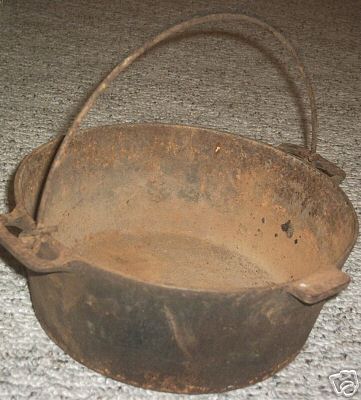
I found this rusted Dutch oven on eBay this morning. After a few bids, I left the auction at $17.75. The pot is being sold without a lid.

The Dutch oven is the same size as the pot that I found in Placerville last July. It appears to be the same pot as the current Lodge 10DO2A. It can also be purchased in the Lodge Logic line of pre-seasoned cast iron cookware (model L10DO3). Lodge lists these oven for $59.95 and $67.95, respectively.

Here's what the seller has to say about the pot:
Found in the back of an old chuckwagon on the Pico Ranch near Blanco, Texas is this cast iron bean pot. The old chuckwagon had completely rotted away, and this old bean pot shows a lot of age and rust. It is an original vintage cowboy collectible. I do not know the age of this pot, it is very heavy cast iron and measures 12 inches in diameter and 4 inches deep.
I couldn't find replacement lids on the Lodge website or catalog. But I've purchased replacement lids at Placerville Hardware in the past. Look around or contact Lodge. You'll find one.

The pot holds seven quarts to the brim. Working capacity is about five quarts, or about 40 (1/2-cup) servings.