Showing posts with label food service planning. Show all posts

Saturday, August 21, 2010

Ready, set, go, part 2

I was selected to prepare the tip of the month for Royal Tine hunting, fishing, guiding and camping forums. Since I could only find one other tip that related to camp cooking, I though I'd start with the fundamentals.

My entry for the August tip of the month is partically based on a post titled "Ready, set, go" from last April. Here's my tip:


At my current job, I work through a mental checklist each morning when I first walk into the kitchen. It's a routine that's served me well for nearly 40 years in the culinary business.

My checklist is much like the pre-flight checklist that my father worked through each time he climbed in the left seat of the family Cessna 182 when I was a child. Dad wanted to ensure all systems on the aircraft were in good working order once we were airborne.

My mental checklist helps me size-up the day. I check refrigerator temperatures and make sure the breakfast cook properly cleaned the kitchen. I also take the time to lay tools out and get the kitchen ready for lunch.

Chefs call this process mise en place. In addition to organizing my work station, I set up the cutting board and collect ingredients for the soup, entree and sides for lunch. This process also helps me make sure that I have enough food for the meal.

It's the "ready, set, go" for the cook. Also known as “prep work,” it basically means the cook gets everything ready to cook before he starts cooking. Tasks include making sure your knives are sharp, honed and clean; setting up your work area; setting out spices, herbs and other ingredients and cutting vegetables and fruit for the meal.

Prep work takes on special meaning for the camp cook. The cook works in a harsh environment, one that’s unforgiving when things go wrong. No one wants to serve their guests or clients an overcooked or cold layered enchilada casserole (for instance) because the cook forgot to grate the cheese, shred the lettuce or chop the onions.

Here are a few tasks the camp cook must attend to before she starts the next meal:
  • Has sufficient firewood been gathered and/or are the propane bottle full?
  • Is the campfire large enough to support the meal? Nothing is more irritating than to run out of coals for the fire and Dutch ovens before the meal is done.
  • Do you have enough potable water to cook the meal and clean up after the meal?
  • Is the workstation clean and organized?
  • Are knives cleaned, sharpened and honed; utensils, pots and pans set out; meat, vegetables and other ingredients handy and ready to go; etc.?
  • Are your hands washed? (Need I say any more?)
I could continue on for some time. But since this tip of the month is already long winded, I’ll stop here. For the camp cooks out there, what tasks do you perform each meal to get ready to cook?

Thursday, April 22, 2010

Ready, set, go ...

At my current position, I work through a mental checklist each morning when I first walk into the kitchen. It's a routine that's served me well for nearly 40 years in the business.

My checklist is much like the pre-flight checklist that my father worked through each time he climbed in the left seat of the family Cessna 182 when I was a child. Dad wanted to ensure all systems on the aircraft were in good working order.

My mental checklist helps me size-up the day. I check refrigerator temperatures and make sure the resident assigned to breakfast properly cleaned the kitchen. I also take the time to lay tools out and get the kitchen ready for production.

The French call this process mise en place. In addition to organizing my work station (to the left of the range), I set up the cutting board and collect ingredients for the soup, entree and sides for lunch.

Here's the process I used for Wednesday's lunch:
  1. Set the soup pot on the range
  2. Set two saute pans on the range, one for sauteed zucchini and the other for Alfredo
  3. Filled the pasta pot with water for ravioli and set it on the range
  4. Set up the cutting board
  5. Placed onion, carrot, celery, ham, split peas and spices behind the cutting board for the soup
  6. Placed Parmesan cheese, butter, milk, flour and frozen corn on the counter for the sauce
  7. Placed zucchini in the sink to be washed
After I punch in for my shift, I head down to my office (in the basement), put on my chef coat and apron and grab my knives. The last thing I usually do is to bring the protein up from the freezer (or refrigerator if thawed).

While mise en place isn't the most glamorous aspect of the chef's day, it's essential.

"Preparing the mise en place ahead of time allows the chef to cook without having to stop and assemble items, which is desirable in recipes with time constraints," according to Wikipedia.

Thursday, January 14, 2010

Shopping on a shoestring budget

I frequently contribute to the Growlies Recipe Exchange and Party Planning Board. Many readers come to Growlies looking for party planning advise. They're often looking for advise from professionals as they plan to cook a meal for a large group.

Anna posted this question on Monday. I was intrigued by the question because 70 cents per person per meal isn't a lot of money to feed a large group, even when discounts for purchasing in bulk.

Even though the food budget at work is more than double Anna's, my answer is based on experience. While I buy the bulk of our food supply from Sysco Food Services, I use the markets listed below to purchase food on sale and to take advantage of special deals to save money.
I cook weekly for 160 needy community members, ages 5 to around 90. I have helpers, so one person can do the entree, one the salad, one the bread and donated desserts, one the beverages. The problem is sustaining the budget as our numbers keep growing. I want to serve the best nutrition possible for about $.70 per serving.
I commend you for your effort. Purchasing on a limited budget is one of the most challenging situations for a chef.

A budget of 70 cents per meal requires intimate knowledge of the food market in your city. You must developed a keen sense of locating deals, as well as becoming a frugal shopper.

You need to be tuned into local market food prices and be ready to adjust the menu on a moment's notice. Stores like Wal-Mart, local 99 cent stores and other discount stores in town can be a great source of discount food.

Pick up the Wednesday section of the newspaper and search the market ads for weekly specials. When ground beef, beef chuck, pork putt, whole chickens, etc., go on sale, be ready to buy in bulk (as long as you have space in the freezer). I take advantage these products when prices hover around $1 per pound.

Learn how to cook the cheaper, but more flavorful, cuts of meat. Beef chuck and pork shoulder can be turned into dozens of dishes, especially when braised, smoked or slow roasted.

I'd also keep a close eye on the serving size of the main protein source. While it's nice to offer a 5- to 6-ounce portion of meat, a budget of 70 cents per meal makes this a challenge. To avoid smaller portions, focus on casseroles, soups and stews, where the protein can be incorporated into the dish.

Another strategy is to offer a vegetarian entree each week (or so). As long as you watch the amount of eggs and cheese in each recipe, the use of vegetarian dishes can help save the cost of purchasing meat, since it's the costliest element of the menu.

One last idea: Search the community for donations, either of food or money. I worked at a boys home many years ago that received produce, dairy and eggs from a local supermarket.

Each morning I planned the meals for the day based on the food that was donated the day before. While it's a challenge, its situations like this that bring out the best in a cook.

Saturday, March 21, 2009

A working job interview

By Tyrone

The ultimate job interview is one where the potential clients sample your work. In the case of Tyronne, the residents of the Xanadu Co-Op at Stanford University ate the product of his labor. It's a situation where the manager and clients can pass judgement on your work.

You see, Tyronne "interviewed" for the job of lunch and dinner chef last Wednesday. His account, re-printed below, describes his process and menu for the day.

Unfortunately, he was told today that the job was given to another chef. The good news is that he may have a second opportunity in September when the chef plans to leave the job.


My job interview/try-out went well today! I went in and just started working in the kitchen like I had always been there, checked in vendors and the laundry man, started prepping and cooking after getting oriented with the kitchen. Later in the day there were a few casual introductions then they left me to work.

Miguel the hasher was none committal about how I was doing, but by the afternoon he was hoping I would come back. I am not sure what the process exactly is, and who (or how many) have to decide and approve. But they told me I would know by the end of the week, then the guy said, "And hopefully it's good news too!"

He really had some questions for me later, and during lunch time I went out and talked to a few of the students in the house. I got compliments from the main guys I was in contact with and a few of the students who ventured their way past or through the kitchen. It was a good day.

I had a few problems that cost me some time, it had to do with the food order. So I just re-adjusted and put out good food anyway.

Lunch: Lemon-caper chicken, roasted artichokes with lemon-caper sauce (vegetarian option), grilled mixed veg (broccoli, red-yellow-orange peppers, red onion), Jasmine rice, and a fresh fruit mix (apples, kiwis, strawberries) with a yogurt-honey sauce and granola topping -- salad bar everyday too.

Dinner: Was going to do petite beef tender medallions (terse major), BUT the beef was chuck bottom round. so, I made a rub, seared it off, finished in the oven and sliced it thin like roast beef. To me that was the only guarantee I know the meat was going to taste great and not be tough to chew.

I then grilled portobella tops (ginger-balsamic) for vegetarian option, herb coated and baked small reds (potatoes), roasted beet salad (red and yellow) with roasted garlic vinaigrette topped with feta, and I made honey wheat rolls, and also jalapeno cheddar bread.

I got my meals out on time, 12 pm and 6 pm with a break between 12-2 pm, so you work 8 hours -- but I actually worked a little more during the lunch and dinner time after getting the meal out -- to finish some things up, but that's to be expected in a foreign kitchen first day.

Tuesday, September 30, 2008

Baytown drive-thru kitchen

From what I've seen, disaster relief agencies, like the American Red Cross, are masters at the efficient use space and layout at their field kitchen sites in Louisiana and Texas. From the kitchen to storage areas to Emergency Support Vehicle parking and service areas, the ARC can transform a large area, like any high school parking lot, into a mass food production facility.

Carol Hedstrom, of the Great Idaho Chapter, hands out lunch to residences in one of the three drive-thru lanes at the Baytown Kitchen site. This is the first time the American Red Cross has used this drive-thru concept for mass feeding.

Photo Courtesy: Ed Porter/American Red Cross.

For more information, please visit our Hurricane Ike Newsroom.

Friday, May 25, 2007

Camp Nerdly Kitchen

I found a website that may offer assistance to anyone who plans to feed 80 to 100 campers at a remote camp.

Camp Nerdly One was held May 4 to 6, 2007 in Prince William Forest National Park, Triangle, Virginia. According to the list of attendees, 64 adults and four children enjoyed "food czar" Meguey Baker's meals.

The website is an open source wiki. It looks like event organizers used it to coordinate planning efforts via the Internet.

Meguey has a complete list of food that's need for 50 people on the food planning page. The menu is relatively basic with eggs, bacon and cereal for breakfast, chili and sandwiches for lunch and tacos for Saturday dinner.

She includes a list of all pots and pans and utensils for the weekend. This note from the National Park Service is posted in the discussion section of the web page:

There is no equipment or utensils provided in the dining halls. You will need to bring all necessary items to prepare your food (pots, pans, spoons, flippers, etc. ...). Please be sure to also bring vegetable oil and salt to clean and season the griddle. The kitchens are equipped with a 10-burner stove, a griddle and three ovens. The park also provides buckets and mops for cleaning up the dining hall and bathrooms, but we do not provide the cleaning solutions, rags, gloves or trash bags.

The website also contains K.P. assignments and a cook's schedule here. Chores were assigned as follows:

Everyone attending will be expected to do some chores. People appointed "Captain" should round up their work crew and decide how they want to divide the labor. Your name should be listed once below. If it is listed zero or two times, let Jason know. If you don't like the job you were more or less randomly assigned for any reason, feel free to note that and offer to swap with somebody. Make your own matches offline, then adjust the wiki. Nobody cares who does what as long as the numbers stay the same - 4 cooks + 4 kitchen cleaners per meal, 9 bathroom cleaners, and so forth. The only people I placed deliberately were early volunteers and, for Friday meals, people I knew would be there early. It would break my heart if you re-jiggered it so you weren't making new friends while you did your chores.
Meal cost was projected at about $20 per person for the weekend. Food was projected as follows:

  • Snacks = $150
  • Condiments = $45
  • Grains = $165
  • Prepared foods = $90
  • Produce = $165
  • Meat = $215
  • Dairy = $250


  • In addition, the group spent $155 on cleaning chemicals and supplies and $25 to cover equipment that was not borrowed from participants.

    Prince William Forest National Park is located 35 miles south of Washington, D.C. in Triangle, Virginia. Camp Nerdly was located at Camp Orenda, one of five cabin camps built by the Civilian Conservation Corps in the 1930s as rustic forest retreats for underprivileged children. The Office of Strategic Services trained intelligence operatives at the site during World War II.

    Friday, June 23, 2006

    Finding the Right Balance Between Scratch Cooking and Ready-to-Use Food

    Two lessons emerged from my first year as chef for Northern California FC Camp. I knew that to keep my sanity (and bring my work-day under 12 hours), I had to train my staff and provide a pleasant work environment for the staff. After all, most of us use vacation time from work. By year two, I was able to let go of some of my cooking duties and focus on leadership.

    I now believe the most important lesson was the realization that I had to change my menu writing ways if I was to keep year-to-year turnover to a minimum. Turnover of kitchen staff didn’t level out until last year (the forth year). It took me three years to develop a menu that satisfied my desire to prepare scratched-cooked food, temper the long work days and make use of volunteers who don’t have professional cooking experience.

    When my staff kept asking me “Can I come back next year?” last July, I knew that I had met my three-fold test. I attribute this to purchasing a balanced mix of raw ingredients and ready-to-use food. (To be fair, a liberal food budget and a former director’s keen ability to recruit quality volunteers also played a role.)

    Volunteer staff have a tendency to give you the “1,000-potato stare” when the produce man unloads three burlap sacks of Idaho’s finest potatoes. The musty sacks can only mean one thing: a potato-peeling party. (And don’t forget my wrestling match with the mandoline.)

    Frozen hash browns, dehydrated scalloped potatoes and par-cooked red potatoes are acceptable substitutes for fresh. I’ve purchased the hash browns from year-one. From the beginning, I didn’t have a desire to shred 40 pounds of potatoes by hand (Daybreak has few electric appliances). I introduced the scallops and the reds last year. Both are wonderful products and great timesavers.

    Finding the balance between scratch cooking and ready-to-use products


    You have to determine which products are best scratch cooked for your menu. I place the focus on several signature items, like my 4 a.m. cinnamon rolls. This breakfast takes me back to my Navy days when I was a baker. I enjoy getting up at oh-dark-thirty one morning to set the rich sweet dough. (The quite morning is punctuated by the deer grazing in the mist of morning sprinklers.)

    I purchase ready-to-use items for several reasons. Many are purchased purely for convenience. Campers are familiar with imitation maple syrup and bottle Kraft barbecue sauce. I could prepare superior syrup or barbecue sauce from scratch. But I don’t have the time, nor the inclination to add a dozen ingredients to the inventory.

    Chef-choice cookies (chocolate chip are winners -- don’t waste your time on oatmeal raisin) were featured on the lunch menu until 2003. Then last year I purchased Sysco cookie mix and chocolate chips. At the suggestion of staff we baked sheet pan chocolate chip “brownie” bars on Monday, Wednesday and Friday. I had found an easy-to-prepare product that the kids loved (so much so that my dining room host assigned an adult monitor to ration the cookies!).

    I do have limitations. I draw the line at frozen lasagna and frozen French toast or pancakes. They save time. But we’ve had four years to practice these menu items. My second cook is an expert lasagna maker. As soon as the sauce is ready, filling mixed and cheeses grated, a four or five person team can build eight shallow hotel pans of lasagna in less than an hour.

    And I think it’s a culinary misdemeanor to waste your food dollar on frozen pancakes or French toast. Scratch-made breakfast staples are superior to their ready-to-cook cousins. I could use a quality pancake mix (Kusteaz is among the best). But I’ve been mixing Armed Forces recipe number D-25 for more than three decades. It’s engraved in my brain -- so why change now? (Don’t get me started on frozen waffles -- too many bad experiences from my large institutional kitchen job!)

    The key is to take my example of a working camp menu write your own. Your campers may bring a different set of culinary experiences to the dining room table. With a little practice, you’ll find the right mix of scratch items and store-bought foods.

    To be continued ...

    Monday, July 25, 2005

    Camp 2005 -- Daily Meeting with the Director

    Communication is vital to any venture, including a camp. A schedule change that appears simple to the director can impact the kitchen, especially if it means moving the meal up 10 or 15 minutes. I resolve this problem by talking to the camp co-directors throughout the day. This is fairly easy in my camp since I see both directors at each meal.

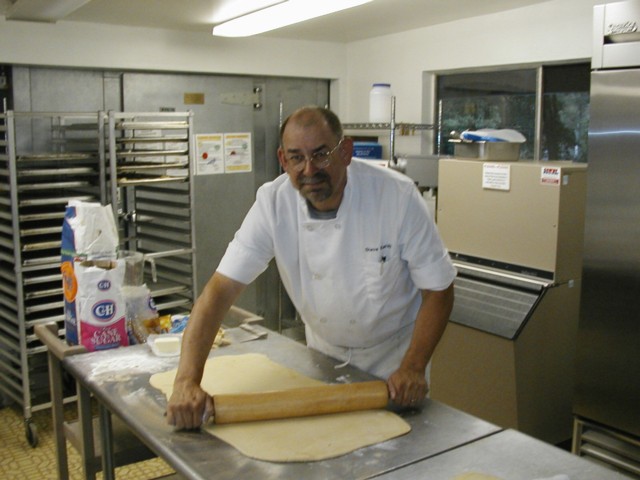
    Chef Steve on Sunday evening, running on about five hours sleep and 20 cups of coffee!

    I am also on the director's calendar for 10 a.m. each morning. We usually meet for two minutes or so we can discuss the day's progress and the impact of the camp schedule on kitchen. The director is always interested in the performance of the K.P. cabins. Other questions that arise include new campers with unique health issues, purchasing trips to Costco or the local market and special events like picture day for campers and staff.

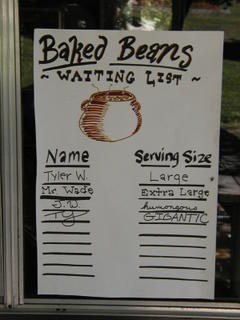
    We have fun too! Last year, Tyler, a councelor from the Sacramento area, boldly announced during Fear Factor that he dislikes baked beans. I took care of his mis-guided adversion to Boston's culinary gift to the world by serving him a special bowl of baked beans for breakfast late in the week.

    Since one co-director handles logistics at our camp, she's always interested in kitchen budgetary matters and the quantity of food on hand. I’m fortunate in that she doesn't micro-manage. Laura learned four years ago that I'm capable of handling food services for our camp.

    I give her periodic updates on the amount of money spent. This is especially important because I need to arrange for reimbursement at the end of camp. The directors do want any end-of-camp budget-busting news.

    Tyler's beans wait on top of the serving line each meal.

    Sunday, July 24, 2005

    Camp 2005 -- Opening Night Dinner

    We served our first meal tonight at about 6:30 p.m., after the evening worship. I just confirmed with the registrar about 30 minutes ago that we have 98 campers and 42 staff at camp this years, for a total of 150.

    Earlier in the week, when I was given a projected camp census of 135, I decided to purchase food for 150 campers and staff. I knew from past experience that we'd have 10 to 15 walk-ins during our afternoon registration.

    This year my projection worked to my advantage. I purchased enough food to feed 150 for the next week. This is one of those areas where you'll be the camp's savoir if the numbers fall to your advantage.

    However, it can backfire on you. Just remember that there are many factors that drive camp attendance, like the weather, competing activities, family vacations, etc. Over the years, I've developed a sense of projecting food purchases for these type of events. Although I'm never that far off, I still over- and under-project for some items.

    Menu

    The menu for Sunday evening, opening night of camp:

    Chicken tenders (2 each, about 3-1/2 ounces)
    Barbecue sauce
    Oven roasted potato wedges (3 wedges)
    Buttered broccoli (1/2 cup)
    Tossed green salad with vegetable toppings
    Marinated tomatoes with basil
    Brownie with vanilla ice cream
    Milk, punch and iced tea

    Chicken tenders -- We panned four (10-pound) boxes onto nine 18- x 26-inch sheet pans. That's about 45 servings per box.

    Barbecue sauce -- we used 1/2-gallon of bottle BBQ sauce tonight.

    Oven roasted potato wedges -- We washed and cut 50 pounds of U.S. No. 1 bakers this afternoon. I counted about 54 wedges per sheet pan. The cooks melted butter and pour it over the potatoes. They seasoned them with salt, pepper, garlic and paprika and baked them in a 350-degree convention oven for about 30 minutes.

    Broccoli -- We steamed 15 pounds of broccoli. Surprisingly, about 50 percent of the kids took my favorite vegetable.

    Marinated tomatoes and basil -- We used 15 sliced tomatoes this evening. At the end of the meal I had the salad cooks save the leftover marinade for tomorrow's tomatoes. The marinade keeps growing in flavor as the week progresses.

    Tossed green salad -- It took about 6 pounds of salad mix to feed 150 campers and staff. We also used 1-1/2 pounds baby carrots, 1-1/2 peeled and sliced cucumbers, 1 each sliced red and green bell peppers and radishes. It takes about 6 cups of ranch dressing for each meal. Although we place creamy Italian and 1,000 island dressings on the salad bar, very few folks use them.

    Brownies with ice cream -- It took 110 brownies and 3 gallons of vanilla ice cream for dessert tonight.

    Tuesday, July 19, 2005

    Second Set of Lessons from a Week-Long Bible Camp, Part 9

    This is my last round of lessons from operating a camp kitchen at a week-long children's Bible camp. I'll post relevant information as I come across it.

    I'm sure that I can come up with a second camper's dozen with little effort. I could write 13 more lessons on the topic of food safety alone--not necessarily lessons from this year's camp but from three decades in the culinary arts. These lessons are dedicated to those who're going to head up a kitchen at a children's camp.

    Don't Forget De-Mobilization

    Unless you operate a year-round kitchen, you need to start thinking about home. Emergency responders (police, fire, medical) call this process de-mobilization. Often, thousands of firefighters and support personnel are called to the large wildland fires. As the fire progresses and the firefighters get it contained, the staff works on a plan to make an orderly transition from from full mobilization to de-mobilization.

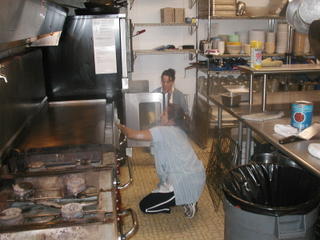
    Cooks at FC Camp clean the Wolf range (foreground) and the convention oven Friday morning last year.

    Early in the week, make plans to distribute leftover food and supplies, pack cookware and utensils (remember the two-dozen Dutch ovens that you carried to camp?) and clean and return the kitchen back to the facility manager.

    Other questions come to mind:

    • Do you have a plan in place to clean all of the equipment in the kitchen?
    • Are all kitchen employees staying to the end? Or are some staff leaving early?
    • Does staff need reimbursement for food purchases?
    • Do you need to account for lost/broken equipment, utensils or dinnerware?
    • What time does the kitchen need to ready to turn back to facility managers?
    • Do you have equipment to pack and transport home (like, 300 pounds of cast iron)?

    I've listed just a few questions here. Sometimes it takes as much effort to go home as initial preparations for camp. Make a list of the tasks that must be accomplished and start making assignments two days before the end of camp.

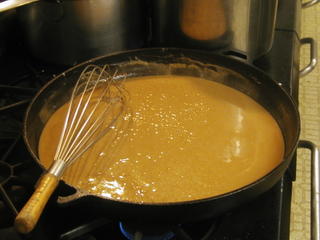
    A perfectly browned roux. I love this cast iron skillet. It's a 20-inch skillet that belongs to Daybreak Camp. I use it all week to brown ground beef, make gravy and saute vegetables.

    But don't be alarmed. If you're like me, you'll piece together an extensive list. After all, kitchen work can be complex at time.

    Here's a few tasks that must be tackled:

    • Final inventory--the chef must evaluate where to fine tune next year's order
    • Records--don't forget to pack the food production worksheet, food safety longs, etc.
    • Dispose of excess food--donate to a food bank, give it to staff, save for next year if possible
    • Clean all major equipment--refrigerators, range, convection ovens, serving line, dishmachine, etc.
    • Plan a leftover blow-out for the last meal--if it can be served safety, it's on the serving line Saturday morning !
    • Garbage and recyling--at Daybreak Camp, we always spend an hour on Saturday compacting the dumpsters because they're too full
    • Take care of personal belongings--don't forget to allot time so your staff can pack their bags
    • Meet with the facility manager--plan a walk-through with the facility manager when you're ready to turn the keys back

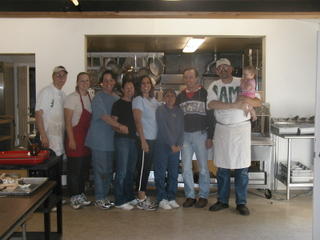
    The 2004 kitchen crew at the Northern California FC Camp. The girl that I'm holding just happens to be an exact copy of my oldest daughter--in personality and looks!

    Monday, July 18, 2005

    Second Set of Lessons from a Week-Long Bible Camp, Part 8

    This is my second-to-last blog taken from three years of "lessons learned." I'll post one note tomorrow that's appropriately titled, "Don't Forget About De-Mobilization."

    Military Wisdom Says "Walk the Ground"

    When a military unit occupies a new position, the first thing a troop leader does is to "walk the ground." The commander learns the lay of the land, notes likely enemy avenues of approach and looks for ideal places to spot weapons. He does this to avoid any unpleasant surprises on the battlefield.

    Likewise, the camp chef must tour the kitchen and dining facilities, especially when using the kitchen for the first time. A trip to the camp--I toured Daybreak Camp in February 2002--removes unnecessary surprises.

    I learned, for instance, that while the kitchen had two mixers (a 10-quart commercial model and a 5-quart Kitchen Aid), the larger of the two didn't have sufficient capacity to prepare enough dough for 150 campers in one batch. Though this wan't earth shattering news, it told me that I would have to allot enough time to prepare two batches of the pizza dough and the cinnamon roll dough on their respective days.

    Tuesday, June 21, 2005

    Lessons From a Week-Long Children's Bible Camp, Part 6

    Once You’ve Made Your List, Check It Twice

    Take meticulous notes during the planning phase. Mid-way through the week in the first year, I discovered that I hadn't purchased enough ground beef. When I reviewed my purchasing spreadsheet, I found that I inadvertently dropped one of the ground beef meals off my purchase spreadsheet.

    As it turned out, this was one of those errors that worked for the common good. We used a combination of leftover taco meat and breakfast sausage for the lasagna. The lasagna brought in enthusiastic reviews for my morning cook (lasagna is one of her specialties).

    Saturday, April 23, 2005

    2005 Camp Menu

    Although I've written a basic menu that changes little from year to year, I still like to change some items. The same children and adult return to camp each year. It's good to add a few new items each year so they don't grow tired of the menu.

    I follow the following criteria when changing menu items from one year to the next:
    • Keep a base of popular, proven menu items -- Don't change these items from year to year. On my menu, this accounts for more than 50 percent of the items. Examples include: Homemade sheetpan pizza, BBQ'd chicken hindquarters, grilled hamburgers and hot dogs, lasagna and breaded chicken breast strips.
    • Change out unpopular or less-than-popular items -- Last year I attempted to serve a fish sandwich, which was poorly accepted. A few adults (including me) liked them. From watching the garbage, I'd say over 75 percent of the children took one bite and tossed the sandwiches.
    • Tweak about 25 percent of the menu -- This mainly refers to side dishes and salads. I feel that this in important because a large number of children and adults return to that camp each year. It helps to offer variety. The cooks also get a change to learn new dishes and expand their personal culinary repertoire.
    • Switch the order of some meals to accommodate the camp program -- From 2002 to 2004, camp met during Independence Day week. Since we did a 4th of July picnic, I had to move the holiday meal each year. In 2002 and 2003, we cooked the homemade sheetpan pizza meal on opening night. I swapped Sunday and Monday dinners last year so that opening night would flow a little smoother. We now serve the breaded chicken breast strip-meal -- our most popular -- on Sunday dinner.

    I'm going to try to post the menu for the 2005 Northern California Florida College Camp. I finished making adjustments two weeks ago. I'm now ready to work on production worksheets and purchasing lists.


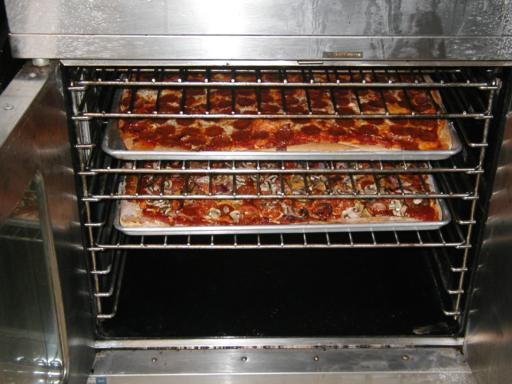
    Sheetpan pizza made from scratch. Pizza night is one of our more popular meals. Last year, I made 8-1/2 fullsized sheetpan pizzas. Cut at 20 servings per sheet, we prepared 170 servings with 21 servings leftover. (We also served leftover chicken strips that night.)

    Tuesday, April 19, 2005

    Food Services for 2005 Northern California Florida College Camp

    I'm not sure if I've mentioned this yet. I'm the chef for a children's Bible camp for one week each summer in the Santa Cruz, California area. We operate the camp for children who come from churches in Northern California. As the name implies, the camp is sponsored by Florida College, located in Temple Terrace, Florida.

    This year camp will meet during the last week of July for six nights and seven days. We run the camp from a Sunday to Saturday. Many staff (with camper children in tow) arrive on Saturday to participate in training. We have a busy week from the moment the Sysco Foodservice truck arrives in Saturday to the minute we ring the last mop on the next Saturday.

    Over the coming two months, I'll post information about the food service program at the Northern California FC camp. This information should be helpful to anyone who's tasked with feeding around 150 children and adult staff members in a camp setting.

    During our conversations, I will talk about:
    • The menu--The menu is the foundation of any food service operation. With it, the chef outlines each meal and plans production for his facility. The menu requires careful attention when working with volunteer cooks.
    • Children's likes and dislikes--You have to remember that you're feeding children from varied backgrounds. Not all children have a chef-father who makes them eat strange foods.
    • Purchasing--Purchasing can be challenging because you only operate for one week. I' was able to secure the services of Sysco Foodservices of San Francisco in the first year.
    • Production planning--Staff, menu and planning go together.
    • Using volunteer staff--Few camps can hire professional cooks. I've been able to draw on a great group of dedicated volunteers. This includes one husband-wife team. We had a mother-grown daughter team until last year (the daughter has since moved out of the area--the mother is returning for year-four!).
    • Food safety and training--Long-distance training is a must. I depend on the National Restaurant Associations ServSafe material for correspondence training. We also conduct on-site training on Saturday.
    • Working with program staff--Remember, you're here to support the overall program. It doesn't work the other way. We have two very good co-directors to work with.
    • Coordinating with the host facility--Few organization are blessed with their own facilities. We rent Daybreak Camp in Felton, California for the week.
    • Lessons learned from prior years (2002, 2003, 2004)--I wrote "lessons learned" following my experiences in the US Navy Seabees after the 2002 and 2003 camps. I'll share this information as it becomes appropriate to our discussion.
    I'd love to hear from others who've experience the joy of feeding children in a summer camp setting.