Showing posts with label camp 2008. Show all posts

Thursday, October 29, 2015

Throwback Thursday: How many servings will a 12-inch Dutch oven deliver?

This article was originally posted on Tuesday, March 25, 2008.

The topic of catering large groups often surfaces on Dutch oven discussion boards, like the IDOS forum and Camp-cook.com. Conversation rarely centers on the business side catering. It's the culinary side of feeding large groups that draws most of the attention. Questions about menus, portion sizes, amount to prepare and equipment are among the most common.

The last discussion that I joined in on began with a question from a Dutch oven group in Porterville, California. Dutchin' Dave, a member of the Sequoia Dutch Ovens, asked this question at Camp-cook.com:
Got a problem. We've been asked to do cobbler for 300 folks at a fancy fundraising dinner for our Cancer Camp for children. We're thrilled to do it, but the problem stems from the fact that the majority of our Sequoia Dutch Ovens chapter is already committed to another function and there will only be 4-5 of us left. Under the circumstances, it's going to be critical that our operation run as efficiently and streamlined as possible. We need to figure out how many ovens these 4-5 cooks are going to have to manage and so we need to calculate pretty closely how many servings we can get out of an oven.
Dave went on to explain his thought process on the issue. Even though he knows how many servings can be served from a 12-inch regular Dutch oven ("6-18 servings of a 'main dish' or 'to 30' servings of a 'side dish'"), he recognized that the number of servings per pot depends upon the portion size.

He planned to prepare one recipe in a 12-inch Dutch oven and scoop the cobbler out in 2- to 3-ounce portions. Dave estimated that the his recipe would yield about 15 servings. The results will, of course, depend on the volume of fruit and topping in his recipe.

To feed 225 guests, Dave figures it will take 15 (12-inch) ovens. He believes "approximately 3/4 of them will want dessert." The remaining 25 percent will avoid dessert due to health concerns or personal taste, said Dave.

Number of cobbler servings per No. 12 Dutch oven
Let me answer Dave's question in two parts. I'll address his immediate cobbler question first since that's the main point of his discussion. Then in a couple days, I'll address the broader question of catering large groups out of Dutch ovens.

I always work from volume, not some generalized table of servings per Dutch oven. Most Dutch oven food is semi-liquid or semi-solid. It spoons or ladles out very well. The key is to calculate the volume each Dutch oven holds for a particular dish and divide by the serving size. That's the basic formula for determining portions per Dutch oven.

There are other factors, like toppings and the number of pieces (of meat, chicken, potatoes, etc.) in the pot. It's hard to serve 20 (1-cup) servings out a pot of pork chops and gravy when there's only 15 chops in there to begin with. Toppings will also limit the number of servings. A pot pie or cobbler that's topped with 15 biscuits will only give you 15 servings.

I like to work out of 14-inch oven when cooking for a crowd. They're lighter than 16-inch ovens and holds more than a 12-inch oven. The 14-inch is a happy medium between lugging heavy 16-inchers and having to wrestle lots and lots of 12-inch ovens. I recommend that you locate as many 14-inch ovens as possible.

I don't recommend using deep-style ovens for recipes that use a topping as a key component of the dish. Deeper ovens are best reserved for bread loaves, large cuts of meat and soups, chili and stew.

The problem with baking a cobbler or crisp in a deep-style oven is it can hold a larger ratio of filling to topping. You'll run out of topping long before the filling is gone. The people at the head of the dessert line will get all the topping.

For the cobbler, I use 2 or 3 (14-inch) Dutch ovens to serve apple crisp to 150 campers. A 14-inch regular oven holds 8 quarts full to the brim. A good working volume is about 2/3 of the oven capacity, or about 5-1/3 quarts of product. Divide that by 1/2-cup into 5-1/3 quarts and you get about 42 servings per 14-inch regular oven. I round to 40. My recipe (below) uses three 14-inch ovens to feed 100 campers.

You can get 50 servings if you push the volume to 6 quarts. Just make sure you leave enough head room for the crisp topping to brown. But remember, to get 50 (1/2-cup) servings per 14-inch oven, you need about 6-1/2 quarts crisp/cobbler in each oven. And don't forget my caution about the filling to topping ratio above.

APPLE CRISP FOR A CROWD

Dutch oven instructions are located in the notes.

FILLING
3 (#10) cans sliced apple
1/2 cup lemon juice
1 tablespoon lemon zest
2-3/4 pounds sugar
8 ounces cornstarch
3 tablespoons ground cinnamon
1 tablespoon salt

TOPPING
3 pounds brown sugar
1-1/4 pound rolled oats
1-1/4 pounds all-purpose flour
1-2/3 teaspoons baking powder
1-3/4 teaspoons baking soda
1 tablespoon salt
2 pounds butter, softened

Arrange 4-1/2 quarts apples in each greased 18x26-inch sheet pan. Sprinkle juice and zest over apples. Combine granulated sugar, starch, cinnamon and salt; sprinkle half over apples in each pan.

Combine brown sugar, flour, baking powder, baking soda, salt and butter or margarine; blend to form a crumbly mixture. Sprinkle an equal quantity of the mixture evenly over apples in each pan.

Using a convection oven, bake at 350 deg F for 30 minutes or until top is bubbling and lightly browned on low fan, open vent. Cut each pan 6 by 9. Serve with serving spoon or spatula.

Yield: 2 sheet pans

Serving ideas: Serve 1 piece or approx 1/2-cup per portion. Acceptability is approx. 100 percent.
NOTES: Use 3 #10 cans sliced apples per 100 portions. Use two 18x26-inch sheet pans per 100 portions. Three lemons will yield 1/2-cup juice. Two pounds flour (total) may be used in place of rolled oats.

For 14-inch Dutch oven, use 1 #10 can of canned apples and a 1/3 the remaining ingredients per oven. This will yield approx 33 (1/2-cup) servings per oven.

Sunday, July 13, 2008

Camp 2008 -- Crazy, crazy

You could say Bob is a "wild and crazy guy." After all, Monday was crazy hair day at camp.

A counselor at Northern California FC Camp, he's one guy that takes theme days to heart.

Bob's the kind of guy you expect to dress like a nerd on Tuesday or wear cammo pants on Wednesday to support the military.

He had reversed his clothing in for backwards day when I caught up with Bob on Thursday. His only confession -- he didn't walk backwards that hot day on the Coastal Range near Santa Cruz.

More important that Bob's camp spirit is his example to the young boys and girls under his charge. You see, he's the kind of guy who walks in love as he imitates God.
Therefore be imitators of God as dear children. And walk in love, as Christ also has loved us and given Himself for us, an offering and a sacrifice to God for a sweet-smelling aroma (Ephesians 5:1-2).
As a boys and girls Bible class teacher, he had much to instill in the young minds. Like Bob's crazy hair, "crazy" themes from Epistle of James -- text for the week at camp -- resonate in the minds of the campers.

Like his example of camp spirit, Bob showed the kids examples of joyfully tackling life's trials (James 1:2-8), emphasised that a living faith works for God everyday (James 2:14-26) and that humble submission to God is the only way to purify their hearts (James 4:6-10).

Bob's actions during the week may not fit the image of a fifty-something guy who takes a week off from work to enrich the lives of the campers. But the kids respect him and love his devotion to God.

And you gotta respect a guy who walks around all day with baked hair goop.

Friday, July 11, 2008

Camp 2008 -- Notes on Sunday, June 29

I've written more about the opening meal than any other at camp. My mind is fresh on Sunday, and I still have lots of energy.

By Thursday, my desire to blog wanes. I often rest for a week before I pick up my blog pen. So, it's time to pick up where I left off last weekend.

I noted in an earlier discussion that the director's decision to eliminate Saturday camp pushed the arrival of kitchen staff back 24 hours.

Allen and Alisa had just finished setting up their tent as Debbie and I pulled in from worship and a Safeway shopping trip. By 2 p.m. -- the start time for kitchen staff on opening day -- the four of us were ready to start dinner prep.

After unloading the Safeway purchase, I immediately put Allen and Alisa to work. Allen scrubbed and cut 40 pounds of russets for roasted potato wedges. Mixing three five-pound packages of brownie mix fell to Alisa while I sliced onions and red and green bell peppers for the tomato-basil sauce.

In the next hour we panned the chicken tenders, sliced tomatoes for a salad and panned and seasoned the potatoes. My immediate goal was to get the time-consuming and time-sensitive tasks done. I was confident that the remaining staff would arrive around 3 p.m.

I put Elisa, Helen and Carol to work as they walked in the kitchen. Dave and Phil were able to set up tents. I wouldn't need their services until it was time to serve the meal. Around 3:30 p.m., I briefly lost Elisa and Helen while they registered children for camp.

In the next hour and a half, Elisa and Helen built the salad bar while others got the dining room tables ready (we don't have K.P. help until Monday morning), mixed beverages (punch and iced tea) and set up the vegetable.

By the time we walked out of the kitchen for 5 p.m. worship at the amphitheater, the meal was in good shape. Dinner was ready with brownies were cut, salads in the walk-in and chicken sandwiches fixin's ready to go.

The nine of us returned to the kitchen just before 6 p.m. This year we assembled the sandwiches instead of serving each item on the steam line.

Elisa watched the front of the house and assigned duties to the line servers (staff on opening night). Allen and Dave set up the dish machine while Debbie filled drink pitchers.

In the back, Carol and I made sandwiches with the tomato-basil sauce. Phil and Elisa (she's a busy woman!) made the barbecue sandwiches. Alisa ran the oven while Helen started working on salads for Monday.

Although I missed having all the kitchen staff report to work early Sunday afternoon, we put the meal out on time though superb teamwork. I was able to get all menu items prepared on time because of a dedicated staff that's flexible and willing to work.

In the photo, Alisa (left) and Elisa prepare pizzas Monday night.

Sunday, July 06, 2008

Camp 2008 -- Goal #3: Watch food production worksheet instructions

My third goal of the week was to carefully watch the instructions that I give to the cooks via the food production worksheet. We were only moderately successful at accomplishing this goal.

This ties nicely with the other two goals -- to reduce volume of leftovers and reduce end-of-camp donations. This point is important because I use the worksheet to communicate meal instructions to the crew.

My intent here was to improve the staff's use of the worksheet. Until two or three years ago, I was the only one recording information onto the worksheet. Then in 2005 or 2006 I started training the cooks to record to use the worksheet.

It's difficult to get the cooks to take time to document their actions. Most cooks like to focus on cooking, not record keeping. I spent most of the week reminding my second and third cooks to record the number of portions that they prepared, final cooking temperatures for potentially hazardous food items and leftover portions.

I say I was moderately successful because the cooks were using the worksheet about 60 to 75 percent of the time. I filled in the gaps for about one out of three meals.

We'll keep working on the importance of keeping good records next year. The food production worksheet, along with the inventory and food safety log, give me the history (click here and here) that I need to plan for next year's camp.

Friday, July 04, 2008

Camp 2008 -- Remember why you're at Bible camp

The cooks completed their last Bible study this afternoon. As I've said in the past, don't neglect the whole reason for coming together at camp -- to study God's word and to grow as Christians.

Elisa asked me last Sunday if the camp was going to have an adult Bible class each afternoon. I said no. Study time for adults was cut last year when classes for campers were reorganized.

She then asked if the cooks could study on our own. I quickly agreed because I know the importance of spiritual growth. I'm thankful she was looking out for our spiritual welfare.

Our study this year came from the "implanted word" (James 1:21) from James' letter to the twelve tribes which are scattered abroad" (James 1:1). James 2:17 formed the main point of our study this year at camp: "Thus faith by itself, if it does not have works, is dead."

James is a book of action. He stress throughout the letter the importance for Christians to take display a faith of action. He emphasises in the second chapter that the only viable faith is one that's working.

This year -- as in the past seven -- the cooks will go home with a broader understanding of God's word. They be ready to work in their communities, at home and in their churches as they put their faith in action.

Here's what I wrote in 2005 on the topic.

Camp 2008 -- Goal #2: Reduce end-of-camp donations

The second goal is to reduce end-of-camp donations to less than 4.5 percent of total purchases (when measured in dollars).

Cooking for or a stand-alone camp presents several inventory management issues. Key among them is getting rid of perishable inventory at the end of the week or weekend. We can't hold perishable food until the next camp, some 51 weeks away.

Dutch oven chocolate cream pie with cookie crust. Five (14-inch) Dutch ovens fed 135 campers and staff. You can serve approximately 15 to 25 portions from each large oven.

In an ideal world, the chef purchases just enough food for the campers. You're okay as long as the campers eat all the food that is prepared and presented to them. But few work in such an environment.

Products like fresh tomatoes, lettuce mix and milk give me the most problems. Each year, I adjust my order based on usage and remaining stock from the prior year. The number of anticipated campers also factors into the amount of food that I purchase.

Some years, my adjustments work. In other years the campers eat less (for a variety of reasons) and I'm faced with large quantities of leftover stock.

Now that it's Friday, I'm well on my way to achieving my goal of reducing the end-of-camp donations. Last week when I submitted by purchase order to Sysco, I was able to reduce my order by 10 to 20 cases.

I don't see a need to purchase an unneeded product just so I can donate it to the next camp. While it benefits that camp, it costs our camp money at a time when budgets are tight.

I've been monitoring the remaining food stocks closely and adjusting the menu to use these stocks up before tomorrow morning. My sous chef and I discuss the menu day and work on strategies to reduce excess stock. I'm confident that, at this point in the week, that my end-of-camp donations will come in much less than four percent.

Instead of making more cookies with the two remaining boxes of cookie mix, I used them to form the crust for a Dutch oven chocolate cream pie for lunch today.

DUTCH OVEN CHOCOLATE CREAM PIE WITH COOKIE CRUST

This morning, for instance, I made a Dutch oven chocolate cream pie in five (14-inch) camp ovens. I took the remaining two (5-pound) boxes of basic cookie mix and made cookie dough using the instructions on the box. I then pressed 2 pounds cookie dough into each 14-inch camp oven. It doesn't matter if you use regular or deep-style ovens for this recipe.

After baking the cookie dough over charcoal for 350 degrees F. for approximately 20 minutes, I used eggs, milk and sugar (all excess stock at this point) to make a chocolate cream pie filling from scratch. I cooled the filling and then poured 1-1/2 quarts over the cookie pie crust in each oven. You can also use your favorite instant pie filling if desired.

The five Dutch ovens fed 135 hungry campers during our Independence Day cookout. This is but one example of a way to use excess stocks.

Wednesday, July 02, 2008

Camp 2008 -- Camp coffee

What happens when you run out of coffee filters?

You go to plan B. If it was good enough for the wagon cook, it's good enough for the camp chef.

Camp 2008 -- Finger saving tips

The mandoline -- the sleek hand-operated vegetable-slicer, not the instrument (a mandolin) -- is an essential culinary tool in my book. In the hands of the right person, it saves time and gives many dishes a nice, professional look. The mandoline's sharp blades will slice vegetables to a uniform thickness.

But I don't allow sliced fingers in my kitchen. The bite of the mandoline quickly disfigures in the hands of an untrained operator. One slip quickly means the loss of a finder tip. Any time gained is quickly lost as the chef puts in a 9-1-1 call to the camp nurse.

Each cook who uses the mandoline must study my five rules of mandoline operation. They're designed to save finger tips and to speed up production. They are:
  1. No multitasking when using the mandoline; your single job at this point is to cut the food and to watch the blade, because it bites.
  2. Use the blade guard at all times; it will protect you fingers.
  3. No distractions allowed; this means no talking and no visiting when cutting on the mandoline.
  4. Know where you fingers are at all times; otherwise, you'll find them when the blade bites.
  5. Your finder is more valuable than the last bit of food; in other words, you don't have to be a hero and balance the food budget with the mandoline.

Tuesday, July 01, 2008

Camp 2008 -- Soup from leftovers

Remember, one of my goals this year is to reduce the leftover load on breakfast Saturday morning. Instead of preparing Navy bean soup as planned, I made a cheesy potato soup with broccoli from leftover from the first two days. This helped reduce our leftovers by three dishes.

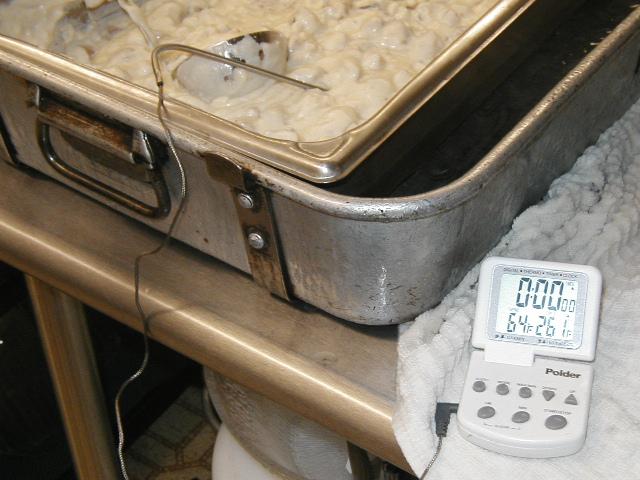
First, you must safely cool the leftover food. Cool leftover food through the danger zone (135 to 41 degrees F. ) by placing the pan in an ice water bath. Most state and local laws in the U.S. allow you to use the two-stage cooling method. You have two hours to cool the leftovers from 135 to 70 degrees and an additional four hours to cool the food from 70 down to 41 degrees or lower.


This pan of leftover pan of sausage gravy is in the second phase of cooling.

Once the leftovers have been properly cooled, store them in the refrigerator at 41 degrees or less. Use the leftovers as quickly as possible, but always within seven days.

To prepare the soup, I placed 5 quarts cheese sauce in a double boiler with 2 quarts fresh milk. I then added 2 quarts leftover cottage fried potatoes and 3 quarts leftover broccoli. I stirred. You then have (by law) two hours to heat the soup (or any leftover dish) to 165 degrees. It took 1-1/2 hours to heat the soup to the proper temperature.

I didn't measure the finished product. You should get about 25 (6-ounce) servings from this soup. Remember, the quantity you make will depend on the quantity of ingredients that you use for the soup.

Monday, June 30, 2008

Camp 2008 -- Creamy zucchini basil soup

Even when midday temperatures reach the high 70s, I like to serve soup for lunch. It gives the campers and staff an alternative to the normal lunch fare.

This is the first year that I prepared zucchini soup with fresh basil. It's a nice in-season summer soup. You can serve it when zucchini is at its peak in the supermarket.

To puree the soup, you'll need a medium to large immersion blender. I used the camp's home-sized blender to puree the soup. It took about five batches, but worked as well. Just remember the immersion blender is a lot safer as there's less chance you'll to burn yourself from a blender explosion.

This recipe comes from the May 2008 issue of Sunset Magazine.

This picture shows the soup just after I placed the zucchini and onion in the stockpot.

CREAMY ZUCCHINI SOUP WITH BASIL

Use extra sour cream (or crème fraîche) and basil leaves for garnish.

1/4 cup olive oil
2 pounds onions -- chopped
8 pounds zucchini slices
3 cups fresh basil leaves
3-1/2 quarts chicken stock
1/2 cup sour cream or crème fraîche
1 teaspoon chili powder

Heat olive oil in a large saucepan over medium heat. Add onion and cook until translucent, about 5 minutes. Add zucchini and cook another 2 minutes. Add chicken broth and basil leaves. Reduce heat to a simmer and cook 20 minutes.

Using an immersion blender, puree until smooth (or puree in a blender and return mixture to pot). Strain if desired. Add sour cream and chili powder and stir to incorporate. Season with salt to taste.

Portion into bowls and garnish (if desired) with some sour cream or crème fraîche, a sprinkle of chili powder and a few basil leaves. Makes 6-1/2 quarts or 24 (6-ounce) servings.

Camp 2008 -- Chicken tender sandwich with tomato-basil sauce

The first meal went off with few problems last night. Since I've written about the meal for the past few years, I won't discuss the meal in detail. Click the blogs about the opening night meal for 2005, 2006 or 2007.

I tried something different with the chicken tenders this year. Instead of serving the baked tenders with barbecue sauce on the side, I made two sandwiches using steak rolls from Smart and Final.

The first was served with barbecue sauce. To improve the sandwich, you can serve it with sliced tomatoes, onion and lettuce. About two-thirds of the campers took the sandwich with barbecue sauce.

I introduced a simple tomato-basil sauce with sauteed red and green bell papers. The sweet peppers adds a lively fruity element to the sauce. About 32 of the 135 campers took the sandwich. We'll definitely serve it next year.

CHICKEN TENDER SANDWICH WITH TOMATO-BASIL SAUCE

Bake the chicken tenders in a convection oven until the breading is crisp and brown. This adds a crunchy element to the sandwich. Substitute a sauteed chicken breat if desired.

1/4 cup olive oil
2 large red onions, diced
4 cloves garlic, minced
2 large red bell peppers, sliced
2 large green bell peppers, sliced
2 (28-ounce) cans chopped plum tomatoes in puree
2 bunches fresh basil
6-1/4 pounds chicken tenders
1 cup grated Parmesan cheese
25 French or Italian rolls

Heat olive oil in a saucepan and saute onion and garlic until translucent, being careful not to burn. Stir in sliced peppers and gently cook until softened. Stir in tomatoes and basil. Season with salt and pepper to taste. Simmer gently to blend flavors. Makes 2 quarts sauce.

Place pre-cooked chicken fillets on sheets pans. Using a convection oven, bake 12 to 14 minutes or until thoroughly heated in a 375-degree F. convection oven on high fan.
Briefly warm French rolls.

To build each sandwich, split open one roll. Set 2 tenders (about 4 ounces) on the bottom piece and spoon 1/4-cup sauce over chicken. Sprinkle 2 teaspoons Parmesan cheese over sauce and close sandwich. Make 25 sandwiches.

Sunday, June 29, 2008

Camp 2008 -- Pre-chill tuna salad

Place canned tuna fish in the walk-in to jump start chilling. Even though my salad cook won't make tuna salad for sandwiches until Monday morning, I placed the three cans in the walk-in this afternoon. Pre-chilling canned salad ingredients helps you stay ahead of the food safety game. Pre-chilling the mayonnaise, tuna and pickle relish helps us ensure the tuna salad will quickly chill to 41 degrees or lower.

Camp 2008 -- Quiet Saturday night

We had a quiet Saturday evening at Daybreak Camp last night. In past years, most of the counselors (and their camper-children) came to camp for training Saturday afternoon. It was an evening full of camaraderie, fellowship and activity.

As a cost-cutting measure, the director decided to forgo the meeting. Instead, he conducted counselor training in several private homes in May and June. This works because most campers and staff live somewhere between the San Francisco Bay Area and Sacramento.

The result is a significant savings. Since we pay Daybreak Camp a set per person per night rate, the director will be able to use those funds elsewhere. The money may help provide another scholarship for a camper.

But the decision has a human cost -- at least for those who spent Saturday night at camp. The director and registrar both came and returned to their homes after working on last-minute cabin assignments, the budget and setting up for registration today.

I miss the companionship we've had each year with the kitchen staff and counselors. It's been a time to catch up on friendships, conduct food safety training and eat Round Table pizza. More than the food (after all, take-out pizza is take-out pizza) our pre-camp meeting was the best night of the week.

Camp was too quiet last night. Constant chatter from our four-year-old granddaughter did little to fill the void. After dinner on the Santa Cruz wharf, we returned to an empty camp. It was an out of place feeling.

By this afternoon the camp will fill with the sounds of campers running on the lawn and jumping over the gopher holes. The registration tables will be a mass of organized chaos as parents drop their children off. Haggling over t-shirt sizes, color of the camp bandanna and cabin assignments will be the norm.

Compared to the peaceful tranquility at Daybreak this morning, campers and staff will ramp up the decibel level. As the cool coastal air of morning turns to the midday heat of the Coast Range, you'll know that the 2008 Northern California FC Camp is in session.

Saturday, June 28, 2008

Camp 2008 -- Goal #1: Reduce leftovers

The first goal is to reduce the volume of leftovers we serve on Saturday.

Although breakfast on Saturday is an impressive meal, it's too much food for our last meal. Most of the leftovers at tossed or packaged for home use by the cooks.

It's hard to convince 90 to 120 campers to eat all the camp's leftovers when they were up half the night eating pizza (a treat of the counselors). Home is all that's on their mind at this point in the week. Plus, many have planned off-camp gatherings at local fast food restaurants.

Since the camp's inaugural year in 2002, I've used creative ways to use camp leftovers. Repackaging has worked for some (see Thomas Jefferson frittata). I've billed Thursday as "Catch Up Day" on the menu for about three years.

Although it may be a challenge because registration numbers are down this year, my goal is to closely monitor the amount of food we prepare for each meal. For many meals I've purchased one or two cases or boxes less than last year. I'd rather cook less food than to be faced with excessive leftovers.

Unfortunately, registration numbers will likely come at about 5 to 10 campers less than the director's planning number. I may have too much food even though I trimmed my Sysco purchase by 20 or more cases. Time will tell.

To accomplish this goal, I plan to watch my instructions closely on the food production worksheet. I'll have more to say about this process in goal number 3.

Thursday, June 26, 2008

Camp 2008 -- Setting goals for camp

Each year I head to camp with several goals to improve the kitchen operation. Some are aimed at correcting problems from the prior year. Other goals target the efficient operation of the kitchen.

Although tempting, I've learned that I couldn’t develop an effective culinary operation in one year. Instead of tackling all issues in a single season, I limit my focus to two or three issues each year. This works well for my team when you remember that we only meet one week each year.
    An early goal was to train my cooks to competent in the use of commercial kitchen equipment, like the six-foot griddle at Daybreak Camp.

    In the early years, my goals served a more immediate need. I had to write a menu that would survive year-to-year, recruit and train a volunteer team, and set administrative systems (record keeping, inventory, cost control, for instance) in place to effectively manage the kitchen.

    Once these basic systems functioned as intended, I was able to turn my attention to the second tier – things that helped "kick" my operation up to the next level.

    I spend the 2005 season recording detailed notes on each recipe. Even though I used quantity recipes from the beginning, I neglected to note many important aspects of a good recipe.

    I wanted to improve my recipes and make more that a list of ingredients and the basic preparation methodology. To do that I needed to note the quantity that fit into the cooking pans (whether a sheet pan, hotel pan or Dutch oven). And I worked on other aspects of a quality recipe, like noting acceptability factors, developing variations and

    The motivation behind these goals is a mixture of self-improvement and crew motivation. Even while I'm working on self-discipline and improving my skills as a camp chef, I've used goals to raise awareness among the kitchen crew.

    It may be a simple as teaching food and energy conservation to the cooks. More complex issues, like how to plan a meal, also come up. The latter aspect of running a camp kitchen is important. Meal preparation is never as simple as cooking one portion per camper. The chef must consider the complexities of weather, camp activities and age-mix of campers when planning the menu.

    I have three goals in mind for the 2008 season at the Northern California FC Camp. They are:
    1. Reduce the quantity of leftovers that we serve at our closing meal
    2. Keep end-of-camp donations below five percent of total food purchases
    3. Watch food purchases closely due to a reduction in the number of campers
    I'll discuss these goals in the next two or three days. Stay tuned ...

    Friday, May 23, 2008

    Camp 2008 -- Menu for the senior banquet

    The theme for this years Thursday-night senior banquet at camp is safari. I've been working on a menu that will appeal to the high school-aged campers and give them the look and feel of a meal they could receive on an African safari.

    Authenticity isn't a big concern. My main concern is to give the kids familiar foods. My goal is to take common American food ingredients, like chicken breasts, and flavor them with spices and ingredients that are commonly found on a safari.

    While writing the menu, I envisioned safari meals being cooked by a native chef who uses familiar African flavors to spice up meals that safari-goers know and love. I've built the menu on common African ingredients like long-grain rice, peanuts (or groundnuts), yams and chicken. Spices like curry, coriander and cardamon will booth the flavor-profile of the menu.

    Here's the basic menu. Although I may change a few things before July, the basic menu for the banquet will remain.
    • Safari chicken -- I've adapted the common African stew with peanut sauce for the banquet. Instead of making a stew, I will pound and run a mixture of salt, pepper, curry and garlic on each chicken breast. After grilling on the barbecue, the chicken will be finished in the oven (until it reaches an internal temperature of 165 degrees F.). If we serve family style, I may plate the breasts over a bed of sauteed spinach.
    • African red sauce -- The sauce will be a combination of aromatics (onion, garlic and green bell peppers) sauteed in olive oil, fresh tomatoes, stock, peanut butter, soy sauce, sesame oil and hot pepper sauce. I'll spoon it over the chicken breasts and place bowls on the table.
    • Jollof rice pilaf -- "Jollof rice," according to Wikipedia, "is a popular dish all over West Africa. Its base consists of rice, tomatoes and tomato paste, onion, salt, and chili pepper, to which optional ingredients can be added such as vegetables, meats, and other spices." I may add black or red beans to the dish.
    • Roasted yams -- Since this common African food may not be as popular with campers, I'll prepare it in smaller quantities. A butter and honey simple glaze will add a wonderful flavor to the yams.
    • Dessert -- Even though I haven't fully landed on a dessert yet, one chef on another website suggested something made with pumpkin, another common ingredient. He said that a pumpkin cheesecake tart may hit the spot.

    These are just a few ideas among many that I could use. I'll report back later in July after the banquet. In the meantime, please leave your comments and any additional ideas for the meal.

    Monday, April 28, 2008

    Camp 2008 -- Dealing with menu fatigue

    For much of culinary history, the chef quietly worked the back of the house. He sought little glory for himself or his food as the customer was his main focus. The chef always looked for ways to satisfy their wants through food and the dining experience.

    In some environments -- the small, chef-owned restaurant, for instance -- the chef traditionally had greater freedom to craft a menu that pleased his creative yearnings. As long as patrons returned to the restaurant, he was free to create innovative meals.

    Each year I change the menu for the senior banquet, which is held on Thursday evening. In 2007, the menu consisted of sauteed chicken breasts with mushroom sauce, creamy mashed potatoes, roasted carrots and iced chocolate cake. I usually try to match the menu with the theme for the banquet. As you can see, disco was the theme for 2007.

    Other settings, the chef was (and still is) bound by rules that restrict his creative spirit. In camps (plus schools, hospitals, prisons), the kitchen's role must always fit in with the institution's mission. The camp chef has a great responsibility toward the nutritional needs of those under his care.

    I bring this point up because every cook is driven to a degree by the an innate desire to create and serve new dishes. I'm sure this comes from a personal desire to satisfy one's "inner culinary self."

    Each year I struggle with the impulse to drastically change the menu for camp. Even though I believe that I serve a good menu -- one that's well accepted by campers and staff alike -- the chef in me wants alter several menu items.

    Each time I contemplate changing the menu item, my motivation comes to mind. I always ask myself, "Am I getting tired of the dish?" Even if the answer is yes, I usually keep it on the menu because the kids like the dish.

    The luxury of changing the menu to satisfy my personal desire is a "nice to have" element of being a camp chef. I always have to fall back on the camper's needs in terms of nutrition and meal satisfaction.

    Besides, constantly changing the menu can work against you. Kitchen staff and the campers rely on a steady menu from year to year. Volunteer cooks benefit by being able to replicate the same meals each year with minimal training. And the campers look forward to certain dishes each year as June approaches.

    Saturday, April 19, 2008

    Camp 2008 -- Menu items with decreasing acceptability

    Each year I review the camp menu and the food preparation worksheet from the prior year. My goal is to check the acceptability of each item on the menu. I them have to decide if I'll replace less popular menu items or look for a recipe that uses different flavors.

    Even though our camp really doesn't have any vegetarians, meatless options are served on the steam line and salad bar. Few menu items enjoy 100 percent acceptability. Vegetarian items are given as an alternative. And they're there for undeclared vegetarian campers.

    The popularity of some items -- chicken tenders on opening night, for instance -- have steadily decreased each year. During the inaugural year in 2002, the campers couldn't get enough. Now I trim the amount I purchase each year even though I'm feeding more campers each year.

    I haven't decided if I'll replace the chicken tenders. If I don't, I may "repackage" the meal with new flavors, like in a sandwich on a hoagy roll. I could also use the pulled chicken (I purchased too much in 2007 anyway!) and make a quick fajita or burrito. I'll keep you posted.

    A NOTE ON MY MENU PLANNING PHILOSOPHY
    I've found the best way to get campers to eat is to provide good food -- food that's familiar and food they enjoy. My menus follow the proposition, "You can lead the children to the table, but you can't make them eat."

    It does no good to prepare nutritionally sound meals if the campers won't eat. A low-fat meal loaded with multi-grain breads and cereals may look good on the nutritional drawing board. But it does not benefit children if they won't eat.

    I find my role as chief cook and menu planner as one who finds that balance between nutrition and the need to feed a diet to campers that will satisfy their social and health needs.

    Elisa (left) and Lisa assemble lasagna for Tuesday night's dinner. (To confuse matters, I also have an Alisa on staff!)

    Tuesday, April 15, 2008

    Camp 2008 -- Menu review

    Each year as camp approaches, I brush off my notebook and review meal comments. As in past years, I recorded written comments each day as the week progressed. I used the notebook to jot down new recipes, meal likes and dislikes, purchasing comments, etc.

    Many of these comments were transformed into blog entries here at ‘Round the Chuckbox. Click on these links to review entries for the last three years:
    Since opening the camp kitchen in 2002, I've used the same menu. So, I plan to leave the menu in place again this year.

    Other than a flop or two (and the Thursday senior banquet meal), the menu stays the same throughout the week. I’m always reluctant to change much because I've the campers like it.

    I've used the adage, “If it’s not broken, don’t fix it,” to my benefit. A consistent menu benefits the chef, staff and campers alike. Even though the staff only cook one out of 52 weeks, it gives them consistency. Experience easily transfers to each succeeding year as the cooks learn the menu and its recipes.

    Since 2007 was a fragmented year -- we exchanged several meals during the week -- the menu requires a much closer review for the 2008 session, which runs from June 29 to July 6, 2008. Overall, I believe the menu is sound and well accepted by campers and staff alike.

    My goal is to find menu items to that need changing due to:
    • Menu items with decreasing acceptability -- some items don't have the appeal they once had with campers. Since my goal is to serve nutritious food that campers enjoy and will eat, I may need to reconsider a few items.
    • Cost due to increasing food prices -- this has been a big factor over the last two years. So far, the camp director has been generous. But this may change because increased prices his all program areas and impact the camp's fund raising goals.
    • Personal menu fatigue -- this aspect of menu review contradicts my stated purpose that food is a means to the end. The chef isn't there to satisfy his creative desire.
    I'll explorer each element of my menu review in separate blogs over the next week. Please stay tuned ...