Showing posts with label water. Show all posts

Wednesday, September 07, 2011

Code of the campfire #5

The code of the campfire says always keep a pot of hot water on the fire. Hot water stands ready to wash dishes, bath your body or tend bumps and bruises.

In the Seabees, the cooks dedicated one 15-gallon stockpot to hot water in the field. The water was used for sanitation, cooking and coffee. (Seabees can get a hot cup of coffee from the field galley any time of the day.)

The second part of the code says share a cup of tea, coffee or chocolate with camp neighbors before retiring for the night.

Thursday, June 25, 2009

Water in a wilderness camp


First Cove
Originally uploaded by SeabeeCook
All cooks and food service workers understand the importance of personal hygiene. A daily shower and clean uniform form the first line of defense in the daily battle against food borne illness. It’s an aspect of food safety that most cooks take for granted.

The situation changes when you’re working in a wilderness kitchen. Since the local utility companies don’t supply water or electricity to Deer Crossing Camp, which is located on the wilderness side of Loon Lake in Eldorado National Forest, all water for cooking, cleaning and hygiene must be pumped from the lake and treated.

Fuel becomes a precious commodity when at a camp that generates its own electricity and pumps, filters and chlorinates lake water in a wilderness location. When the supply of propane and gasoline dips below the comfort level, propane tanks and Jerry cans must be hauled down to the boat landing, loaded on the boat and transported across the lake.

One person must then drive to Pollock Pines or Georgetown to re-stock, a four-hour trip (or more) round trip. This process is repeated every two weeks during the summer season. Not only does the supply trip pull a staff member from his duties, each full fuel container must then be carried back up the hill to their respective storage points.

We view each drop of water as a precious resource, one that must be conserved whenever possible. We run the water generator only for short periods to build water pressure, except when washing dishes.

A 10-minute run on the generator will fill the supply tanks. As long as the campers don’t flush too many toilets during food preparation, the cooks will have sufficient water to cook the meal and clean the kitchen. When the water runs out, the I head down to the generator shack and start the water generator.

In addition to his normal duties as the chef-in-charge of the kitchen, I start the water generator each morning. Water pressure is zero most mornings. I often run down to the generator shack before walking into the kitchen at 6 a.m. and run the generator for 10 minutes.

This process is necessary just to wash our hands; fill the wash, rinse and sanitize sinks; and set aside water for cooking (plus coffee!). I also test the water for chlorine level each day.

Vigilance in all aspects of food safety doesn’t change in the wilderness camp. If anything, the primitive setting calls for increased attention to detail. All the cooks must pay close attention to sanitation, especially where water is needed to clean and sanitize.

The chef must find a balance between the need for a clean kitchen and water and fuel conversation. We run the water generator five or six times each day. This supplies sufficient quantities of water into the kitchen for our needs.

Since hot showers use an incredible amount of propane to heat the water heater, most staff and campers take a shower every three to four days. Since the cooks can’t ignore hygiene, I take a sponge bath each morning. This way I help the camp conserve critical fuel supplies while maintaining a high level of hygiene.

If the cook can’t perform basic hygiene tasks, like washing his hands upon entry into the kitchen, then he must find a reliable source of water before food preparation can begin.

Otherwise, canned food is on the menu.

Wednesday, January 16, 2008

Falls on Fly Creek


Falls on Fly Creek
Originally uploaded by SeabeeCook
I was envious of my brother's ambulance ride in the early 1960s when we lived in Fresno. Although my death-defying attempt to stop an automobile with my bicycle was serious, mom transported my to the hospital in the backseat of the family car. Michael's similar accident one year later gave him the honor of being the first on my generation to make the same journey in the back of an an ambulance.

Content to stay out of the backseat of an ambulance, I've lived my life in the 46 years since the accident in relatively good health. That was until yesterday, when -- indirectly as a result of climbing down the rock embankment on Sunday's photographic adventure -- I rode in the back of Medic 48 from my home to Marshal Hospital in Placerville.

I awoke at 5 a.m. Tuesday with excruciating pain in my left-upper leg, pain that was more like a day-long leg cramp. I finally called 911 about 2 p.m. when I realized that my leg wasn't getting better and there was no one to take me to the hospital -- my wife is visiting the grandkids, my mother was out all day and my son (who doesn't drive) was in school. The doctor said it looks like tendonitis.

So, it looks like I'll have to par back some of my photographic jaunts until my leg heals. It looks like I won't be climbing dowm any rock embankments soon.

Sunday, January 13, 2008

A ride through Wilson Canyon

I first saw Wilson Canyon eighteen months ago I helped friend Keith haul a 1940 Dodge Power Wagon from Yerington, Nevada. The West Walker River cuts through the mile-long canyon on its journey south to Topaz Lake. Though not as spectacular as other canyons, it offers many photographic opportunities.

The two-hour drive from Placerville to Yerington gave me time to scout a score of photo locations. As I pointed the truck through the American River canyon on Highway 50, my son jotted images of the drive in my notebook as I dictated.

I didn't have time to shoot the canyon during our 2006 visit. Loading and towing the Power Wagon occupied most of our time on that trip. After a visit to see my aunt, who lives in Yerington, we pointed our two-truck caravan back home. I never was able to photograph the beautiful scenery along the way.

Yesterday, I returned to Yerington for a sadder visit -- to attend the memorial service for my cousin, Patrick, who died suddenly last month.

The service gave us a chance to remember Patrick. The last time him was at my father's funeral. I believe he counted dad as a favorite uncle -- dad and Patrick had a special bond.

On any other day, this drive would've taken four or five hours. As we drove I made mental note of a dozen or more stops to make on the return trip. Snow covered rapids on the South Fork American River, grazing cows in the fields south of Gardnerville and the red hues of Wilson Canyon attracted my attention.

But I knew that I couldn't get the camera out until the trip home. My only hope was that we'd leave in time to use the natural daylight. Since the day started as one of those neutral gray days that distort your pictures, I was looking for one for the sun to break through the clouds.

We left my aunt's house at 2:30 p.m. Although it'd be nice to walk the canyon end-to-end, an old advertisement painted on the canyon wall attracted me to the south end of the canyon. I'll post three or four photos from the stop in the next week.

I still need to drive up the American River canyon. It was dusk by the time we crested Echo Summit. I'll make it up Highway 50 soon. In the meantime, enjoy the pictures of Wilson Canyon. I'll soon have a chance to explore with my camera in happier times.

Sunday, November 18, 2007

Apple and Red Onion Relish

Isn't it interesting how a photograph attracts you to something? Take this picture of Woods Lake. The idyllic winter setting prompts you to return in July after the snows have melted and the wildflowers are in full bloom.

My reaction to the deep red color of the red onion and apple relish is similar. To me the dish resembled German red cabbage, a holiday side dish that I've loved since childhood. As soon as I saw the picture, I could smell the marriage of the sharp vinegar and sweet apple.

Like many recipes in Christine France's cookbook, The Complete Guide to Making Sauces by (Hermes House: London, 2005), this one comes together quickly. You can prepare the relish in a little more an hour.

You may need to cover your eyes while the onions braise in their own juices. But as they soften into a thick relish, the sharp bite of the onion will mellow into a delicately sweet condiment.

You may find that the relish is a refreshing change from candied cranberry sauce. Use the relish in place of cranberry sauce at the Thanksgiving table this week. And it's great as a condiment on ham or turkey sandwiches made with holiday leftovers.

APPLE AND RED ONION MARMALADE

A pinch of salt will help extract the juices from the onion during the first step. Be careful not to brown the relish. You want it to slowly braise in its own juices and the vinegar.

4 tablespoons extra virgin olive oil
2 large red onions, thinly sliced (about 2 pounds)
6 tablespoons granulated sugar.
2 Granny Smith apples, peeled, cored and grated
6 tablespoons cider vinegar

Heat the olive oil in a large heavy skillet over medium heat. Add the onions and stir in the sugar. Let cook, uncovered, for 40 minutes, stirring occasionally until the onions have softened.

Add apples to the skillet with the vinegar. Continue to cook for an additional 20 minutes until the relish is thick and sticky. Cool and place in an airtight container. It'll keep for a month in the refrigerator. Makes about 3 cups.

Tuesday, November 13, 2007

Save the Best for Last

This is actually the last photo that I took of Woods Lake yesterday. After walking around the lake's outlet for 30 minutes, I climbed back in the truck and was struck by this view. So, I grabbed my camera from the front seat, stepped back out and drdged melting snow as I took a series of pictures before the light changed.

Shot settings: f/6.7, 1/180 second shutter speed, ISO 100, 54 mm focal length in manual exposure mode.

Thursday, November 08, 2007

Gateway to the Desolation

When my son and I were preparing for a backpacking trip in 2000, we hiked to Twin Lakes from this point. The Twin Lakes trailhead is located in the shadow of Blue Mountain and a few hundred feet from the inlet to Wrights Lake. The Desolation Wilderness sets behind the mountain.

Shot settings: f/16, 1/90 second, shutter speed, 31 mm focal length, ISO 200 in aperture priority.

Wednesday, November 07, 2007

Peaceful Shorline

This is a real lake to me. The natural shoreline with its forest canopy offered a peaceful visit as my son and I hiked along the east end of Wrights Lake last Saturday. Cabin owners (there's close to a hundred on the lake) have done a good job of hiding their summer abodes among the tree cover. Most cabins aren't visible until you walk up on them.

Shot settings: f/5.6, 1/250 second shutter speed, 48 mm focal length, ISO 200 in aperture priority.

Tuesday, November 06, 2007

Wright's Lake Lagoon

The photo that I posted Saturday is of the wier to Wright's Lake, a sub-alpine lake along the western boundary of the Desolation Wilderness. This shot was taken at the other end of the lake. The lagoon is formed as the South Fork of Silver Creek meanders through a large, swampy meadow on its journey to the lake.

The stand of young Lodgepole Pines borders the lagoon, now cut off from the creek by low water. Freezing temperature at the 6940-foot elevation have left a thick layer of ice on the lagoon, even an hour before sunset.

Shot settings: f/5.6, 1/250 second shutter speed, 48 mm focal length, ISO 200 in aperture priority.

Saturday, November 03, 2007

Oh Lake, Wier Art Thou?

This is my first attempt to blur water in motion. The water rushing through the wier is located at a local lake in Eldorado National Forest. Can you guess where this picture was taken?

Shot settings: f/11, 1/4 second shutter speed, 42 mm focal length, ISO 200 in shutter priority.

Sunday, September 02, 2007

You're Being Watched

When I'm in Eldorado National Forest I do what comes naturally -- I drive the forest roads. My family has always questioned the sanity of steering a four-wheel-drive truck over less-than perfect roads.

They express their displeasure in my leisure activity by questioning my driving ability. It's kind of the equivalent of "Are we there yet?" Frequent admonishments -- "Don't get lost" and "Don't get stuck" -- come from the back seat.

My son should know by now that that I aways find my way home. Getting stuck? Let's just say he's helped me extricate the truck from more than one snowbank.

We encountered three small herds as we drove down into the Alder Creek basin from Iron Mountain Road. No. 29 kept her distance as I tried to quietly maneuver through the trees. These docile creatures wore loud cow bells that clanked they made their way through the forest.

I caught this cow standing in the middle of Alder Creek upstream from the crossing at Morrison Ranch. Last spring that water would've been about three feet deep in this area. Remind me not to drink the water next summer.

Saturday, September 23, 2006

El Dorado Gold Flows to Georgetown

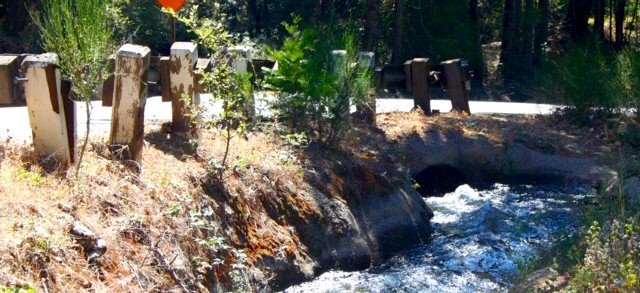
The Georgetown Divide Ditch flows under Wentworth Springs Road as it hugs the mountain contour. The ditch, which dates back to the California Gold Rush, carries valuable Sierra water from Stumpy Meadows Lake to Georgetown for domestic use, irrigation and fire fighting. The ditch is operated by the Georgetown Divide Public Utility District.

Thursday, June 02, 2005

Hot Water in Camp

I’ve always preached the need to keep a continuous supply of hot water. Hot water is always needed in camp for hand washing, doing the dishes and taking a quick sponge bath. It’s also nice to have the water on hand to mend scraped and bumps.


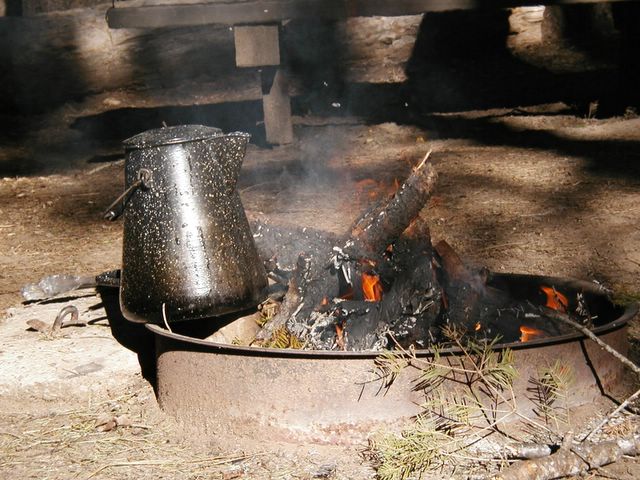
The 9-quart Navy coffee boiler prompted next to a campfire. Somewhat inefficient, this method noneeless provided sufficient hot water for two. Posted by Hello

For me the old fashion cowboy boiler works better than most containers. I favor it over the stockpot. The bail and handle (at its base) assist with pouring. The spout helps direct the stream of scalding water to the receiving container--something you can’t do with a stockpot.


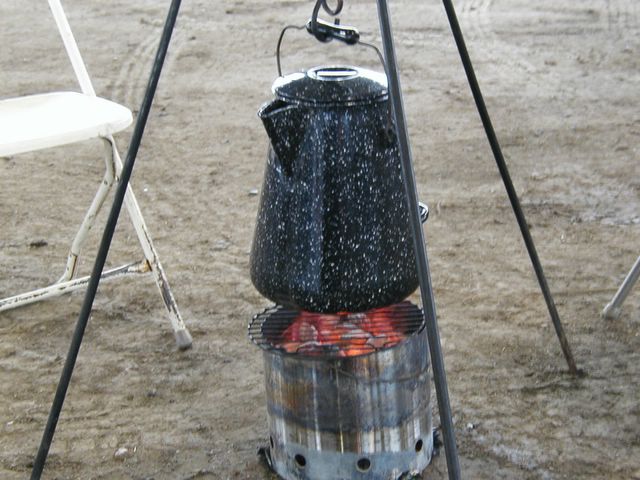
At cookoffs where I'm restricted to charcoal, I set the coffee boiler over a charcoal chimney with briquettes. Posted by Hello

In a typical camp, I set the boiler on the fire grate over the breakfast and dinner fires. My surplus Navy boiler has a capacity of 9 quarts of water (or coffee for those times where I feed a large group in camp). It usually takes about 30 to 45 minutes over the campfire to boil sufficient water for dishes and other sanitation chores.

Quist Hot Tap Outdoor Water Heater

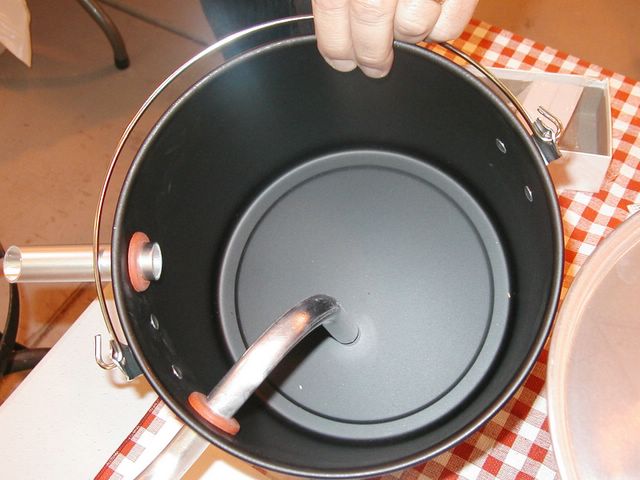
For those who like “low-tech” technology, I recently saw a new product from Quist Camping Company, 246 East 650 West, Kaysville, Utah, 84037. Their Hot Tap outdoor water heater “provides a continuous supply of hot water, no matter where you go. It may be the idea product for campers, especially those who depend on the gasoline or propane camp stove.


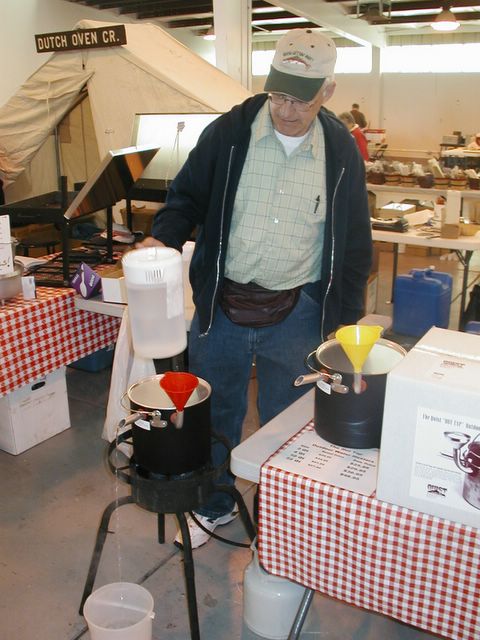
The owner of Quist Camping Company demonstrates the Hot Tap. Posted by Hello

The Hot Tap heater relies on the simple premise that hot water rises to the top of the pot. Once water in the pot boils, you pour cold water into the funnel and hot water will flow out the spout. The intake pipe carries the cold water to the bottom of the pot, forcing hot water through the outflow pipe.


An interior shot of the Hot Tap. Posted by Hello