Showing posts with label fish and seafood. Show all posts

Monday, November 21, 2016

Pancit canton shrimp salad and potlucks

Sauteed green beans with shiitake mushrooms
and bacon. Two large loaves of artisan-style bread
are in the background.
This is one of those dishes that wasn't prepared with a recipe. Many of my dishes have their origin in the minute. I throw the dish together using ingredients in the fridge and cupboard. These dishes are those that I have prepared many times during my career. You could say that the recipe is embedded in my head.

For the second time in a week Debbie and I offered bread and a vegetable dish for a potluck. The first took place last week at a Thanksgiving gathering of a local church family. I prepared two loaves of no-knead bread and sauteed green beans with shiitake mushrooms and bacon. Three scraps of bread and a couple mushroom pieces were all that remained. One person asked me for the bread recipe after the meal.

Saturday we took pancit canton shrimp salad to a memorial service at the same church. For the second time, I offered a dish that was put together on the spur of the moment. The impromptu salad for the potluck, which followed the service, was inspired by my years of sevice in and of of the Philippines. I combined romaine lettuce, canton noodles, carrot sticks and baby shrimp. The salad was tossed with an Asian inspired vinaigrette. It fit in with the salad and sandwich theme for the potluck.

Pancit canton shrimp salad.
To prepare the salad, cooked 4 ounces canton noodles (called pancit canton or canton sticks) in chicken broth until al dente. (Follow the instructions on the package.) After draining and cooling, I cut one head of romaine lettuce and ran a large carrot through the mandoline using the smallest julienne setting. Eight ounces of cooked baby shrimp were thawed as well. Any number of vegetables could've been prepared at this point, including sliced radish or diakon, halved grape tomatoes and chopped cilantro.

The vinaigrette was prepared without measuring. Three cloves of finely minced garlic, tablespoon or two of cane vinegar, teaspoon or two of toyomansi (Filipino soy sauce with calamani), small spoonful of Dijon mustard, few drops of sesame oil and coarsely ground black pepper were whisked together in a bowl. I then streamed in canola oil while vigorously whisking to form a vinaigrette. While I can't tell you the ratio of vinegar to oil that I used, it was somewhere between 1:2 and 1:3. I enjoyed the garlicky sauce with its peppery bite.

To assemble the salad, I first tossed the shrimp in a couple tablespoons of the vinaigrette.While the shrimp marinated for a couple minutes, the lettuce, carrot and noodles were tossed together in a large bowl. The salad was tossed with the remaining vinaigrette, followed by shrimp. Serve cold.

Notes: Purchase Filipino products in any well-stocked Asianmarket. While Filipino soy sauce (toyo) adds a distinct flavor, any soy sauce can be used. Toyo has a mildly subtle flavor to it. Filipino cane vinegar is prepared from the juice of cane sugar (sukano ilocano). Calamansi is Filipino lime. Lemon or lime can be substituted for the calamansi in the Filipino soy sauce. I have yet to locate calamansi (fresh or bottled) in Northern California.

Thursday, September 18, 2014

Lobster, a sea-going favorite

Lobster was a favorite of the crew when I sailed on the USS Stein (DE-1065) in the mid-1970s. We baked it with butter and lemon, grilled over hot coals it on the flight deck and diced leftovers for salad. Our chef (a chief petty officer) was reprimanded for making an unauthorized purchase of lobster in Australia. And yours truly felt the wrath of the chief for noshing on leftovers after a surf and turf barbecue. I suspect lobster remains a seagoing favorite in the US Navy.

PACIFIC OCEAN (Aug. 31, 2014) -- Culinary Specialist 1st Class Marco A. Coll-Dimayo, left, from Rockford, Ill., and Culinary Specialist Seaman Apprentice Dontae R. Flint, from Suffolk, Va., prepare dinner for the crew aboard the guided-missile destroyer USS Dewey (DDG 105). Dewey is underway in the U.S. 3rd Fleet area of responsibility as part of the Carl Vinson Carrier Strike Group.

U.S. Navy photo by Mass Communication Specialist 3rd Class James Vazquez.

Saturday, February 09, 2013

Dave Herzog's Dutch oven paella

Last Sunday, Dave Herzog posted this picture of Spanish paella on his Facebook fan page, Cast Iron "Covered Wagon" Cookin'. He posted the recipe after receiving 30 private messages this week.

Dave entered the paella in the Dutch oven cookoff at the 2007 Nor Cal Boat, Sport and RV Show in Anderson, California. He walked away with first place in the main dish category. For the three-pot competition, Dave prepared German chocolate ice cream topped cake and cheddar sourdough bread for his other two dishes.

This recipe and others are found in Dave's cookbook, Cast Iron "Covered Wagon" Cookin' for Crowds in BIG Ovens. BIG Ovens is the fourth cookbook in a series of five dedicated to cooking in cast iron cookware. It's ideal for the outdoor cook who regularly cooks for groups of 20 or more.

"This book covers recipes for those outdoor cooks with a serious case of castironitis!" Most recipes are written for Maca branch deep Dutch ovens, including the massive 22-inch oven, which tips the scale at over 150 pounds and holds 45 quarts of food!

To purchase, contact Dave at The Official Cast Iron "Covered Wagon" Cookin' website. It costs $10 plus $5 shipping for the paper copy of the book. Discounts apply when purchasing multiple books. The cookbook can also be downloaded for the Cook'n Recipe Organizer software for $7.95. The software must be purchased separately.

You can do paella in a Dutch oven lid or Dutch oven. Dave Herzog cooked this paella in the lid of a 20-inch Cabela's Dutch oven. The cast iron works for the Spanish dish without having to buy a paella pan.
DUTCH OVEN PAELLA

This recipe may be doubled by cooking in the 20-inch Dutch oven by using the oven right-side up.

In the intervening years, Dave has adjusted one or more ingredients. "I also now use 5 pound wing sections instead of chicken thighs," Dave wrote on Facebook. "The wings are easier to divide between people, even though I prefer the thigh meat." Substitute Mexican Chorizo if you can't locate Spanish chorizo.

1/2 cup olive oil, divided
12 chicken thighs
3 tablespoons Emeril’s Essence
2-1/2 teaspoons kosher salt, divided
2 pounds Spanish chorizo, diced into 1/4-inch half moons
1 medium onion, chopped
2 cups red bell peppers, chopped (about 2-3 peppers)
2 cups green bell peppers, chopped (about 2-3 peppers)
4 tablespoons minced garlic
2 teaspoons saffron threads
2 quarts chicken stock
1 quart medium grain rice
2 pounds jumbo shrimp, shells and tails on, back split
1 pound mussels, cleaned and de bearded
1 pound steamer clams, cleaned
2-1/2 cups frozen peas, thawed

In a large mixing bowl or tub season the chicken with 2 tablespoons Emeril’s  Essence and 2 teaspoons salt. Toss the thighs to cover with seasonings. Heat a 20-inch Cabela’s Dutch oven lid over a checkerboard pattern of charcoal briquettes. Add 1/4 cup oil to the lid. Once the oil starts to smoke cook the thighs on each side for 4 minutes per side to sear. Remove the chicken from the lid, and set aside.

Add remaining oil and chorizo and brown, stirring occasionally until well browned, about 7 minutes. Add onions and peppers. Continue cooking until onions are softened, about 5 minutes. Add the rice and saute 3 minutes, then add garlic and saffron. Spread this mixture evenly across the lid then place the chicken thighs across the top of the mixture in a single layer.

Pour about 1 quart stock into the lid or as much liquid it will hold without over flowing. Cover with bottom and add more stock as needed in 15 to 20 minute intervals, adding as much as possible without over flowing until all the broth is used up.

When the last of the broth is added, place the shrimp, mussels, and clams around the entire dish and cover. Cook 15 minutes, remove cover and sprinkle peas over the top, cover and remove from heat, let rest 7 to 10 minutes before serving. Serve from the lid on a lid trivet in the center of a table.

Serves 8 with two chicken thighs per person or 16 with one thigh each.

Recipe and photograph used with permission.

Wednesday, April 11, 2012

Pan seared fish fillet with lemon caper sauce

I serve fish on the dinner menu three times each four weeks at work. Its popularity varies from month to month as residents come and go from the program. One month, they eat all 25 servings. The next I can't give it away.

When fish is on the menu, many residents go out of their way to tell me how much they hate fish. Sixty to 75 percent will not eat a baked fish fillet, even when I pare it with tarter sauce. Serve an oven baked breaded fillet and around 80 to 90 percent of the residents will eat it. (Safety considerations prevent me from deep-frying at work.)

I find the secret to boosting acceptability is to prepare fish in new and interesting ways. Until last October, I baked the talapia fillets. To increase the popularity of the fish, I dredged thawed fillets in seasoned flour. I browned them in several skillets and transferred the fish to waiting hotel pans.

I went to work on a quick pan sauce after placing the fish in a slow oven. I sweated minced shallot in one of the skillets, then reduced chicken stock and lemon juice over high heat. To finish the sauce, I tossed in capers and a bit of fresh chopped parsley. The sauce was poured over the fish and served.

Given the unique population that I work with, 100 percent of the residents may never like fish. I come close with pan seared talapia with lemon caper sauce.

PAN SEARED FISH FILLET WITH LEMON CAPER SAUCE

Use flounder, sole, haddock, perch, grouper or talapia fillets for this dish. If desired, thicken the sauce with a cornstarch slurry.

25 (5 to 6 ounce) Fish fillets
2 cups all-purpose flour
2 teaspoons kosher salt
2 teaspoons paprika
1/2 teaspoon cayenne pepper
1/4 teaspoon white pepper
1/4 cup vegetable oil
1/2 cup minced shallot
1 cup chicken stock
1/2 cup fresh lemon juice
4 ounces capers, drained and rinsed
1/2 cup parsley, chopped

If frozen, thaw fish under refrigeration. Dredge fish in mixture of flour, salt, paprika, cayenne and pepper. Set fish on a wire rack to let flour coating set. Saute until golden brown in oil, about 3 minutes each side. Place in two 12x20x2-inch hotel pans.

Sweat shallots until softened. Add lemon juice to skillet; shake pan gently and cook 3-5 minutes, until sauce is slightly thickened. Add capers and parsley to sauce; shake skillet to combine and pour over fillets. Serve at once or place for a short time in uncovered hotel pans in 250°F oven until service.

Sunday, September 12, 2010

Tuna and noodles

During my teen years it would seem on nights that I was famished, mom always baked a hearty casserole of tuna and noodles. I could never endure the large chucks of celery floating in the casserole. Consiquently, I never really cared for the combination of canned tuna, sauce and noodles.

To this day, tuna and noodles is one dish that I won't purposely eat. I don't remember the last time that I sat down to a helping of the casserole. And I've never cooked it for my own family.

Tuna and noodles wasn't my first choice for dinner at work last Wednesday. My original thought was to prepare hamburger stroganoff, a dish that the residents have enjoyed monthly for the past several months.

A resident who's approaching the half-way mark in the program asked me Tuesday if I could bake tuna and noodles with canned cream of mushroom soup. She'd recently resolved to offer solutions instead of continuously complaining about "chicken burnout." I accepted the idea and menued it in place of the stroganoff.

The residents began asking "What's for dinner" early in the afternoon. With the division between likes and dislikes running neck and neck, I though the casserole was going to be a disaster. Battle lines were clearly drawn. They either loved it or left the kitchen in disappointment.

Then something happened. As the afternoon progressed, likes inched ahead of the dislikes. By dinner time a full 60 percent of the residents said they looked forward to the meal. Over 90 percent of the residents ate the tuna and noodles for dinner that evening.

"Mr. Steve, you did good," said a resident as I headed home for the evening! I smiled and thanked her. I was able to take a dish that I don't like and deliver a quality product to the residents.

TUNA AND NOODLES

One (2 pound 11 ounces) pouch pack of tuna will work for this recipe. Sysco sells 6 pouches in each case under the Classic label.

I prepared the casserole with 1 (50-ounce) can of condensed cream of mushroom soup. See note for procedure. To boost flavor, add 1 pound sliced mushrooms to the sauteed onions and celery.

1-1/2 pounds egg noodles
2 pounds 12 ounces tuna
4 ounces margarine
12 ounces onions, small dice
12 ounces celery, small dice
3 ounces all-purpose flour
1/4 teaspoon black pepper
2 quarts chicken stock
6 ounces shredded cheddar cheese
1/4 teaspoon paprika

Cook noodles according to package direction. Drain and place in bowl. (Should yield 4-1/2 pounds cooked.) Flake tuna and add to noodles.

Melt margarine in medium-sized saucepan. Add onions and celery. Saute until tender. Add flour and pepper to onion mixture. Stir until blended. Cook 5 to 10 minutes.

Stir in chicken stock gradually, stirring constantly with wire whip. Cook until thickened. Add tuna and noodles to sauce. Stir gently until well blended. Check seasoning.

Pour noodle mixture into greased 12x20x2-inch baking pan. Sprinkle with cheese. Sprinkle lightly with paprika. Bake at 350°F until mixture is heated to 180°F and cheese is melted, 30 to 45 minutes. Serves 25 (8-ounce) portions.

Note: One 50-oz can condensed cream of mushroom or cream of celery soup and 1-pint milk may be substituted for the sauce made from margarine, flour and chicken stock.

This recipe was adapted from 11th edition of Food For Fifty by Mary Molt, Ph.D, R.D. (Prentice-Hall: Upper Saddle River, New Jersey, 2001).

Friday, October 17, 2008

Happy navy birthday

This brings me back to a certificate that needs dusting. It honors those who were serving during our nation's 200th anniversary.

And yes, the cooks roasted and served at lot of lobster in the 1970s ...


GULF OF OMAN (Oct. 13, 2008) Culinary Specialist Seaman Recruit Charlene Cruz de-shells a batch of lobster tails in the aft mess decks aboard the Nimitz-class aircraft carrier USS Ronald Reagan (CVN 76) in preparations for a crew appreciation dinner, celebrating the Navy's 233rd birthday. To commemorate the occasion, 117 Sailors reenlisted in the Navy during a mass ceremony earning a combined selective reenlistment bonus of $2.4 million.

Ronald Reagan is deployed to the U.S. 5th Fleet area of responsibility, reassuring regional partners of the United States' commitment to security, which promotes stability and global prosperity.

U.S. Navy photo by Mass Communication Specialist 3rd Class Torrey W. Lee.

Sunday, June 29, 2008

Camp 2008 -- Pre-chill tuna salad

Place canned tuna fish in the walk-in to jump start chilling. Even though my salad cook won't make tuna salad for sandwiches until Monday morning, I placed the three cans in the walk-in this afternoon. Pre-chilling canned salad ingredients helps you stay ahead of the food safety game. Pre-chilling the mayonnaise, tuna and pickle relish helps us ensure the tuna salad will quickly chill to 41 degrees or lower.

Wednesday, April 02, 2008

USS Nevada sailors take 3rd in joint chowder cook-off

By Mass Communication Specialist 2nd Class (AW/NAC) Eric J. Rowley, Fleet Public Affairs Center, Det. Northwest

LAKEWOOD, Wash. (NNS) (April 2, 2008) -- USS Nevada (SSBN 733) culinary specialists competed in a clam chowder cook-off at McChord Air Force Base's Olympic Dinning Facility, March 27-28.

Culinary Specialist 3rd Class (SS) Larry Westerfield and Culinary Specialist 3rd Class (SS) Chris Stehr took third place out of nine two-person teams in the 3rd Annual Northwest Clam Chowder Cook-off.

"I liked this event," said Westerfield. "It was a good way to show who was better for the bragging rights. It was a good competition and I would definitely do it again. Overall it was awesome."

The nine teams, representing Army, Navy, Air Force and Coast Guard, competed in their chowder cooking abilities within a two-hour time limit. An Army team took first place and a Coastguardsmen team took 2nd.

"It was a fun competition," said Stehr. "I like being able to compete against other branches of service to see what kind of training they get. I learned the Army has really good garnishing abilities."

The first day was an orientation day where the participants were able to learn a little bit about the history and origin of clam chowder and they discovered potatoes weren't added to the until the 1800s.

Westerfield and Stehr started making their chowder by making sure all their ingredients were ready to go for their Boston style clam chowder. Then they started sautéing the vegetables in garlic and sherry. Once sautéed, they added flour to make the rue and cooked it until it was a golden brown color to make sure it had a little bit of a nutty flavor.

"We went for a more traditional style of clam chowder," said Stehr. "We wanted to stay away from a lot of the pre-made products and make the chowder from scratch. We used fresh shallots, new potatoes, garlic, truffle-infused oil, cooking sherry, sea clams and Sicilian sea salt. It was all from scratch to make a more natural flavor."

Once the mix was a golden brown they added the whipping cream, clam juice, clams and potatoes then let it simmer until all the flavors melded together. Then they added the heavy cream, then more simmering until it was time to present the dish to the judges.

"The judges said it was a pretty close competition point-wise," said Westerfield. "We were judged on color, texture, aroma and presentation. I really enjoyed our soup when it was done."

All of the participants received continuing education credits used for a degree in culinary arts.

Tuesday, September 27, 2005

Shrimp and Pasta with Creamy Pesto Sauce

I love versatile recipes, especially recipes where you can trade ingredients on a one-for-one basis. Any recipe that adapts to leftovers and stocked pantry items is versatile in my estimation. Sunset’s recipe for shrimp and pasta with creamy pesto sauce is the perfect example.

I’ve had my eye on pasta for over a week now. On the way home from work I purchased a 12-ounce box of angle hair pasta (my country market carries three pastas: spaghetti, angle hair and elbow macaroni). A small jar of traditional pesto, three leftover chicken thighs and the remains of a bag of sun-dried tomatoes all went into my spur-of-the-moment pasta for dinner.

My 13-year old son wolfed down two helpings despite the fragrant aroma from the basil. He even managed to work around the sun-dried tomatoes. I have a hit!

SHRIMP AND PASTA WITH CREAMY PESTO SAUCE

This recipe was published in Sunset Magazine, February 2003. I prefer roasted red pepper pesto to traditional pesto made with basil and pine nuts.

12 ounces penne pasta
1 pound shrimp, cooked, frozen
1/2 cup prepared pesto
1/4 cup heavy cream
1/4 cup chicken broth
3 tablespoon dried tomatoes, oil-packed
Salt and black pepper, to taste

In a 4- to 6-quart pan over high heat, bring 3 quarts water to a boil. Add pasta and cook, stirring occasionally, until tender to bite, 7 to 12 minutes. Drain and return to pan.

Add shrimp, pesto, cream, stock and dried tomatoes to pasta. Stir over medium heat until hot and evenly incorporated, 2 to 3 minutes. Add salt and pepper to taste. Makes 3 to 4 servings.

Friday, July 29, 2005

Camp 2005 -- Improvising Clam chowder

Using up food stocks is one of the drawbacks of running a kitchen for the week only. Sometimes good planning fails. Other times, kitchen staff uses items for something other than its intended use.

Whatever the reason, it's difficult to make quality clam chowder when someone used the half-and-half for French toast (in this case that someone was me) and the fresh potatoes were used up yesterday.

Improvisation makes sense when it means another trip to the local market. Instead of cutting into camp profits (which go to FC students from Northern California in the form of scholarships), it gives you a chance to reduce some of the excess food.

IMPROVISED CLAM CHOWDER

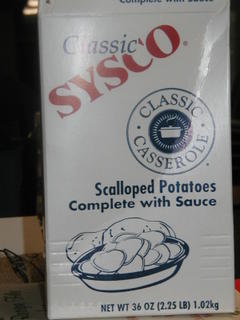
This clam chowder was made using 1 (32-ounce) box of Classic Sysco scalloped potatoes complete with sauce. This product is packaged in a milk carton with dehydrated potato slices andt two packages of sauce mix.


Sweat 4 chopped onions in bacon fat in a 15 to 20 quart stockpot. Meanwhile, crush the contents of a 32-ounce package of scalloped potatoes and add to the stockpot. Pour contents of 2 (46-ounce) cans of clam juice and 3 (51-ounce) cans of minced clams into stock pot. Stir until combined.

Make a slurry from the two packages of scalloped potato sauce mix and add to soup while constantly stirring. Thicken soup with a flour and water paste (about 3 quarts flour to 2 quarts water), storing constantly to avoid lumps. Gently simmer for 45 minutes until thick and creamy.
Just before serving, add 2 quarts milk and bring to serving temperature. Check seasoning. You may not need to add any salt.