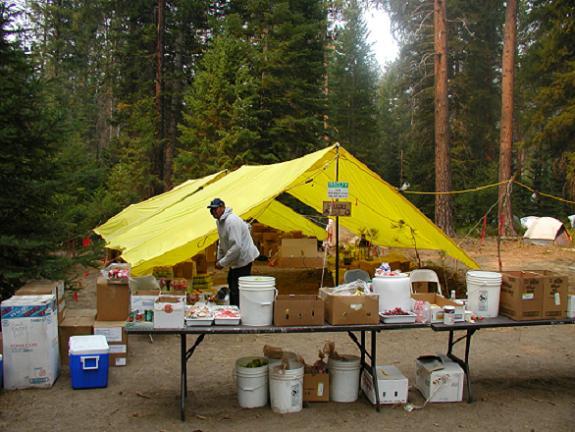
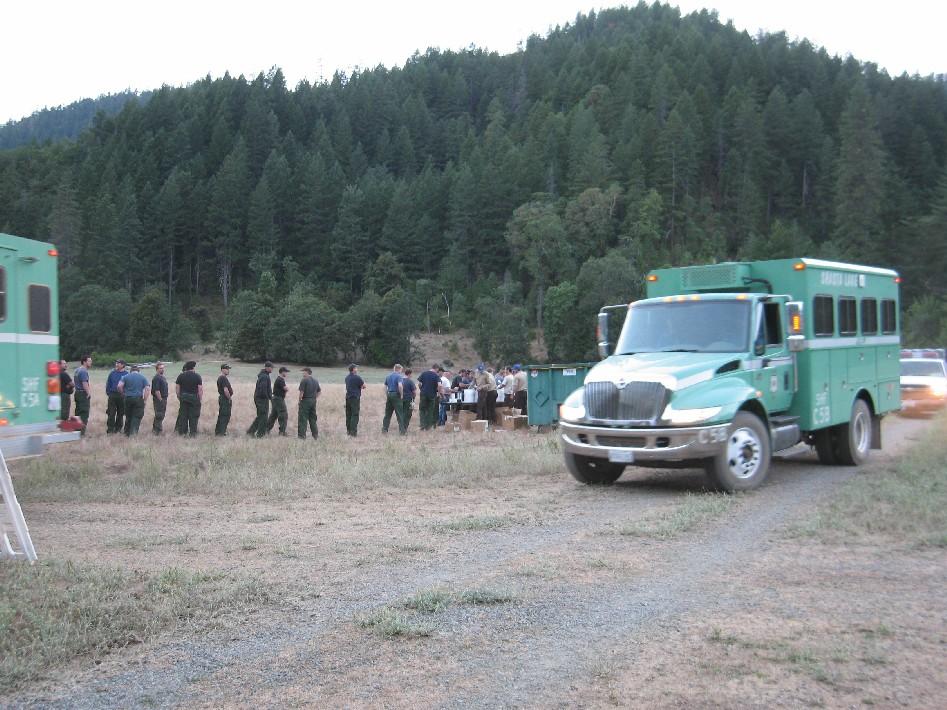
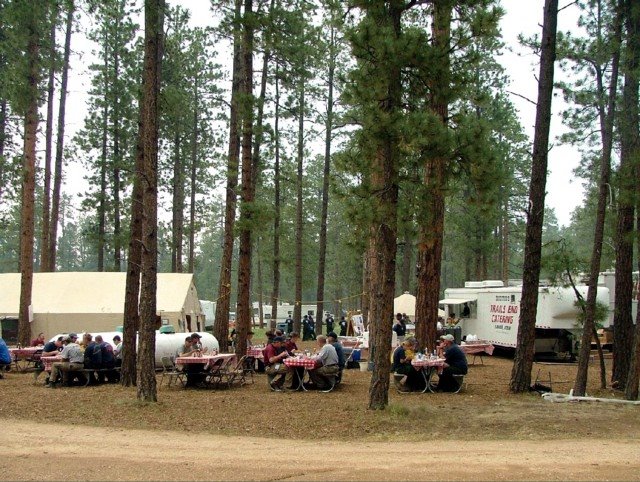
Showing posts with label incident/disaster feeding. Show all posts

Wednesday, November 18, 2015

German red cabbage for a (large) crowd

I realize not many readers of 'Round the Chuckbox have need for six-plus gallon batch of German red cabbage. Faced with a 50-pound of cabbage last September on my mission to Middletown, California, with Mercy Chefs, the natural thing to do was to prepare a large batch of German red cabbage. The cabbage was served with barbecues beef strips, roasted red potatoes, tossed green salad with vinaigrette and peach cobbler.

Two volunteers cut the core out of 24 large heads of red cabbage. They then shredded it by hand after discarding the outer leaves.
I prepared this dish in the 15-gallon tilt skillet on the Mercy Chefs' 32-foot mobile kitchen trailer, known as Mercy One. The red cabbage can also be prepared in one or more large stockpots or in a steam jacketed kettle. See my recipe for a family-sized batch.
GERMAN RED CABBAGE FOR A (LARGE) CROWD

This is a vegetarian recipe. Add 4 or 5 pounds of diced cooked bacon to the cabbage if desired.

50 pounds (1 case) red cabbage, cored, outer leaves discarded and shredded
2 cups vegetable oil
3 pounds yellow onions, diced small
1/4-cup kosher salt
2 tablespoons ground black pepper
3 quarts apple juice
2 quarts red wine vinegar
2 pounds brown sugar
2 tablespoons ground cloves

Heat oil over medium heat. Add onions. Cover; sweat for about 10 minutes, being careful not to brown. Add shredded cabbage. Season with salt and pepper. Stir to coat with oil and onions.

Add juice, vinegar and cloves. Stir to combine. Cover; simmer for 45 to 60 minutes, or until cabbage is tender. Check seasoning. Adjust flavor with additional vinegar and salt, if needed. Makes 200 (1/2-cup) servings.

Tuesday, November 03, 2015

Baked French toast for Valley Fire victims

In late September I deployed to Middletown, California, to serve with the Mercy Chefs, where chefs cooked breakfast, lunch and dinner for victims of the Valley Fire. Many of those served had lost everything when the fire storm raged through the community on September 13. Nearly 2,000 structures -- including 1,280 homes -- were destroyed by the fast moving wildland fire.

The chefs served over 2,500 meals during the 10-day deployment from Mercy One, a 32-foot kitchen trailer. The kitchen is based near Dallas, Texas. Chefs and support staff converged on Middletown from homes in California, Colorado, North Carolina, Virginia and Texas toward the end of September.

Once the managing chef posted the menu each day, we set about preparing the different dishes for the next day. Several days into the mission, I saw an excessive amount of biscuits, cinnamon rolls and apple crumb cake in the refrigerator trailer. Quick calculations showed that the leftovers would give us five two-inch hotel pans, enough to feed a filling breakfast to 150 persons.

This recipe for baked French toast is offered as I prepared it for our fourth breakfast. (I posted a recipe for Dutch oven baked orange French toast last year.) I quickly put the formula together after briefly confirming custard ratios on the internet. Note that I didn't add any sugar or syrup to the recipe. I felt the orange juice and berries added sufficient sweetness to the dish.


BAKED FRENCH TOAST WITH MIXED BERRIES

The important thing here is to fill each pan with diced or crumbled biscuits and pastry. I understand that you won't duplicate my mix of leftovers breads. You'll need about three and one-half to four pounds bread for each hotel pan. (Remember the apples in the crumb cake added additional weight to the formula.)

6-1/2 pounds buttermilk biscuits, cut into medium dice
4-1/2 pounds iced cinnamon rolls, cut into medium dice
8-1/4 pounds apple crumb cake, crumbled
10 pounds frozen mixed berries, thawed
2 flats whole eggs (30 eggs per flat)
1 gallon whole milk
6 cups orange juice
1/4 cup ground cinnamon
1 tablespoon ground nutmeg
1/4 cup vanilla extract
1 tablespoon kosher salt

Lightly grease or spray each 12 by 20 by2-inch hotel pan. Equally divide crumbled/diced biscuits and pastry among five hotel pan. Spread 2 pounds berries over each pan.

In a large bowl, whisk the eggs, milk, juice, cinnamon, nutmeg, vanilla and salt together. Evenly pour 6 to 7 cups of the custard over the bread in each pan. Cover and place in the refrigerator overnight.

In the morning, bake in a 350-degree F oven for 45 to 60 minutes, until set and puffed up. Serves 25 to 30. Serve with fresh berries if available and maple syrup.

Saturday, January 31, 2015

World War II Army field kitchen

Yes, I'm still alive! My last post to 'Round the Chuckbox was over a month ago. I do intend on resuming posts soon. In the meantime, enjoy these videos of World War II era U.S. Army field stoves.


Video description: "Byron "Cooky" Vinyard explains the M1937 field range stove."


Video description: "It has been said that an army marches on their stomachs. For American units in World War II, the field kitchen was the only thing between the hated C-rations and hunger for GIs near the front lines. This functioning field kitchen was set up in the Allied encampment at the Collings Foundation's 2013 Battle for the Airfield re-enactment."

Saturday, December 10, 2011

Robert Mast's World War II U.S. Army field kitchen

Here are two photographs and an article by Robert Mast, a World War II reenactors from Tionesta, Penn. Robert uses the M59 field range outfit in his field kitchen. The M59 was developed after World War II and served military cooks well until it was replaced in the late 1990s. In November I posted a photograph of Roberts immersion heater battery.

The unit that I cook for is Easy Company, 393rd Regiment, 99th Infantry Division. They were instrumental in securing the last bridge over the Rhine for the Allied crossing into German in World War II.

We have had 150 allied and 150 German reenactors for the past three years. You can go to The Bridge at Remagen for information on the event. Everyone has a pretty good time.

I was in during 'Nam 1966-1968. But I was an MP instead of a cook. The MPs and cooks also got along fine. It was like, You scratch my back and I'll scratch yours. Anyway, I decided to buy some cook gear and try being the company cook. It's a lot of fun and a lot of work.

This past year we had two meals for the guys. We served about 175-200 for supper and about 125 for breakfast. We cooked 200 pounds of chicken leg quarters for supper along with mashed spuds, corn, gravy and brownies. For breakfast we had sausage gravy on toast with eggs.

If you look at the picture, you will see a makeshift oven I made out of an old cooling cabinet, which I modified to a shorter height to match the M-59s. It is located to the left of the "open" sign.

I had a third M2 unit that I used to heat the oven. I baked the chicken in it. It has five shelves, each holding two 13- x 18-inch trays. Of course the potatoes, gravy and corn went into the 10- and 15-gallon pots.

The square roasters held the chicken after it was cooked. Of course the SOS went into the 10-gallon pot and the toast was baked in the homemade oven. Coffee was made in another 10 gallon pot and dipped. Wish I had an insulated urn of 4- to 5-gallon size. Eggs were scrambled in the roaster lid.

Saturday, November 05, 2011

Army dish washing

In the coming weeks I will be posting additional photographs of Robert Mast's World War II era field kitchen. Robert is a reenactor from Tionesta, Penn. His group of reenactors represents Easy Company, 393rd Infantry. As one of three infantry regiments in the 99th Infantry Division, the unit crossed the Rhine River into the heart of Germany on March 11, 1945 at the Remagen Bridge.

The reenactors use the gasoline fueled immersion heater to clean and sanitize field mess equipment in the field. After each soldier finishes his meal, he dips his personal mess kit and canteen cup into the series of wash cans (32-gallon GI garbage can). After scraping leftover food into the garbage can (at the far end of the line), he washes his gear in the first two cans (pre-wash and wash cans). The third can is used to rinse the gear. A bleach solution in the last sanitizes the gear.

Wednesday, October 01, 2008

Kitson fire mobile kitchen

Even though fall is upon us, wildland fire continues to threaten many areas in the Western U.S. The worst is yet to come in some areas, like Southern California. Last year's firestorm didn't explode until October 20-21, 2007.

Late summer and early fall often bring out the most damaging forest fires. A long hot summer of without rain has left the forest and grasslands ripe for fire.

The Kitson fire has burned in the central Cascade Range since the early morning hours of September 24, 2008. Containment of the 800-acre fire, which continues to burn in "old growth timber ... regeneration units, brush and grass," is expected by this Friday, according to InciWeb.org.

Cooler weather and decreasing winds have helped firefighters who are fighting the burn in Willamette National Forest. The fire is located about six miles southeast of Oakridge, Oregon, on the south side of State Route 58.

The pictured mobile kitchen unit, owned and operated by Stewart's Firefighter Food Catering out of Redmond, Oregon, was feeding about 775 firefighters and support staff as of this morning's update. The culinary crew is operating from the incident base camp, somewhere near the fire.

The Montana Standard published this on the catering company's work at Big Timber, Montana last August:
Food is prepared by a 20-person crew employed with Stewart’s Firefighter Food Catering out of Oregon. It costs about $45 a day to feed one firefighter.

The kitchen crew must be able to serve 350 meals per hour for breakfast and supper, and each meal carries certain dietary requirements, such as serving 10 ounces of meat on each supper plate.

Lunches go out to the fire line in paper sacks. On a recent day, sacks were filled with a sandwich on wheat bread, two boiled eggs, a peach, a candy bar, a roll, a bag of cookies and two juice packs.

Kitchen manager Anita Hyde wakes at 3 a.m. to begin preparing breakfast, and the last of the kitchen crew turns in after 11 p.m. (Diane Cochran, "Wildfire camp a huge undertaking," August 27, 2008)
Hyde divides her staff into three crews. The "salad bar and service group keep food bowls full and tables clear and clean," said Carrol Harrison (Eureka Reporter, "Hard work, low pay, miserable conditions and more," July 26, 2008).

The kitchen crew preps and serves two hot meals each day. Hyde served breakfast from 5 to 10 a.m. to 1,600 firefighters at Junction City, California last July. Dinner was served from 5 to 10 p.m.

The lunch and freight crew fixes sack lunches for the noon meal and unloads food, beverages and paper goods from the Sysco truck.

Hyde has served some 800,000 meals to firefighters over 18 years as the unit manager of Stewart's mobile kitchen SK-101, according the the company website.

Stewarts is contracted to operate three large mobile kitchens. The federal mobile food service contract sates that each unit can feed up to 1,800 persons per meal. Units are staged in Lakeview and Medford, Oregon, and Wenatchee, Washington during the fire season.

Each mobile kitchen unit is composed of a kitchen trailer, two or three refrigeration units, hand washing unit and beverage trailer. A supply truck, pick-up truck, supply van, office van and bunkhouse round out the kitchen.

Tuesday, September 30, 2008

Baytown drive-thru kitchen

From what I've seen, disaster relief agencies, like the American Red Cross, are masters at the efficient use space and layout at their field kitchen sites in Louisiana and Texas. From the kitchen to storage areas to Emergency Support Vehicle parking and service areas, the ARC can transform a large area, like any high school parking lot, into a mass food production facility.

Carol Hedstrom, of the Great Idaho Chapter, hands out lunch to residences in one of the three drive-thru lanes at the Baytown Kitchen site. This is the first time the American Red Cross has used this drive-thru concept for mass feeding.

Photo Courtesy: Ed Porter/American Red Cross.

For more information, please visit our Hurricane Ike Newsroom.

Monday, September 22, 2008

Day in the life of a Hurricane Ike relief kitchen worker

Here's a snapshot of what it's like to prepare food during disaster relief operations. This information comes from Jason Fletcher's blog, Hey Fletch. Jason lives in Live Oak, Florida.

Jason posted this quote from Fritz Wilson, Director Disaster Relief and Recovery Dept., Florida Baptist Convention, this morning. Fritz was reporting from in Texas City, Texas. He and his team have responded to Hurricane Ike relief.
Yesterday was a good day. We moved out of survive mode and into performing mode. Our kitchen prepared over 23,000 meals yesterday, most of that went out on Salvation Army canteens but about 2,400 meals were served by our people in the drive through line. Our volunteers got up @ 3:30 AM to do the following:
  • Start cooking @ 4 AM so they can have lunch (12,000 meals) ready and shipped by 9 AM.
  • Unloaded, sorted, and organized over 9 semi-trailers of food, drinks and paper products
  • Washed over 700 cambros – That is the containers that we put the food in
  • Cleaned up the site.
  • Went to bed @ 9:30 so they can do it again the next day
About 170 volunteers from Alabama and Florida are working 16 hours per day at the mega kitchen, said writer Mickey Noah ("Sacrifice, sweat and sharing Jesus in Ike-ravaged Texas"). The "mega feeding center" is located in the parking lot of Texas High School in Texas City. (The NAMB.net photo was taken by Jim Whitmer.)

The center is one of four in East Texas currently. The others are located in Baytown, Houston and League City. Each center was asked to "gear up" to 80,000 meals per day. Here's a few more thoughts from the article:
Of course, local victims didn't care who provided their food and bottled water or where they came from. Most of the victims who came through the Alabama/Florida drive-through line had not had power or tap-water in their homes for nearly a week

When asked what she thought about the Southern Baptists’ operation as she drove through to pick up her beef stew-over-rice meals, Cheryl Kasper of Lamarque, Texas said, "I think it’s the most wonderful thing anyone in the world could do for us."

Saturday, April 26, 2008

Fire camp pictures

While searching for information about the food unit leader for the Firgo Fire in New Mexico, I found a sieries of picture from a 2006 fire camp. At the time, Joneen "Jony" Cockman was the alternate food unit leader for the Eastern Arizona Incident Management Team.

Jony took this series of photographs at the base camp for the Potato Complex Fire, which burned for 10 days in Sitgreaves National Forest in June 2006. I'm sure the cooks picture are employees of the caterer.

Thursday, April 24, 2008

Spike camp on the Trigo Incident

Even though it's a bit early to be reporting on fire camp kitchens in Northern California, they're right on time in New Mexico. InciWeb.org is reporting six major wildland fires in Arizona, New Mexico and Texas. The kitchen is feeding the 506 firefighters who're working to contain the 4,600-acre fire in the Cibola National Forest.

The Pima and Southern Pueblos Agency fire crews pick breakfast up after working on the fire line all night. Usually, meals are assembled at the base camp kitchen and transported (by truck or helo) to spike camps located close to the fire line. Joneen Cockman is the food unit leader for the fire.

Photograph by L. Kearns.

Tuesday, September 04, 2007

Kitchen at Castle Rock Fire

These are the first fire camp kitchen photographs that I've found this summer ...

Fire crews completed hand lines and bulldozer lines around the Castle Rock Wildland Fire this morning. The 48,520-acre has burned in the Sawtooth National Forest in south-central Idaho. Mop up and rehabilitation of the burned area will continue. Lightening ignited the fire on August 16, 2007.

Next to the smoke and yellow glow of the fire line, the camp is one of the most visible aspects of any firefighting operation. A camp can grow from a few tents to a bustling city within a days.

All aspects of logistic support for the fire are centered out of the fire camp, which is located at the Upper River Run ski area, just south of Ketchum. The camp is the domain of the of the vast logistics apparatus, led by Logistics Section Chief John Olney.

The Idaho Mountain Express reported that Olney's workforce of 150 men and women erected the camp "in under three days." Like any small city, this one has all the essential services you'd expect, including a state-of-the-art kitchen.
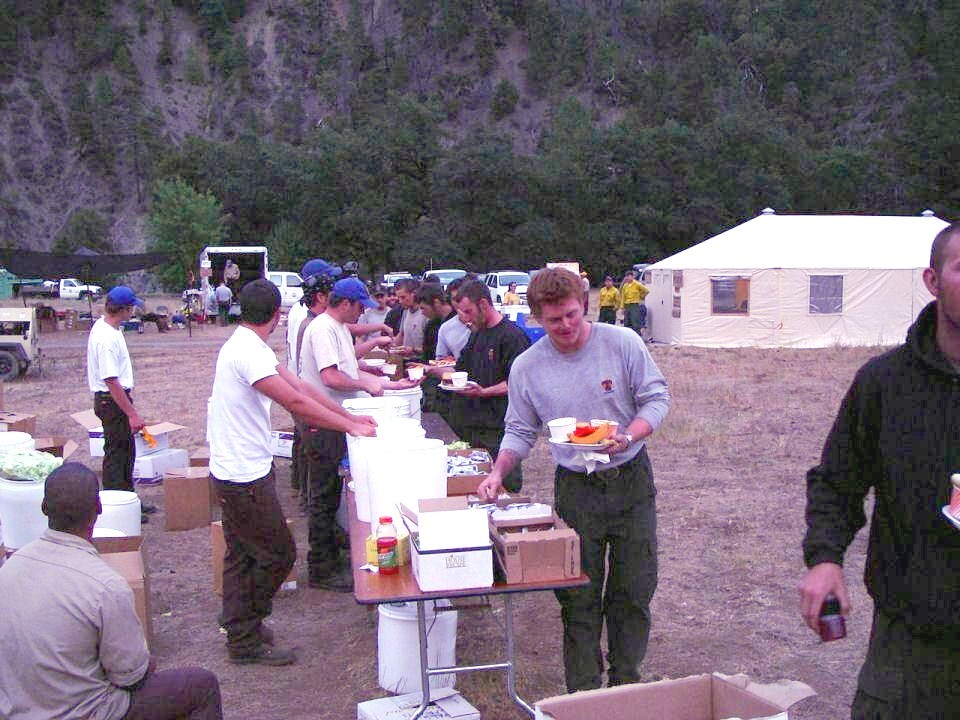
The job of feeding 1,640 firefighter and support personnel (called "overhead" in fire lingo) fell to Incident Catering Services, a mobile catering company from Snohomish, Washington. The Idaho Mountain Express reported on Wednesday, August 29, 2007:


The Food Unit, headed up by Danny Fox, sent 245 hot dinners out to firefighters on the line last night, via helicopter. They then served 1,280 meals at the camp, after dishing out 3,350 sandwiches at lunch.

"Today we served 13,000 lbs of food," explained Ray Keener, owner of Incident Catering Services of Seattle. "At breakfast we went through 500 lbs of eggs and 450 lbs of sausage."

Dinner tonight is lasagna, and the smell of tomatoes and garlic wafting from the kitchen in Upper River Run parking lot is a welcome respite from the constant charred smell of burning trees.

"You have to have a passion to feed people, take care of people," explained Keener, when asked how he manages his demanding role. "Or else you have to be nuts!"
Photo credit goes to Pat York and Gary Chase (second picture).

Friday, July 20, 2007

Fire Camp Kitchen 1966

I found these 40-year old photos of a wilderness fire camp on the Yellowstone National Park website. The camp is identified as the Buffalo Fire Camp. I couldn't locate any information on the fire.

This picture shows the cooking area and supply tent.

The camp crew wouldn't be able to cut poles for the tent and cooking tarp today, even if they've dead and down.

Three wood-burning stoves make up the main cooking units for the fire camp. These are either wilderness pack stoves or military surplus field ranges from the pre-World War I era. These stove were used by the U.S. Army up until the start of World War II.

Friday, June 08, 2007

Noon Meal at Greensburg

Emergency responders pick up sack lunches at the tornado base camp in Greensburg, Kansas. Two hot meals are typically served to emergency responders working forest fires and similar incidents. An enhanced sack lunch is passed out for the noon meal.

Under the 2007 national mobile food services contract, caterers are required to provide the following menu items in each sack lunch:
  • Meat sandwich or vegetarian substitute

  • A second entree, such as a pizza pocket or burrito

  • Fresh fruit or dried fruit package -- dried fruit can only be served once in three days

  • Packaged cookies, brownie or granola bar

  • Two canned fruit juices totaling 11 ounces

  • Packaged snack, such as candy, trail mix, fresh vegetables, pretzels, jerky, shelled nuts or dried/cured meats and cheeses

  • Appropriate condiments

  • Two paper napkins and pre-moistened towelettes
This is a pretty hefty meal that's been formulated for emergency response workers, like wildland firefighters, who exert large amounts of energy on the job. The contractors are required to serve variety, which can be difficult when you consider the limited supply of non-perishable items that can be placed in a sack lunch.

Typically the crews pick up there lunches from a central point after breakfast. Each responder carries his lunch in a day pack until released for lunch. Except for crews located a spike camp, breakfast and dinner are served from the catering trailer in camp.

Photo credit: Mike Ferris of the U.S. Forest Service.

Monday, May 21, 2007

Greensburg, Kansas Tornado Assistance Base Camp Facts

GREENSBURG, KAS. (May 21, 2007) -- The Boise Incident Management Team continues to manage a base camp in Greensburg, Kansas providing emergency responders with hot meals, temporary housing, laundry service, and hot showers. The Base Camp, located in Davis Park, was established on May 8 with help from the San Juan Hotshots from Durango, CO.

The Hotshots assisted the IMT with: removing numerous fallen trees and tornado debris blown into the park; setting up sleeping tents; and mitigating any identified safety hazards within and around the base camp facility. They were released earlier this week, but their efforts were invaluable in getting the Base Camp established. The Base Camp has become very popular with emergency responders, giving them a place to rest and break away from the hectic and stressful environment they are working in.

The Boise IMT will continue to operate the camp over the next few weeks and provide responders with quality logistical support to maintain health and strength to accomplish the response mission for the community and people of Greensburg, Kansas.

Photograph captions: Catering is provided by Incident Catering Service of Snohomish, Wash. To the left, Kansas National Guard is waiting in the chow line at base camp. (Photo credit: Mike Ferris of the U.S. Forest Service.)

CAMP FACTS AS OF MAY 21, 2007

  • Incident Management Team Personnel Includes (these personnel are running the base camp):
    Incident Commander
    Deputy Incident Commander
    Safety Officer
    Public Information Officer
    Planning Section Chief
    Logistics Section Chief (Base Camp Managers, Ground Support, Communications, Supply, Security, & Food Units)
    Finance Section Chief (Equip Time Recorder & Costs)
    2 Camp Crews (20 total)
  • Catering unit: 1 - Capacity to feed up to 1,200 people
  • Shower unit: 1 - Contains 18 shower stalls
  • Sleeping tents: 40 - Each sleeps up to 8 people
  • Housing provided: Sleeping average 269 responders from 36 agencies per night
  • Laundry service: Local laundry service provided daily
  • Meals provided: 15,737 - breakfasts, lunches and dinners
  • Cost to date: $936,000
Emergency responders washing up before dinner at Davis Park Base Camp.

Wednesday, October 04, 2006

Dinner at Tailholt Spike Camp

This spike camp dinner line was set up at a location called Tailholt in the Payette National Forest in Idaho last August. Most of the menu items are being served straight out of its original packaging. The Tailholt Fire was part of the larger South Fork Complex. The complex is a series of nine lightening fires that burned from August 8, 2006.

Photo credit: K. Seay.

Tuesday, October 03, 2006

Denny Spike Camp

Spike camps are often used by incident management teams to locate fire crews close to the fire line. A spike camp is a temporary facility with limited logistic resources. At a minimum, spike camps will have rudimentary dining facilities, with food being trucked or flown in from the incident base camp.

The meal is usually cooked in the mobile kitchen, which can be located 10 to 20 miles from the spike camp. Breakfast and the sack lunch are transported to the spike camp early in the morning. Dinner will be delivered in the evening as the crews are returning from the fire.

These photos are from the InciWeb.com website for the Bar Complex Wildland Fire, which is located in the Shasta-Trinity National Forest in Northern California.

Fire crews eat breakfast at Denny spike camp. Hot food is brought to the camp in the white 5-gallon buckets, or "hot cans." Meals served out of hot cans must be served within a four-hour window. The buckets aren't designed to hold hot or cold food for long periods of time.

Many menu items are purchased in pre-portioned packages. Since there is little refrigeration at a spike camp, leftover food must be consumed or discarded.

This meal line is reminiscent of meals my cooks delivered to Seabees working in the field during my 20 years in Naval Construction Force units. Although we don't use the term spike camp in the Seabees, the idea is the same.

Photo credit: Paul Slenkamp of the Alaska Division of Forestry.

Fire crews returning to the Denny spike camp in the evening after a day on the fire line. This camp is located in a large dry meadow.

Fire crews are often "spiked" in locations much closer to the fire line. It's more efficient to bring meals and supplies to the firefighters than to transport then from and to the base camp each morning and evening. Spike camps are often relocated every two or more days as the fire line changes.

Photo credit: Mike Johnson of the National Park Service.

Saturday, September 30, 2006

Steaks for Firefighters

This has been a slow year for fire kitchen pictures. Outside of the few mobile kitchen photos I posted earlier this summer, federal incident command information officers have focused on the fires and not on the camp and logistics mechanism behind each fire.

Often, incident photographers post a series of camp pictures on incident websites. This gives viewers a look at the large "overhead" structure that keeps the firefighters on the fireline.

In the photo, two cooks from Stewart's Figherfighter Food Catering of Redmond, Oregon grill steaks behind mobile kitchen unit SK-103B at the Burgdorf Fire in the summer of 2000.

According to the 2006 Mobile Food Service Contract, Stewart's three large kitchens are capable of feeding 1,800 diners per day each. The federal government paid Stewart's approximately $45 per firefighter fed per day. Each mobile kitchen consisted of a kitchen trailer, two refrigeration units, handwashing unit, water hauler, supply truck and bunkhouse.

The Burgdorf Fire burned more than 64,000 acres in Idaho's Payette National Forest July to September 2000. Soldiers from the 4th Infantry Division assisted the U.S. Forest Service to contain the wildfire.

Thursday, September 21, 2006

Wildfires and Backyard Cooking

What do these fires mean to outdoor cooks?

Plenty! Much of the Western United States is prone to wildfires. Fire restrictions crimp our collective cooking style, especially to those enjoy cooking over hot coals.

By July each year, campfires and charcoal fires have been banned in most national forests and other public lands. Cooking fuels is limited to gasoline and propane stoves, except in established campgrounds.

And although I haven’t seen any backyard restrictions against using charcoal fires, the weather of late summer does present a serious concern to the outdoor cook. Fire conditions prompt local fire officials to ban dooryard burning by mid-June each year. These restrictions are not usually lifted until the first rain of late fall.

Dooryard, or the burning of yard waste, restrictions don’t stop or limit outdoor charcoal cooking per se. But they do encourage the outdoor cook to carefully consider the ramifications of torching the neighbor’s house. (Steve’s version of Murphy’s Laws says that the neighbors will always burn first!)

I personally reconsider the use of charcoal during hot, dry windy conditions. Any use of charcoal that spits and sputters is out. Lump mesquite is especially hazardous because it showers sparks -- sparks that ignite fires.

Here are my personal guidelines for late-summer outdoor cooking:

  • Don’t burn charcoal or firewood when hot, dry windy conditions exist. These conditions are akin to the Santa Ana of Southern California. Restrict your outdoor cooking to gas or cook indoors.
  • Keep a charged hose with a spray nozzle nearby when you’re burning a charcoal fire. Ready access to water is essential to quickly drown escaping embers.
  • Put the coals out -- dead out -- after you’re done cooking. It’s best to drown the coals in an iron bucket of water.
  • Use your head. Don’t cook with fire in extreme conditions. Consult the local fire department if you’re in doubt.

Thursday, July 13, 2006

Inmate-operated Mobile Kitchen

As a former employee of a large state institution, I’ve always been impressed by inmate-operated mobile kitchen units for the California Department of Forestry and Fire Protection. I’m not alone. Here’s a quote from Meredith Spangler, a dispatcher on the Stephens Fire, near Colfax, California, in August 2004:

At 1900 hours, I reported in for my shift. My partner and I took turns eating from the Mobile Kitchen. The food was very, very good and I ate more than I should have, despite my original reluctance to eat food prepared by convicts (I am primarily a police dispatcher, after all).
Although I can’t say with any accuracy, the kitchen that served the Stephens Fire may have been Mobile Kitchen Unit-45 from the Growlersburg Conservation Camp in Georgetown, California. The Growlersburg MKU was the closest to the fire and, as such, would’ve responded quickly.

Tuesday, July 11, 2006

Fire Camp Kitchen at Warm Incident

Mealtime at the incident command post for the Warm Fire in the Kaibab Nation Forest in Arizona. The kitchen for this fire was operated by Trails End Catering of Kanab, Utah. The Warm Fire was declared 100 percent contained on July 4, 2006. The fire burned approximately 58,630 acres in 27 days. It took took 419 personnel to contain the fire at its peak.

Many mobile kitchen units use these Cambro table-top food bars to serve salads and dessert items. They are available in four-, five- and six-foot lengths and list for $940 to $1,140. The four-, five- and six-foot models hold three, four and five full-sized hotels pans respectively. Cambro literature says: "It is lightweight, easy to handle, extremely durable and affordable. The thick foam ice well holds ice for hours to keep your food presentation looking and tasting fresh. A drain plug is also included to make clean-up quick and easy. This Table Top Model comes complete with a sneeze guard that attaches securely to the Food Bar body. The sneeze guard is double-sided to accomodate serving from both sides of the bar. End panels shield food for even greater food protection."