
David passed this recipe on in the wake of Hurricane Katrina in September 2005. Please remember that references to hurricane relief are dated and no longer valid.
As announced in the IDOS Forums, Dave Herzog has accepted a challenge to bake 900 biscuits in a 22-inch MACA Dutch oven. And what’s a biscuit without gravy? Dave’s recipe for six gallons of gravy is posted below. You have to watch Dave in action at the Iron Chef Challenge for Hurricane Victims to learn his biscuit secret.
SAUSAGE GRAVY FOR A 22-INCHER
The recipe for Emeril’s essence is available on Emerils.com.
5 pounds breakfast sausage
5 pounds bacon, diced
2 pounds yellow onions, diced
3/4 cup minced garlic or 1/4 cup granulated garlic
2 tablespoons red pepper flakes
2 tablespoons black pepper
3 tablespoons kosher salt
2 tablespoons Emeril’s essence
5 cups all purpose flour
4 pounds unsalted butter
5-6 gallons whole milk, cool, not fridge cold.
Preheat a MACA 22-inch Dutch oven with about 35 coals underneath. Add the sausage and bacon together and brown until bacon is golden. Stir in onions, garlic, red and black pepper, salt and essence. Sauté until onions just turn opaque.
Add butter. When melted, stir in flour and cook for about 5 minutes, until flour turns light brown. Add milk, 1 gallon at a time, allowing gravy to thicken, up to 5 gallons. If gravy is too thick, add additional milk a little at a time to thin.
Serve over anything you want! Serves 200 to 250, depending on serving size.
Showing posts with label sausage gravy. Show all posts
Showing posts with label sausage gravy. Show all posts
Thursday, October 23, 2014


Saturday, August 24, 2013
Chef Steven's rules for sausage gravy
After four decades of cooking in military, institutional and camp kitchens, I've learned to follow a number of personal cooking rules. As self-imposed culinary guidelines, they help me prepare and serve great food to my diners, whether at home or in camp. These rules provide consistency each time I prepare a dish.
Earlier this summer, the camp director asked my if I could prepare a "mean" biscuits and gravy. Up to the challenge, we set a date where I could premier biscuits and gravy. I took my standard biscuits and gravy recipe, modified it to use a butter and flour roux (previously, I stirred the flour in with the crumbled sausage meat) and presented camp-made biscuits with my chef's sausage gravy to the staff in mid-May.
Beginning in the third week of June, we presented scratch buttermilk biscuits and rich sausage gravy to the campers every other week. By request, I broke my "pork only" rule to prepare turkey sausage gravy for our largest camp (alongside pork sausage gravy) at the end of July. I came away validating my rule. Campers selected pork gravy three times as often as they did turkey gravy! (The same held true for real bacon vs. turkey bacon!)
Here are my rules for great sausage gravy:
Earlier this summer, the camp director asked my if I could prepare a "mean" biscuits and gravy. Up to the challenge, we set a date where I could premier biscuits and gravy. I took my standard biscuits and gravy recipe, modified it to use a butter and flour roux (previously, I stirred the flour in with the crumbled sausage meat) and presented camp-made biscuits with my chef's sausage gravy to the staff in mid-May.
Beginning in the third week of June, we presented scratch buttermilk biscuits and rich sausage gravy to the campers every other week. By request, I broke my "pork only" rule to prepare turkey sausage gravy for our largest camp (alongside pork sausage gravy) at the end of July. I came away validating my rule. Campers selected pork gravy three times as often as they did turkey gravy! (The same held true for real bacon vs. turkey bacon!)
Here are my rules for great sausage gravy:
- Crumble, finely chop or grind the sausage. Diced sausage may look good on the plate. But it's the fine pieces that carry flavor into the gravy. Throughout the summer, I used pre-cooked patties with success. Grinding partially thawed patties in the food processor gave it the texture I was looking for.
- Don't skip on the milk. The fat in whole milk adds body and richness to the gravy. If you must, drink two percent or skim milk in a glass, not in the gravy. Whole milk works best. And a little cream makes even richer gravy! Unfortunately to some, good gravy isn't low in fat!
- A butter roux is the best thickening agent for gravy. Leave the cornstarch to pudding cookery, where its magic sheen works best. And don't forget to cook out the flour taste in the roux.
- Traditional American breakfast sausage works best for traditional American biscuits and gravy. Use pork sausage, not beef. SOS is made with beef, not pork. Though related, they're not the same.
- Think long and hard before adding a new ingredient or two the gravy. I've successfully worked a modest amount of roasted diced red peppers into my gravy. Leave the mushrooms for a great mushroom sauce or pasta dish. They don't belong in sausage gravy.
- The best biscuits are made from scratch. Develop a good recipe and stick to it.
Saturday, December 24, 2011
Buttermilk biscuits and sausage gravy for a crowd
 Nothing says breakfast more than a tall buttermilk biscuit smothered in sausage gravy. It seems every breakfast joint serves its own version of the classic American breakfast dish. Bert's Cafe, located an hours drive from home in South Lake Tahoe, serves the best sausage gravy in El Dorado County.
I often judge a restaurant by its biscuits and gravy. Any joint that serves frozen biscuits and packaged gravy doesn't deserve a repeat visit. I'll reward any place that takes the time to mix scratch biscuits and crumble real sausage into milk gravy with repeat business. There's nothing like the genuine product.
Since I rarely cook breakfast at work, I've wanted to perfect my sausage gravy for some time. I mastered buttermilk biscuits years ago. A rich sausage flavor is a must in my gravy. And the gravy should be thick, full bodied and void of any flour aftertaste. I insist on whole milk, a roux cooked into the sausage and the right mix of onions, Worcestershire sauce and seasonings.
Last week's Christmas breakfast potluck for employees gave me the right opportunity to test my newest version of biscuits and gravy. I modeled the gravy after the dish I ate in South Lake Tahoe the summer before last. The chef worked roasted red peppers into the sauce. It was the best tasting sausage gravies that I've had.
BISCUITS AND SAUSAGE GRAVY FOR A CROWD
This recipe will serve 25 heafty portions or 50 more modest portions. You can use your favorite biscuit recipe if desired. Don't skimp on the milk. While lowfat or nonfat milk may shave a few calories off the finish product, you loose the richness provided by the extra fat in the milk.
BUTTERMILK BISCUITS:
2 pounds all-purpose flour (baker's percent: 50%)
2 pounds pastry flour (50%)
3 ounces granulated sugar (5%)
1-1/4 ounces table salt (2%)
3-1/4 ounces baking powder (5%)
1/2 ounce baking soda (1%)
1/2 teaspoon cream of tartar
1-3/8 pounds shortening (35%)
2-5/8 pounds buttermilk (65%)
SAUSAGE GRAVY:
12 ounces pork sausage
12 ounces spicy pork sausage
1 cup minced onion
3/4 cup minced red bell pepper
12 ounces all-purpose flour
1 gallon whole milk
2 tablespoons Worcestershire sauce
2 teaspoons kosher salt
2 teaspoons beef base (optional)
1/2 teaspoon ground black pepper
FOR BUTTERMILK BISCUITS: Combine flour, baking powder, sugar, salt and baking soda in mixer bowl. Mix on low speed until blended, approximately 10 seconds, using flat beater. Add shortening to flour mixture. Mix on low speed for 1 minute. Stop and scrape sides and bottom of bowl. Mix 1 minute longer. The mixture will be crumbly. Add buttermilk. Mix on low speed to form a soft dough, about 30 seconds. Do not over mix. Dough should be as soft as can be handled.
Place dough on lightly floured board or table. Knead lightly 15-20 times. Roll to 3/4-inch thickness. Biscuits will approximately double in height during baking. Cut with a 2-inch cutter, or cut into 2- inch squares with a knife. When using round hand cutters, cut straight down and do not twist to produce the best shape. Space the cuts close together to minimize scraps. Use of a roller cutter or cutting the dough into squares eliminates or reduces scraps. The scraps can be rerolled, but the biscuits may not be as tender.
Place on ungreased baking sheets 1/2-inch apart for crusty biscuits, just touching for softer biscuits. Repeat, using remaining dough. Bake at 425°F for 15 minutes, or until golden brown. Biscuits may be held 2-3 hours in the refrigerator until time to bake.
FOR SAUSAGE BRAVY: In a 8- to 10-quart stockpot or braiser, add sausage and cook until browned and cooked through. Drain grease and add onion and red pepper to sausage. Continue cooking until onion softens.
Add flour and cook over medium-high heat until the sausage is well-coated with the flour. Add milk and Worcestershire sauce and stir until desired thickness. Season with salt, beef base (if used) and pepper, to taste.
The recipe prepares 50 (2-inch) biscuits and 5 quarts of gravy. Serve 3 ounces gravy over each split biscuit.
Monday, May 31, 2010
Breakfast menu
Two months ago the program director at work asked me to write a breakfast menu for the residents. She wanted to give the residents a chance to cook a hot, home-style breakfast each Sunday.
Residents currently eat a self-prepared breakfast each day. Menu offerings include fresh fruit (mostly apples, oranges and bananas); an assortment of three to four dry cereals, toaster-ready frozen waffles, French toast and pancakes; toast, English muffins and bagels; and a selection of condiments plus standard beverages.
Most residents quickly fall into a breakfast rut once they enter the program. Since the facility doesn't have the budget or staff to serve a traditional breakfast each morning, the menu will give them a chance to break the monotony one day each week.
This menu doesn't address the monotony of the current continental breakfast. Once the menu menu is put into use in a month or two, I'll have to evaluate the products I purchase for breakfast.
Ultimately, I'll only use four breakfasts since the program uses a four-week cycle menu. The remaining two meals will be reserved as alternative breakfasts.
BREAKFAST BURRITO
Scrambled eggs, shredded cheese & beef chorizo rolled in flour tortilla
Home fried potatoes, fresh salsa & fresh fruit in season
BAKED FRITTATA
Baked frittata (or omelet) with whipped eggs, hash brown potatoes & sweet bell peppers topped with shredded cheese
Sliced cantaloupe or honeydew melon
GRANOLA PANCAKES
One or two hearty pancakes with granola in the batter
Fresh fruit in season, hot syrup & melted margarine served on the side
HOME-STYLE EGGS & POTATOES
Two eggs to order, hash brown potatoes & bacon, ham or sausage
Whole wheat toast with strawberry jam
HAM & EGG MUFFIN SANDWICH
English muffin sandwich with egg patty, ham slice & American cheese
Blueberry muffin with jam & honey plus fresh fruit in season
COUNTRY BREAKFAST
Scrambled eggs with home fried potatoes
Country (turkey) sausage gravy served over biscuits
Fresh fruit in season
Residents currently eat a self-prepared breakfast each day. Menu offerings include fresh fruit (mostly apples, oranges and bananas); an assortment of three to four dry cereals, toaster-ready frozen waffles, French toast and pancakes; toast, English muffins and bagels; and a selection of condiments plus standard beverages.
Most residents quickly fall into a breakfast rut once they enter the program. Since the facility doesn't have the budget or staff to serve a traditional breakfast each morning, the menu will give them a chance to break the monotony one day each week.
This menu doesn't address the monotony of the current continental breakfast. Once the menu menu is put into use in a month or two, I'll have to evaluate the products I purchase for breakfast.
Ultimately, I'll only use four breakfasts since the program uses a four-week cycle menu. The remaining two meals will be reserved as alternative breakfasts.
BREAKFAST BURRITO
Scrambled eggs, shredded cheese & beef chorizo rolled in flour tortilla
Home fried potatoes, fresh salsa & fresh fruit in season
BAKED FRITTATA
Baked frittata (or omelet) with whipped eggs, hash brown potatoes & sweet bell peppers topped with shredded cheese
Sliced cantaloupe or honeydew melon
GRANOLA PANCAKES
One or two hearty pancakes with granola in the batter
Fresh fruit in season, hot syrup & melted margarine served on the side
HOME-STYLE EGGS & POTATOES
Two eggs to order, hash brown potatoes & bacon, ham or sausage
Whole wheat toast with strawberry jam
HAM & EGG MUFFIN SANDWICH
English muffin sandwich with egg patty, ham slice & American cheese
Blueberry muffin with jam & honey plus fresh fruit in season
COUNTRY BREAKFAST
Scrambled eggs with home fried potatoes
Country (turkey) sausage gravy served over biscuits
Fresh fruit in season
Thursday, November 06, 2008
Navy minced beef
I received this email from a disabled Navy veteran the other day:
According to retired chief commissarymam Tom Selland, his ship only served chipped beef one time each year.
"The crew went up in arms," said Selland. Minced beef on toast was the SOS of choice for sailors.
"Minced beef was highly acceptable," said Selland. "They liked it a lot better than spinach quiche."
As you may guess, Selland said this with a smile on his face. To paraphrase a popular cliche from the 1970s: Real sailors didn't eat quiche in those days.
Minced beef is uniquely Navy. It was found in every Navy cookbook until the inception of the Armed Forces Recipe Service in 1969. In fact, the recipe for creamed beef doesn't appear in any Navy cookbook between 1940 and 1962.
Minced beef is prepared by adding ground beef to a tomato sauce, according to Selland. It’s cooked much like Army cooks prepared creamed beef. But it’s the of mace or nutmeg that made minced beef unique.
According the Navy’s 1962 recipe, the commissaryman braised ground beef and chopped onions in a copper -- that’s what commissarymen have called steam-jacketed kettles since the day’s of sail.
He then added flour to the meat and cooked the mixture until it browned. (Commissarymen stirred the meat mixture with large flat paddles called copper paddles.) He finished the dish by adding water, nutmeg or mace, salt and ground black pepper.
Like chipped beef or creamed beef, minced beef was served over toast points.
Selland learned to cook minced beef on his first ship, the USS Polaris (AF 11), as a seaman and commissaryman third class. He said that the chief commissaryman on the Polaris -- he couldn't remember his name -- taught the cooks to thicken the tomato sauce for the minced beef with cornstarch.
Instead of adding flour to the beef as it braised in the copper, the commissarymen on the Polaris added tomatoes, water, nutmeg or mace, salt and pepper to the copper. They thickened it with a cornstarch slurry. Selland continued to use this recipe throughout his career.
NAVY MINCED BEEF
I scaled Armed Forces Recipe Service recipe No. 36 from 100 portions down to 5. It's the recipe I used on the USS Cocopa and USS Stein in the late 1970s.
On board ship, we would cooked the beef in a steam-jacketed kettle with the drain open. The fat drained off as we stirred the meat and onions. Cook beef with onions in its own fat until beef loses its pink color, stirring to break apart. Drain or skim off excess fat.
1-1/2 pounds ground beef
1/2 cup chopped onions
6 tablespoons all-purpose flour
1 (15-ounce) can tomatoes, crushed
1/2 teaspoon ground mace (or ground nutmeg)
1/3 to 1/2 teaspoon salt
1/4 teaspoon ground black pepper
6 tablespoons water
Braise beef in its own fat with onions. Sprinkle flour over beef and continue cooking until flour is absorbed. Add tomatoes, spices and water. Stir to mix well. Simmer 10 to 15 minutes. Makes 5 (1-cup) or 10 (1/2-cup) portions.
I would like the recipe for mince beef on toast for a family of 4. I loved that when I was in the Navy. I am now a disabled vet.Before I print my scaled-down recipe, here's a bit of history on Navy minced beef. I last wrote on the topic two and one-half years ago here.
Thank you,
Billy G. Reeder
According to retired chief commissarymam Tom Selland, his ship only served chipped beef one time each year.
"The crew went up in arms," said Selland. Minced beef on toast was the SOS of choice for sailors.
"Minced beef was highly acceptable," said Selland. "They liked it a lot better than spinach quiche."
As you may guess, Selland said this with a smile on his face. To paraphrase a popular cliche from the 1970s: Real sailors didn't eat quiche in those days.
Minced beef is uniquely Navy. It was found in every Navy cookbook until the inception of the Armed Forces Recipe Service in 1969. In fact, the recipe for creamed beef doesn't appear in any Navy cookbook between 1940 and 1962.
Minced beef is prepared by adding ground beef to a tomato sauce, according to Selland. It’s cooked much like Army cooks prepared creamed beef. But it’s the of mace or nutmeg that made minced beef unique.
According the Navy’s 1962 recipe, the commissaryman braised ground beef and chopped onions in a copper -- that’s what commissarymen have called steam-jacketed kettles since the day’s of sail.
He then added flour to the meat and cooked the mixture until it browned. (Commissarymen stirred the meat mixture with large flat paddles called copper paddles.) He finished the dish by adding water, nutmeg or mace, salt and ground black pepper.
Like chipped beef or creamed beef, minced beef was served over toast points.
Selland learned to cook minced beef on his first ship, the USS Polaris (AF 11), as a seaman and commissaryman third class. He said that the chief commissaryman on the Polaris -- he couldn't remember his name -- taught the cooks to thicken the tomato sauce for the minced beef with cornstarch.
Instead of adding flour to the beef as it braised in the copper, the commissarymen on the Polaris added tomatoes, water, nutmeg or mace, salt and pepper to the copper. They thickened it with a cornstarch slurry. Selland continued to use this recipe throughout his career.
NAVY MINCED BEEF
I scaled Armed Forces Recipe Service recipe No. 36 from 100 portions down to 5. It's the recipe I used on the USS Cocopa and USS Stein in the late 1970s.
On board ship, we would cooked the beef in a steam-jacketed kettle with the drain open. The fat drained off as we stirred the meat and onions. Cook beef with onions in its own fat until beef loses its pink color, stirring to break apart. Drain or skim off excess fat.
1-1/2 pounds ground beef
1/2 cup chopped onions
6 tablespoons all-purpose flour
1 (15-ounce) can tomatoes, crushed
1/2 teaspoon ground mace (or ground nutmeg)
1/3 to 1/2 teaspoon salt
1/4 teaspoon ground black pepper
6 tablespoons water
Braise beef in its own fat with onions. Sprinkle flour over beef and continue cooking until flour is absorbed. Add tomatoes, spices and water. Stir to mix well. Simmer 10 to 15 minutes. Makes 5 (1-cup) or 10 (1/2-cup) portions.
Saturday, March 24, 2007
Sausage Gravy on Biscuits
I found another sausage gravy recipe this afternoon while cleaning for company. I copied it from Cooking from Quilt Country: Hearty Recipes from Amish and Mennonite Kitchens by Marcia Adams (Clarkson Potter, 1988, 224 pages).
I thought a family-sized recipe would nicely round out the collection here at 'Round the Chuckbox. Except for Frank's gravy, most recipes have been for quantity cooking. Other sausage gravy recipes on 'Round the Chuckbox:
Frank's Hearty Skillet Breakfast 2005 -- and 2006
Dave's Scratch Country Gravy -- makes 3 to 4 gallons
Independence Day Country Breakfast -- feeding 160 at summer camp
Navy Creamed Beef -- 100 portions of SOS
SAUSAGE GRAVY ON BISCUITS
A sweet, herbal aroma will waft from Adam's country gravy as it simmers. Omit nutmeg and poultry seasoning for a traditional savory gravy. Or try ground coriander in their place. Double the flour for thick gravy.
I pound sage-flavored bulk sausage, as lean as possible
2 tablespoons finely minced onion
6 tablespoons all-purpose flour
1 quart milk
1/4 teaspoon grated nutmeg, rounded
1/4 teaspoon poultry seasoning, rounded
Dash of Worcestershire sauce
Dash of Tabasco
18 large baking powder biscuits
Crumble sausage into a large cast iron skillet and saute over medium-high heat, breaking the meat into small pieces as it cooks. Don't brown or crisp. When the meat is about three-quarters done, add onion and cook until the onion is transparent.
Drain all but 2 tablespoons of the meat drippings. Stir in flour and cook over medium-low heat for 6 or 7 minutes, or until flour turns golden and bubbles up. Pour in the milk at once and add seasonings. Cook and stir until mixture thickens. Check seasoning.
Place at least 3 biscuits halves on each plate and top with sausage gravy. Makes about 1-1/2 quarts gravy. Serves 6 to 12.
I thought a family-sized recipe would nicely round out the collection here at 'Round the Chuckbox. Except for Frank's gravy, most recipes have been for quantity cooking. Other sausage gravy recipes on 'Round the Chuckbox:
Frank's Hearty Skillet Breakfast 2005 -- and 2006
Dave's Scratch Country Gravy -- makes 3 to 4 gallons
Independence Day Country Breakfast -- feeding 160 at summer camp
Navy Creamed Beef -- 100 portions of SOS
SAUSAGE GRAVY ON BISCUITS
A sweet, herbal aroma will waft from Adam's country gravy as it simmers. Omit nutmeg and poultry seasoning for a traditional savory gravy. Or try ground coriander in their place. Double the flour for thick gravy.
I pound sage-flavored bulk sausage, as lean as possible
2 tablespoons finely minced onion
6 tablespoons all-purpose flour
1 quart milk
1/4 teaspoon grated nutmeg, rounded
1/4 teaspoon poultry seasoning, rounded
Dash of Worcestershire sauce
Dash of Tabasco
18 large baking powder biscuits
Crumble sausage into a large cast iron skillet and saute over medium-high heat, breaking the meat into small pieces as it cooks. Don't brown or crisp. When the meat is about three-quarters done, add onion and cook until the onion is transparent.
Drain all but 2 tablespoons of the meat drippings. Stir in flour and cook over medium-low heat for 6 or 7 minutes, or until flour turns golden and bubbles up. Pour in the milk at once and add seasonings. Cook and stir until mixture thickens. Check seasoning.
Place at least 3 biscuits halves on each plate and top with sausage gravy. Makes about 1-1/2 quarts gravy. Serves 6 to 12.
Sunday, April 30, 2006
SOS
I received this email from J P Maher the other day. He writes about SOS, or creamed beef. SOS is the dish that most servicemen either loved or hated. Few straddled the fence on this one.
My favorite? Creamed ground beef. I still eat it's country kin: sausage gravy with biscuits when I get a chance. Creamed chipped beef was too salty, even after rinsing the salt away. Minced beef is just plain horrible any way you fix it!
We served creamed ground beef each morning during my last large field exercise with NMCB-17 in 1994 at Fort Hunter Liggett, California.
Official 1969 Armed Forces recipe for Creamed Ground Beef
1969 Armed Forces Recipe Service Card no. L-30
Yield: 100 portions
Portion: 1 cup
24 pounds ground beef
2 pounds all-purpose flour
1 tablespoon black pepper
6 tablespoons salt
4 ounces beef soup and gravy base
3-1/2 gallons warm milk
2 tablespoons Worcestershire sauce
Brown beef in its own fat in steam-jacketed kettle or roasting pan. Drain excess fat. Add flour, pepper, salt, and soup and gravy base to beef. Mix thoroughly and cook about 5 minutes until flour is absorbed. Add warm milk to beef mixture. Add Worcestershire sauce; heat to a simmer, stirring frequently. Cook until thickened.
My brothers, brothers-in-law and I logged a total of nearly forty years in the military. My hitch of 3 years, 9 months and 6 days was in the Cold War, the others in WWII and Korean War era. I'm a translator, culture historian and etymologist. We know whereof we speak.Thanks for the information, J.P. From my recollection as a 29-year veteran of Navy and Seabee galleys -- both active service and reserve duty -- SOS had a generic definition. Any of the dishes, creamed ground beef, creamed chipped beef and minced beef for instance, were collectively called SOS by sailors.
SOS ("stuff" on a shingle) was NOT Creamed CHIPPED Beef, but Creamed GROUND Beef. Quite gloppy. Some troops loved it. I tried it once and swore off. This is not to say that some troopers learned it another way, but here's the authentic scoop.
Creamed CHIPPED Beef was one of my favorite dishes, whether in the mess Hall or my mother's kitchen.
It was the greyish ground beef recipe that we called "'stuff' on a shingle/SOS."
J.P. Maher, Ph D, E-5RA
(Regular Army)
Professor Emeritus
My favorite? Creamed ground beef. I still eat it's country kin: sausage gravy with biscuits when I get a chance. Creamed chipped beef was too salty, even after rinsing the salt away. Minced beef is just plain horrible any way you fix it!
We served creamed ground beef each morning during my last large field exercise with NMCB-17 in 1994 at Fort Hunter Liggett, California.
Official 1969 Armed Forces recipe for Creamed Ground Beef
1969 Armed Forces Recipe Service Card no. L-30
Yield: 100 portions
Portion: 1 cup
24 pounds ground beef
2 pounds all-purpose flour
1 tablespoon black pepper
6 tablespoons salt
4 ounces beef soup and gravy base
3-1/2 gallons warm milk
2 tablespoons Worcestershire sauce
Brown beef in its own fat in steam-jacketed kettle or roasting pan. Drain excess fat. Add flour, pepper, salt, and soup and gravy base to beef. Mix thoroughly and cook about 5 minutes until flour is absorbed. Add warm milk to beef mixture. Add Worcestershire sauce; heat to a simmer, stirring frequently. Cook until thickened.
Monday, January 16, 2006
Frank's Hearty Skillet Breakfast Revisited
Many will remember two blogs on Frank's Hearty Skillet Breakfast (here and here). On an overnight camping trip last August to Wench Creek in Eldorado National Forest, Frank cooked a breakfast of bacon, sausage, fried potatoes, gravy and scrambled eggs in to large cast iron skillets.
For some, the troublesome element of this breakfast was its economical use of bacon and sausage grease. Not one drop of the rendered fat was lost to the fire or garbage.
Frank's breakfast is hearty is an epicurean contradiction -- good tasting and not-so-good for you, all in one setting.
My family recently learned that Frank is moving his family and his construction skills to Idaho, where he is going to manage a division for a large contractor.
So last weekend, we took one last camping trip, this time to Sly Park. Campers were few and the fee was reasonable at $10 per night. Winter camping is more primitive than summer camping at Sly Park. They shut the water system off in winter to prevent the pipes from bursting. Sly Park doesn't have electrical hookups.
Frank repeated his breakfast production, this time without the scrambled eggs. This time I snapped several photographs of the breakfast. Here they are:
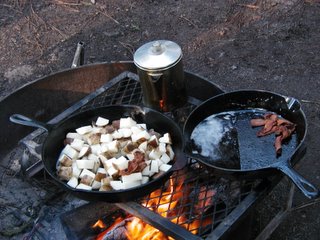 Two cast iron skillets with cottage fried potatoes on the left and bacon grease on the right.
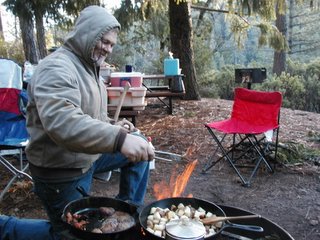 Contractor, turned breakfast cook.
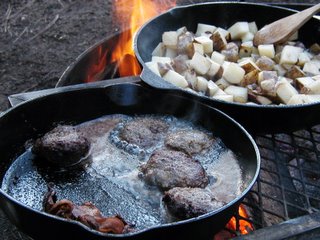 Sausage patties deep fried in bacon grease.
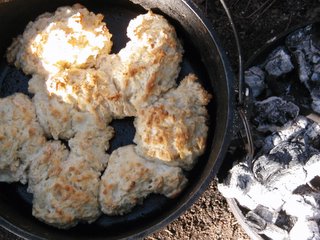 Gravy just isn't gravy without biscuits.
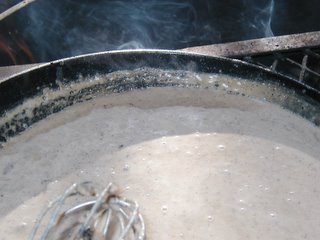 Breakfast gravy simmers over the campfire.
For some, the troublesome element of this breakfast was its economical use of bacon and sausage grease. Not one drop of the rendered fat was lost to the fire or garbage.
Frank's breakfast is hearty is an epicurean contradiction -- good tasting and not-so-good for you, all in one setting.
My family recently learned that Frank is moving his family and his construction skills to Idaho, where he is going to manage a division for a large contractor.
So last weekend, we took one last camping trip, this time to Sly Park. Campers were few and the fee was reasonable at $10 per night. Winter camping is more primitive than summer camping at Sly Park. They shut the water system off in winter to prevent the pipes from bursting. Sly Park doesn't have electrical hookups.
Frank repeated his breakfast production, this time without the scrambled eggs. This time I snapped several photographs of the breakfast. Here they are:
 Two cast iron skillets with cottage fried potatoes on the left and bacon grease on the right.
 Contractor, turned breakfast cook.
 Sausage patties deep fried in bacon grease.
 Gravy just isn't gravy without biscuits.
 Breakfast gravy simmers over the campfire.
 Tuesday, September 20, 2005
Lots of Sausage Gravy
As announced in the IDOS Forums, Dave Herzog has accepted a challenge to bake 900 biscuits in a 22-inch MACA Dutch oven. And what’s a biscuit without gravy? Dave’s recipe for six gallons of gravy is posted below. You have to watch Dave in action at the Iron Chef Challenge for Hurricane Victims to learn his biscuit secret.
SAUSAGE GRAVY FOR A 22-INCHER
The recipe for Emeril’s essence is available on Emerils.com.
5 pounds breakfast sausage
5 pounds bacon, diced
2 pounds yellow onions, diced
3/4 cup minced garlic or 1/4 cup granulated garlic
2 tablespoons red pepper flakes
2 tablespoons black pepper
3 tablespoons kosher salt
2 tablespoons Emeril’s essence
5 cups all purpose flour
4 pounds unsalted butter
5-6 gallons whole milk, cool, not fridge cold.
Preheat a MACA 22-inch Dutch oven with about 35 coals underneath. Add the sausage and bacon together and brown until bacon is golden. Stir in onions, garlic, red and black pepper, salt and essence. Sauté until onions just turn opaque.
Add butter. When melted, stir in flour and cook for about 5 minutes, until flour turns light brown. Add milk, 1 gallon at a time, allowing gravy to thicken, up to 5 gallons. If gravy is too thick, add additional milk a little at a time to thin.
Serve over anything you want! Serves 200 to 250, depending on serving size.
SAUSAGE GRAVY FOR A 22-INCHER
The recipe for Emeril’s essence is available on Emerils.com.
5 pounds breakfast sausage
5 pounds bacon, diced
2 pounds yellow onions, diced
3/4 cup minced garlic or 1/4 cup granulated garlic
2 tablespoons red pepper flakes
2 tablespoons black pepper
3 tablespoons kosher salt
2 tablespoons Emeril’s essence
5 cups all purpose flour
4 pounds unsalted butter
5-6 gallons whole milk, cool, not fridge cold.
Preheat a MACA 22-inch Dutch oven with about 35 coals underneath. Add the sausage and bacon together and brown until bacon is golden. Stir in onions, garlic, red and black pepper, salt and essence. Sauté until onions just turn opaque.
Add butter. When melted, stir in flour and cook for about 5 minutes, until flour turns light brown. Add milk, 1 gallon at a time, allowing gravy to thicken, up to 5 gallons. If gravy is too thick, add additional milk a little at a time to thin.
Serve over anything you want! Serves 200 to 250, depending on serving size.
Tuesday, August 23, 2005
Frank's Hearty Skillet Breakfast
Build a roaring cookfire. I follow two rules: First, build a fire that’s twice to three times the size that you think you need. In pine and cedar country it’s easy to underestimate the amount of wood.
The second rule is equally important. Keep the fire going and avoid the tendency to let it burn out once you start cooking. Otherwise Murphy’s Law steps in and kills any further plans for breakfast.
Use this time to dice the potatoes, crack and whisk the eggs and form sausage patties. The fire will take 30 to 45 minutes to burn down to a nice bed of coals. Don’t forget to add fresh wood as the fire burns.
With the fire ready, it’s time to cook breakfast. I said yesterday that Frank cooks each course in succession. The bacon goes into the first pre-heated skillet.
Push the bacon aside if you’re using a large skillet (14 inches or larger) and add sausage patties to the skillet. You may want to cook the bacon and sausage in batches if you’re using a smaller skillet. Once browned to the desire color, the move the meat waiting plate covered with a double layer of paper towel. (I’m not sure why the paper towels are necessary—you’re going consume enough grease to worry your cardiologist!)
Don’t discard any of the rendered bacon fat. Frank divides it between three dishes (health warnings aside). The potatoes, eggs and gravy all receive generous portions of the swine nectar.
A pot-full of diced potatoes are next poured into the meat skillet. Watch for splattering grease! Crumble a few bacon strips and sausage patties into the potatoes if desired.
Fifteen to 20 minutes over a hot fire will crisp the potatoes to a nice golden color. Move the skillet to a cooler spot over the fire. Stir the potatoes occasionally to keep them from burning.
At this point, turn your attention to the scrambled eggs. It’s important to pre-heat the egg skillet over a medium fire. Otherwise, you’ll burn the eggs and ruin breakfast.
Slow cooking is best for the eggs. Stick around once you pour the whipped eggs into the skillet. They require constant stirring until cooked. Frank never left the fire until the eggs were cooked.
The secret to moist scrambled eggs is to cook them over low heat. Remove the eggs when they’re still moisture seeping out. Remember, overcooked eggs in the skillet become overcooked eggs on the plate.
Place the eggs into a waiting bowl, cover with a sheet of foil and wipe the skillet clean. The pour the remaining bacon fat into the skillet and return it to medium heat. Next place enough flour into the skillet to absorb the fat. (You’ll have to judge quantities for yourself.)
Stir the roux for a few minutes over a low flame, being careful not to brown it. The last step before breakfast is to pour three or four cups of milk into the gravy skillet. Stir constantly for about 10 minutes to work the lumps out. Once the gravy thickens, you’re ready to eat.
Give the potatoes a quick stir just before serving. Warm potatoes, eggs and gravy are a must. And pour gravy over the potatoes and eggs. After all, gravy is the culinary elixir that brings the whole meal together.
The second rule is equally important. Keep the fire going and avoid the tendency to let it burn out once you start cooking. Otherwise Murphy’s Law steps in and kills any further plans for breakfast.
 |
| "I love the smell of bacon in the morning." |
With the fire ready, it’s time to cook breakfast. I said yesterday that Frank cooks each course in succession. The bacon goes into the first pre-heated skillet.
Push the bacon aside if you’re using a large skillet (14 inches or larger) and add sausage patties to the skillet. You may want to cook the bacon and sausage in batches if you’re using a smaller skillet. Once browned to the desire color, the move the meat waiting plate covered with a double layer of paper towel. (I’m not sure why the paper towels are necessary—you’re going consume enough grease to worry your cardiologist!)
Don’t discard any of the rendered bacon fat. Frank divides it between three dishes (health warnings aside). The potatoes, eggs and gravy all receive generous portions of the swine nectar.
 |
| You're allowed to break one egg yoke over a campfire. |
Fifteen to 20 minutes over a hot fire will crisp the potatoes to a nice golden color. Move the skillet to a cooler spot over the fire. Stir the potatoes occasionally to keep them from burning.
At this point, turn your attention to the scrambled eggs. It’s important to pre-heat the egg skillet over a medium fire. Otherwise, you’ll burn the eggs and ruin breakfast.
Slow cooking is best for the eggs. Stick around once you pour the whipped eggs into the skillet. They require constant stirring until cooked. Frank never left the fire until the eggs were cooked.
The secret to moist scrambled eggs is to cook them over low heat. Remove the eggs when they’re still moisture seeping out. Remember, overcooked eggs in the skillet become overcooked eggs on the plate.
Place the eggs into a waiting bowl, cover with a sheet of foil and wipe the skillet clean. The pour the remaining bacon fat into the skillet and return it to medium heat. Next place enough flour into the skillet to absorb the fat. (You’ll have to judge quantities for yourself.)
Stir the roux for a few minutes over a low flame, being careful not to brown it. The last step before breakfast is to pour three or four cups of milk into the gravy skillet. Stir constantly for about 10 minutes to work the lumps out. Once the gravy thickens, you’re ready to eat.
Give the potatoes a quick stir just before serving. Warm potatoes, eggs and gravy are a must. And pour gravy over the potatoes and eggs. After all, gravy is the culinary elixir that brings the whole meal together.
Sunday, August 21, 2005
Hearty Breakfast at Wench Creek
All camp cooks savor a day off from the kitchen. Yesterday was my day off. My duty was to make coffee, lounge beside the campfire and dish out advice. A buddy handled all culinary tasks.
Jacob and I went camping with Frank and Hunter Friday evening. We spent the night at Wench Creek Campground on the east shore of Union Valley Reservoir in Eldorado National Forest. Camping is pleasant now that the heat wave has subsided in the Sacramento Valley. Friday’s high was about 75 degrees. The overnight low was 50.
Frank’s breakfast is hearty -- epicurean contradiction -- good tasting and not-so-good for you, all in one setting.
A carpenter and general contractor by trade, Frank cooked his breakfast in two large cast iron skillets, each course in succession. He normally cooks breakfast in one skillet. When Frank told he about breakfast plans last week, I threw in an extra skillet.
Bacon and sausage patties and links inaugurated the morning meat-egg-potatoes fest. Then in quick succession, Frank fried potatoes to a crisp in the bacon fat and scrambled eggs, again in bacon fat. Lastly he cooked gravy from more bacon grease, flour and milk.
I’ll post the “recipe” to Frank’s hearty skillet breakfast by tomorrow. Unfortunately, forgot my camera. These pictures are from a trip to Wench Creek last month.
Jacob and I went camping with Frank and Hunter Friday evening. We spent the night at Wench Creek Campground on the east shore of Union Valley Reservoir in Eldorado National Forest. Camping is pleasant now that the heat wave has subsided in the Sacramento Valley. Friday’s high was about 75 degrees. The overnight low was 50.
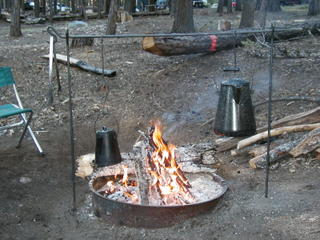 |
| Frank prepared a killer breakfast for us. He got up about 45 minutes ahead of me Saturday morning. Frank had a good bed of coals for cooking by the time I got up at 6:30 a.m. |
A carpenter and general contractor by trade, Frank cooked his breakfast in two large cast iron skillets, each course in succession. He normally cooks breakfast in one skillet. When Frank told he about breakfast plans last week, I threw in an extra skillet.
Bacon and sausage patties and links inaugurated the morning meat-egg-potatoes fest. Then in quick succession, Frank fried potatoes to a crisp in the bacon fat and scrambled eggs, again in bacon fat. Lastly he cooked gravy from more bacon grease, flour and milk.
I’ll post the “recipe” to Frank’s hearty skillet breakfast by tomorrow. Unfortunately, forgot my camera. These pictures are from a trip to Wench Creek last month.
Saturday, June 25, 2005
Second Set of Lessons from a Week-Long Bible Camp, Part 1
Here’s the second installment of my lessons from running a kitchen for a weeklong children's Bible camp. They're based operating a stand-alone kitchen where you plan the menu, purchase food and cook meals for the week only. Several points don't apply to a camp kitchen that operates all summer because you can hold excessive stock from one week to the next.
Don't Neglect the Spiritual Aspect of a Bible Camp
In Ecclesiastes 12:13-14, the preacher says that the whole duty of man is to "Fear God and keep his commandments." Jesus said, "It is written, 'Man shall not live by bread alone, but by every word that proceeds from the mouth of God'" (Matthew 4:3-4).
As Christians, we must always be ready to listen to God. Bible camp is the perfect opportunity for the chef and his cooks to focus on "every word" (see Romans 10:17). Camp is an intense week of spiritually food that we mustn't squander. Be ready to adapt the schedule so kitchen staff can attend Bible study and worship.
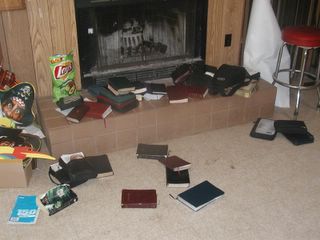
Bible camp!
During the first of year camp, we toiled more than 12 hours each day. On Monday of the 2003 camp session, the cooks worked most of the day. Then Tuesday, the ladies (I was the only man in the kitchen that year) asked if they could attend the woman's Bible class.
I said yes and spent the next hour watching their class from a distance as I did paperwork. I decided that Bible class was more important -- even if only for an hour -- than work. I attended the men's Bible study on Wednesday, Thursday and Friday.
You're missing the whole point of attending a Bible camp if you don't attend to the spiritual along with as the temporal aspects of camp.
Don't Neglect Food Safety
Food safety is the law. Romans 13:1 says "Let every soul be subject to the governing authorities. For there is no authority except from God, and the authorities that exist are appointed by God." This passage says that those who resist these authorities (including food safety authorities, one presumes) bring judgment upon themselves. Our motivation to obey laws, according to vs. 5, is because we have a good conscience to God, not just to avoid punishment (see 1 Pet. 2:13-17).

Next to the menu, the food production worksheet is one of the most important documents in the camp kitchen. Use it to record portions prepared, cooking start and stop times and all temperatures (cooking, holding and cooling) for each menu item.
Secure a health permit where required by law and use a four-pronged approach to food safety:
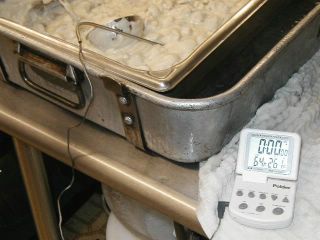
Cool leftover food through the danger zone (135 to 41 degrees) by placing the pan in an ice water bath. Under most state and local laws in the U.S., you have two hours to cool the leftovers from 135 to 70 degrees and an additional four hours to cool the down to 41 degrees or lower. This pan of leftover pan of sausage gravy is in the second phase of cooling.
Index of lessons from a weeklong children's Bible camp
Don't Neglect the Spiritual Aspect of a Bible Camp
In Ecclesiastes 12:13-14, the preacher says that the whole duty of man is to "Fear God and keep his commandments." Jesus said, "It is written, 'Man shall not live by bread alone, but by every word that proceeds from the mouth of God'" (Matthew 4:3-4).
As Christians, we must always be ready to listen to God. Bible camp is the perfect opportunity for the chef and his cooks to focus on "every word" (see Romans 10:17). Camp is an intense week of spiritually food that we mustn't squander. Be ready to adapt the schedule so kitchen staff can attend Bible study and worship.
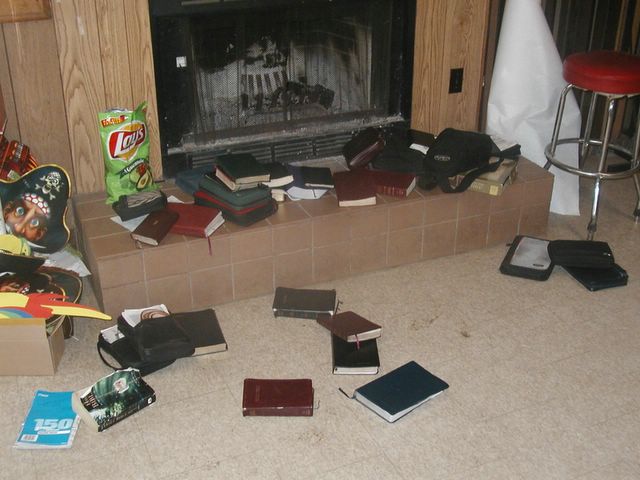
Bible camp!

During the first of year camp, we toiled more than 12 hours each day. On Monday of the 2003 camp session, the cooks worked most of the day. Then Tuesday, the ladies (I was the only man in the kitchen that year) asked if they could attend the woman's Bible class.
I said yes and spent the next hour watching their class from a distance as I did paperwork. I decided that Bible class was more important -- even if only for an hour -- than work. I attended the men's Bible study on Wednesday, Thursday and Friday.
You're missing the whole point of attending a Bible camp if you don't attend to the spiritual along with as the temporal aspects of camp.
Don't Neglect Food Safety
Food safety is the law. Romans 13:1 says "Let every soul be subject to the governing authorities. For there is no authority except from God, and the authorities that exist are appointed by God." This passage says that those who resist these authorities (including food safety authorities, one presumes) bring judgment upon themselves. Our motivation to obey laws, according to vs. 5, is because we have a good conscience to God, not just to avoid punishment (see 1 Pet. 2:13-17).
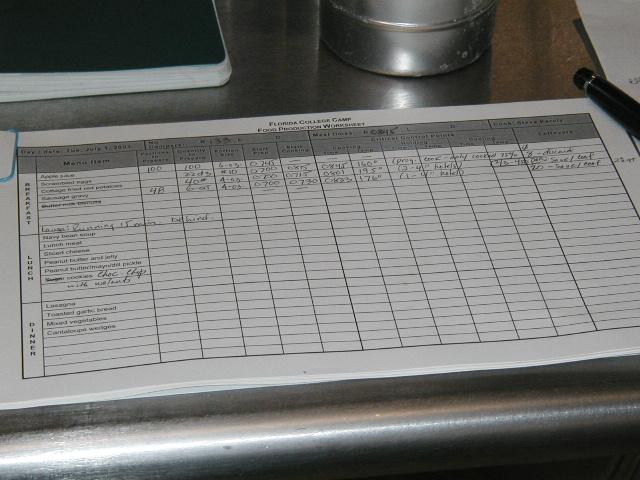
Next to the menu, the food production worksheet is one of the most important documents in the camp kitchen. Use it to record portions prepared, cooking start and stop times and all temperatures (cooking, holding and cooling) for each menu item.
Secure a health permit where required by law and use a four-pronged approach to food safety:
- Prevent time-temperature abuse
- Avoid cross-contamination
- Ensure proper personal hygiene
- Clean and sanitize food contact surfaces regularly
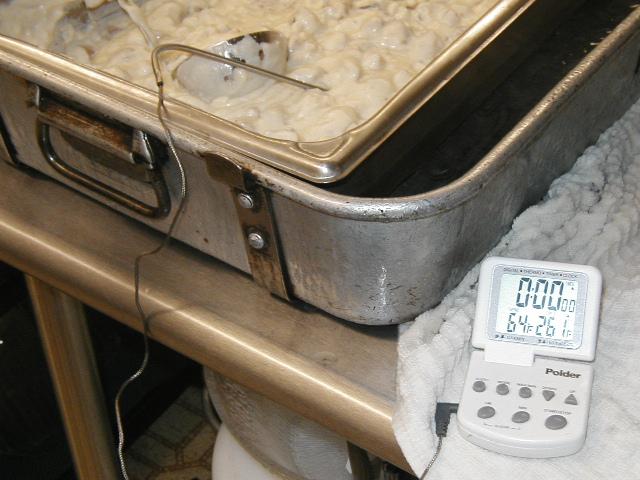
Cool leftover food through the danger zone (135 to 41 degrees) by placing the pan in an ice water bath. Under most state and local laws in the U.S., you have two hours to cool the leftovers from 135 to 70 degrees and an additional four hours to cool the down to 41 degrees or lower. This pan of leftover pan of sausage gravy is in the second phase of cooling.
Index of lessons from a weeklong children's Bible camp
Sunday, February 20, 2005
Scotch Woodcock
Yesterday, I received this email from a retired Navy warrant officer:
According to his description, the stewards served the dish in a fashion similar to eggs Benedict. Down in the galley, we stirred sliced hard boiled eggs into the sauce and served it over toast points or English muffins.
Give this dish a try. It's hearty enough to qualify as camp food. It's a worthy substitute for sausage gravy.
SCOTCH WOODCOCK
Armed Forces Recipe Service Card No. F-3. I "civilianized" the recipe, but it's still identical to the military recipe. This recipe is for 100 (2/3-cup) servings. Figures in parenthesis are for 10 servings, or a little more than 1-1/2 quarts sauce (without the eggs).
100 eggs (10 eggs)
2 gallons warm milk (3-1/4 cups)
1-1/2 pounds butter, melted (4-1/2 tablespoons)
1-1/8 pounds all-purpose four (1/3-cup)
3 pounds Cheddar cheese, shredded (5 ounces)
5-1/8 ounces finely ground bread crumbs
2-1/2 ounces butter, melted
Place eggs in baskets as needed; cover with hot water. Bring to a boil; reduce heat; simmer 10 to 15 minutes. DO NOT BOIL. Remove from water and cool. Remove shells from eggs and eggs in half lengthwise. Arrange 100 egg halves in each hotel table pan. Four (2-inch) hotel pans are needed for 100 portions.
Heat milk to just below boiling. DO NOT BOIL. Blend butter or margarine and flour together; stir until smooth. Add milk to roux, stirring constantly. Cook until thickened. Add cheese to sauce; stir until cheese is melted. Stir as necessary. Check seasoning and add salt to taste if needed. Pour 4-3/4 quarts sauce over egg halves in each steam table pan.
Combine bread crumbs and butter. Sprinkle 2/3 cup buttered crumbs over mixture in each pan. Using a convection oven, bake at 325-degree F 10 minutes or until browned on low fan, open vent. Hold for service at 140 F or higher.
Throughout my career (1960-1984) I enjoyed GREAT Navy chow. The submarine service spoiled me rotten. One of the most memorable meals I enjoyed was in the wardrooms of the USS ORION (AS-18) and USS HOLLAND (AS-32).We prepared this dish in the enlisted mess on board ship. Like the warrant officer, I thoroughly enjoyed the dish.
The entrée is Scotch Woodcock Eggs. As I remember this was a poached egg with the most delicious sauce on an english muffin (not to be confused with eggs Benedict). I have searched high and low for the recipe to no avail. I would have gastronomic orgasims if you could provide the recipe to me. Thanks from an amateur gourmet cook and a true advocate of US Navy cuisine.
According to his description, the stewards served the dish in a fashion similar to eggs Benedict. Down in the galley, we stirred sliced hard boiled eggs into the sauce and served it over toast points or English muffins.
Give this dish a try. It's hearty enough to qualify as camp food. It's a worthy substitute for sausage gravy.
SCOTCH WOODCOCK
Armed Forces Recipe Service Card No. F-3. I "civilianized" the recipe, but it's still identical to the military recipe. This recipe is for 100 (2/3-cup) servings. Figures in parenthesis are for 10 servings, or a little more than 1-1/2 quarts sauce (without the eggs).
100 eggs (10 eggs)
2 gallons warm milk (3-1/4 cups)
1-1/2 pounds butter, melted (4-1/2 tablespoons)
1-1/8 pounds all-purpose four (1/3-cup)
3 pounds Cheddar cheese, shredded (5 ounces)
5-1/8 ounces finely ground bread crumbs
2-1/2 ounces butter, melted
Place eggs in baskets as needed; cover with hot water. Bring to a boil; reduce heat; simmer 10 to 15 minutes. DO NOT BOIL. Remove from water and cool. Remove shells from eggs and eggs in half lengthwise. Arrange 100 egg halves in each hotel table pan. Four (2-inch) hotel pans are needed for 100 portions.
Heat milk to just below boiling. DO NOT BOIL. Blend butter or margarine and flour together; stir until smooth. Add milk to roux, stirring constantly. Cook until thickened. Add cheese to sauce; stir until cheese is melted. Stir as necessary. Check seasoning and add salt to taste if needed. Pour 4-3/4 quarts sauce over egg halves in each steam table pan.
Combine bread crumbs and butter. Sprinkle 2/3 cup buttered crumbs over mixture in each pan. Using a convection oven, bake at 325-degree F 10 minutes or until browned on low fan, open vent. Hold for service at 140 F or higher.
Subscribe to:
Comments (Atom)


