Showing posts with label restaurants and catering. Show all posts

Tuesday, January 21, 2014

Cast iron soup station

Last week my mother and I joined my sister for lunch at the Virginia Theological Seminary, where she's an employee. Dining facilities at the school are called The Refectory and are operated by Meriwether-Godsey, an employee-owned company that specializes in premier dining services. Meals for students, staff and visitors are prepared under the leadership of dining services manager Benjamin Judd.

The layout of service stations impressed me the most about the operation. Set up in the main dining hall, four primary stations allowed diners to freely move about as they selected their meal. Each station included a large buffet stand with a wood framed sneeze shield. Ornate chaffing dishes held the hot food on the meat and vegetarian stations. The salad bar and build-your-own sandwich station each contained an ice well with plenty of space for square and round ingredient containers.

The soup station caught my eye as I walked past it. Looking back I should've taken more than one cell phone picture. Unfortunately, I couldn't locate any photos of The Refectory in the Internet.

The picture shows the layout of the soup pots, cups and bowls. The station was located on the inside end cap to the sandwich station. As I think about the layout, locating soup and sandwiches adjacent to each other makes sense. Two Lodge two cast iron Dutch ovens -- each placed over a heat source -- held the soup, vegetable (vegetarian, I believe) on the left with cream of cauliflower to the right.


Two cast iron Lodge Dutch ovens make up the soup station at Virginia Theological Seminary. They appear to be Lodge Model L8DOL3 Dutch ovens with loop handles.

Tuesday, December 03, 2013

No mixer, no problem

Last Saturday I catered a banquet for the San Jose Youth Shakespeare in the Bay Area. With an ambitious menu at hand, I began meal production with rosemary-garlic dinner rolls at 12:30 in the afternoon. After unloading the equipment, food and supplies into the kitchen, I setup the scale, opened the bag of bread flour and began measuring.

With over 20 pounds of flour, along with yeast, salt, sugar, egg, oil, herbs and water to mix, I'd normally knead the dough in a 20-quart stand mixer. However, the kitchen at the rental hall was not equipped with one. With a large bus tub, I mixed the dough by hand. The pictures tell the rest of the story.

All in ingredients were weighed into a 20 by 15 by 7-inch bus tub. The formula called for 100% bread flour, 6% sugar, 4% chopped fresh parsley, 4% minced garlic, 2% instant yeast, 2 % kosher salt and 1% dried rosemary for the dry ingredients. I used 20 pounds 5 ounces flours as the basis for the dough. Click here for a discussion on baker's percent.

After pouring in about 55% water, 16% egg and 8% olive oil, I mixed the dough by hand. It took several minutes for the dough to come together.

After the dry ingredients were thoroughly mixed into the wet, I cleaned my hands and let the dough rest for 10 minutes. This lets the flour begin to absorb moisture and hydrate.

I started others on separate projects before working on the dough. My niece learned how to dice 10 pounds of yellow onions as another (to my right) set up the buffet area. As the dough came together, I folded the corners into the center of the bus tub. And two gallons of apple cider reduced on the range behind me.

Once the dough was workable, I turned it out onto the bench and continued kneading.

I could only fold the dough 10 to 15 turns before it was too stiff to handle. I gave the dough a 10 to 15-minute rest between kneading sessions. I then divided the dough in half and set each piece in a bus tub to ferment.

Once the dough fermented 90 minutes in an out-of-the-way corner of the kitchen, it was all hands on deck to cut and mold individual rolls. This process took around 30 minutes. We produced 455 rolls Saturday. The diners ate 2 rolls each on average.

Friday, April 20, 2012

So many restaurants

By Penny Welch

We are beginning to get settled from our move from Texas back to Idaho. The Boise area has certainly expanded during our years away. Since getting married and until now, we have lived in rural areas with few options for dining out.

One observation we've made here is there are so many choices for eating out that one could choose a different restaurant every day for weeks on end. All these establishments would not stay in business very long if they had to depend on our visits. Filling all those restaurants all the time must mean that many people are choosing to eat out quite frequently.

When we were traveling, there was no option other than to eat out. We soon realized that dining out was quite expensive; and, sometimes not very enjoyable due to waiting to be served, noise, and even disappointment.

We became anxious to start cooking for ourselves again; not only to save money but also to enjoy our own home-cooked meals. We still derive a sense of satisfaction and accomplishment in preparing delicious meals for our enjoyment.

Don't get me wrong. We, too, enjoy eating out once in awhile and having someone else wait on us. But, for us both, eating out has always been for extra special occasions, usually for the purpose of a celebration. We just can't get used to the idea of eating out as an everyday experience.

And with just a little planning, a trip to the store, and a visit to our pantry, we can prepare wholesome and delicious meals that are more enjoyable and cost far less than regularly dining out.

Cee Dub and Penny Welch recently returned to their native Idaho after an extended residency in the Texas Hill Country. They frequently travel throughout the West as ambassadors of Dutch oven cooking. They sell Dutch ovens and outdoor cooking equipment through www.ceedubs.com/.

Wednesday, October 05, 2011

Cast iron wheels and coffee

I often stop by Sugar Lillie Bakery in historic El Dorado on Saturday morning for coffee and a pastry. Located in a small two-room building behind the Books 'n Bears Bookstore, a walk through a pleasant garden greets you as make your way to the bakery. The garden is a mixture of antique artifacts and vibrant colors of tomatoes, pumpkins and flowering plants.

I frequently linger in the garden before heading on to the railroad work site nearby. It's a pleasant way to relax, drink coffee and photograph the greenery. As I sit at the wrought iron patio table and collect my thoughts, I'm surrounded by industrial tools from the past.

This old shop cart has been given a new life in the garden. With the cart's cast iron wheels are buried in the soil, it won't be moving goods around a railroad dock anytime soon. A collection of potted plans, including flat-leaf parsley and other herbs, have found a home on the cart.

You can view the garden at 6211 Pleasant Valley Road, El Dorado, California.

Tuesday, September 20, 2011

Chef Bob's story

I enjoyed viewing this video. In it Chef Bob Vanigan of tells his personal weight loss story. He encourages others as the camera walks through his Birmingham, Alabama, catering establishment. It's a peak into the action behind the scenes of Chef Bob's Fit2Eat meal program.

Enjoy ...

Monday, September 06, 2010

Breakfast, plow disk cooker and Labor Day street fair

I set out this morning just after 8 a.m. to see what was happening at the Diamond Springs Labor Day Bazaar. Since the Firefighter's Association has centered the street fair around Fire Station 49 on the west end of town in recent years, I walked the length of Main Street before encountering any booths or exhibits. I made a straight line for Charlotte's Baker and Cafe for coffee and a morsel or two for breakfast.

I found chef and owner Carolyn Kumpe and crew busy frying torrijas and enpanadas. While I didn't taste the empanadas, they looked good. She filled them with two or three cheeses and served the stuffed pastries with a lively salsa.

After acquiring my obligatory cup of coffee, Carolyn handed me a paper dish with four gently fried torrijas slices . At a dollar a slice, the Spanish-style French toast made for a quick breakfast. From the first bite I knew I'd found a special treat.

Carolyn featured her torrijas with raspberry and orange blossom honey syrup on a Mother's Day special on News10 last May.

Torrijas are traditionally served at breakfast during Easter in Spain. Like traditional American French toast, torrijas is a popular way to use day-old bread. Carolyn used day-old baquettes, cut on the bias, for hers.

While talking to Carolyn, I saw this shallow outdoor pan. Mounted on a 60,000 BTU propane burner, the pan appeared to be a homemade. It's a cross between the shallow chef's sautee pan and a cast iron skillet.

The cooker was constructed to sit securely on the burner. The last thing you want is to accidently dump hot oil onto the burner. It looks like the cooker was made from of a discarded plow disk. The plow disk cooker can be used as a wok, heavy skillet or pan fryer.

I would've loved to hang around and talk to Carolyn and her cooks. But they were busy and I had to get over to the engine house to held the El Dorado Western Railway crew prepare the new Whiting Trackmobile for the parade at 1 p.m. My report on the parade is found at the El Dorado Western Railway blog.

Tuesday, July 20, 2010

Hope Valley Cafe and Market

I have driven by Hope Valley Cafe and Market many times over the past 30 years. While tempting, my wife and I rarely stopped in.

The rustic building was often just a landmark on a trip the eastern slope of the Sierra Nevada.

Debbie and I first stopped inside the cafe Saturday evening looking for the ATM machine. We had just set up camp at Kit Carson Campground on the other side of the highway. Out of checks, I needed cash to pay the campground fee.

Inside, we found a cross between an old High Sierra resort and a place one would love to call home. Hope Valley Cafe could easily become my coffee bar of choice on a daily commute through Hope Valley.

Joyce DeVore of the The Record-Courier best describes the eatery and market:
From the outside, the café looks like a small mom-and-pop convenience store and coffee shop. Stepping inside, one finds a creative dynamo with tousled black hair, proudly displaying cases of homemade pies and a counter laden with monster cookies and cakes. ("Hope Valley chef cooks her pies to order," October 2, 2009.)
The "creative dynamo" behind Hope Valley Cafe is Leesa Lopazanski, chef and shopkeeper. Frendly and willing to help, Leesa and her counter person pointed us to Woodfords Station when the ATM ran out of cash.

I didn't return to the cafe until late Monday morning when my granddaughter and I stopped in for milk shakes. The young lady behind the counter graciously created a chocolate milkshake off menu for us. The regular menu listed cookies and cream shakes, which would've been good.

My third visit came this morning. After making a 25-mile round trip to call my daughter on the cell phone, I didn't feel like cooking. And it gave me an excuse to stop in for breakfast.

After talking shop with Leesa for a few minutes, I have to say she was a pleasant hostess. From the breakfast menu I chose the 3 Egg Scram, "3 eggs, spinach, sundried tomato, meat & cheese -- all scrambled up w/ toast."

Leesa's 3 Egg Scram is reminiscent of Joe's scramble, a popular breakfast dish with ground beef, onions, mushrooms and spinach folded into three large scrambled eggs and topped with cheese.

Sometimes a simple photograph (above) can help you explorer the menu. Listed under the Scram is The Burrito. "Just like the Scram, all wrapped up in a tortilla w/ salsa & sour cream."

We need to return to the Hope Valley Cafe and Market before we leave for home on Saturday. I'll have to try The Burrito.

If you're in the South Lake Tahoe area as we are this week, you need to take the 30-minute drive out to Hope Valley and meet Leesa. She and her staff will make sure that you have a pleasant meal, full of flavor and goodness.

I promise to stop in next time I drive by.

Saturday, February 20, 2010

Hangtown Winter Fest '10

Louis and Stephanie Hudson of North Highlands, California pause for the camera moments before turning their beef brisket entry in to the judges.

Lou and Stephanie smoked a 13-pound brisket throughout the early morning hours of Sunday, February 14 for the 1st Annual Hangtown Winter Fest '10 in Placerville.

I first met the couple at Oinktoberfest in Oroville, California last October. Lou is currently a culinary arts student at Le Cordon Blue College of Culinary Arts in Sacramento.

"The only reason I'm going to school is to learn the restaurant and catering business," said Hudson.

A "stage lighting designer" by day, Hudson looks forward to the day that he can open a barbecue restaurant in his native Redding, California.

Monday, January 18, 2010

Working on the buffet line, part 2

The most memorable moment in the buffet came early last November. As I worked my first Sunday swing shift, I had this friendly exchange with a buffet patron:

"Thanks for the great food."

I looked up as I assembled a pizza to find a middle-aged woman with silver-streaked hair. Her wave emphasised the compliment.

"Thanks for the great food."

Interaction with buffet patrons helped the evening flow. Most cooks enjoy the occasional compliment about their labor.

It's the valuable feedback that lets know how customers receive our tasty creations.

Saturday, January 02, 2010

Working the buffet line

My job at the casino buffet was the my first restaurant job in 20 years. Since the early 1970s, my career has emphasized institutional food service (now called non-commercial food service by Food Management magazine).

In a way, the 10-week job in the buffet restaurant was really an extension of my nearly 40-year career feeding military, hospital and prison populations. Instead of focusing on plated service, the buffet was organized like an upscale serving line.

Like any new job, I took it to heart and set out to train myself how to become the most competent buffet cook possible. Even though the job was physically demanding -- long hours on your feet with constant running when the buffet was busy -- I quickly learned that I needed to become familiar with each food item on the buffet line.

Over the next month, I'd like to discuss six or seven lessons for cooks working on the buffet line. Really, much of this advise applies to all cooks. A good cook will apply these lessons to any setting, whether in restaurant or institutional food service.

Learn the location of every item on the buffet line.

Customer service is one of the most important jobs for the cook that works in view of the public. Patrons frequently look to the cooks for direction.

From my first shift in October, patrons continually asked, "Where's the cocktail sauce?" I eventually found it helpful to walk the buffet line sometime during the shift to learn the location of each item.

Questions like, "Is the curry shrimp hot?" and "What's in the enchiladas?" often sent me into the kitchen for answers. I found it necessary to taste new foods, a task that I thoroughly enjoyed. (Of course, sometimes it took two bites!)

While standing in front of the buffet line on one of my last days at the casino, a customer asked, "Where are the potatoes?" She was looking for the potatoes that had become the starring attraction on the new Saturday "Steak and Potatoes Night."

In addition to "numerous steaks such as Delmonico, Strip, Tri Tip, Butt Steaks, Pork Chops, Grilled Chicken Breast, Snow Crab Legs and Carved Prime Rib," the buffet served "many styles of potatoes such as Mashed, Pan Fried with Onions, Baked, Sweet Au Gratin and more with all the toppings."

I showed the patron that we had a dozen different potato dishes, all located next to the appropriate steak dish. Mashed potatoes along with roasted red potatoes and peppers were located on my station.

Garlic fries, scalloped potatoes and candied sweet potatoes were on the carver station, between to the prime rib and grilled t-bone steak. Customers could find garlic mashed (along with one or two other preparations) on the American bounty station.

I'd always tried to walk the entire buffet line sometime in the first two hours of my shift. Even though most buffet offerings remain the same from day to day, the chefs introduced new dishes each week.

Remember that you represent the restaurant when you're working on the buffet line. It's your responsibility to know the make-up of each dish on your station, as well as the location.

Monday, December 21, 2009

New job

Postings on 'Round the Chuckbox have been a bit dry over the past few months. After being unemployed for two months, I landed a cook's position in one of the local casinos in early October.

From the beginning, I knew that the casino was the wrong place to jumpstart a post-retirement career. With the physical demands of the job, low pay and work hours (swing shift with Wednesdays and Thursdays off), my search for the ideal retirement job didn't end there.

A particularly crazy weekend in the buffet last month sent me back to Craigslist.

Just when I was considering returning to budget work, I answered an ad for a chef's position in a Sacramento residential facility. I gave notice two weeks ago and worked my last shift last night at the casino.

After working in the buffet for 10 weeks, I started my new job this morning. Saturday night each of the casino's chefs -- from the executive chef to the three sous chefs on duty -- asked what day would be last. One-by-one, I said Sunday.

After the last chef asked the question late into the shift, I realized that I could've closed out my employment with the casino Saturday night. The tactic would've given me a day to rest before joining the Sacramento commute.

Of course, it would've been dishonest on my part. I made a commitment to the casino to work through Sunday in my resignation letter -- one which I honored.

My last shift in the casino went well. We were slammed all night, which is typical for a Sunday night. The crowds didn't break until around 8:15 p.m.

With normal hours (8 a.m. to 5:30 p.m.), I should have more to say on 'Round the Chuckbox. Expect more culinary commentary and recipes soon.

Monday, November 30, 2009

Thanksgiving reservation board

I went to the Diamond Springs Hotel for breakfast lastt Tuesday.

As I left, owner Amy Shim asked if we were coming in for Thanksgiving Day. I said that there's be five for dinner.

Amy walked off and wrote our name in the 5 p.m. block on a large sheet of cardboard.

Since the Hotel doesn't take dinner reservations during the year, she had to find a lasting method to record guest reservations for the speacial menu offering on Thanksgiving Day.

"I tried everything," said Amy, "srap paper, notebooks."

Paper reservation sheets can be lost, torn and soiled, noted Amy. Over the past five years, she's found that the board, cut from a large cardboard box, works the best.

Sometimes, the simplest method makes the most sense. It's sturdy, easily found when misplaced and difficult to damage.

Sunday, August 16, 2009

Choices?

What do you do when faced with this choice, both from the burger menu at The Gateway Cafe (3140 Highway 50, Meyers, California, 96155) in Meyers, California?

Black & Blue Burger
Quite possibly the best burger on the planet! Spicy blackened burger topped with melted blue cheese sauce, crispy onions and two bacon strips
Veggie Burger
Garden burger topped, jack cheese, avocado, lettuce, tomatoes and sprouts with our spicy salsa aioli
While the veggie burger has some good ingredients listed -- who wouldn't try the spicy salsa aioli -- it took me about five milliseconds to select the Black & Blue!

Friday, July 17, 2009

Day off and breakfast with a buddy

June 9, 2009 was the last time I worked on the rail project with friends in the old Southern Pacific rail yard at Diamond Springs.

My summer job at Loon Lake in Eldorado National Forest has kept me far away from the day-to-day action of the El Dorado Western Railway and El Dorado County Historical Museum.

When I left for Deer Crossing Camp the next day, the rail removal project was just getting started. Except for weekly email updates from friend and EDWRF President Keith Berry, I've been out of the loop.

Home for a rare two-day stretch, I emailed Keith earlier in the week and arranged to meet him at the Diamond Springs Hotel for breakfast yesterday.

By chance, Keith and I met up with El Dorado County Fire Battalion Chief Kurt Taylor and EDWRF board member Ed Cuhna at the hotel just after 8 a.m.

Local politics kept the foursome busy as we enjoyed breakfast by Kevin, the hotel's morning cook. With two firefighters at the table (Ed is a retired fire captain), conversation quickly moved to stories of the 1992 Cleveland Fire and Kurt's vintage firetruck that the two are restoring.

Once Kurt and Ed left to work on the fire engine, Keith and I talked on. Our conversation shifted over to railroad happenings in El Dorado County. (Go to the El Dorado Western Railway blog for news of the project.)

I caught up on the happenings of the railway and the proposed El Dorado County Railroad Park at the old El Dorado depot site in El Dorado.

Breakfast gave me a chance to re-connect with rail buddies and get my mind a way from the camp kitchen.

Ever gracious, hotel co-owner Amy Shim (with husband Moon) and Kathy, our server, kept coffee and soda flowing for two and one-half hours.

Tuesday, October 21, 2008

Campfire, takeout and a tree stump ...


Chow time
Originally uploaded by SeabeeCook
No, I'm not in a state of denial about an approaching forest fire. Nor am I picking at my food. I was trying to hide the remote as I fumbled the fork

It was time for one of my campfire, takeout and tree stump sessions up Iron Mountain Road up past Jenkinson Lake in Eldorado National Forest. My last campfire was Veteran's Day 2007.

Until I got involved with the El Dorado Western Railway three years ago, my son and I had a tradition of a campfire and Chinese takeout twice each month.

Two Saturdays each month, we'd shoot up the Eldorado National Forest road to our favorite spot about one and one-half miles beyond the information station. IMR, also known as Mormon Immigrant Trail, connects Pollock Pines and Sly Park with State Route 88.

We'd clear a spot, light a campfire and set up folding camp chairs. A book or two and my ever present notebook occupied our minds as we took in nourishment and the mountain beauty.

It took two or three hours for the fire to burn down to a glowing bed of coals. That was our signal to drown the fire and move out. From there, we'd drive forest roads for another hour or so before heading home.

I've chronicled several campfires on this blog over since 2005. I don't really need to repeat what I've written in the past.

But I will quote campfire cooking expert Johnny Nix:
Something about a campfire invites people in. Strangers start telling their stories. Pretty soon they're not strangers anymore. When you're outdoors, you get a real connection back to what God has created for us all to enjoy -- good food, good friends, the love of family and a sky with more starts in than their are worries in the world. Cooking over the campfire isn't quick, but that's the point. It slows life down enough to remind you of what's important. So come and join me on the range.(Guideposts, August 2006.)
I think that says it all ...

Monday, September 22, 2008

Army mobile kitchen trailer for catering?

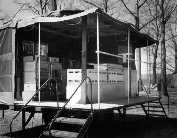
I'm not aware of anyone who's purchased an U.S. Army surplus mobile kitchen trailer (MKT in army parlance) to use in a commercial venture. The design of the culinary war-fighting platform makes conversion to civilian use a difficult issue.

Like military collectors who've restored vintage Army mess trucks, I'm sure there are collectors who've bought the MKT as a collectible. It makes sense when you consider the thousands of trailers that were in service from the 1970s on.

Last week, Ron, a retired U.S. serviceman, posted a comment to an article I wrote on the MKT in June 2006. Although Ron doesn't say so, I suspect that he's a retired Army cook. Here's his question:

May name is Ron I am retired military and currently reside in SC. My dream is to Someday open my own restaurant. I am planning on starting small, with a on the go (type) menu that hopefully will lead to catering, and ultimately a restaurant in 5-10 years.

I was hoping to buy at DRMO a used MKT. Has any one done this before? Would like to know what the drawbacks and positives my be.
Thank you for writing Ron. Your plans are certainly ambitious. But with skill and drive, you should be able to bring you idea to fruition.

You might want to reconsider your plans to use a MKT for street-side vending. I don't believe the trailer will meet code in most U.S. locations without extensive conversion. An used commercial catering trailer or van would serve you better.

Although I'm guessing that you might have more experience on the MKT than I do, the platform wasn't designed with civilian food service in mind. The Army took the existing 2-1/2-ton trailer and added field cooking equipment (mainly the M59 field range outfit with the M2 burner), built in few storage cabinets and and put a collapsing roof over the top.

The lack of on-board lighting, plumbing, ventilation and water storage systems will certainly hinder your plans. The South Carolina health code is going to require on-board lighting, sufficient water storage capacity, sewage holding tanks, hand-washing and food-preparation sinks and adequate refrigeration.

I certainly don't want to discourage you. Your business plans are intriguing. I'd be there to help if I lived in South Carolina.

Talk to your local county environmental health inspectors. They'll be able to guide you in the right direction. It's always helpful to have the local authorities involved in the process from the beginning since they're going to issue the permit.

South Carolina Regulation 61-25, Retail Food Establishments, should help. While I don't know the how South Carolina regulations function in the working world, this paragraph will give you a starting place. Click here to reach the South Carolina food protection program website.
Mobile food units preparing food shall have preparation and display areas completely enclosed with a solid material, and doors shall be kept closed when not in use. These units shall be provided with a handwashing lavatory equipped with hot and cold water under pressure, soap and disposable towels, an approved waste water tank, and may prepare such foods as hot dogs, corn dogs, pizza, soft ice cream, and other similar foods approved by the health authority. (Chapter X, Mobile Food Units, page 43.)
While you should be able to move forward from mobile vending to catering to a restaurant, I don't think a MKT is the way to go.

Friday, August 01, 2008

Comfort food

Here's the best definition of restaurant comfort food that I've heard yet:
It's home made, and I don't have to make it.
As spoken by a female customer at the Central City Cafe in Huntington, West Virginia on Guy Fieri's Diners, Drive-ins and Dives on the Food Network tonight.

Friday, March 09, 2007

No Soul at Starbucks

One of the results has been stores that no longer have the soul of the past and reflect a chain of stores vs. the warm feeling of a neighborhood store. Some people even call our stores sterile, cookie cutter, no longer reflecting the passion our partners feel about our coffee. In fact, I am not sure people today even know we are roasting coffee. You certainly can't get the message from being in our stores. The merchandise, more art than science, is far removed from being the merchant that I believe we can be and certainly at a minimum should support the foundation of our coffee heritage.

Starbucks CEO Howard Schultz

Well, duh!

Does anyone really believe that Seattle-based Starbucks Coffee Company, which has expanded to 13,000 locations worldwide in the past decade, can maintain the look and feel of the quirky neighborhood coffee shop?

Instead of focusing on the sensual experience inherent in buying a robust cup of coffee, Starbucks made a series on business decisions that "have lead to the watering down of the Starbucks experience," said Schultz.

Coffee bins and labor intensive espresso machines gave way to push-button coffee makers and "flavor locked packaging." Theater gave way to basistas who no longer have have a "visual sight line (to) the customer."

"The loss of aroma -- perhaps the most powerful non-verbal signal we had in our stores," said Schultz in an internal memo leaked on the Starbucks Gossip Blog. "The loss of our people scooping fresh coffee from the bins and grinding it fresh in front of the customer, and once again stripping the store of tradition and our heritage?"

Starbucks is fast food. It's the McDonald's of coffee. Like hamburger giant, Starbucks has standardized every aspect of the specialty coffee business.

In the 20 years since Schultz and his inverstors purchased Starbucks, the corporate "cookie cutter" has stamped out the company's passion for coffee.

In its drive to give customers the same coffee drinking experience around the world, small, independent coffee shops are attracting loyal Starbucks customers, a development that "must be eradicated."

And now, competition has come from an unlikely corner of the fast food market.

"Hoping that consumers are fed up with asking Starbucks for 'double-caramel skim half-caf macchiato' before they’ve even had their jolt of joe," said the Consumer Reports website, "Burger King, Dunkin’ Donuts, and McDonald’s have been boosting their coffee cachet."

McDonal's cup of coffee beat out Starbucks on two fronts -- price and flavor.

It seems the morning coffee crowd would rather sip a "desent and moderately strong" cup than one that's "bitter enough to make your eyes water instead of open," said Consumer Reports.

Thursday, September 07, 2006

Diamond Springs Taco Man

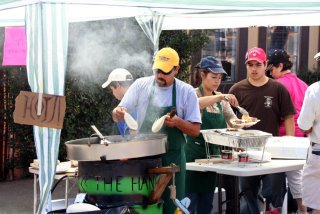
Ingenuity is the motivator that drives some street vendors. The lack of a mobile catering trailer doesn't stop them. They use materials that are readily available to construct a "street legal" vending outfit.

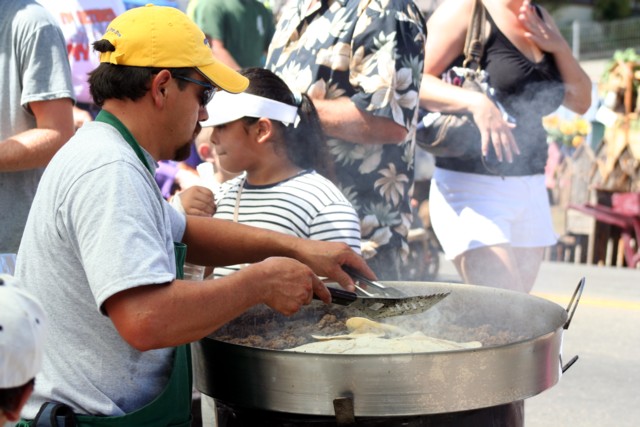
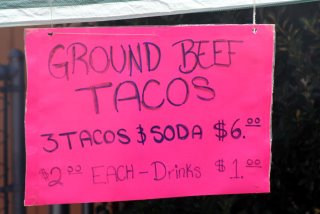
This vendor's taco cooker fascinated me Monday. The cook placed a convex cooking pan over a propane burner. The burner sets inside the drum. He cooked ground beef in the hollow of the cooking pan and used the hump to warm tortillas. I didn't see how he drained the grease from the ground beef.

My only concern with the set up is ease at which cross-contamination could occur. The first time I walked by the booth, the cook was warming torillas in close proximity to raw ground beef. I think a better approach would be to use a flat griddle to warm the tortillas. With care it was a good set up.

Tuesday, August 08, 2006

More on Eating Local

As we pulled away from the motel in Florence during vacation, my son located the local Subway restaurant in the Rite Aid shopping center on Highway 126.

"Hey, we could go to Subway," he said.

"You forget my rule," I responded. "Remember, we only eat local on the road."

"But Subway is local," he countered.

I drove straight through the Highway 126-101 intersection down 9th Street to Old Hickory's (1565 9th Street, Florence, Oregon, 541.997.9739).

My son's right. All restaurants are local in a sense. I'm sure the Subway is owned and operated by a local business operator.

Even the chain stores hire local residents to staff their establishments. They depend on local patrons and travelers for business.

So, yes son, they're local only in the sense of the patrons and employees.

The cuisine is dictated by some distant headquarters. In many cases, the food is only heated on site -- it's actually cooked elsewhere at a large commissary.

Subway has some good sandwiches. I enjoy a BMT at the Subway near my office each week. But I save quick-serve restaurants for my work-a-day week.

Local restaurants -- like Old Hickory -- give us a chance to experience some of the local cuisine. Local chefs bring their ideas to the table. Each chef has his own take on a dish.

Although I didn't detect any unique preparation at Old Hickory, it was a pleasure chowning down on tender baby backs and chicken that was cooked just right. And the cole slaw was not too sweet -- just right in my book.

Plus you know that the food is usually cooked from scratch, especially at places like Old Hickory. It's fun to see how local chefs treat the same food we all love and enjoy.

I figure I can eat mass-produced food 50 weeks of the year.