Showing posts with label Camp 2014. Show all posts

Thursday, November 20, 2014

Throwback Thursday: Finding inspiration for the camp menu

I originally posted this story in 2006 during the ramp-up to a camp that I worked at for one week each summer. 

I glean menu and recipe ideas from many sources. Professional trade magazines -- Foodservice Director and Food Management among them -- give me ideas that are specially suited for the institutional kitchen. Popular magazines like Sunset also provide inspiration. I can often use an idea and work it until it fits a group setting.

A photograph of an artfully arranged collection of skillets arranged on an outdoor buffet table sparked my cowboy breakfast idea. Twin stacks of blue enamel plates and a lone Dutch oven complete the display -- no fancy garnish for the dudes of the Mountain Sky Guest Ranch, near Emigrant, Montana.

This thousand-word inspiration gave me the impetuous to celebrate our nation's 230th birthday. The crisp, smoky air of the campfire will greet campers next Tuesday. Bright yellow scrambled eggs, airy biscuits smothered in sausage gravy and gallons of cowboy coffee (hot chocolate for campers) will kick off our celebration next week. The meal will be cooked in cast iron that's stood the test of time from the colonial hearth to the Western range to the backyards of today.
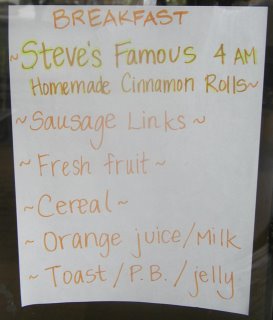
In 2004, campers kept saying, "That's what 4 a.m. rolls look like!," as they walked through the cafeteria line. Their response puzzled me all morning until I walked out into the dining area and saw this hand-printed menu.
Inspiration for camp menu ideas come from many sources. Television programs, cookbooks and magazines have helped my over 35-year culinary career. The one thing that's worked best for me since the late 1980s has been a series of culinary notebooks.

I keep the notebook handy. Now that I'm commuting to Sacramento each day, the 200-page composition book rests in my daypack. I record ideas -- often gathered from professional magazines on my desk -- and clippings on my hour-long commute home. My 18-notebook collection is full of ideas.

It doesn't matter if the idea comes from TV or print. Shows like Al Rocker's Rocker on the Road can give wonderful ideas. Take Douglas Coffin's New Haven, Conn.-based Big Green Pizza Truck (the show that aired last January). I may not be able to restore a 1946 International Harvester flat-bed truck. But the pizza menu idea will come in handy one day.

They key is to clip ideas and place them in your culinary scrapbook. Soon your collection of ideas, complete with thousand-word photographs will have you cooking for a herd of hungry campers.

Monday, September 01, 2014

The truck, the truck

The US Foods truck negotiates a sharp turn as it moves from the main entrance to the upper road at Oakland Feather River Camp last July. The big three purveyors (US Foods, ProPacific Fresh and Sysco) generally sent medium-sized tractor-trailer combinations to the camp, which is located inside the Spanish Creek canyon, five miles north of Quincy, California. Due to the size of the trucks and awkwardness of the dock, drivers parked on the delivery road and moved product into the kitchen with pallet jack and hand truck.

Saturday, August 09, 2014

Rain

Last Tuesday the Quincy, California, area received a full day of rain. I didn't realize that I had earlier moved my Dutch ovens from the camp kitchen to the cabin. They seem to have weathered the storm with little rust. I'll clean and re-season the two 12-inch camp ovens once Debbie and I arrive home.

Herb garden results

I transported a new herb garden to camp with good intentions. I thought it could supply a portion of the fresh herbs for the camp kitchen. Yet with little free time in the evening to tend the garden, I barely kept up with watering. Instead, the container garden served as an element of the "front yard" outside our cabin door.

My herb garden weathered the Sierra Nevada well. It will soon return to our Diamond Springs,California, home, where I plan to use the produce for home and camping. All the plants save one (the camellia plant) survived. The chive, rosemary, sage, tarragon and thyme are growing strong. I will soon add basil.

While I believe my idea to grow herbs for the camp kitchen had merit, the garden never produced amounts needed for large quantities of food. Next year I will continue to purchase fresh herbs from our produce purveyor. In addition to cilantro and parsley (curry and flat leaf), the cooks use fresh basil, mint and thyme. Dried herbs stand in for the other herbs.

Sage awaits wonderful fall cuisine when Debbie and I arrive home late next week.

Sunday, August 03, 2014

Arroz con pollo

It may not be the prettiest dish that we serve at Oakland Feather River Camp. But arroz con pollo is packed with flavor (the link takes you to my Dutch oven version). Two weeks ago, five 12 by 20 by 2-1/2-inch pans fed 135 campers and staff at the family camp. Simmered black beans, succotash with kale and chocolate bread pudding rounded the menu.

Sunday, July 27, 2014

Lots of hummus

Until yesterday, I had only prepared two quarts of hummus at one time. Now my personal record is somewhere around five gallons! The Cuisinart food processor labored for over one hour to turn six #10 cans of chickpeas into the wonderful spread. When I completed the task, one quart olive oil, one quart lemon juice, three pounds tahini, one cup minced garlic and salt and pepper joined the chickpeas.

Oakland Feather Rover Camp featured a Middle Eastern menu for a private camp on Saturday. The two-hour lunch included pita bread, hummus bi tahini, tabbouleh and tuna salad, plus a large salad bar. We will serve the remaining hummus throughout the week on the salad bar.

Friday, July 25, 2014

Chicken Tex-Mex casserole production center

Tex-Mex chicken layered casserole (and here) is on the menu tonight for a private rental group at the camp. The four 12 by 20 by 2-1/2-inch hotel pans will feed around 75 to 100 persons. I cut the pans four by six after it comes out of the oven.

In addition to the meat version, I prepared a vegetarian casserole with cheddar cheese and a black bean layered casserole for vegans. The alternative casseroles (off camera) were prepared in half pans. These two pans are gluten free.

Thursday, July 24, 2014

Morning coffee

Enjoying a morning mug of Joe in the kitchen!

Sunday, July 20, 2014

Roast eye of round at camp

I menu roast beef at Oakland Feather River Camp every week or two. I have been using the eye of round (IMPS/NAMP 171C) for five years now. It can usually be purchased at a reasonable price, slightly above $3 per pound when purchased in a 54-pound case. Each case holds six to eight individual roasts.

You can also purchase the eye of round at the local cash and carry restaurant supply house. I purchased it at Cash and Carry on Richards Boulevard, Sacramento, California, when I worked in midtown Sacramento. The store currently sells the roast for $3.22 per pound for a five-pound average roast.

I like the roast because it cooks quickly and gives a reasonably tender serving to the camper. The cylindrical shape of the roast yields a consistently round serving when sliced on the meat slicer. I don't use a recipe for the roast, but will describe my process:
  1. Trim fat and silver skin on the roast. I generally leave a quarter-inch of fat on each roast.
  2. Rub each roast with a light coat of canola oil. Then rub kosher salt, coarse ground and granulated garlic.Place in roasting pan.
  3. Brown roasts in pre-heated 450-degree convection oven until browned, 20 to 25 minutes.
  4. Pull pan from oven and reduce oven setting to 200 degrees. Turn roasts over. Add a bit of water or stock to pan if the drippings have dried.
  5. Cover pan and return to the oven. Roast until roasts reach desired temperature. At camp I pull them when the internal temperature reaches 145 to 150 degrees. This gives you a nice, evenly colored roast.
  6. Rest meat 10 to 15 minutes. Slice on meat slicer to desired thickness. I prefer it on the thinner side. This lets campers take as many slices as they desire without impacting portion control. Each six to seven-pound roast yields 20 to 25 (4-ounce) servings at Oakland Camp.
  7. Prepare gravy or au jus as desired from the drippings.


I find that it's best to slice the roast using a meat slicer. The slicer gives you consistently sized pieces. It also helps maximize the slices from each roast. 

Sunday, July 13, 2014

Horse ridin' chef

Please do not think that I'm a seasoned horseman as I guide Samsonite into the corral. I just appear to know what I'm doing. I spent a good part of the hour-long ride trying to convince him that I'm the chef and he's the horse. Yet, Samsonite is a good steed. I look forward to riding him again before Debbie and I leave for home next month.

Saturday, July 12, 2014

Mexican rice on the griddle

Earlier this week my sous chef and I wanted to use up two pans of leftover rice. In order to re-purpose the rice into a new dish, I prepared a sauce from canned tomatoes, poblano chilies, onion and garlic. The rice was poured onto a oiled griddle and stirred several times. I then folded the sauce into the rice and brought it up to temperature.

The rice looked just like Mexican restaurant rice. It even had one or two obligatory pieces of tomato in the mixture! Here's our new process for cooking Mexican rice at Oakland Feather River Camp:

  1. Combine 2 quarts white or brown rice with 4 quarts chicken or vegetable stock in a 12x20x4-inch hotel pan. Cover tightly with aluminum foil and lid. Two pans of rice will feed around 100 campers at Oakland Camp.
  2. Bake in a 325-degree convection oven until tender. White rice takes 20 to 30 minutes. You need 45 to 50 minutes for brown rice. 
  3. Cool rice overnight in the walk-in refrigerator.
  4. Pre-heat griddle to 350 degrees.
  5. Saute 4 large pobleno chilies (diced), 1 or 2 jalapeno chilies (minced), 2 onions (diced) with a couple tablespoons minced garlic until soft and slightly charred. Roasted poblano chilies work as well.
  6. Puree 1/2 #10 can diced tomatoes with the sauteed vegetables in a blender or food processor.
  7. Pour one pan of rice onto griddle. Stir to break up clumps and heat rice.
  8. Pour half the puree mixture over the rice. Stir quickly to ensure even distribution of the sauce. Cook until mixture reaches 165 degrees or higher.
  9. Check seasoning. Season with salt and pepper to taste. Portion into serving pans.
  10. Repeat the process for additional pans of rice.

Mexican brown rice cooks on the griddle at around 350 degrees. 

Cook's position at Murphys, California, Christian camp

Here's recent posting from Gold Country Craigslist. The part-time position pays $9 per hour. To respond, click the box titled 'Contact' in the upper left corner of the Craigslist ad.

Position available immediately at Dream Mountain Christian Camp! We are looking for extra help in our camp kitchen for the busy summer season. We need someone local with reliable transportation that would be willing to work split shifts.

We are a Christian camp that's looking for someone with a strong work ethic, servant's heart and can exemplify the love of Christ through humble, excellent and genuine guest service.

Hours would be from 11 a.m. to 2 p.m. for the lunch shift and 5 to 8 p.m. for dinner shift (with some flexibility). Summer dates would be July 14-20, July 23-26, July 27-31, August 1-4 and August 7-9. We will also need help on weekends after the summer season as an on-call basis.

We are a Christian family-run camp. If interested, please contact Camp Director Cheree Munoz.

Job Duties Include:
  • Prepare, cook and present food quickly and efficiently, meeting our standards
  • Assist in keeping the kitchen clean, hygienic and tidy, at all times
  • Assist in fixing beverages, salads, lunch, dinner and simple desserts. 
  • Assists with setting up serving line.
  • Washes dishes and pots and pans after meals. 
  • Operates dishwasher. 
  • Cleans and secures dining area. 
  • Checks in and putting away orders and deliveries in storeroom and freezer on days needed. 
  • Performs heavy cleaning, such as ovens and grill, when needed. 
  • Performs other duties as required. 
  • Ability to work on your feet.
  • Ability to lift 20-50 pounds

Thursday, July 10, 2014

Hotcakes at Oakland Camp

Whole wheat hotcakes on the griddle at Oakland Feather River Camp earlier this week. Last month, the local appliance service technician replaced the four thermostats to the camp griddle. During the initial service call, John of Az-Tech Appliance discovered the thermometer tubes had split. The burners were either on or off. There was no middle ground. The griddle now works as it should.

Monday, July 07, 2014

Favorite time of day at camp

My favorite time of day takes place in the evening between seven and eight o'clock. The cool of the evening is a refreshing change from the hot kitchen. I recharge my spirit by studying the Holy Scriptures, catching up on transcribing the day's activities into my notebook and contemplating the days, both behind and ahead. It gives me time to relax before turning in as morning comes quickly.

Sunday, July 06, 2014

Doin' the math

This Facebook photo of Senior Chief
Hunt teaching culinary math to
U.S. Navy culinary specialists
prompted me to write this article.
Senior Chief Hunt is assigned
to Navy Food Management
Team Norfolk, Virginia as an
instructor. She conducted a
coarse in culinary math for
Norfolk area culinary specialists
last month.
The ability to perform basic mathematical calculations is an essential skill for the cook. Converting ounces into pounds, quarts into gallons and teaspoons into tablespoons is frequently done on the fly, without benefit of calculator or chart. The cook must be able to work quickly, and accurately, each time a math problem presents itself.

The number of cooks who have trouble navigating the world of weights and measures amaze me. Experience cooks often ask, “How many quarts in a gallon?” What I regard as elementary easily stumps seasoned cooks. While I don’t expect him to recite the number of teaspoons in a gallon (there are 768 teaspoons), he must understand the relationship between pounds and ounces and the various units of dry and liquid measure.

There are:
  • 16 ounces in a pound
  • 3 teaspoons in a tablespoon
  • 16 tablespoons in a cup
  • 2 cups in a pint
  • 4 cups or 2 pints in a quart
  • 4 quarts or eight pints in a gallon
Once the cook understands the relationship from one unit of measure to another, whether smaller or larger, it simplifies his job. The skilled cook can move between smaller and larger units, and larger to smaller, with ease. The relationship between weights and measures in the American system can only be with difficulty.

Baking steamed rice in the oven will serve as an illustration of culinary math skills. At Oakland Feather River Camp, long grain white (or brown) rice is measured into the standard 12 by 20 by 4-inch hotel pan. The cook measures four pints of rice into each greased pan. (The pint measure is used because it’s handy.) The cook doubles the volume of rice to figure out the amount of boiling water to pour into the pan. At this point, the cook shifts to a half-gallon measure, mainly for efficiency.

To determine the number of half-gallon measures of water, the cook must understand that there are four pints or eight cups in the measure before proceeding. There are two cups in a pint. Since the cook previously measured four pints of rice into the pan, he multiplies four times two (in his head). The product is eight cups. He then doubles that number for 16 cups of boiling water. (I instruct the cooks to use a half-gallon measure because it safer to handle when handling boiling water.)

Sixteen cups divided by two is eight. Thus the cook adds two half-gallon pitchers of water to the rice in each pan. The rice is seasoned with salt and butter, then covered with plastic wrap and a hotel pan lid. It’s baked in a 325-degree convection oven for 20 to 30 minutes, until tender.

Admittedly, this explanation of preparing steamed rice is long. It takes more time to explain the process than to bake the rice! But it serves as an example of how culinary math finds its way into the kitchen. This is basic math to be sure, but it’s an essential skill. Too little water and the rice is dry and crunchy. Too much and you end up with a soggy mess.

There are a number of applications for math in the kitchen. I've addressed baker’s math previously on ‘Round the Chuckbox. The science of adjusting recipes is a crucial skill for the cook as well. I’ll have more to say in a later article.

In the meantime, let’s mind our pints and quarts!

Saturday, July 05, 2014

Raising the ensign, year two

For the second year, I was selected to lead Independence Day ceremonies around the camp flagstaff. The honor has fallen to the chef for the last several years. The ceremony has special meaning to me as a retired U.S. Navy senior chief petty officer. The raising of the ensign at 8 o'clock in the morning was always a memorable time of day.

During the ceremony, I discussed protocol surrounding raising the ensign (the U.S. Navy term for the Stars and Stripes), read the Resolution of the Continental Congress of June 14, 1777 and led campers in the Pledge of Allegiance.

Tuesday, July 01, 2014

Oat hotcakes

At Oakland Feather River Camp, campers travel down both sides of the buffet line. To facilitate movement, I place a pan of hotcakes or French toast facing each direction as pictured. It never seems to work. Campers grab cakes from the first pan they see regardless of the side it's facing!
OAT HOT CAKES

For apple, banana, blueberry or peach hot cakes, prepare 1 pound 8 ounces to 2 pounds fruit. Drop a handful of selected fruit onto the hotcake just prior to turning on the griddle. Continue cooking.

1 pound 12 ounces all-purpose or pastry flour
8 ounces old fashion oats
3-1/2 tablespoons baking powder
1 tablespoon baking soda
1 tablespoon salt
3 ounces sugar
14 ounces eggs (8 large)
1 quart 2 cups buttermilk
8 ounces vegetable oil or melted bacon grease

In a large bowl, mix flour, oats, baking powder, baking soda, salt and sugar. In a separate bowl, whisk eggs and buttermilk until blended. Combine dry and wet ingredients; mix just until blended. Do not over mix.

Blend in vegetable oil or melted bacon grease. Pour 1/5-cup batter (#20 disher) onto lightly greased hot griddle (350 to 375 degrees). A #16 disher will give a larger hot cake. Cook on one side until top is covered with bubbles and underside is browned, 1 to 1-1/2 min. Turn, cook on other side 1-1/2 to 2 minutes.


Yield is approximately 50 hotcakes, depending of size.

Monday, June 30, 2014

Program Director

Program Director Aaron Ross fuels up with hot dogs before leading afternoon activities at Oakland Feather River Camp.

Sunday, June 29, 2014

Baked asparagus frittata with basil and Swiss cheese

Set-up for baked asparagus frittata with
basil and Swiss cheese.
Two weeks ago I prepared baked asparagus frittata with basil and Swiss cheese for the Feather River Adult Art Camp. The process is the same that I used during the 2013 season (click for recipe).

To begin, I cut one pound of asparagus for each 2-1/2-inch hotel pan. Next the asparagus with a splash of canola-olive blend oil went into each pan. Five pans were placed in a 325-degree convection oven for around 10 minutes.

Once the asparagus was a bright green color, I removed the pans and poured in three cartons of liquid egg, along with a handful of chopped fresh basil and parsley and grated Parmesan cheese. I returned the pans to the oven and baked until the eggs was almost set. Each pans was then topped with 15 slices of Swiss cheese and given another five minutes in the oven.

The frittata was a hit. One campers said, "I've never seen that up here." I find that one pan of frittata feeds 35 family campers at Oakland Feather River Camp. We also place a pan of plain scrambled eggs on the serving line for campers that don't like frittata.


Sunday, June 22, 2014

Baked Dutch apple pancake recipe

I recently adapted a recipe for big Dutch apple from the January 2014 issue of Sunset Magazine. Thanks to a test by fellow chef Paul Kleiforth, I added caramelized apples to the original recipe. The result is a wonderful breakfast dish. It's a refreshing alternative to hot griddle cakes or French toast.

After testing Paul's baked Dutch apple pancake on staff at Oakland Feather River Camp last month, I introduced it to the adult campers of the art camp this week. They loved it. After receiving several compliments from the older campers, many in their sixties and seventies, I will place it on the menu every other week.

BAKED DUTCH APPLE PANCAKE

I prepared six 2-1/2-inch hotel pans of the baked apple pancake for around 140 adult campers Friday. The picture shows me portioning eight cups batter into each pan. Liquid eggs stand in for fresh eggs at Oakland Camp. Use 14 large or 16 medium eggs if you don't buy liquid eggs. To date, I've simultaneously baked six pans in the oven.

One pan will serve 25 campers. At Oakland Camp, we place a pan of plain scrambled eggs on the vegetarian line for campers that prefer them.

8 ounces butter
1/2 can sliced apples, drained, juices reserved
2 ounces sugar
1.5 pounds eggs
3 cups all-purpose flour
1 cup reserved apple juice
2 cups milk
Toppings: nutmeg, powdered sugar, lemon wedges and honey

Place butter in a 12 by 20 by 2-1/2-inch hotel pan and set on lowest rack of oven. Preheat oven to 425 degrees in a conventional oven or 375 degrees in a convection oven. Combine apples and sugar. Remove pan from oven and place apples in pan. Return to oven and cook until lightly caramelized, 10 to 15 minutes.

While the apple caramelizes, quickly mix batter. Put eggs in a blender or food processor and whirl on high speed for 1 minute. With motor running, gradually pour in milk and juice, then slowly add flour; continue whirling 30 seconds. (Or, in a bowl, beat eggs until blended; gradually beat in milk, then flour.)

Remove pan from oven and pour batter over apples. Return pan to oven and bake until pancake is puffy and well browned, 20 to 25 minutes, rotating pan halfway through baking. When working with multiple pans in the oven, rotate from top to bottom shelves if necessary for even cooking.

Dust pancake with nutmeg if desired, then powdered sugar. Cut as desired and serve with more powdered sugar and lemon wedges, plus a drizzle of honey if you like.