Showing posts with label forest fire. Show all posts

Thursday, September 29, 2011

Code of the campfire #10

The code of the campfire says put the fire dead out when you break camp. The U.S. Forest Service campfire permit requires that you use the "drown, stir and feel" technique to extinguish the campfire. Any method that leaves burning embers -- even those buried under a layer of dirt -- can spark a wildland fire.

To drown the campfire, pour several pails of water over the campfire. I find that it takes five or more gallons of water to drown the fire. With a shovel, thoroughly mix the ash and water until it resembles a soupy mess. Feel the ashes to make sure the fire is dead out. Walk the ground within a fifty-foot radius to make sure no embers have escaped.

The second part of the code says consider your neighbor. Watch the prevailing wind as you pour water onto the hot fire. This way you'll avoid showering your neighbor (or wife for that matter!) with an ash cloud.

Saturday, September 24, 2011

Code of the campfire #9

The code of the campfire says be responsible. Don't wander from camp while the campfire is hot. A momentary wind gust could carry embers far from the campfire. Be ready to extinguish any that escape.

The responsible camper always considers the ramifications of a misstep or two. As I said earlier this week, you could be held legally and financially responsible should embers from your campfire spark a wildland fire.

The second part of the code points back to a prior code -- tool up. Should campfire embers escape, stomp it out with your shovel (or boot if that's quicker!). Once the flame is dead, extinguish the ember with water.

Sunday, September 18, 2011

Code of the campfire #8

The code of the campfire says obey all laws. This is especially critical when forestry officials restrict or prohibit campfires when conditions warrant. These conditions often occur in late summer and early fall.

The last thing I desire is to be responsible for a wildland fire. The Angora Fire, which destroyed 254 homes and burned 3,100 acres in South Lake Tahoe in June 2007, started when an illegal campfire escaped on a windy day. You can be held criminally and financially libel for such a fire.

Be a good citizen. That's the second part of the code. Secure an annual campfire permit where required by law. Please pay attention to instructions from the issuing official. And make sure you know current fire restrictions before lighting a campfire.

Saturday, September 04, 2010

Close call

A Placerville family is safe this afternoon after a wildland fire damaged their home on Missouri Flat Road. The fire was sparked by a malfunctioning catalytic converter, according to FOX40 News at 5:30 P.M. Firefighters contained the fire before it grew out of hand.

The fire had the potential to destroy a number of homes in the vicinity. At one point, the CHP Traffic Incident Information Page reported that it was evacuating Halyard Lane to the northeast of the fire. The fire had the potential to wipe out about a dozen historic California Door Company mill homes on Wedge Hill.

Units from the Diamond Springs-El Dorado Fire Protection District (DSP), El Dorado County Fire Protection District (ECF), Rescue Fire Protection District (RES) and California Department of Forestry and Fire Protection (CalFire) responded to the incident. DSP Fire Chief Todd Cunningham was on the scene. While I'm not certain, he may've been the incident commander.

A cell phone call by my daughter alerted me to the fire shortly after 1 p.m. She encountered the CHP blockade at Forni Road while traveling south on Missouri Flat. Christen deduced from drifting smoke and a circling helicopter that a fire in the area caused the road closure.

Little did Christen know that she awakened the fire photographer in me. While I don't desire any loss of life or property, there's a certain sense of excitement when a fire occurs in the area. (I'm certain that excitement would turn to panic if my home was threatened by an advancing wildland fire.)

Bright yellow Nomex fire suits, polished red fire engines and drifting smoke all come together to make for great photography. Add a long camera lens and plenty of action and you have the potential for award-winning photographs. Although I've not received any awards for any of my photography, it's personally exciting to produce colorful photographs that are full of action.

In the past three years I've chanced upon four incidents that have given me the opportunity to "play" fire photographer. They include the 49er and Palmer fires in 2007. The 49er burned within two miles on my home. I also caught aircraft action at Dawson helispot and on the Clay Fire in 2008. Today was my first opportunity in two years to photograph a fire.

Here's a sampling of the pictures that I captured this afternoon:

The fire damaged the south side of the house, which was originally built for mill workers employed by the California Door Company. Shortly after I took this picture, I saw firefighters dragging smoldering objects from the interior of the house.

Firefighters assigned to Engine 2761 mop up hot spots on Wedge Hill. The CalFire engine is based at Station 20 in Camino. The headquarters of the Amador-El Dorado Unit (AEU) of CalFire is located at Station 20.

A firefighter assigned to AEU Engine 2771 just shut off the reel hose from the engine. You can see water dripping from the nozzle when you enlarge the picture. E2771 is quartered at Station 43 at the El Dorado Wye.

Water Tender 46 dwarfs E2771 during the mop up stage of the fire. Three water tenders supplied much needed water to the units on the scene.

A FOX40 cameraman interviews DSP Assistant Fire Chief Erik Peterson. The television station only ran a 10- or 15-second video of the fire as the second story at 5:30 p.m. The chief's interview was omitted from the coverage.

Thursday, April 30, 2009

Gearing up for fire season

To look outside, one wouldn't think that fire season is just around the corner. The past two mornings the thermometer hovered above freezing. And a layer of clouds cooled the Sierra Nevada foothills today.

But Cal Fire's fleet of North American-Rockwell OV-10A air attack aircraft and Grummun S-2T air tankers were busy preparing for fire season. As I listed to one of the air operations frequencies, I heard the pilots talking back and forth as they coordinated practice runs at two target areas.

The pilots of Air Tankers 80, 86, 89, 94 and 95 took turns dropping their loads at practice areas located near Georgetown and Bear Valley. Meanwhile, Air Attacks 120, 340 and 460 were in the air as well.

We'll soon be listening to these same pilots as they drop their cooling loads on real fires over the sky's of El Dorado County.

In the picture, Cal Fire Tanker 88 runs up the center of the 2008 Clay Fire in Placerville, California, and drops its load of fire retardant on Division Mike, a group of fire engines led by Diamond Springs Fire Chief Todd Cunningham (Chief 8100). Division Mike was assigned to suppress the head of the fire as it ran up a ravine toward a cluster of houses.

Saturday, April 26, 2008

Fire camp pictures

While searching for information about the food unit leader for the Firgo Fire in New Mexico, I found a sieries of picture from a 2006 fire camp. At the time, Joneen "Jony" Cockman was the alternate food unit leader for the Eastern Arizona Incident Management Team.

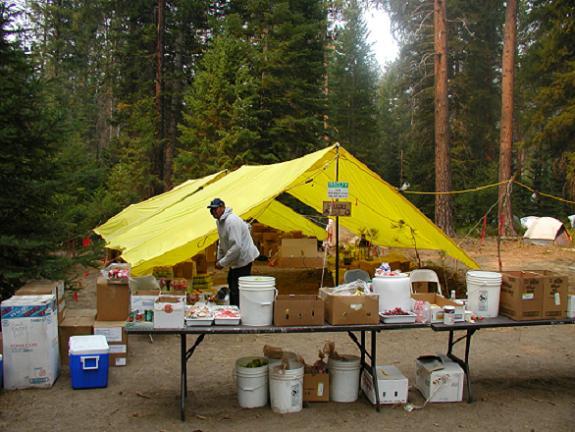
Jony took this series of photographs at the base camp for the Potato Complex Fire, which burned for 10 days in Sitgreaves National Forest in June 2006. I'm sure the cooks picture are employees of the caterer.

Thursday, April 24, 2008

Spike camp on the Trigo Incident

Even though it's a bit early to be reporting on fire camp kitchens in Northern California, they're right on time in New Mexico. InciWeb.org is reporting six major wildland fires in Arizona, New Mexico and Texas. The kitchen is feeding the 506 firefighters who're working to contain the 4,600-acre fire in the Cibola National Forest.

The Pima and Southern Pueblos Agency fire crews pick breakfast up after working on the fire line all night. Usually, meals are assembled at the base camp kitchen and transported (by truck or helo) to spike camps located close to the fire line. Joneen Cockman is the food unit leader for the fire.

Photograph by L. Kearns.

Tuesday, September 04, 2007

Kitchen at Castle Rock Fire

These are the first fire camp kitchen photographs that I've found this summer ...

Fire crews completed hand lines and bulldozer lines around the Castle Rock Wildland Fire this morning. The 48,520-acre has burned in the Sawtooth National Forest in south-central Idaho. Mop up and rehabilitation of the burned area will continue. Lightening ignited the fire on August 16, 2007.

Next to the smoke and yellow glow of the fire line, the camp is one of the most visible aspects of any firefighting operation. A camp can grow from a few tents to a bustling city within a days.

All aspects of logistic support for the fire are centered out of the fire camp, which is located at the Upper River Run ski area, just south of Ketchum. The camp is the domain of the of the vast logistics apparatus, led by Logistics Section Chief John Olney.

The Idaho Mountain Express reported that Olney's workforce of 150 men and women erected the camp "in under three days." Like any small city, this one has all the essential services you'd expect, including a state-of-the-art kitchen.

The job of feeding 1,640 firefighter and support personnel (called "overhead" in fire lingo) fell to Incident Catering Services, a mobile catering company from Snohomish, Washington. The Idaho Mountain Express reported on Wednesday, August 29, 2007:


The Food Unit, headed up by Danny Fox, sent 245 hot dinners out to firefighters on the line last night, via helicopter. They then served 1,280 meals at the camp, after dishing out 3,350 sandwiches at lunch.

"Today we served 13,000 lbs of food," explained Ray Keener, owner of Incident Catering Services of Seattle. "At breakfast we went through 500 lbs of eggs and 450 lbs of sausage."

Dinner tonight is lasagna, and the smell of tomatoes and garlic wafting from the kitchen in Upper River Run parking lot is a welcome respite from the constant charred smell of burning trees.

"You have to have a passion to feed people, take care of people," explained Keener, when asked how he manages his demanding role. "Or else you have to be nuts!"
Photo credit goes to Pat York and Gary Chase (second picture).

Saturday, August 04, 2007

Lake Tahoe Blue

The grandeur of Lake Tahoe has always amazed me. Its beep blue color makes it the jewel of the Sierra Nevada. The waters of Fallen Leaf Lake in the foreground are blue. This picture was shot from Angora Ridge, near the old lookout.

Eldorado National Forest rangers placed the Angora Lookout on the narrow Angora Ridge in 1924. Lookouts had an almost unobstructed 360-degree view of the forest in the South lake Tahoe area. This structure was built in 1935 by the Civilian Conservation Corps. The original lookout cab was converted to a residence after this one was completed.

The Angora Fire scorched the trees to the left of the lookout. The ridge formed the eastern flank of the fire. Firefighters used the ridge road as a natural fire break. Fortunately, the lookout was spared.

Tuesday, July 31, 2007

Helicopter on the Palmer Fire

We had an exciting afternoon yesterday. I worked on the laptop while my wife was in the dentist's chair. Shortly after 4 p.m., a patient walked in the office and said that she saw a large fire along the highway.

I ran to the truck, grabbed my camera and walked out to the street to view the fire. After her appointment, we spent the next hour trying to get around the fire as we made our way home.

Most of the local roads were busy, but not impassible. After taking photos of air activity, we decided to visit our daughter in Cameron Park. I took these pictures at 7:15 p.m. after Cal Fire crews had built a line around the fire and air craft had been released.

For the second time in two weeks, I was able to watch Cal Fire helicopters shuttle water to the brush fire. Here Cal Fire H-104 lands along U.S. 50 to take down its water bucket and (presumably) head to base. The pilot set the copter down in a small clearing in the chaparral.

Helitack crew members run up to the water bucket to disconnect it and place it in the cab of the helicopter. The helicopter landed about 20 feet to the north of the highway. The LZ was located about one-quarter mile east of the fire.

Monday, July 30, 2007

Close call on the Palmer Fire

A helicopter from the California Department of Forestry and Fire Protection prepares to drop water on the Palmer Fire. The fire, which burned around 20 acres in the dry chaparral between Cameron Park and Shingle Springs this afternoon, forced the evacuation of 150 homes. In the end, no homes burned.

Engine 285 from the El Dorado Hills Fire Department passes backed up eastbound traffic on U.S. 50. At this point the fire had been burning for about 60 minutes. I took this photograph from the Cambridge Drive overpass on Highway 50 while my wife was at the dentist.

Friday, July 20, 2007

Fire Camp Kitchen 1966

I found these 40-year old photos of a wilderness fire camp on the Yellowstone National Park website. The camp is identified as the Buffalo Fire Camp. I couldn't locate any information on the fire.

This picture shows the cooking area and supply tent.

The camp crew wouldn't be able to cut poles for the tent and cooking tarp today, even if they've dead and down.

Three wood-burning stoves make up the main cooking units for the fire camp. These are either wilderness pack stoves or military surplus field ranges from the pre-World War I era. These stove were used by the U.S. Army up until the start of World War II.

Tuesday, July 17, 2007

Too Close for Comfort

A large plume of smoke drifted above El Dorado County this afternoon. We first saw the smoke as we drove through the town of Plymouth in Amador County on Highway 49.

Just after the top-of-the-hour news at 3 p.m., I struggled to locate a news story on the radio. All I heard on KFBK NewsTalk Radio were the words "evacuation" and "El Dorado County Fair Grounds."

In my haste to find news, I had neglected to leave the radio dial on one station. The tail end of the story did little to comfort me.

Once we drove into our driveway, I realized the fire was burning in the area between Big Cut and Coon Hollow roads, along the east side of Highway 49.

Although my neighborhood was safe, some 50 to 60 homes were threatened by the 49er Fire according to CBS-13.

Sheriffs deputies evacuated 15 homes in the area. An additional 45 homes fell under a voluntary evacuation. The fire was contained sometime after 5:30 p.m. It burned around 30 acres.

Cal Fire Helitack 404 pulls skyward after dipping its water bucket into a local pond. I took my first photo at 3:24 p.m. and continued aiming my telephoto lens at the two helitacks working the fire for 45 minutes.

Helimax Aviation Helitack H-516 drops needed moisture on the 49er Fire just before 4 p.m. Both helicopters shuttled water between the pond and the fire for over an hour. During the six-minute round trip, the helicopters flew in a counter-clockwise pattern.

The Bell 214B1 is stationed at the Big Hill Helitack Base in Eldorado National Forest. Although two Cal Fire air tankers circled above the helicopters, I didn't see them drop any retardant on the fire.

The contractor-operated Bell Helicopter lifts up through the trees after filling its water bucket. Each pilot approached the pond from a different angle. The Helimax pilot flew straight into the pond from the north, filled the bucket and continued along his southern track as he lifted his load out of the pond.

In contrast, the Cal Fire pilot pivoted himself northward before he glided down to the pond. He approached the pond from the south. Helitack 404 was then oriented toward the fire as he gained altitude and headed for the fire.

Monday, June 25, 2007

Fire Season in Full Swing

Driving home from dinner last night I saw a smoke head bellowing from the east. My first impression told me the fire was burning just over Sacramento Hill. I rushed home to grab my camera and run up Highway 49 to get some pictures.

I soon realized the fire was aggressively burning in the Lake Tahoe basin, to the north of the town of Meyers. As of the last update about 10:30 this morning, the Angora Fire had burned approximately 2,000 acres to the south and east of Fallen Leaf Lake.

The sad news is that it has consumed 240 structures. This includes 165 homes in the Washoe Basin area along Lake Tahoe Boulevard and North Upper Truckee Road. An additional 500 homes and business are threatened as the fire moves north toward the Tahoe "Y." Cabins along Fallen Leaf Lake's east shore are also threatened.

The photo looks north from Johnson Pass in more peaceful times. Twin Peaks stands watch (center of photo) over the Lake Tahoe Airport. The Angora Fire is burning immediately to the left of the photograph.

Friday, June 08, 2007

Noon Meal at Greensburg

Emergency responders pick up sack lunches at the tornado base camp in Greensburg, Kansas. Two hot meals are typically served to emergency responders working forest fires and similar incidents. An enhanced sack lunch is passed out for the noon meal.

Under the 2007 national mobile food services contract, caterers are required to provide the following menu items in each sack lunch:
  • Meat sandwich or vegetarian substitute

  • A second entree, such as a pizza pocket or burrito

  • Fresh fruit or dried fruit package -- dried fruit can only be served once in three days

  • Packaged cookies, brownie or granola bar

  • Two canned fruit juices totaling 11 ounces

  • Packaged snack, such as candy, trail mix, fresh vegetables, pretzels, jerky, shelled nuts or dried/cured meats and cheeses

  • Appropriate condiments

  • Two paper napkins and pre-moistened towelettes
This is a pretty hefty meal that's been formulated for emergency response workers, like wildland firefighters, who exert large amounts of energy on the job. The contractors are required to serve variety, which can be difficult when you consider the limited supply of non-perishable items that can be placed in a sack lunch.

Typically the crews pick up there lunches from a central point after breakfast. Each responder carries his lunch in a day pack until released for lunch. Except for crews located a spike camp, breakfast and dinner are served from the catering trailer in camp.

Photo credit: Mike Ferris of the U.S. Forest Service.

Sunday, March 25, 2007

Crown of the Peavine Ridge Forest

This impressive stand of conifers guards the southern entrance to the Crystal Basin in Eldorado National Forest. Ice House Road marks the lower end of the grove. This stand is one of many survived the Cleveland Fire along the southern slope of Peavine Ridge. Here's what the U.S Forest Service had to say about these survivors:
Within the fire perimeter, a few areas of large trees survived the conflagration and the living trees stand in stark contrast with their surroundings. Activities that began some 13 years previous had made the difference. In 1979, about 150 acres near the Cleveland Corral Information Station had been prescribed burned with repeat burning in 1981. A 30 acre stand of trees was prescribed burned for a third time in the Spring prior to the Cleveland Fire. Amazingly, when the 100 foot tall flames burning in the crowns of the neighboring trees approached this stand, without the buildup of dead woody material on the ground, the flames dropped to the ground and left the larger trees alive (via ElDoradoCounty.net).
The fire grew from a humble five-foot diameter fire when reported to a crown fire that danced along the tree tops withing minutes on September 29, 1992. The fire claimed the lives of two pilots. It wouldn't be declared controlled until October 14 and burned 22,485 acres along U.S. Highway 50 in the vicinity of Riverton.

Wednesday, October 25, 2006

Note on the Skunk Fire

"Firefighters breathed a sigh of relief Wednesday morning after a wildfire that burned 92 acres in El Dorado County was fully contained," reported the Sacramento Bee at 8:50 a.m.

Quick response by the California Department of Forestry and Fire Projection may have saved any number of homes in the largely rural area.

The Bee story describes the response in terms of the resources committed to the Skunk Incident:

Battling the blaze at its height were about 200 firefighters, 18 engines, eight inmate crews, four air tankers, three helicopters and one air attack aircraft, according to the CDF.
Although such a response can be costly for these incidents, this is one area where I don't mind committing hard-earned tax dollars.

I'd rather knock down these fires that occur in the foothills in the vicinity to homes and businesses first before committing millions to fires in the national forests and parks that are away from life and property.

Skunk Fire Contained

As of the 7 a.m. report on the CDF website, the Skunk fire is being reported as fully contained. Interestinly, the New10 story that was last updated at 9:58 a.m. makes no mention of the 100 percent containment.

Tuesday, October 24, 2006

Skunk Fire

Even at this late date, fires like the Skunk show that the Northern California fire season is not over. I snapped this photo from my back yard at about 6:10 this evening. The CDF Bell Huey was flying to the northwest toward a new fire burning in the brush east of Folsom Lake, about 15 miles from my home.

A vehicle fire spread this afternoon into the nearby brush along Salmon Falls Road in El Dorado County. Currently at 80 acres, this fire has the potential to blow up.

"A red flag warning is in effect Tuesday night through Wednesday afternoon," according to a KXTV Internet news story updated at 6:14 p.m.

"News10 meteorologist Monica Woods said breezy north winds will make for dry conditions," said writer C. Johnson. "Tuesday night northwest winds are expected to be between 15 and 25 miles per hour with gusts up to 35 mph."

Wednesday, October 04, 2006

Dinner at Tailholt Spike Camp

This spike camp dinner line was set up at a location called Tailholt in the Payette National Forest in Idaho last August. Most of the menu items are being served straight out of its original packaging. The Tailholt Fire was part of the larger South Fork Complex. The complex is a series of nine lightening fires that burned from August 8, 2006.

Photo credit: K. Seay.