Thursday, February 15, 2007

Cookin' on the Railroad

Good food and railroads had symbiotic relationship until Amtrak took over passenger service in the early 1970s. Mainline roads were know for operating high-class diners as their trains crossed the country. Even the logging companies and their railroads used food draw employees. Many loggers were known for their cookhouses.

It was nice to see another railroad that cooks in the engine house like we do at the El Dorado Western.

My counterpart on the Pacific Coast Railroad Co. blog, Ed "Oil Can" Kelly, recently posted his January 2006 update. The crew gathered mid-month to thaw the engine house and trainmen at the height of California's deep freeze last month.

A busted water main left as flood in the engine house. The coffee pot, beef brisket and a frozen fireman's manifold competed for space on the shop's wood stove.

"Sometimes I am also the cook for this outfit and the chief bottle washer as well," said chief mechanical officer Phil Reader in response to my message on the Narrow Gauge Railroad Discussion Forum.

"Dutch ovens are a lot of fun. I get a kick out of using them."

I agree. Dutch ovens are a great way to combine my love for outdoor cooking and trains. A hearty meal in the engine house can bring the crew together. It's akin to mealtime tradition in the caboose.

So it seems natural that a train guy like Phil would cook in the steam locomotive. You have the essential ingredients for great railroad chow. Heat from the backhead and a hungry crew make for the perfect combination.

Cooking on the backhead is a tradition at the PCRR. Simplicity seems to be the rule. No gourmet foods on these rails. Spam and eggs, burritos and canned chili beans make perfect railroad fare.

"Someday I may have to write the steam railroader's backhead cookbook," said Phil.

Tuesday, February 13, 2007

Friday, February 09, 2007

Grill Cook for the Gator Flleet

This photograph brings memories to mind. I spent many early morning hours grilling eggs for the sailors at Naval Air Station Lemoore, in California's Central Valley.

The only difference was we didn't grill six or eight omelets at a time. We didn't have time. Five hundred to 1,000 sailors lined up each morning at the airfield galley where I worked.

When omelets were on the menu, I'd spread a layer of whipped eggs over the griddle. Just before the egg set up, I'd sprinkle grated ham and cheese over the surface and cut and fold the eggs. You had to learn to work fast and keep the griddle working.


Virginia Beach, Va. (Feb. 6, 2007) - Culinary Specialist 3rd Class Eric Williams prepares eggs for the breakfast crowd. Gator Inn, the Naval Amphibious Base Little Creek galley, was awarded first place in the continental U.S. ashore general mess category of the 2007 Captain Edward F. Ney Memorial Award for food service excellence.

U.S. Navy photo by Mass Communication Specialist Seaman Ash Severe.

Wednesday, February 07, 2007

Smothered Chicken from Cee Dub

It's always gratifying when someone likes one of my recipes. C.W. "Butch" Welch, cookbook author and proprietor of CeeDubs.com, left the this comment on the Yahoo! Dutch oven group the other day:
Steve,

I like your modifications to the recipe! I encourage folks at all the demos I do and clinics to treat recipes regardless of the source as an outline. I like to see folks take something I've done and expand on it!

Cee Dub
I baked a version of his DISCO chicken (Darn Incredible Stuff Cooking in Oven, or something like that) for the El Dorado Western Railway two weeks ago. My recipe for smothered chicken can be found here.

A post on the Yahoo! prompted me to look up the recipe and see if I could use it. After reading Cee Dub's recipe (it's in his More Cee Dub's Dutch Oven and Other Camp Cookin'), I though it would be a great pick-me-up for the crew down at the engine house.

Once the dishes were cleaned, I went back and added my thoughts to the long thread that had since developed. Cee Dub came 'round the other day and added his endorsement.

Thanks, Cee Dub.

Friday, February 02, 2007

Faith Matters

Sports has had little impact on my life. It’s not that I dislike sports. I just don’t pay any attention to football, baseball or basketball. I'd rather sit by a rushing Sierra Nevada creek than to play volleyball or golf.

And I probably won’t find out who won the Super Bowl until late Monday evening. I can't even tell you which team is favored to win.

So I wouldn't have found the feature article on Tony Dungy and Lovie Smith from the Miami Herald's on my own initiative. My supervisor handed me the Sacramento Bee sports section this morning and said, "You'll find this interesting."

Sandi's husband is the sports enthusiast her family. I have him to thank for making me aware of these two coaches.

Without Sandi's prompting, I would never have known that the two reigning football coaches in the country are men who place a higher value on their individual relationship with God than worldly coaching techniques.

Although one of these men will go down in history as the first African American NFL coach to win a Super Bowl title, skin color is not what makes Dungy and Smith stand out from other coaches.

These men have nurtured a life-changing relationship with the God of Heaven according to the article.

But the more you learn about these two men, the more it becomes apparent their close friendship stems from something far deeper than race -- their convictions. Both are devout Christians who don't drink or curse.

In my book, it's their apparent hold on the message of the cross that makes these men stand out.

The church of Corinth was one that tried to follow the code of wordly wisdom in their dealing with each other. Division and the creation of sects, placing too much emphasis on human leaders, accepting blatant sin among members of the church and conducting disorderly worship marred the congregation.

The apostle Paul said:

For the message of the cross is foolishness to those who are perishing, but to us who are being saved it is the power of God (1 Corinthians 1:18).

Paul takes the 16 chapters of his Corinthian epistle to explain what the "power of God" means to the Christian. Christians are men and women who place God first in their lives. They have learned to love God with "heart ... soul ... mind" (Matthew 22:37).

This means that Christians place God first in their lives. They "seek first the kingdom of God and His righteousness" (Matthew 6:33a). This means relationships with neighbors, including football players, are always conducted in a Godly manner.

Writer Michelle Kaufman reported that neither drinks or curses, characteristics that the world often lifts high. These character traits are symptoms of something greater. They show that Dungy and Smith have set aside human traits and have replaced them with Godly fruit, as Paul said:

"But the fruit of the Spirit is love, joy, peace, longsuffering, kindness, goodness, faithfulness, gentleness, self-control. Against such there is no law" (Galations 5:22-23).

I suspect that these men are strong coaches, men who have learned to use their God-inspired love for their players for good. "Rather than belittle players with profanity-laced tirades on the sidelines, they shoot a stare that delivers the message loud and clear," said Kaufman.

I'm certain Super Bowl XLI will be a unique game. One history-making coach will be the first African American coach to lead his team to the title.

But Dunge and Smith have a higher calling. Each coach is running his personal life like a football game. Paul said: "Do you not know that those who run in a race all run, but one receives the prize? Run in such a way that you may obtain it" (1 Corinthians 9:24-25).

Both Dungy and Smith are running to obtain "an imperishable crown" at the end of life's race.

Cookin' The Books

During my time at sea (in the 1970s), the watch captain prepared a NAVSUP Form 1282 each watch. As the senior cook on watch, the watch captain formulated a requisition for the following day's food needs in the galley.

Once approved by the chief, the jack of the dust -- the Navy term for the subsistence storeroom supervisor -- fulfilled the order. The JOOD didn't run a delivery service. I usually sent the mess cooks to the storeroom and reefers to hustle the food up to the galley.


Pacific Ocean (Feb. 1, 2007) – Culinary Specialist 2nd Class Jimnett Santos checks food order forms for accuracy in the galley aboard the Nimitz-class aircraft carrier USS Ronald Reagan (CVN 76). Ronald Reagan recently received the Captain Edward F. Ney Award for excellence in food service for aircraft carriers. The Ronald Reagan Carrier Strike Group is currently underway on a deployment in support of U.S. military operations in the western Pacific.

U.S. Navy photo by Mass Communication Specialist Seaman Kathleen Gorby.

Sunday, January 28, 2007

Freeze No More

The daily low temperature has slowly risen to the high 30s over the last two weeks. The mercury hit bottom at 22 degrees the day I cooked potato soup at the El Dorado Western Railway engine house. The low in Placerville didn't rise above 30 until January 18.

The temperature in nearby Grizzly Flats sat low 30s in the day Jacob and I drove down North-South Road. North-South crosses the icy creek midway between Mormon Immigrant Trail and Capps Crossing. In the summer, it's a popular "dispersed" camping spot. The Forest Service allows campers to settle along the north shore of the creek.

Saturday, January 27, 2007

Rice Pilaf

Rice pilaf is the perfect accompaniment to many Dutch oven entrees. It’s easy to prepare and the cast iron Dutch oven adds an element of forgiveness. You can forget the rice for a few minutes, and it’ll still come out light and fluffy.

To cook wonderful pilaf, lightly browning rice in hot oil. The browned grain gives off a nutty flavor that compliments the stock that’s used to cook the rice. For perfect rice, boil the stock before adding it to the browned rice and sauteed vegetables.

I rarely cook this dish the same way twice. I often use use my basic rice pilaf recipe to get rid of leftover condiments and salsa from the refrigerator.

Today at the El Dorado Western Railway engine house, I added two chopped roasted red peppers from a jar that's been in the cooler for several months. I will often replace up to one-third of the broth with a liquid-based flavor enhancing condiment. My favorites are salsa, tomato sauce and sundried tomato pesto.

RICE PILAF

This recipe prepares enough for 12 persons. Figure about 1/4-cup raw long-grain rice per serving.

3 tablespoons vegetable or olive oil
1 medium onion, chopped
3 cloves garlic, minced
2 large roasted red peppers, chopped
2 teaspoons chopped fresh thyme
2-1/2 cups long grain rice
4-3/4 cups chicken broth
Salt and pepper to taste

Pour oil in 12-inch Dutch oven and heat over medium-high heat. Add onions and sweat. Add garlic and sweat until soft. Add rice, coat with oil and lightly saute until rice is a light brown color. Add broth, salt and pepper and stir to combine.

Place lid on oven. Arrange 7 charcoal briquettes under the oven and 15 on lid. Bake for 20 to 30 minutes, until done. Fluff rice. Serves 12.

Smothered Chicken Breasts with Mushroom Sauce

Unlike the freeze of two weeks ago, the thermometer hovered around the mid-40s at the engine house of the El Dorado Western Railway this morning. We capped productive week with a hearty meal.

Here's what happens when you offer food to the trainmen at the El Dorado Western Engine House:

About noon, I commented to EDWRF President Eric Stohl that the crew was sticking around for the meal. Eric (in white coveralls) didn't seem that amused.

"Yea, but I'm loosing productivity here!"

I think the crew ignored him. Nine volunteers (including the cook) scarfed a large pot of smothered chicken in mushroom sauce. The rice pilaf and cucumbers salad disappeared as well.

SMOTHERED CHICKEN BREASTS WITH MUSHROOM SAUCE

I like Pepperridge Farms Herb Seasoned Stuffing because it makes a coarse bread crumb topping. You’ll need about two-thirds of a 16-ounce package. Substitute seasoned bread crumbs if desired.

2 large onions, sliced
1 pound mushrooms, sliced
6-ounces unsalted butter, divided use
5 pounds chicken breasts
3 (10-3/4-ounce) cans condensed cream of mushroom soup
3/4 cup dry sherry
1 tablespoon chopped fresh thyme
4 cups seasoned bread stuffing mix
1/4-cup chopped Italian parsley
2 (5-ounce) packages shredded Swiss cheese

Heat a 14-inch cast iron skillet over medium-high heat. Melt butter in skillet. Set 4 tablespoons melted butter aside for later use. Add onions and mushrooms. Lightly season with kosher salt. Stir onions and mushrooms frequently for about 2- to 30 minutes until soft, translucent and golden brown golden brown. Set aside in bowl.

Return skillet to heat. Brown chicken breasts over medium-high heat until browned, turning once. Don’t crowd chicken in skillet. Remove chicken to cutting board. Cut against the grain into 1/2-inch slices. Set sliced chicken breast in a single layer in a 14-inch Dutch oven.

Spoon caramelized onions and mushrooms over chicken. Mix soup, thyme and sherry until smooth. Pour over onions and mushrooms. Mix bread stuffing mix, parsley and reserved melted butter. Spread bread mixture over sauce in Dutch oven.

Bake in a 350-degree oven (8 charcoal briquettes underneath oven and 20 on lid) for about 35 minutes. Bread crumbs should be toasted. Spread cheese oven bread crumbs and return lid to oven. Bake an additional 10 to 15 minutes or until cheese has melted.

Nine trainmen ate the whole dish today at the engine house. If you allow 5-1/3 ounces chicken per person, you can serve 15 normal eaters.

Friday, January 26, 2007

Winter Camp Cookoff Update

Don Mason just sent me this note:

Winter Camp Cookoff is being held on February 10, 2007 in the parking lot of Our Lady of Lourdes School, 745 Ware Ave., Coluda, California. The event is sponsored by the Sacramento River Cast Iron Cookers. Contact Vickie Stegall at (530) 458-8009 for additional information.

Gates open at 7 a.m. The cooks meeting starts at 8:30 sharp. And tasting begins at 1 p.m.

My blog on the cookoff is posted here.

Thursday, January 25, 2007

Capps Crossing Bridge

I love the quite solitude of the Sierra Nevada is winter. A holiday drive up the Mormon Emigrant Trail gave my son and me the chance to soak in warmth from a campfire at our secret spot. After a lunch of grilled sandwiches, we drove down North-South Road and stopped at Capps Crossing Campground to hike and look around.

This structure bridges the North Fork of the Consumnes River. Built in 1932 by the U.S. Forest Service, the bridge is now closed to vehicles. I'm certain that the steel and timber bridge made crossing the river much easier, especially over swift water of spring. A large concrete bridge spans the river today.

Monday, January 22, 2007

Northern California Dutch Oven Cookoff Schedule

Here's the cookoff schedule for Northern California, Nevada and Oregon from Don Mason:

I posted an updated version of the cookoff list on Tuesday, January 23, 2007.

Saturday, January 20, 2007

Sunset over Plummer Ridge

I hiked Trestle Trail in Eldorado National Forest last Sunday afternoon. It was nearly 5:30 p.m. after I made a brisk mile-long hike up the old Steely Fork railroad grade to the truck. The bright orange hues of the sun as it set over Plummer Ridge caught my eye. The photo is a little grainy. Next time I'll carry the tripod and shoot the picture at a much lower ISO.

Friday, January 19, 2007

Trestles on the Steely Fork Branch Line

Once the rails of the Diamond & Caldor Railway reached Caldor, some 34 rail miles east of Diamond Springs, three main feeder lines fanned to the north, east and south of the mill. The California Door Company used these lines to haul the freshly cut logs to its mill each day during the six to seven month logging season.

One of these feeder lines is still viable in the Eldorado National Forest several miles east of Grizzly Flat. The Steely Fork line ran northwest from the mill. At its northern most limit, it reached Bear Meadow.

The narrow-gauge expansion began in 1907. The line encompassed some 50 miles of logging spurs. The line allowed the company to log along North and South Steely creeks to Capps Crossing on the North Fork of the Consumnes River. The line reached Long Canyon and Bear Meadow to the west.

The Steely Fork line heads to the west as it climbs out of the Steely Fork canyon. This cut is found a hundred feet west of the ruins of the river trestle. The Steely Fork trestle crossed the river just west of the confluence of the North and South Steely creeks.

One of the few trestle bents that's remains upright. All four trestles collapsed years ago. Today the heavy timbers are slowly rotting.

The first trestle can be reached after a 10 minute hike from the Trestle Trail trail head. It's still possible to see some organization to the heavy bridge timbers on the ground. I was able to count a dozen or more bents at this trestle site. Most of the timbers (10x10 or larger) are in very good condition considering it's been 54 years since abandonment.

Bridge timbers are lined up on the ground between the eastern and western landings. This picture looks to the east.

Cross-posted at El Dorado Western Railway blog.

Thursday, January 18, 2007

Remembering Dr. King at Sea

Norfolk, Va. (Jan. 16, 2007) -- Culinary Specialist Seaman Devin Aikene prepares a cake in remembrance of Martin Luther King Jr., aboard USS Theodore Roosevelt (CVN 71). The nuclear-powered aircraft carrier is currently maintaining qualifications as part of the fleet response plan.

U.S. Navy photo by Mass Communication Specialist Seaman Kenneth Mays.

Navy Chef Mans the Guns

Mediterranean Sea (Jan. 17, 2007) - Master Chief Culinary Specialist Scott Montgomery stands watch on the MK-38 25mm machine gun aboard the multi-purpose amphibious assault ship USS Bataan (LHD 5) while transiting through the Mediterranean Sea. Bataan, commanded by Capt. David Hulse is on a regularly scheduled deployment as the flagship of the Bataan Expeditionary Strike Group (ESG).

U.S. Navy photo by Mass Communication Specialist 2nd Class Justin Webster.

Sunday, January 14, 2007

Ice in the Pipes

Freezing temperatures in California take all the fun out of gardening in the Bay Area. My sister Elizabeth reported via email:
Here's my COLD story. I was attempting to water our yard this morning when the nozzle on the hose appeared to not be working. So I thought I'd just remove it and water straight from the hose. See (the picture) for the real problem!
According to the National Weather Service, a freeze warning remains in effect for much of Northern California. "A dry and very cold airmass will remain in place over Northern California through at least the first part of this week ... resulting in cold overnight and early morning temperatures."

We can expect temperatures in the teens and twenties to continue across the Sacramento Valley, the Delta, the Motherlode and Southern Lake County, including the Clear Lake area. Overnight lows in California's Central Valley will decrease by a degree or two each morning.

Overnight lows should reach above freezing by Wednesday.

Saturday, January 13, 2007

Potato Soup in the Engine House

Northern California is in the middle of a freeze this weekend. I realize that temperatures in the lower 20s don't match the brain-numbing temperatures of the northern United States.

I thought a thick potato soup with leeks would warm the trainmen at the El Dorado Western engine house around noon. Like the loggers who ate in the camp kitchens of the California Door Company, our workers appreciate a hearty meal that fills the belly and warms the soul.

I prepared the soup in the 6-quart Dutch oven that I picked up at a Placeville antique shop last July. It's interesting that I commented on the 100-degree heat and power outage when I wrote my blog.

Under normal circumstances, the soup only takes about 1-1/2 hours to prepare. But the cold weather added an additional 30 to 45 minutes to the process. Although the temperature at the engine house was in the high 30s this morning, the dry conditions made cooking with charcoal easy.

I used Yukon gold potatoes because they added a nice, creamy texture to the soup. And the soup gave me an opportunity to use the pint-sized jar of garlicky Alfredo sauce that's been in the cupboard for several months.

I forgot to purchase chives at the market this morning. Strips of the tops of the leeks made a nice substitute. Also try frying julienned leeks in hot oil for garnish.

POTATO LEEK SOUP

Substitute an equal amount of heavy cream for the Alfredo sauce if desired.

1/4 cup unsalted butter
2 leeks, white and light green parts sliced thinly
6 tablespoons all-purpose flour
2 (14-ounce) cans low-sodium chicken broth
6-7 medium Yukon gold potatoes, peeled and diced
1 (16-ounce) jar garlic Alfredo sauce
Salt and ground black pepper, to taste

Garnish:

1 pound bacon, cooked and crumbled
1 bunch chived, chopped
3-ounces grated Parmesan cheese

Melt butter in a 6-quart Dutch oven over medium heat. Sweat leeks until soft, about 3-5 minutes. Stir in flour and cook for several minutes. Do not scorch flour.

Add potatoes and broth. Cook until potatoes start to crumble, about 20-25 minutes. Mash mixture with a potato masher. The soup will be chunky. Add Alfredo sauce and gently bring to serving temperature. Season with salt and black pepper to taste.

Garnish each bowl with chopped chived, crumbled bacon grated Parmesan cheese. Makes about 10 (8-ounce) servings.

Technorati Tags: , , , , , ,

Thursday, January 11, 2007

5th Annual Winter Camp Dutch Oven Cookoff

Here's notice of the 5th Annual Winter Camp Dutch Oven Cookoff in Colusa, California on Saturday, February 10, 2007.

Sunday, January 07, 2007

Trestle Trail

This afternoon I took advantage of a light snow pack in the old logging area of the California Door Company. I've been looking for a weekend where I could survey the Trestle Trail in Eldorado National Forest east of the community of Grizzly Flat.

Very little evidence of the Diamond & Caldor Railway and its parent company, California Door Company, remain in the forest. Trestle Trail is a hiking trail that travels along one of the logging company's main feeder lines north of Caldor.

Here are three photos of our hike:

To access Trestle Trail, take Capps Crossing Road from Grizzly Flat to Forest Road 9N86. Continue east along the road for a half mile. Turn right onto Road 9N86A. An abandoned vehicle about three-tenths of a mile down the road partially blocks the road.
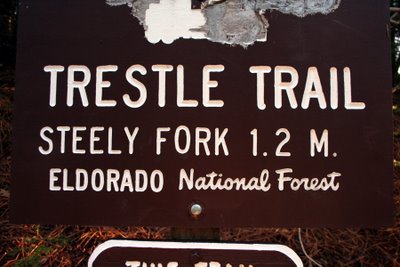
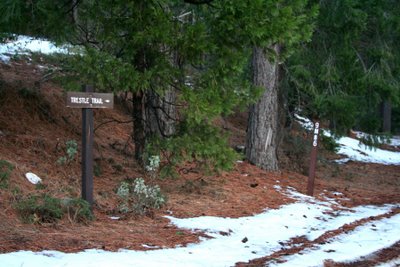
After you drive another half mile (or so -- I didn't clock it), you'll see this sign to the left up on the old railroad grade. Park your car in the wide spot and hike the trail.
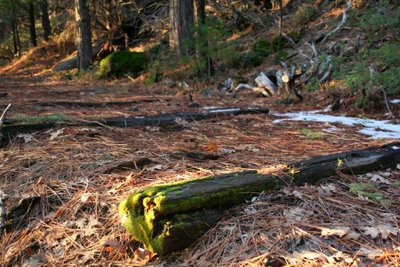
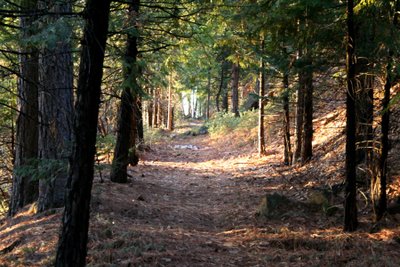
Partially buried railroad ties are visible a few hundred feet from the trail head. Please don't disturb the ties.

You can visualize a Shay locomotive pulling a consist of empty skels up the grade toward Camp Webster.

Here's what the Eldorado National Forest website has to say about the trail:

Trestle Trail: Follow the Capps Crossing Road from Grizzly Flat or the North South Road (Forest Route 6) to the dirt road 9N36. Turn south on this road and stay to the right for approximately one-half mile to the trailhead. This pleasant foot trail follows a railroad grade for 1.2 miles to the site of the main bridge (removed) over Steely Fork Creek. The trail is in excellent condition, and passes three collapsed trestles (wooden railroad bridges) on the steep hillside. Return to the trailhead along the same route.
Technorati Tags: , , , , , ,