Sunday, September 04, 2005

Tri-Tip Roast with Mushrooms and Onions

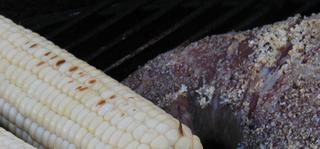
Two of my favorite summer foods are tri-tip roast and grilled corn-on-the-cob. Tri-tip has been available for $2.99 to $3.99 per pound through most of the summer. Local Raleys and Bel Air markets have a sale running though tomorrow. I plan to pick up a few more roasts for the next couple weeks.


GRILLED TRI-TIP ROAST WITH MUSHROOMS AND ONIONS

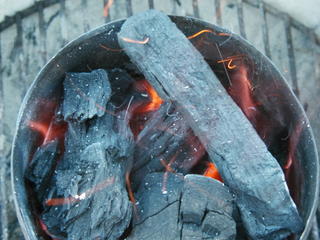
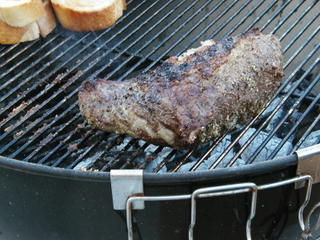
The roast will develop a seasoned crust as it cooks over the searing fire. To prevent overcooking, use a two-stage fire. Spread the coals to create a hot zone for searing and developing the crust. The cool zone is used to cook the roast to a consistent medium rare color inside.

2 pounds tri-tip roast
Kosher salt, to taste
Garlic powder, to taste
Onion powder, to taste
Fresh ground black pepper, to taste
2 tablespoons unsalted butter
1/2 cup sliced onions
8 ounces sliced mushrooms
3/4 cup low-sodium beef broth
1 tablespoon balsamic vinegar

Prepare mesquite lump charcoal or charcoal briquettes for grilling. Spread hot coals to create a cool zone and a hot zone. Season the tri-tip roast with kosher salt, garlic powder, onion powder and fresh ground pepper to taste. Place roast fat side down on grill for 10 minutes. Turn and continue cooking until medium-rare or it reaches desired doneness, about 30 additional minutes for medium-rare.

Move meat to the cool zone for the last 20 minutes. Remove roast when internal temperature reaches 135 degrees for medium rare or 145 degrees for medium. Place roast on a platter and tent with a sheet of aluminum foil. The temperature of the roast will rise 5 to 10 degrees while it stands.

Meanwhile, caramelize the onions. is Heat a 10-inch cast iron skillet over medium-high heat and melt the butter. Add onions and mushrooms to skillet. Lightly season with salt and pepper. Stir onions and mushrooms frequently for about 10 minutes, until golden brown.

Add beef broth and balsamic vinegar to onions and mushrooms. Reduce over medium heat until broth is thickened to a glaze, about 5 to 10 minutes. The onions and mushrooms sweeten as the broth evaporates.

Tent roast with a sheet of aluminum foil and rest for 10 minutes. Carve roast against the grain into thin slices. Serve with onions and mushrooms. Serves 6.

Saturday, September 03, 2005

Campfire Corn-on-the-Cob, Part 2

Two of my favorite summer foods are tri-tip roast and grilled corn-on-the-cob. Fresh corn can still be purchased at a quarter apiece, up recently from five to the dollar. It's sweet and plentiful. It looks like we'll be munching on the ears for several more weeks.

For variety, I cook corn three different ways. My cobs rarely see the inside of a stockpot. It takes too much effort to fill the pot and heat the water to a boil. Don't get me wrong -- simmered corn is good. I just rarely cook it this way.

I grilled most of my corn, shucked or unshucked. The intense heat of the grill concentrates the sugars and adds a robust flavor. Coarse salt and melting butter are the only adornments for grilled corn. A few pepper grinds and that's it.

The only question left is to pull the husks off or leave them on. To me, the answer is, "It just depends."

The simplest method is to lay the corn--husk and silk included--over a very hot fire and roast until the husk has dried out and is charred. That's it. All you have to do is peel the husk back and butter and season.

Don't worry about the silk. It comes right off when you peel the husk back. Just pull it off the ear and throw it into the fire.

Last night, I was prompted by a Wednesday food section article to clean the hush and silk from each ear before grilling.

Associated Press Writer J.M. Hirsch said, "The grilling itself is a careful process. Corn singes easily, and corn singe doesn't taste good. As I said, a painfully elaborate process for wonderfully simple food" (Sacramento Bee, Taste, August 31, 2005).

Hirsch hearkened back to childhood when his father's corn cooking days of yesteryear., After a prophetic pronouncement of the "best corn ever," his father cooked his corn "simple."

The senior Hirsch husked the ears and then filled a large stockpot with an inch of water. The corn was steamed until tender. Nothing but butter and salt adorned the kernels.

Now in the corn cookin' prime of his life, Hirsch's own experiences with corn grilling led him back to his father's method, with a few refinments. Flavored butters and coarse salt are all that adorn his corn these days.

My experience with grilled corn is mixed. Unlike Hirsch, I don't have a corn singeing problem. The ears had a slight smokiness after being grilled over mesquite coals. But, leave them on the grill a minute or two too long and you too much moisture evaporates. The kernels were flat, but still good with butter and kosher salt.

I guess I'll have to try Hirsch's method next time!

New Photo for Profile

I've uploaded a new photo of myself. The one was taken at camp last July.

BBQ Junkie -- A California Barbecue Blog Worth Viewing

Looking for an outdoor blog dedicated to California barbecue? Try BBQ Junkie -- a Los Angeles barbecue odyssey.

The tag line says it all: "BBQ Junkie is a blog that focuses on what's happening in the Southern California barbecue scene. Here you will find recipes, restaurant reviews, book reviews, and other useful information on barbecue."

BBQ Junkie is worth a visit for dedicated BBQ fanatics. It appears to have a good mix of reports from the Southern California barbecue scene.

Recent posts include: Charcoal chimney starter, Becoming a Certified BBQ Judge and Hawaiian BBQ Kalua Pig.

Updated Listing of Incident Management Team Mobilizations for Katrina

Here's an updated list of National Interagency Incident Management Teams (Type I unless noted) that have been mobilized on in response to Hurricane Katrina:

Southern Area Incident Management Team, Blue Team (Incident Commander Mike Quesinberry) -- mobilized August 28. The team is managing a mobilization center in Meridian, Mississippi.

Southern Area Incident Management Team, Red Team (George Custer) -- mobilized August 28. The team is managing a field hospital and refugee camp at the Louis Armstrong New Orleans International Airport in Port Allen, Louisiana.

California Interagency Incident Management Team 2 (Bill Molumby) -- mobilized September 1. The team is being assigned to San Gabriel, Louisiana.

California Interagency Incident Management Team 3 (Jeanne Pincha-Tulley) -- mobilized August 28. The team is managing two camps and supporting the receiving and distribution of relief supplies at Stennis Space Center in Mississippi.

California Interagency Incident Management Team 4 (Aaron Gelobter) -- mobilized August 30. The team is managing a base camp at Montgomery, Alalamba.

California Interagency Incident Management Team 5 (Tom Cable) -- mobilized August 31. The team is assigned to Metairie, Louisiana.

New Mexico Incident Management Team (Type II) (Bob Lineback). The team is providing support for the receiving and distribution of supplies and resources at a mobilization center in Camp Beauregard, Pineville, Louisiana.

Rocky Mountain Area Team A (Type II) (Marc) Mullenix). The team is being assigned to San Antonio, Texas.

I'm looking for information on their feeding operations. Likely feeding of victims of Hurricane Katrina is being done by the American Red Cross, Salvation Army and other large relief organizations. Base camp feeding for relief workers is usually handled by catering contractors.

Friday, September 02, 2005

FEMA National Situation Update

Here’s a few food and shelter reports from the FEMA National Situation Update for Friday, September 2, 2005:

  • Planning to move 4 million MREs daily for the next three days. An MRE, or Meal, Ready to Eat, is the U.S. military version of the brown bag lunch.

  • 76,000 people being sheltered (Steve: total across the region).

  • Logistics: Searching alternate sources for meals; 2 million MREs are going into the affected area.

  • Mississippi Emergency Operation Center (EOC): Shortages of MREs and getting food to shelters; NGOs (Non-Government Organizations) and faith-based organizations are arriving, but still having problems providing meals; 8 refrigerator trucks have arrived (Steve: these truck may be for bodies); expect to have 100,000 people in shelters across the state.

  • Alabama EOC: 15 shelters are open and housing 1670 people; 20 distribution sites in 6 counties (1.9 million pounds of ice distributed; 460,000 MREs distributed); 8 mobile kitchens are in place and 7 more to arrive.

  • Louisiana EOC: No food or shelter reports.

  • Texas EOC: 81 shelters available for 44,258 people; 44 are open and housing 9,346 people.

Incident Management Team Mobilizations for Katrina

The following additional National Interagency Incident Management Teams (all are Type I teams unless noted) have been mobilized on in response to Hurricane Katrina:

The National Incident Management Situation report can be found here. It’s updated daily and contains wildland fires and natural disasters, like hurricanes. These reports usually give a synopsis of Incident Management teams mobilized to manage the incident, recourses ordered (personnel and equipment) to the incident and containment (for fires).

As these teams get established, they should start posting incident information like photographs, news releases and information bulletins on their respective websites. You may even get a glimpse or two of the catering trucks.

Military Hurricane Relief Focuses on Saving Lives, Reducing Suffering

By Donna Miles, American Forces Press Service

WASHINGTON (9/1/2005) — Military support for the hurricane-stricken Gulf Coast intensified today as more troops and assets arrived in the region, where responders are focusing on saving lives and relieving suffering among thousands of the hurricane’s victims, the commander of Joint Task Force Katrina told Pentagon reporters today.

Speaking to reporters by satellite phone from Biloxi-Gulfport (Miss.) Regional Airport, Army Lt. Gen. Russel Honore outlined details of a massive DoD effort to support the Federal Emergency Management Agency, state governors, and other federal, state and civil authorities in the hurricane-stricken region.

More than 13,000 Army and Air National Guard members were on state active duty this morning in Louisiana, Mississippi, Alabama and Florida, a number expected to surge to more than 20,000 by the day’s end, National Guard Bureau officials reported.

Honore said the National Guard currently has 4,700 National Guardsmen on the ground in Louisiana and 2,700 in Mississippi. In Louisiana, those numbers will increase to 7,400 later today and 8,600 by Sept. 2, he said. In Mississippi, 6,000 guardsmen will be on duty by nightfall and 9,500 by Sept. 2.

Pentagon spokesman Larry Di Rita told reporters today the total National Guard contribution to the effort is likely to spike closer to 30,000 in the days ahead.

Many of those troops will be dedicated to the law-enforcement mission, helping local and state law-enforcement officials in maintaining security, he said. Unlike federal troops, the guardsmen operate under their state governors’ authority and are not subject to laws that prevent active-duty troops from performing law enforcement in the United States, U.S. Northern Command officials explained.

In addition, more than 7,000 active-duty troops, mostly Navy, were also supporting hurricane-relief operations in the region, a number defense officials acknowledged will increase as required.

USS Harry S. Truman, a Nimitz-class aircraft carrier, was preparing to leave Norfolk, Va., today to serve as a command center and afloat staging base, Lt. Trey Brown, a Navy spokesman, confirmed. Truman is expected to carry additional helicopters from Naval Air Station Jacksonville, Fla., to support search-and-rescue operations.

USS Whidbey Island, a dock landing ship also based in Norfolk, was also slated to depart for the Gulf today. Once there, it will help move heavy equipment ashore in areas not accessible by land, Brown explained.

In addition, National Guard troops and elements in every state except Hawaii and Guam were either supporting or poised to support the effort if needed, Army Lt. Gen. H Steven Blum, chief of the National Guard Bureau, told Pentagon reporters Aug. 31.

The military support is concentrating on three priorities President Bush laid out during an Aug. 31 statement to the nation: first, save lives; second, sustain lives with food, water, shelter and medical supplies; and finally, execute a comprehensive recovery effort.

Toward that end, Honore said, the primary emphasis is on conducting search-and-rescue missions and providing other life-saving support, such as getting people to the medical care they need. Equally critical, he said, is getting food and drinkable water to those left homeless by Katrina.

The task force is also helping the Louisiana National Guard and Federal Emergency Management Agency evacuate New Orleans residents taking refuge at the city’s Superdome and move them to the Houston Astrodome.

U.S. Transportation Command is transporting some 2,500 patients from New Orleans International Airport to federal coordinating centers as part of the Defense Department’s extensive support for the hurricane-stricken Gulf Coast, U.S. Northern Command officials reported.

Military support for search-and-rescue efforts continues throughout the region. Today, four MH-53 Sea Stallion and two HH-60 Seahawk helicopters from USS Bataan were flying medical-evacuation and search-and-rescue missions in Louisiana.

Honore told Pentagon reporters today he’s ordered the Bataan to move to Biloxi, Miss., to support search-and-rescue efforts in Mississippi, where he said the disaster had spread over a far larger area than in Louisiana, leaving many areas isolated.

Three helicopters from the Army’s 3rd Corps at Fort Hood, Texas, are in Baton Rouge, La., and two more are in Mississippi supporting search-and-rescue missions and damage assessments. Another five helicopters from the 920th Rescue Wing at Patrick Air Force Base, Fla., and the 347th Rescue Wing at Moody Air Force Base, Ga., are also in Mississippi continuing searches and rescues, officials said.

U.S. Transportation Command also flew eight swift-water rescue teams from California to Lafayette, La. These civilian volunteer teams are trained to rescue stranded people from flooded areas.

High Speed Vessel Swift was also in the waters off Louisiana in anticipation of filling requests for help by the Federal Emergency Management Agency, officials said.

Meanwhile, more help is on the way. The Iwo Jima Expeditionary Strike Group is sailing from Norfolk and expected to be operating off the Louisiana coast beginning Sept. 4, officials said. The strike group includes USS Iwo Jima, USS Shreveport, USS Tortuga and USNS Arctic.

The hospital ship USNS Comfort is slated to leave its Baltimore port Sept. 2, to reach the hurricane region by Sept. 8 to provide critical medical support, Air Force Brig. Gen. Terry Scherling, deputy director of antiterrorism and homeland defense for the Joint Staff, told reporters Aug. 31.

Four HH-60G Pave Hawk helicopters from the 55th Rescue Squadron are slated to leave Davis-Monthan Air Force Base, Ariz., Sept. 2 to provide additional search-and-rescue support in Mississippi, Air Force officials reported.

The Tanker Airlift Control Center at Scott Air Force Base, Ill., started generating missions for Air Mobility Command aircrews to fly supporting relief efforts in Louisiana and Mississippi, Air Force officials said.

In addition, plans are being made to deploy USS Grapple to the region to help with maritime and underwater survey and salvage operations, NORTHCOM officials reported.

Joint Task Force Katrina continued setting up its operation today at Camp Shelby, Miss., to provide command and control of DoD assets supporting recovery and relief efforts along the Gulf Coast.

Federal operational staging areas set up at Maxwell Air Force Base, Ala.; Naval Air Station Meridian, Miss.; Barksdale Air Force Base, La.; Alexandria, La.; and Fort Polk, La., are helping expedite the movement of relief supplies and emergency personnel into the affected areas, officials said.

Joint Forces Command is also providing DoD-leased property at the former England Air Force Base, La., as an intermediate staging base to support hurricane response in Louisiana. The airfield will serve as a staging point for National Guard troops arriving from other states to join the hurricane relief effort.

Liaisons are also based in Clanton, Ala., Baton Rouge; and Jackson, Miss., to coordinate operations among U.S. Northern Command, other DoD elements and FEMA.

Honore said DoD’s contribution to the overall effort is expected to get stronger every day as more forces and their equipment pour into the region.

“A lot of people need help, and our job is to try and bring that help to them, working in support of the state agencies and the lead federal agency, FEMA,” he said.

Thursday, September 01, 2005

Hurricane Katrina Aftermath: Keeping Food Safe During Flooding and Power Outages

Food safety is critical important during natural disasters. This press release will help you take food safety precautions in the hours after flooding. I recognize this press release is too late for those in the path of Katrina. But it will help those who live in flood-prone areas.

=====<<>>=====

WASHINGTON, Aug. 29, 2005—The U.S. Department of Agriculture is providing recommendations in the aftermath of Hurricane Katrina, which has caused widespread flooding and power outages in Gulf Coast states. Distribution of this important public health information will help minimize the potential for foodborne illnesses due to power outages or flooding.

In response to this public health emergency, USDA is extending the hours of the USDA Meat and Poultry Hotline this week in order to accommodate consumers' questions and concerns 24 hours a day. Callers to the hotline will be able to speak to a live-operator who will be able to provide them with answers to their food safety questions. The Hotline number is 1-888-MPHotline.

Food Safety and Power Outages

  1. Keep the refrigerator and freezer doors closed as much as possible to maintain the cold temperature. Each time the door is opened, a significant amount of refrigeration is lost.

  2. The refrigerator will keep food safely cold for about four hours if it is unopened. A full freezer will hold the temperature for approximately 48 hours (24 hours if it is half full and the door remains closed.)

  3. Food may be safely refrozen if it still contains ice crystals or is at 40° F or below.

  4. Never taste a food to determine its safety!

  5. Obtain dry or block ice to keep your refrigerator and freezer as cold as possible if the power is going to be out for a prolonged period of time. Fifty pounds of dry ice should hold an 18-cubic-foot full freezer for two days.

  6. If the power has been out for several days then check the temperature of the freezer with an appliance thermometer or food thermometer. If the food still contains ice crystals or is at 40° F or below, then the food is safe.

  7. If a thermometer has not been kept in the freezer then check each package of food to determine its safety. If the food still contains ice crystals, then the food is safe.

  8. Discard refrigerated perishable food such as meat, poultry, fish, soft cheeses, milk, eggs, leftovers and deli items after four hours without power.

  9. Drink only bottled water if flooding has occurred.

  10. Discard all food that came in contact with flood waters, including canned goods. Discard wooden cutting boards, plastic utensils, baby bottle nipples and pacifiers.

  11. Thoroughly wash all metal pans, ceramic dishes and utensils that came in contact with flood water with hot soapy water and sanitize by boiling them in clean water or by immersing them for 15 minutes in a solution of one teaspoon of chlorine bleach per quart of water.

  12. When in Doubt, Throw it Out!
Consumers with food safety questions can phone the toll-free USDA Meat and Poultry Hotline at 1-888-MPHotline (1-888-674-6854). The hotline is available in English and Spanish and can be reached from l0 a.m. to 4 p.m. (Eastern Time) Monday through Friday. Recorded food safety messages are available 24 hours a day.

Consumers can also ask safe food handling questions by logging on to FSIS' online automated response system called "Ask Karen," on the Food Safety and Inspection Service's Web site, http://www.fsis.usda.gov/. E-mail inquiries can be directed to http://www.fsis.usda.gov/contact_us/Email_Form/index.asp?rcpt=mphotline.fsis@fsis.usda.gov. Additional information about USDA's food safety efforts can be accessed on the FSIS Web site.

Food Safety and Flooding

Discard:
Canned foods, including those bought in stores as well as home-canned foods.

All foods in cardboard boxes, paper, foil, cellophane or cloth should be thrown out.

Meat, poultry, eggs or fish.

Spices, seasonings, extracts, flour, sugar, grain, coffee and other staples in canisters.

Unopened jars with waxed cardboard seals such as mayonnaise and salad dressing. Also throw away preserves sealed with paraffin.

Wooden cutting boards, plastic utensils, baby bottle nipples and pacifiers.

Save:
Canned foods that did not come into contact with flood waters.

Any metal pans, ceramic dishes and utensils that came in contact with flood water that has been washed with hot soapy water and sanitized by boiling in clean water or by immersing for 15 minutes in a solution of one teaspoon of chlorine bleach per quart of water.

When in doubt, throw it out.

Susan Conley (301) 504-9605Matt Baun (301) 504-0235

National Interagency Fire Center Provides Response Teams

A press release from the National Interagency Fire Center, dated August 31, 2005:

=====<<>>=====

National Interagency Fire Center Provides Response Teams, Crews to Assist FEMA in Hurricane Efforts

Boise–The National Interagency Fire Center is joining in the massive response effort in the wake of this week’s Hurricane Katrina. As of today, more than 1,000 people, representing Department of the Interior agencies, including the Bureau of Land Management, National Park Service, Bureau of Indian Affairs, and the U.S. Fish and Wildlife Service, along with the U.S.D.A. Forest Service and the National Association of State Foresters, have been mobilized to support the relief effort.

“Although wildland fire is our primary focus, we are organized to respond to all types of emergencies and we have the expertise needed to manage large, complex incidents,” said Phil Street, fire director for the U.S. Fish and Wildlife Service and spokesman for the National Multi-Agency Coordinating group.

Incident Management Teams, hand crews, logistics specialists, and other support personnel are responding to assist FEMA at sites from Georgia to Florida, Louisiana, Alabama, and Mississippi.

“We are participating at all levels of the incident response,” Street said. “We have crews there with skilled sawyers to help remove damaged and fallen trees, along with management and logistics teams to manage staging areas for distributing supplies, and more. We also have planning teams in place that are assisting with long-term recovery planning.”

Noting that everyone’s heart goes out to those people affected by the tragic losses inflicted by the hurricane, Street also said the personnel mobilized through NIFC have a tremendous service ethic and commitment to the public and public safety.

While NIFC will continue to support requests for assistance, fire season continues in the West and efforts will be made to maximize hurricane aid while maintaining the ability to protect lives and property from wildfire.

“We will do all we can to assist in the hurricane response effort while at the same time fulfilling our fire responsibilities throughout the West,” Street said.

With the number of resources going to support the hurricane response, the federal fire community will up its preparedness planning level from 3 to 4 Thursday morning. This more heightened state of preparedness recognizes that requests for wildland fire resources for hurricane relief support have the potential to be significant and long term.

Incident Management Team Mobilizations for Katrina

I’ve had an interest in the Incident Command System since learning about the large catering contractors at large wildland fires. Large catering companies, such as Z-Best Mobile Catering, OK’s Cascade Company and Nuway, contract with the federal government to provide mobile catering service for fires and disasters. Information on the federal mobile food service contracts can be found here.

The following National Interagency Incident Management Teams (all are Type I teams unless noted) were mobilized on in response to Hurricane Katrina:

  • Southern Area Incident Management Team, Blue Team (Incident Commander Mike Quesinberry) -- mobilized August 28 to a logistics staging area in Meridian, Mississippi with FEMA.
  • Southern Area Incident Management Team, Red Team (George Custer) -- mobilized August 28 to establish a base camp in Port Allen, Louisiana with FEMA.
The National Incident Management Situation report can be found here. It’s updated daily and contains wildland fires and other natural disasters, like hurricanes. These reports usually give a synopsis of Incident Management teams mobilized to manage the incident, recourses ordered (personnel and equipment) to the incident and containment (for fires).

As these teams get established, they should start posting incident information like photographs, news releases and information bulletins on their respective websites. You may even get a glimpse or two of the catering trucks.

Hurricane Katrina Relief

Hurricane Katrina devastated the Mississippi Delta and Gulf Shoreline of Louisiana, Mississippi and Alabama late Sunday and Monday. Thousands have been left without homes and any visible means of support for the foreseeable future. Our hearts and support goes out to the victims of what is being called the most devastating natural disaster in recent decades.

Please support the rescue and recovery effort by giving liberally to one of the relief organizations involved. At this point it’s impractical to donate food and clothing because such donations can overwhelm the nation’s logistical system.

The American Red Cross is the best place to start. Talk Radio bloggers N.Z. Bear and Instapundit have made their recommendations. Please give to one of these organizations.

Cash donations are the best way to help. Cash allows relief organizations on the ground in the devastated regions the chance to best determine where recourses are needed.

Click on LA Katrina News & Resources for the latest news bullets on Hurricane Katrina relief efforts.

Wednesday, August 31, 2005

Emergency Preparedness with Camp Chef

I received this news release from Ed Quinlan of Camp Chef:

=====<<>>=====

Dear Camp Chef friends,

I join with everyone here at Camp Chef to express our sorrow at the devastation, loss and pain caused by the recent hurricane Katrina. Such events are difficult to anticipate and plan for. We join you in extending our heartfelt prayers for the safety and concern of those affected. Camp Chef is working to play a part in the relief effort through its retailers and aid efforts.

As the hurricane season begins, we are reminded of the massive power of Mother Nature. From potential earthquakes to tornadoes, the list of potential hazards can be overwhelming.

Hopefully, we have put in place (or are working to do so) emergency plans for our families to help with the essentials of shelter, food and communication in times of disaster.

A Camp Chef stove can be an integral part of any emergency preparedness plan. When the power is out, the gas is disconnected or other unexpected events occur, a Camp Chef stove can help us to boil water for drinking and cook food for us to eat.

Here are some key tips for emergency preparedness cooking:

- Have a Camp Chef stove ready. Check the stove regularly to ensure that it lights and works properly.
- Keep a full propane cylinder in a safe location (not inside the house), accessible in case of an emergency.
- If you don't have one, purchase a large pot that can be used for boiling water to purify it for drinking.
- Stock a standard supply of food storage that can be used if necessary. Be sure to rotate your food storage stock.

If an appropriate opportunity arises, please feel free to discuss the benefits of Camp Chef products as part of emergency preparedness with your constituents. By presenting the products as an informational tool to assist in preparation, your constituents can reap the rewards of having an information source who cares for their prepared safety.

Please note that the American Red Cross is requesting cash donations to assist with the relief/rebuilding effort. They can be found at http://www.redcross.org/.

Thanks,

Edward Quinlan
Camp Chef
-----------------------
edwardq@campchef.com

Sunday, August 28, 2005

Pursue Heavenly Treasures

A House of Gold by Hank Williams:

Some people cheat, they steal and lie
For wealth and what it will buy
Don't they know on judgment day
All the gold and silver melt away

What good is gold and silver too
If your heart's not pure and true
Sit and hear me when I say
You better get down on your knees and pray

I'd rather be in a deep dark grave
And know that my poor soul was saved
Than livin' in this world in a house of gold
And deny my God and loose my soul

Some people cheat, they steal and lie
For wealth and what it will buy
Don't they know on judgment day
All the gold and silver melt away

Performed by Tim O'Brien and Darrel Scott
real time (Full Light Records, 2005)

Sometimes Godly wisdom comes from a sea of hurt and suffering. A nugget of truth comes from the life of the person who let his life fall into sin and fast living.

It's so easy to listen to artists like Patsy Cline, Hank Williams and Willie Nelson. I enjoy their music because it expresses the true sorrows of this life. Their music reminds me that life is fragile and doomed to failure when you fail to include God.

These artists often chronicled their lives through music. They'd expressed sorrow and wayward living in one song. The next song would express a faint understanding of faith, repentance and hope.

Your heart will follow your treasure. That's the inherent message in "A House of Gold." Maybe Jesus' words flowed through Hank's mind when wrote, "What good is gold and silver too if your heart's not pure and true."

In the Sermon on the Mount (Matthew 5-7), Jesus instructs His disciples that Godly life is often reduced to the choices we make in life. He says those "who hunger and thirst for righteousness" (Matthew 5:6) will be "filled."

Riches are no different. I'm not aware of any passage where Jesus or His apostles instruct us to turn our backs on money. Instead the emphasis is a matter of loyalty.

"Moth and rust destroy riches" (Matthew 7:19), often long before you're called to give an account for your life. Stock market crashes and $65 a barrel oil prices exhaust monetary recourses. Thieves steel and friends mislead.

What good is gold if you don't trust God? The central point of Jesus' message on riches is this: "Lay up for yourselves treasures in heaven, where neither moth nor rust destroys and where thieves do not break in and steal" (Matthew 7:19-21).

Hank had a way of expressing life's bumpy road. I know little of Hank's faith and nothing about his status with God, but he knew something about the futility of worldly pursuits.

Hank gave valuable advice at this point in his life, advice that reflects Jesus' words: "For where your treasure is, there your heart will also be" (Matthew 7:21).

Saturday, August 27, 2005

Limited Lodge Banners Available

I received this message from biscuit Simms of the DutchOvenCookingGroup on Yahoo Groups> These banners are nice for Dutch oven organizations. They're large, colorful and help attract guide spectators to the DOG, cookoff or demonstration. Limited Lodge Banners Available

=====<<>>=====

Lodge has a Limited supply of Flags. It is 3X5 , yellow with their Cast Iron Skillet and Egg logo. You can fly it at your Dutch Oven Events. The cost is $80. Contact Gayle Allen Grier at Lodge. It looks really good!

PS--This is a representation of the banner. The real banner will vary.
=====<<>>=====
Lodge Manufacturing Company
P.O. Box 380
South Pittsburg, TN 37380
Phone: (423) 837-7181
FAX: (423) 837-8279

Friday, August 26, 2005

Search of the Week

This is a quick post for the weekend. I'm heading to my in-law's 50th anneversary celebration in the Bay Area tonight. I won't be posting until Monday or Tuesday. I'm also working on the IDOS newsletter, so that's taking up my time.

Here's the search of the week:

firering range in california on Yahoo.

At first I thought that I miss-spelled "firing." But the searcher actually found my Wednesday, June 8, 2005 blog on Sanborn County Park in Saratoga, California. I refered to the fire-rings, hence "firering" in the search.

I suspect the searcher was looking for rifle firing ranges in California.

Thursday, August 25, 2005

Cee Dub’s Latest Venture: Cowboy Cooking at It’s Finest

How many like Western cooking? For many, like me, who've never spend any measurable time tending cattle on a Western ranch, Ranch food brings the "Yee haw!" out of us.

Ranch food stirs images of campfires and Dutch ovens lined up over a long cookfire. You get a vision of cookie laboring under the noonday sun behind a rustic chuckwagon. Chicken fried steaks, scratch biscuits and Amy Tanner's apple crunch are dishes you expect on the range.

C.W. "Butch" Welch has captured the essence of Western ranch cuisine in Retro Ranch: A Roundup of Classic Cowboy Cookin', published this spring by Collectors Press of Portland, Oregon Cee Dub explains the emphasis of Retro Ranch: "The cuisine, if it could be called that, leans toward the simple side."

Simple? Yes. A quick scan of the horizon reveals many recipes in Retro Ranch use 10 or less ingredients and need about an hour to cook.

Simple it may be simple, cowboy cuisine harkens back to a simpler time. The fare in Retro Ranch doesn't mean the food that lacks flavor or character. This is the kind of food IDOS hands love to eat. It's plain, rich and full of flavor. Retro Ranch recipes are classic comfort food.

As the cookbook title implies, Retro Ranch food is food from our past. Retro Ranch has the look and feel of a 1950s cookbook with its grainy photographs and drawings. These are the same enhanced images we saw in cookbooks and magazines of the era.

If you read Life or Look or remember the recipes and photographs in cookbooks like Fanny Farmer from the 1950s, you'll love Retro Ranch.

These recipes are at home on the range with the beginning Dutch oven cook. Prepared in camp or in your suburban ranch kitchen, Retro Ranch vittles will please the pallet today just as they did 50 years ago.

I say run to the general store today and pick up a copy of Retro Ranch. Copies of the cookbook, packed with recipes from a bygone era, are available for purchase at CeeDubs.com for $16.95 plus shipping and handling. You can also order by calling Cee Dubs Dutch Oven and Camp Supplies at (208) 983-7937.

"We don't need to pore through historical accounts of that era ... to learn more about cowboy cooking." Cee Dub's right. Just get Retro Ranch and you'll soon enjoy the "tantalizing odors of simmering briskets, cowboy beans and peach cobblers plus the subtle smell of camp coffee ...."

This reveiw was originally published in the Summer 2005 issue of the Dutch Oven News.

Tuesday, August 23, 2005

Frank's Hearty Skillet Breakfast

Build a roaring cookfire. I follow two rules: First, build a fire that’s twice to three times the size that you think you need. In pine and cedar country it’s easy to underestimate the amount of wood.

The second rule is equally important. Keep the fire going and avoid the tendency to let it burn out once you start cooking. Otherwise Murphy’s Law steps in and kills any further plans for breakfast.

"I love the smell of bacon in the morning."
Use this time to dice the potatoes, crack and whisk the eggs and form sausage patties. The fire will take 30 to 45 minutes to burn down to a nice bed of coals. Don’t forget to add fresh wood as the fire burns.

With the fire ready, it’s time to cook breakfast. I said yesterday that Frank cooks each course in succession. The bacon goes into the first pre-heated skillet.

Push the bacon aside if you’re using a large skillet (14 inches or larger) and add sausage patties to the skillet. You may want to cook the bacon and sausage in batches if you’re using a smaller skillet. Once browned to the desire color, the move the meat waiting plate covered with a double layer of paper towel. (I’m not sure why the paper towels are necessary—you’re going consume enough grease to worry your cardiologist!)

Don’t discard any of the rendered bacon fat. Frank divides it between three dishes (health warnings aside). The potatoes, eggs and gravy all receive generous portions of the swine nectar.

You're allowed to break one egg yoke over a campfire.
A pot-full of diced potatoes are next poured into the meat skillet. Watch for splattering grease! Crumble a few bacon strips and sausage patties into the potatoes if desired.

Fifteen to 20 minutes over a hot fire will crisp the potatoes to a nice golden color. Move the skillet to a cooler spot over the fire. Stir the potatoes occasionally to keep them from burning.

At this point, turn your attention to the scrambled eggs. It’s important to pre-heat the egg skillet over a medium fire. Otherwise, you’ll burn the eggs and ruin breakfast.

Slow cooking is best for the eggs. Stick around once you pour the whipped eggs into the skillet. They require constant stirring until cooked. Frank never left the fire until the eggs were cooked.

The secret to moist scrambled eggs is to cook them over low heat. Remove the eggs when they’re still moisture seeping out. Remember, overcooked eggs in the skillet become overcooked eggs on the plate.

Place the eggs into a waiting bowl, cover with a sheet of foil and wipe the skillet clean. The pour the remaining bacon fat into the skillet and return it to medium heat. Next place enough flour into the skillet to absorb the fat. (You’ll have to judge quantities for yourself.)

Stir the roux for a few minutes over a low flame, being careful not to brown it. The last step before breakfast is to pour three or four cups of milk into the gravy skillet. Stir constantly for about 10 minutes to work the lumps out. Once the gravy thickens, you’re ready to eat.

Give the potatoes a quick stir just before serving. Warm potatoes, eggs and gravy are a must. And pour gravy over the potatoes and eggs. After all, gravy is the culinary elixir that brings the whole meal together.

Monday, August 22, 2005

Camp Verde Pioneer Days Dutch Oven Cookoff

I received this email from Mark Wilkins today:

=====<<>>=====

When: Saturday, September 17, 2005.
Where: Camp Verde, Arizona, Community Center (in pavillion to the rear).
What: A 3-pot Dutch oven cook-off; maximum of 12 teams will be allowed; pioneer or old western dress is encouraged.
Deadline & Entry Fee: Must register, include entry fee of $25, & submit recipes by September 10, 2005; limit is 12 teams, so register early!

Schedule

7:00 a.m. Setup
8:30 Judges/Team Meeting
9:00 Start
12:00 Dessert Judging
1:00 p.m. Main Dish Judging
2:00 Bread Judging
4:30 Awards ceremony & prizes awarded

For more info or questions, contact: Mark Wilkins by email or at (602) 451-3544

Cookoff rules
  1. A team may consist of two members. An adult must accompany any contestant under the age of 18.
  2. ONLY TEAM MEMBERS are allowed in the cooking area! Violators will be disqualified. One team member must remain in the cooking area at all times for fire safety reasons.
  3. Contestants will not consume alcoholic beverages during the cook-off. Smoking is allowed in designated areas only away from the cooking area.
  4. Ingredients cannot be precooked and must be combined, chopped, sliced, or diced during the competition-- on site-including garnishes and marinating. For safety reasons, no ingredients prepared or processed at home are allowed, except where health codes deem this acceptable. All meat must be USDA inspected.
  5. All cooking must be done in a Dutch oven and everything cooked MUST be presented to the judges with the exception of excess gravies and sauces, and/or cooked garnishes not specified in the recipe. Removing burnt or undercooked sections of food will lead to disqualification. Side items such as butter, jam or sauces should not be presented to the judges' table unless specifically listed in the recipe and prepared on site. Dishes must be presented to the judges' table on time-NO EXCEPTIONS. All foods submitted for judging should be displayed in the pot or on the lid. For sanitation concerns, please do not display foods on fabric. Field Judges will give time warnings periodically throughout the cook-off.
  6. Only competition recipes can be cooked during the cook off, unless otherwise specified. There should be no eating in the cooking area, but all teams should be aware of need to stay hydrated during the cook-off. Drinking water will be provided to contestants.
  7. Use good fire safety practices. Keep yourself and the public safe. You may not use propane stoves to cook your dishes. If fire code allows, propane may be used to start coals. Otherwise, other arrangements will need to be made.
  8. Know and practice safe food handling procedures. Food service gloves and some type of hair restraint (hat, hairnet, etc.) should be worn when handling food, except where health codes do not require this. The teams should provide dishwashing facilities and sanitation supplies. Coolers should be provided for all refrigerated items. Keep hot foods above 140° and cold foods below 40° Field Judges will check cooked meat temperatures prior to judging. There should be no finger licking. Tasting utensils must be washed immediately after use. Wash cutting boards between meats and vegetables to avoid cross-contamination.
  9. We encourage each team to have a current food handler’s permit from their local county to compete in the cook-off.
  10. Garnishing should be simple and complement the dish being presented. This is not a garnishing contest. Garnishes should be edible. Any flowers used in garnishing should be pesticide free and edible. Field judges have the right to request proof from place of purchase that the flowers comply with this rule.
  11. Interaction with the public is encouraged. Please be courteous in sharing cooking information.
  12. All judging decisions are final.
  13. This cook-off is the 3-pot format requiring a main dish with meat, a dessert, and a bread which must be yeast-rise or sourdough only.
Contestants will be required to provide their own Dutch ovens, recipe ingredients, cooking equipment, fuel and supplies/ all cooking will be done on charcoal off the ground. (Propane can only be used for starting charcoal and heating water for cleanup.)

Contestants will be judged by a panel of judges and field judges on the manner of cooking, cleanliness, spectator interaction, how well the food follows the theme of the cook off, and appearance and taste of entrees. All food must be presented to the judges in the Dutch oven or on the lid. All food must be prepared on site.

Entry in the cook off releases recipes and contestants for media use by the cook off committee. Reasonable sanitary conditions will be observed.

Sunday, August 21, 2005

Hearty Breakfast at Wench Creek

All camp cooks savor a day off from the kitchen. Yesterday was my day off. My duty was to make coffee, lounge beside the campfire and dish out advice. A buddy handled all culinary tasks.
Jacob and I went camping with Frank and Hunter Friday evening. We spent the night at Wench Creek Campground on the east shore of Union Valley Reservoir in Eldorado National Forest. Camping is pleasant now that the heat wave has subsided in the Sacramento Valley. Friday’s high was about 75 degrees. The overnight low was 50.

Frank prepared a killer breakfast for us. He got up about 45 minutes ahead of me Saturday morning. Frank had a good bed of coals for cooking by the time I got up at 6:30 a.m.
Frank’s breakfast is hearty -- epicurean contradiction -- good tasting and not-so-good for you, all in one setting.

A carpenter and general contractor by trade, Frank cooked his breakfast in two large cast iron skillets, each course in succession. He normally cooks breakfast in one skillet. When Frank told he about breakfast plans last week, I threw in an extra skillet.

Bacon and sausage patties and links inaugurated the morning meat-egg-potatoes fest. Then in quick succession, Frank fried potatoes to a crisp in the bacon fat and scrambled eggs, again in bacon fat. Lastly he cooked gravy from more bacon grease, flour and milk.

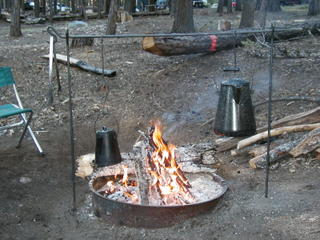
I’ll post the “recipe” to Frank’s hearty skillet breakfast by tomorrow. Unfortunately, forgot my camera. These pictures are from a trip to Wench Creek last month.