Tuesday, October 25, 2005

Don Mason's Dutch Oven Newsletter

Here's the latest issue of Don Mason's Dutch Oven Newsletter from Northern California. Email Don at iron_kettle@hotmail.com to receive an electronic copy.


Monday, October 24, 2005

More on "The Complete Guide to Making Sauces"

I can't find any information on The Complete Guide to Making Sauces on the Internet.

The publisher's website at Alibris also draws a blank. A search for author Christine France yields 53 books that she wrote or co-wrote. Titles include everything from Chocolate to Low Calorie Desserts to The Barbecue Book. Tomatoes is another popular theme.

But no The Complete Guide to Making Sauces. She did write a book on Salsas, Dips, Dressings, and Marinades, as well as Cook's Book of Sauces.

Quick and Easy Sauces: Over 70 Delicious Recipes to Transform Sweet or Savoury Dishes is the closest title to the book that I purchased at Borders.

Since the tag line for The Complete Guide to Making Sauces says, "Transform your cooking with over 200 step-by-step great recipes for classic sauces, toppings, dips, dressings, marinades, relishes, condiments and accompaniments," I suspect that this book is a compilation of her prior cookbooks on everything related to sauces, salsas and the like.

Sunday, October 23, 2005

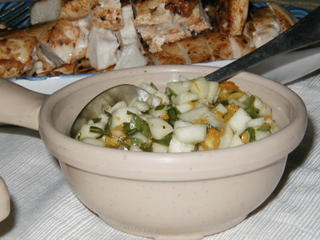
Sweet Bell Pepper Salsa

Here's a second salsa from The Complete Guide to Sauce Making. I served this and fiery citrus salsa last light with grilled chicken breast for a friend who recently suffered a heart attack. He and his wife must now eat a heart-friendly diet. I though the salsas would liven the meal with flavor.


SWEET BELL PEPPER SALSA

This recipe is adapted from The Complete Guide to Sauce Making by Christine France.

1 red bell pepper
1 yellow bell pepper
1 red chili, seeded
2 tablespoons chopped cilantro leaves
2 tablespoons olive oil
1 tablespoon red wine vinegar
1 teaspoon cumin
Salt and ground black pepper, to taste

Blacken the skins of the bell peppers under a broiler or over the flame of a gas burner. Place peppers in a bowl and cover with a clean dish towel. Leave for 5 minutes so the steam helps to lift the skin from flesh. Remove the dish towel.

When the peppers are cool enough to handle,, pierce a hole in the bottom of each and squeeze out the juices into a bowl. Peel, core and seed the peppers, then process the flesh in and juices in a blender or food processor with the chilies until finely chopped. Stir in oil, vinegar and cumin. Season with salt and ground black pepper to taste. Serve immediately.

Saturday, October 22, 2005

Fiery Citrus Salsa

I made a rare addition to my cookbook library on my way home from work Friday. I often stop at Borders to purchase a magazine and enjoy a mug of iced tea before making the commute up the hill.

The price and the pictures are the best things about The Complete Guide to Making Sauces by Christine France. The $7.99 price tag initially attracted me to the book. Its 256 glossy pages are full of instructive pictures for everything from heavy traditional sauces to lighter fruit-based salsas.


FIERY CITRUS SALSA

This recipe is adapted from The Complete Guide to Making Sauces. The original recipe called for fresh mint, a herb that I dislike. Cilantro will also work in this recipe.

This spicy salsa is a nice alternative to heavy, fat-laden sauces. Use a Granny Smith apple for more tart sauce. For a milder or hotter salsa, vary the number and type of hot chilies. Fiery citrus salsa is delicious alongside grilled shrimp or chicken breasts.

1 orange
1 green apple
2 fresh red chilies, halved and seeded
1 garlic clove
8 fresh parsley leaves
Juice of 1 lemon
Salt and ground black pepper, to taste

Peel and section the orange into bowl. Peel the apple, cut into wedges and remove the core. Place chilies in a blender or food processor with orange segments, apple wedges, garlic and parsley leaves. Process for a few seconds until smooth. Then with the motor running, slowly pour the lemon juice into the mixture. Season with salt and ground black pepper to taste. Serve immediately.

Wednesday, October 19, 2005

More Beyond

As you know, the Strait of Gibraltar connects the Mediterranean Sea with the Atlantic Ocean. The narrow passage is about 40 miles long and varies in width from about nine to 24 miles. All ships that sail from the Atlantic to the Mediterranean—and vice versa—must pass through the straits.

Prominent mountains (known as promontories) flank the entrance to the Strait of Gibraltar from the east. These guardians were known to antiquity as the “Pillars of Hercules.” The Rock of Gibraltar guards the European shore of the strait. To the south, a mountain in Morocco, Jebel Musa, guards the African shore.

The Spanish drew the Pillars on their 15th century coat of arms. The scroll that crossed the Pillars contained the Latin motto: Ne Plus Ultra—No More Beyond. These words warned sailors not to enter the Atlantic Ocean, for they believed nothing existed beyond the Pillars. Certain death lay beyond the Pillars, where mariners would surely sail off the edge of the earth.

However, in 1492 Christopher Columbus destroyed that common belief by sailing far out into the Atlantic Ocean—beyond the Pillars of Hercules. He discovered the New World on October 12, 1492, after a 36-day voyage from the Canary Islands.

In Valladolid, Spain, where Christopher Columbus died in 1506, stands a monument commemorating the great discoverer. Perhaps the most interesting feature of the memorial is a statue of a lion destroying one of the Latin words that had been part of Spain’s motto for centuries. The word being torn away by the lion is the Latin word Ne, to make it read Plus Ultra, which means More Beyond.

Columbus had proven that there was indeed “more beyond” the Pillars of Hercules.

When you think about it, the Sadducees espoused Ne Plus Ultra as well. Like the early mariners of the Mediterranean Sea, who said there was no more beyond the Pillars, the Sadducees said there was no more beyond the grave.

Jesus corrected the Sadducees’ mistaken understanding of God’s power to resurrect:

Jesus answered and said to them, “You are mistaken, not knowing the Scriptures nor the power of God. For in the resurrection they neither marry nor are given in marriage, but are like angels of God in heaven. But concerning the resurrection of the dead, have you not read what was spoken to you by God, saying, ‘I am the God of Abraham, the God of Isaac, and the God of Jacob’? God is not the God of the dead, but of the living.” (Matthew 22:29-32).
Jesus Christ, the “Lion of Judah,” through His life, death, and resurrection, has torn that word Ne from the phrase, giving us the reality of More Beyond. Jesus clearly taught the Sadducees that Abraham, Isaac and Jacob had moved beyond the grave to be with Him in heaven.

The Hebrew writer cautioned: “And as it is appointed for men to die once, but after this the judgment” (Hebrews 9:27). Beyond the grave, there are two destinies: The righteous shall enter into eternal life, and the wicked into everlasting punishment, according to Jesus in Matthew 25:46.

Because there is “more beyond” the grave, Jesus pleaded:

Enter by the narrow gate; for wide is the gate and broad is the way that leads to destruction, and there are many who go in by it. Because narrow is the gate and difficult is the way which leads to life, and there are few who find it (Matthew 7:13-14).
What is your destiny beyond the grave? Which way will you take?
Will you stand with the Sadducees and proclaim that there is no more beyond the grave? To do so is to “go away onto everlasting punishment” when you die.

Or will you pass through the narrow “strait”—that is to heaven? Jesus has prepared a home for you in heaven (John 14:1-3). Be ready, for there is more beyond.

Adapted from an invitation by Brent Wiley, evangelist for the church of Christ in Los Osos, California.

Tuesday, October 18, 2005

IDOS Fall Convention in Camp Verde, Arizona

Here's an email from Mark Wilkins, director of the Arizona Chapter of IODS. This will be the second year that the convention is being held in Arizona. Next year, the convention will move elsewhere, likely somewhere in the west.

=====<<>>=====

Reminder of the upcoming IDOS Fall Convention & DOG

When: Saturday, November 5, 2005

Where: Camp Verde, Arizona Community Center

Come enjoy a great day learning & sharing about Dutch ovens at the International Dutch Oven Society Fall Convention in Camp Verde November 5th, 2005 at the Community Center in downtown Camp Verde. Classes will begin at 9 a.m. and will run 50 minutes each until 3 p.m.

Topics to be covered are:
  1. Dutch Oven Beginner Basics -- selection, seasoning, cleaning, care, accessories, are just a few of the ideas discussed.
  2. Fabulous Breakfasts -- Various ideas & samples of great Breakfast dishes that can be prepared in Dutch Oven.
  3. "Don't Be Chicken" -- Variety of chicken ideas and methods of preparation for the Dutch Oven.
  4. Creative Dutch Oven Tips & Tricks -- explore some innovative and creative ways to use your Dutch Oven & accessories. Ever make Ice Cream in your Dutch Oven?
  5. Ultimate Dutch Oven -- demonstration & methods for cooking in the Camp Chef Ultimate Dutch oven & Camp Chef Turkey Roasters.
  6. Breads & Cakes -- The fun & ease of preparing fabulous breads & cakes in the Dutch Oven.
There will also be a few vendors on hand with Dutch Oven related items, as well as a Taste of Dutch booth with samples throughout the day. Meet the current president of IDOS Clyde Miller. Vice-president & former world champion Randy Macari who will be on hand to greet and meet you along with other IDOS Board members, including the leadership of the Southern California Chapter Brenda Wildish and her gang.

There will be a IDOS member meeting from 3:15 to 4 p.m. with the leadership of IDOS on hand to explain the future goals of IDOS and answer any questions or suggestions from the floor. This is open to all to attend.

And then, at 4 p.m. the real fun begins! We invite all those in attendance to bring their ovens, equipment and supplies to prepare their favorite dish on site for our evening potluck. Serving time to be 6 p.m. If your new to Dutch oven and not quite confident yet -- bring your stuff and there will be plenty of folks on hand to walk you thru your first Dutch oven experience to make it a pleasant and successful experience! For those that arrive early, on Friday evening we will do a mini-DOG for those that are there and wish to participate.

A list of local hotels and RV Campgrounds in the area is posted on the http://www.blogger.com/www.idos.org website, or email me at: cobweb7513@qwest.net for a listing.

We look forward to seeing as many of you as possible as this is the last time we will have the opportunity to host the Fall Convention for a while as next year it will move to another location.

Saturday, October 08, 2005

Pot Luck with Family and Friends

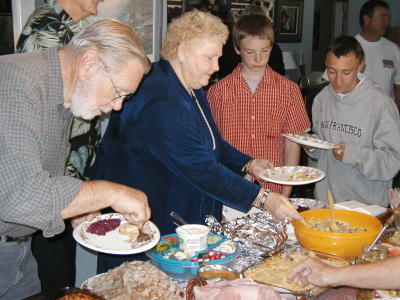
There's nothing better than to attend a pot luck dinner with family and friends. The food is always delicious. And the company is even better.

If it weren't for the company, the food would be the best part of any pot luck dinner.
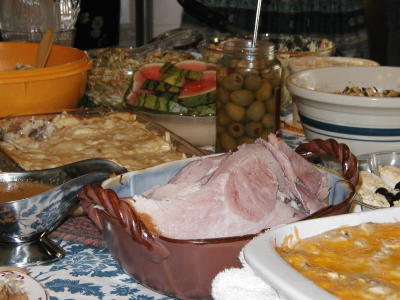
Most pot lucks offer a wide variety of dishes.
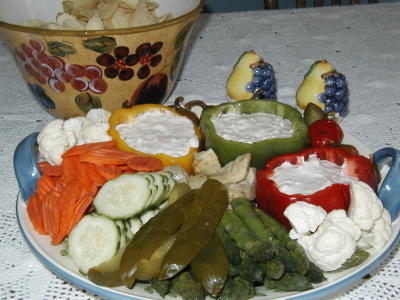
I brought this relish tray to the pot luck.

Friday, October 07, 2005

Old West's Restaurant on the Range

The chuckwagon -- a moving storehouse and kitchen for the Old West's cowhand. This weekend, authentic cowboy cooks from some 25 ranches are competing in Ruidoso, New Mexico in one of the nation's richest chuckwagon cookoffs.

Here's an article on the Lincoln County Cowboy Symposium by Martha Hollis, from last July:
Put on your cowboy hat and working pair of boots to celebrate the Old West's restaurant on the range — the chuckwagon. Betcha there will be no microwave ovens in the infield of the Ruidoso Downs Race Track on New Mexico Highway 70 where 40 cowboy cookin' teams will compete over open fires for a large purse for their beef, beans, potatoes, biscuit and dessert creations. Judges points are swayed by authenticity. This competition is the hottest in the West. (Continue reading on SouthernNewMexico.com.)
Thursday, October 06, 2005

Lincoln County Cowboy Symposium

For the chuckwagon enthusiasts our there in blogland, the Lincoln County Cowboy Symposium (and here) and Chuckwagon Cookoff is happening this weekend in Ruidoso Downs, New Mexico.

Here's the address incase you're ridin' through:

The Hubbard Museum of the American West
841 Hwy 70 West
PO Box 40
Ruidoso Downs, NM 88346

Photos from the 2004 event can be found here.

The symposium schedule is full of serious stuff, like "Ranching for Substainability and Profit." There's also plenty of campfires, barbecues and entertainment for us city folk.

Monday, October 03, 2005

Iron Chef Challenge Location in Reno Update

Dave Herzog posted this message on the IDOS Forum this afternoon:

=====<<>>=====

Ok everyone! here is the latest info on the DOG in Reno. I have lined up 2 hotel/motels with lodging discounts for the weekend. just mention that you are with the Dutch oven Cook-off to save on the hotel rates!

The first is the Meyer Crest Quality Inn in Reno at 1-800-626-1900 or 775-329-10011, 885 S. Virginia St., Reno, Nevada. Price including tax is $56.00 per night. Cut off date for this price is October 12.

The second one is the Super 8 Motel in Sparks at 775-358-8884, 1900 E. Greg St, Sparks, Nevada. Price is $59.99 with no cut off date on this one.

I'm working on a third but, no promises!

This weekend in Reno will be a busy and full weekend with pro bull riding in town and a few other big events, so book as soon as you can! Also for the DOG contact me now for a space with a table to use in your cooking area. I have only a few left, after they are gone you will need to supply your own tables for prep, etc.

I hope to see you there! Gary Bergoff (Radar from M*A*S*H) is going to try to fly from Florida to Judge! But, no promises! He told me he can't promise because of his schedule, but, he will try.

Saturday, October 01, 2005

Cobb Salad with Roast Beef

I enjoy a crisp green dinner salad all year. Salads with few ingredients are winners in my book. I'm not a fan of complex salads. You can please me with iceberg, romaine or red leaf lettuce. Add a little color--shredded carrot and red cabbage--and a creamy homemade blue cheese dressing.

Don't cloud the salad with celery (the stuff gags me!), broccoli flowerets (I love it cooked, though) or those tiny pickled corn cobs. I don’t mind pickled red beets (in fact, I love them). And a few cauliflower flowerets on the side as fine with me.

And forget the fresh tomatoes. My mother tried, but failed to pass the Karoly’s summer-long love affair with garden fresh tomatoes on to me. Pass catsup, salsa and canned tomatoes by my plate and I’ll bite. I’ll leave the fresh tomatoes to others.
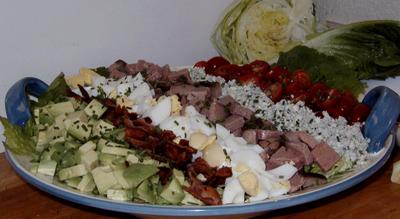
Sometimes I think my obsession with green dinner salads is just an excuse to eat blue cheese dressing. But it’s one obsession that’s rubbed off on my daughters. Together we serenade “Blue cheese, blue cheese, blue cheese” when we order salads. My son has to be different. He’ll ask for Italian.

I’ve said all this to say this: When I find a restaurant that serves a first-rate Cobb salad, I latch on to it. So much so, that I’ll only order that entrée from that particular restaurant. Locally, Main Street Grill in Placerville, California offers a great tri-tip Cobb with avocado, bacon, hard-cooked eggs, tomatoes and blue cheese crumbles.

I enjoy a hearty meat salad summer or winter. They’re ideal when the thermometer passes the century mark. Leftover grilled meat and the opportunity to run an oven-free kitchen make the Cobb salad the ideal summertime dinner entrée.

But what about fall and winter when the sun wanes over the horizon? A Cobb is the ideal entrée for a lazy fall day. No cooking is required if the meats and eggs are cooked ahead. The Cobb can be the perfect vessel for leftover items.

Unless you’re chilled to the bone and need a hearty bowl of soup to warm you through, try Cobb salad this week.

COBB SALAD WITH ROAST BEEF

Any meat or poultry can be used for this salad. Grilled meat adds a nice charred flavor to the salad. Dice the meat and arrange in rows with the avocado, tomato, bacon, blue cheese and eggs. Dress with your favorite salad dressing if desired.

4 cups iceberg (about 1/2 head), cut into bite-size pieces
1 bunch watercress, stems removed
2 cups romaine (about 1/2 head), leaves separated and torn into bite-size pieces
8 ounces cooked roast beef or steak, diced
2 medium tomatoes, diced
4 strips cooked bacon, crumbled
3 hard-cooked eggs, diced
1 ripe avocado, peeled and diced
4 ounces blue cheese, crumbled
2 tablespoons finely cut chives
1 cup Cobb dressing (recipe follows)

Arrange lettuce and watercress in a large bowl or individual serving bowls. Arrange beef, tomatoes, bacon, eggs, avocado and blue cheese in neat rows on top of greens. Completely cover the greens. Sprinkle chives over the salad to garnish. Dress the salad just before serving. Toss if desired. Serves 6.

COBB DRESSING

3 tablespoons red wine vinegar
1 tablespoon fresh lemon juice
2 teaspoons Dijon mustard
1 small clove garlic, minced
1/2 teaspoon salt
1/2 teaspoon ground black pepper
1/2 cup extra-virgin olive oil

Whisk together all ingredients except oil in a small bowl. Add oil in a slow stream, whisking until emulsified.

Friday, September 30, 2005

Camp Kitchens for Hurricane Katrina Relief Workers, #5

.
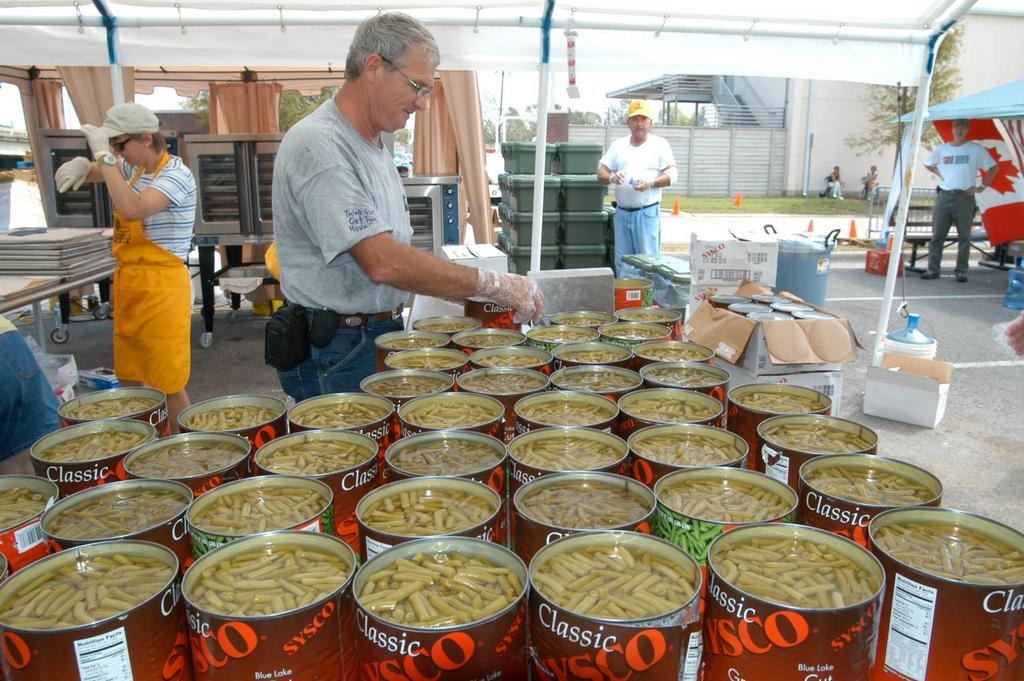
New Orleans, Louisiana, September 17, 2005 -- Gallon-sized cans of green beans are open and ready to be cooked at a field kitchen set up by the Arkansas branch of the Southern Baptist relief association. The American Red Cross provides these hot meals using their feeding trucks to people throughout the city . Win Henderson/FEMA photo. (A #10 can is actually 3 quarts in volume.)

Thursday, September 29, 2005

Camp Kitchens for Hurricane Katrina Relief Workers, #4

.
Base Camp, New Orleans, Louisiana, September 15, 2005 -- A cook prepares the grill to cook a meal at Base Camp Zephyer Field. This mobile kitchen is operated by Port-A-Pit Catering Services of Tuscon, Arizona. Marvin Nauman/FEMA photo.

Camp Kitchens for Hurricane Katrina Relief Workers, #3

.
Base Camp, Louisiana, September 15, 2005 -- A relief worker hands out a meal to a disaster worker at Base Camp Zephyer Field. Marvin Nauman/FEMA photo.

Wednesday, September 28, 2005

Camp Kitchens for Hurricane Katrina Relief Workers, #2

.
Base Camp, New Orleans, Louisiana, September 15, 2005 -- The food line for emergency workers and relief workers at Base Camp, Zephyer Field. Hotel rooms are difficult to find and many workers sleep in tents, sleeping bags, cars or where ever they can. Many areas of the city are still without power and utilities. Marvin Nauman/FEMA photo.
Camp Kitchens for Hurricane Katrina Relief Workers, #1

.
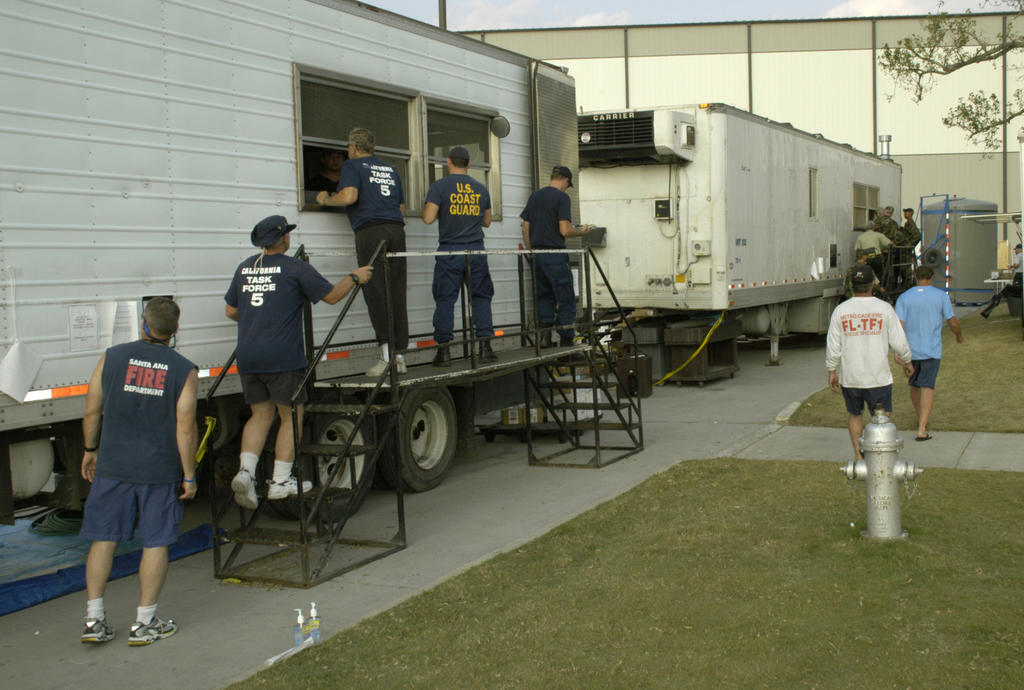
New Orleans, Louisiana, September 15, 2005 -- Disaster Workers at Base Camp are lined up at one of the kitchens to get a meal. During a disaster all of the needs of disaster workers must be met along with those of the victims. Marvin Nauman/FEMA photo.
Tuesday, September 27, 2005

Shrimp and Pasta with Creamy Pesto Sauce

I love versatile recipes, especially recipes where you can trade ingredients on a one-for-one basis. Any recipe that adapts to leftovers and stocked pantry items is versatile in my estimation. Sunset’s recipe for shrimp and pasta with creamy pesto sauce is the perfect example.

I’ve had my eye on pasta for over a week now. On the way home from work I purchased a 12-ounce box of angle hair pasta (my country market carries three pastas: spaghetti, angle hair and elbow macaroni). A small jar of traditional pesto, three leftover chicken thighs and the remains of a bag of sun-dried tomatoes all went into my spur-of-the-moment pasta for dinner.

My 13-year old son wolfed down two helpings despite the fragrant aroma from the basil. He even managed to work around the sun-dried tomatoes. I have a hit!

SHRIMP AND PASTA WITH CREAMY PESTO SAUCE

This recipe was published in Sunset Magazine, February 2003. I prefer roasted red pepper pesto to traditional pesto made with basil and pine nuts.

12 ounces penne pasta
1 pound shrimp, cooked, frozen
1/2 cup prepared pesto
1/4 cup heavy cream
1/4 cup chicken broth
3 tablespoon dried tomatoes, oil-packed
Salt and black pepper, to taste

In a 4- to 6-quart pan over high heat, bring 3 quarts water to a boil. Add pasta and cook, stirring occasionally, until tender to bite, 7 to 12 minutes. Drain and return to pan.

Add shrimp, pesto, cream, stock and dried tomatoes to pasta. Stir over medium heat until hot and evenly incorporated, 2 to 3 minutes. Add salt and pepper to taste. Makes 3 to 4 servings.

Sunday, September 25, 2005

Sailor Becomes Navy's First, Only Personal Executive Chef

By JO2 (SW) Ahron Arendes, Commander, Naval Air Forces Public Affairs

Culinary Specialist 1st Class (SW) Brandon Parry became the first Sailor to earn the title of Personal Certified Executive Chef (PCEC) May 13, 2005.

An enlisted aide to Commander, Naval Air Forces (COMNAVAIRFOR), VADM James Zortman, Parry earned the certification after passing the practical exam, a written exam, and nearly a decade of culinary education.

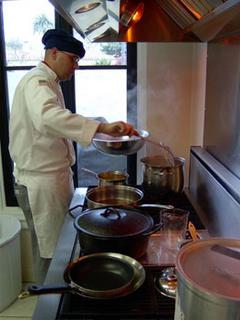
CS1 (SW) Brandon Parry became the first Sailor to earn the title of Personal Certified Executive Chef (PCEC). Pictured above he is at the stove taking the practical cooking exam for the certification.

"It's awesome!" Parry said about earning the qualification. "So far, this is the pinnacle in my culinary career. A lot of people can cook well, but the certification process forces you to learn everything there is to know about being a chef."

According to the American Culinary Federation (ACF), a PCEC is a chef with advanced culinary skills and a minimum of seven years of professional cooking experience, with a minimum of two years as a personal chef. They provide cooking services on a "cook-for-hire basis" to a variety of clients. They are responsible for menu planning and development, marketing, financial management, operational decisions, and providing nutritious, safe, eye-appealing and properly-flavored foods.

The PCEC certification, which the ACF created in 2003, is awarded based on excellence in three areas: education, work experience, and tests.

The education portion includes formal schooling (high school to graduate studies) and continuing education. In addition to these, each candidate must complete food safety, sanitation, nutrition, hospitality and supervisory courses. The work experience portion includes a practical cooking exam where candidates prepare two different three-course menus, while practical examiners and executive chefs observe and critique the candidate's cooking and sanitation skills. The written exam portion includes 100 questions on basic and advanced cooking, sanitation, nutrition, personal chef management, and basic and advanced baking. The test must be completed in one hour with a score of at least 70 percent.

"The [practical] exam can be a little intimidating, because it's outside of the normal type of procedure that we do, but I think CS1 did very well," said Chef Michael Harants, Corporate Chef of the Navy at Naval Supply Systems Command (NAVSUP) and practical examiner.

Parry said that reaching his goal of earning the PCEP qualification was something he has been focused on for several years.

"I have been working for this my whole career," said the 15-year Sailor. "When I first came in, I was 18 and stationed on the USS Independence (CV 62). I was put into the bake shop, baking 3,000 loaves of bread a day. I found out then that I was a natural at cooking. About midway through my career, I decided I wanted the certification, and I had been working for that since then."

According to Parry, being an E-7 to E-8 is a requirement for the qualification, but since he has been performing the job of an E-7, he was able to have that waived. He also said that in order to reach his goal, he had to have ambition and a deep passion for culinary arts.

"CS1 stands out because of his ambition," said Harants. "Culinary certification was one of his career goals, and he did what he needed to do to reach that goal." Harants added that culinary certification is an opportunity for Sailors to validate their skills and knowledge. "The certification application process that a cook or chef has to go through is not just checks in the box. There is a written and a practical exam demonstrating that one is knowledgeable and can apply those skills to everyday duties," he said. "One of the significant factors of certification is the level of professionalism that one demonstrates by going the extra mile."

According to Marylin Burchfield, ACF certification programs coordinator, Parry is not only the first Sailor in the Navy to have the PCEC certification, but he's only the second in the Department of Defense. She said the PCEC certification or any certification, will help people get better jobs and better pay once they reach the civilian sector. They will also have the skills and knowledge to run their own businesses.

"If one wants to take their culinary skills to the next level, then they have to put forth the effort to seek out any additional culinary education they can to excel and set themselves above the rest," said Harants. "The Navy offers CSs several avenues for continuing education in culinary arts. The Adopt-a-Ship program, bringing industry professionals to the CS community, is one way they can open up new culinary experiences. Culinary internship opportunities in the local fleet area can also help one to progress with culinary skills and knowledge."

"I think certification is important to the Navy," Parry said. "It forces people to know the formal aspects and history of cooking. The whole process also forces you to be a good cook, and that is what it's all about, knowing the nitty-gritty of food."

For more information on the certification process or future culinary educational opportunities, contact Chef Michael Harants by e-mail at Michael.Harants@navy.mil.

Saturday, September 24, 2005

Lightning Cake with Pears and Almonds

All meals at Grandma Bertha Karoly’s Mill Valley home were good. We often enjoyed a Sunday afternoon roast leg of lamb with roasted potatoes and German red cabbage. Although, I don’t remember many desserts, I’m certain I ate any number of sweets at her table.

This recipe is adapted from Any One Can Bake, published by Royal Baking Powder Company in 1927. My grandmother purchased this book on April 18, 1927 when my father was 17 months old.

I suspect that this recipe was called lightning cake because it’s made “lightning fast.” The original cake is a brownie-like dessert with a sugar-cinnamon topping. I adapted it by folding diced Bartlett pears and sliced almonds into the batter. And a used a crumb topping made from oatmeal, flour and sugar.

LIGHTNING CAKE WITH PEARS AND ALMONDS

Use your favorite crumb topping for the cake. My favorite recipe follows.

1/2 cup milk
3 eggs
1/2 cup melted butter
1-1/2 teaspoon vanilla
1-1/2 cups sugar
1.2 teaspoon salt
3 cups all-purpose flour
1 tablespoon baking powder
2 Bartlett pears, peeled, stemmed and diced
1/2 cup sliced almonds
2 cups crumb topping (recipe follows)

Pre-heat a 12-inch Dutch oven with 9 coals underneath and 18 coals on the lid. Combine milk, eggs, sugar and vanilla in a large bowl. Sift flour, salt and baking powder in a bowl. Add dry ingredients to liquid ingredients and mix thoroughly. Dough will be stiff. Fold in pears and almonds.

Lightly oil Dutch oven. Spread dough in Dutch oven. Sprinkle crumb topping evenly over cake dough. Bake at 375 degrees for 50 minutes or until a toothpick inserted in the center comes out clean. Cool; cut into 12 to 18 servings.

CRUMB TOPPING

1-1/2 cups all-purpose flour
3/4 cup packed brown sugar
1/2 cup sugar
1/4 teaspoon salt
1 teaspoon cinnamon
1-1/2 cups old fashion rolled oats
1/2 cup softened butter, cut into pieces

Combine flour, sugars, salt, cinnamon and oats in a medium bowl. Rub in the butter with your finger tips until it’s well blended and the mixture crumbles coarsely. Refrigerate until needed. Makes about 1 quart.

Friday, September 23, 2005

Guest Chef Brings "Canadian Baking" To USS Tarawa

By JO3 Adam Stapleton, USN, USS Tarawa (LHA 1)

It may have seemed like your average "Hamburger Tuesday" aboard USS Tarawa (LHA 1), but in fact it was far from an average burger day as cooks had the aid of a professional chef to spice it all up.

"Let's try the option of adding sautéed mushrooms and onions," Chef Samuel Glass said to the wardroom culinary specialists (CSs) over the sizzle of the beef-patty "sliders" on the grill. "Let's add some flair to an old Navy favorite."

Chef Samuel Glass, center, passes on cooking tips to CS2 Tawney Cortezparedes, left, and CS3 Michelle Harvey, both USS Tarawa (LHA 1) crew members. Glass visited the San Diego-based amphibious assault ship as part of the Naval Supply Systems Command's Adopt-A-Ship program during a recent pre-deployment training exercise off the coast of Southern California in mid May. U.S. Navy Photo by PHAN (AW) Kelly Morgan.

Chef Samuel Glass, a volunteer in the Adopt-A-Ship Program, came on board the San Diego-based amphibious assault ship during pre-deployment training operations with the goal of inspiring the CS's creativity.

"It was a pleasure working with him," said Tarawa CS2 (SW/AW) Michelle Harvey. "We learned a lot of new techniques, like how to take what the menu calls for and then spice it up a bit."

This is the ninth time the Mississauga, Ontario, Canada, native has participated in the program and his third time instructing on Tarawa.

"None of the other armed forces have a program anywhere near as accessible," said the certified executive chef. "The opportunity to go underway on a ship, for me, was a thrill and an honor."

Chef Glass, the Director of Culinary Education at the Culinary Arts School of Ontario, also shared his personal philosophy on food preparation with Tarawa CSs. "I've always followed the saying, 'You're only as good as your last meal.' If you screw up on a meal, then nobody remembers how many times you've done well. That's something I try to instill in the other cooks, the art of caring about every dish you prepare."

"Time management and proper meal planning," said Harvey. "That's the main lesson I took from Chef Glass, how to really focus on dish preparation for the hours during which we serve."

Not all of the teaching is one-sided, however, as Glass also has picked up a few tricks from Sailors. "I once saw someone here chopping hard-boiled eggs and putting them in the chicken gravy. I'd never seen that done, so when I asked him about it he said, `Well, that's the way we do it in the South.' To this day I talk about how the best turkey gravy I've ever tasted was cooked by a Navy Sailor."

Tarawa CSs received training they can use in more ways than one. "I've seen how the Navy is not only providing CSs with training for life in the military, but also for life after the Navy as well," said Glass. "And to help out, after my visit, I'll file a report with NAVSUP that gives these CS's credit towards their certifications as cooks by the American Culinary Federation."

"It's a great program, and it's good for our Sailors to see a side other than the Navy," said CS1 (SW) Janelle Goosby. "What they do and learn here they can take with them and use in the civilian world."

In addition to training the CSs in the main galley, wardroom, and the Expeditionary Strike Group 1 flag mess, Chef Glass also visited USS Cleveland (LPD 7) for two days of training with their food service team. As Chef Glass' week at sea came to an end, he recounted how lucky he feels to be involved with the Adopt-a-Ship program.

"I get to do this as a volunteer chef, I get to share my love of cooking while supporting those whom I think are some unsung heroes," said Glass. "It's important to remember how hard these Sailors work. The next time you see a CS, don't hesitate to thank them for their hard work and to compliment them on a meal well done."