

Thursday, March 29, 2007
Cookin' in the Park Dutch Oven Cookoff
Here's information about the Cookin' in the Park cookoff in Red Bluff, California, Saturday, May 12, 2007. Don Mason said those on his mailing list would receive a flyer soon. Email Don at dmason@tco.net for additional information.


Tuesday, March 27, 2007
Sailor Take Warning
 The red sky over Broadway in Placerville last Saturday reminded me of my sailing days in the 1970s. As a sailor who didn't have a fondness for rough seas, I watched the morning sky for any sign of color. I wanted to prepare myself for the coming storm.
The old weather proverb guided me each day: "Red sky in morning, sailor take warning, Red sky at night, sailor's delight."
When you think about it, man has always looked for signs of the coming Lord. In Jesus' time on earth, the Pharisees and Sadducees longed for Jesus to prove that He was the Messiah. Jesus said in one encounter that they had the signs of the messiah. All they had to do was read the existing signs.
Then the Pharisees and Sadducees came, and testing Him asked that He would show them a sign from heaven. He answered and said to them, “When it is evening you say, ‘It will be fair weather, for the sky is red’; and in the morning, ‘It will be foul weather today, for the sky is red and threatening.’ Hypocrites! You know how to discern the face of the sky, but you cannot discern the signs of the times. A wicked and adulterous generation seeks after a sign, and no sign shall be given to it except the sign of the prophet Jonah.” And He left them and departed (Matthew 16:1-4).Like the Pharisees and Sadducees, we have today many signs that point to Jesus. All we have to do is read them. Like the young sailor who searches the sky each morning for any sign of a coming storm, Jesus tells us all we have to do is look for the "sign of the prophet Jonah."
Monday, March 26, 2007
A Night at the Races
 My friends and I watched the 410 cubic-inch powered sprint car races at the Placerville Speedway last Saturday. In one of the early qualification heats, Brandon Wimmer guides his car into the turn. Wimmer won the evening's 30-lap main event in a contriversial pass on the last lap when he collided with driver Andrew Gregg.
Sunday, March 25, 2007
Crown of the Peavine Ridge Forest
 This impressive stand of conifers guards the southern entrance to the Crystal Basin in Eldorado National Forest. Ice House Road marks the lower end of the grove. This stand is one of many survived the Cleveland Fire along the southern slope of Peavine Ridge. Here's what the U.S Forest Service had to say about these survivors:
Within the fire perimeter, a few areas of large trees survived the conflagration and the living trees stand in stark contrast with their surroundings. Activities that began some 13 years previous had made the difference. In 1979, about 150 acres near the Cleveland Corral Information Station had been prescribed burned with repeat burning in 1981. A 30 acre stand of trees was prescribed burned for a third time in the Spring prior to the Cleveland Fire. Amazingly, when the 100 foot tall flames burning in the crowns of the neighboring trees approached this stand, without the buildup of dead woody material on the ground, the flames dropped to the ground and left the larger trees alive (via ElDoradoCounty.net).The fire grew from a humble five-foot diameter fire when reported to a crown fire that danced along the tree tops withing minutes on September 29, 1992. The fire claimed the lives of two pilots. It wouldn't be declared controlled until October 14 and burned 22,485 acres along U.S. Highway 50 in the vicinity of Riverton.
Saturday, March 24, 2007
Sausage Gravy on Biscuits
I found another sausage gravy recipe this afternoon while cleaning for company. I copied it from Cooking from Quilt Country: Hearty Recipes from Amish and Mennonite Kitchens by Marcia Adams (Clarkson Potter, 1988, 224 pages).
I thought a family-sized recipe would nicely round out the collection here at 'Round the Chuckbox. Except for Frank's gravy, most recipes have been for quantity cooking. Other sausage gravy recipes on 'Round the Chuckbox:
Frank's Hearty Skillet Breakfast 2005 -- and 2006
Dave's Scratch Country Gravy -- makes 3 to 4 gallons
Independence Day Country Breakfast -- feeding 160 at summer camp
Navy Creamed Beef -- 100 portions of SOS
SAUSAGE GRAVY ON BISCUITS
A sweet, herbal aroma will waft from Adam's country gravy as it simmers. Omit nutmeg and poultry seasoning for a traditional savory gravy. Or try ground coriander in their place. Double the flour for thick gravy.
I pound sage-flavored bulk sausage, as lean as possible
2 tablespoons finely minced onion
6 tablespoons all-purpose flour
1 quart milk
1/4 teaspoon grated nutmeg, rounded
1/4 teaspoon poultry seasoning, rounded
Dash of Worcestershire sauce
Dash of Tabasco
18 large baking powder biscuits
Crumble sausage into a large cast iron skillet and saute over medium-high heat, breaking the meat into small pieces as it cooks. Don't brown or crisp. When the meat is about three-quarters done, add onion and cook until the onion is transparent.
Drain all but 2 tablespoons of the meat drippings. Stir in flour and cook over medium-low heat for 6 or 7 minutes, or until flour turns golden and bubbles up. Pour in the milk at once and add seasonings. Cook and stir until mixture thickens. Check seasoning.
Place at least 3 biscuits halves on each plate and top with sausage gravy. Makes about 1-1/2 quarts gravy. Serves 6 to 12.
Wednesday, March 21, 2007
Seagoing Chef Sails to Alanta TV Kitchen
 ATLANTA (March 16, 2007) - Sailors from USS Carl Vinson (CVN 70) stand behind local Atlanta WAGA Fox 5 morning anchor Suchita Vadlamani and Rear Adm. Frank Drennan, Commander Submarine Groups 9 and 10, while Culinary Specialist 1st Class Maria Velo demonstrates her culinary skills before a local television audience. Vinson Sailors visited Atlanta and surrounding areas as part of Fleet Week and to commemorate the aircraft carrier's Georgia ties with the ship's namesake of former congressman Carl Vinson. USS Carl Vinson is currently undergoing her scheduled Refueling Complex Overhaul (RCOH) at Northrop Grumman Newport News shipyard.
U.S. Navy photo by Mass Communication Specialist Seaman Apprentice Candice Villarreal.
Tuesday, March 20, 2007
BCHC Rendezvous 2007 10th Annual Dutch Oven Cooking Competition
The BCHC Rendezvous 2007 10th Annual Dutch Oven Cooking Competition will be held on Sunday, March 25, 2007, at the Turlock, California, county fairgrounds.
THEME: "Real Camp Cooking" with an eye toward "Realistic & Practical"
Canned & Packaged Foods Encouraged
Pre-boiled Foods Allowed (Rice, Noodles, Potatoes etc)
19th Century Costumes Encouraged but “ANY” Costume will Accumulate Points
PROFESSIONAL & AMATEUR DIVISIONS:
Children’s Competition will be Added with Enough Interest
AMATEUR Division is 2 or Less Wins in Previous Dutch oven Competitions; 1 Pot Any Dish
PROFESSIONAL Division is 3 or More Wins in Previous Dutch oven Competitions or Paid Catering Dutch Oven; 2 Pots
Main Dish must Include a MEAT/PROTEIN Ingredient & Any Dish
COOKING STARTS ANYTIME AFTER 8am
COOKS MEETING PROMPTLY AT 9:15am
AWARDS @ 1 pm
Judging Based on COSTUMES, DUTCH OVEN COOKING TECHNIQUES, SPECTATOR INTERACTION, AROMA, TASTE & PRACTICAL (CAMP FRIENDLY)
Bragging Rights Perpetual Trophy & Dutch Oven Equipment Prizes
2nd & 3rd Place Winners TO BE ANNOUNCED
Entry Fee: $20 for Single Over 18 + $5 for Each Additional Member up to a Total of 6
Must Have Detailed Recipes to Judges by Noon
RECIPES Included in Upcoming BCHC Dutch oven Cook Book
ENTRY FEE: $20.00 per team
DATE & SCHEDULE: The Cook-Off will be held on Sunday, March 25, 2007
Check in: 8:00 a.m. – 9:10 a.m. Cooks' Meeting: 9:15 a.m. (draw for presentation order)
Cooking time: 8:00 a.m. To 12:30 p.m. Awards Presentation: 1:00 p.m.
LOCATION: The Cook-Off will take place at the Stanislaus County Fairgrounds, Turlock, California, in SA (Shaded Area)
CATEGORIES: Amateur Division is a ONE POT ANY DISH. Professional Division is a ONE POT
MAIN DISH and a ONE POT ANY DISH (2 pot total); the main dish recipe must include a MEAT/PROTEIN INGREDIENT.
THE COOK-OFF WILL PROVIDE: Basic fire pits if needed and notified prior to Rendezvous, for each team, kitchen facilities for clean up, judges and wonderful prizes. You may provide your own fire pit as long as it protects the ground from heat damage.
CONTESTANTS WILL PROVIDE: Dutch Ovens, culinary water, charcoal, lighter fluid, cooking utensils, all food and other essential items necessary to prepare their recipe(s).
TEAMS: Contestant teams will consist of 1 to 6 BCHC members. One member must be over the age of 18 and all others over the age of 12. Spectators are welcome but only team members will be allowed inside the Cook-Off area.
DRESS: Dress should reflect "19th century attire" but "Any" Costume will garner points.
JUDGING: Team contestants will be judged in one of two divisions: Amateur or Professional. Professionals are team members who have been paid to prepare dutch oven meals or who have won 3 or more Dutch Oven cooking events (honor system). Entries will be judged on aroma, taste, practical (camp friendly), cooking techniques, spectator interaction & costumes. Practical & realistic ingredients are acceptable. No pre-cooked items except those requiring boiling only (noodles, rice, etc). A judging criteria sheet will be made available to all entrants.
RECIPES: All recipes must be included with your Entry Form and Entry Fee.
RECIPE RELEASE: Your names, photograph and/or recipe may be selected for use by various media covering these events as well as future Dutch Oven Cook-Offs. Your entry in the Rendezvous 2007 Dutch Oven Cook-Off establishes your agreement for the release of the same and their use by the Cook-off Committee, the Cook-Off sponsors, and the media.
PRIZES: Amateur Division - 1st place will receive Equipment; 2nd and 3rd places to be announced. Professional Division – Equipment, bragging rights to the perpetual trophy; 2nd & 3rd places to be announced.
HEALTH & SAFETY: Contestants are solely responsible for the proper selection, storage and refrigeration (if necessary) of all ingredients, the sanitation of their cooking area, and the preparation of foods that are safe for human consumption. Aside from a simple rope barrier separating cooking and spectator areas, responsibility for safety of contestants and spectators rests solely with the contestants. Safe use of fires, other heat sources and cooking equipment is the responsibility of the individual contestants.
COOK-OFF COMMITTEE: Debra Mason, (209) 545-3005 and Rudy Dezzani, (209) 538-1296
FOOD SAMPLE DISTRIBUTION: In so much as there are strict laws governing the distribution of food to the general public, the BCHC Dutch Oven Cook-Off Committee and Rendezvous 2007 Committee do not sanction , endorse, or encourage the distribution of "samples" of any food to the general public. Contestants who wish to give samples must provide their own serving utensils and sample cup containers.
DISCLAIMER: Judges' decisions on contestants' scores and the Cook-Off Committee's decisions on policies and procedures are final. Complete contestant rules will be distributed to all Cook-Off teams at the Cook-Off and are available upon request.
Friday, March 16, 2007
Army Chefs from Fort Bliss Claim Title
FORT LEE, Va. - Soldier-chefs from Fort Bliss, Texas claimed the Installation of the Year title at the 32nd Annual U.S. Army Culinary Arts Competition.
Fort Bliss team members and winners in other categories were recognized at an awards ceremony held today concluding the two-week long competition.
Team U.S. Army, Europe placed second followed by Fort Stewart, Ga. rounding out third in the Installation of the Year competition. This year's competition was extremely close with less than 2/10ths of one point deciding this year's winners.
Winners in the other major competition categories were:
- Senior Army Chef of the Year: Staff Sgt. Nolan Kniss, Team Pentagon
- Junior Army Chef of the Year: Pvt. 1st Class Robert Capazzi, Fort Bliss, Texas Field
- Cooking Competition: 1st - Fort Bliss, Texas; 2nd - Fort Bragg, NC; 3rd - Team Hawaii
- Student Team Skills Competition: Team Korea
- Best Exhibit Cold Food Buffet: Staff Sgt. Monica Roberts, Team Korea
- Best Exhibit Hot Food Shown Cold: Sgt. 1st Class Bryan Nixon, Fort Bragg, N.C.
- Best Exhibit in Pastry and Confection: Pvt. 1st Class Robert Capazzi, Fort Bliss, Texas
- Best Exhibit in Culinary Showpiece: Spec. Laron Smith, Fort Bliss, Texas
- Special Judges Award Most Artistic Centerpiece: Spec. Laron Smith, Fort Bliss, Texas
- Best Team Buffet Table Exhibit: Team Korea
- Best in Class - Contemporary Cooking: Master Sgt. Mark Morgan, Fort Benning, Ga./75th Ranger Regiment
- Best in Class - Contemporary Pastry: Spec. Leia Heeter, Team Europe
- Best Two Member Team, Nutritional Hot Food Challenge: Team Europe Baron H. Garland
- Culinary Knowledge Bowl: 1st - Team Alaska, 2nd - Team Hawaii, 3rd - Fort Carson, Co.
- Best Centerpiece in Ice: Sgt. 1st Class David Russ, Sgt. 1st Class Andre Rush and Cpl. Robert Lough, Fort Bragg, N.C.
Dutch Oven Cooking Newsletter Extra
Here's an extra issue of Don Mason's Dutch Oven cooking newsletter:

Tuesday, March 13, 2007
Dutch Oven Cooking For Large Groups
 Ron H. Daumn of the Seattle area spreads a layer of hot coals on a pizza pan. The Scout camp features a unique Dutch oven cooking platform. A bed of river rock and sand protect the wood table. The pizza pans provide a solid surface for the Dutch ovens.
Ron recently cooked a Dutch oven meal for Scout Masters at Camp Pigott of the Chief Seattle Council, near Lake Roesiger, Washington.
He used nine Dutch ovens to feed 45 Scout Masters and camp staff one Friday afternoon. He designed his menu around seven regular and two deep ovens. Ron figures each standard oven will hold enough portions for eight to 10 persons and the deep-style oven will feed 10 to 12.
Here's the menu:
Rattlesnake with Wild Rice (Tastes Just Like Chicken) -- 2 ovensA photo essay gives detailed instructions to cook the meal. Access the lead page (of 14 webpages) here. The five or six pictures will help the novice and expert prepare a Dutch oven meal for a larger group.
Shepherds Pie -- 2 ovens
Mountain Man Stew -- 1 deep oven
Broccoli Au Gratin -- 1 deep oven
Green Bean Casserole -- 1 oven
Dutch Apple Cobbler -- 1 oven
Bread Pudding -- 1 oven
Friday, March 09, 2007
No Soul at Starbucks
One of the results has been stores that no longer have the soul of the past and reflect a chain of stores vs. the warm feeling of a neighborhood store. Some people even call our stores sterile, cookie cutter, no longer reflecting the passion our partners feel about our coffee. In fact, I am not sure people today even know we are roasting coffee. You certainly can't get the message from being in our stores. The merchandise, more art than science, is far removed from being the merchant that I believe we can be and certainly at a minimum should support the foundation of our coffee heritage.
Starbucks CEO Howard Schultz
Well, duh!
Does anyone really believe that Seattle-based Starbucks Coffee Company, which has expanded to 13,000 locations worldwide in the past decade, can maintain the look and feel of the quirky neighborhood coffee shop?
Instead of focusing on the sensual experience inherent in buying a robust cup of coffee, Starbucks made a series on business decisions that "have lead to the watering down of the Starbucks experience," said Schultz.
Coffee bins and labor intensive espresso machines gave way to push-button coffee makers and "flavor locked packaging." Theater gave way to basistas who no longer have have a "visual sight line (to) the customer."
"The loss of aroma -- perhaps the most powerful non-verbal signal we had in our stores," said Schultz in an internal memo leaked on the Starbucks Gossip Blog. "The loss of our people scooping fresh coffee from the bins and grinding it fresh in front of the customer, and once again stripping the store of tradition and our heritage?"
Starbucks is fast food. It's the McDonald's of coffee. Like hamburger giant, Starbucks has standardized every aspect of the specialty coffee business.
In the 20 years since Schultz and his inverstors purchased Starbucks, the corporate "cookie cutter" has stamped out the company's passion for coffee.
In its drive to give customers the same coffee drinking experience around the world, small, independent coffee shops are attracting loyal Starbucks customers, a development that "must be eradicated."
And now, competition has come from an unlikely corner of the fast food market.
"Hoping that consumers are fed up with asking Starbucks for 'double-caramel skim half-caf macchiato' before they’ve even had their jolt of joe," said the Consumer Reports website, "Burger King, Dunkin’ Donuts, and McDonald’s have been boosting their coffee cachet."
McDonal's cup of coffee beat out Starbucks on two fronts -- price and flavor.
It seems the morning coffee crowd would rather sip a "desent and moderately strong" cup than one that's "bitter enough to make your eyes water instead of open," said Consumer Reports.
Monday, March 05, 2007
Alder Ridge Lookout, Part II
 Internal conflict between desiring solitude and craving the company of others has plagued me since childhood. Give me a good book at a noisy party, and I'll homestead the couch. I may be drawn into an occasional conversation. But, in the end, the book will win.
That's why Alder Ridge Lookout appeals. The well-groomed grounds of the lookout gives me the chance to read and write in notebook in solitude. I haven't seen anyone else at the lookout my four or five trips to the top.
I'd love to see the Forest Service establish a cabin rental at Alder Ridge like the one at Robbs Hut (PDF file), about 15 or 20 miles north. Family and a few friends would provide conversation and fellowship. And there are plenty of nearby rocks when solitude needed.
 This is the residence at Alder Ridge Lookout in Eldorado National Forest from the lookout cab. The lookout sits a top a plateau at the highest point on Alder Ridge. The ridge stands guard over the confluence of Alder Creek (above in the photo) and South Fork of the American River. The lookout was built by the Civilian Conservation Corps in 1936.
Friday, March 02, 2007
Lessons in Digital Photography
 By the time I returned to the truck last President's Day, I realized that I had shot over 100 digital pictures of Alder Ridge Lookout in ISO 1600.
In the past, I've taught myself to watch the different exposure settings and to make sure I framed the picture to my liking. This day I forgot to change the ISO back to 100 or 200 after shooting low-light pictures the night before.
I've developed a mental checklist that I run through each time I get the camera out of my daypack. And I've shot several hundred test pictures so I can test the result as I learn to adjust aperture, shutter speed, ISO, etc. Normally, I reset each setting to a default to avoid problems like this one.
ALDER RIDGE LOOKOUT
This 60-foot Aermotor lookout tower was built by the Civilian Conservation Corps in 1936. Situated at 6,687 feet above sea level, the tower overlooks the South Fork of the American River. A 2004 U.S Forest Service Passport in Time project was planned to restore the cabin for use a rental.
The single-car garage and residence were painted within the past two or three years. To this point, the lookout has not been offered for rent by the Forest Service.
Wednesday, February 28, 2007
U.S. Navy Announces New Award Winners
I found this news release via Food Service Director magazine:
FEB. 5, 2007 - The Mid-Atlantic Naval Amphibious Base, Little Creek, VA, heads the list of winners of the 50th Captain Edward F. Ney Memorial Awards for 2007.
The Ney Awards represent excellence in Navy food service, and will be presented March 31 during the International Food Service Executives Association conference in Kansas City, MO. The Little Creek base won in the Continental U.S. General Mess category. The Hawaii Silver Dolphin Bistro won in the Overseas General Mess category.
In the five Afloat categories, the winners were: USS Cheyenne, Submarine; USS Taylor, Small Afloat; USS Oscar Austin, Medium Afloat; USS Essex, Large Afloat, and USS Ronald Reagan, Aircraft Carrier.
Sunday, February 25, 2007
Where Do You Heat a Burrito in a Locomotive?
I sat down to lunch with Garrtett Augustus at Denny's after working at the engine house yesterday. I wanted to know where on the backhead is the best place to heat lunch.
Garrett ordered the mega meat lover's breakfast, a meal that comes loaded with hash browned potatoes, scrambled eggs and three breakfast meats.
 It's easy to imagine sausage, bacon and sausages sizzling on a clean shovel. But I forgot one key element to cooking on West Coast Shays.
"Oil-fire locomotives have no coal scoop," said Garrett. He's right.
An experienced locomotive cook and one who has fired historic Shay locomotives, like the Yosemite Mountain Sugar Pine Nos. 10 and 15, Garrtett should know.
Garrett heats burritos, sandwiches and "anything that's packaged" in the engine cab with heat from the backhead. But he doesn't really cook.
There's "no surface with a controllable heat source that you can really cook on," said Gattett.
But the immense heat radiating off the boiler backhead will heat any prepared meal through. It's a matter of locating a good spot to capture the wasted heat.
The theory is simple enough. "Look for a good place to basically jam your food so it doesn't fall out."
Garrett likes several spots, but has no favorite. "It just depends what you're making," said Garrett.
Do you need slow heat? Try the oil can pan that sits above the firebox door. But be sure to wrap the burrito well as things get messy.
Intense heat can be found on the hydrostatic lubricator on the engineer's side of the cab. The four lubricating lines on the Shay are full of steam. Set close together, the lines act "almost like a grill."
It sounds like a good spot to grill a Rubin or grilled cheese sandwich. Just keep it simple and focus on firing the engine.
Any spot will do. All you need is is an exposed steam line, added Garret.
Garrett will sometimes jam a burrito behind the lifting injectors on the fireman's side. He also tucks it up behind the steam turret on top of the backhead. The turret's a great spot because it's the steam source for all accessories in the engine cab.
It's too bad an oil-burning locomotive like the Diamond & Caldor No. 4 Shay doesn't need a coal shovel. Just think of the culinary creations a fireman could cook on its flat griddle-like surface.
The photograph shows the backhead of Roaring Camp & Big Trees Narrow-Guage Railroad No. 1 Shay.
Saturday, February 24, 2007
Coppers
 The "large kettle steamer" that Seaman Viera is cleaning is called a copper in Navy parlance. It's a steam-jacketed kettle to the civilian cook.
Navy culinary specialists use coppers to prepare soups, sauces, vegetables, meats and beverages. These large cooking vessels are often found in 80- to 100-gallon sizes in Navy galleys and aircraft carriers. Smaller-sized coppers are outfitted on destroyers and cruisers.
The lower two-thirds of each kettle is surrounded by a jacket offset from the main kettle body. Steam to circulates in this space and heat the contents of the kettle.
Coppers are permanently mounted on a pedestal (illustrated in drawing to right) or three legs and have a hinged lid or cover. The faucet can be used to draw liquids instead of dipping them out. Each kettle has a steam inlet connection, steam outlet connection and safety valve.
Trunnion-operated models (illustrated in drawing to left) have a handle on the side that makes it possible to tilt the kettle and pour contents into a service container. This type of kettle is usually used to prepare gravies and sauces.
 WHIDBEY ISLAND, Wash. (Feb 21, 2007) - Culinary Specialist Seaman Danny Viera, from Florida, Puerto Rico, washes out a large kettle steamer in the Admiral Nimitz Dining Facility located on Naval Air Station Whidbey Island. The dining facility was recently awarded a five star accreditation.
U.S. Navy photo by Mass Communication Specialist 1st Class Bruce McVicar.
Friday, February 23, 2007
Phil Reader's Beef Stew
This recipe was provided by Phil and Karell Reader. Phil often reheats the stew on the boiler backhead on one of the Pacific Coast Railroad Company's locomotives.
Phil grew up eating his Grandmother Bessie’s home cooking and fondly remembers her warm beef stews on cold winter nights. Karell had never really gotten into stewing, but after a couple of false starts and coaching from what Phil could remember from his grandmother’s stew, they put their crockpot to work, producing a thick, hearty and wholesome stew. Phil says it almost rivals Bessie’s and there are rarely any leftovers, so that is a good sign that they are on the right track with this recipe.
BEEF STEW
Vegetable oil
1 cup flour
Pepper to taste
Salt to taste
1 pound stew meat, 1-inch cubes
3 cups water
2 carrots, 1-inch cubes
2 celery stalks, 1/2-inch slices
2 russet potatoes, 1-inch cubes
1 package gravy or stew mix
Dredge the stew meat in flour, salt and pepper mix. Brown beef in oil in deep skillet. Heat water in crockpot on high. Add carrots, celery and potatoes. Place browned beef in pot with other ingredients and gravy or stew mix. Stew on high for 1-1/2 or 2 hours until all ingredients are soft and ready to eat.
Serve with fresh baked bread and garden salad.
Train Meals, Texas Style
It seems a good track-side hunt kept crews of the Frerdericksburg and Northern Railroad busy. Fresh food for the dinner table caused more than one train to run late on the Texas Hill Country line in the early 1900s.The F&N was never an on time line. Not only did the train have to stop to have the tunnel checked on every run, but the crew including the conductor and porters kept shotguns aboard except during deer season, when they kept rifles aboard.
--C. F. Eckhardt
Texas Escapes Online Magazine
Any deer (in or out of season), rabbit or fowl seen along the right-of-way would give cause for an unscheduled stop. At other times, "the locomotive crew would find it necessary to stop 'to oil the bearings'," especially when black bass were biting. The engineer timed track-side maintenance as the train crossed Grape or Black creeks.
While the one crewman oiled the bearings, the other dipped hook and line into the creek. The fresh bass was cooked on the boiler backhead. "The bass would be done to a turn about the time the train pulled into Fredericksburg Junction."
Thursday, February 22, 2007
Don Mason's Dutch Oven Newsletter
Here's the latest issue of Don Mason's Dutch Oven Newsletter from Northern California. Email Don at iron_kettle@hotmail.com to receive an electronic copy.


Tuesday, February 20, 2007
Bakery Scales at Sea
 The baker uses the balance or beam scale, pictured at right, to measure ingredients by weight, not volume. The Navy baker gets consistent results every time by measuring by weight. All Navy training manuals have said the same thing since the 1950s and before:
"The set of scales is one of the most important pieces of equipment you have. For best results weight everything use. If the recipe calls for 165 pounds of meat, weight out 165 pounds. Don't guess (Commissaryman 3 and 2 rate training manual, 1952)."
 Pacific Ocean (Feb. 6, 2007) - Culinary Specialist 3rd Class Lisa Greenlee, from Rockford, Ill., measures shortening for pie dough in the bakery aboard USS Ronald Reagan (CVN 76). The Ronald Reagan Carrier Strike Group is currently underway on deployment in support of U.S. military operations in the Western Pacific.
U.S. Navy photo (above) by Mass Communication Specialist Seaman Joe Painter.
Monday, February 19, 2007
Maple Pepper Chicken
This recipe was provided by Phil and Karell Reader ...
With chicken breasts in the freezer but no new ideas on how to prepare them, it was looking a bit bleak and boring until Phil found a recipe from a "recipe" machine at Nob Hill Foods. There it was, a sheet of recipes that no one had claimed. Phil thought it sounded good and the ingredients were readily available, so it was time to break out of the rut. It was a smash hit on the first try and has been a favorite to serve company ever since.
MAPLE PEPPER CHICKEN
4 boneless, skinless chicken breasts
1 cup flour
2 tablespoon pepper
Vegetable oil
1 cup water
1 package chicken bouillon
1-1/2 cups maple syrup
Heat 2 tablespoons oil in large skillet on high. Mix flour and pepper. Rinse and dredge chicken in the flour and pepper mixture. Lay in skillet and fry until golden and crispy on both sides. Turn down heat. Add water to bullion and mix well. Add to chicken. Pour in maple syrup. Cover and cook slowly until sauce reduces down and thickens. Remove from heat and serve, using the sauce on chicken and side dishes.
Serving suggestions -- Serve over mashed potatoes with a side of buttered peas and carrots.
Dutch Oven Bread Pudding
BREAD PUDDING: Break up any old leftover biscuits or sourdough bread. Mix soft with milk and sugar; some spices. Dump in some raisins and cook slow in dutch oven. If you have eggs you can add them to the pudding.--Slim Ellison, Globe, Arizona
Chuck Wagon Cookin' by Stella Hughes
(Univ. Ariz. Press, 1974)
I was initially apprehensive about baking a traditional bread pudding in a cast iron Dutch oven. In the camp kitchen, I always bake the pudding in a water bath. The water bath is an essential element when baking custard-like recipes.
The water bath insulates delicate foods like custard and quiches from the intense direct heat in the oven. I used this technique in the Dutch oven in September 2005 when I baked individual custard cups.
Yesterday I didn't want to fool with placing a glass dish or pie pan inside the 12-inch Dutch oven. Since we were traveling to my brother's house in Davis, California for a family gathering, I wanted a dish that came together with little fuss.
I found an appealing recipe by Dian Thomas, author of Recipes for Roughing it Easy, in Camp Cooking: 100 Years, 1905-2005. Two features of Thomas' recipe didn't make sense to me -- the use of an aluminum foil liner and her layered approach to the recipe. Otherwise, the recipe is essentially the same, including her use of sour cream.

DUTCH OVEN BREAD PUDDING
Add 1/2 cup dried fruit to the recipe if desired.
6 eggs
1/2 cup granulated sugar
1/2 cup sour cream
1 cup half-and-half
1 teaspoon vanilla
1 pound sliced bread, cubed
1/2 cup melted unsalted butter
3/4 cup packed brown sugar
1/2 teaspoon ground nutmeg
In a medium bowl, mix eggs, granulated sugar, sour cream, half-and-half and vanilla. Grease 12-inch Dutch oven with melted butter. Place bread in oven. Stream butter over bread and toss to thoroughly coat. Evenly sprinkle brown sugar and nutmeg over bread. Toss to combine. Pour egg mixture over bread and thoroughly mix. Let set about 20 minutes until the bread adsorbs most of the mixture.
Bake in moderate oven (6 coals under oven and 16 on lid) for 40 to 50 minutes until a toothpick inserted in the center comes out clean. Serve warm or cold. Serves 8 to 12.
Thursday, February 15, 2007
Cookin' on the Railroad
Good food and railroads had symbiotic relationship until Amtrak took over passenger service in the early 1970s. Mainline roads were know for operating high-class diners as their trains crossed the country. Even the logging companies and their railroads used food draw employees. Many loggers were known for their cookhouses.
It was nice to see another railroad that cooks in the engine house like we do at the El Dorado Western.
 My counterpart on the Pacific Coast Railroad Co. blog, Ed "Oil Can" Kelly, recently posted his January 2006 update. The crew gathered mid-month to thaw the engine house and trainmen at the height of California's deep freeze last month.
A busted water main left as flood in the engine house. The coffee pot, beef brisket and a frozen fireman's manifold competed for space on the shop's wood stove.
"Sometimes I am also the cook for this outfit and the chief bottle washer as well," said chief mechanical officer Phil Reader in response to my message on the Narrow Gauge Railroad Discussion Forum.
"Dutch ovens are a lot of fun. I get a kick out of using them."
I agree. Dutch ovens are a great way to combine my love for outdoor cooking and trains. A hearty meal in the engine house can bring the crew together. It's akin to mealtime tradition in the caboose.
So it seems natural that a train guy like Phil would cook in the steam locomotive. You have the essential ingredients for great railroad chow. Heat from the backhead and a hungry crew make for the perfect combination.
Cooking on the backhead is a tradition at the PCRR. Simplicity seems to be the rule. No gourmet foods on these rails. Spam and eggs, burritos and canned chili beans make perfect railroad fare.
"Someday I may have to write the steam railroader's backhead cookbook," said Phil.
Tuesday, February 13, 2007


Friday, February 09, 2007
Grill Cook for the Gator Flleet
This photograph brings memories to mind. I spent many early morning hours grilling eggs for the sailors at Naval Air Station Lemoore, in California's Central Valley.
The only difference was we didn't grill six or eight omelets at a time. We didn't have time. Five hundred to 1,000 sailors lined up each morning at the airfield galley where I worked.
When omelets were on the menu, I'd spread a layer of whipped eggs over the griddle. Just before the egg set up, I'd sprinkle grated ham and cheese over the surface and cut and fold the eggs. You had to learn to work fast and keep the griddle working.
 Virginia Beach, Va. (Feb. 6, 2007) - Culinary Specialist 3rd Class Eric Williams prepares eggs for the breakfast crowd. Gator Inn, the Naval Amphibious Base Little Creek galley, was awarded first place in the continental U.S. ashore general mess category of the 2007 Captain Edward F. Ney Memorial Award for food service excellence.
U.S. Navy photo by Mass Communication Specialist Seaman Ash Severe.
Wednesday, February 07, 2007
Smothered Chicken from Cee Dub
It's always gratifying when someone likes one of my recipes. C.W. "Butch" Welch, cookbook author and proprietor of CeeDubs.com, left the this comment on the Yahoo! Dutch oven group the other day:
A post on the Yahoo! prompted me to look up the recipe and see if I could use it. After reading Cee Dub's recipe (it's in his More Cee Dub's Dutch Oven and Other Camp Cookin'), I though it would be a great pick-me-up for the crew down at the engine house. Once the dishes were cleaned, I went back and added my thoughts to the long thread that had since developed. Cee Dub came 'round the other day and added his endorsement.
Thanks, Cee Dub.
Steve,I baked a version of his DISCO chicken (Darn Incredible Stuff Cooking in Oven, or something like that) for the El Dorado Western Railway two weeks ago. My recipe for smothered chicken can be found here.
I like your modifications to the recipe! I encourage folks at all the demos I do and clinics to treat recipes regardless of the source as an outline. I like to see folks take something I've done and expand on it!
Cee Dub
A post on the Yahoo! prompted me to look up the recipe and see if I could use it. After reading Cee Dub's recipe (it's in his More Cee Dub's Dutch Oven and Other Camp Cookin'), I though it would be a great pick-me-up for the crew down at the engine house. Once the dishes were cleaned, I went back and added my thoughts to the long thread that had since developed. Cee Dub came 'round the other day and added his endorsement.
Thanks, Cee Dub.
Friday, February 02, 2007
Faith Matters
Sports has had little impact on my life. It’s not that I dislike sports. I just don’t pay any attention to football, baseball or basketball. I'd rather sit by a rushing Sierra Nevada creek than to play volleyball or golf.
And I probably won’t find out who won the Super Bowl until late Monday evening. I can't even tell you which team is favored to win.
So I wouldn't have found the feature article on Tony Dungy and Lovie Smith from the Miami Herald's on my own initiative. My supervisor handed me the Sacramento Bee sports section this morning and said, "You'll find this interesting."
Sandi's husband is the sports enthusiast her family. I have him to thank for making me aware of these two coaches.
Without Sandi's prompting, I would never have known that the two reigning football coaches in the country are men who place a higher value on their individual relationship with God than worldly coaching techniques.
Although one of these men will go down in history as the first African American NFL coach to win a Super Bowl title, skin color is not what makes Dungy and Smith stand out from other coaches.
These men have nurtured a life-changing relationship with the God of Heaven according to the article.
The church of Corinth was one that tried to follow the code of wordly wisdom in their dealing with each other. Division and the creation of sects, placing too much emphasis on human leaders, accepting blatant sin among members of the church and conducting disorderly worship marred the congregation.
The apostle Paul said:
This means that Christians place God first in their lives. They "seek first the kingdom of God and His righteousness" (Matthew 6:33a). This means relationships with neighbors, including football players, are always conducted in a Godly manner.
Writer Michelle Kaufman reported that neither drinks or curses, characteristics that the world often lifts high. These character traits are symptoms of something greater. They show that Dungy and Smith have set aside human traits and have replaced them with Godly fruit, as Paul said:
I'm certain Super Bowl XLI will be a unique game. One history-making coach will be the first African American coach to lead his team to the title.
But Dunge and Smith have a higher calling. Each coach is running his personal life like a football game. Paul said: "Do you not know that those who run in a race all run, but one receives the prize? Run in such a way that you may obtain it" (1 Corinthians 9:24-25).
Both Dungy and Smith are running to obtain "an imperishable crown" at the end of life's race.
And I probably won’t find out who won the Super Bowl until late Monday evening. I can't even tell you which team is favored to win.
So I wouldn't have found the feature article on Tony Dungy and Lovie Smith from the Miami Herald's on my own initiative. My supervisor handed me the Sacramento Bee sports section this morning and said, "You'll find this interesting."
Sandi's husband is the sports enthusiast her family. I have him to thank for making me aware of these two coaches.
Without Sandi's prompting, I would never have known that the two reigning football coaches in the country are men who place a higher value on their individual relationship with God than worldly coaching techniques.
Although one of these men will go down in history as the first African American NFL coach to win a Super Bowl title, skin color is not what makes Dungy and Smith stand out from other coaches.
These men have nurtured a life-changing relationship with the God of Heaven according to the article.
In my book, it's their apparent hold on the message of the cross that makes these men stand out.But the more you learn about these two men, the more it becomes apparent their close friendship stems from something far deeper than race -- their convictions. Both are devout Christians who don't drink or curse.
The church of Corinth was one that tried to follow the code of wordly wisdom in their dealing with each other. Division and the creation of sects, placing too much emphasis on human leaders, accepting blatant sin among members of the church and conducting disorderly worship marred the congregation.
The apostle Paul said:
Paul takes the 16 chapters of his Corinthian epistle to explain what the "power of God" means to the Christian. Christians are men and women who place God first in their lives. They have learned to love God with "heart ... soul ... mind" (Matthew 22:37).For the message of the cross is foolishness to those who are perishing, but to us who are being saved it is the power of God (1 Corinthians 1:18).
This means that Christians place God first in their lives. They "seek first the kingdom of God and His righteousness" (Matthew 6:33a). This means relationships with neighbors, including football players, are always conducted in a Godly manner.
Writer Michelle Kaufman reported that neither drinks or curses, characteristics that the world often lifts high. These character traits are symptoms of something greater. They show that Dungy and Smith have set aside human traits and have replaced them with Godly fruit, as Paul said:
I suspect that these men are strong coaches, men who have learned to use their God-inspired love for their players for good. "Rather than belittle players with profanity-laced tirades on the sidelines, they shoot a stare that delivers the message loud and clear," said Kaufman."But the fruit of the Spirit is love, joy, peace, longsuffering, kindness, goodness, faithfulness, gentleness, self-control. Against such there is no law" (Galations 5:22-23).
I'm certain Super Bowl XLI will be a unique game. One history-making coach will be the first African American coach to lead his team to the title.
But Dunge and Smith have a higher calling. Each coach is running his personal life like a football game. Paul said: "Do you not know that those who run in a race all run, but one receives the prize? Run in such a way that you may obtain it" (1 Corinthians 9:24-25).
Both Dungy and Smith are running to obtain "an imperishable crown" at the end of life's race.
Cookin' The Books
During my time at sea (in the 1970s), the watch captain prepared a NAVSUP Form 1282 each watch. As the senior cook on watch, the watch captain formulated a requisition for the following day's food needs in the galley.
Once approved by the chief, the jack of the dust -- the Navy term for the subsistence storeroom supervisor -- fulfilled the order. The JOOD didn't run a delivery service. I usually sent the mess cooks to the storeroom and reefers to hustle the food up to the galley.
 Pacific Ocean (Feb. 1, 2007) – Culinary Specialist 2nd Class Jimnett Santos checks food order forms for accuracy in the galley aboard the Nimitz-class aircraft carrier USS Ronald Reagan (CVN 76). Ronald Reagan recently received the Captain Edward F. Ney Award for excellence in food service for aircraft carriers. The Ronald Reagan Carrier Strike Group is currently underway on a deployment in support of U.S. military operations in the western Pacific.
U.S. Navy photo by Mass Communication Specialist Seaman Kathleen Gorby.
Sunday, January 28, 2007
Freeze No More
 The daily low temperature has slowly risen to the high 30s over the last two weeks. The mercury hit bottom at 22 degrees the day I cooked potato soup at the El Dorado Western Railway engine house. The low in Placerville didn't rise above 30 until January 18.
The temperature in nearby Grizzly Flats sat low 30s in the day Jacob and I drove down North-South Road. North-South crosses the icy creek midway between Mormon Immigrant Trail and Capps Crossing. In the summer, it's a popular "dispersed" camping spot. The Forest Service allows campers to settle along the north shore of the creek.
Saturday, January 27, 2007
Rice Pilaf
 Rice pilaf is the perfect accompaniment to many Dutch oven entrees. It’s easy to prepare and the cast iron Dutch oven adds an element of forgiveness. You can forget the rice for a few minutes, and it’ll still come out light and fluffy.
To cook wonderful pilaf, lightly browning rice in hot oil. The browned grain gives off a nutty flavor that compliments the stock that’s used to cook the rice. For perfect rice, boil the stock before adding it to the browned rice and sauteed vegetables.
I rarely cook this dish the same way twice. I often use use my basic rice pilaf recipe to get rid of leftover condiments and salsa from the refrigerator.
Today at the El Dorado Western Railway engine house, I added two chopped roasted red peppers from a jar that's been in the cooler for several months. I will often replace up to one-third of the broth with a liquid-based flavor enhancing condiment. My favorites are salsa, tomato sauce and sundried tomato pesto.
RICE PILAF
This recipe prepares enough for 12 persons. Figure about 1/4-cup raw long-grain rice per serving.
3 tablespoons vegetable or olive oil
1 medium onion, chopped
3 cloves garlic, minced
2 large roasted red peppers, chopped
2 teaspoons chopped fresh thyme
2-1/2 cups long grain rice
4-3/4 cups chicken broth
Salt and pepper to taste
Pour oil in 12-inch Dutch oven and heat over medium-high heat. Add onions and sweat. Add garlic and sweat until soft. Add rice, coat with oil and lightly saute until rice is a light brown color. Add broth, salt and pepper and stir to combine.
Place lid on oven. Arrange 7 charcoal briquettes under the oven and 15 on lid. Bake for 20 to 30 minutes, until done. Fluff rice. Serves 12.
Smothered Chicken Breasts with Mushroom Sauce
Unlike the freeze of two weeks ago, the thermometer hovered around the mid-40s at the engine house of the El Dorado Western Railway this morning. We capped productive week with a hearty meal.
Here's what happens when you offer food to the trainmen at the El Dorado Western Engine House:
 About noon, I commented to EDWRF President Eric Stohl that the crew was sticking around for the meal. Eric (in white coveralls) didn't seem that amused.
"Yea, but I'm loosing productivity here!"
 I think the crew ignored him. Nine volunteers (including the cook) scarfed a large pot of smothered chicken in mushroom sauce. The rice pilaf and cucumbers salad disappeared as well.
SMOTHERED CHICKEN BREASTS WITH MUSHROOM SAUCE
I like Pepperridge Farms Herb Seasoned Stuffing because it makes a coarse bread crumb topping. You’ll need about two-thirds of a 16-ounce package. Substitute seasoned bread crumbs if desired.
2 large onions, sliced
1 pound mushrooms, sliced
6-ounces unsalted butter, divided use
5 pounds chicken breasts
3 (10-3/4-ounce) cans condensed cream of mushroom soup
3/4 cup dry sherry
1 tablespoon chopped fresh thyme
4 cups seasoned bread stuffing mix
1/4-cup chopped Italian parsley
2 (5-ounce) packages shredded Swiss cheese
Heat a 14-inch cast iron skillet over medium-high heat. Melt butter in skillet. Set 4 tablespoons melted butter aside for later use. Add onions and mushrooms. Lightly season with kosher salt. Stir onions and mushrooms frequently for about 2- to 30 minutes until soft, translucent and golden brown golden brown. Set aside in bowl.
Return skillet to heat. Brown chicken breasts over medium-high heat until browned, turning once. Don’t crowd chicken in skillet. Remove chicken to cutting board. Cut against the grain into 1/2-inch slices. Set sliced chicken breast in a single layer in a 14-inch Dutch oven.
Spoon caramelized onions and mushrooms over chicken. Mix soup, thyme and sherry until smooth. Pour over onions and mushrooms. Mix bread stuffing mix, parsley and reserved melted butter. Spread bread mixture over sauce in Dutch oven.
Bake in a 350-degree oven (8 charcoal briquettes underneath oven and 20 on lid) for about 35 minutes. Bread crumbs should be toasted. Spread cheese oven bread crumbs and return lid to oven. Bake an additional 10 to 15 minutes or until cheese has melted.
Nine trainmen ate the whole dish today at the engine house. If you allow 5-1/3 ounces chicken per person, you can serve 15 normal eaters.
Here's what happens when you offer food to the trainmen at the El Dorado Western Engine House:
About noon, I commented to EDWRF President Eric Stohl that the crew was sticking around for the meal. Eric (in white coveralls) didn't seem that amused."Yea, but I'm loosing productivity here!"
I think the crew ignored him. Nine volunteers (including the cook) scarfed a large pot of smothered chicken in mushroom sauce. The rice pilaf and cucumbers salad disappeared as well.SMOTHERED CHICKEN BREASTS WITH MUSHROOM SAUCE
I like Pepperridge Farms Herb Seasoned Stuffing because it makes a coarse bread crumb topping. You’ll need about two-thirds of a 16-ounce package. Substitute seasoned bread crumbs if desired.
2 large onions, sliced
1 pound mushrooms, sliced
6-ounces unsalted butter, divided use
5 pounds chicken breasts
3 (10-3/4-ounce) cans condensed cream of mushroom soup
3/4 cup dry sherry
1 tablespoon chopped fresh thyme
4 cups seasoned bread stuffing mix
1/4-cup chopped Italian parsley
2 (5-ounce) packages shredded Swiss cheese
Heat a 14-inch cast iron skillet over medium-high heat. Melt butter in skillet. Set 4 tablespoons melted butter aside for later use. Add onions and mushrooms. Lightly season with kosher salt. Stir onions and mushrooms frequently for about 2- to 30 minutes until soft, translucent and golden brown golden brown. Set aside in bowl.
Return skillet to heat. Brown chicken breasts over medium-high heat until browned, turning once. Don’t crowd chicken in skillet. Remove chicken to cutting board. Cut against the grain into 1/2-inch slices. Set sliced chicken breast in a single layer in a 14-inch Dutch oven.
Spoon caramelized onions and mushrooms over chicken. Mix soup, thyme and sherry until smooth. Pour over onions and mushrooms. Mix bread stuffing mix, parsley and reserved melted butter. Spread bread mixture over sauce in Dutch oven.
Bake in a 350-degree oven (8 charcoal briquettes underneath oven and 20 on lid) for about 35 minutes. Bread crumbs should be toasted. Spread cheese oven bread crumbs and return lid to oven. Bake an additional 10 to 15 minutes or until cheese has melted.
Nine trainmen ate the whole dish today at the engine house. If you allow 5-1/3 ounces chicken per person, you can serve 15 normal eaters.
Friday, January 26, 2007
Winter Camp Cookoff Update
Don Mason just sent me this note:
 Winter Camp Cookoff is being held on February 10, 2007 in the parking lot of Our Lady of Lourdes School, 745 Ware Ave., Coluda, California. The event is sponsored by the Sacramento River Cast Iron Cookers. Contact Vickie Stegall at (530) 458-8009 for additional information.
Gates open at 7 a.m. The cooks meeting starts at 8:30 sharp. And tasting begins at 1 p.m.
My blog on the cookoff is posted here.
Thursday, January 25, 2007
Capps Crossing Bridge
 I love the quite solitude of the Sierra Nevada is winter. A holiday drive up the Mormon Emigrant Trail gave my son and me the chance to soak in warmth from a campfire at our secret spot. After a lunch of grilled sandwiches, we drove down North-South Road and stopped at Capps Crossing Campground to hike and look around.
This structure bridges the North Fork of the Consumnes River. Built in 1932 by the U.S. Forest Service, the bridge is now closed to vehicles. I'm certain that the steel and timber bridge made crossing the river much easier, especially over swift water of spring. A large concrete bridge spans the river today.
Monday, January 22, 2007
Northern California Dutch Oven Cookoff Schedule


Saturday, January 20, 2007
Sunset over Plummer Ridge
 I hiked Trestle Trail in Eldorado National Forest last Sunday afternoon. It was nearly 5:30 p.m. after I made a brisk mile-long hike up the old Steely Fork railroad grade to the truck. The bright orange hues of the sun as it set over Plummer Ridge caught my eye. The photo is a little grainy. Next time I'll carry the tripod and shoot the picture at a much lower ISO.
Friday, January 19, 2007
Trestles on the Steely Fork Branch Line
Once the rails of the Diamond & Caldor Railway reached Caldor, some 34 rail miles east of Diamond Springs, three main feeder lines fanned to the north, east and south of the mill. The California Door Company used these lines to haul the freshly cut logs to its mill each day during the six to seven month logging season.
One of these feeder lines is still viable in the Eldorado National Forest several miles east of Grizzly Flat. The Steely Fork line ran northwest from the mill. At its northern most limit, it reached Bear Meadow.
The narrow-gauge expansion began in 1907. The line encompassed some 50 miles of logging spurs. The line allowed the company to log along North and South Steely creeks to Capps Crossing on the North Fork of the Consumnes River. The line reached Long Canyon and Bear Meadow to the west.
 The Steely Fork line heads to the west as it climbs out of the Steely Fork canyon. This cut is found a hundred feet west of the ruins of the river trestle. The Steely Fork trestle crossed the river just west of the confluence of the North and South Steely creeks.
 One of the few trestle bents that's remains upright. All four trestles collapsed years ago. Today the heavy timbers are slowly rotting.
 The first trestle can be reached after a 10 minute hike from the Trestle Trail trail head. It's still possible to see some organization to the heavy bridge timbers on the ground. I was able to count a dozen or more bents at this trestle site. Most of the timbers (10x10 or larger) are in very good condition considering it's been 54 years since abandonment.
 Bridge timbers are lined up on the ground between the eastern and western landings. This picture looks to the east.
Cross-posted at El Dorado Western Railway blog.
One of these feeder lines is still viable in the Eldorado National Forest several miles east of Grizzly Flat. The Steely Fork line ran northwest from the mill. At its northern most limit, it reached Bear Meadow.
The narrow-gauge expansion began in 1907. The line encompassed some 50 miles of logging spurs. The line allowed the company to log along North and South Steely creeks to Capps Crossing on the North Fork of the Consumnes River. The line reached Long Canyon and Bear Meadow to the west.
The Steely Fork line heads to the west as it climbs out of the Steely Fork canyon. This cut is found a hundred feet west of the ruins of the river trestle. The Steely Fork trestle crossed the river just west of the confluence of the North and South Steely creeks.One of the few trestle bents that's remains upright. All four trestles collapsed years ago. Today the heavy timbers are slowly rotting.The first trestle can be reached after a 10 minute hike from the Trestle Trail trail head. It's still possible to see some organization to the heavy bridge timbers on the ground. I was able to count a dozen or more bents at this trestle site. Most of the timbers (10x10 or larger) are in very good condition considering it's been 54 years since abandonment.Bridge timbers are lined up on the ground between the eastern and western landings. This picture looks to the east.Cross-posted at El Dorado Western Railway blog.
Thursday, January 18, 2007
Remembering Dr. King at Sea
 Norfolk, Va. (Jan. 16, 2007) -- Culinary Specialist Seaman Devin Aikene prepares a cake in remembrance of Martin Luther King Jr., aboard USS Theodore Roosevelt (CVN 71). The nuclear-powered aircraft carrier is currently maintaining qualifications as part of the fleet response plan.
U.S. Navy photo by Mass Communication Specialist Seaman Kenneth Mays.
Navy Chef Mans the Guns
 Mediterranean Sea (Jan. 17, 2007) - Master Chief Culinary Specialist Scott Montgomery stands watch on the MK-38 25mm machine gun aboard the multi-purpose amphibious assault ship USS Bataan (LHD 5) while transiting through the Mediterranean Sea. Bataan, commanded by Capt. David Hulse is on a regularly scheduled deployment as the flagship of the Bataan Expeditionary Strike Group (ESG).
U.S. Navy photo by Mass Communication Specialist 2nd Class Justin Webster.
Sunday, January 14, 2007
Ice in the Pipes

Freezing temperatures in California take all the fun out of gardening in the Bay Area. My sister Elizabeth reported via email:
Here's my COLD story. I was attempting to water our yard this morning when the nozzle on the hose appeared to not be working. So I thought I'd just remove it and water straight from the hose. See (the picture) for the real problem!
We can expect temperatures in the teens and twenties to continue across the Sacramento Valley, the Delta, the Motherlode and Southern Lake County, including the Clear Lake area. Overnight lows in California's Central Valley will decrease by a degree or two each morning.
Overnight lows should reach above freezing by Wednesday.
Saturday, January 13, 2007
Potato Soup in the Engine House
Northern California is in the middle of a freeze this weekend. I realize that temperatures in the lower 20s don't match the brain-numbing temperatures of the northern United States.
 I thought a thick potato soup with leeks would warm the trainmen at the El Dorado Western engine house around noon. Like the loggers who ate in the camp kitchens of the California Door Company, our workers appreciate a hearty meal that fills the belly and warms the soul.
I prepared the soup in the 6-quart Dutch oven that I picked up at a Placeville antique shop last July. It's interesting that I commented on the 100-degree heat and power outage when I wrote my blog.
Under normal circumstances, the soup only takes about 1-1/2 hours to prepare. But the cold weather added an additional 30 to 45 minutes to the process. Although the temperature at the engine house was in the high 30s this morning, the dry conditions made cooking with charcoal easy.
I used Yukon gold potatoes because they added a nice, creamy texture to the soup. And the soup gave me an opportunity to use the pint-sized jar of garlicky Alfredo sauce that's been in the cupboard for several months. I forgot to purchase chives at the market this morning. Strips of the tops of the leeks made a nice substitute. Also try frying julienned leeks in hot oil for garnish.
POTATO LEEK SOUP
Substitute an equal amount of heavy cream for the Alfredo sauce if desired.
1/4 cup unsalted butter
2 leeks, white and light green parts sliced thinly
6 tablespoons all-purpose flour
2 (14-ounce) cans low-sodium chicken broth
6-7 medium Yukon gold potatoes, peeled and diced
1 (16-ounce) jar garlic Alfredo sauce
Salt and ground black pepper, to taste
Garnish:
1 pound bacon, cooked and crumbled
1 bunch chived, chopped
3-ounces grated Parmesan cheese
Melt butter in a 6-quart Dutch oven over medium heat. Sweat leeks until soft, about 3-5 minutes. Stir in flour and cook for several minutes. Do not scorch flour.
Add potatoes and broth. Cook until potatoes start to crumble, about 20-25 minutes. Mash mixture with a potato masher. The soup will be chunky. Add Alfredo sauce and gently bring to serving temperature. Season with salt and black pepper to taste.
Garnish each bowl with chopped chived, crumbled bacon grated Parmesan cheese. Makes about 10 (8-ounce) servings.
Technorati Tags: Diamond & Caldor, Dutch oven, potato soup, leeks, camp cooking, El Dorado County, El Dorado County Historical Museum
Thursday, January 11, 2007
5th Annual Winter Camp Dutch Oven Cookoff
Here's notice of the 5th Annual Winter Camp Dutch Oven Cookoff in Colusa, California on Saturday, February 10, 2007.


Sunday, January 07, 2007
Trestle Trail
This afternoon I took advantage of a light snow pack in the old logging area of the California Door Company. I've been looking for a weekend where I could survey the Trestle Trail in Eldorado National Forest east of the community of Grizzly Flat.
Very little evidence of the Diamond & Caldor Railway and its parent company, California Door Company, remain in the forest. Trestle Trail is a hiking trail that travels along one of the logging company's main feeder lines north of Caldor.
Here are three photos of our hike:
Here's what the Eldorado National Forest website has to say about the trail:
Very little evidence of the Diamond & Caldor Railway and its parent company, California Door Company, remain in the forest. Trestle Trail is a hiking trail that travels along one of the logging company's main feeder lines north of Caldor.
Here are three photos of our hike:
 To access Trestle Trail, take Capps Crossing Road from Grizzly Flat to Forest Road 9N86. Continue east along the road for a half mile. Turn right onto Road 9N86A. An abandoned vehicle about three-tenths of a mile down the road partially blocks the road.
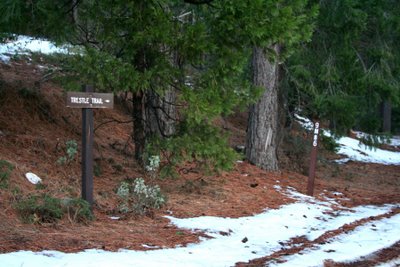
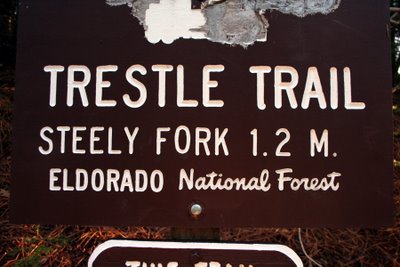 After you drive another half mile (or so -- I didn't clock it), you'll see this sign to the left up on the old railroad grade. Park your car in the wide spot and hike the trail.
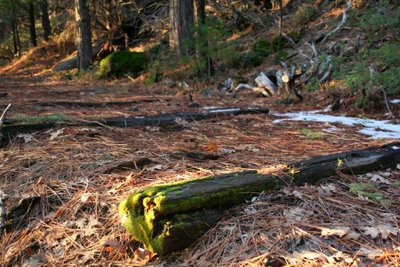
Partially buried railroad ties are visible a few hundred feet from the trail head. Please don't disturb the ties.
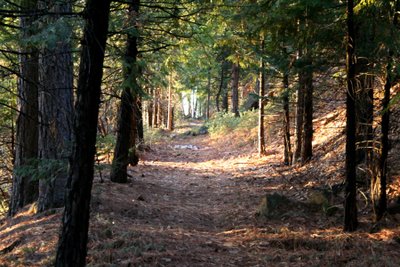
Here's what the Eldorado National Forest website has to say about the trail:
Trestle Trail: Follow the Capps Crossing Road from Grizzly Flat or the North South Road (Forest Route 6) to the dirt road 9N36. Turn south on this road and stay to the right for approximately one-half mile to the trailhead. This pleasant foot trail follows a railroad grade for 1.2 miles to the site of the main bridge (removed) over Steely Fork Creek. The trail is in excellent condition, and passes three collapsed trestles (wooden railroad bridges) on the steep hillside. Return to the trailhead along the same route.Technorati Tags: Shay locomotive, Diamond & Caldor, Eldorado National Forest, Grizzly Flats, railfan, narrow gauge, Trestle Trail
Subscribe to:
Posts (Atom)


