Sunday, September 06, 2009

Military field range stockpots

Tom sent me a picture of the 15- (left) and 10-gallon stockpots for the M59 field range. The smaller pot is designed to fit inside that larger pot, thus creating the perfect double boiler.

This picture shows the 10-gallon pot nesting inside the 15-gallon pot. Note the cradle, which steadies the pot as you slide it in and out of the field range cabinet.

Field range gasoline burner

As one who used the military field range burner for 20 years in the U.S. Navy Seabees, I initially expressed concern when Tom asked the readers of the Royal Tine camp cooks forum for advise on his M59 field range outfit. I know from first hand experience that the gasoline-powered burner can be deadly when misused.

I advised Tom to not use the burner. In its place I suggested that he to rig a propane burner in the frame of the military M2 burner.

Tom assured me that he's proficient in the operation of the burner. "I have used the burners keeping a close eye on the pressure gauge," said Tom. He explained that he will shut the burner down when the fuel tank pressure climbs above the green zone, a practice that we follwed in the Seabees.

"I worked in the place that made (the field range) before the Army changed" to the new multi-fueled burner, said Tom. He acquired the "double pots, whisk, ladle, serving spoon, strainer, and the pot rack from where I worked" by asking the owner, who gave the equipment to him.

Tom was able to purchase two new-in-box burners from a military surplus dealer. He later purchased the roasting pan and 10- and 15-gallon stockpots to complete the field range.

Thursday, September 03, 2009

Double boiler set up in the military field range

I recently answered a question from a former Pennsylvania National Guard soldier about his U.S. Army surplus M59 field range.

Tom currently uses the M2A gasoline burner inside the field range cabinet to heat a large pressure cooker while canning food (pictured to left).

"I have been using this set up for canning," said Tom on the Royal Tine camp cooks forum. The benefit is "no heat and little mess in the kitchen."

Tom would like to use the large 10- and 15-gallon stockpots to make "gallons of tomato sauce at one time." He asked Royal Tine readers how to use the double boiler.

The answer to Tom's dilemma comes from the April 1996 edition of the Army Field Manual 10-23: "When you need a double boiler, put 21 liters (22 quarts) of water in the 60-quart pot. Place the pot in the cradle. Put a 40-quart pot in the 60-quart pot and then cover the 40-quart pot."

A double boiler is used to cook delicate sauces, soups and chocolate dishes that easily burn under direct heat.

Although the cook can buy specially manufactured double boilers, any two pots can be used as long as they nest together. In the field range, the 10-gallon pot is designed to nest inside the 15-gallon pot. .

Water level is poured into the larger pot to just under the bottom of the smaller or upper pot. Boiling water shouldn't touch the smaller pot.A tight-fitting upper pot prevents steam from escaping

The two stockpots were part of the standard outfit with the field range. Modern equipment has since replaced the M59 in U.S. military field kitchens.

Note: I'll post a picture of the military double boiler as soon as I can acquire one.

Monday, August 31, 2009

Boot chief petty officer

I post this photo in honor of the latest class of chief culinary specialists in the U.S. Navy. I was first advanced to chief petty officer 24 years ago next month ...

PEARL HARBOR (Aug. 29, 2009) -- Chief Culinary Specialist (Select) Frankie Lee landscapes an area outside an abandoned air control tower on Ford Island. Chief petty officers and chief selects cleaned the area as part of the chief induction process as it will be the backdrop for the Naval Station Pearl Harbor's official chief pinning ceremony next month.

U.S. Navy photo by Mass Communication Specialist 3rd Class Eric J. Cutright.

Saturday, August 29, 2009

Saga of the Deer Crossing oven, part 3

Relief came during the first week of Session 2. Jim called RJB Gas Plumbing Service, a local El Dorado County gas plumber. Owner Roy, a man my age with over 30 years experience, quickly discovered the problem and repaired it.

Roy said that Deer Crossing's oven was in better condition that two well-known El Dorado County eateries, both restaurants that Debbie and I have enjoyed. Roy brought me up-to-date on happenings in local establishments while he repaired the oven pilots and cleaned both burners.

Costly parts precluded replacement of both thermostats. I told Jim that I could live without a thermostat for the season as long as the ovens worked. I manually adjusted the oven temperature for the remainder of the summer.

I put both ovens to the test one day later during my third pizza night of the season. "The oven worked beautifully -- no flame-outs -- took 12 to 15 minutes for each batch," I wrote in my notebook.

As I often did throughout the summer, I expressed my relief in words. With 26 (12-inch) pizzas to bake that evening, pizza night had the potential of being a disaster.

"Music to my ears," I wrote with a feeling of liberation. "I lit both ovens and after a momentary pause, both burners went 'whoosh' as they're supposed to do -- the infamous DCC oven has been conquered!"

I wrote that note on Thursday, July 9, my last recoded comment regarding the ovens for the summer. Three weeks into my summer job the problem was solved.

Deer Crossing Camp's most important piece of culinary equipment was in top shape. Many thanks, Jim!

Thursday, August 27, 2009

Don Mason's Dutch oven newsletter

Here's the mid-summer edition of Don Mason's Dutch oven cooking newsletter. To have a copy emailed directly to you, contact Don at dmason50@att.net.

Saga of the Deer Crossing oven, part 2

The first big test for the ovens came on the first of eight pizza nights. I couldn't go one meal without re-lighting the oven pilot. Many meals I had to re-light it one or two times.

The process to light a pilot was cumbersome at best. I knelt down, pushed the pilot button down with my left hand and shoved the stick lighter up next to the pilot.

My hand cramped as I depressed the red button. And I couldn't release it because it it took a minute or more to heat the pilot to a point where it'd stay lit.

In the 35 to 40 minutes it took to bake a cake, I was usually on my knees three or four time making sure the burner was still burning. The pilot had to be re-lit once just to bake the cake.

Jim must've sensed my frustration with the whole process. I talked to him about the ovens daily with the hope that he'd locate the technical manual and repair the oven.

But there was no manual to be found on-line. Jim expressed his reluctance to tinker with adjusting the pilot. Although as the camp director, Jim has trained himself to maintain the camp, he had never tackled the oven.

Trepidation surfaced as I approached the first pizza night. Both ovens had to heat to 500 degrees for an hour or more as I baked 20 (12-inch) pizzas. The only way the meal would be successful was to have two ovens that worked perfectly.

"Both ovens handled reasonably well," I recorded in my notebook with some relief. "I had to manually light the left oven -- it worked all evening." Although the right oven eventually gave out, disaster was adverted that night.

To manually light the burner (or bypass the pilot), I jammed the stick lighter up against the burner and turned the oven dial to 350 degrees. Flame slid down the burner after a 10-second pause.

This was the only time that I successfully lit the burner in this manner. I tried unsuccessfully one other time. Safety concerns (like burning all hair off my head and face) restrained me from trying the unsafe method any more.

The right oven gave me more fits that first pizza night. "(It) gave out on me twice and I couldn't re-light it after the second time," I wrote.

That means that I went to me knees -- a physically challenging move for this fifty-something chef -- and once again jammed the stick lighter up against the pilot and start the process over. Fortunately, I was able to finish baking the pizza in the left-hand oven.

To be continued ...

Sunday, August 23, 2009

Saga of the Deer Crossing oven

Two events made life in the Deer Crossing Camp kitchen easier this summer. Debbie's constant companionship was a great comfort to me during her seven-week stay.

She was a constant companion (as I reported here), one with whom I could talk and find solace. Even when we were in different rooms in the lodge, just knowing that she was present. I always knew that I'd see her in a little while and we'd be able to talk.

I can't imagine what this summer would've been like of Jim hadn't allowed Debbie to join me. Each work week would've felt much longer than the sum of its six days. Her presence relieved my mind of endless waiting for my next day off, a wait that would've been marked by loneliness and longing to see her.

I was blessed this summer and I am grateful to the camp's owner and director, Jim Wiltens, for allowing her to stay with me.

The second event had more of a physical impact on my stay at Deer Crossing Wilderness Camp. I discovered early during the training session that the ovens were going to give me fits all summer long.

An early heads up from the camp's 2008 chef in May warned me that the "ovens must be watched carefully for temperature fluctuations." Blake's words came true on Tuesday of my second week at camp.

I served caramelized chicken (chicken breasts basted with a soy-catsup-honey sauce that caramelized in the oven) and mashed potatoes with apple crisp that evening to the 15 staff at camp for training. I had to re-light each oven four or five times. The pilot seemed to blow out each time the burner cycled off.

I wasn't able to brown the crisp topping to a nice, even golden color. Jim and I talked about the ovens that night – this first of many conversations over the next two weeks.

From that first conversation we looked for solutions. Jim searched for a technical manual for the Imperial brand oven on the Internet, but never found one. Neither Jim nor I were willing to play with the oven's settings without some technical guidance.

The problem calmed down during the remainder of the training week. I didn't record anything in my notebook for the until the first pizza night during Session 1. Once I learned to handle the oven with care, like gingerly opening and closing the oven door, the problem seemed to go away for a few days.

To be continued ...

Thursday, August 20, 2009

Iron horse chef

Every so often I find pose on the blogoshere that's worth reprinting with little comment. One steam engineer for the Pacific Coast Railroad at the historic Santa Margarita Ranch in Southern California has devolpoed the unique talent of cookin' on the backhead.

Enjoy ...
Engineer Jeff "Grumps" Badger may be a vegetarian, but that doesn't stop him from enjoying some good eatin'. You see, when God gave us the steam engine, he intended for no hoghead to ever go hungry on a hard day's work. The steam locomotive backhead -- the great grandaddy of the dashboard -- might well be the most unexpected kitchen known to man. From injectors to hydrostatic lubricators, firedoor dampers to deck hoses and trycocks to warming trays, there's enough cooking capabilities on these rolling teapots to concoct every carbon-coated creation imaginable. And you thought we'd just let all that lost thermal efficiency escape into the atmosphere! (Click here read more.)

Monday, August 17, 2009

Leeks at Meyers Farmer's Market

I took my family to The Gateway Cafe in Meyers, California, for lunch yesterday after church services. Since we live less than an hour from the Lake Tahoe area, it was an easy drive.

As we drove up to the restaurant, which is located near the junction of U.S. Highway 50 and California State Route 89, I saw the Meyers Farmer's Market. The market runs each Sunday in August from 2 to 7 p.m. It's located at 3200 U.S. 50.

After lunch -- a tough choice between The Gateway's black & blue burger and a veggie burger -- my wife, son and I drove over to the farmer's market, located adjacent to the Meyers Downtown Cafe. The open air market gave us a chance to stock up on produce. The crisper in the refrigerator of a bit bare since I've been out of town for the past 10 weeks.

We purchased a basic produce selection (carrots, cauliflower, corn-on-the-cob, green onions and leeks) from the Rodriguez Fruit & Vegetable Growers booth of Watsonville, California.

I now need to work on a few ideas to use the vegetables. A couple soups from 'Round the Chuckbox come to mind: creamy potato leek soup with bacon or Dutch Girl Cooking's split pea soup with leeks and celery root. A pan-roasted cauliflower gratin will make a flavorful casserole for tomorrow night.

I might also try something new, like leeks braised in cream, garlic and lemon. Or a in a dinner quiche with ham and a nice blue cheese. The other option is to use them in place of onions for a few dinners this week.

I now need to head to the Cameron Park Farmer's Market on Wednesday or Placerville Farmer's Market on Saturday to buy more produce.

Sunday, August 16, 2009

Choices?

What do you do when faced with this choice, both from the burger menu at The Gateway Cafe (3140 Highway 50, Meyers, California, 96155) in Meyers, California?

Black & Blue Burger
Quite possibly the best burger on the planet! Spicy blackened burger topped with melted blue cheese sauce, crispy onions and two bacon strips
Veggie Burger
Garden burger topped, jack cheese, avocado, lettuce, tomatoes and sprouts with our spicy salsa aioli
While the veggie burger has some good ingredients listed -- who wouldn't try the spicy salsa aioli -- it took me about five milliseconds to select the Black & Blue!

Home at last ...

I arrived home at 1:30 p.m. after enjoying a fulfilling 67 days at camp. By my account I was responsible for 6,863 meals over nine and one-half weeks.

While that sounds like an impressive accomplishment, remember that I was only feeding 65 campers and staff of the camp's peak attendance in July. It was a relaxing summer, one where I rarely had to rush meals.

I'll have more to say in the coming week or so. My notebook is full of articles, enough to keep the blog going for the rest of August and into September.

Now onto important things, like looking for work.

Thursday, August 13, 2009

Old Glory no more


Old Glory no more
Originally uploaded by SeabeeCook
The flag pole at Deer Crossing Camp is a hold over from its days as the Loon Lake Boy Scout Camp (mid-1960s to mid-1970s). It stands proudly on the rock knoll that overlooks the Deer Crossing lodge.

I can imagine many a moving flag raising ceremony at the pole when the Boy Scouts used the camp. Young Boy Scouts standing in formation on the rock shelf below the ensign, dressed in khaki uniforms with neatly tied kerchiefs, give a steady salute to the proud symbol of our wonderful nation.

Deer Crossing only uses the pole as a rally point for fire drills and missing campers. I'd love to see the pole renovated and the nation's proud flag flown again up high.

Friday, August 07, 2009

A lonely time at camp

It's been lonely at Deer Crossing Camp without my wife. I took her home last night so that she could stay with our son, who returned from a summer at grandma's house.

It didn't really hit me until 11:30 this morning, when I sat down for the first time during lunch production. I felt a tear or two as I scribed notes in my camp cooking notebook.

An acute emptiness came over me. It's strange. As long as I was busy this morning, I didn't seem to miss her as much.

It's that empty feeling you get when half is missing -- a void that can only be filled one person, my wife of 28 years. Staying busy only takes my mind off of her for a few minutes.

Although we were at odds in the kitchen sometimes -- probably because I acted like the chef even when Debbie was in the kitchen. It's tough trying to be both husband and chef when your wife is one of your workers. It's a relationship that needs great care and understanding.

Still Debbie was a great comfort these past seven weeks. We'd talk when things became stressful in the camp kitchen. She's always been a good shoulder to lean on, especially when I was willing to listen.

We had a unique relationship at Deer Crossing Camp. Debbie and I were the only married couple at the camp for most of the summer. We'd talk in the evening and work out our differences.

Even though we had some rough days in the kitchen -- probably because her ideas differed from my on some issues -- I've learned to approach marriage as designed by God.

I treat her with understanding and give her a place of honor in my life. After all, we're "together of the grace of life" (1 Peter 3:7). I doesn't make sense to me to treat my wife any other way.

I'm going to continue to miss Debbie as I work this last week at camp.

Unlike the training session last June, when I didn't see her for 10 days, I have a day off on Sunday. I'll be home in time to pick Debbie and Jacob up so we can worship in Camino.

Wednesday, August 05, 2009

Knot tying chef

One of the side benefits to working a wilderness camp is you have the opportunity to learn skills other than in the culinary arts. Over the past nine weeks, I've become proficient in operating two different Honda generators, testing the water for chlorine content, bear-proofing waist disposal and cleaning the grease trap.

These are skills that I initially learned in the U.S. Navy Seabees in the early 1980s, but had set aside. But they are skills that the wilderness chef must master if he's to work independently of other camp staff.

Often the chef and his crew are the only ones in camp between meals. A self-sufficient culinary crew can relieve others of these tasks during the day when many are busy with other duties.

I recently re-learned to tie several important camp knots. Last week I asked David at Deer Crossing Camp to show me the bowline, a knot that's eluded me for years. I could never remember when the rabbit was supposed to come in or out of the hole or when he was supposed to go around the tree and dive back into the hole.

David patiently said, "The rabbit comes out of the hole, goes around the tree and back into the hole."

Simple enough. Then he said something that made sense to me.

"The tree in the lower piece in the loop," explained David.

It clicked -- suddenly I understood the process. In one simple sentence, David, an 18-year-old sailing instructor from Lenzie, Scotland, erased several decades of frustration with the bowline.

Since our Saturday know tying class -- one that took me back to knot tying in Navy boot camp -- I've working on a dozen other knots. Musty from handling pigtails, my hands have been busy practicing several useful knots.

Some, like the monkey fist, won't help me secure a kitchen tent to the forest floor. But it may if I need to weight down the end of a line or anchor a line to a rock crevace.

The figure eight, clove hitch and half hitch -- all knots that I've re-acquainted myself with over the past week -- will come in handy next time I need to secure a tarpiline over the wilderness kitchen.

Note: The links take you to an animated knot tying website called Animated Knots by Grog.

Tuesday, August 04, 2009

Scrambled eggs in camp

I find scrambled eggs in camp to be an easy process. You can cook the perfect eggs every time by following a few simple rules. The key is to use the right skillet, control heat and stop cooking at the right time.

I start with two large eggs per person at camp at the beginning of each session. We serve scrambled eggs four times during each two-week session. I crack more or less eggs for the next egg breakfast, based on camper acceptance.

The campers at Deer Crossing Camp generally won't eat more than two eggs each. Crack more eggs if you have a group of hearty eaters. I found that 10 dozen was good for the 65 campers and staff during Session 2.

I cracked 12 dozen for the session's first breakfast on Monday, July 6, 2009. After watching campers dump leftover eggs into the garbage, I reduced the number by two dozen. Sessions 2 and 3 ate closer to two eggs per person.

Crack the eggs into the appropriate-sized bowl or bowls. Whisk to combine. Season each dozen large eggs with 1-cup milk, 1-teaspoon salt and white pepper to taste. Whisk to incorporate milk and seasonings.

I like to cook scrambled eggs in a cast iron skillet. While you can use any heavy skillet with a thick cooking surface, I find cast iron to be a good conductor of heat. And with a well seasoned skillet, you won't have any problem with sticking.

Heat the skillet over medium heat until a layer of butter sizzles lightly in the bottom of the pan. Don't over-heat the skillet as this leads to scorched eggs.

I prefer to cook the eggs at a lower temperature than what's recommended by many recipes. I find that I get better quality control.

Pour the eggs into the skillet once it's heated. You should hear a light sizzle. Too much sizzle means that the skillet is too hot. This is where practice will help. About four- to five-dozen large eggs will fit inside a 17-inch Lodge skillet.

Using a steel or wood spatula, gently pull the spatula across the bottom of the skillet. Let the spatula glide. Apply too much pressure and you'll pick up the layer of overcooked eggs on the bottom. The goal is to release newly cooked eggs into the liquid mass while leaving any crust behind.

Watch the heat during cooking. Lower the temperature if the eggs are cooking too fast. Conversely, increase the flame is the eggs aren't cooking fast enough. Again, experience counts here. It takes upwards of 20 minutes to cook a 4- or 5-dozen batch of scrambled eggs in a large skillet.

Cook the eggs to the soft-set stage. A digital thermometer should read between 165 and 170 degrees F. The eggs will continue to cook for the first 10 minutes the skillet. I find that eggs with a slight undercooked appearance will be perfect by the time they reach the table.

While you can cook then to medium-set (about 175 degrees) your group is squeamish about soft eggs, I don't recommend going much further than medium-set. No one appreciates dry, overcooked eggs.

SCRAMBLED EGGS

This recipe comes from Food For Fifty. This recipe varies slightly in amounts than my recommendations. It gives you a good, basic recipe to start, plus some variations.

8-1/3 pounds eggs (about 75 total)
1-1/2 quarts milk
2 tablespoons salt
8 ounces margarine

Break eggs into mixer bowl. If using frozen eggs, defrost. Beat slightly on medium speed, using wire whip attachment.

Add milk and salt to eggs. Beat until blended. Refrigerate mixture, removing small amounts as needed.

Melt margarine in fry pan, griddle or steam-jacketed kettle. Pour in egg mixture (see notes). Cook over low heat, stirring occasionally, until of desired consistency. Eggs should be glossy and 165°F. Serve with No. 10 dipper.

NOTES:

Potentially hazardous food. Hold uncooked mixture below 41°F and cooked eggs above 135°F.

Breaking and pooling large quantities of shell eggs is not recommended.

Use pasteurized eggs when scrambled egg mixture must be held longer than 2 hours.

The type of equipment used will determine batch size. Eggs should be cooked in small batches and held for a minimum amount of time before serving.

STEAMER METHOD. Melt 4 ounces margarine or butter in each of two steamer or counter pans. Pour egg mixture into pans. Steam for 6-8 minutes at 5 pounds pressure until desired degree of hardness is reached.

OVEN METHOD. Melt 4 ounces margarine or butter in each of two counter or baking pans. Pour egg mixture into pans. Bake approximately 20 minutes at 350°F, stirring once after 10 minutes of baking.

For lower cholesterol, egg whites may be substituted for half of the whole eggs.

VARIATIONS:

Scrambled Eggs and Cheese. Add 1-pound grated cheddar cheese.

Scrambled Eggs and Chipped Beef. Add 1-pound chopped chipped beef. Reduce salt to 1 Tbsp or less.

Scrambled Eggs and Ham. Add 1-1/4 pounds chopped cooked ham. Reduce salt to 1-tablespoon or less.

Navy iron chef competition

We never had this much fun "back in the day" ...

JACKSONVILLE, Fla. (July 30, 2009) -- Food Network Chef Robert Irvine gives Culinary Specialist 2nd Class Andre Keith, assigned to Naval Hospital Jacksonville, pointers during the cooking portion of the 2009 Commander, Navy Region Southeast Iron Chef Competition at Naval Air Station Jacksonville. Keith's team took second place during the competition.

JACKSONVILLE, Fla. (July 30, 2009) -- Navy Culinary Specialists rush to prepare their dishes before the clock runs out during the 2009 Commander, Navy Region Southeast Iron Chef Competition.

U.S. Navy photos by Mass Communications Specialist 1st Class Rebecca Kruck.

Monday, August 03, 2009

Flying cook for Jeep Jamporee

Friend and fellow outdoor chef Dave Herzog flew into Rubicon Springs in El Dorado County, California, Sunday to cook for the Jeep Jamporee for two weeks. Since the helo pad is very close to Deer Crossing Camp, I tried to get across Loon Lake on Sunday to see him and take a look at his gear, but missed him.

Last Thursday I inquired as to when we could get together. Dave replied with this message on Facebook:
I'm teaching classes at SW [Sportsman's Warehouse] in Rocklin, grocery shopping at Cosco, then packing and weighing everything for the helicopter lift into camp on Sunday morning. Sunday Morning we will be at the heli pad around 9 a.m. flying Cast Iron, food and gear into camp to set up. The pad is over by the Dam and that's where I'll be all morning, then flying overhead around noon to set up the kitchen and cook dinner.
We have a chance to get together Saturday when he has a few days off. I'll report back on his menu and see if I can get some pictures of the kitchen set up.

Since I took this photo around 1 p.m. Sunday, he could be on this helo!

Update: I spoke to Dave on Sunday, August 16. He was on the pictured helo, a long with the head cook.

Friday, July 31, 2009

Sysco has arrived


Sysco has arrived
Originally uploaded by SeabeeCook
How do you get food to a wilderness camp? By boat, of course!

Two staff meet the Sysco food truck at the Loon Lake boat ramp and load the 60 cases (or so) onto the camp's boat. After a 10-minute ride across the lake -- all one asks for are calm waters -- the boat is ready to be off-loaded at Ghost Boat Cove, the camp's main cargo point.

From there, the process gets physical. Although campers normally help, staff manually move the food along a 1/4-mile-long trail when campers are on out-trips, as they are today. Once at the lodge building, it's broken down and stowed for the week.

Today, five staff (including the chef) moved the 60 cases in about two hours. It took six loads in our three handcarts. All the frozen and refrigerated food was brought up to the food storeroom first. Dry goods and cleaning chemicals were handled last.

Thursday, July 30, 2009

Good to be home

Homecoming was always a time of great joy and many tears me. The tears came with a sense of relief that the seven-month deployment was finally over and I was back home with family. But the next deployment was always in the back of my mind, which would within the year.

GROTON, Conn. (July 22, 2009)-- Culinary Specialist 1st Class Joseph Appold hugs his wife and his 1-year-old son upon the return of the Virginia-class attack submarine USS New Hampshire (SSN 778) to Submarine Base New London. New Hampshire returned from her maiden deployment and was the first Virginia-class submarine to be deployed to the U.S. European Command area of responsibility.

U.S. Navy photo by John Narewski.

Monday, July 27, 2009

Iced tea

You miss the simpler things in life at a wilderness camp, like iced tea. It's not a nice medium-rare steak or juicy hamburger at the local restaurant, but a tall glass of freshly brewed iced tea.

While we enjoy cool water drawn from the depths of Loon Lake, Debbie and I long for an ice cold beverage after a nine-day stretch in the kitchen.

The first thing we did at The Forrester, a pub and grill in Camino, California, was to ask for a glass of iced tea. Filled to the brim with crystal-clear ice cubes that melt into the tea, the first two glasses slipped down easily. Our served left the pitcher after she poured my third glass of iced tea.

Our refreshing beverages (Debbie ordered ice water) were the hit of the evening. Debbie's shepherd's pie and my baby back ribs took second place to our ice cold thirst-quenching drinks.

Friday, July 24, 2009

Oatmeal explosion

I serve Deer Crossing Camp's "oatmeal explosion" meal once each week. The first comes on Friday of the first week, repeated on the following Monday or Wednesday, just before campers leave on their out-trips.

The meal is so named because it explodes in your mouth when topped with a dozen add-ons.

Served plain, often with cream of wheat for non-oatmeal eaters, I supply campers cinnamon, cocoa powder, brown sugar, honey, syrup, raisins, shredded coconut, chocolate chips, butter and milk (or soy milk). Nuts and other toppings are served when available.

Each camper assembles toppings for form a special breakfast. With seven tables currently, I call each table to the front counter of the kitchen in order. Campers then take a ladle of oatmeal or cream of wheat before rummaging through the toppings.

It takes 1-1/2 (42-ounce) boxes of oatmeal and 1/2 (28-ounce) box of cream of wheat to serve a camp of about 65 campers and staff. Campers average a 5- or 6-ounce portion when self-served. This amount is enough for firsts and seconds.

Because I often don't have any water in the system at 6 a.m., I fill a 20-quart pot with water in the evening and leave it covered on the range overnight. I turn the burner on as soon as I walk in the kitchen. It takes about 45 minutes for a large pot of water to boil at the 6,500-foot elevation of Loon Lake.

Once the water boils in the morning, I dip the water into waiting pots for the two cereals. Once I add the cereal to the pot, I simmer it for a minute or two, then cut the heat and let is steep until breakfast. This helps me avoid burnt oatmeal as our pots are rather thin.

Wednesday, July 22, 2009

First meal of the session

Deer Crossing Camp menus spaghetti with meat and vegetarian sauces for the first dinner of each session. The meal is universally accepted, easy to prepare and reminds new campers of home.

Tuesday, July 21, 2009

Mark Twain on bacon update

Almost three weeks ago I commented on Mark Twain's quote, "Nothing helps scenery like bacon and eggs." This morsel of culinary wit from America's celebrated writer fascinated me. Any writer who takes the time to comment on two long-standing breakfast staples is worth reading.

So I eagerly purchased a copy of reprint of Roughing It (Mark Twain, Dover Publications: Mineola, N.Y., 2003, reprint of 1913 Harper and Brothers ed.) on Amazon.com and had it shipped to Deer Crossing Camp, where I starve for bacon. The tale of Twain's western adventure arrived in the mail Saturday.

Now some 120 pages into Twain's fourth book, I'm certain the editor of The Wit and Wisdom of Mark Twain: A Book of Quotes (Paul Negri, eds., Dover Publications: Mineola, N.Y., 1999) misquoted Twain. He may've cited an unknown edition of the book.

My research in Dover's reprint of the 1913 edition, along with several on-line copies, indicates the correct quote should be: "Nothing helps scenery line ham and eggs."

Before you get the idea that Twain and his companions sat down to breakfast at a trail-side diner somewhere west of Salt Lake City, where the scenery-enhancing meal took place, understand that he and his traveling companions had laid in a supply of boiled ham and hard-cooked eggs during their recent layover in Salt Lake City. The purpose of this "alteration" in travel meals was to seemingly take the matter of meals into their own hands.

One grotesque breakfast stands out of the three or four meals penned into the 1872 account of "several years of variegated vagabondizing" to this point in the book. Twain and his traveling companions "could not eat the bread or the meat, nor drink the 'slumgullion.'" The stage, carrying Twain, older brother Orion Clements and fellow passenger Bemis, had pulled into a stage stop on the prairie in Nebraska early one morning.

"Our breakfast was before us, but our teeth were idle," complained Twain. Station keepers laid breakfast before the hungry travelers on a table made of a "greasy board on stilts." The bill of fare consisted of condemned army bacon and crusty bread that Twain described as "last week's." The trio was supposed to wash the meal down with a concoction called "Slumgullion" that "really pretended to be tea, but there was too much dish-rag, and sand, and old bacon-rind in it to deceive the intelligent traveler."

"A battered tin platter, a knife and fork, and a tin pint cup, were at each man's place, and the (stage) driver had a queens-ware saucer that had seen better days," said Twain. On these plates, Twain and his companions were subjected to "condemned army bacon which the United States would not feed to its soldiers in the forts, and the stage company had bought it cheap for the sustenance of their passengers and employees."

"We gave up the breakfast, and paid our dollar apiece and went back to our mail-bag bed in the coach, and found comfort in our pipes." With breakfast a lost cause, Twain and his companions returned to the coach.

Twain's best meal of the 20-day journey from St. Joseph, Missouri, to Carson City, Nevada, came at the Green River station in Wyoming. The "simple" breakfast of "hot biscuits, fresh antelope steaks, and coffee" was fresh in Twain's memory a decade later when he wrote Roughing It.

"Think of the monotonous execrableness of the thirty (meals) that went before it," said Twin, "to leave this one simple breakfast looming up in my memory like a shot-tower after all these years have gone by!"

Twain and his traveling companions finally took control of their own destiny and acquired a supply of bread, boiled ham and hard-cooked eggs for the torturous trip through the Nevada desert. The supply was sufficient to "last double the six hundred miles of staging we had still to do" to Carson City.

It's within this context that Twain writes the paragraph that I quoted in my last blog on Mark Twain:
And it was comfort in those succeeding days to sit up and contemplate the majestic panorama of mountains and valleys spread out below us and eat ham and hard boiled eggs while our spiritual natures revelled alternately in rainbows, thunderstorms, and peerless sunsets. Nothing helps scenery like ham and eggs. Ham and eggs, and after these a pipe--an old, rank, delicious pipe--ham and eggs and scenery, a "down grade," a flying coach, a fragrant pipe and a contented heart--these make happiness. It is what all the ages have struggled for.
I'm a little saddened that Mark Twain's original wit didn't include the phrase "bacon and eggs" because it fit so nicely into my story of bacon and butter. But I can equally accustom myself to a steady diet of "ham and eggs" as Twain did during that last push across the desert to his destination.

Bath a thick slice of boiled ham in butter, fry it over a hot fire and you've got the makings of a scenery-improving breakfast, as Twain discovered in 1861. A dollop of yellow mustard and some salt and pepper for the eggs will make any scene a spectacular one.

Sunday, July 19, 2009

Philly-style Polish sausage sandwiches and inter-session meals

My number-one inter-session food request from staff is for adult food. The instructors (and the small number of campers staying for the next session) want off-menu food items. They welcome any dish that's a change from the standard Deer Crossing Camp two-week cycle menu.

When I started lunch prep at 11 a.m. yesterday, I quickly assembled 2 salsas. My first thought was to offer a trio of salsas to the 14 staff and campers that would eat lunch. Three unique flavor combinations would form the basis for a chip and salsa extravaganza.

The first two salsas quickly came together. The fiery orange and apple salsa contained two dice Valencia oranges and two diced granny smith apples with ground cumin and the juice of two limes.

Red and green bell peppers, roasted and cut into strips, and flavored with a quick spicy vinaigrette (vegetable oil, white vinegar, chili powder, salt and pepper) formed a sweet pepper salsa.

I switched gears by the time I got to make a salsa fresca. When I first posed the idea of serving leftovers from the Friday barbecue, one instructor doubled her request for something other than leftovers. She may have thought I was going to throw a plate of warmed-over hamburger patties and sausages on the table.

Inter-session meals are the perfect time to get rid of the few leftovers in the refrigerator. I rarely have sufficient quantity to feed the whole camp. Inter-session gives me the opportunity to mold the leftovers into something new.

So, ingenuity and the desire to fulfill instructor requests for adult food drive many of my ideas for inter-session meals, which run from Saturday lunch to Sunday lunch. Once campers for the next session arrive on Sunday afternoon, I'm back on the two-week cycle menu.

My original thought was to slice the 22 Polish sausages and saute them with tomatoes, onions and sweet peppers. Leftover Boca burgers would form the basis for the vegetarian option.

With my newly revised menu in my heads, I figured the orange and apple salsa could double as a fruit salad, while the sweet pepper salsa would make a good relish for Polish sausage sandwiches with melted cheese – a quick camp version of the famed Philly cheese steak sandwich.

I slice the tomatoes for the salsa fresca and marinated them in a quick vinaigrette with garlic and basil. It only took a few minutes to slice onions, green bell peppers and tomatoes for the sandwiches.

To complete the sandwiches, I sauteed the onions and sweet peppers in a large cast iron skillet, then added sliced Polish sausages. Once the sausages came to temperature, I spooned the mixture onto toasted hamburger buns, topped with sliced cheese and melted the cheese in a 350-degree oven.

Note: In the last two pictures, the sandwiches with the bell pepper on top of the cheese are vegetarian sandwiches. This helped me identify them from the meat sandwiches.

Saturday, July 18, 2009

Bread at sea

Back in the my day, aircraft carrier bakeries ran two shifts. One 12-hour shift baked all the bread. The second 12-hour shift baked all the pastries.

PACIFIC OCEAN (July 16, 2009) Culinary Specialist Seaman Samantha Garza butters loaves of fresh baked bread in the bakeshop aboard the aircraft carrier USS George Washington (CVN 73). George Washington is participating in Talisman Saber 09, a biennial joint military exercise between the U.S. and Australia focusing on operational and tactical interoperability.

U.S. Navy photo by Mass Communication Specialist Seaman Adam K. Thomas.

Friday, July 17, 2009

Day off and breakfast with a buddy

June 9, 2009 was the last time I worked on the rail project with friends in the old Southern Pacific rail yard at Diamond Springs.

My summer job at Loon Lake in Eldorado National Forest has kept me far away from the day-to-day action of the El Dorado Western Railway and El Dorado County Historical Museum.

When I left for Deer Crossing Camp the next day, the rail removal project was just getting started. Except for weekly email updates from friend and EDWRF President Keith Berry, I've been out of the loop.

Home for a rare two-day stretch, I emailed Keith earlier in the week and arranged to meet him at the Diamond Springs Hotel for breakfast yesterday.

By chance, Keith and I met up with El Dorado County Fire Battalion Chief Kurt Taylor and EDWRF board member Ed Cuhna at the hotel just after 8 a.m.

Local politics kept the foursome busy as we enjoyed breakfast by Kevin, the hotel's morning cook. With two firefighters at the table (Ed is a retired fire captain), conversation quickly moved to stories of the 1992 Cleveland Fire and Kurt's vintage firetruck that the two are restoring.

Once Kurt and Ed left to work on the fire engine, Keith and I talked on. Our conversation shifted over to railroad happenings in El Dorado County. (Go to the El Dorado Western Railway blog for news of the project.)

I caught up on the happenings of the railway and the proposed El Dorado County Railroad Park at the old El Dorado depot site in El Dorado.

Breakfast gave me a chance to re-connect with rail buddies and get my mind a way from the camp kitchen.

Ever gracious, hotel co-owner Amy Shim (with husband Moon) and Kathy, our server, kept coffee and soda flowing for two and one-half hours.

Thursday, July 16, 2009

What do you do with excess stock of cream cheese and mozzarella?

Here's a question that I answered at Growlies Recipe Exchange and Party Planning Board this afternoon. ReBecca, who appears to cook at a homeless shelter somewhere in Canada or the U.S., posed this question recently:
I have a situation here. I have a woman who was so thrilled with the poor man's fettuccine Alfredo (cream cheese recipe) that she now brings me cream cheese and shredded mozzarella almost every week now.

I can't make any more fettuccine because my homeless guys are starting to complain; plus-I would love something other than pasta since we already serve spaghetti every week for the main course.

My meals are the "to-go" meals to sustain our homeless community for the 'next' day when there are no churches making meals. SO ... does anyone have any recipes for copious amounts of sausage, cream cheese and shredded mozzarella? Thanks!
There are many things do do with the mozzarella and cream cheeses. First, you can use the shredded mozzarella in place of most shredded cheeses the shelter acquires.

If mozzarella is too stringy once it melts, try combining it with shredded cheddar. The two flavors will compliment each other.

Cheesy potato soup, rich two- or three-cheese macaroni and cheese or salad topping are just a few of ways to use the shredded mozzarella cheese. Use extra cheese in each recipe as long as your inventory holds.

Consult cookbooks like Food For Fifty or Professional Cooking for ideas. They're too numerous to print on this blog.

You can also make a versatile cream cheese and mozzarella mixture. Use it for any number of dishes, both hot and cold.

Mix cream cheese, shredded mozzarella, garlic powder and hot pepper sauce. Season lightly with salt and pepper while whipping in a mixer bowl. Although you should be careful with the hot sauce, I suspect these guys will appreciate it.

Use the mixture on:
  • Celery sticks in place of peanut butter; this is a good, filling appetizer
  • Dip for crackers or chips
  • Sliced French bread halves, baked under broiler until lightly browned; use any excess hamburger/hot dog buns, French rolls or other donated bread
  • Twice-baked potatoes, baked under broiler until cheese melts and topping browns
You didn't say what kind of sausage the lady donates. Many breakfast and Italian sausages (especially if donated in bulk form) can be used interchangeably. This recipe from Food For Fifty will help you use both cheese and sausage:

EGG AND SAUSAGE BAKE

40 ounces sliced bread
9 pounds bulk sausage
40 ounces cheddar cheese, shredded
72 ounces eggs (about 42 total), beaten
3 quarts milk
1-1/2 tablespoons dry mustard

Cut bread in cubes. Cover bottom of 2 greased 12x20x2-inch baking pans with bread cubes. Pans should be well covered.

Brown sausage. Drain well. Spread cheese and sausage over bread cubes.

Combine eggs, milk, and mustard. Pour over mixture in pans, 2-1/2 quarts per pan. May be mixed, covered, and refrigerated overnight.

Bake uncovered at 325 degrees F for approximately 1 hour or until set, 180-degree internal end-point temperature. If browning too fast, cover with foil.

Cut each pan 4x6. Recipe yields 2 (12x20x2-inch) hotel pans.

VARIATIONS:

Sausage-Potato Bake. Substitute frozen hashed brown potatoes for bread cubes.

Egg-Potato Bake. Delete sausage. Substitute frozen hashed brown potatoes for bread cubes.

Pickle brine

Tyrone Barton, fellow chef and blogger in the S.F. Bay Area, answeres the timeless question for pickel lovers. His blog at Tyronebcookin offers ideas to use the brine left in the jar after all the pickles are gone.

This is an easy experiment I think you will like. If you have a certain favorite pickle or pickled vegetable that you buy at the store then after eating all the contents inside the jar save the ‘pickling’ juice or liquid (read more...).

Tuesday, July 14, 2009

Grilled cheese extravaganza

Campers will surprise you, at least at Deer Crossing Camp. Just when you think that they will only eat chicken nuggets, grilled cheese sandwiches and cold cereal, they surprise you and devour so-called adult food.

When I served Mulligatawny soup two week ago, the campers at Deer Crossing ate a bowl each. And they thanked me after the meal for the wonderful alternative to canned cream of chicken soup.

Saturday night I accompanied the grilled pork chops with caramelized onions. I sliced three large yellow onions and slowly sweated them in a cast iron skillet until they turned golden.

I set the skillet on the kitchen counter, not in bowls for the tables. I figured staff would be the only ones to eat the delectable onion dish, which I consider equal to bacon and butter.

I knew that I was in trouble when the first four tables (of seven that night) decimated the caramelized onions. The teary eyed head of the last table (a second-year instructor) almost sent tears to my eyes when he missed out on the onions.

With this background, I knew that I had to prepare enough "special" sandwiches when I created a grilled cheese extravaganza yesterday. Once again, the campers ate every sandwich that was placed on the table.

I grilled 60 sandwiches for the 37 campers that ate in camp yesterday (a couple dozen campers and staff were out on a whitewater rafting trip). They included:
  • Traditional grilled cheese with two slices of cheese -- 30 sandwiches; we use Sysco sliced cheddar cheese; it comes in 8 (1-1/2-pound) packages per case or 32 slices per package
  • Mozzarella, pesto and sliced tomato -- 10 sandwiches; the number was limited by a small quantity of tomatoes on hand; campers and staff would've eaten more
  • Tuna melt with two slices of cheese -- 14 sandwiches; used tuna salad leftover from Saturday’s lunch
  • Cheese and salami – 6 sandwiches; only made a small quantity for the staff table
One sandwich came back to the kitchen after lunch, and it was a traditional grilled cheese. That’s a good indication that the campers at Deer crossing Camp will explore beyond conventional camper food.

Saturday, July 11, 2009

Johnny Nix cooking at Lodge factory store

I normally only post news of Northern California events at 'Round the Chuckbox. Since I enjoyed watching Johnny Nix when he was on RFD TV, I though I'd post this bit of news, which came to me in a promotional email from Lodge.

Enjoy ...


Thursday, July 09, 2009

Cook turned gunner

I always love an opportunity to fire heavier weapons from the ship's fantail.

PACIFIC OCEAN (July 5, 2009) Culinary Specialist 3rd Class Nicholas Zaricor, from Vancouver, Wash., fires a .50 cal machine gun with Aviation Ordnanceman Airman Marcus Gilmore, from Colorado Springs, Colo. during a gun shoot demonstration for Tiger Cruise participants aboard the aircraft carrier USS John C. Stennis (CVN 74). Tiger Cruise gives the family and friends of Sailors and Marines stationed aboard the ship a chance to share the underway experience.

John C. Stennis is en route to San Diego, Ca. to offload Carrier Air Wing 9 before returning to her homeport in Bremerton, Wash. Stennis is returning from a scheduled six-month deployment to the western Pacific Ocean.

U.S. Navy photo by Mass Communication Specialist 3rd Class Kenneth Abbate.

Tuesday, July 07, 2009

Sailors and Marines join efforts in the mess to support BHR crew

By Mass Communication Specialist 3rd Class Eva-Marie Ramsaran

PACIFIC OCEAN (NNS) (7/4/2009) -- Navy and Marine Corps personnel aboard USS Bonhomme Richard (LHD 6) combined efforts cooking and serving more than 2,400 meals, June 29, while operating at sea off the coast of Southern California.

Bonhomme Richard, the flagship for the Bonhomme Richard Amphibious Ready Group is at sea conducting its initial integration exercise with the 11th Marine Expeditionary Unit. Quick integration of the culinary specialists, Marine cooks, food service attendants, and messmen was crucial to a crew of nearly 3,000 hungry personnel.

"It's an organized chaos," said Culinary Specialist 1st Class Nino Villamor. "The first day of being underway is always a trial and error on how much food to prepare because we don't know how many people are going to eat or be in line."

The crew members and embarked Marines didn't disappoint. Crowds, noise and long chow lines were the norm, keeping the cooks and mess personnel busier than imaginable.

But such scenes will be the norm as the ARG/MEU team participates in three consecutive training evolutions prior to the start of a regularly scheduled deployment later this year.

"It's important to integrate with the ship and crew to learn your way around, get to know people and keep a positive attitude doing this type of work," said Cpl. Joseph Cahoon of the 11th MEU.

"With the planning, the food preparation and the execution of each meal, it is almost impossible to do it all in two hours," said Villamor. "But my guys in the kitchen work efficiently and they add their personal touch and flavors to each meal."

In order to meet mess deck requirements, each FSA and messman must participate in sanitation training, cleaning procedures, and food preparation procedures while underway. During training, both Marines and Sailors bring their unique skills and techniques to the kitchen; therefore the mess operates smoothly and in a timely manner.

Cahoon says, "By working in the mess decks with Navy Sailors, it takes a while to adjust to the new environment of being on the ship but I look to them for advice and I expect to learn from them."

By having the cooks in the kitchen, they give insight as to what kind of meals their fellow Marines would prefer. There are 20 cooks in the galley and 40 messmen and FSAs that take part in servicing the Bonhomme Richard's crew with not just hot meals but with great customer service.

"I take it as an opportunity to always serve and put on a good show because our rate is all about customer service and supporting the overall mission of the Navy," said Villamor.

Monday, July 06, 2009

Banana bread from scratch

I don't get many opportunities to bake from scratch at Deer Crossing Camp. Most quick breads (pancakes, cake and muffins, for instance) at the wilderness camp are made from baking mixes. Bridgford frozen bread dough is also used for dinner.

I enjoyed an opportunity to bake banana bread from scratch yesterday. Faced with four or five over-ripe banana bunches, I used the bread to replace the blueberry muffins that normally run on Monday of the first week in each session.

My assistant cook, Oyu -- she's from Mongolia! -- and I prepared a batch of banana bread during our opening day baking session. It took us two and one-half hours to bake carrot cake with cream cheese icing and French bread for last night’s dinner, along with the banana bread.

The banana bread gave me a chance to show Oyu how to scale ingredients in the bakery. It also shows her how to use over-ripe produce and to adjust the menu to fit a need.

BANANA BREAD

The dry and wet mixtures may be prepared in advance if desired. Once combined, the batter should be baked without delay to avoid loss of volume.

3 pounds all-purpose flour
1 pound 4 ounces sugar
2-1/2 ounces baking powder
2 teaspoons baking soda
4 teaspoons salt
12 ounces chopped nuts (optional)
1 pound 4 ounces eggs
3 pounds ripe banana pulp, pureed
1 pound vegetable oil or melted butter

Thoroughly combine flour, sugar, baking powder, baking soda, salt and nuts in large bowl. Set aside.

Combine eggs, banana pulp and oil or melted butter in separate bowl. Add liquids to dry ingredients and mix just until flour is moistened. The batter will appear lumpy. Don't overmix.

Scale 1 pound 8 ounces batter into each greased 8-1/2 by 4-1/2-inch loaf pan. Bake at 375-degrees F. for 50 minutes, or until done in center. Cool and cut each loaf into approximately 15 (1/2-inch) slices.

The recipe yields 9 pounds batter. Six loaf loaves will give you approximately 90 slices of banana bread.

This recipe comes from the 4th edition of Professional Cooking (Wayne Gisslen, John Wiley & Sons: N.Y., 1999), page 711.

Saturday, July 04, 2009

Mark Twain on bacon

Debbie and I visited the Taylor Creek Visitor Center before dinner last Thursday. It was our day off and we were looking to relax and take in a few sights in the Lake Tahoe Basin. I always enjoy visiting the U.S. Forest Service centers because they carry a wide selection of historical books, wildlife guides and maps.

I picked up The Wit and Wisdom of Mark Twain: A Book of Quotes (Paul Negri, ed., Dover Publications: Mineola, N.Y., 1999), a collection of Twain’s sayings. Many were taken from his books, speeches and letters written over a writing career that spanned some five decades.

One quote that caught my attention was borrowed from Twain’s 1872 publication of Roughing It. Twain said, "Nothing helps scenery like bacon and eggs."

The full quote from Roughing It contains a bit more information. Although the line from this later version used "ham," I suspect he spoke of bacon, a common staple in the west.
And it was comfort in those succeeding days to sit up and contemplate the majestic panorama of mountains and valleys spread out below us and eat ham and hard boiled eggs while our spiritual natures revelled alternately in rainbows, thunderstorms, and peerless sunsets. Nothing helps scenery like ham and eggs (page 63).
Bacon and eggs are among my favorite breakfast foods in camp. Twain is right--the salty goodness of bacon helps any setting.

Bacon is one of those foods that go with most anything. The smoky goodness of cured pork belly compliments a wide range of foods, even butter.

Yes, I said butter. As Debbie and I approached Loon Lake last Thursday, she asked me if I wanted to split the remaining piece of bacon from our breakfast at Ernie’s Coffee Shop. Never one to refuse bacon, I accepted.

My palette received a pleasant surprise when I bit into my half. It seems that Debbie had also saved the cup of whipped butter from her French toast. The bacon marinated in the butter as it melted in the afternoon sun.

If you agree that bacon and eggs improve your surroundings as Twain proposed, bacon and butter make the wilderness seem like the Garden of Eden.

The combination of two prized culinary fats made for a pleasurable end to a day of rest and relaxation. Here we were driving up to the boat landing for our ride back to camp, enjoying the lodgepole forest in the setting sun, munching on bacon and butter.

It’s a near perfect combination in the culinary scheme of things. I’m sure Twain would agree, bacon and butter make everything better, even scenery.

Friday, July 03, 2009

BBQ tonight

Barbecue tonight ... too tired to blog ... going to bed!

Thursday, July 02, 2009

Day off ...

As at most summer camps across the United States, staff get one 24-hour period off each week. The day off at Deer Crossing runs from 7 a.m. to 7 a.m. the next day.

We have chosen to leave camp on each of our days off. It lets us "get aways from it all" and enjoy a relaxing day out of the kitchen. After a five-minute boat ride across Loon Lake, we're free to relax, catch up on laundry and take care of business (banking, for instance) that can't be done at camp.

Debbie and I left the camp at 8:30 this morning and arrived in South Lake Tahoe in time for a late breakfast at Ernie's Coffee Shop. Laundry was next on the agenda, then a visit to an art and craft fair at the "Y" and coffee and Internet at Alpina Coffee Cafe.

Coffee gave us a chance to dodge the rain and catch up on the whereabouts of our 17-year-old son, who's staying with his sister. The rain was a pleasant relief from the heat and dry conditions at camp.

In the photo, I was about to stuff my special peanut butter, dill pickle and mayonnaise sandwich into my mouth at camp. I plan to demonstrate the sandwich to each new group of campers, every two weeks. Four staff and about eight campers accepted my challenge to try the sandwich last week.

I've been eating the sandwich, named "The Jonathon" after a Florida College employee who ate them by the dozen after camp in 2003, since childhood.

Tuesday, June 30, 2009

Square biscuits

Campers liked my square biscuits the other morning. Square biscuits save the time of punching out individual biscuits with a biscuit cutter. And because you avoid re-forming the dough after the first cutting, this method ensures that each biscuit will be equally tender.

All I do is dump the dough onto a greased sheetpan and press it into the pan. I pre-cut the dough (6x8 or 6x9 for an 18x26-inch sheetpan) and bake at the normal temperature. The biscuits come out standing tall.

Monday, June 29, 2009

Training at Deer Crossing Camp

Three weeks into camp, I can clearly see the three-phase approach to training at Deer Crossing Camp. Training begins 10 days before the first campers arrive. While most training sessions (like first aid, CPR and life guarding) are direct at the instructors, the cook and his assistance use the training period to:
  • Clean and organize the kitchen after nine months in mothball status
  • Clean and organize the food storeroom and refrigerators
  • Learn the Deer Crossing two-week cycle menu
  • Prepare all of the recipes as is practical
  • Adjust to the erratic nature of food supply and refrigeration
  • Prepare and submit the first Sysco order
  • Teach the instructors food safety in the role as they supervise clean-up and dishes
  • Learn how to re-fuel and to safely start the generators
  • Learn how to take daily chlorine readings in the water system
Once campers arrive for Session 1, the next two weeks are devoted to preparing all the DCC recipes in larger quantities, adjusting to the likes and dislikes of the campers, appetites and meal set-up and family style of service.

Session 1 helps because it typically has less than 50 campers and staff. The cooks are able to ease in to Sessions 2 and 3, which max out at 65 to 70 campers and staff.

The remainder of the summer season is devoted to fine tuning the skills of the cooks. One of my goals this year is to work on the DCC recipes and to purchase a few extra herbs and spices (mainly missing standards like thyme, oregano and garlic graduals), revise the two-week menu and continue training my assistant cook (her home is in Mongolia!).

By Session 4, I envision a well-running team in the kitchen. We’ll then be ready for the 2010 season.

Sunday, June 28, 2009

Mandoline vs. mandolin

I just learned this afternoon that I've been misspelling mandoline at 'Round the Chuckbox. While you slice potatoes (and other produce) on a mandoline, Doc Mercer won't play one with his Cumberland Highlanders band.

Drop the "e" and you have Doc's favorite muscical instument, the mandolin.

Whishbone, a camp cook from the neighborhood of Wichita, Kansas, posted this request at Camp-Cook.com last Thursday:
Anyone ever use one & what type do You Like. I looking at Pampered Chef ones on eBay. Son & I need to cook up a bunch of potatoes (augratin style) for 28 Girl Scouts, Leaders & Parents the last Meal at Local summer Camp. Wishbone-Ks
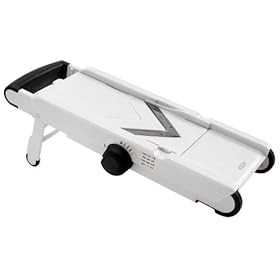
Stick with a simple mandoline, one that cuts without all the "bells and whistles." I purchased a top-line model at a local restaurant supply several years ago (pictured below). It works well enough, but it's heavy, a bit clunky and the safety guard is doesn't flow smothly.

I wouldn't spend more than $40 or 50. I spent about $200 and now wish that I had purchased an economy model. They do the same thing for much less. I found an Oxo V-blade model on Amazon for $40 (pictured at left).

Either way, Wishbone, a mandoline is a worthy investment if you plan to do any camp cooking for large groups. A sharp one will quickly cut a load of potatoes for scallops or au gratin.

I used mine at camp yesterday to cut cucumbers for the cuke and onion salad for today. I had the job done in 10 minutes with nice, thin slices of cucumber.

I don't care how good you are with a knife, a mandoline just makes good sense for the camp kitchen.

I wrote a safety brief on the use of a mandoline in the kitchen last year. Mandoline safety is serious business in the kitchen. Properly used, they are a great time saver and help you produce professional looking products. In the wrong hands, you'll be spending a lot of time in the emergency ward.

Remember: Doc Mercer plays great Bluegrass tunes on his mandolin as I slice potatoes for scallops on my mandoline.

Saturday, June 27, 2009

Mulligatawany soup

The camp uses canned soup for lunch about four or five days each week. Instead of heating a can and serving it to the campers, I often "doctor" the soup by using the canned soup as a base for a new dish.

So far, the campers and staff have been receptive to my innovative ideas. Most are simple and fit in within my limited variety of ingredients.

When I arrived three weeks ago, I found over six cases of Campbell's Cream of Chicken soup in the storeroom. With 12 (50-ounce) cans per case, I quickly figured that I was going to be serving a lot of cream of chicken soup to the campers.

I've used the soup as a base in macaroni and cheese and to make a thick chicken noodle soup. Although I have yet to serve plain cream of chicken soup, I may during one of the sessions.

During staff training I hit on an idea that dates back to my Navy service in the 1970s. Why not make a mulligatawny soup?

I was looking for something to add to the soup when I remembered the curry-spiced soup from India. The ingredients of the soup were always the subject of a question on the advancement exam for Navy cooks.

The soup started when sweated a one-pound mire poix with two julienned bell peppers. I them dumped one can of the creamy soup base with a can of water into the stockpot and stirred.

The soup was flavored with two diced apples and a moderate dash of curry powder. I then cooked one pound of dry pasta and added it to the soup. Although rice is more traditional, pasta is a big hit at Deer Crossing.

A little thyme would've been a nice addition, but I don’t have any right now. The zest from one lemon would also give the soup extra pep.

Of six quarts of soup, I had enough leftover for the picture. Thirty-six campers and staff enjoyed an interesting diversion from cream of chicken soup today.

Friday, June 26, 2009

Pizza night

Pizza night was last night. Since the menu was pizza, double chocolate chip cookies and punch, I planned of three to four slices for each camper. Three campers helped assemble the pizzas.

I used one of Sysco's pre-baked pizza shells and had the campers apply either pesto or pizza sauce to each pizza. We then topped them with mozzarella, sprinkling of cheddar cheese and Parmesan.

The pizza were baked in a 450- to 500-degree oven and cut into eighths. Here's the breakdown for 45 campers and staff:
20 pizzas total
10 cheese with tomato sauce (50%)
6 cheese with sausage (30%)
4 cheese with pesto and various toppings (20%)