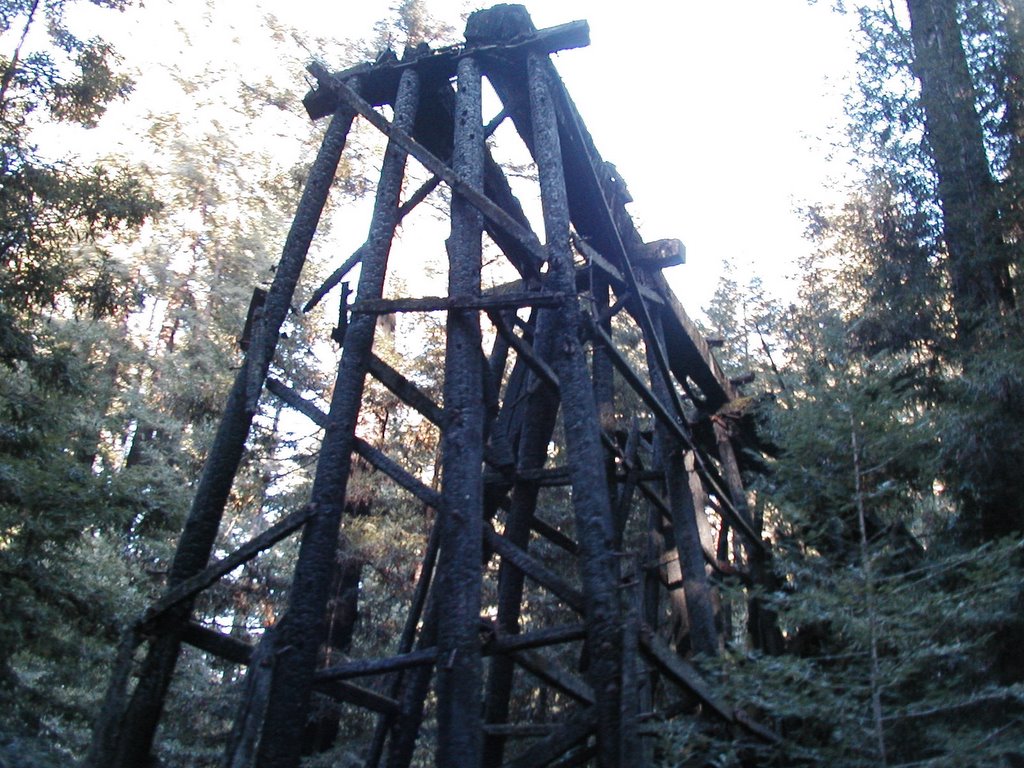
Thursday, March 16, 2006

Spring 2006 Issue of IDOS Newsletter Ready for Printers

I finished my last issue of the International Dutch Oven Society's Dutch Oven News last week. The president has it and it should be off to the printers very soon.

Members should start seeing their copies of the newsletter around mid-April, just in time for the IDOS spring convention in Farmington, Utah. East and west coast members won't receive their copies until the end of April (or later).

Bulk mail is fickle and slow. Those who live close to Ogden, Utah, usually receive their copy first. I've received mine in Northern California as late as a month and a half after its posting.

The spring issue is back up to 24 pages after the dismal showing of 12 pages for the winter issue. IDOS really needs all of the chapters to send in quarterly reports. I encourage all chapter directors to send a 150 to 200 word report to the new editor as soon as he/she is announced.

Here's what's inside the spring issue:
  • Pair honored with private tour of Lodge plant
  • Clyde Miller's last column as president -- the election for society and regional officers
  • president, vice-president, treasurer and 6 regional directors) is underway
  • Pilaf is ideal camp food
  • Mississippi's Kast Iron Kookers practice art of Dutch oven cooking, a re-printed article from Today in Mississippi
  • Rust removal using electrolysis
  • Chapter reports from Florida, Mississippi and Southern California
  • The Outlaw Gourmet by Ron Clanton
At this point, I don't know who the editor will be. In IDOS, the newsletter editor is appointed by the president. It will be up to the new president. That will likely be Randy Macari of Utah since he's the only candidate.

Tuesday, March 14, 2006

The Weather Report

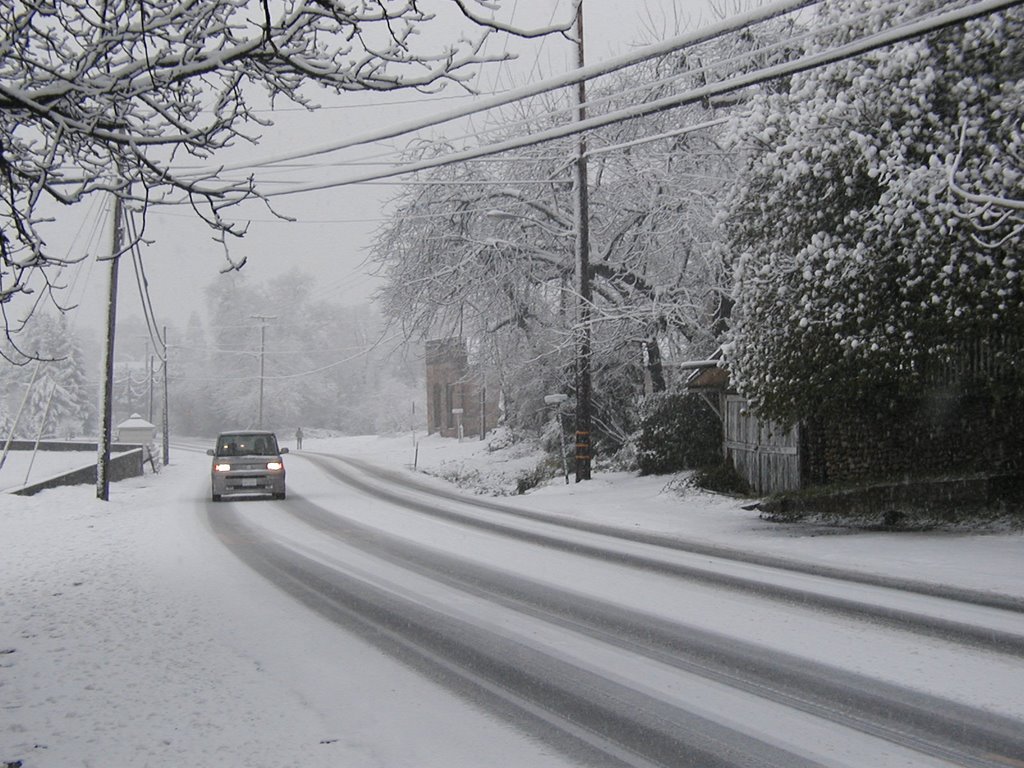
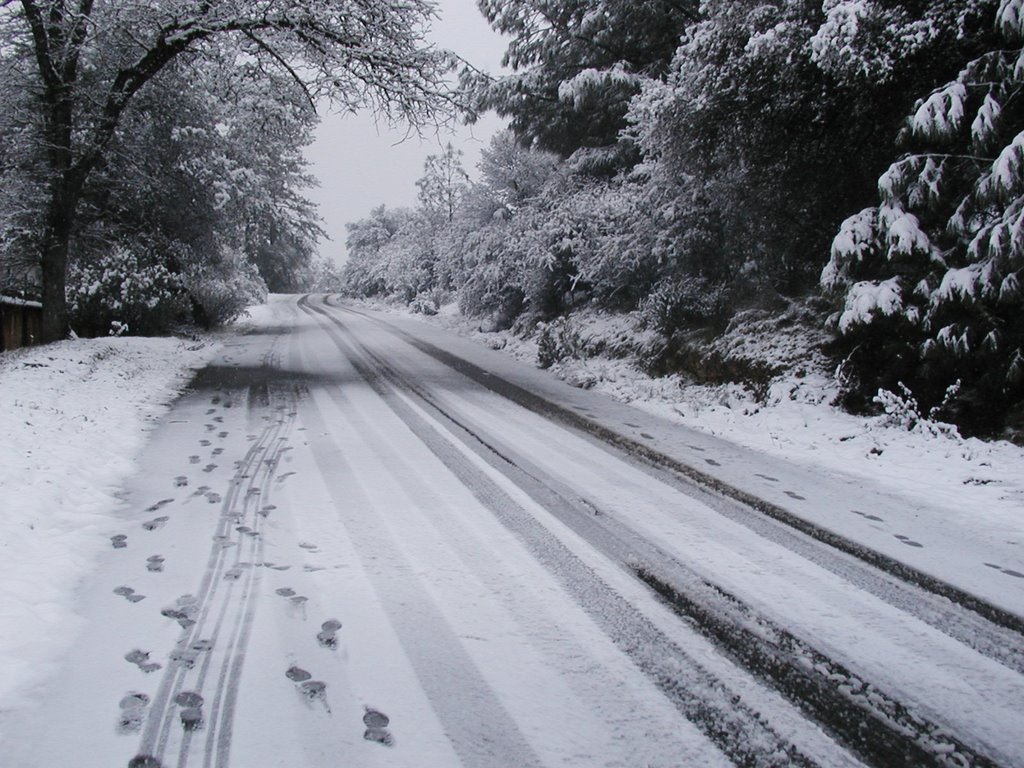
A white weekend! There's no other way to describe the weather events of last weekend.

A cold front blanketed Western El Dorado County Friday and Saturday nights, down to 1,000 feet elevation and lower.

It was a welcomed change from the warm rains so typical to the lower foothills to the Sierra Nevada Mountain Range.

County snow plows worked Missouri Flat and Pleasant Valley roads in the hours leading up to noon.

The last heavy snows in Diamond Springs fell on March 17, 2002. That's the date stamp on the photograph on the wall in the Diamond Barber Shop -- the one in the Diamond's original one-room school house.

Further east, Eric Stohl, president of El Dorado Western Rail Foundation reported, "I have 2 feet of snow on my back deck. I use it as a gauge because it is the least disturbed."

A white commute
But the afternoon commute up the hill was the most entertaining.

Sometime between 4:30 and 5 p.m., at least two thunder cells moved up U.S. 50 and hammered Cameron Park, Placerville, and Diamond Springs with fingernail-sized hail.

The bus driver's radio gave us our first indication that our homes were being pounded with ice.

Earlier, the National Weather Service had issued a sever thunder storm warning for San Joaquin and El Dorado counties, according to CBS13.com.

"It was like driving through an ice dispenser," reported one El Dorado Transit driver over the radio.

Sacramento commuter no. 4 approached 65th Street and U.S. 50 when we heard the broadcasts.

The dispatcher cautioned all drivers. Proceed with care. Pull over if conditions warrant, she warned.

The next 20 minutes were uneventful, although I suspect cell phone traffic peaked as we headed east.

As we approached the East Bidwell exit, all four lanes of traffic were backed up to the base of Carpenter Hill. The diamond lane didn't help the driver.

We received our first indication of the severity of the storm came as the bus headed up the Bass Lake grade. I glanced down the hill in the direction of Clarksville Road.

A sport utility vehicle resting a ditch that drains into Carson Creek. Apparently, four-wheel drive didn't help the driver as he spun off the road.

At the top of the hill, the driver took the initiative and exited the highway at Bass Lake Road and drove east on Country Club Road to our first stop.

As we turned onto Merrychase Drive, which parallels the highway, the whole area was blanketed with two to three inches of hail and ice.
Back on U.S. 50, I saw two CalTrans plows cleaning the shoulder, a rare event for Cameron Park

The interesting thing about this storm was the indiscriminate manner in which the thunder cell hit one community and skipped the next.

Cameron Park was hammered. But I didn't see any evidence that Shingle Springs received more than a light dusting of hail.

Further east, the bus trailed a CalTrans plow as it approached El Dorado Road. Again, the area between the El Dorado and Missouri Flat roads was covered in a thick blanket of ice -- three inches in places.

The drive home, south on Missouri Flat, gave an indication of how wide a swath the storm cut. The heaviest hail fell near the highway. Pleasant Valley Road, about two miles south of the freeway, had a half-inch.

Interestingly, none of the local media (as of the time I posted this blog) have posted stories about the storm to their respective websites. They, instead focused on funnel clouds at Camp Far West and hail in San Joaquin County.

Monday, March 13, 2006

A Couple Busy Months

January and February were busy months for me. Writing a grant for the El Dorado Western Railway Foundation started the process in early January. February and early March were dedicated to editing my last issue of the International Dutch Oven Society's Dutch Oven News.

The event that had the greatest impact on me is is a new job. After 12 years at the same desk, I've changed careers. I've worked in large institutional kitchens for the most of the past 35 years. I now evaluate the budget for a large government program.

On February 1, I boarded the commuter bus for the first time in 20 years and headed to downtown Sacramento. I've had long commutes before. But this is the first time since my college days that I'm able to relax during the commute.

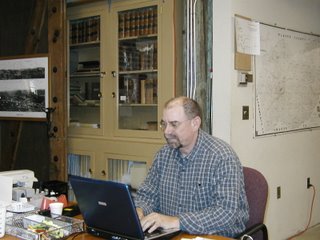
Working on the grant application for the California Cultural and Historic Endowment. I'm in the research room of the El Dorado County Historical Museum.

The bus gives me plenty of time to read, write and sleep. Reclining seats with headrests allow for plenty of relaxation. I use the time to search the scriptures, read railroad books and design a newsletter for the railroad.

Long hours on the road leave little time for cooking. For the first few weeks in February, I left home before sunrise. And the sun set long before six. Most home meals are simple and we've been eating out too much -- it's just too hard on the pocket book!

Grant writing -- a new adventure
Last January, I wrote a grant to fund with the president and vice-president of the railroad. Our goal is to acquire funding to bring the boiler of the Diamond & Caldor No. 4 Shay locomotive up to federal standards. We dedicated some 75 hours to the project.

Now that tourist railroads fall under the watchful eye of the Federal Railroad Administration, we must recertify the boiler -- this time to a higher standard than those of California. Our 1997 certificate to operate the boiler (a "pressure vessel unit") doesn't meet federal standards.


There's still time for cooking. Only now the venue has changed to the engine house.

Our hope is that the grant will supply critical funding to acquire the certificate. Skilled volunteers will perform most of the in-kind work. We'll use the dollars to purchase services and supplies that the Foundation can't provide.

With any grant, you must find the balance between writing to your audience -- those who read the applications and give the thumbs up or down -- and describing our needs. We were pleased to read that round-one grants from the California Cultural and Historical Endowment were awarded to 33 California orgnaiztions. Among them: the Bay Area Electric Railroad railroad and five museums.

Now comes the waiting game. We won't hear if we made the first cut until this spring. And the final decision won't be published until this summer. More to come.

Sunday, March 12, 2006

Don Mason's Dutch Oven Newsletter

Here's the latest issue of Don Mason's Dutch Oven Newsletter from Northern California. Email Don at iron_kettle@hotmail.com to receive an electronic copy.


Sunday, February 05, 2006

Chuckwagon Chili in the Engine House

Today marks the first anniversary of 'Round the Chuckbox. After 252 posts, I've come around to my first recipe -- chuckwagon chili.

A rare Saturday board meeting of the El Dorado Western Railway Foundation led to Keith's suggestion that I bring my outdoor cooking equipment to the engine house and cook chili for the crew.

I cooked chuckwagon chili -- slightly revised from last year's recipe -- and cornbread inside the engine house for 10 board members and crew.


CHUCKWAGON CHILI

6 pounds round steak, coarsely ground
2 medium red onions, chopped
6 cloves garlic, minced
3 jalapeño peppers, seeded and minced
3 cups beef broth
3 ounces chili powder
6 tablespoons ground cumin
1 tablespoon dried oregano
2 tablespoons paprika
2 tablespoons red wine vinegar
1 (7-ounce) can diced green chilies
1 (15-ounce) can diced tomatoes
Hot pepper sauce, to taste

Brown meat in a 6-quart Dutch oven over medium heat. Drain excess fat. Add onions, garlic and jalapeños and continue to cook until translucent. Add chili powder and cumin and cook over low heat for a minute or two.

Simmer over low heat 30-45 minutes using as little liquid as possible. Add beef stock only as necessary. Stir often. Add oregano, paprika, vinegar, remaining beef broth, green chilies, diced tomatoes and hot pepper sauce. Simmer 30-45 minutes. Stir often. Adjust seasoning.

Serve with fresh bread. Makes about 1 gallon or 12 (1-1/3 cup) servings. Traditional chili garnishes -- diced onions, grated sharp cheddar cheese and chopped cilantro -- compliment this dish well.

Saturday, January 21, 2006

Camping in Snowy Weather

Last Friday, we had great weather for the middle of January. After the warmth of the sun broke through the clouds sometime before noon, I stripped to a long-sleeve T-shirt. The day ended with moisture-laden storm clouds making their approach. But even as darkness encroached, the moon broke through and bathed our camp with the soft beams of light.

It rained from midnight until 7 a.m. At 8, when I snapped this photograph, a slushy layer of snow covered the colder patches of ground. Sly Park sets at 3,500 feet. The snow line that morning sat at around 3,800 feet.

I trust my 14-inch skillet will survive! I left it and my cutlery roll on the picnic table overnight.

Cucumber Salsa

I sent this salsa over to my parent's house last Thursday. My sister and her daughters have been visiting and helping Mom in her recovery from hip-replacement surgery two weeks ago.

The salsa was a hit with the kids, including my 14-year old son. He's since asked for more -- a rather impressive deed for a teenager who's idea of food is hamburgers, Taco Bell and chicken tenders.

CUCUMBER SALSA

The recipe is from the September 2005 issue of Sunset magazine.

2 cucumbers (1-1/2 pounds total), peeled
2 Roma tomatoes (8 ounces total), rinsed and cored
1 red onion (6 ounces total), peeled and chipped
5 green onions, rinsed and thinly sliced, including green tops
3 cloves garlic, peeled and minced
1/2 cup reduced-sodium soy sauce
3 tablespoons distilled white vinegar
1/2 teaspoon black pepper
1/4 teaspoon cayenne

Dice cucumbers and tomatoes into 1/4-inch cubes and combine in a bowl. Add red and green onions, garlic, soy sauce, vinegar and black pepper. Add cayenne to taste. Mix well. Cover and chill at least 30 minutes.

Monday, January 16, 2006

Frank's Hearty Skillet Breakfast Revisited

Many will remember two blogs on Frank's Hearty Skillet Breakfast (here and here). On an overnight camping trip last August to Wench Creek in Eldorado National Forest, Frank cooked a breakfast of bacon, sausage, fried potatoes, gravy and scrambled eggs in to large cast iron skillets.

For some, the troublesome element of this breakfast was its economical use of bacon and sausage grease. Not one drop of the rendered fat was lost to the fire or garbage.

Frank's breakfast is hearty is an epicurean contradiction -- good tasting and not-so-good for you, all in one setting.

My family recently learned that Frank is moving his family and his construction skills to Idaho, where he is going to manage a division for a large contractor.

So last weekend, we took one last camping trip, this time to Sly Park. Campers were few and the fee was reasonable at $10 per night. Winter camping is more primitive than summer camping at Sly Park. They shut the water system off in winter to prevent the pipes from bursting. Sly Park doesn't have electrical hookups.

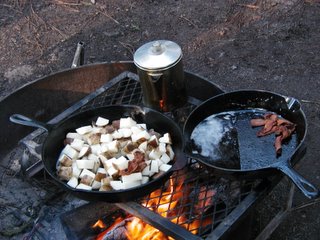
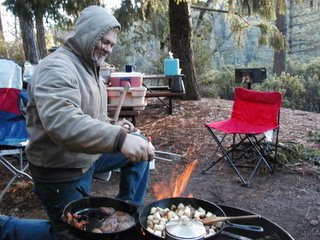
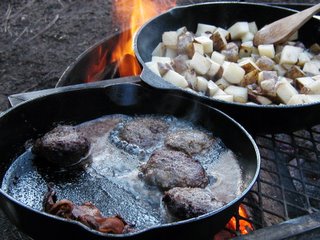
Frank repeated his breakfast production, this time without the scrambled eggs. This time I snapped several photographs of the breakfast. Here they are:

Two cast iron skillets with cottage fried potatoes on the left and bacon grease on the right.

Contractor, turned breakfast cook.

Sausage patties deep fried in bacon grease.

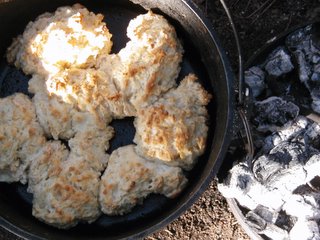
Gravy just isn't gravy without biscuits.

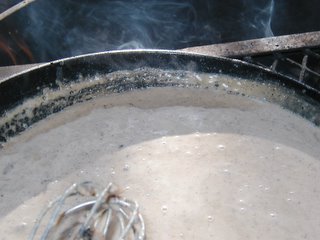
Breakfast gravy simmers over the campfire.

Tuesday, January 10, 2006

Dutch Oven Potatoes and Chicken with Broccoli

I borrowed the idea for this recipe from 5 Year Taste of Dutch: IDOS Convention Recipes, 2000 to 2004. Lou and Senia Winrich presented a dish called Top Hat Chicken Casserole at an International Dutch Oven Convention during the past five years.

In the original recipe, cooked chicken breasts were placed over a bed of lightly browned onion, carrot, celery, mushrooms and potatoes. With no desire to eat celery and no mushrooms in the larder, re-wrote the Dutch oven one-pot casserole to include two ingredients in the refrigerator—chicken drumsticks and thighs and fresh broccoli.

DUTCH OVEN POTATOES AND CHICKEN WITH BROCCOLI

Resist the temptation to use too much moisture in the Dutch oven. The heavy cast iron lid creates a fairly tight seal. As a result, very little moisture escapes during cooking.

1/2 cup vegetable oil
1 cup all-purpose flour
2 teaspoons salt
1 teaspoon ground black pepper
1-1/2 teaspoons paprika
10 pieces chicken, thighs and drumsticks
1 teaspoon dried thyme
1 medium onion, sliced
5 medium potatoes, cut into eighths
2 cloves garlic, minced
2 carrots, sliced
1/2 cup chicken broth
2 bay leaves
1 teaspoon dried thyme
1 tablespoon Worcestershire sauce
1/4 cup chopped flat leaf parsley
3 small bunches broccoli, cut into florets

Heat a 12-inch cast iron skillet over medium heat. Add 2 tablespoons oil and heat. Combine flour, salt, black pepper thyme and paprika. Dredge each piece of chicken until coated with seasoned flour. Set on plate. Place the thighs, skin side down, in hot oil. Brown chicken and turn to brown other side. Remove thighs to a plate. Repeat process with drumsticks.

Heat a 12-inch Dutch oven medium heat. Add remaining 2 tablespoons oil and heat. Add onion, potatoes, garlic and carrots to oven. Sauté vegetables until lightly browning, stirring continually. Combine broth thyme and Worcestershire sauce in a measuring cup. Pour over potatoes and stir. Sprinkle parsley over potatoes. Spread broccoli in a layer over potatoes. Place chicken in a single layer over broccoli.

Place lid on Dutch oven. Set 8 charcoal briquettes underneath oven and 17 on lid for 350 degrees. Bake for 30 to 45 minutes until potatoes are soft and chicken is cook through. Serve 2 pieces of chicken and a hearty portion of potatoes for each person.

Saturday, January 07, 2006

Chili Verde with Tomatoes?

Few accuse me of being a food purest. Claims of authenticity at ethnic restaurants (be it Italian, Hungarian or Mexican) don't move me.

My test is simple: Does the food taste good? Beyond taste, I don't really care where a dish came from or how authentic are its flavors.

So when I express alarm over Sunset's latest chili verde ("Dishes that define the West," Sunset, Northern California edition, pages 97-8), it's not because the recipe violates some long-standing culinary code.

It's because the test cooks used tomatoes (the red kind) as the foundational ingredient.

The caption to the photograph of Sunset's tomato-infused verde reads, "Cooks have long battled it out whether New Mexico, Arizona or Colorado has the 'true' version of the spicy simmered pork dish."

So, I guess I'm injecting myself into the battle.

I’m not sure how cooks make chili verde in New Mexico, Arizona or Colorado. We use tomatillos here in Northern California. Mexican restaurants that I frequent use tomatillos and green chilies in their verde. I've never had a tomato-infused verde at Casa Ramos or Colina de Oro (click for El Dorado Co. restaurants).

Sunset's approach baffles me. Although I love to mix flavors (when combinations make sense and the dish comes a live in my palate), I look to traditional flavors in some dishes. Chili verde is a prime example. I enjoy the lively flavors of the green pork stew.

This approach makes sense to me. After all, verde means green in Spanish. You use green ingredients, not the red tomatoes in the Sunset recipe, in chili verde. I though a red chili was called chili colorado!

I suppose I could learn to relish a green and red pork stew. But why try?

So add tomatoes if you must. You won't offend me. But I think you'll enjoy the traditional chili verde. It's a refreshing change from the thick, hearty red chili.

CHILI VERDE
Many supermarkets stock canned tomatillos. You'll find them in the Mexican isle.

2 tablespoons vegetable oil
4 pounds boned pork shoulder (Boston butt), fat-trimmed and cut into 2-inch cubes
Salt and pepper, to taste
3 onions (2 pounds total), cut into 1/4-inch-thick wedges
5 large cloves garlic, minced
3 tablespoons ground cumin
1 (28-ounce) can canned whole tomatillos
1 (14-ounce) can chicken broth
2 (7-ounce) cans whole green chilies, chopped
2 tablespoons chopped fresh oregano leaves
2 bay leaves
Chopped fresh cilantro
Lime wedges

Heat vegetable oil in a 12-inch Dutch oven over medium-high heat. Meanwhile, lightly season cubed pork with salt and ground black pepper. When hot, add 1/3 the pork. Turn pieces as necessary until well browned on all sides, 8 to 10 minutes total. Transfer meat to a bowl. If pot is dry, add 1 tablespoon oil. Repeat process for next 2 batches to brown pieces on all sides.

Reduce heat to medium. Discard all but 2 tablespoons of leftover pork fat in Dutch oven. Add oil, if necessary, to bring the total to 2 tablespoons. Add onion, garlic and cumin. Cook, stirring occasionally, until onions are soft, about 8 minutes.

Return meat and any accumulated juices to Dutch oven. Crush tomatillos with your hand and place in Dutch oven. Add broth, chilies, bay leaves and oregano to Dutch oven. Bring chili mixture to a simmer

Place lid on Dutch oven. Bake at 350 degrees (17 coals under oven and 8 on lid) until pork is very tender when pierced and flavors are blended, about 1-1/2 to 2 hours. Adjust seasoning. Serve topped with cilantro leaves. Garnish with lime to squeeze over chili. Makes 6 to 8 servings.

Friday, January 06, 2006

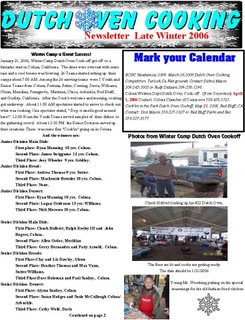
Winter Camp Cookoff in Colusa, California

I received this email from Don Mason the other day:

Sacramento River Cast Iron Cookers are having their Winter Camp Dutch Oven Cookoff on Saturday, January 21, 2006 at the Colusa County Fairgrounds in Colusa, California. Cooking starts soon after the cooks meeting at 8:30 a.m.

Once again this year we are inviting the youth to come out and cook. Ages 9 through 17 can cook, no entry fee will be charged. Every youth that cooks will receive a participation gift. If they should win their class (first through third place) they will receive a plaque.

All judging will be Peoples Choice for both youth and adults. The public may purchase a $5 ticket and sample the food cooked that day and then vote on the best cook and pot of food. Youth judging will start at 12:00 noon and end at 12:30 p.m. Adult judging starts at 12:30 and ends at 1:30 p.m.

Winners will be announced at 2 p.m. Adult class winners for first place will receive $100 and a plaque. Second and third places will receive plaques. Youth winners only receive a plaque.

SRCIC will provide prep tables and one plastic table cloth, trash cans, cold running water and hot ash cans. Everything else is on you. Hope you can come. Dress warm and enjoy the day with us.

I would like to wish all of you a happy holiday and a happy healthy new year. Hope to see you in 2006.

Thank you, Vickie Stegall.

Crowds at the 2005 Winter Camp Dutch Oven Cookoff.

Applications for the Winter Camp Dutch Oven Cookoff are due to Vickie by January 15, 2006. The fee is $30 per team. Categories are main dish, bread and dessert. Each team may cook in one, two or three pots.

To participate, contact Vickie at: (530) 458-8009.

Tuesday, January 03, 2006

Big Green Truck Pizza

My favorite shows on the Food Network are those that give me food business ideas. You'll find me viewing Best Of, Food Finds and Rocker on the Road when my schedule permits. I love it when one of these shows features a big green 1946 chuckwagon on rubber tires.

I like these shows -- I believe Al Roker's show is the only one currently in production -- because they move around the country showcasing small food businesses.

As a frustrated government worker, these shows have given me hundreds of hours of fantasy-filled viewing. I always seem to be a retirement check away from filling a food niche here in El Dorado County.

My latest business idea came to me Friday evening in the form of a 1946 International Harvester flatbed truck. Roker featured the New Haven, Connecticut based truck in the Tapas and Brownies episode.

The Big Green Truck is a self-contained wood-fired pizza oven on wheels. For $950, Douglas Coffin, a self-trained chef who’s operated a successful catering business for 15 years, will bring the truck to your home or business and prepare hand-made pizza for 50 of your closest friends or business associates.

I'm always looking business ideas. My ideal post-retirement culinary business must meet several self-imposed limitations. The full service restaurant is definitely out. I’m done with late hours and early mornings and every hour in between.

My concept has to fill a local need -- one that's unique to the local area. The idea must sell and not cost a fortune. And it must be operated with two or three employees.

I have no illusions about starting the next culinary empire in Northern California. Ideally, my concept will be centered around on or two products -- like Coffin's handmade pizza, galeto and cappuccino.

That's where the Big Green Truck comes in. It gave me an idea for a local catering business. More correctly, his idea confirmed an idea that I've had for some time now. All I have to do now is to blend the two (soon, Lord willing).

But just in case Coffin finds these words: Don’t worry about competition from the left coast.

Coffin's concept will give me ideas. I can certainly garner thoughts on menu, design and concept. Unless he shares his well-guarded trade secrets for a West Coast division, I’ll develop my own concept from scratch.

You'll have to click over to Douglas Coffin’s website to see more photographs. It sounds fun if you live near New Haven.

Saturday, December 31, 2005

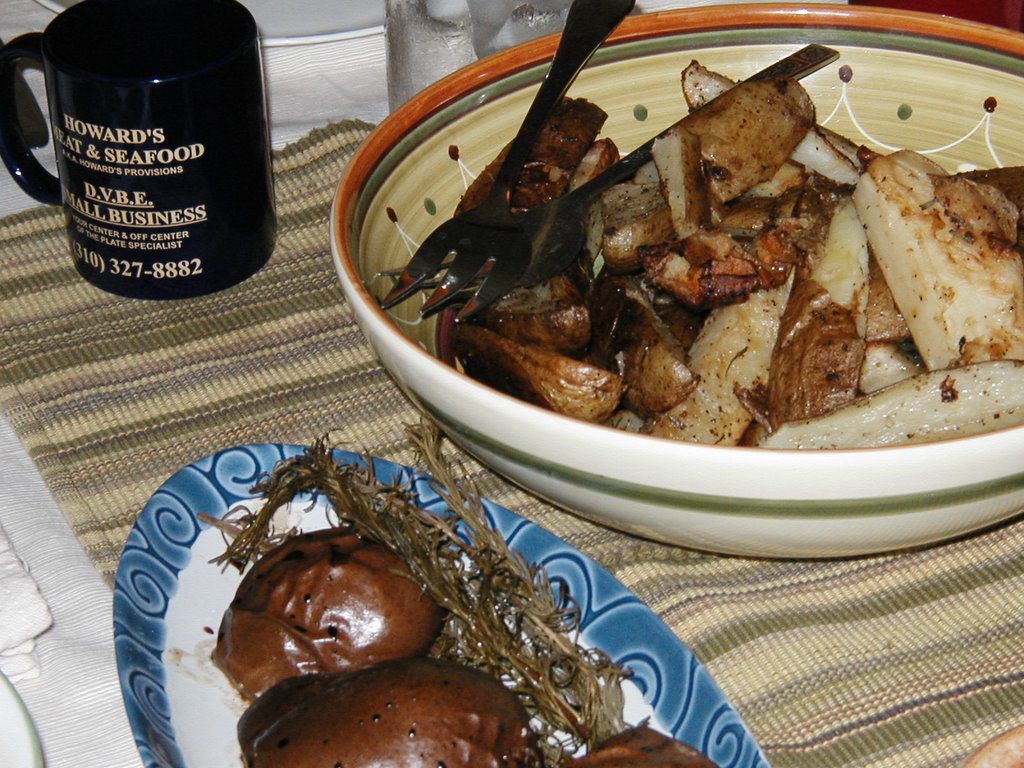
Grilled Leg Of Lamb With Rosemary, Roasted Pears, and Black Pepper Polenta

Unlike Thanksgiving, Christmas dinner was a little more adventuresome, but not by much. Those in attendance -- my parents and brother David's family -- all enjoy a good leg of lamb, especially one that's roasted over a fire.

GRILLED LEG OF LAMB WITH ROSEMARY, ROASTED PEARS, AND BLACK PEPPER POLENTA

Have your butcher butterfly the lamb for you. I added the juice from one lemon to the oil and garlic mixture.

1 head garlic, cloves removed and peeled
2 fresh rosemary sprig, needles stripped from stem, plus 8 sprig
Extra-virgin olive oil
Salt and fresh ground black pepper
5 to 7 pound leg of lamb, boned butterflied and surface fat removed
Salt and pepper
8 red-skinned pears
4 tablespoons balsamic vinegar
8 fresh rosemary sprig
Black Pepper Polenta, recipe follows

Preheat oven to 350 degrees F. In a blender, combine the garlic, rosemary, and 3/4-cup of oil; season with salt and pepper. Puree until everything comes together to form a paste; set aside for a few minutes to let the flavors marry.

Lay the lamb out flat, open like a book. Score the surface lightly with a paring knife. Rub the lamb with the garlic paste, being sure to get in the incisions. Roll up the lamb and tie with butcher's twine to hold the roast together.

Prepare an outdoor gas or charcoal grill. Season the lamb generously with salt and pepper, and then place it on the hot grill (put it on the top rack if you are using a gas grill). Sear the outside of the meat, turning, until brown all around, but do not char. Close the grill cover and roast for 30 minutes. The lamb is done when the center is still pink and the internal temperature reads 135 degrees. Allow the lamb to stand 10 minutes to let the juices settle before cutting off the twine and slicing.

To prepare the pears, halve the pears lengthwise and cut out the cores. Place the pears face down on a baking pan. Drizzle with 4 tablespoons of oil, toss the 8 rosemary sprig on top, and season with salt and pepper. Bake for 20 to 25 minutes, until the pears are fork tender.

To serve, spoon some polenta on the base of the plate and lay a few slices of the lamb on top; drizzle with a little oil and season with salt and pepper. Put a pear on each plate, face up, and drizzle them with balsamic vinegar. Garnish with a rosemary sprig.

SOFT POLENTA WITH PARMESAN AND BLACK PEPPER

2 quarts chicken stock
1 teaspoon salt
2 cups polenta or yellow cornmeal
1/3 cup heavy cream
2 tablespoons unsalted butter, at room temperature
1 cup freshly grated Parmesan
1 1/2 teaspoons freshly ground black pepper

In a large pot, bring the chicken stock and salt to a boil. Gradually whisk in the cornmeal in a slow steady stream. The liquid will be absorbed and the cornmeal will lock up; don't freak, just whisk through it. Lower the heat and continue to whisk until the polenta is thick and smooth, about 20 minutes. Add the cream and butter; continue to stir until incorporated, about 10 minutes.

Remove from heat, fold in the Parmesan and black pepper and serve.

This recipe by Tyler Florence was adapted from the Food Network website.

Tuesday, December 27, 2005

Now that the holidays are over ...

Now that the holidays are over and we’re tired of leftover turkey (okay, I still have a zipper bag in the freezer), it’s time to move onto broader culinary delights.

We had to wonderful meals this year. Turkey and all the fixin’s for Thanksgiving and lamb for Christmas. Both meals were roasted to perfection on the Webber kettle barbecue.

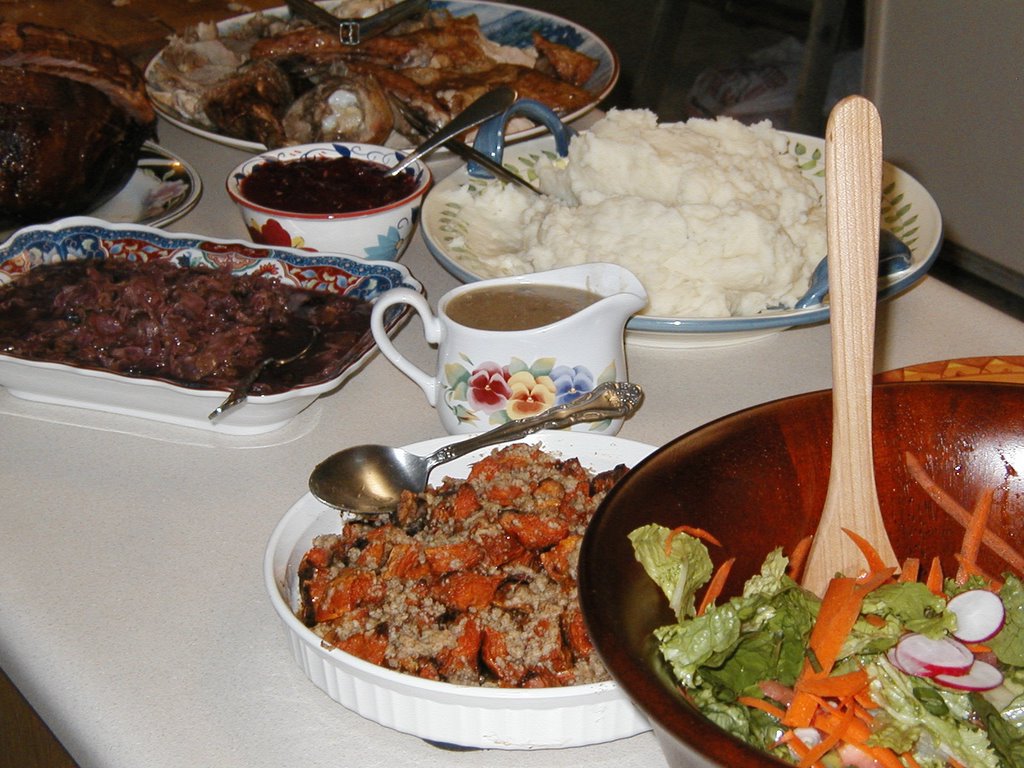
Tradition was the watch word last month for a large family Thanksgiving. With some 20 in attendance, the Karoly-Enriquez clan enjoyed a meal that was repeated in thousands of homes across this great land. Mashed potatoes, stuffing with rustic mushrooms, giblet gravy and German red cabbage complimented a 15-pound roasted tom turkey and honey-baked ham.

Thanksgiving has been my favorite holiday since childhood. As a kid it was mostly about the food. We always had oven-roasted turkey. Over the years, Dad roasted the heavy bird (always in the 20- to 22-pound range) on his no-name, non-descript barbecue rotisserie (you know, the kind with a half-dome hood that held the spit and motor).

Karoly Thanksgivings have rarely been used as R&D sessions. Mom prepared mashed potatoes, stuffing and gravy from the same family-tested recipes year after year. Good food was always placed on the table through my 18 years of home life.

One family custom always bothered me. In later years, each person at the table was asked to express what he or she’s thankful for. I don’t remember when this annual ritual started. Knowing my mother, it goes back to the 1950s or my grandmother’s table.

I have much to be thankful for -- a beautiful wife, three children who love the Lord, a son-in-law who loves my daughter and the most beautiful granddaughter on earth. The though of expressing all this in front of my siblings sent terror through my veins. I’d usually mutter, “I’m thankful for my life and please pass the gravy.”

As I said to the family this year before the blessing, I have a lot to be thankful for -- prime among that is my salvation in our Lord and Savior Jesus Christ. A wife who is a “fellow heir of the grace of life” (1 Peter 3:7); children who, after much discipline and instruction (Ephesians 6:1-4), have named the name of Jesus; and a 2 year old granddaughter who can recite “Jesus Loves Me” in toddlereeze all bring tears to my eyes. There’s much more -- like home and job -- all of which can be lost at a moment’s notice.

Sunday, December 11, 2005

Roaring Camp & Big Trees Railroad

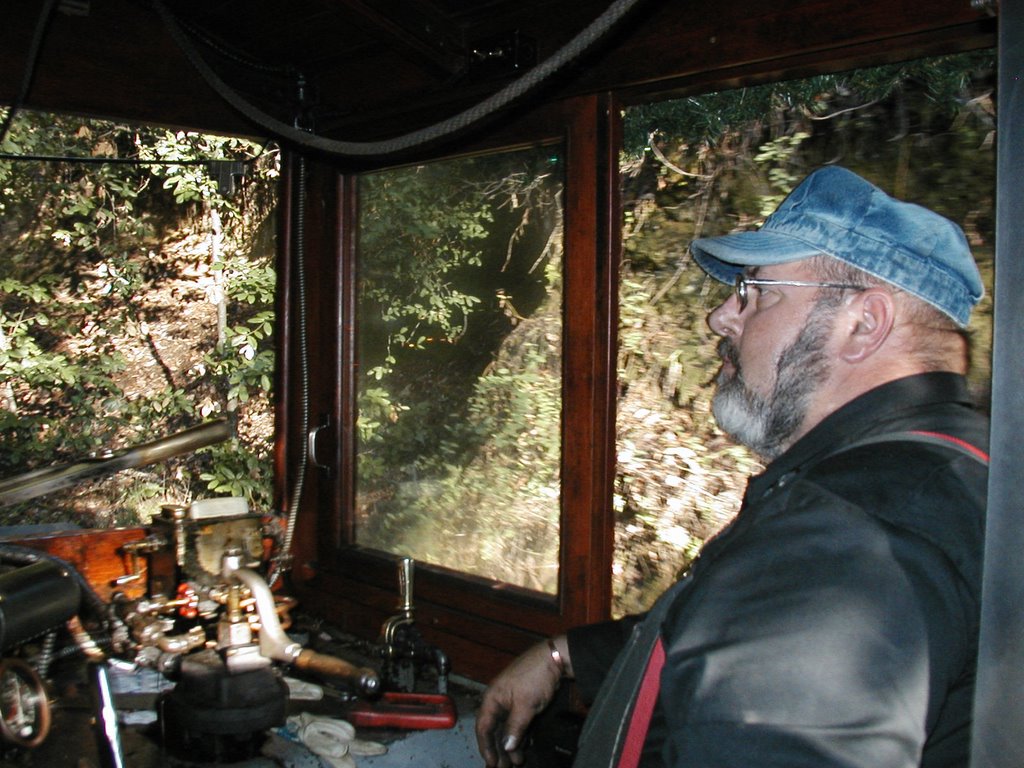
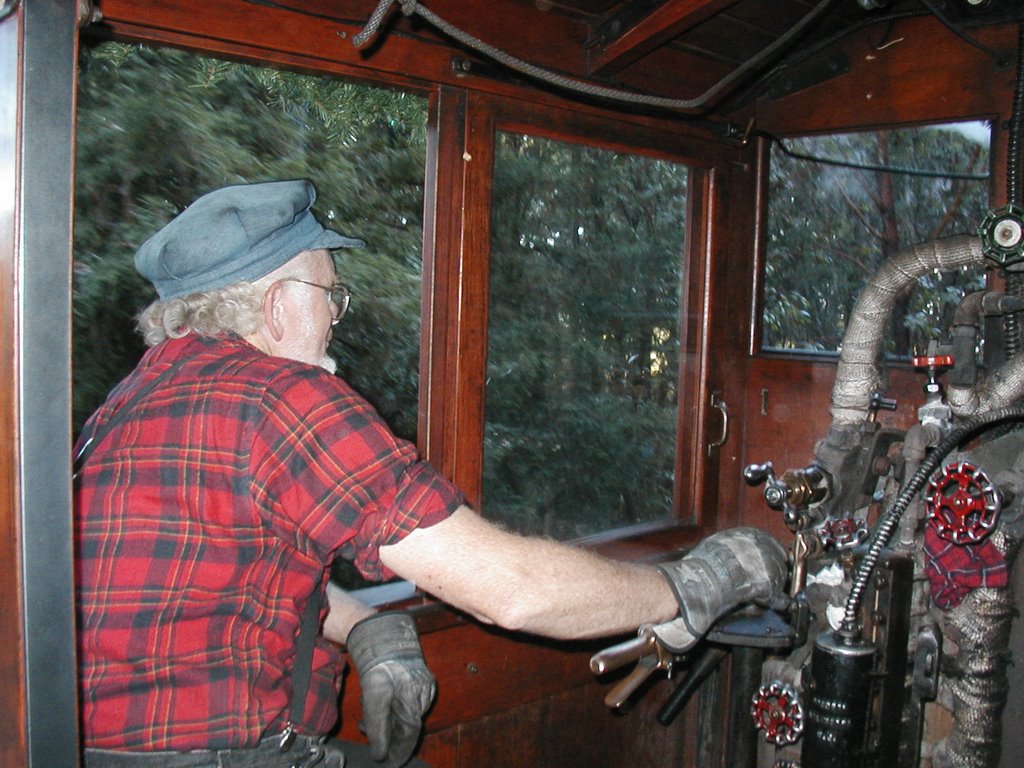
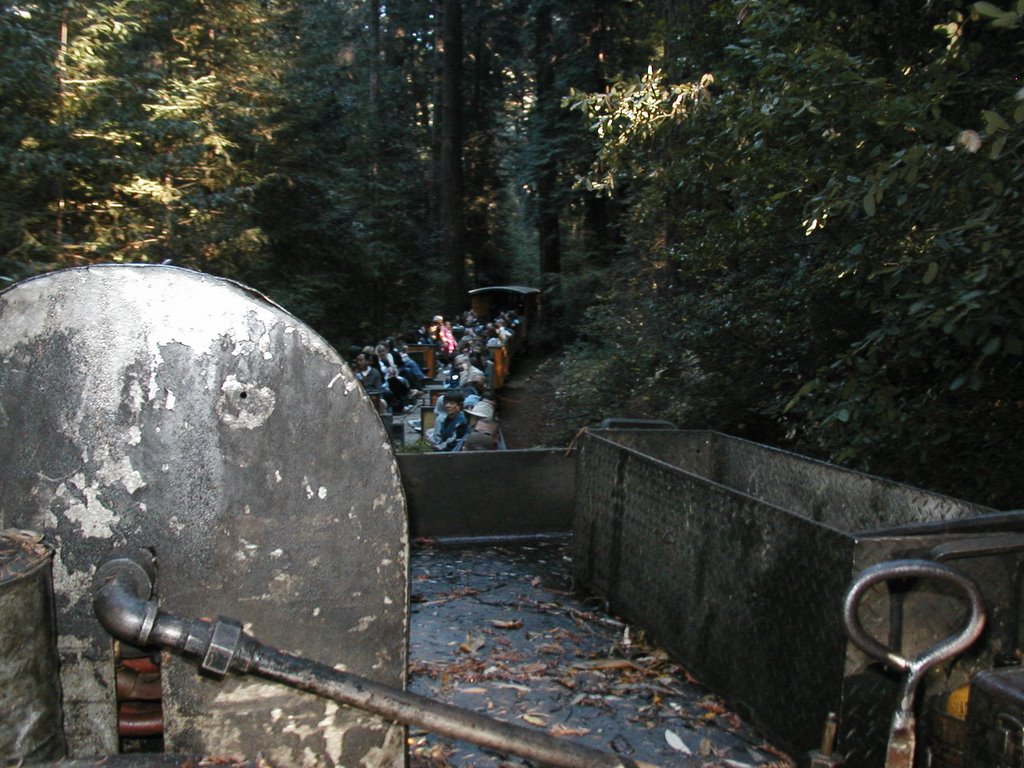
I rode in the cab of Roaring Camp & Big Trees Narrow Gauge Railroad yesterday on the downgrade trip from Bear Mountain.

After the climb to the summit -- an eight percent grade at times -- I was taking pictures of the two-truck Shay locomotive. I was under the mistaken impression that the Dixiana was an old West Side Lumber Co. Shay. I asked the conductor, but directed me to the engineer.

So I walked over to Tom the engineer as he inspected the train for the return trip to the depot. Tom told me that the RC&BTNGRR #1 locomotive came from the east and that it had five or six pervious owners before Roaring Camp purchased it in the early 1960s. (The WSL Shay that's owned by roaring camp is the former West Side #7.) I had confused Roaring Camp with the Yosemite line, which owns two WSL Shays -- #10 and #15.

I introduced myself to Tom as one of the guys who's renovating the Diamond & Caldor Ry. No. 4 in Placerville. In discussion, it was evident that Tom was very knowledgeable of the El Dorado Western Railway Foundation's effort to restore the Four-Spot to its former glory.

Tom motioned me to follow him around the train as he made his inspection (and picked garbage up). We talked. He has seen the West Side & Cherry Valley Ry. parlor and combine cars that EDWRF is restoring. And he knew of the Michigan-California Lumber Co. 0-4-0 Poter locomotive in the yard of the museum.

I followed Tom to the rear of the train and up the fireman's side as we talked. By the time we had passed the first passenger car I had a sense that he was going to invite me into the cab.

A hot, greasy rattletrap -- that was my first impression of the cab ride. When I commented on the heat that radiated off the boiler head, Tom said, "You should've been in here on the uphill trip!" It made me appreciate the intermittent wafts of cool mountain air. The cab must be unbearable in the summer, I thought.

As a railroading novice, I find it hard to describe the trip to the depot. Tom and Doug worked in unison, rarely speaking except to discuss restoration efforts at Roaring Camp. The only command Tom gave was, “Open 'er up, Doug.” Doug responded with no more than a grunt as he jumped into action, turning valves.

Nor can I explain Tom's actions as he led the 93-year old Shay off the mountain. The geared locomotive never got above a walk, even when Tom fed steam to the three verticle engines. The weight on the engine and low gear ration restrained the train from its natural inclincation to run down the hill.

In all, I spent 20 to 25 minutes in the cab of the Shay. It's a ride that I'll repeat again. For the next trip, I'd like to learn the duties of the fireman and engineer. It will be a much more rewarding trip if know what they were doing.

Sunday, December 04, 2005

Spicy Polenta Lasagna

The El Dorado Western Railway Foundation held its annual Christmas party and pot luck dinner last Thursday. We offered spicy polenta lasagna, made from Italian sausage and store-bought polenta. Spicy polenta lasagna is adapted from an Associated Press recipe in the October 19, 2005 Sacramento Bee Taste section.

SPICY POLENTA LASAGNA

Use a 12-inch Dutch oven for a double recipe.

8 ounces sweet Italian sausage
1 medium onion, diced
1 (14-1/2 ounce) diced tomatoes
2 teaspoons hot pepper sauce
2 tablespoons chopped flat leaf parsley
2 tablespoons butter
1 (18-ounce) tube prepared polenta, cut into 1-2-inch thick slices
1 cup shredded mozzarella cheese
1/4 cup grated Parmesan cheese

Cook sausage until well-browned in 10-inch Dutch oven medium heat. Break up sausage as it cooks. (Remove casings from meat first if using links.) Remove sausage to bowl.

In drippings remaining in Dutch oven, cook onion until softened over medium heat. Add to bowl with sausage. Stir in tomatoes and their liquid, hot pepper sauce and parsley.

Melt 1 tablespoon butter in same skillet. Cook polenta, half at a time, until browned on both sides. Repeat with remaining butter and polenta slices. Set polenta aside on plate.

Spoon half of the sausage mixture into Dutch oven. Top with half of polenta slices and half of mozzarella and Parmesan cheeses. Repeat layer again, ending with Parmesan cheese.

Bake 20 minutes or until cheese is melted and bubbling. Serves 4.

Wednesday, November 30, 2005

Don Mason's Dutch Oven Newsletter

Here's the latest issue of Don Mason's Dutch Oven Newsletter from Northern California. Email Don at iron_kettle@hotmail.com to receive an electronic copy.

Don said in a recent email: "Your Blogger site is working. I am getting requests for our newsletter from Utah, Kansas, Michigan, New York and Vermont."


Friday, November 18, 2005

Barbecued Thanksgiving Turkey

Thanksgiving is one of those holidays where food is almost as important as the meaning behind the holiday. I’m thankful to have been raised in a family that agrees with me. It doesn’t matter which direction we travel -- south to one of the in-law’s houses, or to my sister’s in San Jose -- a roasted turkey awaits us.

A barbecued turkey at Thanksgiving -- or any other time of the year -- is simply divine. It's browned to perfection in the barbecue. Instead of filling the house with the pleasant aroma of a roasting turkey, you’ll be inviting all of your neighbors as its scent wafts over the fence into their yard. Better set extra place settings just in case.

BARBECUED TURKEY

I find that a fifteen-pound turkey is about right for the barbecue. But the important question is this: Will the turkey fit under the dome lid? On their Website, Weber advises that turkeys over 24 pounds may not fit under the lid of their barbecue kettles.

Completely thaw your turkey before grilling. It should be thawed in the refrigerator. A 15-pound turkey takes about three days to thaw. Thaw the turkey on the lowest shelf and place it over a pan to catch juices. Never thaw a turkey at room temperature.

I don’t recommend stuffing the bird. Instead, place the stuffing into a baking pan and place the pan on the grill (or in a Dutch oven) during the last 45 to 60 minutes that the turkey is on the grill. Use a thermometer to test the stuffing for doneness. It should reach 165 degrees. If the stuffing isn’t hot enough, leave it on the grill while the turkey cools. A colorful alternative is to stuff green, red and yellow bell peppers with your favorite stuffing. Grill alongside the turkey.

1 (15 pound) turkey, thawed if frozen
Olive or vegetable oil
Salt and pepper to taste
1 chopped medium onion
2 stalks diced celery
2 diced carrots

Consult the instructions for your charcoal barbecue kettle before proceeding. The amount of needed charcoal briquettes will vary slightly from model to model. This recipe is written for the Weber 22-1/2-inch Bar-B-Kettle™ Grill.

Ignite 50 charcoal briquettes and let them burn until they are barely covered with ash, about 20 to 30 minutes. While charcoal is burning, rinse thoroughly turkey under running cold water and pat dry. Rub skin with oil. Season with salt and pepper inside and out. Place turkey, breast side up, on a baking rack.

When charcoal is ready, place an even number of briquettes on the left and right sides of the lower grill. Place a drip pan between the charcoal. Position the cooking grill with the handles directly over the charcoal. This will make adding fresh briquettes easier. Adjust the top and bottom vents to maintain the barbecue at 325 degrees.

Place the turkey (in the baking rack) on the cooking grill. Make sure to center the turkey directly over the drip pan. Cover barbecue kettle. Add 7 charcoal briquettes to each side each hour. A 15-pound turkey is done in about 3 hours. During the last hour of grilling, add onion, carrot and celery to drip pan if desired to flavor drippings. You don’t have to turn or baste the turkey.

When the thermometer reaches 170 degrees in the breast or 180 degrees in the thigh, remove turkey from the grill. Let cool about 20 minutes before carving. The meat just under the skin will be pink. Figure about 1 pound of turkey (with bones) for each person.

Strain vegetables into a pint-sized measuring cup. Skim fat from drippings. Discard vegetables. Reserve 1/4 cup of the fat for the gravy, and discard the remainder. Serve sliced turkey with camp mashed potatoes and turkey gravy.

According the Weber Website, unstuffed turkeys will take:

10-11 pounds -- 1-3/4 to 2-1/2 hours
12-14 pounds -- 2-1/4 to 3 hours
15-17 pounds -- 2-3/4 to 3-3/4 hours
18-22 pounds -- 3-1/2 to 4hours
23-24 pounds -- 4 to 4-1/2 hours

This article was originally posted on www.Suite101.com in November 2000.

Saturday, November 12, 2005

Dutch Oven at El Dorado County Historical Museum

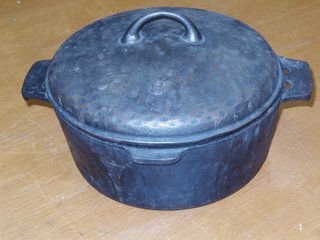
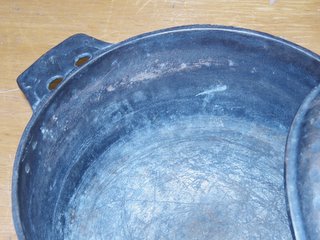
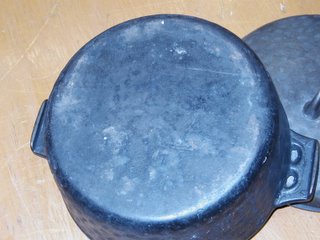
Two weeks ago, while working on rolling stock for the El Dorado Western Railway Foundation, Keith took me inside the county museum to view a recently donated Dutch oven.

Here's a few photographs of the cast iron oven:

The oven measures about 9-1/2 inches in diameter and 4 inches deep. The only marking that I found is the number 8 on the lid.

The interior of the oven. Note that it need to be scrubbed and re-seasoned.

The underside of the oven.

The inside of the lid. Note the rust. The oven is in very good shape.
Sunday, November 06, 2005

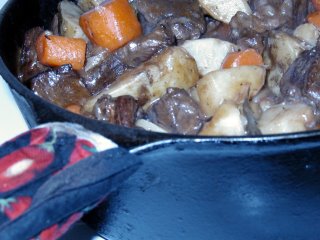
Beef Stew

Although I've been enjoying a self-imposed sabbatical from 'Round the Chuckbox, it's time to get cookin' again. My son and I enjoyed a simple beef stew last night that I baked in the oven

Here's the recipe:


BEEF STEW

2 pounds beef chuck roast, cubed
1 medium onion, chopped.
1 cup red wine
1-1/2 cups beef broth
2 tablespoons Worcestershire sauce
1 tablespoon tomato paste
2 bay leaves
1 teaspoon dried thyme
3 tablespoons all-purpose flour
2 medium carrots, cut into 1/2-inch rounds
4 medium potatoes, cut ieighth'shths

Pre-heat oven to 350 degrees. Lightly season cubed beef chuck roast salt and ground black pepper. Brown beef in hot oil in a 3-quart Dutch oven in 2 to 3 batches to avoid overcrowding. Remove each batch of beef to a plate after it is browned. Sauté onions in hot oil until browned, about 5 minutes.

Return browned beef to Dutch oven. Add red wine, beef broth, Worcestershire sauce, tomato paste, bay leaves and thyme to Dutch oven. Stir, replace lid and set inside oven. Bake for 1 hour. Prepare a slurry by whisking flour into 1/2-cup cold water. Remove lid and pour slurry into stew. Immediately stir until thickened. Replace lid and return to oven.

Meanwhile, prepare vegetables. Bring 1-quart salted water to a boil in a medium saucepan. Add potatoes and carrots. Reduce heat to a simmer and continue cooking until fork tender, about 10 to 15 minutes. Drain vegetables. Remove stew from the oven Stir vegetables into the stew. Return stew to the oven. Continue cooking until beef is tender.

Total cooking time for the stew will be approximately 1-1/2 to 2 hours. Makes about 2 quarts.