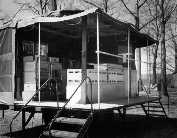
Hi: First of all, GREAT site! I am a military vehicle collector who loves to cook, my wife is a quazi professional chef, and we both have had great fun with this site.The MKT, or Mobile Kitchen Trailer, that Hank speaks of is the 1970s version of the Army chuckwagon. At one point, the mess section of each mobile Army company had a MTK. The kitchen was designed to feed troops constantly on the move on the modern battlefield.I have a MKT-75 that is restored, I have gathered up most of the equipment (ranges, burners, utensils, mermite cans, etc ...) but I am looking for the grill asbys- (the 2 sheet metal racks that M2A burners slide into and heat the large griddle and hold the pot warmer racks on the serving side of the MKT) I have the Griddle itself, and can fabricate the pot warmer racks, but I am looking for leads for the asbys and the associated splatter shields, and grease trap. If you have any leads, I would appreciate it. I will send some pix of the MKT when I have it deployed at a rally this summer. we typically feed about 300 people 9 meals over 3 days. Thanks and keep up the great work. By the way, My father was a Merchant Marine cook on
liberty ships during WWII and he enjoyed the site as well.
Oh, I also forgot, I am looking for one ladder as well.
 I organize my menu, notes, inventory and recipes for camp into two binders. The first -- "Camp Food Service Operations Binder" -- is used to assemble all the emails and notes for the administrative end of running a camp kitchen. All this information gets filed under appropriate tabs (menu, program, production, purchasing, food safety, staff, training, facility and snack shack).
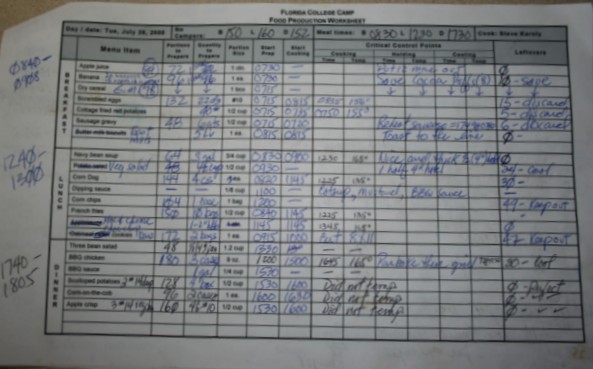 Detailed records are a must. As the saying goes, the pen is mightier than the sword. Daily food production worksheets and food safety logs, accurately completed, can defend your organization against allegations of foodborne illness.
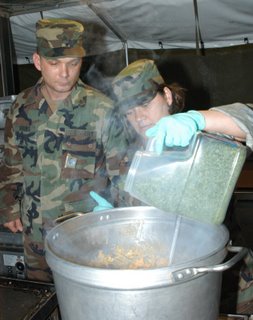 |
| Sgt. Erica Vega, Fort Riley, Kan., adds parsley flakes to the macaroni pot. Sgt. Brian Brooks supervises the team to ensure a timely finish. (Photo by Sgt. Jorge Gomez, Fort Lee Public Affairs Office.) |
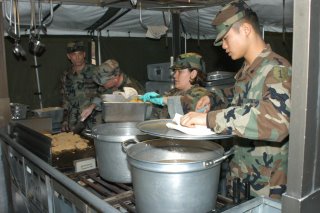 |
| With less than 30 minutes left before deadline, the Fort Riley, Kan., team rushes to complete their menu of breaded pork chops, macaroni and green beans in a mobile kitchen trailer. (Photo by Sgt. Jorge Gomez, Fort Lee Public Affairs Office.) |
Chefs faced the pressure of preparing 50 meals in cramped space with very little room for error. Teams of four Soldiers marched into their mobile kitchen trailers and took inventory of equipment. With a mystery basket of ingredients featuring pork chops, the chefs sketched a plan of attack.
Mobile burner units lit up at 8:30 a.m., launching the competition into full-battle cooking.
Two senior food service judges from Fort Lee closely observed the teams throughout the morning. Like hawks, they watched the Soldiers butcher meats, knead dough, sauté onions and maintain sanitation procedures to meet the 11:30 a.m. deadline.
Designed to try the Soldiers in field cookery and teamwork, the event tested how the teams used their equipment, planned, prepared and served their meals. Points were awarded for sanitation, timing, techniques, presentation, nutrition and enhancement. Major points were awarded for flavor, taste, texture, temperature and doneness.Given limited resources, Soldiers tackled the challenge of coming up with a creative way to “sell” their product to the judges, said Chief Warrant Officer 4 Arnold Montiel, Basic Food Services Training Division chief and judge.
“This experience encourages the Soldiers to maximize the use of all their ingredients to better prepare meals when they are out in the field. It teaches them that there is always another way to prepare the same menu,” Montiel said.
“Anyone can make a pork chop,” said Command Sgt. Maj. Clinton Jackson, food service sergeant major at Fort Drum, N.Y.
“Creativity will be a key element in the competition, but the advantage may go to the teams who have more experience cooking in the field,” Jackson said.
Norman Scott wrote: "A friend, now 84 years old, was in the navy long ago aboard a carrier and when fish was served he thought the tarter sauce was exceptional. He now fishes for fun in Ontario, Canada, and would dearly like to have the recipe for tarter sauce. Other than buying old USN cookbooks, is there a way I can find an old tarter sauce formulation?"Here's the recipe for tartare sauce (yes, that's the correct spelling for the recipe):
I am a former CS-2 and served on the Bon Homme Richard (CVA-31) from '69-'72. I helped de-commission her. Recently I tried to remember how to do sauerbraten beef which was a recipe in the standardized recipe file. I came close but the flavor wasn't what I remembered. How do I get a copy of that recipe? For that matter is there a chance of getting a complete set of those cards? I look forward to hearing from you on this; any help you could give would be greatly appreciated.Thanks for writing, David. I too remember cooking sauerbraten, although it wasn't one of my favorites. I like the sharpness that the vinegar adds, but the dish looses it for me once you add the gingersnaps.
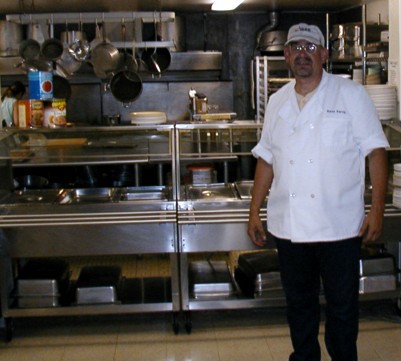 Last year I posted my thoughts on operating a kitchen at a children's Bible camp. Each summer, I chef for the Northern California Florida College Camp, which meets at Daybreak Camp in Felton, California for one week. I'll blog on preparations for the 2006 session as we get closer to our July 2 start date.
I have a similar goulash story. I too never heard the term goulash applied to the macaroni dish until I got off active duty in 1979 and met my wife. The Navy recipe card called the dish that you described "American chop suey."I came across your website while doing a little preliminary exploring about Navy food. I am a free lance writer and especially like to write humorous pieces about food and wine. Having served in the Navy during 1969-73, I have thought about doing something relating to Navy chow, though I'm not too sure in what way. Sometime these things require a long incubation, during which time I do some research. Sometime these things require a long incubation, during which time I do some research. One reason I wanted to contact you now is to ask whether you can recommend any books that talk about how recipes were developed in the Navy in past times, let's say in the period from WWII to Vietnam. I would be interested in reading about specific recipes as well as the general topic. I'd also like to know about how much leeway a cook has in 'bending' recipes as need be. I am sure galley cooks must have some very funny stories in that regard.
I notice that you have a Hungarian last name. I am Hungarian on my mother's side, and you might enjoy this story as much as I did when it happened. I was a yeoman aboard the USS Enterprise, and one day my assistant came back from lunch and said they had "goulash." Of course my ears perked up and I went down to the alley ... Only to find elbow macaroni with ground beef and some tomato and what not. I tried to explain to my shipmate that this concoction has nothing to do with goulash. But I couldn't get it across to him. He was from the mountains of West Virginia, and I was surprised recently to see in June Carter Cash's cookbook that she had exactly the same idea of goulash!
I remember the chow at ... was good. I particularly remember what I call "American Chop Suey" -- macaroni noodles and hamburger all mixed up. I love that stuff, especially with Tabasco sauce. Breakfasts were typically GI, and I've always liked that stuff, too. Yes, I like SOS.The first time Debbie invited me to her grandmother's house for dinner, she proudly announced they were having goulash for dinner. Unlike your initial reaction, I puzzled over her Missouri-born and raised grandmother cooking a traditional Hungarian dish (a dish I've only had a few times in my life).

 Here's an email that I received from Don Mason today concerning the Carson City Rendezvous:
My brothers, brothers-in-law and I logged a total of nearly forty years in the military. My hitch of 3 years, 9 months and 6 days was in the Cold War, the others in WWII and Korean War era. I'm a translator, culture historian and etymologist. We know whereof we speak.Thanks for the information, J.P. From my recollection as a 29-year veteran of Navy and Seabee galleys -- both active service and reserve duty -- SOS had a generic definition. Any of the dishes, creamed ground beef, creamed chipped beef and minced beef for instance, were collectively called SOS by sailors.
SOS ("stuff" on a shingle) was NOT Creamed CHIPPED Beef, but Creamed GROUND Beef. Quite gloppy. Some troops loved it. I tried it once and swore off. This is not to say that some troopers learned it another way, but here's the authentic scoop.
Creamed CHIPPED Beef was one of my favorite dishes, whether in the mess Hall or my mother's kitchen.
It was the greyish ground beef recipe that we called "'stuff' on a shingle/SOS."
J.P. Maher, Ph D, E-5RA
(Regular Army)
Professor Emeritus


 |
Amtrak engine 2007 pulls westbound Train 537 for San Jose. This engine is one of 14 EMD F59PHI locomotives purchased by the California Department of Transportation for use on the Capitol Corridor and other routes.
|
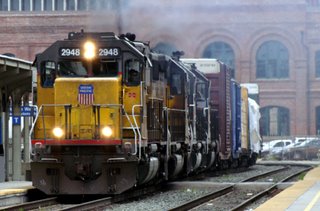 |
| Union Pacific 2948, an EMD SD40-2TR, leads three other locomotives as the westbound freight rambles through the depot on track 3. |
 |
| Here's what happens when you use the wrong setting on the camera. The automatic setting set the shutter speed much too low for my telephoto lens. I had a shot of the San Joaquin 701 arriving on track 2 as the UP roared by on track 3. Next time. |