
Tuesday, August 29, 2006


How Many Ducklings?
Here's the answer to Sunday's puzzle ...

Eight ducklings (plus mamma, center left) swam away from the photographer along the eastern shore to Odell Lake.
Monday, August 28, 2006
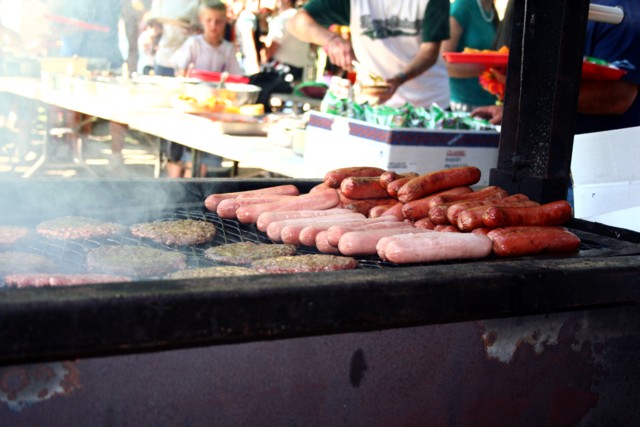
Alton's Road Crew Has Dinner at the The Swinging Grill
The restaurant the most intregued me on Feasting on Asphalt, was the Mexican Hat Lodge, in Mexican Hat, Utah. The town of 88 residents is located near the four corners area of Arizona, Colorado, New Mexico and Utah.
Here's what a Scrips Howard News Service story had to say about the restaurant and lodge:
Here's what a Scrips Howard News Service story had to say about the restaurant and lodge:
The menu is primarily steak, which is cooked outdoors on an open grill that is held up by a wagon-wheel-shaped frame and swings back and forth while the beef sizzles. Hence, the restaurant's motto: "Home of the Swingin' Steak."
J.D. Mueller's family has owned the place since coming to Mexican Hat in 1979. (The town gets its name from a giant sandstone rock formation that resembles an upside-down sombrero.) Initially a dance hall and beer bar, the restaurant opened in 1990 and has been dishing up slabs of beef ever since to tourists who come to town to go hiking, rafting or horseback riding.
There is no indoor seating - "it's too nice outside to be inside," Mueller says.
Everything is cooked and served outside, except for the beans, which are first prepared in a pressure cooker for an hour and a half, then finished off on a wood cook stove outdoors.
The dining area is lit primarily by a string of bare light bulbs that bathe the place in a yellowish, campfire-like glow. On some nights, a garage door raises to reveal a makeshift stage. Mueller and his family are all musicians, and the family band often entertains guests by playing covers of country and rock songs.
Sunday, August 27, 2006
The Mallards of Odell Lake
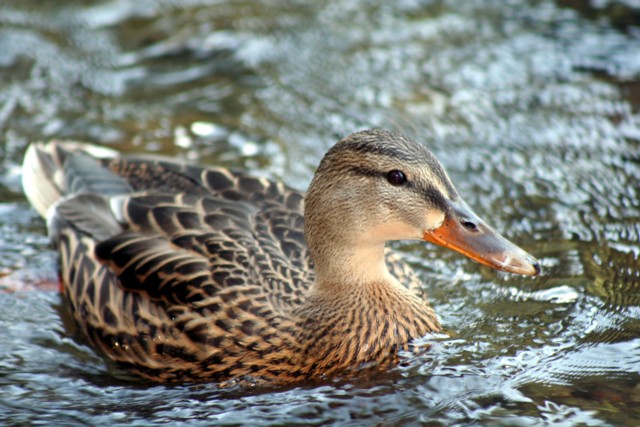 We watched a flock of female Mallard ducks during our stay at the Odell Creek Campground earlier this month.
The ladies, about four or five in number, lived around the headwaters of Odell Creek.
Each evening, they fed along the shore of the creek, which is the main drainage for the lake in the eastern Cascade Range in central Oregon.
Usually the main group of females paddled in the wake of several exposed rocks along the southern shore of the creek.
 Momma and her ducklings held back 10 or 15 feet further down stream.
I was confused all week as to the number of ducklings. Then Friday morning I had an opportunity to count them as the sat in the morning sun near the campground.
Can you count the ducklings? How many are they?
The answer in a few days.
Alton Brown's Hash Brown Breakfast
 Alton Brown's new series, Feasting on Asphalt, concluded last Saturday with the crew winding its way from Monument Valley, New Mexico into the Los Angeles Basin.
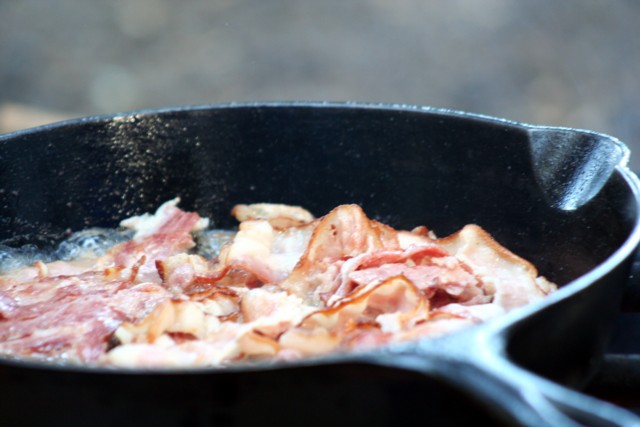
My favorite segment on Feasting featured a hasty breakfast of hash browns, bacon and eggs, prepared in Linda and Woody Mettler's rolling kitchen.
Hungry for hash browns, Alton sent his production crew ahead to arrange "a place to cook breakfast." What they found was the Mettler's large Class A RV, camped at Monument Valley.
Linda gave Alton a tour of the galley, which featured a microwave/convention combo oven, sizable pantry and refrigerator and freezer with ice maker.
"Wow! That's more food than I have at home," said Alton.
After a brief segue to the history of mobile camping, starting with covered wagon, Alton settled down to breakfast.
He grated the potatoes into a bowl of water. The water is key, said Alton, to removing excess starch in the potato.
Then came the bams! Lots of 'em.
I suppose he could've skipped this part. But since Alton recovered a bottle of Emeril's Essence from the pantry, I'm sure he felt obligated.
"What the heck is that? Emeril's? He's everywhere!"
Don't stir the hash browns, cautioned Alton. Just toss with a spatula in the skillet. He looks for a crusty exterior with a creamy interior.
The scene shifted to Woody, coffee mug in hand: "You folks wouldn't believe how much coffee he used."
Alton believes in full-bodied coffee, packed with flavor. I agree. It's the only way to brew.
"He brought a pound. He used a pound."
Woody feasted on hash browns, bacon and eggs -- and a large mug of joe -- as the Alton and the crew joined in.
Next up after the commercial break: My favorite restaurant on Feasting on Asphalt.
Until then ...
Friday, August 25, 2006
The Trust Bus
 This bus pulled up one evening when we were camped at Harris Beach State Park last month. They spent one night at the beach-side campground.
Although I didn't meet the couple who owned RV bus, they appeared to be in their 50s. I'm not sure what the bus is about or where they were heading. The bus had California plates.
Sunday, August 20, 2006
Fire Finance
 Have you ever wandered how fire media relations people can say, "The so-and-so fire cost $3.1 million dollars to suppress?"
The folks who staff the finance section tabulate all costs associated with the fire and pay the bills. They also serve as the incident time keepers and handle workers compensation claims.
The Mt. Hood Complex Wildlands Fire has been burning since August 7. Lightening started the series of fires in the Mt. Hood Wilderness and Badger Creek Wilderness.
To date, approximately 1,400 acres has burned. The fire is 35 percent contained at this time.
Tuesday, August 15, 2006
West Davis Lake Campground
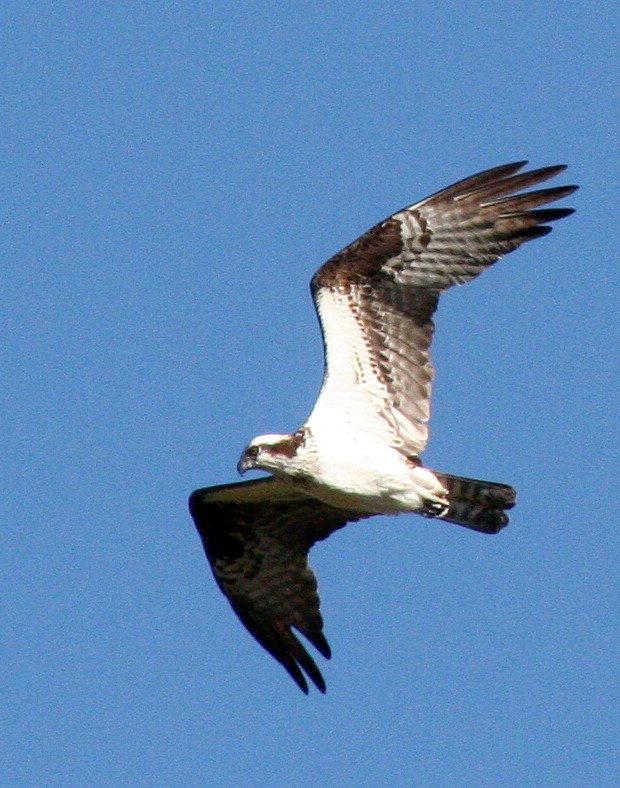 |
| An Osprey circles above the lake shore in search of prey in the warm afternoon sun. |
Today, the campground is closed. The Davis Fire destroyed the campground in 2003. The area since has been converted to day use. The boat ramp is still in use.
According the the website for the Deschutes National Forest, the campground was supposed to reopen in 2005.
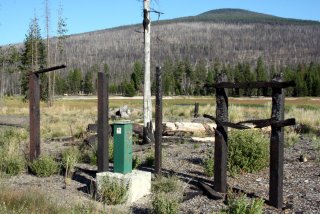 |
| The 21,000-acre fire destroyed much of the lodgepole pine forest that surrounds Davis Lake. The fire started somewhere near the East Davis Lake Campground, visible in the stand of live pine trees in the background. Investigators believe the fire was of human origin. |
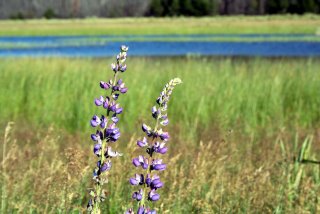 |
| Lupine flowers grow in the meadow along Odell Creek, near the boat ramp. |
Wednesday, August 09, 2006
Alton Brown Endorses Campfires
Alton Brown has a new four-part special on the Food Network. Feasting on Asphalt "explores the history of eating on the move." The two remaining episodes air on Saturday, August 12 and 19 at 9 p.m. ET/PT.
Here's Alton's endorsement of things campfire:
Here's Alton's endorsement of things campfire:
Although we’ll stay in the occasional motor lodge as needed, many nights will be spent under tent or stars. For vast majority of human history, hotels didn’t exist and eating meant lighting a fire. The social aspect of sitting around that fire is one of the things our culture lost by taking most of our meals locked inside our cars.
Alton Brown, 2006
Tuesday, August 08, 2006
More on Eating Local
As we pulled away from the motel in Florence during vacation, my son located the local Subway restaurant in the Rite Aid shopping center on Highway 126.
"Hey, we could go to Subway," he said.
"You forget my rule," I responded. "Remember, we only eat local on the road."
"But Subway is local," he countered.
I drove straight through the Highway 126-101 intersection down 9th Street to Old Hickory's (1565 9th Street, Florence, Oregon, 541.997.9739).
My son's right. All restaurants are local in a sense. I'm sure the Subway is owned and operated by a local business operator.
Even the chain stores hire local residents to staff their establishments. They depend on local patrons and travelers for business.
So, yes son, they're local only in the sense of the patrons and employees.
The cuisine is dictated by some distant headquarters. In many cases, the food is only heated on site -- it's actually cooked elsewhere at a large commissary.
Subway has some good sandwiches. I enjoy a BMT at the Subway near my office each week. But I save quick-serve restaurants for my work-a-day week.
Local restaurants -- like Old Hickory -- give us a chance to experience some of the local cuisine. Local chefs bring their ideas to the table. Each chef has his own take on a dish.
Although I didn't detect any unique preparation at Old Hickory, it was a pleasure chowning down on tender baby backs and chicken that was cooked just right. And the cole slaw was not too sweet -- just right in my book.
Plus you know that the food is usually cooked from scratch, especially at places like Old Hickory. It's fun to see how local chefs treat the same food we all love and enjoy.
I figure I can eat mass-produced food 50 weeks of the year.
"Hey, we could go to Subway," he said.
"You forget my rule," I responded. "Remember, we only eat local on the road."
"But Subway is local," he countered.
I drove straight through the Highway 126-101 intersection down 9th Street to Old Hickory's (1565 9th Street, Florence, Oregon, 541.997.9739).
My son's right. All restaurants are local in a sense. I'm sure the Subway is owned and operated by a local business operator.
Even the chain stores hire local residents to staff their establishments. They depend on local patrons and travelers for business.
So, yes son, they're local only in the sense of the patrons and employees.
The cuisine is dictated by some distant headquarters. In many cases, the food is only heated on site -- it's actually cooked elsewhere at a large commissary.
Subway has some good sandwiches. I enjoy a BMT at the Subway near my office each week. But I save quick-serve restaurants for my work-a-day week.
Local restaurants -- like Old Hickory -- give us a chance to experience some of the local cuisine. Local chefs bring their ideas to the table. Each chef has his own take on a dish.
Although I didn't detect any unique preparation at Old Hickory, it was a pleasure chowning down on tender baby backs and chicken that was cooked just right. And the cole slaw was not too sweet -- just right in my book.
Plus you know that the food is usually cooked from scratch, especially at places like Old Hickory. It's fun to see how local chefs treat the same food we all love and enjoy.
I figure I can eat mass-produced food 50 weeks of the year.
Monday, August 07, 2006
A Quick Dutch Oven Beef Stew
 Last Tuesday, we escaped the constant driving wind of Oregon's Odell Lake and set out for a picnic at nearby Davis Lake. We camped at Davis Lake, which is located about 20 miles by road northeast of Odell, in 1990.
We remembered that the Davis Lake campgrounds and picnic areas were set in among the lodgepole pine forest between several tall volcanic peaks. To our advantage, the area was much warmer and calmer than Odell Lake.
Odell Lake is know for its "quite brisk" winds. The U.S. Forest Service webpage for Odell Creek Campground (where we camped) says "whitecaps occasionally form." This isn't quite accurate -- they form everyday, usually in the afternoon.
 We found ourselves looking for activities away from the lake to escape the winds.
We never made it to Davis Lake for the picnic. Two factors impeded our decision to find a spot along Odell Creek: First, Forest Road 4660, the main access into Davis Lake from the south, was closed at the Odell Creek bridge. Contractors were strengthening the bridge.
And we discovered that the lodgepole pine forest centered around the lake was burned on June and July 2003. Although we were able to reach the lake once the construction workers went home at 5 p.m., the area wasn't conducive to a picnic.
QUICK DUTCH OVEN STEW
Please don't let the adjective quick fool you. The stew won't be ready in 30 minutes or less. Instead, this meat dish is quickly assembled before letting it simmer for 1-1/2 to 2 hours. Unlike traditional beef stew recipes, the diced chuck won't brown as the moisture in the marinate impedes browning. The peppy steak sauce compensates for the missing flavor from the deleted step.
2 pounds chuck roast, 1-1/2-inch dice
1 cup A1 Steak Sauce Marinade
1 tablespoon olive oil
1 large onion, sliced
2 cloves garlic, minced
1 (14-ounce) can low-sodium beef broth
2 large carrots, 1/2-inch slice
2 medium potatoes, 1/2-inch dice
Place meat in 1-gallon zipper top bag and coat with marinade. Set in cooler for 30 minutes. Pre-heat 12-inch Dutch oven over medium heat. Sweat onions and garlic in oil until soft. Place meat in oven with broth. Stir and simmer approximately 1-1/2 hours, until meat is tender. Add carrots and potatoes and continue cook about 30 minutes, until done. Serve with toasted garlic bread, biscuits or cornbread.
Saturday, August 05, 2006
Corning Olive Festival and Dutch Oven Cookoff
I'm back home after a week at Odell Creek Campground at Odell Lake, Oregon. The campground is operated by the Odell Lake Resort. I'll have more to say in the coming week.
Here's the latest ...
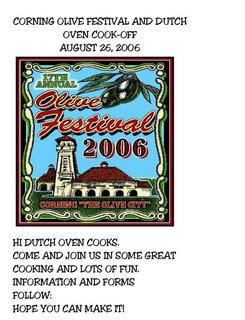
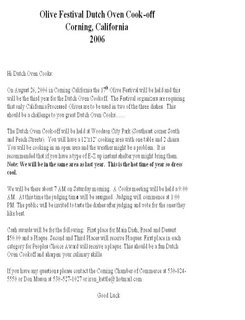
Don Mason has informed me that the 2006 Corning Olive Festival Dutch Oven Cookoff will be held at Woodson County Park in Corning, California on Saturday, August 26, 2006.
He provided the details in Jpeg images. Let me know if you can't read them.
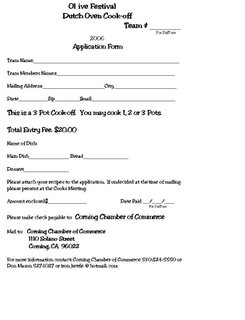
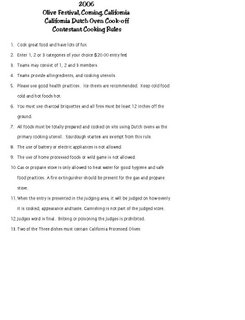
Here's the latest ...
Don Mason has informed me that the 2006 Corning Olive Festival Dutch Oven Cookoff will be held at Woodson County Park in Corning, California on Saturday, August 26, 2006.
He provided the details in Jpeg images. Let me know if you can't read them.
Saturday, July 29, 2006
Roasted Cauliflower Gratin with Gorgonzola
 By Thursday evening I knew I had to do something with the head of cauliflower in the cooler. I bought it last Sunday with no recipe in mind.
Then I though that a dish of roasted cauliflower topped with bread crumbs and gorganzola cheese would liven up a dreary day. What better way to brighten to the bland white flowers the cousin of broccoli.
The first time cooked this dish was at my in-law's house. But I've lost the recipe, which I believe came from Fine Cooking. Everyone, including my brother-in-law, loved the dish. It's refreshing nuttiness seemed to be a hit.
Like the pizza rice from Tuesday night, I used the roasted cauliflower to use up a few ingredients that have been lurking in the cooler.
There is no recipe for this dish. This is one of those side dishes that came together as I cooked.
To get started, cut a head of cauliflower into flowerets, about 1/2-inch across. In the meantime, set a 10-inch Dutch oven over a medium flame to pre-heat. When hot, pour a couple tablespoons of extra virgin olive oil in the oven.
Sweat a bit of sliced onion (about 1/2-cup) until translucent. Then add the cauliflower to the onion and stir. Watch the heat. Too much and you'll burn everything.
With the flame adjusted properly, it'll take 5 to 10 minutes to see the cauliflower change color. At first the flowerets will turn a creamy yellow. Then as you stir and toss, the peaks will turn to a golden brown.
Be patient. This part takes time to thoroughly brown the cauliflower. Turn the heat down a notch if it's browning too fast. Give it a small boost if nothing's happening.
What you're looking for is a rich golden brown color and nutty aroma. When brown, leave the cauliflower in the Dutch oven. Stir in some sun-dried tomato pesto (about 1/2-cup) and the juice of one lemon. A tablespoon of chopped fresh oregano or parsley (I didn't have any) will liven the dish.
Top the cauliflower mixture with several hands of bread crumbs. I made my own from the remains of a rustic garlic loaf. It's best to moisten the bread crumbs with a little olive oil.
Then top the dish with crumbled gorganzola cheese and place the lid on the Dutch oven. Scoop a shovel of hot coals (or 20 charcoal briquettes) onto the lid. Bake 10 minutes or until the cheese just starts to brown. You'll know the roasted cauliflower is done when the nutty aroma wafts up to you.
Enjoy ...
Local Eateries Best When on the Road
 I have one rule when traveling: Never eat in chain restaurants. This includes quick-serve and full-serve eateries.
Much to the disdain of my children in their younger years, we always eat in local establishments on the road.
Even if the restaurant doesn't contribute to the flavor or culture of the town -- a steakhouse on the waterfront, for instance -- we always eat local.
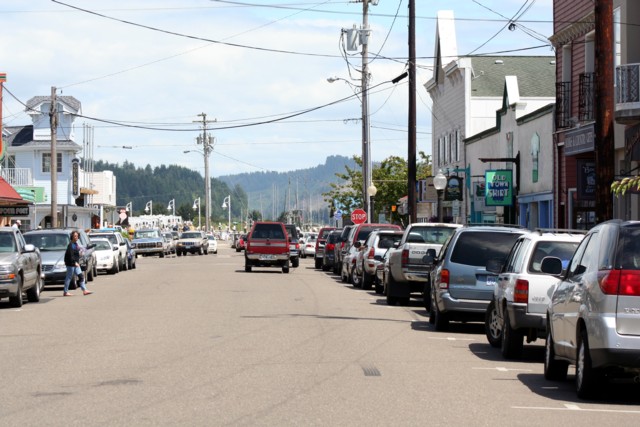
This noon, my son and I drove down to Old Town Florence to walk the eclectic collection of shops along the Siuslaw River. He picked up a copy of C.S. Lewis' The Lion, The Witch and The Wardrobe at Books N' Bears on Bay Street. I'm still looking for that perfect item.
We found great food at The Firehouse Restaurant & Lounge (1263 Bay Street, Florence, Oregon, 541.997.2800), an eatery with t-shirts, patches and fire department memorabilia decorating its walls. In a town where every other restaurant features seafood, The Firehouse offers hearty sandwiches.
 They let you design a sandwich that matches your heat tolerance. Fire levels are classed as 1-, 2- or 3-alarm, which is fitting for a place called The Firehouse.
Who can resist a great blow of clam chowder on the coast? The Firehouse Restaurant gives a choice of sides, fries, garlic fries, cole slaw, salad and chowder among them.
The chowder has a distinct clam flavor, a plus when looking for great chowder. It's thick, chunky and is full of large pieces of clam.
Florence is full of wonderful restaurants. Seafood on the harbor or ribs and barbecue off the Coast Highway -- the selection seems endless.
You'll find great food when you eat local.
Friday, July 28, 2006
Movin' On
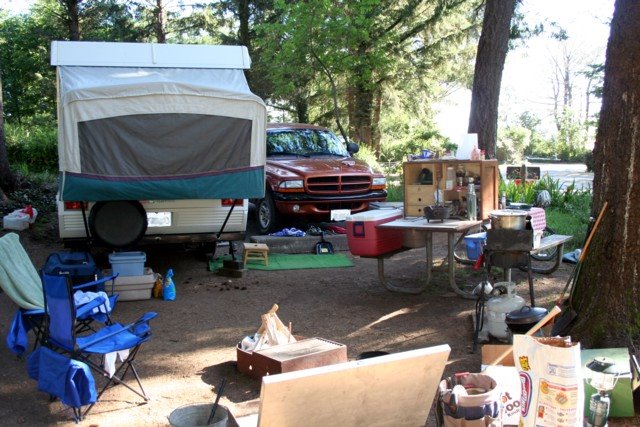 We ended our five-day stay at the Harris Beach State Park in Brookings, Oregon and have moving up the coast to Florence, which is about half-way between California and Washington.
I'd recommend Harris Beach to anyone who likes to camp along the Oregon coast. Its 149 campsites and 6 yurts are all situated close to water and showers. Many sites come with electrical hookups as well.
The staff are helpful and courteous, even when they're correcting minor rule violations! The other night a ranger approached our neighbor's camp and asked them to turn down the boom box, saying, "You know, that's one of my favorite CDs. But I've got to ask you ..."
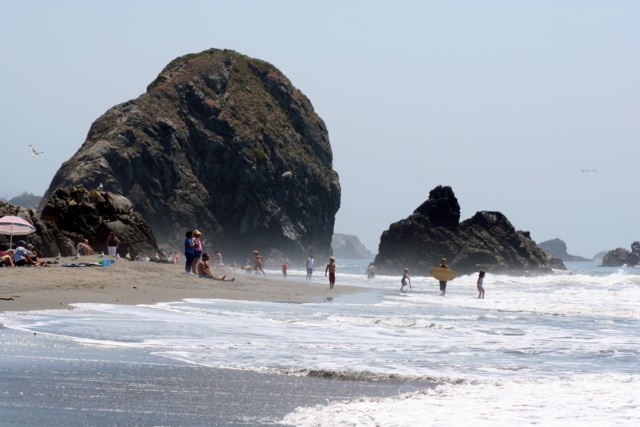 This is our fourth time using the campground. Each time we visit, usually in July, we encounter different weather. Be ready for cold, foggy mornings. A heat wave is defined as any temperatures above 90.
I prefer C Loop. The campsites (both RV and tent sites) that are the roomiest are situated on the outside of the loops. D Loop is closest to U.S. 101. Expect lots of highway noise until later in the evening.
Reserve your site ahead. We've learned the painful lesson that Harris Beach is popular. It's almost impossible to get a reservation this time of year. When you find unreserved blocks of days, they rarely include electrical hookups. These are the least desirable sites as well.
We were fortunate this year. I made a reservation a week before heading north for a tent site with no hookups. The spot (C5) wasn't as roomy as we like, but it was acceptable.
We're heading inland tomorrow and plan to end up somewhere along Orgeon Highway 58, possiable Odell Lake. Until then ...
Thursday, July 27, 2006
Camping on the Information Supper Highway
Being connected to the Internet at the campground is great. All you need is a reliable electrical source.
Sunday as we approached Harris Beach State Park turnoff, I noticed a sign that said, "Wireless Internet." The ranger at campground entrance confirmed that the campground had a wireless connection.
She cautioned that the signal didn't reach all 149 campsites. "You may need to park in the campground office parking lot to find an adequate connection." Just park your car in the employee parking lot and connect, she added.
Sunday evening I opened the wireless connection dialog box on the laptop, located the signal and logged in to Road Connect -- Oregon's roadside Internet provider. Access for seven days cost $6.99.
Being connected is great. It allows me to answer email, blog on last night's dinner and checkout SeaLionCaves.com (we've planned a visit there Friday).
But campsite C5 has one drawback: It's classified as "No hook, typical site." That means no electricity.
The batteries on my connectivity devises -- laptop, Palm Pilot, cell phone and digital camera -- require frequent charging. The phone and PDA can be charged via the cigarette lighter in the truck. The other two require an electrical outlet.
But I've only found one outlet at Harris Beach to charge the laptop and camera batteries. I've resisted the urge to sit in the men's rest room and baby sit the laptop (and serf the Internet) while the batteries charge.
Fortunately, we're headed to my sister-in-law's house this evening to fill up on conversation, grilled chicken and electricity.
I'll be connected through Sunday at motels, roadside rest stops and coffee houses. Then we're heading into dark territory (remember Steven Segal in Under Siege 2?).
Any one have an extension cord and satellite Internet connection?
Sunday as we approached Harris Beach State Park turnoff, I noticed a sign that said, "Wireless Internet." The ranger at campground entrance confirmed that the campground had a wireless connection.
She cautioned that the signal didn't reach all 149 campsites. "You may need to park in the campground office parking lot to find an adequate connection." Just park your car in the employee parking lot and connect, she added.
Sunday evening I opened the wireless connection dialog box on the laptop, located the signal and logged in to Road Connect -- Oregon's roadside Internet provider. Access for seven days cost $6.99.
Being connected is great. It allows me to answer email, blog on last night's dinner and checkout SeaLionCaves.com (we've planned a visit there Friday).
But campsite C5 has one drawback: It's classified as "No hook, typical site." That means no electricity.
The batteries on my connectivity devises -- laptop, Palm Pilot, cell phone and digital camera -- require frequent charging. The phone and PDA can be charged via the cigarette lighter in the truck. The other two require an electrical outlet.
But I've only found one outlet at Harris Beach to charge the laptop and camera batteries. I've resisted the urge to sit in the men's rest room and baby sit the laptop (and serf the Internet) while the batteries charge.
Fortunately, we're headed to my sister-in-law's house this evening to fill up on conversation, grilled chicken and electricity.
I'll be connected through Sunday at motels, roadside rest stops and coffee houses. Then we're heading into dark territory (remember Steven Segal in Under Siege 2?).
Any one have an extension cord and satellite Internet connection?
Wednesday, July 26, 2006
Deep Dish Pizza Rice Entree
 Three times during dinner my son pronounced, "This is good!" He backed his words with action and ate two hefty portions.
Deep dish rice pizza grew out of a desire to bake a pizza in the Dutch oven last night. But a dead laptop battery prevented me from searching for a recipe.
The recipe that I could find was one for 100 servings on the Palm Pilot. That wouldn't work. The recipe was written for weights, not measures. And I didn't want to break the dough recipe down to one pie.
Also on the Palm Pilot was a "pizza" recipe that I clipped from Food Management magazine several years ago. Thomas Long created this dish for the Milton Hershey Schools in Hershey, Penn.
Give it a try. This deep dish "pizza" is good. You find yourself reaching for seconds.
DEEP DISH PIZZA RICE ENTREE
Don't add any additional oil to the recipe. Pesto has sufficient oil to sweat the onions and garlic.
1 cup chopped onion
2 cloves garlic, minced
1-1/2 cups long-grain rice
4 ounces sliced pepperoni, cut into quarters
4 ounces Italian sausage, cooked and crumbled
1/2 cup sun-dried tomato pesto
1 teaspoon dried oregano
2-1/2 cups chicken broth
1-1/2 cups shredded mozzarella cheese
Use a 10-inch Dutch oven for this recipe. Ignite 21 charcoal briquettes and let them burn until they are barely covered with ash, about 20 minutes. For a 350-degree oven, you'll need 5 briquettes underneath and 16 on top of the oven.
 Arrange 16 briquettes underneath oven in a checkerboard pattern. Pour about 1 tablespoon of pesto oil into oven and heat. Add onions and garlic and sweat until translucent. Add rice and stir to coat with oil.
Add pepperoni, sausage, pesto, oregano and broth. Stir. Place lid on oven. Remove 11 briquettes from underneath the oven and set aside. Arrange remaining 5 briquettes underneath oven in a circle. Arrange 16 briquettes on lid. Replace lid and cook for about 20 minutes, until done.
Top with cheeses and bake an additional 5-7 minutes, until cheese melts. Top cheese with additional pepperoni slices before baking if desired. Serves 6.
Tuesday, July 25, 2006
Yankee Pot Roast
Yankee pot roast with red potatoes and carrots made a wonderful dinner last night. Braised in a 12-inch deep-style Dutch oven, the chuck roast cooked at a slow simmer for about 2 hours. Once the potatoes and carrots were added it cooked an additional 30 minutes.
This my standard pot roast recipe. As often happens when I'm camping, I didn't have all of the ingredients on hand. I seasoned the chuck roast with Carl's seasoning because the thyme was left behind and I left the nutmeg out. And since I don't drink, extra beef broth took the place of the wine. A splash of Worcestershire finished the sauce.
I neglected to take a picture, however.
YANKEE POT ROAST
2-1/2 to 3 pound chuck roast
1 tablespoon vegetable oil
1 medium onion, chopped
2 cloves garlic, minced
2 diced carrots
1 (15-ounce) can tomatoes, crushed
3/4 cup red wine
1 teaspoon beef base
1/2 teaspoon nutmeg or allspice
1 teaspoon dried thyme
2 tablespoons chopped fresh parsley
1 bay leaf
Salt and pepper to taste
3 tablespoons water
2 tablespoons all-purpose flour
Use a 12-inch Dutch oven for this recipe. Ignite 25 to 30 charcoal briquettes and let them burn until they are barely covered with ash, about 20 minutes. For a 350-degree oven, you'll need 8 briquettes underneath and 17 on top of the oven. You may need several extra briquettes underneath the oven while browning the meat.
Arrange 14 briquettes underneath oven in a circle. Add oil to oven and heat. Season roast with salt and pepper. Brown roast in oil until a rich brown color develops, about 10 to 15 minutes. Remove roast and place on a plate. Add onions and sweat. Add the garlic and sweat until you smell them. Add remaining ingredients, to a boil and simmer until slightly reduced. Return roast to oven and cover with sauce.
Place lid on oven. Remove 6 briquettes from underneath oven and place them on lid. Place 11 additional briquettes on lid and cook for 1-1/2 to 2 hours, until roast is fork tender. (You will have 8 briquettes underneath and 17 on top.) You will need to add additional briquettes after about 1 hour to maintain oven heat.
When done, remove roast and place on a plate. Let roast stand about 10 to 20 minutes before slicing. Transfer remaining briquettes from lid to underneath oven. Strain sauce if desired. Mix water and flour with a fork until blended. Add to sauce and cook until thicken, about 10 minutes. Slice roast against the grain and top each serving with sauce.
This my standard pot roast recipe. As often happens when I'm camping, I didn't have all of the ingredients on hand. I seasoned the chuck roast with Carl's seasoning because the thyme was left behind and I left the nutmeg out. And since I don't drink, extra beef broth took the place of the wine. A splash of Worcestershire finished the sauce.
I neglected to take a picture, however.
YANKEE POT ROAST
2-1/2 to 3 pound chuck roast
1 tablespoon vegetable oil
1 medium onion, chopped
2 cloves garlic, minced
2 diced carrots
1 (15-ounce) can tomatoes, crushed
3/4 cup red wine
1 teaspoon beef base
1/2 teaspoon nutmeg or allspice
1 teaspoon dried thyme
2 tablespoons chopped fresh parsley
1 bay leaf
Salt and pepper to taste
3 tablespoons water
2 tablespoons all-purpose flour
Use a 12-inch Dutch oven for this recipe. Ignite 25 to 30 charcoal briquettes and let them burn until they are barely covered with ash, about 20 minutes. For a 350-degree oven, you'll need 8 briquettes underneath and 17 on top of the oven. You may need several extra briquettes underneath the oven while browning the meat.
Arrange 14 briquettes underneath oven in a circle. Add oil to oven and heat. Season roast with salt and pepper. Brown roast in oil until a rich brown color develops, about 10 to 15 minutes. Remove roast and place on a plate. Add onions and sweat. Add the garlic and sweat until you smell them. Add remaining ingredients, to a boil and simmer until slightly reduced. Return roast to oven and cover with sauce.
Place lid on oven. Remove 6 briquettes from underneath oven and place them on lid. Place 11 additional briquettes on lid and cook for 1-1/2 to 2 hours, until roast is fork tender. (You will have 8 briquettes underneath and 17 on top.) You will need to add additional briquettes after about 1 hour to maintain oven heat.
When done, remove roast and place on a plate. Let roast stand about 10 to 20 minutes before slicing. Transfer remaining briquettes from lid to underneath oven. Strain sauce if desired. Mix water and flour with a fork until blended. Add to sauce and cook until thicken, about 10 minutes. Slice roast against the grain and top each serving with sauce.
Monday, July 24, 2006
Three-sided Chicken: Use Your Next Campfire to Roast a Chicken in a Dutch Oven
I wrote this article while camping in Oregon's Diamond Lake two years ago. It ran in the fall 2004 issue of the IDOS Dutch Oven News. It was written from the perspective of fall camping.
Temps were in the low 90s along the Southern Oregon coast today. It's downright cold for someone accustomed to highs in the 105s.
Do you remember the last time you stood around a glowing fall campfire? Your backside froze in the crisp autumn air while your front roasted. To equalize the radiant energy of the campfire, you’d momentarily turn your back to the fire. But soon, your front would freeze and you’d once again turn to face the fire.
The autumn campfire gives fall campers the perfect opportunity to cook a favorite among camp dishes. So, why waist a good campfire? Prepare three-sided chicken for dinner with your next fall campfire. Like the two-sided effect of the campfire, a whole chicken fryer roasts on three sides (top, bottom and the side facing the fire) in a deep-model Dutch oven.
Three-sided cooking in camp
Next time you light a campfire on a fall camping adventure, clear a spot in front of the fire for a large Dutch oven. Meanwhile, slip a jacket on to keep your back warm, step over to the chuckbox and rub a fresh four to five pound chicken fryer your favorite seasoning. Once the campfire burns to a nice bed of coals, you’re ready to cook.
You’ll need a large campfire to produce sufficient coals to boost the oven to an estimated internal temperature of 375 degrees to 400 degrees F. The hot oven turns the skin to a crisp golden brown and the breast meat to a succulent juiciness when cooked just right. To evenly brown the bird, apply heat to three sides of the oven. Top, bottom and backside heat creates a bird with perfectly browned skin.
To start, burn a large campfire until a hot, glowing bed of coals remains. This’ll take 30 to 60 minutes, depending on the available wood. Then clear a shallow pit in front of the fire that’s the approximate diameter of a 12-inch Dutch oven. When ready, use a shovel to transfer hot coals to the pit and pre-heat the Dutch oven over the bed of coals.
Since you don’t want to set the chicken onto the floor of the oven, place a round baking rack or Dutch oven trivet in the oven. (Don’t have a trivet? Set the chicken on a bed of roughly chopped onion, carrot and celery.)
Place the seasoned chicken on the rack or trivet. Then place the lid on the oven and shovel a heap of coals over the Dutch oven. It’s this blast of heat that’ll radiate to the skin and transform the chicken into a delicious meal.
The problem with three-sided cooking is that the fourth side languishes without intense heat. It sets at sub-roasting temperatures while the side that faces the fire sizzles dangerously close to carbonization. To ensure even cooking, frequently turn the Dutch oven. At the same time, rotate the lid in the opposite direction. This’ll compensate for the uneven cooking of the coals.
If you haven’t done so already, add fresh firewood to the fire. Heat from the flame and the coals of the fire will radiate to the exposed side of the oven. Next time that you lift the lid, you’ll notice the skin and juices sizzling toward a simple meal.
Senses become your doneness meter
I can’t tell you how long you’ll be able to face the fire before you must turn your body. Each person comes to the campfire with his own tolerances for heat and cold. This is where you’ll have to depend on experience––both as a camper and cook.
Nor can I tell you how many coals that you’ll need to heat the oven to 375 degrees F. Just pile fresh coals on the lid of the oven as often as needed to maintain oven temperature. Experience will teach you how many coals to add to the pot.
Your senses will become your thermometer and doneness indicator. You’ll have to gauge temperature by watching the chicken cook. (Is the skin sizzling or sitting limp? Has the skin started to brown within 20 to 30 minutes?) Since you don’t want to lift the lid too often, listen for cooking sounds (can you hear the sizzle?). And as the chicken cooks, satisfying aromas will waft up to you.
All three--browning action, sizzle and aroma--work together to help you assess the bird’s progress and ultimate doneness. To gauge doneness, simply pull one leg from the body. If it gives with an effortless twist and the juices run clear, the chicken is done. It’ll take 1-1/4 to 1-1/2 hours to roast the chicken.
The key is to cook the chicken just until it’s done––not a minute longer. Overcook the bird and you’ll be rewarded with dry meat. You’ll need a quart of gravy to make the meal palatable. And remember, if it smells burnt, it is.
For a complete meal, add Yukon Gold or Klondike Rose potatoes to the pot about 45 minutes before the chicken is done. One or two small potatoes per person should do. Or cool the chicken slightly and pull the meat off of the bone. Then wrap in flour tortillas with Spanish rice, salsa and sour cream.
Plan to cook three-sided chicken on your next fall camping adventure. Follow these simple techniques and you’ll be rewarding with one of the simplest Dutch oven meals that you can produce in camp. You’ll need a jacket to warm your back and a campfire to heat your front and roast the chicken.
The softwood solution
I depend on downed softwood in the Sierra Nevada high country to build my campfires. To me, it’s a waste of precious dollars to haul oak firewood or charcoal briquettes to the campground. I instead rely of the natural resources of the forest.
I’ve learned that to be successful with softwood you must pay constant attention to your Dutch oven. Pine, fir and cedar burns quickly. As a result, you need watch your oven and replenish the coals often.
I don’t focus oven temperature when camping. I just pile hot coals from the campfire onto the oven with a gloved hand and a pair of 14-inch tongs. I use experience and the five senses to approximate the correct number of coals.
I usually build a campfire that’s four to five times the volume of the camp oven and burn it down to a glowing bed of coals. You can accomplish this in approximately 30 minutes with pine, fir and cedar.
I've learned from many poorly cooked dishes that you can never have too many campfire coals. To make sure I finish the dish with sufficient heat, I continue to feed the campfire even after I’ve heated the oven. I keep feeding the fire as long as I have a plentiful supply of firewood.
TIPS FOR A PERFECTLY ROASTED CHICKEN
Temps were in the low 90s along the Southern Oregon coast today. It's downright cold for someone accustomed to highs in the 105s.
Do you remember the last time you stood around a glowing fall campfire? Your backside froze in the crisp autumn air while your front roasted. To equalize the radiant energy of the campfire, you’d momentarily turn your back to the fire. But soon, your front would freeze and you’d once again turn to face the fire.
The autumn campfire gives fall campers the perfect opportunity to cook a favorite among camp dishes. So, why waist a good campfire? Prepare three-sided chicken for dinner with your next fall campfire. Like the two-sided effect of the campfire, a whole chicken fryer roasts on three sides (top, bottom and the side facing the fire) in a deep-model Dutch oven.
Three-sided cooking in camp
Next time you light a campfire on a fall camping adventure, clear a spot in front of the fire for a large Dutch oven. Meanwhile, slip a jacket on to keep your back warm, step over to the chuckbox and rub a fresh four to five pound chicken fryer your favorite seasoning. Once the campfire burns to a nice bed of coals, you’re ready to cook.
You’ll need a large campfire to produce sufficient coals to boost the oven to an estimated internal temperature of 375 degrees to 400 degrees F. The hot oven turns the skin to a crisp golden brown and the breast meat to a succulent juiciness when cooked just right. To evenly brown the bird, apply heat to three sides of the oven. Top, bottom and backside heat creates a bird with perfectly browned skin.
To start, burn a large campfire until a hot, glowing bed of coals remains. This’ll take 30 to 60 minutes, depending on the available wood. Then clear a shallow pit in front of the fire that’s the approximate diameter of a 12-inch Dutch oven. When ready, use a shovel to transfer hot coals to the pit and pre-heat the Dutch oven over the bed of coals.
Since you don’t want to set the chicken onto the floor of the oven, place a round baking rack or Dutch oven trivet in the oven. (Don’t have a trivet? Set the chicken on a bed of roughly chopped onion, carrot and celery.)
Place the seasoned chicken on the rack or trivet. Then place the lid on the oven and shovel a heap of coals over the Dutch oven. It’s this blast of heat that’ll radiate to the skin and transform the chicken into a delicious meal.
The problem with three-sided cooking is that the fourth side languishes without intense heat. It sets at sub-roasting temperatures while the side that faces the fire sizzles dangerously close to carbonization. To ensure even cooking, frequently turn the Dutch oven. At the same time, rotate the lid in the opposite direction. This’ll compensate for the uneven cooking of the coals.
If you haven’t done so already, add fresh firewood to the fire. Heat from the flame and the coals of the fire will radiate to the exposed side of the oven. Next time that you lift the lid, you’ll notice the skin and juices sizzling toward a simple meal.
Senses become your doneness meter
I can’t tell you how long you’ll be able to face the fire before you must turn your body. Each person comes to the campfire with his own tolerances for heat and cold. This is where you’ll have to depend on experience––both as a camper and cook.
Nor can I tell you how many coals that you’ll need to heat the oven to 375 degrees F. Just pile fresh coals on the lid of the oven as often as needed to maintain oven temperature. Experience will teach you how many coals to add to the pot.
Your senses will become your thermometer and doneness indicator. You’ll have to gauge temperature by watching the chicken cook. (Is the skin sizzling or sitting limp? Has the skin started to brown within 20 to 30 minutes?) Since you don’t want to lift the lid too often, listen for cooking sounds (can you hear the sizzle?). And as the chicken cooks, satisfying aromas will waft up to you.
All three--browning action, sizzle and aroma--work together to help you assess the bird’s progress and ultimate doneness. To gauge doneness, simply pull one leg from the body. If it gives with an effortless twist and the juices run clear, the chicken is done. It’ll take 1-1/4 to 1-1/2 hours to roast the chicken.
The key is to cook the chicken just until it’s done––not a minute longer. Overcook the bird and you’ll be rewarded with dry meat. You’ll need a quart of gravy to make the meal palatable. And remember, if it smells burnt, it is.
For a complete meal, add Yukon Gold or Klondike Rose potatoes to the pot about 45 minutes before the chicken is done. One or two small potatoes per person should do. Or cool the chicken slightly and pull the meat off of the bone. Then wrap in flour tortillas with Spanish rice, salsa and sour cream.
Plan to cook three-sided chicken on your next fall camping adventure. Follow these simple techniques and you’ll be rewarding with one of the simplest Dutch oven meals that you can produce in camp. You’ll need a jacket to warm your back and a campfire to heat your front and roast the chicken.
The softwood solution
I depend on downed softwood in the Sierra Nevada high country to build my campfires. To me, it’s a waste of precious dollars to haul oak firewood or charcoal briquettes to the campground. I instead rely of the natural resources of the forest.
I’ve learned that to be successful with softwood you must pay constant attention to your Dutch oven. Pine, fir and cedar burns quickly. As a result, you need watch your oven and replenish the coals often.
I don’t focus oven temperature when camping. I just pile hot coals from the campfire onto the oven with a gloved hand and a pair of 14-inch tongs. I use experience and the five senses to approximate the correct number of coals.
I usually build a campfire that’s four to five times the volume of the camp oven and burn it down to a glowing bed of coals. You can accomplish this in approximately 30 minutes with pine, fir and cedar.
I've learned from many poorly cooked dishes that you can never have too many campfire coals. To make sure I finish the dish with sufficient heat, I continue to feed the campfire even after I’ve heated the oven. I keep feeding the fire as long as I have a plentiful supply of firewood.
TIPS FOR A PERFECTLY ROASTED CHICKEN
- Don’t truss the chicken. Though recommended by chefs, trussing forces the breast up into the oven’s head space. This reduces the likelihood that the chicken will brown properly.
- Rotate the Dutch oven often. For a perfectly browned chicken, rotate the oven in increments. You have to judge how often based on experience and observation. As the skin in the first section browns, give the oven a 45- to 90-degree turn to brown the next section.
- Think food safety. A bout of Salmonella is the last thing you want in camp. Freeze the bird at home. Then wrap it in two sheets of newsprint and enclose it in a large zipper-lock bag. And thoroughly scrub your hands in warm soapy water after handling the chicken.
Sunday, July 23, 2006
Darle Coates' Modern-day Chuckwagon
How do you like this: I'm camping and connected to the Internet! We're at Harris Beach Campground, part of the Oregon State Parks system in Brookings Oregon.
Here's a picture and story from Daryle Coates from Texas:
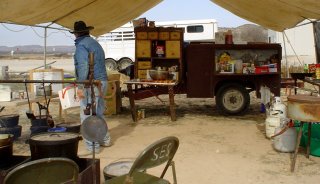 The story on the trailer is interesting. I got the gig to feed the International Guests in the International Room at the Houston Livestock Show and Rodeo one meal. This consisted of BBQ goat, pinto beans, cole slaw, potato salad, cobbler and condiments. I did this 2 years in a row.
There were over 500 each year. I needed something to haul the necessities and a larger shade. I found this service bed that had been for sale a long time and purchased it. I did some welding on the frame to add a space for a chuck box and a cooler. Later I also added a water storage tank.
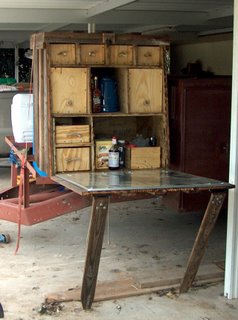 There had been an old barn on the place where I was raised. When I was young, my Father tore it down and moved the lumber to another ranch and built a small barn. Many years later, I tore down the barn and used some of the wood to build the chuck box. That barn wood is approaching 100 years old. I had a tarp company make me a 16x20 tarp and made the frame using preformed corners, etc.
I am not a carpenter and will never build another chuck box, but I am sure proud of the one I have. I will send you a better pic of it.
Stay cool on your vacation.
Here's a picture and story from Daryle Coates from Texas:
 The story on the trailer is interesting. I got the gig to feed the International Guests in the International Room at the Houston Livestock Show and Rodeo one meal. This consisted of BBQ goat, pinto beans, cole slaw, potato salad, cobbler and condiments. I did this 2 years in a row.
There were over 500 each year. I needed something to haul the necessities and a larger shade. I found this service bed that had been for sale a long time and purchased it. I did some welding on the frame to add a space for a chuck box and a cooler. Later I also added a water storage tank.
 There had been an old barn on the place where I was raised. When I was young, my Father tore it down and moved the lumber to another ranch and built a small barn. Many years later, I tore down the barn and used some of the wood to build the chuck box. That barn wood is approaching 100 years old. I had a tarp company make me a 16x20 tarp and made the frame using preformed corners, etc.
I am not a carpenter and will never build another chuck box, but I am sure proud of the one I have. I will send you a better pic of it.
Stay cool on your vacation.
Subscribe to:
Posts (Atom)


