Tuesday, July 21, 2009

Mark Twain on bacon update

Almost three weeks ago I commented on Mark Twain's quote, "Nothing helps scenery like bacon and eggs." This morsel of culinary wit from America's celebrated writer fascinated me. Any writer who takes the time to comment on two long-standing breakfast staples is worth reading.

So I eagerly purchased a copy of reprint of Roughing It (Mark Twain, Dover Publications: Mineola, N.Y., 2003, reprint of 1913 Harper and Brothers ed.) on Amazon.com and had it shipped to Deer Crossing Camp, where I starve for bacon. The tale of Twain's western adventure arrived in the mail Saturday.

Now some 120 pages into Twain's fourth book, I'm certain the editor of The Wit and Wisdom of Mark Twain: A Book of Quotes (Paul Negri, eds., Dover Publications: Mineola, N.Y., 1999) misquoted Twain. He may've cited an unknown edition of the book.

My research in Dover's reprint of the 1913 edition, along with several on-line copies, indicates the correct quote should be: "Nothing helps scenery line ham and eggs."

Before you get the idea that Twain and his companions sat down to breakfast at a trail-side diner somewhere west of Salt Lake City, where the scenery-enhancing meal took place, understand that he and his traveling companions had laid in a supply of boiled ham and hard-cooked eggs during their recent layover in Salt Lake City. The purpose of this "alteration" in travel meals was to seemingly take the matter of meals into their own hands.

One grotesque breakfast stands out of the three or four meals penned into the 1872 account of "several years of variegated vagabondizing" to this point in the book. Twain and his traveling companions "could not eat the bread or the meat, nor drink the 'slumgullion.'" The stage, carrying Twain, older brother Orion Clements and fellow passenger Bemis, had pulled into a stage stop on the prairie in Nebraska early one morning.

"Our breakfast was before us, but our teeth were idle," complained Twain. Station keepers laid breakfast before the hungry travelers on a table made of a "greasy board on stilts." The bill of fare consisted of condemned army bacon and crusty bread that Twain described as "last week's." The trio was supposed to wash the meal down with a concoction called "Slumgullion" that "really pretended to be tea, but there was too much dish-rag, and sand, and old bacon-rind in it to deceive the intelligent traveler."

"A battered tin platter, a knife and fork, and a tin pint cup, were at each man's place, and the (stage) driver had a queens-ware saucer that had seen better days," said Twain. On these plates, Twain and his companions were subjected to "condemned army bacon which the United States would not feed to its soldiers in the forts, and the stage company had bought it cheap for the sustenance of their passengers and employees."

"We gave up the breakfast, and paid our dollar apiece and went back to our mail-bag bed in the coach, and found comfort in our pipes." With breakfast a lost cause, Twain and his companions returned to the coach.

Twain's best meal of the 20-day journey from St. Joseph, Missouri, to Carson City, Nevada, came at the Green River station in Wyoming. The "simple" breakfast of "hot biscuits, fresh antelope steaks, and coffee" was fresh in Twain's memory a decade later when he wrote Roughing It.

"Think of the monotonous execrableness of the thirty (meals) that went before it," said Twin, "to leave this one simple breakfast looming up in my memory like a shot-tower after all these years have gone by!"

Twain and his traveling companions finally took control of their own destiny and acquired a supply of bread, boiled ham and hard-cooked eggs for the torturous trip through the Nevada desert. The supply was sufficient to "last double the six hundred miles of staging we had still to do" to Carson City.

It's within this context that Twain writes the paragraph that I quoted in my last blog on Mark Twain:
And it was comfort in those succeeding days to sit up and contemplate the majestic panorama of mountains and valleys spread out below us and eat ham and hard boiled eggs while our spiritual natures revelled alternately in rainbows, thunderstorms, and peerless sunsets. Nothing helps scenery like ham and eggs. Ham and eggs, and after these a pipe--an old, rank, delicious pipe--ham and eggs and scenery, a "down grade," a flying coach, a fragrant pipe and a contented heart--these make happiness. It is what all the ages have struggled for.
I'm a little saddened that Mark Twain's original wit didn't include the phrase "bacon and eggs" because it fit so nicely into my story of bacon and butter. But I can equally accustom myself to a steady diet of "ham and eggs" as Twain did during that last push across the desert to his destination.

Bath a thick slice of boiled ham in butter, fry it over a hot fire and you've got the makings of a scenery-improving breakfast, as Twain discovered in 1861. A dollop of yellow mustard and some salt and pepper for the eggs will make any scene a spectacular one.

Sunday, July 19, 2009

Philly-style Polish sausage sandwiches and inter-session meals

My number-one inter-session food request from staff is for adult food. The instructors (and the small number of campers staying for the next session) want off-menu food items. They welcome any dish that's a change from the standard Deer Crossing Camp two-week cycle menu.

When I started lunch prep at 11 a.m. yesterday, I quickly assembled 2 salsas. My first thought was to offer a trio of salsas to the 14 staff and campers that would eat lunch. Three unique flavor combinations would form the basis for a chip and salsa extravaganza.

The first two salsas quickly came together. The fiery orange and apple salsa contained two dice Valencia oranges and two diced granny smith apples with ground cumin and the juice of two limes.

Red and green bell peppers, roasted and cut into strips, and flavored with a quick spicy vinaigrette (vegetable oil, white vinegar, chili powder, salt and pepper) formed a sweet pepper salsa.

I switched gears by the time I got to make a salsa fresca. When I first posed the idea of serving leftovers from the Friday barbecue, one instructor doubled her request for something other than leftovers. She may have thought I was going to throw a plate of warmed-over hamburger patties and sausages on the table.

Inter-session meals are the perfect time to get rid of the few leftovers in the refrigerator. I rarely have sufficient quantity to feed the whole camp. Inter-session gives me the opportunity to mold the leftovers into something new.

So, ingenuity and the desire to fulfill instructor requests for adult food drive many of my ideas for inter-session meals, which run from Saturday lunch to Sunday lunch. Once campers for the next session arrive on Sunday afternoon, I'm back on the two-week cycle menu.

My original thought was to slice the 22 Polish sausages and saute them with tomatoes, onions and sweet peppers. Leftover Boca burgers would form the basis for the vegetarian option.

With my newly revised menu in my heads, I figured the orange and apple salsa could double as a fruit salad, while the sweet pepper salsa would make a good relish for Polish sausage sandwiches with melted cheese – a quick camp version of the famed Philly cheese steak sandwich.

I slice the tomatoes for the salsa fresca and marinated them in a quick vinaigrette with garlic and basil. It only took a few minutes to slice onions, green bell peppers and tomatoes for the sandwiches.

To complete the sandwiches, I sauteed the onions and sweet peppers in a large cast iron skillet, then added sliced Polish sausages. Once the sausages came to temperature, I spooned the mixture onto toasted hamburger buns, topped with sliced cheese and melted the cheese in a 350-degree oven.

Note: In the last two pictures, the sandwiches with the bell pepper on top of the cheese are vegetarian sandwiches. This helped me identify them from the meat sandwiches.

Saturday, July 18, 2009

Bread at sea

Back in the my day, aircraft carrier bakeries ran two shifts. One 12-hour shift baked all the bread. The second 12-hour shift baked all the pastries.

PACIFIC OCEAN (July 16, 2009) Culinary Specialist Seaman Samantha Garza butters loaves of fresh baked bread in the bakeshop aboard the aircraft carrier USS George Washington (CVN 73). George Washington is participating in Talisman Saber 09, a biennial joint military exercise between the U.S. and Australia focusing on operational and tactical interoperability.

U.S. Navy photo by Mass Communication Specialist Seaman Adam K. Thomas.

Friday, July 17, 2009

Day off and breakfast with a buddy

June 9, 2009 was the last time I worked on the rail project with friends in the old Southern Pacific rail yard at Diamond Springs.

My summer job at Loon Lake in Eldorado National Forest has kept me far away from the day-to-day action of the El Dorado Western Railway and El Dorado County Historical Museum.

When I left for Deer Crossing Camp the next day, the rail removal project was just getting started. Except for weekly email updates from friend and EDWRF President Keith Berry, I've been out of the loop.

Home for a rare two-day stretch, I emailed Keith earlier in the week and arranged to meet him at the Diamond Springs Hotel for breakfast yesterday.

By chance, Keith and I met up with El Dorado County Fire Battalion Chief Kurt Taylor and EDWRF board member Ed Cuhna at the hotel just after 8 a.m.

Local politics kept the foursome busy as we enjoyed breakfast by Kevin, the hotel's morning cook. With two firefighters at the table (Ed is a retired fire captain), conversation quickly moved to stories of the 1992 Cleveland Fire and Kurt's vintage firetruck that the two are restoring.

Once Kurt and Ed left to work on the fire engine, Keith and I talked on. Our conversation shifted over to railroad happenings in El Dorado County. (Go to the El Dorado Western Railway blog for news of the project.)

I caught up on the happenings of the railway and the proposed El Dorado County Railroad Park at the old El Dorado depot site in El Dorado.

Breakfast gave me a chance to re-connect with rail buddies and get my mind a way from the camp kitchen.

Ever gracious, hotel co-owner Amy Shim (with husband Moon) and Kathy, our server, kept coffee and soda flowing for two and one-half hours.

Thursday, July 16, 2009

What do you do with excess stock of cream cheese and mozzarella?

Here's a question that I answered at Growlies Recipe Exchange and Party Planning Board this afternoon. ReBecca, who appears to cook at a homeless shelter somewhere in Canada or the U.S., posed this question recently:
I have a situation here. I have a woman who was so thrilled with the poor man's fettuccine Alfredo (cream cheese recipe) that she now brings me cream cheese and shredded mozzarella almost every week now.

I can't make any more fettuccine because my homeless guys are starting to complain; plus-I would love something other than pasta since we already serve spaghetti every week for the main course.

My meals are the "to-go" meals to sustain our homeless community for the 'next' day when there are no churches making meals. SO ... does anyone have any recipes for copious amounts of sausage, cream cheese and shredded mozzarella? Thanks!
There are many things do do with the mozzarella and cream cheeses. First, you can use the shredded mozzarella in place of most shredded cheeses the shelter acquires.

If mozzarella is too stringy once it melts, try combining it with shredded cheddar. The two flavors will compliment each other.

Cheesy potato soup, rich two- or three-cheese macaroni and cheese or salad topping are just a few of ways to use the shredded mozzarella cheese. Use extra cheese in each recipe as long as your inventory holds.

Consult cookbooks like Food For Fifty or Professional Cooking for ideas. They're too numerous to print on this blog.

You can also make a versatile cream cheese and mozzarella mixture. Use it for any number of dishes, both hot and cold.

Mix cream cheese, shredded mozzarella, garlic powder and hot pepper sauce. Season lightly with salt and pepper while whipping in a mixer bowl. Although you should be careful with the hot sauce, I suspect these guys will appreciate it.

Use the mixture on:
  • Celery sticks in place of peanut butter; this is a good, filling appetizer
  • Dip for crackers or chips
  • Sliced French bread halves, baked under broiler until lightly browned; use any excess hamburger/hot dog buns, French rolls or other donated bread
  • Twice-baked potatoes, baked under broiler until cheese melts and topping browns
You didn't say what kind of sausage the lady donates. Many breakfast and Italian sausages (especially if donated in bulk form) can be used interchangeably. This recipe from Food For Fifty will help you use both cheese and sausage:

EGG AND SAUSAGE BAKE

40 ounces sliced bread
9 pounds bulk sausage
40 ounces cheddar cheese, shredded
72 ounces eggs (about 42 total), beaten
3 quarts milk
1-1/2 tablespoons dry mustard

Cut bread in cubes. Cover bottom of 2 greased 12x20x2-inch baking pans with bread cubes. Pans should be well covered.

Brown sausage. Drain well. Spread cheese and sausage over bread cubes.

Combine eggs, milk, and mustard. Pour over mixture in pans, 2-1/2 quarts per pan. May be mixed, covered, and refrigerated overnight.

Bake uncovered at 325 degrees F for approximately 1 hour or until set, 180-degree internal end-point temperature. If browning too fast, cover with foil.

Cut each pan 4x6. Recipe yields 2 (12x20x2-inch) hotel pans.

VARIATIONS:

Sausage-Potato Bake. Substitute frozen hashed brown potatoes for bread cubes.

Egg-Potato Bake. Delete sausage. Substitute frozen hashed brown potatoes for bread cubes.

Pickle brine

Tyrone Barton, fellow chef and blogger in the S.F. Bay Area, answeres the timeless question for pickel lovers. His blog at Tyronebcookin offers ideas to use the brine left in the jar after all the pickles are gone.

This is an easy experiment I think you will like. If you have a certain favorite pickle or pickled vegetable that you buy at the store then after eating all the contents inside the jar save the ‘pickling’ juice or liquid (read more...).

Tuesday, July 14, 2009

Grilled cheese extravaganza

Campers will surprise you, at least at Deer Crossing Camp. Just when you think that they will only eat chicken nuggets, grilled cheese sandwiches and cold cereal, they surprise you and devour so-called adult food.

When I served Mulligatawny soup two week ago, the campers at Deer Crossing ate a bowl each. And they thanked me after the meal for the wonderful alternative to canned cream of chicken soup.

Saturday night I accompanied the grilled pork chops with caramelized onions. I sliced three large yellow onions and slowly sweated them in a cast iron skillet until they turned golden.

I set the skillet on the kitchen counter, not in bowls for the tables. I figured staff would be the only ones to eat the delectable onion dish, which I consider equal to bacon and butter.

I knew that I was in trouble when the first four tables (of seven that night) decimated the caramelized onions. The teary eyed head of the last table (a second-year instructor) almost sent tears to my eyes when he missed out on the onions.

With this background, I knew that I had to prepare enough "special" sandwiches when I created a grilled cheese extravaganza yesterday. Once again, the campers ate every sandwich that was placed on the table.

I grilled 60 sandwiches for the 37 campers that ate in camp yesterday (a couple dozen campers and staff were out on a whitewater rafting trip). They included:
  • Traditional grilled cheese with two slices of cheese -- 30 sandwiches; we use Sysco sliced cheddar cheese; it comes in 8 (1-1/2-pound) packages per case or 32 slices per package
  • Mozzarella, pesto and sliced tomato -- 10 sandwiches; the number was limited by a small quantity of tomatoes on hand; campers and staff would've eaten more
  • Tuna melt with two slices of cheese -- 14 sandwiches; used tuna salad leftover from Saturday’s lunch
  • Cheese and salami – 6 sandwiches; only made a small quantity for the staff table
One sandwich came back to the kitchen after lunch, and it was a traditional grilled cheese. That’s a good indication that the campers at Deer crossing Camp will explore beyond conventional camper food.

Saturday, July 11, 2009

Johnny Nix cooking at Lodge factory store

I normally only post news of Northern California events at 'Round the Chuckbox. Since I enjoyed watching Johnny Nix when he was on RFD TV, I though I'd post this bit of news, which came to me in a promotional email from Lodge.

Enjoy ...


Thursday, July 09, 2009

Cook turned gunner

I always love an opportunity to fire heavier weapons from the ship's fantail.

PACIFIC OCEAN (July 5, 2009) Culinary Specialist 3rd Class Nicholas Zaricor, from Vancouver, Wash., fires a .50 cal machine gun with Aviation Ordnanceman Airman Marcus Gilmore, from Colorado Springs, Colo. during a gun shoot demonstration for Tiger Cruise participants aboard the aircraft carrier USS John C. Stennis (CVN 74). Tiger Cruise gives the family and friends of Sailors and Marines stationed aboard the ship a chance to share the underway experience.

John C. Stennis is en route to San Diego, Ca. to offload Carrier Air Wing 9 before returning to her homeport in Bremerton, Wash. Stennis is returning from a scheduled six-month deployment to the western Pacific Ocean.

U.S. Navy photo by Mass Communication Specialist 3rd Class Kenneth Abbate.

Tuesday, July 07, 2009

Sailors and Marines join efforts in the mess to support BHR crew

By Mass Communication Specialist 3rd Class Eva-Marie Ramsaran

PACIFIC OCEAN (NNS) (7/4/2009) -- Navy and Marine Corps personnel aboard USS Bonhomme Richard (LHD 6) combined efforts cooking and serving more than 2,400 meals, June 29, while operating at sea off the coast of Southern California.

Bonhomme Richard, the flagship for the Bonhomme Richard Amphibious Ready Group is at sea conducting its initial integration exercise with the 11th Marine Expeditionary Unit. Quick integration of the culinary specialists, Marine cooks, food service attendants, and messmen was crucial to a crew of nearly 3,000 hungry personnel.

"It's an organized chaos," said Culinary Specialist 1st Class Nino Villamor. "The first day of being underway is always a trial and error on how much food to prepare because we don't know how many people are going to eat or be in line."

The crew members and embarked Marines didn't disappoint. Crowds, noise and long chow lines were the norm, keeping the cooks and mess personnel busier than imaginable.

But such scenes will be the norm as the ARG/MEU team participates in three consecutive training evolutions prior to the start of a regularly scheduled deployment later this year.

"It's important to integrate with the ship and crew to learn your way around, get to know people and keep a positive attitude doing this type of work," said Cpl. Joseph Cahoon of the 11th MEU.

"With the planning, the food preparation and the execution of each meal, it is almost impossible to do it all in two hours," said Villamor. "But my guys in the kitchen work efficiently and they add their personal touch and flavors to each meal."

In order to meet mess deck requirements, each FSA and messman must participate in sanitation training, cleaning procedures, and food preparation procedures while underway. During training, both Marines and Sailors bring their unique skills and techniques to the kitchen; therefore the mess operates smoothly and in a timely manner.

Cahoon says, "By working in the mess decks with Navy Sailors, it takes a while to adjust to the new environment of being on the ship but I look to them for advice and I expect to learn from them."

By having the cooks in the kitchen, they give insight as to what kind of meals their fellow Marines would prefer. There are 20 cooks in the galley and 40 messmen and FSAs that take part in servicing the Bonhomme Richard's crew with not just hot meals but with great customer service.

"I take it as an opportunity to always serve and put on a good show because our rate is all about customer service and supporting the overall mission of the Navy," said Villamor.

Monday, July 06, 2009

Banana bread from scratch

I don't get many opportunities to bake from scratch at Deer Crossing Camp. Most quick breads (pancakes, cake and muffins, for instance) at the wilderness camp are made from baking mixes. Bridgford frozen bread dough is also used for dinner.

I enjoyed an opportunity to bake banana bread from scratch yesterday. Faced with four or five over-ripe banana bunches, I used the bread to replace the blueberry muffins that normally run on Monday of the first week in each session.

My assistant cook, Oyu -- she's from Mongolia! -- and I prepared a batch of banana bread during our opening day baking session. It took us two and one-half hours to bake carrot cake with cream cheese icing and French bread for last night’s dinner, along with the banana bread.

The banana bread gave me a chance to show Oyu how to scale ingredients in the bakery. It also shows her how to use over-ripe produce and to adjust the menu to fit a need.

BANANA BREAD

The dry and wet mixtures may be prepared in advance if desired. Once combined, the batter should be baked without delay to avoid loss of volume.

3 pounds all-purpose flour
1 pound 4 ounces sugar
2-1/2 ounces baking powder
2 teaspoons baking soda
4 teaspoons salt
12 ounces chopped nuts (optional)
1 pound 4 ounces eggs
3 pounds ripe banana pulp, pureed
1 pound vegetable oil or melted butter

Thoroughly combine flour, sugar, baking powder, baking soda, salt and nuts in large bowl. Set aside.

Combine eggs, banana pulp and oil or melted butter in separate bowl. Add liquids to dry ingredients and mix just until flour is moistened. The batter will appear lumpy. Don't overmix.

Scale 1 pound 8 ounces batter into each greased 8-1/2 by 4-1/2-inch loaf pan. Bake at 375-degrees F. for 50 minutes, or until done in center. Cool and cut each loaf into approximately 15 (1/2-inch) slices.

The recipe yields 9 pounds batter. Six loaf loaves will give you approximately 90 slices of banana bread.

This recipe comes from the 4th edition of Professional Cooking (Wayne Gisslen, John Wiley & Sons: N.Y., 1999), page 711.

Saturday, July 04, 2009

Mark Twain on bacon

Debbie and I visited the Taylor Creek Visitor Center before dinner last Thursday. It was our day off and we were looking to relax and take in a few sights in the Lake Tahoe Basin. I always enjoy visiting the U.S. Forest Service centers because they carry a wide selection of historical books, wildlife guides and maps.

I picked up The Wit and Wisdom of Mark Twain: A Book of Quotes (Paul Negri, ed., Dover Publications: Mineola, N.Y., 1999), a collection of Twain’s sayings. Many were taken from his books, speeches and letters written over a writing career that spanned some five decades.

One quote that caught my attention was borrowed from Twain’s 1872 publication of Roughing It. Twain said, "Nothing helps scenery like bacon and eggs."

The full quote from Roughing It contains a bit more information. Although the line from this later version used "ham," I suspect he spoke of bacon, a common staple in the west.
And it was comfort in those succeeding days to sit up and contemplate the majestic panorama of mountains and valleys spread out below us and eat ham and hard boiled eggs while our spiritual natures revelled alternately in rainbows, thunderstorms, and peerless sunsets. Nothing helps scenery like ham and eggs (page 63).
Bacon and eggs are among my favorite breakfast foods in camp. Twain is right--the salty goodness of bacon helps any setting.

Bacon is one of those foods that go with most anything. The smoky goodness of cured pork belly compliments a wide range of foods, even butter.

Yes, I said butter. As Debbie and I approached Loon Lake last Thursday, she asked me if I wanted to split the remaining piece of bacon from our breakfast at Ernie’s Coffee Shop. Never one to refuse bacon, I accepted.

My palette received a pleasant surprise when I bit into my half. It seems that Debbie had also saved the cup of whipped butter from her French toast. The bacon marinated in the butter as it melted in the afternoon sun.

If you agree that bacon and eggs improve your surroundings as Twain proposed, bacon and butter make the wilderness seem like the Garden of Eden.

The combination of two prized culinary fats made for a pleasurable end to a day of rest and relaxation. Here we were driving up to the boat landing for our ride back to camp, enjoying the lodgepole forest in the setting sun, munching on bacon and butter.

It’s a near perfect combination in the culinary scheme of things. I’m sure Twain would agree, bacon and butter make everything better, even scenery.

Friday, July 03, 2009

BBQ tonight

Barbecue tonight ... too tired to blog ... going to bed!

Thursday, July 02, 2009

Day off ...

As at most summer camps across the United States, staff get one 24-hour period off each week. The day off at Deer Crossing runs from 7 a.m. to 7 a.m. the next day.

We have chosen to leave camp on each of our days off. It lets us "get aways from it all" and enjoy a relaxing day out of the kitchen. After a five-minute boat ride across Loon Lake, we're free to relax, catch up on laundry and take care of business (banking, for instance) that can't be done at camp.

Debbie and I left the camp at 8:30 this morning and arrived in South Lake Tahoe in time for a late breakfast at Ernie's Coffee Shop. Laundry was next on the agenda, then a visit to an art and craft fair at the "Y" and coffee and Internet at Alpina Coffee Cafe.

Coffee gave us a chance to dodge the rain and catch up on the whereabouts of our 17-year-old son, who's staying with his sister. The rain was a pleasant relief from the heat and dry conditions at camp.

In the photo, I was about to stuff my special peanut butter, dill pickle and mayonnaise sandwich into my mouth at camp. I plan to demonstrate the sandwich to each new group of campers, every two weeks. Four staff and about eight campers accepted my challenge to try the sandwich last week.

I've been eating the sandwich, named "The Jonathon" after a Florida College employee who ate them by the dozen after camp in 2003, since childhood.

Tuesday, June 30, 2009

Square biscuits

Campers liked my square biscuits the other morning. Square biscuits save the time of punching out individual biscuits with a biscuit cutter. And because you avoid re-forming the dough after the first cutting, this method ensures that each biscuit will be equally tender.

All I do is dump the dough onto a greased sheetpan and press it into the pan. I pre-cut the dough (6x8 or 6x9 for an 18x26-inch sheetpan) and bake at the normal temperature. The biscuits come out standing tall.

Monday, June 29, 2009

Training at Deer Crossing Camp

Three weeks into camp, I can clearly see the three-phase approach to training at Deer Crossing Camp. Training begins 10 days before the first campers arrive. While most training sessions (like first aid, CPR and life guarding) are direct at the instructors, the cook and his assistance use the training period to:
  • Clean and organize the kitchen after nine months in mothball status
  • Clean and organize the food storeroom and refrigerators
  • Learn the Deer Crossing two-week cycle menu
  • Prepare all of the recipes as is practical
  • Adjust to the erratic nature of food supply and refrigeration
  • Prepare and submit the first Sysco order
  • Teach the instructors food safety in the role as they supervise clean-up and dishes
  • Learn how to re-fuel and to safely start the generators
  • Learn how to take daily chlorine readings in the water system
Once campers arrive for Session 1, the next two weeks are devoted to preparing all the DCC recipes in larger quantities, adjusting to the likes and dislikes of the campers, appetites and meal set-up and family style of service.

Session 1 helps because it typically has less than 50 campers and staff. The cooks are able to ease in to Sessions 2 and 3, which max out at 65 to 70 campers and staff.

The remainder of the summer season is devoted to fine tuning the skills of the cooks. One of my goals this year is to work on the DCC recipes and to purchase a few extra herbs and spices (mainly missing standards like thyme, oregano and garlic graduals), revise the two-week menu and continue training my assistant cook (her home is in Mongolia!).

By Session 4, I envision a well-running team in the kitchen. We’ll then be ready for the 2010 season.

Sunday, June 28, 2009

Mandoline vs. mandolin

I just learned this afternoon that I've been misspelling mandoline at 'Round the Chuckbox. While you slice potatoes (and other produce) on a mandoline, Doc Mercer won't play one with his Cumberland Highlanders band.

Drop the "e" and you have Doc's favorite muscical instument, the mandolin.

Whishbone, a camp cook from the neighborhood of Wichita, Kansas, posted this request at Camp-Cook.com last Thursday:
Anyone ever use one & what type do You Like. I looking at Pampered Chef ones on eBay. Son & I need to cook up a bunch of potatoes (augratin style) for 28 Girl Scouts, Leaders & Parents the last Meal at Local summer Camp. Wishbone-Ks
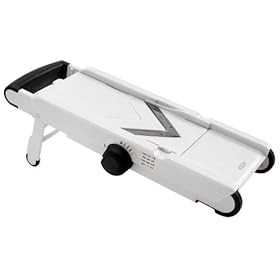
Stick with a simple mandoline, one that cuts without all the "bells and whistles." I purchased a top-line model at a local restaurant supply several years ago (pictured below). It works well enough, but it's heavy, a bit clunky and the safety guard is doesn't flow smothly.

I wouldn't spend more than $40 or 50. I spent about $200 and now wish that I had purchased an economy model. They do the same thing for much less. I found an Oxo V-blade model on Amazon for $40 (pictured at left).

Either way, Wishbone, a mandoline is a worthy investment if you plan to do any camp cooking for large groups. A sharp one will quickly cut a load of potatoes for scallops or au gratin.

I used mine at camp yesterday to cut cucumbers for the cuke and onion salad for today. I had the job done in 10 minutes with nice, thin slices of cucumber.

I don't care how good you are with a knife, a mandoline just makes good sense for the camp kitchen.

I wrote a safety brief on the use of a mandoline in the kitchen last year. Mandoline safety is serious business in the kitchen. Properly used, they are a great time saver and help you produce professional looking products. In the wrong hands, you'll be spending a lot of time in the emergency ward.

Remember: Doc Mercer plays great Bluegrass tunes on his mandolin as I slice potatoes for scallops on my mandoline.

Saturday, June 27, 2009

Mulligatawany soup

The camp uses canned soup for lunch about four or five days each week. Instead of heating a can and serving it to the campers, I often "doctor" the soup by using the canned soup as a base for a new dish.

So far, the campers and staff have been receptive to my innovative ideas. Most are simple and fit in within my limited variety of ingredients.

When I arrived three weeks ago, I found over six cases of Campbell's Cream of Chicken soup in the storeroom. With 12 (50-ounce) cans per case, I quickly figured that I was going to be serving a lot of cream of chicken soup to the campers.

I've used the soup as a base in macaroni and cheese and to make a thick chicken noodle soup. Although I have yet to serve plain cream of chicken soup, I may during one of the sessions.

During staff training I hit on an idea that dates back to my Navy service in the 1970s. Why not make a mulligatawny soup?

I was looking for something to add to the soup when I remembered the curry-spiced soup from India. The ingredients of the soup were always the subject of a question on the advancement exam for Navy cooks.

The soup started when sweated a one-pound mire poix with two julienned bell peppers. I them dumped one can of the creamy soup base with a can of water into the stockpot and stirred.

The soup was flavored with two diced apples and a moderate dash of curry powder. I then cooked one pound of dry pasta and added it to the soup. Although rice is more traditional, pasta is a big hit at Deer Crossing.

A little thyme would've been a nice addition, but I don’t have any right now. The zest from one lemon would also give the soup extra pep.

Of six quarts of soup, I had enough leftover for the picture. Thirty-six campers and staff enjoyed an interesting diversion from cream of chicken soup today.

Friday, June 26, 2009

Pizza night

Pizza night was last night. Since the menu was pizza, double chocolate chip cookies and punch, I planned of three to four slices for each camper. Three campers helped assemble the pizzas.

I used one of Sysco's pre-baked pizza shells and had the campers apply either pesto or pizza sauce to each pizza. We then topped them with mozzarella, sprinkling of cheddar cheese and Parmesan.

The pizza were baked in a 450- to 500-degree oven and cut into eighths. Here's the breakdown for 45 campers and staff:
20 pizzas total
10 cheese with tomato sauce (50%)
6 cheese with sausage (30%)
4 cheese with pesto and various toppings (20%)

Thursday, June 25, 2009

Water in a wilderness camp


First Cove
Originally uploaded by SeabeeCook
All cooks and food service workers understand the importance of personal hygiene. A daily shower and clean uniform form the first line of defense in the daily battle against food borne illness. It’s an aspect of food safety that most cooks take for granted.

The situation changes when you’re working in a wilderness kitchen. Since the local utility companies don’t supply water or electricity to Deer Crossing Camp, which is located on the wilderness side of Loon Lake in Eldorado National Forest, all water for cooking, cleaning and hygiene must be pumped from the lake and treated.

Fuel becomes a precious commodity when at a camp that generates its own electricity and pumps, filters and chlorinates lake water in a wilderness location. When the supply of propane and gasoline dips below the comfort level, propane tanks and Jerry cans must be hauled down to the boat landing, loaded on the boat and transported across the lake.

One person must then drive to Pollock Pines or Georgetown to re-stock, a four-hour trip (or more) round trip. This process is repeated every two weeks during the summer season. Not only does the supply trip pull a staff member from his duties, each full fuel container must then be carried back up the hill to their respective storage points.

We view each drop of water as a precious resource, one that must be conserved whenever possible. We run the water generator only for short periods to build water pressure, except when washing dishes.

A 10-minute run on the generator will fill the supply tanks. As long as the campers don’t flush too many toilets during food preparation, the cooks will have sufficient water to cook the meal and clean the kitchen. When the water runs out, the I head down to the generator shack and start the water generator.

In addition to his normal duties as the chef-in-charge of the kitchen, I start the water generator each morning. Water pressure is zero most mornings. I often run down to the generator shack before walking into the kitchen at 6 a.m. and run the generator for 10 minutes.

This process is necessary just to wash our hands; fill the wash, rinse and sanitize sinks; and set aside water for cooking (plus coffee!). I also test the water for chlorine level each day.

Vigilance in all aspects of food safety doesn’t change in the wilderness camp. If anything, the primitive setting calls for increased attention to detail. All the cooks must pay close attention to sanitation, especially where water is needed to clean and sanitize.

The chef must find a balance between the need for a clean kitchen and water and fuel conversation. We run the water generator five or six times each day. This supplies sufficient quantities of water into the kitchen for our needs.

Since hot showers use an incredible amount of propane to heat the water heater, most staff and campers take a shower every three to four days. Since the cooks can’t ignore hygiene, I take a sponge bath each morning. This way I help the camp conserve critical fuel supplies while maintaining a high level of hygiene.

If the cook can’t perform basic hygiene tasks, like washing his hands upon entry into the kitchen, then he must find a reliable source of water before food preparation can begin.

Otherwise, canned food is on the menu.

Tuesday, June 23, 2009

Powdered milk

Deer Crossing Camp uses a lot of powdered milk. With limited refrigeration, it's not practical to purchase and store large quantities of fresh milk at the camp.

All food must be brought to the camp by a boat. We just don't have any space in the camp's one reach-in refrigerator to store 20 or 30 gallons of milk for the week.

Each morning I make two gallons of milk from instant non-fat dry milk. For each gallon, I add:

5-1/3 cups instant non-fat dry milk
1/2 (12-ounce) can evaporated milk
Water

Since our water is cool in the morning, I usually make the milk in the morning. It doesn't make sense to make it at night, I don't have a lot of extra space in the refrigerator in the for two or three days after the food delivery.

Deer Crossing currently uses about 1-1/2 gallons of milk for 45 campers and staff. Most campers use the milk with their morning cereal. Space permitting, leftover milk is saved for the next morning or used during the day.

Monday, June 22, 2009

Spice cake with caramel fudge icing from cake mix

I’m finding it very easy to improvise in the kitchen at Deer Crossing Camp. Although I rely on canned food items and boxed baking mixes, I've been able to find ways to improve these products each day.

During the camp’s 10-day training session, which ended Saturday, I improved one or more dishes each meal. For dinner last Thursday, I added cinnamon and nutmeg to a yellow cake mix to form a spice cake. I then made a caramel fudge icing for the topping.

This is just one way to extend the flavor potential for boxed cake mixes. Even if your facility camp relies on the mixes, you can always improve on the product as I have.

Check the box when looking for ideas. The manufacturer often prints one or two recipes on the side panels.

The box for BakerSource blueberry muffin mix (Sysco #5912290), for instance, includes two recipes. Blueberry banana muffins may help when you have too many bananas. I won’t use this recipe at my camp. A 40-pound box evaporates in about three days!

The second recipe is sour cream crumb cake. Add 13 fluid ounces water, 40 ounces sour cream, 5 eggs and 1/3-cup vegetable oil to 5 pounds (1 box) blueberry muffin mix in a mixer bowl. Mix on low speed using a paddle for 30 seconds. Scrape the sides and continue mixing for 30 seconds. Scale 29 ounces batter into each of 5 (8-1/2x4-1/2x2-1/2-inch loaf pans.

For the topping, Place 7 ounces brown sugar, 6 ounces sugar, 4-1/2 ounces all purpose flour and 4 ounces softened butter or margarine in mixer bowl. Mix on low speed with a paddle for 30 seconds or until crumbly. Sprinkle topping over batter in loaf pans.

Bake at 350 degrees F 55 to 60 minutes in a conventional oven. Or bake 50 to 55 minutes in a 300 degree convection oven. The recipe yields 40 (1-inch) slices.

SPICE CAKE WITH CARAMEL FUDGE ICING

I tested this recipe using BakerSource yellow cake mix (Sysco #5908371).

5 pounds yellow cake mix
1/4 cup cinnamon
3/4 teaspoon nutmeg
1-1/2 teaspoon ground cloves

Add cinnamon, nutmeg and cloves to cake mix. Prepare cake mix according to the instructions on the package.

3 pounds brown sugar
3 cups milk
12 ounces butter
1/4 teaspoon salt
1 tablespoon vanilla

Combine sugar and milk in a saucepan. Bring to a boil, stirring to dissolve sugar. Using a brush dipped in water, wash down sides of saucepan to prevent sugar crystal formation.

Bring mixture slowly to a boil without stirring, until it reaches 240 degrees F. Pour mixture into mixer bowl. Add butter and salt. Mix with paddle attachment.

Turn machine off. Let mixture cool to 110 degrees F. Add vanilla and turn machine on low speed. Beat icing until it is smooth and creamy in texture. If it is too thick, thin with a little cream or milk.

Spread cooled cake while icing is warm, or rewarm in a double boiler.

Thursday, June 18, 2009

Deer Crossing Summer Camp

Camp has been going great for the post 10 days. I've been feeding 15 staff for the training session. After a day off on Saturday (to go home and get my wife!), I'll start feeding about 40 staff and campers.

I've been working on the menu and would like to make more items from scratch as many are made from cans and baking mixes. Even when I can't make a scratch dish, I've improvised and improved the boxed mix. Tonight I was able to turn a yellow cake mix into spice cake and cook a caramel fudge icing from scratch.

More to come ...

Wednesday, June 10, 2009

Culinary toolbox

Last March, I posed this question on the Christian Chefs Forum:
If you can only carry six culinary tools, what would they be? I'm looking for hand-held tools, not pots, pans, skillets, etc.
My thought was to canvas chefs who customarily carry the tools that they can't work without. These are chefs who have a lot of experience walking into poorly-equipped kitchens.

Like a carpenter who brings his own tools to the jobsite, I often carry a wide selection of culinary tools when I work in an unfamiliar kitchen. It's frustrating to walk in a kitchen -- especially one that you've never seen -- and find out that there are no tongs anywhere.

After receiving input, I composed the following list:
  1. Knives--I never leave home without my knife roll; it includes French, slicer, bread and boning knives plus a steel
  2. Tongs--I use tongs for everything: pick up food, stir a saute or sweat or baste chicken breasts in a skillet
  3. Dough cutter--Outside of tongs, this is the best all-around tool; I use it for scraping, cutting dough, picking up chopped vegetables, etc.; it double as a spat in a pinch
  4. Digital thermometer--A necessity; every chef should own one or more quality thermometers
  5. Scoops or dishers--I love dishers and keep a bunch in my utensil drawer at home; essential sizes include #8, 12, 16, 24 and 30; they're good for portioning out meatballs or cookies and can be used to measure ingredients in a pinch
  6. Whisk--I rarely find a decent whisks in kitchens
My original intent was to put together a short list of tools that I could pack in my duffel bag. While shopping the other day, I changed direction. I purchased a sturdy Craftsman 20-inch toolbox with liftout tote tray.

Over the weekend, I packed a wide selection of tools into the toolbox. While compact, the toolbox has sufficient room in the tub to hold everything that I need. The tote tray holds all the small items.

I figure that I can leave the toolbox in the truck if necessary and recover it later in the week. My knife roll is already packed in my duffel bag. All I'll have to do is stuff the scale, dough cutter, thermometer and one or two other tools in the bag for the trip across the lake.

Off to my summer camp job

I leave this morning for my summer camp job at Deer Crossing Summer Camp. The camp is a hour and one-half drive from my home. I meet the boat at Loon Lake in Eldorado National Forest at 1 p.m.

I'll try to keep blogging at my normal pace, about 15 posts per month. The camp has Internet access via satellite, so I'll have to gauge how often I can get on-line each week.

The camp website says that staff average about one and one-half hours per week on the Internet. I plan to write blogs out longhand in my notebook before posting them to 'Round the Chuckbox. This will save precious time.

My contract carries me through August 15. Hopefully, one or two photographs of me will appear on the camp's photo page as the summer progresses.

The first campers arrive on Sunday, June 21, after a 10-day staff training session. The camp features four (two-week) sessions. My assistant cook and I will feed between 50 and 60 staff and campers each day.

Tuesday, June 09, 2009

Tuesday Teatime: The Smiths

My sister posted this blog and picture with my granchildren at Brave Writer:

We had quite a crowd over that day. My niece’s children joined us as well as a close friend’s two children. Because of the span of ages, we read from a poetry book that we haven’t enjoyed for awhile: Mice are Rather Nice ... (continue reading).

Workin' on the railroad

I've twice had opportunity to lay and remove railroad track. The first came in 1983 when my reserve unit, Naval Mobile Construction Battalion 2's Detachment 0402, built a 880-foot rail spur at McClellen Air Force Base in Sacramento.

I should've come away from the five-month project with a new found appreciation for the heavy physical labor required by track workers. But it didn't happen that way back then.

I worked a desk job during the years that I drilled with Det. 0402. As the detachment career counselor, it was my job to convince the young Seabees to stay in the Naval Reserves when their first enlistment came to an end.

During those years, I often held counseling sessions on the tailgate of my pick up truck at the job site. While I spent many hours at McClellen as the Seabees removed the old spur, built a new loading dock and lay the ties and rail, I pushed paper instead of driving spikes.

I did drive several spikes at the insistence of some of the Seabees on the project. As a life-long rail enthusiast, I eagerly joined in. I can say that driving a spike with the long, pointed spike maul is not easy. It takes years of experience to hit the spike square on its head.

My newest experience started Saturday. The crew of the El Dorado Western Railway is removing the track on the old Southern Pacific Placerville Branch right-of-way east of Missouri Flat Road in Placerville, California.

The crew is relocating the track, along with the switches, joiners, joiner bolts, spikes and tie plates from the old Diamond Springs yard to the site of the proposed El Dorado County Railroad Park in the town of El Dorado. A contractor is currently expending the El Dorado Trail a long the old right-of-way from Placerville to Missouri Flat Road.

I have a new found appreciation for the work of the old section gangs. It took two four-hour days for the crew to remove the joiner bolts on approximately 1,000-feet of mainline and siding track.

Using early twentieth century track tools, our crew of six unbolted the joiners that were spaced every 30 feet on Friday and Saturday. A four-man crew removed spikes on 300 feet of track on Sunday afternoon.

I realized Sunday that track work gives you a good, healthy cardio workout. My pulse approached 130 beats per minute after I had pulled spikes for an hour. I felt good despite a few aches and pains Sunday night. I belive my evening walks helped.

The track relocation is a project of the El Dorado County Historical Museum. As volunteers of the museum, the El Dorado Western Railway is providing labor and technical assistance to the museum as it moves forward with the railroad park in El Dorado.

Thursday, June 04, 2009

Thoughts on Cmdr. Duane Wolfe

My father-in-law offered these thoughts on Duane's service to his country and Lord:
To a fallen soldier, first of the Lord, secondly of his country. Thank you Duane for your friendship and hospitality at the Los Osos/Cayucos spiritual gatherings of God's Family in this beautiful area; but especially thank you for your sacrifices throughout your career and finally for this ultimate final sacrifice. We thank all our fallen heros (Lalo Enriquez).
This passage comes to mind every time I attend a funeral:
A good name is better than precious ointment,
And the day of death than the day of one’s birth;
Better to go to the house of mourning
Than to go to the house of feasting,
For that is the end of all men;
And the living will take it to heart (Ecclesiastes 7:1-2)

Monday, June 01, 2009

Sea food at sea

I always loved it when we had surf and turf at sea ... both for the cookin' and eatin'.

PACIFIC OCEAN (May 21, 2009) Culinary Specialist Seaman Manuelito Belocura stirs a pot of crab legs for dinner on the last night the amphibious command ship USS Blue Ridge (LCC 19) is underway before beginning a ship's restrictive availability period.

U.S. Navy photo by Mass Communication Specialist 2nd Class Cynthia Griggs.

Sunday, May 31, 2009

Don Mason's Dutch oven newsletter

Here's the summer edition of Don Mason's Dutch oven cooking newsletter. To have a copy emailed directly to you, contact Don at dmason50@att.net.


Thursday, May 28, 2009

Summer camp job at Sacramento YMCA Camp

Here's a summer camp job that I found on Craig's List:

Are you familiar with working in a small kitchen and feeding 50 or more hungry kids? We need your experience for our Resident Camp. Would you like to spend part of the summer in the woods?

The Sacramento YMCA is looking for the right people to work as part of our kitchen staff. Duties include, preparing all 3 meals a day and snacks, set up and clean up of kitchen and dining hall. Some participation in camp activites, like evening skits and songs. We are currently accepting applications for the following summer positions:

Resident Camp Cook and Kitchen Staff

If you think you might have the skills to be part of our team please visit our web site at http://www.sacymca.org/. Applications and Resumes may be submitted via e-mail, fax or USPS.

Wednesday, May 27, 2009

Comdr. Duane G. Wolfe, CEC, USNR

I learned yesterday that shipmate and brother-in-Christ Duane Wolfe was killed Monday in the line of duty in Iraq. Duane and I served together in Naval Mobile Construction Battalion 17 in the 1980s and early 1990s as chief petty officers. He later promoted in to the officer ranks in the Navy Civil Engineer Corps.

The Department of Defense announced today the death of a sailor who was supporting Operation Iraqi Freedom.

Cmdr. Duane G. Wolfe, 54, of Port Hueneme, Calif., died May 25, 2009, from injuries suffered as a result of an improvised explosive device attack on his convoy southeast of Fallujah. Wolfe was assigned to the U.S. Army Corps of Engineers’ Gulf Region Division in Iraq.

Wednesday, May 20, 2009

Jeep Jamboree USA looking for cook

I'd apply for this job myself if I wasn't busy during August. The job will be the perfect challenge for an experienced camp cook with a love for the Sierra Nevada high country. Here's the classified ad for the job:
COOK-Rubicon Trail cook needed for trips over the Rubicon Trail during the month of August. Must have prior food service experience & references. Submit resume to Jeep Jamboree USA, PO Box 1601, Georgetown, CA, 95634.
This information comes from the Mountain Democrat, Monday, May 18, 2009.

Navy cooks test field skills at Seabee Rodeo

By Naval Air Station Jacksonville Public Affairs

JACKSONVILLE, Fla. (NNS) (5/20/09) -- The Third Naval Construction Regiment Seabee Rodeo was held aboard NAS Jacksonville April 28-May 3, and the competing teams were Naval Mobile Construction Battalion (NMCB) 14 of NAS Jax, NMCB 23 of Fort Belvoir, Va., and NMCB 24 of Redstone Arsenal, Ala.

"Each team competes in general military skills, uniform appearance, physical training and readiness, construction skills, marksmanship and other skills," explained NMCB 14 Commanding Officer Capt. Joseph Hinson.

To simulate being deployed, competitors bivouacked in tents and dined on MREs (Meals Ready to Eat). Events took place throughout the day and night with teams competing in events representing every aspect of Seabee life — such as personnel inspections, close order drill, land navigation, erecting tents within a secure perimeter and command operations center exercises that simulate attacks on their base.

They also participated in practical rate exercises that test the skills of the individual Seabee. Construction mechanics had to build a working cabinet with sink. Engineering aides surveyed construction sites. Equipment operators were tasked with loading and unloading a tractor onto an 18-wheeler flat bed. Steelworkers welded and cut sheet metal, and utilitiesmen erected lights and ran power cables. Other rates attached to Seabee battalions, such as storekeepers and culinary specialists, had events of their own.

The "Iron CS Challenge" mimicked the Iron Chef television show — but with some aspects geared more toward cooking on deployment rather than in a regular galley kitchen.

"This is the second running of the Iron CS Challenge. We try to set the same tone and environment, as they would encounter in the field. They get limited resources and a surprise item, which today happens to be a tomato," said Culinary Specialist Chief Michael Farrell of NMCB 23.

"Competitors have to create a meal around that tomato and only have 2.5 hours to prepare, cook and serve the meal. The skipper and the commodore will evaluate each chef's creation on taste, presentation and creativity. The winner is presented with the Iron Culinary Specialist Trophy that they will keep until next year's rodeo."

Hinson continued, "After six days of friendly but serious competition, we tally up the scores to determine our rodeo champion. They take home the trophy until the next year's rodeo."

Staff from the 3rd Naval Construction Regiment, headquartered in Atlanta, judged the events. At the end of the competition, NMCB 23 came out on top — winning both the Iron CS Challenge and the overall Seabee Rodeo.

Tuesday, May 19, 2009

Cooking trailer for sale in Kentucky

I reveived this email from Biscuit the other day. Friends of a longtime Yahoo Dutch Oven Cooking group member Jim Harper are selling his cooking trailer. Know as Tapscrew to his friends, Jim passed from this life on February 5, 2009.

Although I didn't know Jim, he must've been a great camp cook.


Photographs of the trailer are posted here.

Here's Biscuit's description of the trailer:

My friends in Kentucky are selling Tapscrews cooking trailer. Below is a discription of trailer.

Please contact Biscuit at n5hbb@yahoo.com for more information and photos.

The price is $1,500.

Trailer Description

This customer cooking trailer is 5' x 8'. It has rear stabilizers on both sides, is wired for light and ready to travel. It is made of water resistant material and can be removed from the trailer for storage.

Cook prep area is 6' in length with a sink and side counter. Also a fifteen-gallon water tank with a battery operated pump to move water from storage to sink. Waste is collected under trailer and can be dumped.

There is storage for all things Dutch Oven, pots, fires buckets (not included). There is also room for tents, chairs, and other large items. The trail is new, used only 3 times.

Chuck wagon boxes: 3 different boxes

Box measures: 30" (w) x 13" (d) x 24" (h). Drop in lids form the closure for the box. Inside of lid is covered with Formica to provide added work space. One box has storage for dry goods, while another has storage for utensils. Boxes are made of beautiful wood with handles for easy transport.

Biscuit

Saturday, May 16, 2009

Vegetable lasagna with roasted zucchini and mushrooms

I an not a vegetarian, nor do I see myself becoming one. The closest I come most days is with my morning cereal with milk and sugar. Other than an occasional meatless meal, I eat meat every day at lunch and dinner.

(Of course, I'm talking about being an ovo-lacto vegetarian, not vegan.)

A vegetarian meal is one where I simply leave the meat out of the dish that I'm cooking. I don't make any effort to make a special vegetarian dish. Any item without meat, like a slice of cheese pizza or scrambled eggs with hotcakes, qualifies as a vegetarian meal in my mind.

I just made the best lasagna ever last night. While I still relish an aromatic tomato-based lasagna with three or four layers of quality Italian sausage sandwiched between layers of ricotta and mozzarella, roasted diced zucchini and crimmini slices did a very good job of substituting for the sausage.

I will use this recipe this summer at camp. I'll be able to use vegetables on-hand to vary the layered dish each week or two. I should be able to purchase no-boil lasagna noodles from Sysco.

Pre-cooking the vegetables drives out excess water and adds flavor. The biggest flavor boost comes from the caramelization of the natural sugars in the vegetables.

Pair pre-cooking technique to the moisture content of the vegetable. High-moisture vegetables, like eggplant and zucchini, are best sauteed or roasted. Blanch, chop and saute low-moisture vegetables like broccoli or cauliflower.

Vary the vegetables as desired: Substitute 1-pound diced eggplant for mushrooms. For spinach and mushroom lasagna, saute 1 pound sliced crimmini mushrooms with a small amount of onion. Season and remove from skillet. Add 10-ounces (12 cups) chopped spinach leaves to skillet and saute until wilted. Season and combine with mushrooms.

VEGETABLE LASAGNA WITH ROASTED ZUCCHINI AND MUSHROOMS

You need 16 no-boil lasagna sheets (approximately 3-1/2- x 7-in.) for the recipe. It takes 4 sheets to cover the bottom of a 9- x 13-in. baking pan. Depending on the size of the lasagna sheets and the baking pan, their may be some overlap.

1 pound zucchini, diced small
1 pound mushrooms, sliced
2 cloves garlic, minced
2 tablespoons olive oil
15 ounces ricotta cheese
2 eggs, slightly beaten
1/4 cup chopped parsley
3-1/2 cups tomato sauce
8 ounces no-boil lasagna noodles
1 pound mozzarella cheese, shredded
2/3 cup grated Parmesan cheese

To roast zucchini and mushrooms, toss vegetables with olive oil and garlic. Spread vegetables in a thin layer on 1 or more greased sheet pans. Season with salt and pepper.

Roast vegetables in a 400-degree F. oven for about 35 minutes, turning occasionally, until golden brown. Yields 3 to 3-1/2 cups roasted vegetables.

Combine ricotta cheese, eggs and parsley until eggs are incorporated in cheese mixture. Season with pepper to taste. Set aside.

To assemble the lasagna, spread 1/2-cup tomato sauce over bottom of 9 x 13-in. baking pan. Lay 4 lasagna sheets so they cover the completely tomato sauce. Spread 2/3-cup ricotta over noodles, 1-cup vegetables evenly over ricotta, 2/3-cup tomato sauce evenly over vegetables and 1-cup mozzarella cheese and 3 tablespoon Parmesan over sauce.

Repeat layering noodles, ricotta mixture, vegetables, tomato sauce and cheeses 2 more times. For the fourth and final layer, lay the final 4 lasagna sheets over the previous layer. Top with remaining 1 cup tomato sauce, 1 cup mozzarella cheese and 2 heaping tablespoons Parmesan.

Cover pan with large sheet aluminum foil greased with cooking spray. Bake covered 40 minutes in 375-degree F oven. Remove foil and continue baking 15 minutes until cheese brown in spots. Remove and let rest 10 minutes. Cut into 8 (2 x 4) or 15 (3 x 5) portions as desired.

Friday, May 15, 2009

Bakery scales and pizza

I have long advocated the use of scales in the bakery. Measurement by weight is more accurate the by volume. This is especially true for the dry ingredients like flour.

The actual weight of a cup of flour, for instance, varies considerably. A cup of sifted bread flour weighs about 4 ounces while a cup of unsifted weighs about 4-3/4 ounces. The difference is considerable when working with multiple cups of flour.

For consistent results, bakers weigh most of the ingredients. This includes the water and most other the wet ingredients. Although a "pint is a pound the world 'round," liquid measures vary in capacity, unlike scales.

The dough comes together nicely when weighing the ingredients. You'll achieve the right balance between flour and water (usually in the neighborhood of a 3:2 ratio by weight). If the dough is a little loose, you can work some additional flour into it.

After using a mechanical portion scale for 10 years, I purchased a digital scale last month. The digital scale is convenient. To measure, set a measuring container on the scale, press the tare button and it's ready to go.

To add a second ingredient without removing the first, press the tare bottom again and add the next ingredient. This method is helpful when you're going to sift the dry ingredients together.

I purchased the My Weight 7000DX digital scale (pictured) from Old Will Knot Scales on the Internet. The scale has a capacity of 7,000 grams or 15.45 pounds. With the right-sized measuring container, you can weigh enough flour for 15-pound batch of bread, pizza dough or pastry.

I plan to take the scale with me to camp this summer (without the bowl). Its slender profile easily fits inside a duffel bag with a few other must-have baking tools, like a dough cutter, plastic bowl scraper and lame.

CHEESE PIZZA

This recipe makes enough for 4 (10- to 12-inch) pizzas. It'll yield 24 to 32 slices, depending on how you slice the pizzas. You can double the recipe when using the 5-quart Kitchen Aid mixer.

I provided baker's percent so you can adjust the recipe to fit the needs at your camp.

1 pound 12 ounces bread flour (100 baker's percent)
1/4 ounce instant yeast (.9%)
1/2 ounce table salt (1.8%)
1/4 ounce sugar (.9%)
3/4 ounce olive oil (2.7%)
1 pound warm water (57%)
3 ounces pizza sauce
4 ounces shredded cheese

Place flour, yeast, salt and sugar into 5-quart mixer bowl. Mix dry ingredients using paddle attachment. Replace paddle with dough hook. Knead dough for 15 minutes on medium speed.

Use widow pane test to determine if dough is kneaded long enough. Pinch off a small piece of dough and slowly stretch it like pizza dough. As you gently pull and rotate the dough, stretch it until a thin, translucent membrane forms. If it tears easily, continue kneading for a few more minutes and test again.

Roll pizza dough into a smooth ball on counter top. Place into a stainless steel or glass bowl. Add a little olive oil to the bowl and toss to coat. Cover with plastic wrap and ferment 45 minutes, until double in size.

Place the pizza stone onto bottom of a cold oven and turn the oven to its 500 degrees F. If the oven has coils on the oven floor, place the tile onto the lowest rack of the oven.

Split the pizza dough into 4 equal parts, about 11 ounces each. Flatten into a disk on counter top and then fold the dough into a ball. Let dough relax 5 to 10 minutes.

Work with 1 dough at a time. Flatten dough with hands on a slightly floured work surface. Starting at the center and working outwards, use your fingertips to press the dough to 1/2-inch thick.

Turn and stretch dough until it won't stretch further. Let relax 5 minutes and then continue to stretch it until it reaches the desired diameter, 10 to 12 inches. Flatten edge of the dough where it is thicker.

Dust pizza peel with light coat of cornmeal. Place pizza on peel. Brush with light coat of olive oil. Spoon on tomato sauce and sprinkle with cheese.

Slide pizza off the peel onto pizza stone. Bake 7 to 10 minutes until cheese is golden and crust has browned. Remove pizza from oven with peel. Rest pizza about 3 minutes before slicing.

Cut each 12-inch pizza into 6 or 8 slices as desired.

Thursday, May 14, 2009

Messman Chronicles added to Navy Professional Reading Program

Here's a book review from the U.S. Navy Supply Corps Newletter:

The Messman Chronicles by Richard Miller is the latest work added by the Advisory Group to the Navy Professional Reading Program Supplemental Reading List.

A synopsis of the book from the Navy Professional Reading Program Web site states that despite racial discrimination and second-class status within the enlisted corps, the U.S. Navy’s mess attendants, officer’s cooks and stewards compiled a proud legacy of combat service in World War II.

The heroism of a few like Doris "Dorie" Miller became well known to the American public, but most have long been forgotten. This book tells the story of those thousands of unheralded sailors of African descent who served in frontline combat with fellow "messmen" of Filipino, Guamanian and Chinese ancestry from the first day of war to the last.

Messmen and Stewards were recognized for their service during a ceremony held at the Naval Academy in September 2008. The Messmen Memorial Marker is a tribute to the messmen and stewards who served with distinction at the Naval Academy midshipman's mess.

Both the ceremony at Annapolis, Md., and the addition of The Messman Chronicles to the reading list highlight the accomplishments of U.S. Navy mess attendants, officers' cooks and stewards, and add to a proud legacy of service for today's Culinary Specialist community.

Spearheading the effort for the ceremony and addition to the reading list was Master Chief Culinary Specialist (SW) Thaddeus Wright, Commander, Naval Surface Force, Atlantic Fleet (CNSL) , Force Culinary Specialist. With the support of SURFOR leadership and the Navy's Chief Petty Officer Mess, CSCM Wright was committed to make sure that the contributions and combat service of the Messmen would not go unnoticed.

Capt. Dana Weiner, CNSL Force Supply Officer noted, "I did not appreciate how challenging it was to get a book added to the Navy's Professional Reading List, but Master Chief Wright’s persistence was relentless, not unlike the Messmen featured in the book."

The Navy Professional Reading Program was developed to encourage a life-long habit of reading and learning among all Sailors. The books included in these collections can provide readers with a deeper understanding and appreciation for naval heritage, the profession of arms and the complex modern world in which we operate.

For more information on the Navy Professional Reading Program, visit http://www.navyreading.navy.mil/.

Wednesday, May 13, 2009

Special report: Pricing charcoal briquettes in Northern California

By Don Mason

The other day I checked my charcoal supply and found that I was a little low. So I checked some store and newspaper ads to find the best deal. Following are some prices that made me say, “My-my!” I suggest you do some checking before you pay too much.

Red Bluff (California) True Value Hardware
2 Twin Bags: 15 pounds per bag or 30 pounds total.
Sale price: $10.50 x 8.25%*=$0.86
Total is $11.36 or 37 cents per pound

Wal-Mart (newspaper ad)
2 Twin Bags: 12 pounds per bag of 24 pounds total
Sale price: $9.50 x 8.25%*=$0.78
Total is $19.28 or 43 cents per pound

Redding (California) Costco
2 Twin Bags: 16.5 pounds per bag or 33 pounds total**
Price: $16.99 x 8.25%*=$1.49
Total is $18.49 or 58 cents per pound

**The new "Kingsford Competition Charcoal" bag gave me the impression that you are getting 42 pounds. You are getting 42 pounds of heat out of 32 lb of charcoal. What?

Has anyone used the new Kingsford Competition Charcoal? If so let us know what you found.

If you find a better prices, please let us know and we will spread the word.

*California Sales Tax in Northern California

Navy culinary specialist is a master at cake decorating

By Lt. Melinda Johnson, SC, USN, Supply Officer USS San Antonio (LPD 17)

Culinary Specialist 1st Class (SW) Adrian Dorsey has made his mark on USS San Antonio with his creativity and skill in designing and decorating cakes. Whether it’s a Navy event, re-enlistment, birthday or Tiger Cruise, he is sure to create a great cake.

He has designed and decorated cakes that amaze everyone. For the ship’s commissioning anniversary, The Alamo was his choice. Not only did it have the intricate detail, but it was draped with the Texas flag.

St. Patrick’s Day was celebrated underway in Irish style with a cake that looked exactly like a Lucky Charms cereal box all the way down to the detail of net weight. When San Antonio hosted her very first Tiger Cruise, Dorsey dazzled all friends and family with a huge Tony the Tiger cake. Surface line week was marked with the replica of the Navy NASCAR. Re-enlistments are a special time for all involved and special care is taken with every re-enlistment cake.

Dorsey recently exceeded anything anyone could have even conceived for the ship’s Change of Command. He planned and prepared for this special day for months; his intent was to impress both the outgoing and incoming commanding officers.

The ceremony was marked with a one and a half foot wide and six foot long exact replica of San Antonio. This replica was complete with radar, RAM launchers, boat valley, stern gate, gun mounts and flight deck markings. There was no detail forgotten!

Dorsey began his art techniques at the Art Institute of Houston before joining the Navy. He joined the Navy and served on USS John C. Stennis (CVN 74).

While serving as a Food Service Attendant he found his calling for cooking, baking, and decorating. His inspirations and dedication are a direct result of his mentors but he is most motivated by the sheer delight and smile of Sailors and Marines that benefit from his work.

While stationed in Spain he was infamously known as the "Cake Man" and was sought out for any occasion. The Navy Food Management Team, when they opened their new offices in Norfolk , Va., sought out Dorsey and asked him to prepare the Grand Opening cake and devoted his own personal time during pre-deployment leave to grant their request.

Tuesday, May 12, 2009

Chef's luncheon on ship

You can learn a lot from these chefs, even when you're just watching ...

PORT EVERGLADES, Fla. (April 29, 2009) Patrick J. Fagen, executive chef at Pine Tree Golf Club, and assisting chef Jason Boekholder prepare the main course during the Fleet Week Port Everglades 2009 Celebrity Chef luncheon while Culinary Specialist 1st Class John C. Scherr, the wardroom supervisor aboard the guided-missile destroyer USS Forrest Sherman (DDG 98), looks on. Local chefs prepared meals for Sailors, Marines, Coast Guardsmen and guests aboard the Fleet Week participating ships.

U.S. Navy photo by Mass Communication Specialist 2nd Class Joseph R. Wax.

Monday, May 11, 2009

Dutch oven macaroni and cheese

I find that it takes about 1-quart cheese sauce to properly moisten 1-pound dry macaroni, when cooked, for macaroni and cheese.

1 pound elbow macaroni
1/2 cup butter
1/2 cup minced onion
6 tablespoons all-purpose flour
2 tablespoons mustard powder
1 teaspoon paprika
2 bay leaves
1 quart milk
2 cups (8 ounces) shredded cheddar cheese
2 cups (8 ounces) shredded Monterrey jack cheese
1/2 cup shredded Asiago cheese
Kosher salt and while pepper, to taste
2 cups croutons, crushed

Cook macaroni according to package directions at home. Drain water. Cool macaroni in cold water. Package in zipper-top bag and refrigerate.

If desired, Melt butter in a 12-inch Dutch oven over medium heat. Add onion and sweat until soft. Do not brown onions or butter. Blend in flour, mustard, paprika and bay leaves. Cook until mixture is smooth and buddly.

Gradually add milk, whisking constantly. Cook sauce over medium heat, stirring constantly. Simmer 5 to 10 minutes while stirring until smooth. Gradually mix in cheese. Stir over low heat until cheese is melted. Season to taste with salt and pepper.

Add pasta to sauce and mix thoroughly. Top with croutons. Place lid on Dutch oven and bake approximately 25 to 30 minutes with coals for 350 degrees. Serves 10 to 12.

Thursday, May 07, 2009

Pioneer Day in Fall River Mills

The annual Pioneer Day Celebration will be held on June 6, 2009 in Fall River Mills, California. This is always a fun event that celebrates the heritage of the Fall River Valley.

In addition to the Pioneer Museum, there will be a working blacksmith shop, old engine display (working and non working), craft booths, lots of food and additional activities and of course, the Dutch Oven Cook-off which is always a local favorite.

The event will be held at the Fall River Mills Museum grounds right next to State Route 299 on the west end of town.

Dutch oven cookoff details

No registration fee!

This will be a 3 cookoff with main dish, bread and dessert.

Awards include 1st, 2nd and 3rd place plus Public "Tasters Choice" in each category.

You will have a 12'X12' cooking area with one table. You will be cooking in an open area and it is recommended that you have a E-Z up type of shelter for your area.

Weather: Usually the mornings are very pleasant and sunny. The wind begins to pick up about 12:00 noon and can be a problem. Be prepared to protect your cooking area.

7 a.m. setup
8 a.m. cooks meeting; cooking starts
11:30 a.m. judging begins
12 noon Tasters Choice begins
1:30 p.m. awards announced

Awards: Plaques for 1st, 2nd and 3rd each category, plus $50.00 for Peoples Choice main dish.

If you have any questions please contact:

Jim Geiger
(530) 873-4863
JimsAdventures@aol.com