
Thursday, March 23, 2006
Bakin' Bill Johnson's Photographs


Wednesday, March 22, 2006
Deseret Morning News Article on the World Championship
By Carma Wadley, Deseret Morning News
Allen Jones learned about Dutch-oven cooking years ago in Scouting, but it wasn't until his brother-in-law invited him to participate in a cook-off that he "got inspired" to seriously get into it.
Allen Jones, left, and Huey Hooks, of Idaho Falls, Idaho, prepare Lobster Stuffed Salmon, which won the grand prize. Huey Hooks recently moved to Idaho Falls from Texas and soon found "that everyone here was doing it. I thought it was something I should add on to my cooking experience." [more]
Tuesday, March 21, 2006
World Championship Dutch Oven Cookoff Photos
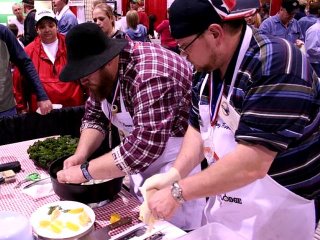
Allen Jones and Huey Hooks prepare their signature dish
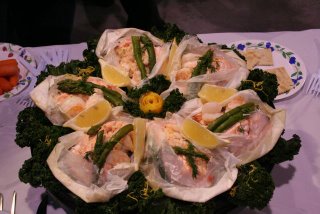
Lobster Stuffed Salmon en Papilata with Prawns
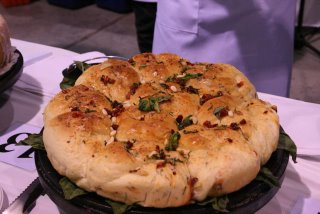
Basil and Asiago Bread Twist with Pine Nuts and Roasted Garlic Butter
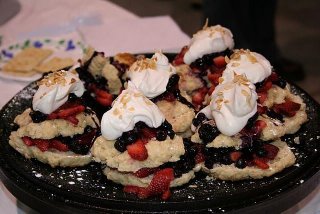 Red, White & Blue Berry Shortcake
Photographs used with permission.
Monday, March 20, 2006
The Real Reason Why There Are Too Few Cooks in the Kitchen
If Bonnie Slontnick's half-hearted prediction comes true, cookbook editors will soon replace the recipe instruction, "beat two eggs until lightly mixed," with this one.
Over the past two generations, cookbook editors like Slontick, have been "dumbing down" recipes with "simple instructions and lots of step-by-step illustrations." This is a response to a culinary illiteracy that grows with each succeeding generation.
The culprit is, according to a Washington Post article from today's Sacramento Bee ("Too Few Cooks in the Kitchen," by Candy Sagon), that no one is learning how to cook these days.
Mothers and home economics classes kept our nations culinary IQ at a high level for past generations. A lifetime of classes at Mom's culinary college with backing from the middle school home ec teacher, meant that students understood the subtle differences between terms like "simmer" and "braise."
Today, the top food manufacturers, like Kraft Foods and Pillsbury, avoid these terms because no one understands them.
Who's to blame? Working moms, says a Betty Crocker survey and culinary educators like Richard Ruben. Chef-instructor Ruben was named the 2003 “Cooking Teacher of the Year” by the International Association of Culinary Professionals.
People are singing up for cooking classes at the Institute of Culinary Education in New York City because culinary knowledge was not passed to the next generation, said Ruben in the article.
I agree. Despite the ever growing number of cooking programs on the Food Network, Discovery Channel and PBS, we've created a generation or two of culinary illiterates.
But I'm not ready to completely blame the educational system. Yes, home ec, along with scores of shop classes have been diluted in the past 25 years. Home ec is now just part of a jumbled syllabus in what's called "family and consumer education."
I'm from a generation of boys who recall the countless shop safety lectures by teachers in faded blue lab coats. Although I don't see myself as "mechanically inclined," I don't wear loose clothing around power tools. And I know the difference between a rip saw and a crosscut saw.
I would've enjoyed leaning to cook in high school. But those were the days when girls took cooking and sewing classes and boys rebuild Chevy 357 engines in auto shop.
I believe the problem lies with the family and our eating habits -- all driven by modern food technology. I can personally attest that it's more convenient to walk in the front door and pop frozen burritos into the microwave.
Few cook from scratch any longer. That includes homes, restaurants and the military services.
Why simmer pinto beans (“cook in a liquid that’s just hot enough that tiny buddles break the surface”) or braise a chuck roast (“to cook meat by searing in fat, then simmering in a covered dish in a small amount of moisture”) when frozen burritos heat up quickly without the mess.
Food shows are there primarily for entertainment value. Viewers love to watch Emeril "Bam" his way across the kitchen and talk to himself ("I said to myself, self!"). And have you ever noticed how many Food Network shows are sponsored by frozen convenience products?
The real reason for our culinary illiteracy? It because we don’t need to cook.
Sunday, March 19, 2006
World Championship Dutch Oven Cookoff
Allen and Huey's winning dishes:
Dessert: Red, White & Blue Berry Shortcake
Bread: Basil & Asiago Bread Twist with Pine Nuts & Roasted Garlic Butter
Main: Lobster Stuffed Salmon en Papilata with Prawns
Jay and Carol Fuller of Utah took second place with the following recipes:
Dessert: Heavenly Tropical Pie
Bread: Stromboli Pizza Bread
Main: Stuffed Beef Tenderloin
Third place winners are Ben and Debbie Auxier of Utah. Their dishes have not been posted to the IDOS website yet.
Additional information and photographs can be found of the front page to the International Dutch Oven Society website.
This is the first year that the reigning champions were openly encouraged to return to the cookoff and defend their title. In past years there was no restriction against champions competing in the cookoff again. The custom grew to the point where the champions didn't compete again. Most have not competed that I'm aware of.
The IDOS board changed that last year and offered the reigning champions an automatic place in the cookoff. The 2005 champions, Keith and Wendy Fisher of Utah, were the first returning champions to compete that I'm aware of.
Saturday, March 18, 2006
New Editorship for The Dispatcher
My friend Keith Berry, vice-president of the group, asked me to stop by the El Dorado County Historical Museum on a Saturday morning early last August. Keith and I did odd jobs around EDWRF's flagship, the 1907 Shay locomotive that once hauled lumber for the Diamond & Caldor Railway in Diamond Springs, California. The Shay was the D&C road No. 4.
Around November, railway president Eric Stohl asked me to be the group's membership chairman. The Foundation had just amended the bylaws to include an associate membership program.
Previously, you were either on the board of directors, a volunteer or both. No one tracked any kind of membership other than a name and phone number. You just "joined" the group and went to work.
I've since relinquished membership duties. A woman who tracks membership for the El Dorado County Historical Foundation has assumed the clerical duties. And Eric took the rest of my duties.
The Dispatcher newsletter
At the January board meeting, we were discussing how to get the Foundation's newsletter, The Dispatcher, which had languished over the past year, up and running again. I volunteered to take over the editorship of the newsletter.
Since I was committed to one more issue of the Dutch Oven News, I told the president that couldn't do any work on it until March. Eric and I decided the we could get my first issue to press my the end of the month.
Now that I've completed my work with the Dutch Oven News, it's time to get The Dispatcher on the road.
Last week I was busy designing a fresh template for the newsletter. The best way to describe its look is to say that its clean lines and consistent appearance will be a testament to the uncomplicated nature of the Diamond & Caldor.
Like most Sierra Nevada logging lines, the D&C functioned with little fanfare. The dispatcher often issued verbal train orders. And I've never seen any evidence in the photographic record that the line had any signals.
We've planned a 6- to 8-page newsletter that will be printed report style for now. Ultimately, I'd like to move to 11- by 17-inch folded paper, which will limit us to page multiples of four.
My first issue will feature a review of George Turner's reprinted Narrow Gauge Nostalgia (it was reprinted as California High Country Narrow Gauge Railroads in 2001) by Ron Callahan, media chairman for the railway.
Today, I found several historic photos of the line, including an early picture of the D&C No. 1 Baldwin saddle-tank rod engine. I plan each issue to locate and publish two or three previously unpublished (or rarely published--the Baldwin in posted to the website) photos in the newsletter.
If you're interested in the newsletter and the work of the El Dorado Western Railway Foundation, you can join for as little as $35 per year for an individual. Family membership costs $60, corporate $100 and life membership is $500 for individual or family and $1,000 for a business.
Send a ckeck or money order to:
EDWRF
P.O. Box 3517
Diamons Springs, CA 95619
World Championship Dutch Oven Photos
This year, for the first time, Thursday and Friday are devoted to runoffs. The top teams from from each day move onto the finals that are being held later today.
Here are the photo pages:
Day one photos
Day two photos
The following teams have advanced to the finals:
Team #1 Keith & Wendy Fisher (Returning champions)
Team #4 Debbie & Mindy Hair
Team #5 Dannie & Patsy Phillips
Team #7 Ben & Debbie Auxier
Team #8 Bill & Toni Thayn
Team #10 Katrina Wylie & Maline Robison
Team #11 Cindy & Aimee Overton
Team #12 Kent & Nancy Pappleye
Team #13 Allen Jones & Huey Hooks
Team #14 Jay & Carol Fuller
Team #15 Curtis Wall & Dennis Baker
Team #16 Wil & Jen Ward
Team #17 Mark Brown & Bill Treadway
Friday, March 17, 2006
Team Korea Repeats Top Honor at 31st Annual U.S. Army Culinary Arts Competition
Team Korea and winners in other categories were recognized at an awards ceremony held today concluding the two-week long competition.
“We really were not sure if we were going to win again this year,” said Chief Warrant Officer 3 Travis Smith, team manager. “It was a really close competition right up until the last day when we won the student team skills competition. Our team really worked well together.”
Fort Bragg placed second followed by Team USAREUR (US Army Europe) finishing third in the Installation of the Year competition.
Winners in the other major competition categories were:
Senior Army Chef of the Year: Spec. Jeffery Lagyak, Fort Bliss, TX
Junior Army Chef of the Year: Cpl. Randy Agno, Team Hawaii
Field Cooking Competition: 1st - Fort Riley, KS; 2nd - Fort Bragg, NC; 3rd - Team USAREUR
Student Team Skills Competition: Team Korea
Winners in special categories were:
Best Exhibit Cold Food Buffet: Sgt. Jason Pratt, Team Korea
Best Exhibit Hot Food Shown Cold: Staff Sgt. Bernard Book, Team Korea
Best Exhibit in Pastry and Confection: Spec. Alicia Hight, Team USAREUR
Best Exhibit in Culinary Showpiece: Spec. Jowanna Carroll, Team USAREUR
Special Judges Award Most Artistic Centerpiece: Spec. Carmen Rosario, Fort Bragg
Best Team Table Exhibit: Team USAREUR
Highest Score in Contemporary Cooking: Sgt. Joshua Speiss, Fort McNair
Highest Score in Contemporary Pastry: Spec. Joanna Carrol, Team USAREUR
Best Two Member Team, Nutritional Hot Food Challenge: Team Hawaii
Baron H. Garland Culinary Knowledge Bowl: Team Korea
Best Centerpiece in Ice: Sgt. First Class David Russ, Fort Bragg
Fort Lee is the host for the most prestigious culinary competition in the military. The competitors are Soldiers first and culinary artists second with many of this year’s competitors serving in combat operations overseas.
Thursday, March 16, 2006
Spring 2006 Issue of IDOS Newsletter Ready for Printers
 Members should start seeing their copies of the newsletter around mid-April, just in time for the IDOS spring convention in Farmington, Utah. East and west coast members won't receive their copies until the end of April (or later).
Bulk mail is fickle and slow. Those who live close to Ogden, Utah, usually receive their copy first. I've received mine in Northern California as late as a month and a half after its posting.
The spring issue is back up to 24 pages after the dismal showing of 12 pages for the winter issue. IDOS really needs all of the chapters to send in quarterly reports. I encourage all chapter directors to send a 150 to 200 word report to the new editor as soon as he/she is announced.
Here's what's inside the spring issue:
- Pair honored with private tour of Lodge plant
- Clyde Miller's last column as president -- the election for society and regional officers
- president, vice-president, treasurer and 6 regional directors) is underway
- Pilaf is ideal camp food
- Mississippi's Kast Iron Kookers practice art of Dutch oven cooking, a re-printed article from Today in Mississippi
- Rust removal using electrolysis
- Chapter reports from Florida, Mississippi and Southern California
- The Outlaw Gourmet by Ron Clanton
Tuesday, March 14, 2006
The Weather Report
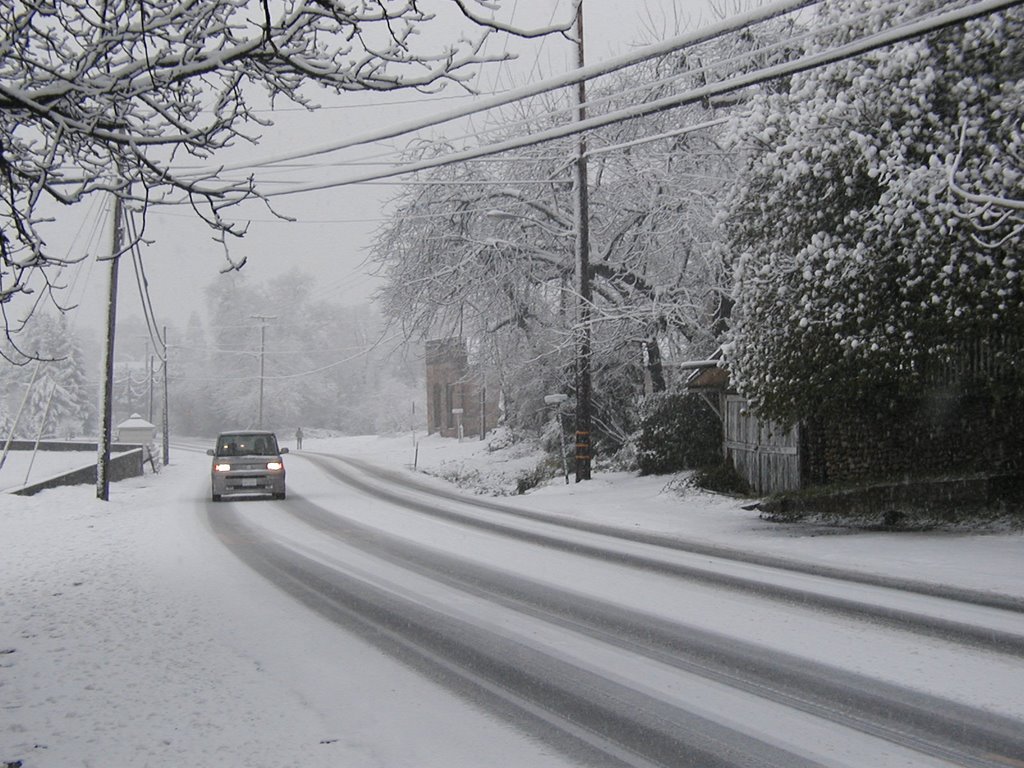 A cold front blanketed Western El Dorado County Friday and Saturday nights, down to 1,000 feet elevation and lower.
It was a welcomed change from the warm rains so typical to the lower foothills to the Sierra Nevada Mountain Range.
County snow plows worked Missouri Flat and Pleasant Valley roads in the hours leading up to noon.
The last heavy snows in Diamond Springs fell on March 17, 2002. That's the date stamp on the photograph on the wall in the Diamond Barber Shop -- the one in the Diamond's original one-room school house.
Further east, Eric Stohl, president of El Dorado Western Rail Foundation reported, "I have 2 feet of snow on my back deck. I use it as a gauge because it is the least disturbed."
A white commute
But the afternoon commute up the hill was the most entertaining.
Sometime between 4:30 and 5 p.m., at least two thunder cells moved up U.S. 50 and hammered Cameron Park, Placerville, and Diamond Springs with fingernail-sized hail.
The bus driver's radio gave us our first indication that our homes were being pounded with ice.
 Earlier, the National Weather Service had issued a sever thunder storm warning for San Joaquin and El Dorado counties, according to CBS13.com.
"It was like driving through an ice dispenser," reported one El Dorado Transit driver over the radio.
Sacramento commuter no. 4 approached 65th Street and U.S. 50 when we heard the broadcasts.
The dispatcher cautioned all drivers. Proceed with care. Pull over if conditions warrant, she warned.
The next 20 minutes were uneventful, although I suspect cell phone traffic peaked as we headed east.
As we approached the East Bidwell exit, all four lanes of traffic were backed up to the base of Carpenter Hill. The diamond lane didn't help the driver.
We received our first indication of the severity of the storm came as the bus headed up the Bass Lake grade. I glanced down the hill in the direction of Clarksville Road.
A sport utility vehicle resting a ditch that drains into Carson Creek. Apparently, four-wheel drive didn't help the driver as he spun off the road.
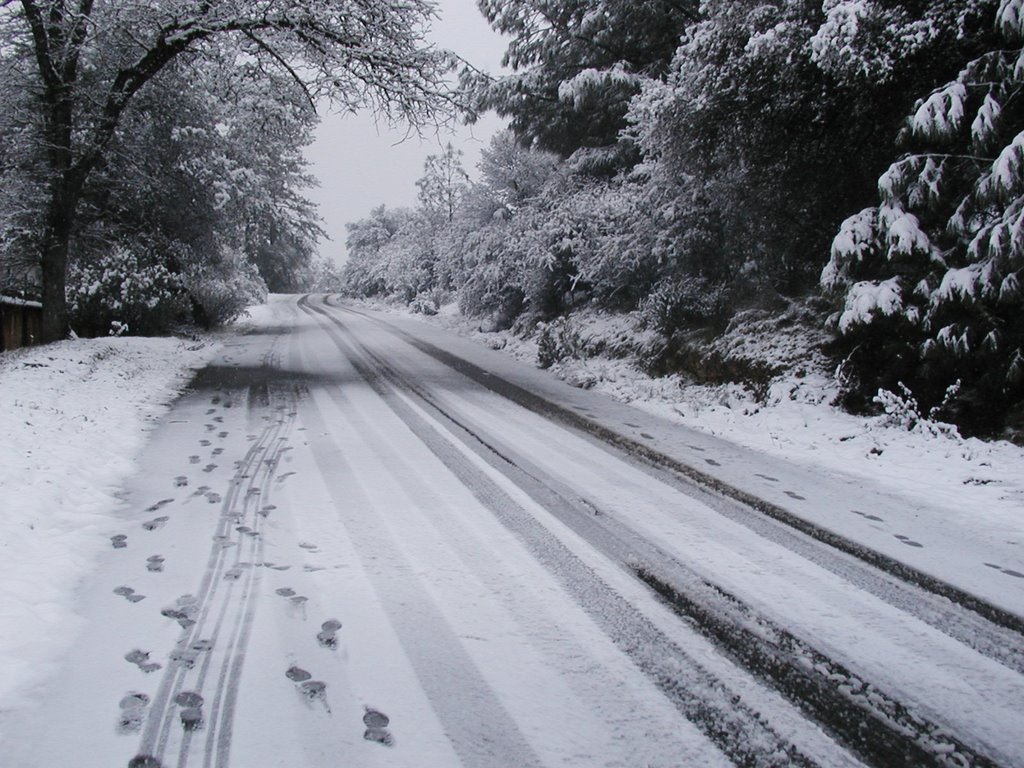 At the top of the hill, the driver took the initiative and exited the highway at Bass Lake Road and drove east on Country Club Road to our first stop.
As we turned onto Merrychase Drive, which parallels the highway, the whole area was blanketed with two to three inches of hail and ice.
Back on U.S. 50, I saw two CalTrans plows cleaning the shoulder, a rare event for Cameron Park
The interesting thing about this storm was the indiscriminate manner in which the thunder cell hit one community and skipped the next.
Cameron Park was hammered. But I didn't see any evidence that Shingle Springs received more than a light dusting of hail.
Further east, the bus trailed a CalTrans plow as it approached El Dorado Road. Again, the area between the El Dorado and Missouri Flat roads was covered in a thick blanket of ice -- three inches in places.
The drive home, south on Missouri Flat, gave an indication of how wide a swath the storm cut. The heaviest hail fell near the highway. Pleasant Valley Road, about two miles south of the freeway, had a half-inch.
Interestingly, none of the local media (as of the time I posted this blog) have posted stories about the storm to their respective websites. They, instead focused on funnel clouds at Camp Far West and hail in San Joaquin County.
Monday, March 13, 2006
A Couple Busy Months
The event that had the greatest impact on me is is a new job. After 12 years at the same desk, I've changed careers. I've worked in large institutional kitchens for the most of the past 35 years. I now evaluate the budget for a large government program.
On February 1, I boarded the commuter bus for the first time in 20 years and headed to downtown Sacramento. I've had long commutes before. But this is the first time since my college days that I'm able to relax during the commute.
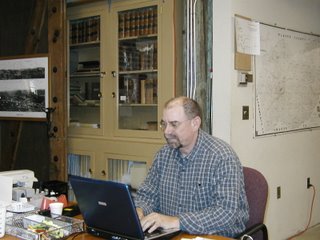 Working on the grant application for the California Cultural and Historic Endowment. I'm in the research room of the El Dorado County Historical Museum.
The bus gives me plenty of time to read, write and sleep. Reclining seats with headrests allow for plenty of relaxation. I use the time to search the scriptures, read railroad books and design a newsletter for the railroad.
Long hours on the road leave little time for cooking. For the first few weeks in February, I left home before sunrise. And the sun set long before six. Most home meals are simple and we've been eating out too much -- it's just too hard on the pocket book!
Grant writing -- a new adventure
Last January, I wrote a grant to fund with the president and vice-president of the railroad. Our goal is to acquire funding to bring the boiler of the Diamond & Caldor No. 4 Shay locomotive up to federal standards. We dedicated some 75 hours to the project.
Now that tourist railroads fall under the watchful eye of the Federal Railroad Administration, we must recertify the boiler -- this time to a higher standard than those of California. Our 1997 certificate to operate the boiler (a "pressure vessel unit") doesn't meet federal standards.
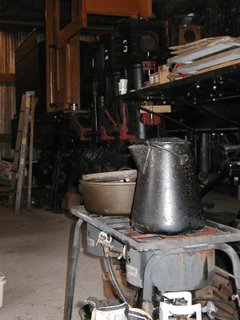
There's still time for cooking. Only now the venue has changed to the engine house.
Our hope is that the grant will supply critical funding to acquire the certificate. Skilled volunteers will perform most of the in-kind work. We'll use the dollars to purchase services and supplies that the Foundation can't provide.
With any grant, you must find the balance between writing to your audience -- those who read the applications and give the thumbs up or down -- and describing our needs. We were pleased to read that round-one grants from the California Cultural and Historical Endowment were awarded to 33 California orgnaiztions. Among them: the Bay Area Electric Railroad railroad and five museums.
Now comes the waiting game. We won't hear if we made the first cut until this spring. And the final decision won't be published until this summer. More to come.
Sunday, March 12, 2006
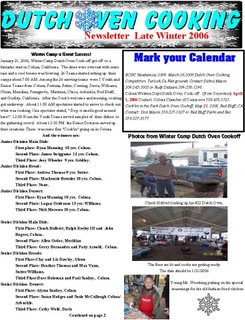
Don Mason's Dutch Oven Newsletter


Sunday, February 05, 2006
Chuckwagon Chili in the Engine House
A rare Saturday board meeting of the El Dorado Western Railway Foundation led to Keith's suggestion that I bring my outdoor cooking equipment to the engine house and cook chili for the crew.
I cooked chuckwagon chili -- slightly revised from last year's recipe -- and cornbread inside the engine house for 10 board members and crew.

CHUCKWAGON CHILI
6 pounds round steak, coarsely ground
2 medium red onions, chopped
6 cloves garlic, minced
3 jalapeño peppers, seeded and minced
3 cups beef broth
3 ounces chili powder
6 tablespoons ground cumin
1 tablespoon dried oregano
2 tablespoons paprika
2 tablespoons red wine vinegar
1 (7-ounce) can diced green chilies
1 (15-ounce) can diced tomatoes
Hot pepper sauce, to taste
Brown meat in a 6-quart Dutch oven over medium heat. Drain excess fat. Add onions, garlic and jalapeños and continue to cook until translucent. Add chili powder and cumin and cook over low heat for a minute or two.
Simmer over low heat 30-45 minutes using as little liquid as possible. Add beef stock only as necessary. Stir often. Add oregano, paprika, vinegar, remaining beef broth, green chilies, diced tomatoes and hot pepper sauce. Simmer 30-45 minutes. Stir often. Adjust seasoning.
Serve with fresh bread. Makes about 1 gallon or 12 (1-1/3 cup) servings. Traditional chili garnishes -- diced onions, grated sharp cheddar cheese and chopped cilantro -- compliment this dish well.
Saturday, January 21, 2006
Camping in Snowy Weather

It rained from midnight until 7 a.m. At 8, when I snapped this photograph, a slushy layer of snow covered the colder patches of ground. Sly Park sets at 3,500 feet. The snow line that morning sat at around 3,800 feet.

I trust my 14-inch skillet will survive! I left it and my cutlery roll on the picnic table overnight.
Cucumber Salsa
The salsa was a hit with the kids, including my 14-year old son. He's since asked for more -- a rather impressive deed for a teenager who's idea of food is hamburgers, Taco Bell and chicken tenders.
CUCUMBER SALSA
The recipe is from the September 2005 issue of Sunset magazine.
2 cucumbers (1-1/2 pounds total), peeled
2 Roma tomatoes (8 ounces total), rinsed and cored
1 red onion (6 ounces total), peeled and chipped
5 green onions, rinsed and thinly sliced, including green tops
3 cloves garlic, peeled and minced
1/2 cup reduced-sodium soy sauce
3 tablespoons distilled white vinegar
1/2 teaspoon black pepper
1/4 teaspoon cayenne
Dice cucumbers and tomatoes into 1/4-inch cubes and combine in a bowl. Add red and green onions, garlic, soy sauce, vinegar and black pepper. Add cayenne to taste. Mix well. Cover and chill at least 30 minutes.
Monday, January 16, 2006
Frank's Hearty Skillet Breakfast Revisited
For some, the troublesome element of this breakfast was its economical use of bacon and sausage grease. Not one drop of the rendered fat was lost to the fire or garbage.
Frank's breakfast is hearty is an epicurean contradiction -- good tasting and not-so-good for you, all in one setting.
My family recently learned that Frank is moving his family and his construction skills to Idaho, where he is going to manage a division for a large contractor.
So last weekend, we took one last camping trip, this time to Sly Park. Campers were few and the fee was reasonable at $10 per night. Winter camping is more primitive than summer camping at Sly Park. They shut the water system off in winter to prevent the pipes from bursting. Sly Park doesn't have electrical hookups.
Frank repeated his breakfast production, this time without the scrambled eggs. This time I snapped several photographs of the breakfast. Here they are:
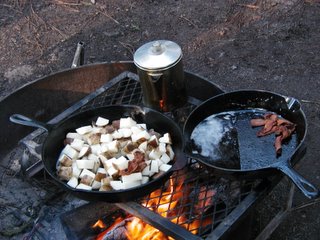 Two cast iron skillets with cottage fried potatoes on the left and bacon grease on the right.
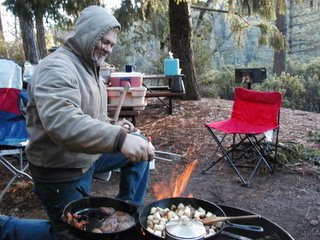 Contractor, turned breakfast cook.
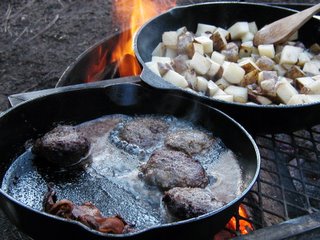 Sausage patties deep fried in bacon grease.
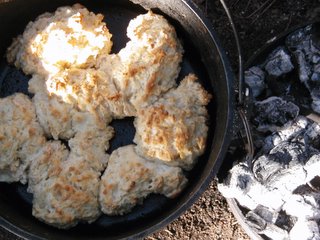 Gravy just isn't gravy without biscuits.
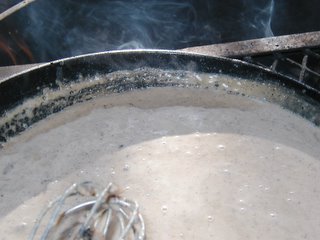 Breakfast gravy simmers over the campfire.
Tuesday, January 10, 2006
Dutch Oven Potatoes and Chicken with Broccoli
 In the original recipe, cooked chicken breasts were placed over a bed of lightly browned onion, carrot, celery, mushrooms and potatoes. With no desire to eat celery and no mushrooms in the larder, re-wrote the Dutch oven one-pot casserole to include two ingredients in the refrigerator—chicken drumsticks and thighs and fresh broccoli.
DUTCH OVEN POTATOES AND CHICKEN WITH BROCCOLI
Resist the temptation to use too much moisture in the Dutch oven. The heavy cast iron lid creates a fairly tight seal. As a result, very little moisture escapes during cooking.
1/2 cup vegetable oil
1 cup all-purpose flour
2 teaspoons salt
1 teaspoon ground black pepper
1-1/2 teaspoons paprika
10 pieces chicken, thighs and drumsticks
1 teaspoon dried thyme
1 medium onion, sliced
5 medium potatoes, cut into eighths
2 cloves garlic, minced
2 carrots, sliced
1/2 cup chicken broth
2 bay leaves
1 teaspoon dried thyme
1 tablespoon Worcestershire sauce
1/4 cup chopped flat leaf parsley
3 small bunches broccoli, cut into florets
 Heat a 12-inch cast iron skillet over medium heat. Add 2 tablespoons oil and heat. Combine flour, salt, black pepper thyme and paprika. Dredge each piece of chicken until coated with seasoned flour. Set on plate. Place the thighs, skin side down, in hot oil. Brown chicken and turn to brown other side. Remove thighs to a plate. Repeat process with drumsticks.
Heat a 12-inch Dutch oven medium heat. Add remaining 2 tablespoons oil and heat. Add onion, potatoes, garlic and carrots to oven. Sauté vegetables until lightly browning, stirring continually. Combine broth thyme and Worcestershire sauce in a measuring cup. Pour over potatoes and stir. Sprinkle parsley over potatoes. Spread broccoli in a layer over potatoes. Place chicken in a single layer over broccoli.
Place lid on Dutch oven. Set 8 charcoal briquettes underneath oven and 17 on lid for 350 degrees. Bake for 30 to 45 minutes until potatoes are soft and chicken is cook through. Serve 2 pieces of chicken and a hearty portion of potatoes for each person.
Saturday, January 07, 2006
Chili Verde with Tomatoes?
My test is simple: Does the food taste good? Beyond taste, I don't really care where a dish came from or how authentic are its flavors.
So when I express alarm over Sunset's latest chili verde ("Dishes that define the West," Sunset, Northern California edition, pages 97-8), it's not because the recipe violates some long-standing culinary code.
It's because the test cooks used tomatoes (the red kind) as the foundational ingredient.
The caption to the photograph of Sunset's tomato-infused verde reads, "Cooks have long battled it out whether New Mexico, Arizona or Colorado has the 'true' version of the spicy simmered pork dish."
So, I guess I'm injecting myself into the battle.
I’m not sure how cooks make chili verde in New Mexico, Arizona or Colorado. We use tomatillos here in Northern California. Mexican restaurants that I frequent use tomatillos and green chilies in their verde. I've never had a tomato-infused verde at Casa Ramos or Colina de Oro (click for El Dorado Co. restaurants).
Sunset's approach baffles me. Although I love to mix flavors (when combinations make sense and the dish comes a live in my palate), I look to traditional flavors in some dishes. Chili verde is a prime example. I enjoy the lively flavors of the green pork stew.
This approach makes sense to me. After all, verde means green in Spanish. You use green ingredients, not the red tomatoes in the Sunset recipe, in chili verde. I though a red chili was called chili colorado!
I suppose I could learn to relish a green and red pork stew. But why try?
So add tomatoes if you must. You won't offend me. But I think you'll enjoy the traditional chili verde. It's a refreshing change from the thick, hearty red chili.
CHILI VERDE
Many supermarkets stock canned tomatillos. You'll find them in the Mexican isle.
2 tablespoons vegetable oil
4 pounds boned pork shoulder (Boston butt), fat-trimmed and cut into 2-inch cubes
Salt and pepper, to taste
3 onions (2 pounds total), cut into 1/4-inch-thick wedges
5 large cloves garlic, minced
3 tablespoons ground cumin
1 (28-ounce) can canned whole tomatillos
1 (14-ounce) can chicken broth
2 (7-ounce) cans whole green chilies, chopped
2 tablespoons chopped fresh oregano leaves
2 bay leaves
Chopped fresh cilantro
Lime wedges
Heat vegetable oil in a 12-inch Dutch oven over medium-high heat. Meanwhile, lightly season cubed pork with salt and ground black pepper. When hot, add 1/3 the pork. Turn pieces as necessary until well browned on all sides, 8 to 10 minutes total. Transfer meat to a bowl. If pot is dry, add 1 tablespoon oil. Repeat process for next 2 batches to brown pieces on all sides.
Reduce heat to medium. Discard all but 2 tablespoons of leftover pork fat in Dutch oven. Add oil, if necessary, to bring the total to 2 tablespoons. Add onion, garlic and cumin. Cook, stirring occasionally, until onions are soft, about 8 minutes.
Return meat and any accumulated juices to Dutch oven. Crush tomatillos with your hand and place in Dutch oven. Add broth, chilies, bay leaves and oregano to Dutch oven. Bring chili mixture to a simmer
Place lid on Dutch oven. Bake at 350 degrees (17 coals under oven and 8 on lid) until pork is very tender when pierced and flavors are blended, about 1-1/2 to 2 hours. Adjust seasoning. Serve topped with cilantro leaves. Garnish with lime to squeeze over chili. Makes 6 to 8 servings.
Friday, January 06, 2006
Winter Camp Cookoff in Colusa, California
Sacramento River Cast Iron Cookers are having their Winter Camp Dutch Oven Cookoff on Saturday, January 21, 2006 at the Colusa County Fairgrounds in Colusa, California. Cooking starts soon after the cooks meeting at 8:30 a.m.
Once again this year we are inviting the youth to come out and cook. Ages 9 through 17 can cook, no entry fee will be charged. Every youth that cooks will receive a participation gift. If they should win their class (first through third place) they will receive a plaque.
All judging will be Peoples Choice for both youth and adults. The public may purchase a $5 ticket and sample the food cooked that day and then vote on the best cook and pot of food. Youth judging will start at 12:00 noon and end at 12:30 p.m. Adult judging starts at 12:30 and ends at 1:30 p.m.
Winners will be announced at 2 p.m. Adult class winners for first place will receive $100 and a plaque. Second and third places will receive plaques. Youth winners only receive a plaque.
SRCIC will provide prep tables and one plastic table cloth, trash cans, cold running water and hot ash cans. Everything else is on you. Hope you can come. Dress warm and enjoy the day with us.
I would like to wish all of you a happy holiday and a happy healthy new year. Hope to see you in 2006.
Thank you, Vickie Stegall.

Crowds at the 2005 Winter Camp Dutch Oven Cookoff.
Applications for the Winter Camp Dutch Oven Cookoff are due to Vickie by January 15, 2006. The fee is $30 per team. Categories are main dish, bread and dessert. Each team may cook in one, two or three pots.
To participate, contact Vickie at: (530) 458-8009.
Tuesday, January 03, 2006
Big Green Truck Pizza
 I like these shows -- I believe Al Roker's show is the only one currently in production -- because they move around the country showcasing small food businesses.
As a frustrated government worker, these shows have given me hundreds of hours of fantasy-filled viewing. I always seem to be a retirement check away from filling a food niche here in El Dorado County.
My latest business idea came to me Friday evening in the form of a 1946 International Harvester flatbed truck. Roker featured the New Haven, Connecticut based truck in the Tapas and Brownies episode.
The Big Green Truck is a self-contained wood-fired pizza oven on wheels. For $950, Douglas Coffin, a self-trained chef who’s operated a successful catering business for 15 years, will bring the truck to your home or business and prepare hand-made pizza for 50 of your closest friends or business associates.
I'm always looking business ideas. My ideal post-retirement culinary business must meet several self-imposed limitations. The full service restaurant is definitely out. I’m done with late hours and early mornings and every hour in between.
My concept has to fill a local need -- one that's unique to the local area. The idea must sell and not cost a fortune. And it must be operated with two or three employees.
I have no illusions about starting the next culinary empire in Northern California. Ideally, my concept will be centered around on or two products -- like Coffin's handmade pizza, galeto and cappuccino.
That's where the Big Green Truck comes in. It gave me an idea for a local catering business. More correctly, his idea confirmed an idea that I've had for some time now. All I have to do now is to blend the two (soon, Lord willing).
But just in case Coffin finds these words: Don’t worry about competition from the left coast.
Coffin's concept will give me ideas. I can certainly garner thoughts on menu, design and concept. Unless he shares his well-guarded trade secrets for a West Coast division, I’ll develop my own concept from scratch.
You'll have to click over to Douglas Coffin’s website to see more photographs. It sounds fun if you live near New Haven.


